© 2017, IRJET | Impact Factor value: 6.171 | ISO 9001:2008 Certified Journal | Page 476
The Effect of Cement Type on Behavior of Reinforced Concrete against
Attack Sulfate Salt
Ahmed Abd El-Azim A.
1, Magdy A. Abd El-Aziz
2, Basma M. Abd El-Haleem
31 Assistant Professor, Civil Engineering Dept. 2 Professor, Civil Engineering Dept. 3 Post Graduate Student, Civil Engineering Dept. Faculty of Engineering, Fayoum University, Fayoum, Egypt
---***---Abstract -This research work studies The Effect of Cement
Type on Behavior of Reinforced Concrete against Attack Sulfate Salt. Two concrete mixes with the same materials content and different cement types were used. Frist mix was used ordinary Portland cement (Type I) and the second mix was used sulfate resistant Portland cement (Type V). For every mix cubes (100*100*100 mm) and cylinders (100*200 mm) were molded. Samples were exposed to magnesium sulfate solutions (MgSo4) with sulfate concentration of 0%, 5%, 7%, and 10% until time periods 28, 60 and 90 days. The concrete strength (compressive and splitting tensile), and rate of steel corrosion were measured. The sulfate resistance Portland cement (Type V) was improved the resistant of concrete against the sulfate salt about 14.2% for compressive strength, 0.8% for splitting tensile strength, and 2.5% for the rate of steel corrosion than ordinary Portland cement (Type I).
Key Words: sulphate; magnesium; steel corrosion; strength;
resistance.
1. INTRODUCTION
The major problems affecting concrete durability is the external attack of sulfate salts. Sulfates are highly soluble salts in the form of sodium sulfate (Na2So4), calcium sulfate
(CaSo4), potassium sulfate (K2So4), and magnesium sulfate
(MgSo4) which are sometimes found in soil or dissolved in
ground water or present in aggregates [1]. The deterioration of reinforced concrete structures due to sulfate attack is the result of sulfate ions in the soil, ground water, and sea water. In hardened cement, C3A reacts with sulfate ions in the presence of calcium hydroxide to form gypsum, leading to degradation of concrete into a non-cohesive granular mass and disruptive expansion [2–5].
Lei and Ditao [6] studied the effect of different types of sulfate solutions on the deterioration of concrete under drying-wetting cycles. Davood, Farzaneh, and Hamed [7] studied the effect of magnesium sulfate concentration on durability of concrete containing micro-silica, slag and limestone powder using durability index. Ittiporn and others [8] studied the durability and testing of mortar with fly ash and limestone cement in sulfate solutions. Kamile [9] studied the effect of C3A content on sulfate durability of Portland
limestone cement mortars. Thidar and Chiaki [10] studied
the resistance of plain and blended cement mortars exposed to severe sulfate attacks.
2. MATERUALS AND METHODS
2.1. Materials
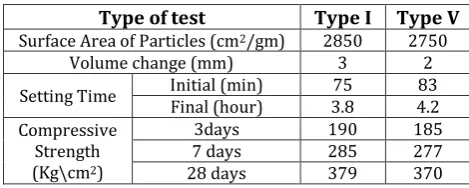
[image:1.595.321.556.506.600.2]Properties of materials used are shown in table 1,2.
Table -1: Properties of Coarse Aggregate (Basalt) and Sand
Type of test value
Maximum Aggregate size 16
Fineness Modulus of Sand 2.21
Specific Gravity of Coarse Aggregate 2.7
Specific Gravity of Fine Aggregate 2.5
Unit Weight of Coarse Aggregate (t\m3) 1.63 Unit Weight of Coarse Aggregate (t\m3) 1.7
Table -2: Properties of Cement
Type of test Type I Type V
Surface Area of Particles (cm2/gm) 2850 2750
Volume change (mm) 3 2
Setting Time Initial (min) Final (hour) 3.8 75 4.2 83 Compressive
Strength (Kg\cm2)
3days 190 185
7 days 285 277
28 days 379 370
2.2. Concrete Mix Proportions, Samples, and Experimental Program
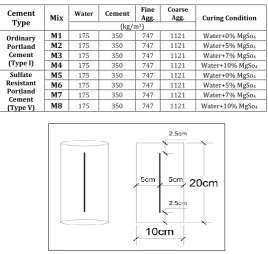
Two mixes of concrete were produced to cast a series of test specimens divided from mix M1 to mix M8. M1, M2, M3, and M4 were contained ordinary Portland cement (Type I) and exposed to magnesium sulfate solutions (MgSo4) with
sulfate concentration of 0%, 5.0%, 7.0%, and 10.0% until time periods 28, 60 and 90 days respectively. M5, M6, M7, and M8 were contained sulfate resistant Portland cement (Type V) and exposed to magnesium sulfate solutions (MgSo4) with sulfate concentration of 0%, 5%, 7%, and 10%
© 2017, IRJET | Impact Factor value: 6.171 | ISO 9001:2008 Certified Journal | Page 477
in Table 3. For each mix 12 cubes (100*100*100 mm), 12 cylinders (100*200 mm), and 12 cylinders (100*200 mm) inside it Ǿ16 steel reinforcement as shown in in figure 1 were molded.The Concrete was cast in steel cubes and cylinders, a vibration table was used to compact them. They were demolded after approximately 24 h, were initially cured in water for 7 days, and were transferred to tanks containing magnesium sulfate solutions (MgSo4) with sulfate
[image:2.595.313.571.71.170.2] [image:2.595.24.293.229.483.2]concentration of 0%, 5%, 7%, and 10% until their testing ages 28, 60 and 90 days.
Table -3: Concrete Mixes
Cement
Type Mix Water
Cement Fine
Agg. Coarse Agg. Curing Condition
(kg/m3) Ordinary
Portland Cement (Type I)
M1 175 350 747 1121 Water+0% MgSo4
M2 175 350 747 1121 Water+5% MgSo4
M3 175 350 747 1121 Water+7% MgSo4
M4 175 350 747 1121 Water+10% MgSo4
Sulfate Resistant
Portland Cement (Type V)
M5 175 350 747 1121 Water+0% MgSo4
M6 175 350 747 1121 Water+5% MgSo4
M7 175 350 747 1121 Water+7% MgSo4
M8 175 350 747 1121 Water+10% MgSo4
Fig. (1): The Corrosion Specimen
2.3. Experimental Tests
Compression tests were carried out on 100 mm cubic and splitting tensile test carried out on 100*200 mm cylinder using a 2000 KN compression machine. The loading rates for the machine applied in the compression and splitting tensile tests were 0.6 and 0.03 N/mm2/sec
respectively. Compressive strength and splitting tensile strength were measured at the ages of 28, 60, and 90 days.
The high impedance voltmeter was used to measure the corrosion potentials and noting the potentials against a saturated calomel electrode (SCE). Half-cell potentials more positive than-270 mV represents a passive state of corrosion while potentials more negative than -270 mV represent an active state of corrosion (figure 2). The qualitative indication of the corrosion of reinforcing bars was measured by using this technique. The rate of steel corrosion was measured at the ages of 28, 60, and 90 days.
Fig. (2): The Half-Cell Potential Test
3. RESULTS AND DISCUSSION
Results of compressive strength, splitting tensile strength, and rate of corrosion for all mixes of concrete was shown in the table 3 to 5.
3.1 Compressive Strength
The compressive strength of specimens was determined after exposure time periods of 28, 60 and 90 days of magnesium sulfate salt solution 5, 7, and 10% MgSo4. The values of average compressive strength for
each mix was shown in Table 3, Figure 3, and Figure 4. The relation between the period of sulfate exposure and percentage of average decrease in compressive strength for cement Type I and Type V were shown in Figure 5. It was observed that the compressive strength of concrete decreased with the increasing of percentage MgSo4. After 90 days of exposure to 5, 7, and 10% magnesium sulfate solution MgSo4 the percentage of decreasing in compressive strength of specimens with Type I cement was 20.5, 31.4, and 34.1% and the percentage of decreasing in compressive strength of specimens with Type V cement was 5.1, 9.7, and 13%. The sulfate resistance Portland cement (Type V) was improved the compressive strength of concrete against the sulfate salt solution 5, 7, and 10%MgSo4 by averaging about 2.0, 6.6,
[image:2.595.301.566.584.711.2]and 14.2%.
Table -3: Compressive Strength for Average 3 Cubes at 28, 60, 90 Days
Cement Type Mix
Compressive Strength (Kg/cm2)
Curing Condition 28
days days 60 days 90 Ordinary
Portland Cement (Type I)
M1 369 386 440 Water+0% MgSo4
M2 347 358 350 Water+5% MgSo4
M3 334 320 302 Water+7% MgSo4
M4 320 305 290 Water+10% MgSo4
Sulfate Resistant
Portland Cement (Type V)
M5 360 381 432 Water+0% MgSo4
M6 350 370 410 Water+5% MgSo4
M7 338 354 390 Water+7% MgSo4
© 2017, IRJET | Impact Factor value: 6.171 | ISO 9001:2008 Certified Journal | Page 478 3.2 Splitting Tensile Strength
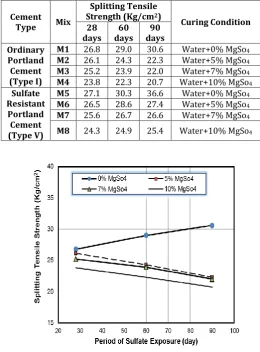
The splitting tensile strength of specimens was determined after exposure time periods of 28, 60 and 90 days of magnesium sulfate salt solution 5, 7, and 10%MgSo4.
The average splitting tensile strength values for each mix
was shown in Table 4, Figure 6, and Figure 7. The relation between the period of sulfate exposure and percentage of average decrease in splitting tensile strength for cement Type I and Type V were shown in Figure 8. It was observed that the splitting tensile strength of concrete decreased with the increasing of percentage MgSo4. After 90 days of
exposure to 5, 7, and 10% magnesium sulfate solution MgSo4 the percentage of decreasing in splitting tensile strength of specimens with Type I cement was 27.1, 28.1, and 32.3% and the percentage of decreasing in splitting tensile strength of specimens with Type V cement was 25.1, 27.3, and 30.6%, The sulfate resistance Portland cement (Type V) was improved the splitting tensile strength of concrete against the sulfate salt solution 5, 7, and 10%MgSo4
[image:3.595.302.563.304.657.2]by averaging about 0.3, 3.7, and 0.8%.
Table -4: Splitting Tensile Strength for Average 3 Cylinders at 28, 60, 90 Days
Cement
Type Mix
Splitting Tensile
Strength (Kg/cm2)
Curing Condition 28
days days 60 days 90
Ordinary Portland Cement (Type I)
M1 26.8 29.0 30.6 Water+0% MgSo4
M2 26.1 24.3 22.3 Water+5% MgSo4
M3 25.2 23.9 22.0 Water+7% MgSo4
M4 23.8 22.3 20.7 Water+10% MgSo4
Sulfate Resistant Portland Cement (Type V)
M5 27.1 30.3 36.6 Water+0% MgSo4
M6 26.5 28.6 27.4 Water+5% MgSo4
M7 25.6 26.7 26.6 Water+7% MgSo4
© 2017, IRJET | Impact Factor value: 6.171 | ISO 9001:2008 Certified Journal | Page 479
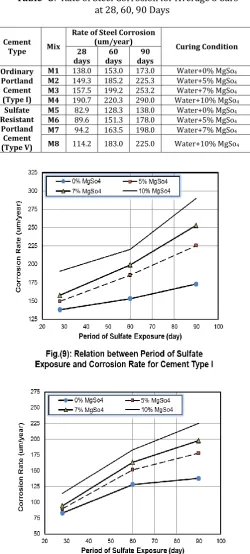
Table -5: Rate of Steel Corrosion for Average 3 bars at 28, 60, 90 Days
Cement Type Mix
Rate of Steel Corrosion
(um/year) Curing Condition 28
days days 60 days 90 Ordinary
Portland Cement (Type I)
M1 138.0 153.0 173.0 Water+0% MgSo4 M2 149.3 185.2 225.3 Water+5% MgSo4 M3 157.5 199.2 253.2 Water+7% MgSo4 M4 190.7 220.3 290.0 Water+10% MgSo4 Sulfate
Resistant Portland Cement (Type V)
M5 82.9 128.3 138.0 Water+0% MgSo4 M6 89.6 151.3 178.0 Water+5% MgSo4 M7 94.2 163.5 198.0 Water+7% MgSo4 M8 114.2 183.0 225.0 Water+10% MgSo4
3.3 Rate of Steel Corrosion
The rate of steel corrosion for specimens was determined after exposure time periods of 28, 60 and 90 days of
magnesium sulfate salt solution 5, 7, and 10%MgSo4. The
average rate of steel corrosion values for each mix was shown in Table 5, Figure 9, and Figure 10. The relation between the period of sulfate exposure and percentage of average increase in the rate of steel corrosion for cement Type I and Type V were shown in Figure 11. It was observed that the rate of steel corrosion increased with the
increasing of percentage MgSo4. After 90 days of exposure
to 5, 7, and 10% magnesium sulfate solution MgSo4 the
percentage of increase in rate of steel corrosion of specimens with Type I cement was 30.2, 46.4, and 67.6% and the percentage of increase in rate of steel corrosion of specimens with Type V cement was 29.0, 43.5, and 63.0%,
The sulfate resistance Portland cement (Type V) was improved the rate of steel corrosion against the sulfate salt solution 5, 7, and 10% MgSo4 by averaging about 0.3,
© 2017, IRJET | Impact Factor value: 6.171 | ISO 9001:2008 Certified Journal | Page 480
3.4Surface Disintegration
Concrete specimen exposed to magnesium sulfate solution (MgSo4) exhibits slight attack with only a surface
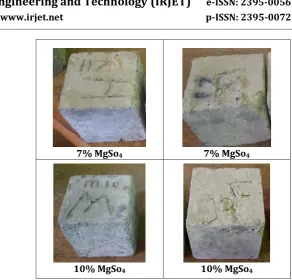
[image:5.595.267.560.42.322.2]layer of mortar scaled. While the specimen in water suffers the loss of surface material from the corner and edges, the surface becomes uneven. It is observed that the surface deterioration isdifferent in the three concentrations of solutions. Visual in section revealed that the specimen exposed to 10% magnesium sulfate solution is more severely damaged than that exposed to other solutions. Type V cement specimens have a smaller disintegration and breakup than Type I cement specimens. The shape of cubes specimens after exposed to time period 90 days of sulfate solution were shown in the Table 6.
Table -6: Shape of Cubes Specimens after Exposed to time Period 90 days of Sulfate Solution
Cement Type (I) Cement Type (V)
0% MgSo4 0% MgSo4
5% MgSo4 5% MgSo4
7% MgSo4 7% MgSo4
10% MgSo4 10% MgSo4
4. CONCLUSION
Based on the experimental results presented in this paper, the main conclusions are as the follows:
1- Sulfate attack process decreases the mechanical
properties of the concrete due to change the chemical and physical properties of the cement.
2- A decrease in strength, with a period of exposure, was
noted in all types of specimens in MgSo4 solutions.
3- A higher reduction in strength was noted in specimens
immersed in 10% MgSo4 solution, followed by 7% and
5% MgSo4 solution after 90 days of exposure.
4- The sulfate resistance Portland cement (Type V) was
improved the compressive strength of concrete against the sulfate salt solution 5, 7, and 10% MgSo4 by
averaging about 2.0, 6.6, and 14.2%.
5- The sulfate resistance Portland cement (Type V) was
improved the splitting tensile strength of concrete against the sulfate salt solution 5, 7, and 10%MgSo4 by
averaging about 0.3, 3.7, and 0.8%.
6- The sulfate resistance Portland cement (Type V) was
improved the rate of steel corrosion against the sulfate salt solution 5, 7, and 10% MgSo4 by averaging about 0.3, 1.3, and 2.5%.
5. REFERENCES
© 2017, IRJET | Impact Factor value: 6.171 | ISO 9001:2008 Certified Journal | Page 481
[2] Rasheeduzzafar, Al-Amoudi OSB, Abduljawad SN, Maslehuddin M., “Magnesium–Sodium Sulfate Attack in Plain and Blended Cements,” J Mater Civil Eng 1994;6(2):201–22.
[3] Al-Amoudi OSB, Maslehuddin M, Saadi MM., “Effect of Magnesium Sulfate Sodium on the Durability Performance of Plain and Blended Cements,” ACI Mater J 1955;92(1):15–24.
[4] Al-Amoudi OSB. , “Performance of 15 Reinforced Concrete Mixtures in Magnesium and Sodium Sulfate Environments,” Construct Build Mater J 1995;9(3): 149–58.
[5] Al-Amoudi OSB., “Sulfate Attack and Reinforcement Corrosion in Plain and Blended Cements Exposed to Sulfate Environments,” Build Environ 1998;33(1): 53– 61.
[6] Lei Jiang and DitaoNiu,“Study of deterioration of concrete exposed to different types of sulfate solutions under drying-wetting cycles,”Construction and Building Materials 117 (2016) 88–98.
[7] Davood M., Farzaneh N. and Hamed N.,“Influence of magnesium sulphate concentration on durability of concrete containing micro-silica, slag and limestone powder using durability index,” Construction and Building Materials 117 (2016) 107–120.
[8] Ittiporn S., Warangkana S., Lalita B., Pitisan K., and Somnuk T.,“ Durability and testing of mortar with inter ground fly ash and lime stone cements in sulfate solutions,” Construction and Building Research, Vol. 64,PP. 39-46, 2014.
[9] Kamile T. F.,“ The effect of C3A content on sulfate
durability of Portland limestone cement mortars ,” Construction and Building Materials 36 (2012) 437–447.