R E S E A R C H
Open Access
Mann iteration for monotone
nonexpansive mappings in ordered CAT(0)
space with an application to integral
equations
Izhar Uddin
1, Chanchal Garodia
1*and Juan Jose Nieto
2*Correspondence:
[email protected] 1Department of Mathematics, Faculty of Natural Sciences, Jamia Millia Islamia, New Delhi, India Full list of author information is available at the end of the article
Abstract
In this paper, we establish some convergence results for a monotone nonexpansive mapping in a CAT(0) space. We prove the
- and strong convergence of the Mann iteration scheme. Further, we provide a numerical example to illustrate the convergence of our iteration scheme, and also, as an application, we discuss the solution of integral equation. Our results extend some of the relevant results.
MSC: 47H09; 47H10
Keywords: CAT(0) space; Fixed point;
-convergence; Monotone nonexpansive mapping
1 Introduction
The Banach contraction principle [1] is one of the most fundamental results in fixed point theory and has been utilized widely for proving the existence of solutions of different non-linear functional equations. In the last few years, many efforts have been made to obtain fixed points in partially ordered sets. In 2004, Ran and Reurings [2] generalized the Banach contraction principle to ordered metric spaces. Later on, in 2005, Nieto and Rodriguez [3] used the same approach to further extend some more results of fixed point theory in partially ordered metric spaces and utilized them to study the existence of solutions of differential equations.
Note that the Banach contraction principle is no longer true for nonexpansive map-pings, that is, a nonexpansive mapping need not admit a fixed point on a complete metric space. Also, Picard iteration need not converge for a nonexpansive map in a complete metric space. This led to the beginning of a new era of fixed point theory for nonexpan-sive mappings by using geometric properties. In 1965, Browder [4], Göhde [5], and Kirk [6] gave three basic existence results for nonexpansive mappings. With a view to locating fixed points of nonexpansive mappings, Mann [7] and Ishikawa [8] introduced two basic iteration schemes.
Now, fixed point theory of monotone nonexpansive mappings is gaining much attention among the researchers. Recently, Bachar and Khamsi [9], Abdullatif et al. [10], and Song et
al. [11] proved some existence and convergence results for monotone nonexpansive map-pings. Dehaish and Khamsi [12] proved the weak convergence of the Mann iteration for a monotone nonexpansive mapping. In 2016, Song et al. [11] considered the weak con-vergence of the Mann iteration scheme for a monotone nonexpansive mappingT under some mild different conditions in a Banach space.
The aim of this paper is to study the convergence behavior of the well-known Mann iter-ation [7] in aCAT(0) space for a monotone nonexpansive mapping. Further, we provide a numerical example and application related to solution of an integral equation. Our results generalize and improve several existing results in the literature.
2 Preliminaries
To make our paper self-contained, we recall some basic definitions and relevant results. A metric spaceXis aCAT(0) space if it is geodesically connected and if every geodesic triangle inXis at least as thin as its comparison triangle in the Euclidean plane. For further information about these spaces and the fundamental role they play in various branches of mathematics, we refer to Bridson and Haefliger [13] and Burago et al. [14]. Every convex subset of Euclidean spaceRnendowed with the induced metric is aCAT(0) space. Further,
the class of Hilbert spaces are examples ofCAT(0) spaces.
The fixed point theory inCAT(0) spaces is gaining attention of researchers, and many results have been obtained for single- and multivalued mappings in aCAT(0) space. For different aspects of fixed point theory inCAT(0) spaces, we refer to [15–24]. The following few results are necessary for our subsequent discussion.
Lemma 2.1([21]) Let(X,d)be aCAT(0)space.For e,f ∈X and z∈[0, 1],there exists a unique h∈[e,f]such that
d(e,h) =zd(e,f) and d(f,h) = (1 –z)d(e,f).
We use the notation (1 –z)e⊕zf for the unique pointhof the lemma.
Lemma 2.2([21]) Let(X,d)be aCAT(0)space.For e,f,h∈X and z∈[0, 1],we have d(1 –z)e⊕zf,h≤(1 –z)d(e,h) +zd(f,h).
Lemma 2.3([21]) Let X be aCAT(0)space.Then
d(1 –z)e⊕zf,h2≤(1 –z)d(e,h)2+zd(f,h)2–z(1 –z)d(e,f)2
for all e,f,h∈X and z∈[0, 1].
Let{un}be a bounded sequence in a completeCAT(0) spaceX. Foru∈X, we denote
ru,{un}=lim sup
n→∞ d(u,un).
The asymptotic radiusr({un}) is given by
r{un}=infr(u,un) :u∈X
and the asymptotic centerA({un}) of{un}is defined as
A{un}=u∈X:r(u,un) =r
{un}.
It is known that in aCAT(0) space,A({un}) consists of exactly one point [25, Proposi-tion 5].
In 1976, Lim [26] introduced the concept of-convergence in a metric space. Later on, Kirk and Panyanak [22] proved thatCAT(0) spaces presented a natural framework for Lim’s concept and provided precise analogs of several results in Banach spaces involving weak convergence inCAT(0) space setting.
Definition 2.4 A sequence {un} inX is said to be -convergent tou∈X if u is the unique asymptotic center of{vn}for every subsequence{vn}of{un}. In this case, we write
-limnun=uand say thatuis the-limit of{un}.
Definition 2.5 A Banach spaceXis said to satisfy Opial’s condition if for any sequence
{un} inXwithunu(denotes weak convergence), we havelim supn→∞un–u<
lim supn→∞un–vfor allv∈Xwithv=u.
Examples of Banach spaces satisfying this condition are Hilbert spaces and alllpspaces
(1 <p<∞). On the other hand,Lp[0, 2π] with 1 <p= 2 fail to satisfy Opial’s condition. Notice that if given a sequence{un}inXsuch that{un}-converge tou, then forv∈X
withv=u, we have
lim sup
n→∞ un–u<lim supn→∞ un–v.
So, everyCAT(0) space satisfies Opial’s property.
Lemma 2.6 ([22]) Every bounded sequence in a complete CAT(0) space admits a -convergent subsequence.
Lemma 2.7([21]) If G is a closed convex subset of a completeCAT(0)space X and if{un} is a bounded sequence in G,then the asymptotic center of{un}is in G.
Next, we introduce the concept of partial order in the setting ofCAT(0) spaces. LetXbe a completeCAT(0) space endowed with partial order “ ”. An order interval is any of the subsets
[a,→) ={u∈X;a u} or (←,a] ={u∈X:u a}
for anya∈X. So, an order interval [u,v] for allu,v∈Xis given by
[u,v] ={w∈X:u w v}.
Definition 2.8 LetGbe a nonempty subset of an ordered metric spaceX. A mapping
P:G→Gis said to be:
(i) monotone ifPu Pvfor allu,v∈Gwithu v, (ii) monotone nonexpansive if P is monotone and
d(Pu,Pv)≤d(u,v)
for allu,v∈Gwithu v.
Now we present the Mann iteration scheme in the setting of orderedCAT(0) spaces (X, ). LetGbe a nonempty convex subset of aCAT(0) spaceX. Then the Mann iteration is as follows:
u1∈G,
un+1= (1 –κn)un⊕κnPun, n∈N,
(2.1)
where{κn} ⊂[0, 1]. In this paper, we prove some-convergence and strong convergence results inCAT(0) spaces.
3 Some
-convergence and strong convergence theorems
We begin with the following important lemma.
Lemma 3.1 Let G be a nonempty closed convex subset of a complete orderedCAT(0)space
(X, ),and let P:G→G be a monotone nonexpansive mapping.Fix u1∈G such that
u1 Pu1.If{un}is defined by(2.1)with condition ∞
n=1κn(1 –κn) =∞,then we have: (i) un un+1 Punfor anyn≥1,
(ii) un u,provided that{un}-converges to a pointu∈G.
Proof (i) We will prove the result by induction onn. Note that ifq1,q2∈Gare such that
q1 q2, thenq1 λq1+ (1 –λ)q2 q2 for anyλ∈[0, 1]. This is true because we have
assumed that order intervals are convex. Thus we only need to show thatun Punfor any
n≥1. We have already assumed thatu1 Pu1, and hence the inequality holds forn= 1.
Assume thatun Punforn≥2. Sinceκn∈[0, 1] for alln, we have
un (1 –κn)un⊕κnPun Pun,
that is,un un+1 Pun. SinceP is monotone, we havePun Pun+1. By using the
tran-sitivity of the order we getun+1 Pun+1. Thus by induction the inequality is true for any
n≥1.
(ii) Letube the-limit of{un}. From part (i) we haveun un+1for alln≥1 since{un}
is increasing and the order interval [um,→) is closed and convex. Thereforeu∈[um,→)
for a fixedm∈N; otherwise, ifu∈/[um,→), then we could construct a subsequence{ur}
Lemma 3.2 Let G be a nonempty closed convex subset of a completeCAT(0)space(X, ),
and let P:G→G be a monotone nonexpansive mapping.Fix u1∈G such that u1 Pu1.If {un}is a sequence described as in(2.1)and F(P)=∅with r∈F(P)such that r u1,then:
(i) limn→∞d(un,r)exists,and (ii) limn→∞d(Pun,un) = 0.
Proof (i) Sincer u1, using part (i) of Lemma3.1, we haveun un+1 Pun. In particular,
forn= 1, we haveu1 u2 Pu1. Using the transitivity of the order, we getr u2. By
mathematical induction we haver unfor alln≥1. Now we have
d(un+1,r) =d
(1 –κn)un⊕κnPun,r
≤(1 –κn)d(un,r) +κnd(Pun,r)
= (1 –κn)d(un,r) +κnd(Pun,Pr).
SincePis a monotone map andr unfor alln≥1, we have
d(un+1,r)≤(1 –κn)d(un,r) +κnd(un,r)
=d(un,r).
Thus we haved(un+1,r)≤d(un,r) for alln≥1. So{d(un,r)}is a decreasing real sequence
bounded below by zero. Hencelimn→∞d(un,r) exists.
(ii) First, consider
d(Pun+1,un+1) =d
Pun+1, (1 –κn)un⊕κnPun
≤(1 –κn)d(Pun+1,un) +κnd(Pun+1,Pun) ≤(1 –κn)d(Pun+1,un) +κnd(un+1,un) ≤(1 –κn)
d(Pun+1,Pun) +d(Pun,un)
+κnd(un+1,un) ≤(1 –κn)
d(un+1,un) +d(Pun,un)
+κnd(un+1,un)
= (1 –κn)d(Pun,un) +d(un+1,un)
= (1 –κn)d(Pun,un) +d
(1 –κn)un⊕κnPun,un
≤(1 –κn)d(Pun,un) + (1 –κn)d(un,un) +κnd(Pun,un)
=d(Pun,un).
Solimn→∞d(Pun,un) exists.
Sincer u1, using the Lemma3.1, we haver u1 unfor alln≥1. Then, sincePis a
nonexpansive map andris a fixed point ofP, we have
d(un+1,r)2 =d
(1 –κn)un⊕κnPun,r
2
≤(1 –κn)d(un,r)2+κnd(Pun,r)2– (1 –κn)κnd(un,Pun)2
≤(1 –κn)d(un,r)2+κnd(un,r)2– (1 –κn)κnd(un,Pun)2
=d(un,r)2– (1 –κn)κnd(un,Pun)2.
From this we get
∞
n=1
(1 –κn)κnd(un,Pun)2≤d(u1,r)2<∞. (3.1)
Since∞n=1(1 –κn)κn=∞, there exists a subsequence{unk}of{un}such that
lim
n→∞d(Punk,unk) = 0.
Sincelimn→∞d(Pun,un) exists, it follows thatlimn→∞d(Pun,un) = 0, and this proves the
result.
The following lemma is an analogue of Theorem 3.7 of [22].
Lemma 3.3 Let G be a nonempty closed convex subset of a completeCAT(0)space(X, ),
and let P :G→G be a monotone nonexpansive mapping. Fix u1∈G such that u1
Pu1. If{un} is a sequence described as in (2.1),then the conditions-limnun=u and
limn→∞d(Pun,un) = 0imply that u is a fixed point of P.
Proof Since-limnun=u, by Lemma3.1we getun ufor alln≥1. Then from the
non-expansiveness ofPandlimn→∞d(Pun,un) = 0 it follows that
d(Pu,un)≤d(Pu,Pun) +d(Pun,un),
lim sup
n→∞ d(Pu,un)≤lim supn→∞
d(Pu,Pun) +d(Pun,un)
=lim sup
n→∞ d(Pu,Pun) ≤lim sup
n→∞ d(u,un).
Thus by the uniqueness of asymptotic center we get Pu=u, which proves the desired
result.
Theorem 3.4 Let G be a nonempty closed convex subset of a completeCAT(0)space(X, ),
and let P:G→G be a monotone nonexpansive mapping with F(P)=∅.Fix u1∈G such
that u1 Pu1.If{un}is a sequence described as in(2.1),then{un}-converges to a fixed
point of P.
Proof From Lemma3.2we have thatlimn→∞d(un,r) exists for eachr∈F(P), so the
se-quence{un}is bounded, andlimn→∞d(un,Pun) = 0.
LetWω({un}) =:X({vn}), where the union is taken over all subsequences{vn} over
{un}. To show the-convergence of {un}to a fixed point of P, we will first prove that
Wω({un})⊂F(P) and thereafter argue that Wω({un}) is a singleton set. To show that
thatX({yn}) =y. By Lemmas2.6and2.7there exists a subsequence{zn}of{yn}such that
-limnzn=zandz∈G. Sincelimn→∞d(Pun,un) = 0 and{zn}is a subsequence of{un}, we
have thatlimn→∞d(zn,Pzn) = 0. In view of Lemma3.3, we havez=Pz, and hencez∈F(P).
Now we wish to show thatz=y. If, on the contrary,z=y, then we would have
lim sup
n→∞ d(zn,z) <lim supn→∞ d(zn,y) ≤lim sup
n→∞ d(yn,y)
< lim sup
n→∞ d(yn,z)
=lim sup
n→∞ d(un,z)
=lim sup
n→∞ d(zn,z),
which is a contradiction sinceXsatisfies the Opial condition and hencez=y∈F(P). Now it remains to show thatWω({un}) consists of a single element only. For this, let{yn}be a subsequence of{un}. Again, using Lemmas2.6and2.7, we can find a subsequence{zn}of
{yn}such that-limnzn=z. LetX({yn}) =yandX({un}) =u. Previously, we have already
proved thaty=z; therefore, it suffices to show thatz=u. Ifz=u, then since z∈F(P),
{d(un,z)}is convergent by Lemma3.2, By the uniqueness of asymptotic center we have
lim sup
n→∞ d(zn,z) <lim supn→∞ d(zn,u) ≤lim sup
n→∞ d(un,u)
< lim sup
n→∞ d(un,z)
=lim sup
n→∞ d(zn,z),
which gives a contradiction. Therefore we must havez=u, which proves thatWω({un}) is a singleton set and that a particular element is a fixed point ofP. Hence the conclusion
follows.
Theorem 3.5 Let X be a completeCAT(0)space endowed with partial ordering ,and let G be a nonempty closed convex subset of X.Let P:G→G be a monotone nonexpansive mapping such that F(P)=∅.Fix u1∈G such that and u1 Pu1.If{un}is a sequence
de-scribed as in(2.1)such that∞n=1κn(1 –κn) =∞,then{un}converges to a fixed point of P
if and only iflim infn→∞d(un,F(P)) = 0.
Proof If the sequence {un} converges to a point u ∈ F(P), then it is obvious that
lim infn→∞d(un,F(P)) = 0.
For the converse part, assume thatlim infn→∞d(un,F(P)) = 0. From Lemma3.2(i) we
have
d(un+1,r)≤d(un,r) for anyr∈F(P),
so that
dun+1,F(P)
≤dun,F(P)
Thus {d(un,F(P))} forms a decreasing sequence that is bounded below by zero, so
limn→∞d(un,F(P)) exists. Aslim infn→∞d(un,F(P)) = 0, we havelimn→∞d(un,F(P)) = 0.
Now we prove that {un} is a Cauchy sequence in G. Let >0 be arbitrary. Since
lim infn→∞d(un,F(P)) = 0, there existsn0such that, for alln≥n0, we have
dun,F(P)
< 4. In particular,
infd(un0,r) :r∈F(P)
< 4, so there must existr∈F(P) such that
d(un0,r) <
2.
Thus, form,n≥n0, we have
d(un+m,un)≤d(un+m,r) +d(un,r) < 2d(un0,r) < 2
2=,
which shows that{un} is a Cauchy sequence. SinceGis a closed subset of a complete metric spaceX, soGitself is a complete metric space, and therefore{un}must converge inG. Letlim infn→∞un=q.
Now P is a monotone nonexpansive mapping, and from Lemma 3.3(i) we have
limn→∞d(Pun,un) = 0. Also, from the proof of Lemma 3.1 in [12] we can easily deduce
thatun qfor anyn≥1. Therefore we have
d(q,Pq) ≤ d(q,un) +d(un,Pun) +d(Pun,Pq) ≤ d(q,un) +d
un,P(un)
+d(un,q) →0 asn→ ∞,
and henceq=Pq. Thusq∈F(P).
4 Numerical example
In this section, we present a numerical example to illustrate the convergence behavior of our iteration scheme (2.1).
LetX= [0, +∞) be a complete metric space with the metric
d(u,v) =|u–v|, u,v∈X.
Now, consider the order relationu vas
u,v∈[0, 1] and u≤v or
LetPbe defined by
P(0) = 0, P(u) =n 2+
u
2, u∈(n,n+ 1],n= 0, 1, 2, . . . . Then, clearly,Pis not continuous atv=n+ 1 forn= 0, 1, 2, . . . , since
Pn+ 1–=n+1
2=n+ 1 =P
n+ 1+.
Also, ifuv, thenu,v∈[0, 1] oru,v∈(n,n+ 1] for somen= 1, 2, . . . , and
dP(u),P(v)=d
n 2+ u 2, n 2+ v 2 =1 2d(u,v).
So,Pis a monotone nonexpansive map but not a nonexpansive map, and 0 is the unique fixed point ofP.
Now, we show the convergence of (2.1) using two different sets of values.
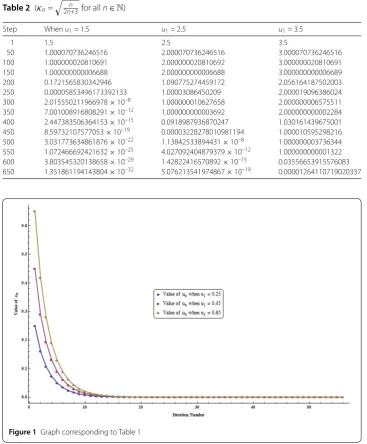
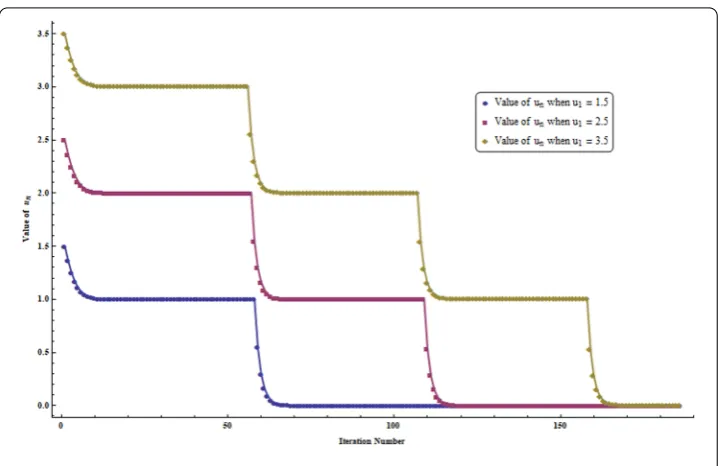
[image:9.595.121.478.406.730.2]It is evident from the tables (Table1and Table2) and graphs (Fig.1and Fig.2) that our sequence (2.1) converges to 0, which is a fixed point ofP.
Table 1 (κn=5n2+2n for alln∈N)
Step Whenu1= 0.25 u1= 0.45 u1= 0.65
1 0.25 0.45 0.65
2 0.1607142857142857 0.2892857142857142 0.4178571428571429 3 0.1071428571428571 0.1928571428571428 0.2785714285714286 4 0.07247899159663865 0.1304621848739496 0.1884453781512605 5 0.04941749427043545 0.0889514896867838 0.1284854851031322 6 0.03386013496307614 0.06094824293353705 0.088036350903998 7 0.02327884278711485 0.04190191701680672 0.0605249912464986 8 0.01604352678571429 0.02887834821428571 0.04171316964285715 9 0.01107767325680272 0.0199398118622449 0.02880195046768708 10 0.007660093209491246 0.01378816777708424 0.01991624234467724 11 0.005303141452724708 0.00954565461490447 0.01378816777708424 12 0.003674983989168876 0.006614971180503976 0.00955495837183908 13 0.002548779218294543 0.004587802592930178 0.006626825967565813 14 0.001768928860458153 0.003184071948824675 0.004599215037191199 15 0.001228422819762606 0.002211161075572691 0.003193899331382777 16 0.000853514556588304 0.001536326201858948 0.002219137847129592 17 0.0005932967039699188 0.001067934067145854 0.00154257143032179 18 0.0004125798918411505 0.0007426438053140709 0.001072707718786992 19 0.0002870120986721047 0.0005166217776097884 0.0007462314565474726 20 0.0001997249140244027 0.0003595048452439249 0.0005192847764634474 21 0.0001390242048601234 0.0002502435687482223 0.0003614629326363212 22 0.0000967972267484037 0.0001742350081471267 0.0002516727895458498 23 0.00006741235434263828 0.0001213422378167489 0.0001752721212908597 24 0.0000469581784523506 0.0000845247212142311 0.0001220912639761116 25 0.00003271676367581804 0.0000588901746164725 0.000085063585557127 26 0.00002279868964810942 0.00004103764136659699 0.00005927659308508453 27 0.000015889995815349 0.00002860199246762819 0.00004131398911990741 28 0.00001107660292237831 0.00001993788526028096 0.00002879916759818363 29 7.722420347291922×10⁻⁶ 0.00001390035662512546 0.00002007829290295901
30 5.384680854404231×10⁻⁶ 9.69242553792×10⁻⁶ 0.00001400017022145
Table 2 (κn=
n
2n+3for alln∈N)
Step Whenu1= 1.5 u1= 2.5 u1= 3.5
1 1.5 2.5 3.5
50 1.000070736246516 2.000070736246516 3.000070736246516 100 1.000000020810691 2.000000020810692 3.000000020810691 150 1.000000000006688 2.000000000006688 3.000000000006689 200 0.1721565830342946 1.090775274459172 2.056164187502003 250 0.00005853496173392133 1.00003086450209 2.000019096386024 300 2.015550211966978×10⁻⁸ 1.000000010627658 2.000000006575511
350 7.001008916808291×10⁻¹² 1.000000000003692 2.000000000002284
400 2.447383506364153×10⁻¹⁵ 0.0918987936870247 1.030161439675001
450 8.59732107577053×10⁻¹⁹ 0.00003228278010981194 1.000010595298216
500 3.031773634861876×10⁻²² 1.13842533894431×10⁻⁸ 1.000000003736344
550 1.072466692421632×10⁻²⁵ 4.027092404879379×10⁻¹² 1.000000000001322
600 3.803545320138658×10⁻²⁹ 1.42822416570892×10⁻¹⁵ 0.03556653915576083
650 1.351861194143804×10⁻³² 5.076213541974867×10⁻¹⁹ 0.00001264110719020337
Figure 1Graph corresponding to Table1
5 Application to integral equations
In this section, we use our iteration scheme (2.1) to find the solution of following integral equation:
u(t) =h(t) +
1
0
Bt,v,u(v)dv, t∈[0, 1], (IE)
where
(i) h∈L2([0, 1],R),
(ii) B: [0, 1]×[0, 1]×L2([0, 1],R)→Ris measurable and satisfies the condition
0≤B(t,v,u) –B(t,v,w)≤ u–w
Figure 2Graph corresponding to Table2
Recall that, for allu,w∈L2([0, 1],R), we have
u≤w ⇔ u(t)≤w(t) for almost everyt∈[0, 1].
Next, assume that there exist a nonnegative functionf(·,·)∈L2([0, 1]×[0, 1]) andM<1 2
such that
B(t,v,u)≤f(t,v) +M|u|
fort,v∈[0, 1] andu∈L2([0, 1],R).
Let
G=w∈L2[0, 1],Rsuch thatwL2([0,1],R)≤ρ
,
whereρis sufficiently large, that is,Gis the closed ball ofL2([0, 1],R) centered at 0 with
radiusρ.
Define the operatorP:L2([0, 1],R)→L2([0, 1],R) by
Pw(t)=h(t) +
1
0
Bt,v,w(v)dv. (5.1)
ThenP(G)⊂G, and it is a monotone nonexpansive map.
It is worth mentioning that every Hilbert space is aCAT(0) space, and so isL2([0, 1],R). TakingX=L2([0, 1],R) andPas in (5.1) in Theorem3.4, we get the following result.
Theorem 5.1 Under the above assumptions,the sequence generated by iteration scheme
Acknowledgements
Authors are grateful to the anonymous referees for their valuable suggestions and pointing out an omission in example.
Funding
The first author is thankful to University Grants Commission, India for the financial assistance in form of BSR-Startup reserach grant. The second author is grateful to University Grants Commission, India, for providing financial assistance in the form of the Junior Research Fellowship. The research of J.J. Nieto has been partially supported by AEI of the Ministerio de Economia y Competitividad of Spain under Grant MTM2016-75140-P and cofinanced by European Community fund FEDER and XUNTA de Galicia under grants GRC2015-004 and R2016/022.
Competing interests
The authors declare that they have no competing interests.
Authors’ contributions
The authors have contributed in this work on an equal basis. All authors read and approved the final manuscript.
Author details
1Department of Mathematics, Faculty of Natural Sciences, Jamia Millia Islamia, New Delhi, India.2Departamento de
Estadística, Análisis Matemático y Optimización, Facultad de Matemáticas, Universidad de Santiago de Compostela, Santiago de Compostela, Spain.
Publisher’s Note
Springer Nature remains neutral with regard to jurisdictional claims in published maps and institutional affiliations.
Received: 4 September 2018 Accepted: 27 November 2018 References
1. Banach, S.: Sur les opérations dans les ensembles abstraits et leurs applications aux équations intégrales. Fundam. Math.3, 133–181 (1922)
2. Ran, A.C.M., Reurings, M.C.B.: A fixed point theorem in partially ordered sets and some applications to matrix equations. Proc. Am. Math. Soc.132, 1435–1443 (2004)
3. Nieto, J.J., Rodriguez-Löpez, R.: Contractive mapping theorems in partially ordered sets and application to ordinary differential equations. Order22, 223–239 (2005)
4. Browder, F.E.: Nonexpansive nonlinear operators in a Banach space. Proc. Natl. Acad. Sci. USA54, 1041–1044 (1965) 5. Göhde, D.: Zum Prinzip der kontraktiven Abbildung. Math. Nachr.30, 251–258 (1965)
6. Kirk, W.A.: A fixed point theorem for mappings which do not increase distances. Am. Math. Mon.72, 1004–1006 (1965)
7. Mann, W.R.: Mean value methods in iteration. Proc. Am. Math. Soc.4, 506–510 (1953) 8. Ishikawa, S.: Fixed points by a new iteration method. Proc. Am. Math. Soc.44, 147–150 (1974)
9. Bachar, M., Khamsi, M.A.: On common approximate fixed points of monotone nonexpansive semigroups in Banach spaces. Fixed Point Theory Appl.2015, 160 (2015)
10. Abdullatif, B., Dehaish, B., Khamsi, M.A.: Browder and Göhde fixed point theorem for monotone nonexpansive mappings. Fixed Point Theory Appl.2016, 20 (2016)
11. Song, Y., Kumam, P., Cho, Y.J.: Fixed point theorems and iterative approximations for monotone nonexpansive mappings in ordered Banach spaces. Fixed Point Theory Appl.2016, 73 (2016)
12. Dehaish, B.A.B., Khamsi, M.A.: Mann iteration process for monotone nonexpansive mappings. Fixed Point Theory Appl.2015, 177 (2015)
13. Bridson, M., Haefliger, A.: Metric Spaces of Non-Positive Curvature. Springer, Berlin (1999)
14. Burago, D., Burago, Y., Ivanov, S.: In: A Course in Metric Geometry. Graduate Studies in Math., vol. 33. Am. Math. Soc., Providence (2001)
15. Kumam, W., Pakkaranang, N., Kumam, P.: Modified viscosity type iteration for total asymptotically nonexpansive mappings in CAT(0) spaces and its application to optimization problems. J. Nonlinear Sci. Appl.11(2), 288–302 (2018) 16. Pakkaranang, N., Kumam, P., Cho, Y.J., Saipara, P., Padcharoen, A., Khaofong, C.: Strong convergence of modified
viscosity implicit approximation methods for asymptotically nonexpansive mappings in complete CAT(0) spaces. J. Math. Comput. Sci.17(3), 345–354 (2017)
17. Kumam, W., Pakkaranang, N., Kumam, P.: Convergence analysis of modified Picard-S hybrid iterative algorithms for total asymptotically nonexpansive mappings in Hadamard spaces. Int. J. Comput. Math. (2018)
18. Pakkaranang, N., Kumam, P., Cho, Y.J.: Proximal point algorithms for solving convex minimization problem and common fixed points problem of asymptotically quasi-nonexpansive mappings in CAT(0) spaces with convergence analysis. Numer. Algorithms78(3), 827–845 (2018)
19. Uddin, I., Dalal, S., Imdad, M.: Approximating fixed points for generalized nonexpansive mapping in CAT(0) spaces. J. Inequal. Appl.2014, 155 (2014)
20. Laowang, W., Panyanak, B.: Strong and Delta convergence theorems for multivalued mappings in CAT(0) spaces. J. Inequal. Appl.2009, Article ID 730132 (2009)
21. Dhompongsa, S., Panyanak, B.: On-convergence theorems in CAT(0) spaces. Comput. Math. Appl.56, 2572–2579 (2008)
22. Kirk, W.A., Panyanak, B.: A concept of convergence in geodesic spaces. Nonlinear Anal.68, 3689–3696 (2008) 23. Uddin, I., Nieto, J.J., Ali, J.: One-step iteration scheme for multivalued nonexpansive mappings in CAT(0) spaces.
Mediterr. J. Math.13, 1211–1225 (2017)
25. Dhompongsa, S., Kirk, W.A., Sims, B.: Fixed points of uniformly Lipschitzian mappings. Nonlinear Anal.65, 762–772 (2006)