Volume 2010, Article ID 392431,11pages doi:10.1155/2010/392431
Research Article
A Class of Logarithmically Completely Monotonic
Functions Associated with a Gamma Function
Tie-Hong Zhao and Yu-Ming Chu
Department of Mathematics, Huzhou Teachers College, Huzhou 313000, China
Correspondence should be addressed to Tie-Hong Zhao,[email protected]
Received 15 November 2010; Accepted 27 December 2010
Academic Editor: Shusen Ding
Copyrightq2010 T.-H. Zhao and Y.-M. Chu. This is an open access article distributed under the Creative Commons Attribution License, which permits unrestricted use, distribution, and reproduction in any medium, provided the original work is properly cited.
We show that the functionGα,βx exΓxa/xβxβis strictly logarithmically completely
monotonic on0,∞if and only ifα, β ∈ {α, β : 0 < α ≤ β}andGα,βx−1is strictly
loga-rithmically completely monotonic on0,∞if and only ifα, β∈ {α, β: 0< β≤α−1/2}.
1. Introduction
For real and positive values ofxthe Euler gamma functionΓand its logarithmic derivativeψ, the so-called digamma function, are defined as
Γx
∞
0
tx−1e−tdt, ψx Γx
Γx. 1.1
For extension of these functions to complex variables and for basic properties, see1. These functions play central roles in the theory of special functions and have lots of extensive applications in many branches, for example, statistics, physics, engineering, and other mathematical sciences. Over the past half century monotonicity properties of these functions have attracted the attention of many authorssee2–22.
Recall that a real-valued functionf:I → Êis said to be completely monotonic onIif
fhas derivatives of all orders onIand
for allx∈I andn≥ 0. Moreover,f is said to be strictly completely monotonic if inequality 1.2is strict.
Recall also that a positive real-valued function f : I → 0,∞is said to be loga-rithmically completely monotonic onIiffhas derivatives of all orders onIand its logarithm logfsatisfies
−1klogfxk≥0 1.3
for allx∈Iandk∈Æ. Moreover,fis said to be strictly logarithmically completely monotonic if inequality1.3is strict.
Recently, the completely monotonic or logarithmically completely monotonic func-tions have been the subject of intensive research. In particular, many remarkable results for the complete monotonicity or logarithmically complete monotonicity involving the gamma, psi and polygamma functions can be found in the literature18,19,23–42.
The Kershaw’s inequality in21states that the double inequality
xs
2
1−s
< Γx1 Γxs <
⎛ ⎝x− 1
2 s
1 4
⎞ ⎠
1−s
1.4
holds for 0< s <1 andx≥1. In43, Laforgia extends the both sides of inequality in1.4as follows:
Γx1 Γxλ >
xλ
2
1−λ
1.5
for 0< λ <1 orλ >2 andx≥0, and inequality1.5is reversed for 1< λ <2 andx≥0. Let us define
zs,tx
⎧ ⎪ ⎪ ⎨ ⎪ ⎪ ⎩
Γ
xt Γxs
1/t−s
−x, s /t,
eψxs−x, st
1.6
for x ∈ −α,∞ with α min{s, t} ands, t ∈ Ê. In order to establish the best bounds in Kershaw’s inequality1.4, the following monotonicity and convexity properties of zs,tx are established in13,44,45: the functionzs,txis either convex and decreasing for|t−s|<1 or concave and increasing for|t−s|>1.
This work is motivated by an paper of Guo46, who proved that the function
gx e
xΓx1
x1/2x1/2 1.7
is strictly logarithmically concave and strictly increasing from −1/2,∞ onto π/e,
monotonic? We will give the positive answer. Actually, we investigate a more general problem. The goal of this article is to discuss the logarithmically complete monotonicity properties of the functions
Gα,βx e
xΓxα
xβxβ 1.8
on0,∞andGα,βx−1for fixedα, β >0.
Recently Chen et al.38, Theorem 1proved the following result: leta∈Êandb≥0 be real numbers, define forx >−b,
fa,bx
exΓxb
xbxa. 1.9
Then, the functionx→fa,bxis strictly logarithmically completely monotonic on−b,∞if and only ifb−a≤1/2. So is the functionx→fa,bx−1if and only ifb−a≥1.
Our main results are summarized as follows.
Theorem 1.1. Letα >0,β >0, andGα,βxis defined as1.8, then
1Gα,βxis strictly logarithmically completely monotonic on0,∞if and only ifα, β ∈
{α, β: 0< α≤β};
2 Gα,βx−1 is strictly logarithmically completely monotonic on 0,∞ if and only if
α, β∈ {α, β: 0< β≤α−1/2}.
As applications ofTheorem 1.1, one has the following corollaries.
Corollary 1.2. Forα >0and0 < x < y, one has the double inequalities for the ratio of the gamma functions
ey−xxα1/2xα1/2
yα1/2yα1/2 <
Γxα1/2 Γyα1/2 <
ey−xxαxα
yαyα . 1.10
In particular, one has
es−1x1/2x1/2 xs−1/2xs−1/2 <
Γx1 Γxs <
es−1x1x1
xsxs 1.11
forx≥1and0< s <1, and
es−1x1x1 xsxs <
Γx1 Γxs <
es−1x1/2x1/2
xs−1/2xs−1/2 1.12
Corollary 1.3. Forα >0andx, y∈0,∞×0,∞, one has the following double inequality
M
xα 1
2, yα 1 2
< Γxα1/2Γ
yα1/2 Γ2xy1/2α < M
xα, yα, 1.13
whereMu, v 2uvuuvv/uvuv.
2. Lemmas
In order to prove ourTheorem 1.1, we need serval lemmas which we collect in this section. In our second lemma we present the area ofα, βto determine positiveor negativefor a function, which plays a crucial role in the proof of our resultTheorem 1.1given inSection 3.
Letμx, ybe a function defined on0,∞×0,∞as
μx, y−3y2 4x−3y−x−12. 2.1
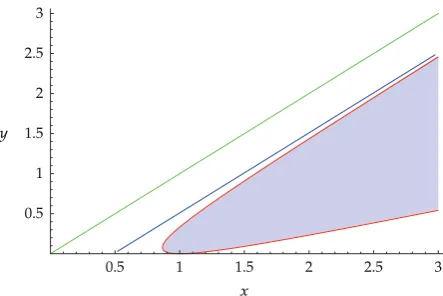
We will discuss the properties for this function and refer to viewFigure 1more clearly. The functionμx, ycan be interpreted as a quadric equation with respect toy, that is
μx, yaxy2bxycx, 2.2
whereax −3,bx 4x−3,cx −x−12and its discriminant function
Δx
b2x−4axcx 4x2−3. 2.3
Obviously, if 0< x <√3/2, thenΔx<0. It follows fromax −3 thatμx<0. If x ≥ √3/2, thenΔx ≥ 0. We can solve two roots of the equation μx, y 0, which are
y1x 4x−3− √
4x2−3
6 , y2x
4x−3√4x2−3
6 . 2.4
It follows from the properties of the quadratic equation thatμx, y>0 fory1x< y < y2x
andμx, y<0 for 0< y < y1xory > y2x.
Differentiatingy1xwith respect tox, one has
dy1x dx
2 3
1−√ x
4x2−3
,
d2y1x dx2
3
4x2−33/2 >0.
2.5
Obviously,y2xis strictly increasing on√3/2,∞. Note that
y2x−
x−1
2
− 1
2√4x2−32x −→0 2.6
asx → ∞. In other words,y2x< x−1/2 andy2xhas the asymptotic lineyx−1/2.
Lemma 2.1. The psi or digamma function, the logarithmic derivative of the gamma function, and the polygamma functions can be expressed as
ψx Γx Γx −γ
∞
0
e−t−e−xt
1−e−t dt, 2.7
ψnx −1n1
∞
0 tn 1−e−te−
xtdt 2.8
forx >0andn∈Æ :{1,2, . . .}, whereγ 0.5772· · · is Euler’s constant.
Lemma 2.2. Letα, β∈0,∞andgt te−αt−1−e−te−βt. Then the following statements are true:
1if0< α≤β, thengt>0fort∈0,∞;
2if0< β≤α−1/2, thengt<0fort∈0,∞;
3ifβ >0andα−1/2< β < α, then there existδ2> δ1>0such thatgt>0fort∈0, δ1
andgt<0fort∈δ2,∞.
Proof. Letg1t eαtgtandg2t eβ−α1tg1t. Then simple computations lead to
g0 0, lim
t→ ∞gt 0, 2.9
gt 1−αte−αtβe−βt−β1e−β1t,
g10 g0 0,
2.10
g1t βeα−βt−
β1eα−β−1t1−αt, 2.11
g1t βα−βeα−βtβ1β−α1eα−β−1t−α,
g10 2β−α1,
2.12
g1t βα−β2eα−βt−β1β−α12eα−β−1t,
g20 μα, β,
2.13
g2t β
α−β2et−β1β−α12 2.14
1If 0< α≤β, then we divide the proof into two cases.
Case 1. Ifαβ, theng1t α1e−t−αimplies thatg1t>0 fort∈0,log11/αand
g1t < 0 fort ∈ log11/α,∞. Thusg1tis strictly increasing on0,log11/αand
strictly decreasing onlog11/α,∞. From2.10and limt→∞g1t −∞we clearly see
that there existsζ1 > log11/α > 0 such thatg1t > 0 fort ∈ 0, ζ1andg1t < 0 for
t∈ ζ1,∞, which implies thatgtis strictly increasing on0, ζ1and strictly decreasing on ζ1,∞. It follows from2.9that
gt>min
g0, lim t→∞gt
0 2.16
fort∈0,∞.
Case 2. If 0< α < β, then we knowμα, β<0 sinceβ > α−1/2> y2α. It follows from2.13 and2.15that
g20<0,
g2t>0.
2.17
Therefore, there existsζ2 > 0 such thatg2t < 0 fort ∈ 0, ζ2andg2t > 0 fort ∈ ζ2,∞
follows from 2.17, which implies that g1t is strictly decreasing on 0, ζ2 and strictly increasing on ζ2,∞. It follows from 2.12 and limt→∞g1t −α < 0 that there exists
ζ3 > ζ2 > 0 such thatg1t > 0 for t ∈ 0, ζ3 and g1t < 0 fort ∈ ζ3,∞. By the same
argument, it follows from2.10and limt→∞g1t −∞that there existsζ4 > ζ3such that
g1t>0 fort∈0, ζ4andg1t<0 fort∈ζ4,∞.
Therefore,gt>0 fort∈0,∞follows from2.9.
2If 0 < β ≤ α−1/2, then fromFigure 1we know thatμx, ycould be positive or negative. We divide the proof into two cases.
Case 1. Ifμα, β≥0, then from2.13and2.15we clearly know thatg2t>0 fort∈0,∞, which implies thatg1tis strictly increasing on0,∞. Then the properties ofμx, yand
μα, β≥0 lead to
β < y2α< α−
1
2. 2.18
It follows from2.12and2.18that there existsζ5 >0 such thatg1t<0 fort∈0, ζ5and
g1t >0 fort ∈ζ5,∞sinceg1t → ∞ast → ∞. Henceg1tis strictly decreasing on 0, ζ5and strictly increasing onζ5,∞. From2.10and limt→∞g1t ∞we know that
0.5 1 1.5 2 2.5 3
x
0.5 1 1.5 2 2.5 3
[image:7.600.188.410.96.244.2]y
Figure 1:The shading area is denoted byμx, y>0. Otherwise,μx, y<0. The red curve is the graph of
μx, y 0 with an asymptotic lineyx−1/2.
follows from2.9that
gt<max
g0, lim t→∞gt
0 2.19
fort∈0,∞.
Case 2. Ifμα, β< 0, then from2.13and2.15we know that there existsζ7 > 0 such that
g2t<0 fort∈0, ζ7andg2t>0 fort∈ζ7,∞. Thusg1tis strictly decreasing on0, ζ7
and strictly increasing onζ7,∞. It follows from2.12and limt→∞g1t ∞that there
existsζ8 > 0 such thatg1t < 0 fort ∈ 0, ζ8and g1t > 0 for t ∈ ζ8,∞. By the same argument as Case1,gt<0 fort∈0,∞follows from2.9and2.10.
3If β > 0 andα−1/2 < β < α, then from2.12we clearly know thatg10 > 0. Thus there existsδ1 >0 such thatg1t>0 fort∈0, δ1. It follows from2.10thatg1t>0,
t∈0, δ1. Sinceg1t → ∞ast → ∞, we know that there existsδ2> δ1such thatg1t>0 fort∈δ2,∞, which implies thatgtis strictly increasing on0, δ1andδ2,∞. Therefore, gt> g0 0 fort∈0, δ1andgt<limt→∞gt 0 fort∈δ2,∞.
We state a simple lemma as the results of12,47.
Lemma 2.3. Inequality
logx− 1
2x−
1
12x2 < ψx<logx−
1
2x 2.20
3. Proof of
Theorem 1.1
Proof ofTheorem 1.1. Taking the logarithm of1.8and differentiating, then we have
−logGα,βx
logxβ−ψxα. 3.1
Forn≥1, it follows from2.8that
−1n1logGα,βx
n1 −1n1
ψnxα−−1n−1n−1! xβn
∞
0 tn 1−e−te−
xαtdt−
∞
0
tn−1e−xβtdt 3.2
∞
0
tn−1e−xt 1−e−tgtdt,
where
gt te−αt−1−e−te−βt. 3.3
1If 0< α≤β, then it follows from3.1and2.20that
−logGα,βx
>logxβ−logxα 1
2xα >0. 3.4
From3.2and3.3together withLemma 2.21we clearly see that
−1n1logGα,βx
n1
>0 3.5
holds forn≥1. Therefore,Gα,βxis strictly logarithmically completely monotonic on0,∞ that follows from3.4and3.5.
Conversely, if 0< β < α, then we can divide the set{α, β: 0< β < α}into two subsets: Ω1{α, β: 0< β≤α−1/2}andΩ2 {α, β:β >0, α−1/2< β < α}. Therefore, it follows fromLemma 2.22and3thatGα,βxis not strictly logarithmically completely monotonic on0,∞forα, β∈Ω1∪Ω2.
2If 0< β≤α−1/2, then from3.1and2.20we get
−logGα,βx
−1
>logxα
xβ−
1 2xα−
1 12xα2
≥log xα
xα−1/2− 1 2xα−
1 12xα2
ηx>0,
since
lim
x→∞ηx 0,
dηx dx −
xα1
6xα32x2α−1 <0. 3.7
Forn≥1, it follows from3.2that
−1n1logGα,βx
−1n1−∞
0
tn−1e−xt
1−e−t gtdt, 3.8
wheregtis defined as3.3.
Therefore,Gα,βx−1is strictly logarithmically completely monotonic on0,∞that follows from3.6,3.8, andLemma 2.22.
Conversely, ifβ > 0 andβ > α−1/2, then we can divide the set {α, β : β > 0, β > α−1/2}into two subsets:Ω1 {α, β: 0< α≤β}andΩ2{α, β:β >0, α−1/2< β < α}. Therefore, it follows fromLemma 2.21and3thatGα,βx−1is not strictly logarithmically completely monotonic on0,∞forα, β∈Ω1∪Ω2.
Remark 1. Although the upper and lower bounds of Kershaw’s inequalities given in1.11 and1.12are not better than those of inequalities in1.4and1.5, the difference between them is close to zero asxis large enough. For example,
log
⎡ ⎢
⎣es−1x1
x1
xsxs
!⎛ ⎝x−1
2 s
1 4
⎞ ⎠
1−s⎤
⎥ ⎦
s−1 1−slog
1 1−s
xs
xs/1−s
1−slog x1
x−1/2s1/4 ⇒s−11−s0 x−→ ∞.
3.9
Furthermore, the advantage of our inequalities is to give the upper and lower bounds of Kershaw’s inequality for s > 1 and x ≥ 0 while Laforgia established only one side of Kershaw’s inequality.
Acknowledgment
This work was supported by the National Science Foundation of China under Grant no. 11071069 and the Natural Science Foundation of Zhejiang Province under Grant no. Y7080106.
References
1 E. T. Whittaker and G. N. Watson, A Course of Modern Analysis, Cambridge University Press, Cambridge, UK, 1996.
3 X. M. Zhang and Y. M. Chu, “A double inequality for gamma function,”Journal of Inequalities and Applications, vol. 2009, Article ID 503782, 7 pages, 2009.
4 T.-H. Zhao, Y.-M. Chu, and Y.-P. Jiang, “Monotonic and logarithmically convex properties of a function involving gamma functions,”Journal of Inequalities and Applications, vol. 2009, Article ID 728612, 13 pages, 2009.
5 X. M. Zhang and Y. M. Chu, “An inequality involving the gamma function and the psi function,” International Journal of Modern Mathematics, vol. 3, no. 1, pp. 67–73, 2008.
6 Y. M. Chu, X. M. Zhang, and X. Tang, “An elementary inequality for psi function,” Bulletin of the Institute of Mathematics. Academia Sinica, vol. 3, no. 3, pp. 373–380, 2008.
7 Y. Q. Song, Y. M. Chu, and L. Wu, “An elementary double inequality for gamma function,” International Journal of Pure and Applied Mathematics, vol. 38, no. 4, pp. 549–554, 2007.
8 Ch.-P. Chen, “Monotonicity and convexity for the gamma function,”Journal of Inequalities in Pure and Applied Mathematics, vol. 6, no. 4, p. 6, article no. 100, 2005.
9 B.-N. Guo and F. Qi, “Two new proofs of the complete monotonicity of a function involving the PSI function,”Bulletin of the Korean Mathematical Society, vol. 47, no. 1, pp. 103–111, 2010.
10 Ch.-P. Chen, F. Qi, and H. M. Srivastava, “Some properties of functions related to the gamma and psi functions,”Integral Transforms and Special Functions, vol. 21, no. 1-2, pp. 153–164, 2010.
11 F. Qi, “A completely monotonic function involving the divided difference of the psi function and an equivalent inequality involving sums,”The ANZIAM Journal, vol. 48, no. 4, pp. 523–532, 2007.
12 F. Qi and B.-N. Guo, “Monotonicity and convexity of ratio between gamma functions to different powers,”Journal of the Indonesian Mathematical Society, vol. 11, no. 1, pp. 39–49, 2005.
13 Ch.-P. Chen and F. Qi, “Inequalities relating to the gamma function,” The Australian Journal of Mathematical Analysis and Applications, vol. 1, no. 1, article no. 3, 7 pages, 2004.
14 B.-N. Guo and F. Qi, “Inequalities and monotonicity for the ratio of gamma functions,”Taiwanese Journal of Mathematics, vol. 7, no. 2, pp. 239–247, 2003.
15 F. Qi, “Monotonicity results and inequalities for the gamma and incomplete gamma functions,” Mathematical Inequalities & Applications, vol. 5, no. 1, pp. 61–67, 2002.
16 F. Qi and J.-Q. Mei, “Some inequalities of the incomplete gamma and related functions,”Zeitschrift f ¨ur Analysis und Ihre Anwendungen, vol. 18, no. 3, pp. 793–799, 1999.
17 F. Qi and S.-L. Guo, “Inequalities for the incomplete gamma and related functions,” Mathematical Inequalities & Applications, vol. 2, no. 1, pp. 47–53, 1999.
18 H. Alzer, “Some gamma function inequalities,”Mathematics of Computation, vol. 60, no. 201, pp. 337– 346, 1993.
19 H. Alzer, “On some inequalities for the gamma and psi functions,”Mathematics of Computation, vol. 66, no. 217, pp. 373–389, 1997.
20 G. D. Anderson and S.-L. Qiu, “A monotoneity property of the gamma function,”Proceedings of the American Mathematical Society, vol. 125, no. 11, pp. 3355–3362, 1997.
21 D. Kershaw, “Some extensions of W. Gautschi’s inequalities for the gamma function,”Mathematics of Computation, vol. 41, no. 164, pp. 607–611, 1983.
22 M. Merkle, “Logarithmic convexity and inequalities for the gamma function,”Journal of Mathematical Analysis and Applications, vol. 203, no. 2, pp. 369–380, 1996.
23 H. Alzer and Ch. Berg, “Some classes of completely monotonic functions. II,”The Ramanujan Journal, vol. 11, no. 2, pp. 225–248, 2006.
24 H. Alzer, “Sharp inequalities for the digamma and polygamma functions,”Forum Mathematicum, vol. 16, no. 2, pp. 181–221, 2004.
25 H. Alzer and N. Batir, “Monotonicity properties of the gamma function,”Applied Mathematics Letters, vol. 20, no. 7, pp. 778–781, 2007.
26 W. E. Clark and M. E. H. Ismail, “Inequalities involving gamma and psi functions,”Analysis and Applications, vol. 1, no. 1, pp. 129–140, 2003.
27 A. Elbert and A. Laforgia, “On some properties of the gamma function,”´ Proceedings of the American Mathematical Society, vol. 128, no. 9, pp. 2667–2673, 2000.
28 J. Bustoz and M. E. H. Ismail, “On gamma function inequalities,”Mathematics of Computation, vol. 47, no. 176, pp. 659–667, 1986.
29 M. E. H. Ismail, L. Lorch, and M. E. Muldoon, “Completely monotonic functions associated with the gamma function and itsq-analogues,”Journal of Mathematical Analysis and Applications, vol. 116, no. 1, pp. 1–9, 1986.
31 M. E. Muldoon, “Some monotonicity properties and characterizations of the gamma function,” Aequationes Mathematicae, vol. 18, no. 1-2, pp. 54–63, 1978.
32 F. Qi, Q. Yang, and W. Li, “Two logarithmically completely monotonic functions connected with gamma function,”Integral Transforms and Special Functions, vol. 17, no. 7, pp. 539–542, 2006.
33 F. Qi, D.-W. Niu, and J. Cao, “Logarithmically completely monotonic functions involving gamma and polygamma functions,”Journal of Mathematical Analysis and Approximation Theory, vol. 1, no. 1, pp. 66–74, 2006.
34 F. Qi, S.-X. Chen, and W.-S. Cheung, “Logarithmically completely monotonic functions concerning gamma and digamma functions,”Integral Transforms and Special Functions, vol. 18, no. 5-6, pp. 435– 443, 2007.
35 F. Qi, “A class of logarithmically completely monotonic functions and the best bounds in the first Kershaw’s double inequality,”Journal of Computational and Applied Mathematics, vol. 206, no. 2, pp. 1007–1014, 2007.
36 Ch.-P. Chen and F. Qi, “Logarithmically complete monotonicity properties for the gamma functions,” The Australian Journal of Mathematical Analysis and Applications, vol. 2, no. 2, article no. 8, 9 pages, 2005.
37 Ch.-P. Chen and F. Qi, “Logarithmically completely monotonic functions relating to the gamma function,”Journal of Mathematical Analysis and Applications, vol. 321, no. 1, pp. 405–411, 2006.
38 Ch.-P. Chen, G. Wang, and H. Zhu, “Two classes of logarithmically completely monotonic functions associated with the gamma function,”Computational Intelligence Foundations and Applications, vol. 4, pp. 168–173, 2010.
39 Ch.-P. Chen, “Complete monotonicity properties for a ratio of gamma functions,” Univerzitet u Beogradu. Publikacije Elektrotehniˇckog Fakulteta. Serija Matematika, vol. 16, pp. 26–28, 2005.
40 M. Merkle, “On log-convexity of a ratio of gamma functions,” Univerzitet u Beogradu. Publikacije Elektrotehniˇckog Fakulteta. Serija Matematika, vol. 8, pp. 114–119, 1997.
41 A.-J. Li and Ch.-P. Chen, “Some completely monotonic functions involving the gamma and polygamma functions,”Journal of the Korean Mathematical Society, vol. 45, no. 1, pp. 273–287, 2008.
42 F. Qi, D.-W. Niu, J. Cao, and S.-X. Chen, “Four logarithmically completely monotonic functions involving gamma function,” Journal of the Korean Mathematical Society, vol. 45, no. 2, pp. 559–573, 2008.
43 A. Laforgia, “Further inequalities for the gamma function,”Mathematics of Computation, vol. 42, no. 166, pp. 597–600, 1984.
44 N. Elezovi´c, C. Giordano, and J. Peˇcari´c, “The best bounds in Gautschi’s inequality,”Mathematical Inequalities & Applications, vol. 3, no. 2, pp. 239–252, 2000.
45 F. Qi, B.-N. Guo, and Ch.-P. Chen, “The best bounds in Gautschi-Kershaw inequalities,”Mathematical Inequalities & Applications, vol. 9, no. 3, pp. 427–436, 2006.
46 S. Guo, “Monotonicity and concavity properties of some functions involving the gamma function with applications,”Journal of Inequalities in Pure and Applied Mathematics, vol. 7, no. 2, article no. 45, 7 pages, 2006.