2019 International Conference on Computer Science, Communications and Multimedia Engineering (CSCME 2019) ISBN: 978-1-60595-650-3
The Performance Evaluation System for Explosive Enterprise by
Balanced Scorecard
Yu SHANG
1,*and Yan-hong FENG
2 1D11, Xueyuan Road, Haidian District, Management School, China University of Mining & Technology(Beijing), Beijing, China
2
BRGIMM Advanced Materials Science &Technology Co., Ltd, Beijing, China
*Corresponding author
Keywords: Balanced Scorecard, Explosive Industry, Performance Evaluation.
Abstract. A scientific and effective performance evaluation system plays a great significance role
for an enterprise to achieve its strategic goals. The Balanced Scorecard integrates both financial and non-financial index, which makes up for traditional evaluation that is done only around unitary financial index. However, only four evaluation dimensions cannot cover all the specific circumstances of enterprises. This paper is taking civil explosive industry as research target, which is not paid enough attention as the basis of Chinese energy industry as well as there are no enough studies on its operating performance. Guided with strategic goal, this paper focuses on difference between this industry and others and extends traditional four performance evaluation indices to six, in which security index and social responsibility index are added. Considering a lot of non-financial index such as market share, customer satisfaction, employee satisfaction and etc., it innovatively completes the extraction, analysis and calculations of assessment index. As a result, it builds a strategy-based performance evaluation system with industry applicability so that it can reflect the drive relationship among the perspectives of index.
Introduction
In the mid of 1990s, Balanced Scorecard (BSC), as an advanced management tool, was introduced to China by eGate Management & Consulting Co. It is a financial and non-financial index system used to evaluate corporate strategic business performance, which is proposed by Prof Kaplan, the famous Accounting scientist from Harvard University, and Norton, CEO of American Recovery Solutions Enterprise. It consists of the following four components: financial index, customer index, internal business processes index and learning and growth index. Due to unsmooth information transmission and knowledge dissemination, BSC was seldom applied successfully in China. It still remain in the conceptual stage for most companies. This led us to deep thinking why the most influential management tools in foreign countries does not work in China. Is the problem in BSC itself, or do we not grasp its essence when applying BSC?
in performance evaluation. If those non-financial index such as market share, customer satisfaction, employee satisfaction and so on do not attract executives’ attention, it will be difficult to reach a high strategic level for business decision making.
Therefore, from viewpoint of strategic management, this paper is describing how to build enterprise performance evaluation system which is adapt to civil explosive industry.
Framework of Civil Explosive Industry Performance Evaluation System
When Balanced Scorecard was founded initially, Kaplan proposed to measure and appraise business from four aspects. This method is just for generic business, which might not applicable to explosive industry. When companies use BSC, besides revising BSC model and index based on their own actual situation, they also need to integrate corporate strategic target into it.
In viewpoint of performance evaluation, the difference between civil explosive industry and other industries is mainly in the security risk perspective. The risks includes the risk in producing process and the potential safety hazards caused by bad quality. So safety evaluation is particularly important for them. It is required not only for companies to promptly eliminate or renew deprecated production lines, but also for employees to operate and transport in strict accordance with regulation. It is necessary to ensure both safe producing process and good product quality, then further use safety as well. That also helps to archive corporate’s social responsibility. This is the purpose of the enterprise performance evaluation.
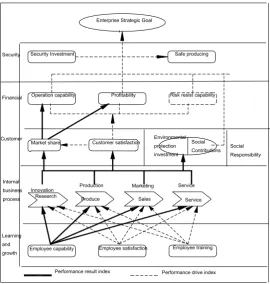
The model consists of six interrelated indices. Based on financial perspective index, it involves main perspectives (security, internal business process, learning and growth, social responsibility & customer) which may impact corporate strategic operations and is expanded into a comprehensive, multi-angle strategic business performance measurement system. The security perspective index is put in the top place that is treated higher than the other indices. It also reflects how important security perspective index is for the entire index system. This system is not only an improvement to traditional performance evaluation system but also a balance between internal operations and customer satisfaction as well as a balance between assessment to past performance evaluation and future performance evaluation. All of this, eventually, will be reflected in enterprise financial target.
Design and Analysis of Evaluating Index
Because of the potential danger of civil explosive business, it is necessary to evaluate safety comprehensively to producing, storing, transporting and other operational stages. Currently civil explosive companies normally pay more attention on a series of formal safety evaluation on pre-production. This kind of safety evaluation generally is done to actual situation of the actual site by special safety evaluation institute. After that, then entering the production process, the safety is only implemented through some rules and regulations. It is agreed that these methods and measures are very important. However it will be greatly helpful if the safety of producing, storing, transporting and other operational stages can be evaluated periodically by experienced technical experts. The evaluation can also help to take preventive measures to eliminate accidents in the bud. Among security perspective index, this paper chooses three: safety evaluation, security investment ratio and security productivity. Safety evaluation includes security assessment in phases of pre-production, in-product and transportation. Detail of key evaluation index is described in Table 1. And the well-known G-K risk assessment method, i.e. working conditions risk assessment method, is introduced into civil explosive industry. The purpose is to find risky hazards and identify potential risk sources. In the method, there are three main factors affecting the risk: (1) possibility of an accident or a dangerous event occurs, (2) frequency of exposure to hazardous environments, (3) consequence caused. The calculating methods is shown as Eq.1.
Table 1. Key evaluation indices of security.
Attention content
Key Evaluation
Index Calculation Method
Security perspective
Safety Evaluation “G-K” Evaluation
Security Investment Ratio
Safety Investment Cost Security Cost Extraction
× 100%
Security Productivity
Days being safe in a certain period Days in operation
× 100%
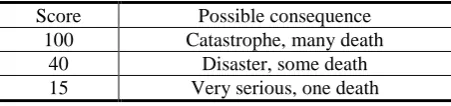
Wherein, D is working conditions risk score. L is likelihood scores of accidents or dangerous events as shown in Table 2. E is scores of exposure to potential hazardous environments as shown in Table 3. C is scores of consequence caused by accidents or dangerous incidents may result scores as shown in Table 4.
It is stated in scores of Table 2 that probability of accidents or dangerous incidents is related to its actual occurrence. In actual production conditions, the range of possibilities of accidents or dangerous incidents is very wide. Thus entirely unexpected or rarely possible is defined as 1 intentionally, while completely expected or predicable that an accident may occur in the future is defined as 10. Then, accordingly, some intermediate values can be determined between above two depending on possibility. For example, seldom happen but still possible can be scored as 3. Very possible can be scored as 6. Similarly, between 0.1 and 1, some certain likelihood scores can be inserted. The score of impossible accidents or dangerous incidents is defined as 0.1. Then a series of scores, from 0.1, passing 1, to 10, are comprehensively declared.
Table 2. Score for the possibility of accident event.
Score possibility of accident Score possibility of accident 10 completely predictable 0.5 be envisaged but
improbable
6 Very possible 0.2 Highly improbable
3 Seldom but possible 0.1 Actually impossible
1 Rarely possible
Table 3. Score when exposed to potentially dangerous environment.
Score exposure to potentially
dangerous environment Score
exposure to potentially dangerous environment
10 Continuously 2 Monthly
6 Daily 1 Some times in a year
3 Weekly or occasionally 0.5 Very rarely
[image:3.595.185.411.713.766.2]Scores in Table 3 describes that more frequently people are exposed to dangerous working conditions, longer for each time, greater the likelihood of injury will be. In G-K risk assessment method, it is defined that frequency score of consecutively potential hazardous exposure will be 10 and only a few occurrence in a year or a rare exposure frequency is scored as 1. With 1 and 10 as reference points, the interval between them is divided depending on their frequencies exposure to potentially hazardous working conditions and corresponding scores are determined. For example, Score of once a month exposure is set to 2 while score of weekly or casual exposure is set to 3.
Table 4. Score for consequence of accident event.
Score Possible consequence 100 Catastrophe, many death
determined, the calculation as Eq.1can be done and the result of risk score can be assessed as risk score with reference to severity shown in Table 5.
Table 5. Score for the risk.
Score Possible consequence
>320 Extremely dangerous and cannot continue
160-320 Highly dangerous and requires immediate rectification
70-160 Significantly dangerous and need rectification
After preliminary evaluation with G-K risk assessment method, a further safety assessment should be conducted to analysis of main risk sources so that root cause that may lead to accidents can be discovered. At the same time, possibility and consequence of potential accident can be estimated in order to prevent the accidents from root.
Key Index in Social Responsibility Perspective Index
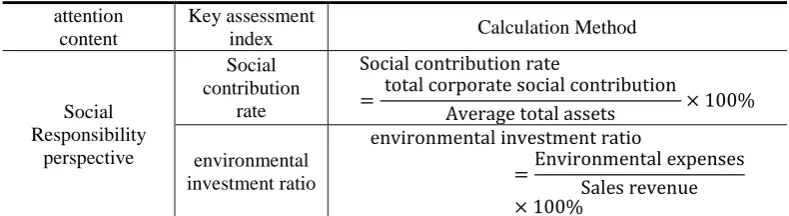
In the six aspects of social responsibility, the most important factors are economic responsibility, community responsibility, rights protection and ecological responsibility. They can be quantified with two indices: namely, social contribution rate (including financial responsibility, community responsibilities, rights responsibilities) and the ratio of investment in environmental protection (environmental responsibility), specific index as shown in table 6.
Table 6. Key evaluation index of social responsibility.
attention content
Key assessment
index Calculation Method
Social Responsibility
perspective
Social contribution
rate
Social contribution rate
= total corporate social contribution
Average total assets × 100%
environmental investment ratio
environmental investment ratio
=Environmental expenses
Sales revenue × 100%
Note: total corporate social contribution = salary + Labor and Manpower + unemployment insurance + + net interest expenses + profit + tax payable.
[image:4.595.100.495.404.512.2]Figure 1. Driving relationship among evaluation index.
Conclusion
With the civil explosive industry market gradually growing, corporates would focus on improving business performance when whether initially pursuing to corporate profit or developing enterprise value. Objective and accurate evaluation of business performance plays an active role in guiding to improve the overall competitiveness and capability to achieve strategic business objectives for enterprises.
In this paper, the Balanced Scorecard theory to strategic orientation is used as a starting point. The performance evaluation of civil explosive business is expanded to six by adding the safety management index and social responsibility index. Based on that, the enterprise performance evaluation system customizing to the civil explosive industry is constructed, which is suitable for strategic level management. It also quantifies assessment of key check points of the perspective index. As a result, it reflects the driving relationship among all indices at corporate strategy level.
Acknowledgments
The paper is supported by Yue Qi Young Scholar Project (No.2018QN11), and the Fundamental Research Funds for the Central University (No.2009QG09)
References
[1] Lobo, Gerald J.; Neel, Michael; Rhodes, Adrienne. Accounting comparability and relative performance evaluation in CEO compensation [J]. Review of Accounting Studies. 2018, 23(3): 1137-1176.
[2] Calik, Ahmet; Yapici Pehlivan, Nimet; Kahraman, Cengiz. An integrated fuzzy AHP/DEA approach for performance evaluation of territorial units in Turkey [J].Technological and Economic Development of Economy. 2018, 24(4): 1280-1302.
Customer satisfaction Enterprise Strategic Goal
Security Investment Safe producing
Operation capability Profitability Risk resist capability
Market share Environmental protection investment
Social Contributions
Research
Employee capability Employee satisfaction Employee training Produce Sales Service Innovation Production Marketing Service
Performance result index Performance drive index Security
Financial
Customer
Internal business process
Social Responsibility
[3] Li, Yongjun; Shi, Xiao; Emrouznejad, Ali. Environmental performance evaluation of Chinese industrial systems: a network SBM approach [J]. Journal of the Operational Research Society. 2018, 69(6): 825-839.
[4] Jamali, Dima; Karam, Charlotte.Corporate Social Responsibility in Developing Countries as an Emerging Field of Study[J].International Journal of Management Reviews. 2018, 20(1):32-61.
[5] Dai, Narisa Tianjing; Kuang, Xi (Jason); Tang, Guliang. Differential weighting of objective versus subjective measures in performance evaluation: experimental evidence [J]. European Accounting Review. 2018, 27(1): 129-148.
[6] Cui, Jinhua; Jo, Hoje; Na, Haejung. Does Corporate Social Responsibility Affect Information Asymmetry?[J].Journal of Business Ethics. 2018, 148(3):549-572.
[7] Bi, Gong-bing; Shao, Yingying; Song, Wen, A performance evaluation of China's coal-fired power generation with pollutant mitigation options [J]. Journal of Cleaner Production. 2018, 171(1): 867-876.
[8] Opsal, Ryan.Energy Security, Trade, and the EU: Regional and International Perspective[J].Energy Journal.2018, 39(2):285-287.
[9] Platonova, Elena; Asutay, Mehmet; Dixon, Rob.The Impact of Corporate Social Responsibility Disclosure on Financial Performance: Evidence from the GCC Islamic Banking Sector[J].Journal of Business Ethics. 2018, 151(2):451-471.
[10] Basso, Antonella; Casarin, Francesco; Funari, Stefania. How well is the museum performing? A joint use of DEA and BSC to measure the performance of museums [J]. Omega-international Journal of Management Science. 2018, 81: 67-84.
[11] Froelich, Markus; Huber, Martin; Wiesenfarth, Manuel. The finite sample performance of semi- and non-parametric estimators for treatment effects and policy evaluation [J]. Computational Statistics & Data Analysis. 2017, 115: 91-102.
[12] Su, Meirong; Zhang, Mingqi; Chen, Bin. Assessment and regulation of urban crude oil supply security: A network perspective [J]. Journal of Cleaner Production. 2017, 165:93-102.
[13] Biresselioglu, Mehmet Efe; Yildirim, Cansu; Demir, Muhittin Hakan.Establishing an energy security framework for a fast-growing economy: Industry perspectives from Turkey. Energy Research & Social Science. 2017, 27(5):151-162.
[14] Ahn, Heinz; Novoa, Nadia Vazquez. The decoy effect in relative performance evaluation and the debiasing role of DEA [J]. European Journal of Operational Research. 2016, 249(3): 959-967.
[15] Fuerst, Christine; Opdam, Paul; Inostroza, Luis. Evaluating the role of ecosystem services in participatory land use planning: proposing a balanced score card [J]. Landscape Ecology. 2014, 29(8): 1435-1446.
[16] Robert S. Kaplan, David P. Norton. The balanced scorecard—measures that drive performance [J]. Harvard Business Review, 1992(2):71-79.
[17] Chiwamit, Pimsiri; Modell, Sven; Scapens, Robert W. Regulation and adaptation of management accounting innovations: The case of economic value added in Thai state-owned enterprises [J]. Management Accounting Reserach.2017, 37: 30-48. [18] Cooper, David J.; Ezzamel, Mahmoud; Qu, Sandy Q. Popularizing a management accounting idea: the case of the balanced scorecard [J]. Contemporary Accounting Research. 2017, 34(2): 991-1025.
[20] Li Wenwen, Wu, Rongtao. A Fertility evaluation of cultivated land in Yichuan County based on analytic hierarchy process[J]. Journal of Henan Agricultural University, 2013(2):216-221.
[21] Flammer, Caroline.Does Corporate Social Responsibility Lead to Superior Financial Performance? A Regression Discontinuity Approach[J].Management Science.2015, 61(11): 2549-2568.
[22] Xue Yaohui, Wang Yanping. Research of comprehensive performance evaluation method in civil explosive manufacturing enterprises [J]. Explosive Materials, 2011(4):22-25.
[23] Gillenkirch, Robert M.; Kreienbaum, Heike. What guides subjective performance evaluation: Incentive alignment or norm enforcement [J]? Review of Managerial Science. 2017, 11(4): 933-957.