T
he
face
of
modern-day
The University of Michigan Law School Volume 54, Number 1
SPRING 2011
Cover Illustration by Carolyn Reed Barritt
Copyright © 2011
The Regents of the University of Michigan All rights reserved.
Law Quadrangle (USPA #144) is issued by the University of Michigan Law School. Postage paid at Ann Arbor, Michigan.
Publication Office: Law Quadrangle, University of Michigan Law School, Ann Arbor, MI 48109-1215. Published two times a year.
Postmaster, send address changes to: Editor, Law Quadrangle
University of Michigan Law School B38 Hutchins Hall
Ann Arbor, MI 48109-1215
Special Counsel for Communications: Lisa Rudgers
Assistant Director for Communications: Lisa Yellin
Editor: Katie Vloet
Design: Tish Holbrook
Writers: Lori Atherton, Amanda Chalifoux, Shannon Cook, Rebecca Freligh, Frank Kimball, John Masson, Pat Materka, Clarissa Sansone, Sandra Svoboda, Fritz Swanson, James Tobin, Jared Wadley, Lara Zielin
Photos: Bentley Historical Library, Eric Bronson Photography, Glenn Carpenter, Cybelle Codish, Jeffrey Cunningham, Philip Dattilo Photography, Gregory Fox Photography, Sam Hollenshead Photography, Ashley Kempher, M.J. Murawka, Mary Small, Peter Smith Photography, Leisa Thompson Photography, U-M Photo Services (Scott Galvin, Scott Soderberg), Nancy Van Goethem, Hardy Vieux
1
[
o p e n i n g
]
1.
My first dinner out with my roommate and friends at the still-legendary Brown Jug. I remember my roommate, Mark Penskar, telling me that you could order a double pepperoni double sausage pizza with “extra grease.” An outstanding option.2.
Signing up for firm interviews in Room 250. Nancy Krieger would distribute clipboards at random, and the row you sat in had a lot to do with whether you were able to sign up for a firm. Students would game the system by having friends in other rows sign up for them.3.
Seeing the first Lexis machine, a contraption about half the size of a large freezer and vaguely reminiscent of Mr. Sulu’s Star Trek work station. Located in a room off the side of the Reading Room, it had a very slow dot-matrix printer that used silver paper on a roll. It only covered a few years of New York and federal cases, but it was viewed as a miracle.4.
Lugging a Smith Corona electric typewriter from the Quad to Room 200 about 7 a.m. on an exam day to get a scarce studycarrel with a functioning electrical outlet.
5.
Thursday steak nights at the Lawyers Club. Only one steak and one mushroom were permitted (I never knew that button mushrooms were in such short supply). The yogurt police stood by to make sure that you took no more than one Dannon to your room by confiscating the lid (you could fit two or three comfortably in the pocket of a parka— not that any of us ever did that).The Lighter Side of Law School
Frank Kimball, ’77 (Section 2), recently established a partner-levelattorney search firm, Kimball Partner Group in Chicago, along with Lateral Link Group LLC. Previously, he ran Kimball Professional Management, which focused on lawyer placements and consulting services. Here, he recalls a random sampling of memories from his years in Ann Arbor.
An early Lexis terminal—the kind Frank Kimball would have seen at the Law School in the 1970s.
lexisnexis photographs
C o n t r i b u t o r s
L e t t e r s t o t H e e D i t o r
2
Nicholas Howson is professor of law at Michigan and a former partner of Paul, Weiss, Rifkind, Wharton & Garrison who worked in New York, Paris, London, and Beijing for the firm. He writes and lectures on Chinese law issues, focusing on corporate law and governance, the Chinese capital mar-kets, and legal institutions in China. He regularly serves as an expert witness or
party advocate in Chinese law-related litigation, and has consult-ed for foreign and Chinese government departments and multilat-eral institutions on developing Chinese law and regulation. A member of the Council on Foreign Relations, he joined the faculty of Michigan Law in 2005 after teaching at Columbia, Harvard, and Cornell law schools.
Sandra Svoboda has been a Detroit-area journalist for 20 years. A native of Chicago, she moved to the Motor City to work for the Associated Press. She has since been the education-children’s affairs reporter at The (Toledo) Blade, dabbled in public relations, and taught as adjunct faculty in political science and journalism at Wayne State University. For four years she has been
the staff writer at the Metro Times in Detroit. Her work has been recognized by the Michigan Bar Association, and she won first place in the Michigan Press Association’s sport feature category in 2008 for a piece about University of Michigan women’s sports. She lives in Grosse Pointe Park with her husband and rescued dog and cat.
I discovered James Tobin by reading the book he wrote for the sesquicentennial, and now I find him spot-on describing one of my favorite professors, L. Hart Wright. Tobin has that research-guided instinct enabling him to find the essence of the personality of someone he never met. Well, I did, and what a kick to learn more about the academic side and about his work with the IRS and the then-Commissioner, which he occasionally referenced.
In one class, opening with the phrase: “This is how a judge can write an opinion that can’t be overturned!” he told about a tax court opinion from Texas. The taxpayer had claimed a catastrophic loss due to termite damage, and won. The decision began with “…great swarms of termites…” descending on the house. I recall that very night reading the IRC and the code section added to rectify what the IRS felt was the wrong decision, stating in essence—no way, not ever, don’t even think to claim a catastrophic loss for termite damage.
Deliciously, Tobin’s final paragraph, quoting Wright on research, sums up Wright’s teaching philosophy and underscores Wright’s legacy while very much catching the elusive what-he-really-was-like. Richard Helzberg, ’65
San Rafael, California
I read with great interest and fond memories the article in the Fall 2010 issue of the Law Quadrangle on L. Hart Wright. I had the great good fortune to have had him for his class on the federal income tax. He liked to debate with his students over an issue. I was there during the Korean War and I will always remember one of his favorite rejoinders to a student who asserted a position was, “Would you fight and die in Korea on that position?” He had a great sense of humor.
James H. LoPrete, ’53 Orchard Lake, Michigan
I was pleased to see the article regarding L. Hart Wright in the Fall 2010 issue. He and Alan Polasky were inspirations to me as a student and were instrumental in my career path. Doug Kahn was just starting at the time; he and others have contributed to the School’s reputation in the tax area. R. Peter Prokop, ’69
Farmington Hills, Michigan
c
L A W Q u A D r A n g L e
0 4 A M E S S A G E F r o M D E A N C A M i N k E r 04 Trajectory-Changing
0 6 B r i E F S
06 Historic Agreement with India Law School 07 Taking Home the Gold
10 New Medical Testimony Leads to Exoneration
1 2 S P E C i A L F E A T U r E S
12 THE FACE OF MODERN-DAY SLAVERY
‘No, Slavery Did Not End’
20 WHiTHER THE LAW LibRARiAN?
In Fact, the Digital Age Makes Law Librarians More Necessary than Ever
26 NEW LiFE FOR A DYiNG TREE 30 HiGHER MATH AT DOMiNiCK’S 32 MuNGER’S $20M GiFT
3 4 G i v i N G
4 6 C L A S S N o T E S
46 Judge McClain reflects on lifetime of ‘firsts’ 50 Verse and Versatility
56 Working Toward the Greater Good, 30 Years Later
6 2 F A C U L T y v i E w S
62 China’s Judicial System and Judicial Reform
6 6 F A C U L T y N E w S
73 In the News
7 4 C L o S i N G
74 Mocking and Mooting, Then and Now
1 2
2 0
2 6
Spring 2011
l
eisa
t
hompson
p
hotography
4
A m e s s A g e f r o m D e A n C A m i n k e r
Trajectory-Changing
This profound sense of place is built on the architecture, the feel of the arched doorway, the warm wood of the classroom chairs, the green space as you step outside. Even decades after your Contracts class, those surroundings are etched into your memory, a snapshot of time, space, and place.
Since the 1930s the Law Quadrangle has been that sort of indelible environment, a space unlike any other in the United States. A place that, when constructed, changed the trajectory of Michigan Law. It turned what had started as a department of law into one of the nation’s leaders in legal education. Those stone hallways became a magnet for some of the world’s finest legal scholars, people whose intellectual contributions shaped American law even as their outsized personalities were ingrained in the hearts and minds of their students. The Quad emerged as home to generations of students from across the globe, who together with their faculty created a memorable sense of community, of camaraderie, that continues today.
The story of the Law Quadrangle, historical and contemporary, hinges on the power of a philanthropic gift. It was William Cook’s series of visionary donations in the 1920s that brought the Law Quadrangle to life. Cook imagined “a great center of legal education and of jurisprudence for the common good of the people.”
A few weeks ago an alumnus in his mid-60s walked into Hutchins Hall to meet with
a faculty member. As they walked down the hall together, the alumnus pointed to the
classroom on his left. “I took Tax from Professor Wright in there,” he noted, recalling the
scene vividly.
Law Quadrangle
•
Spring 2011
philip da
ttilo
p
hotography
5 Over the course of the last few years, as we celebrated the Law
School’s sesquicentennial and broke ground on both the new academic building and the stunning Commons, I’ve thought again about the trajectory-changing
nature of philanthropy for Michigan Law. William Cook envisioned a future of leadership in legal education, and his gift made the critical difference in the University of Michigan’s ability to realize that future. Now, almost 80 years later, the gifts of more than 420 alumni and friends dedicated to that same leadership have made our new learning and gathering spaces possible; envisioning a future where legal education includes professional clinical suites for students and clients to meet, where skills-based education blends with extraordinary legal scholarship. At the same time, Bob and Ann Aikens’ gift of $10 million is bringing to life the Robert B. Aikens Commons, an arched glass gathering area that is soon to be the heart of our historic Quad.
And this March, we celebrated yet another transformational moment that will change the future of living space in the Law Quadrangle. Charles Munger, a long-time friend of the University (and the man responsible for the lighting and Reading Room renovation project), has given the Law School $20 million to renovate the residence portions of the Lawyers Club. We had long recognized the need to bring the residences up to
contemporary standards, and this gift will enable us to do just that. And yet, taken together with the construction of the new academic building and the Aikens Commons, the total is far greater than the sum of its parts. This visionary philanthropy will enable the Law School to match its modern-day facilities with the quality of its academic mission. As President Mary Sue Coleman said when we announced Mr. Munger’s gift, “Charlie Munger has a powerful vision of world-class facilities that will match a world-class law school at the University of Michigan.”
As we look at Michigan Law’s proud history, it is that sort of powerful vision and commitment that fueled the Law School’s leadership and carved such a memorable sense of place from quarried stone. And it is that sort of vision and commitment that will mark the Law School’s future strength as well.
As I look across the hallway of Hutchins Hall, I see that Professor Monica Hakimi’s class on the law of foreign affairs is about to start. And yet, I can almost hear students in L. Hart Wright’s 1971 Tax class gathering down the hall.
Sincerely,
b r i e f s
6
Head of State
leisa thompson photography
l
eisa
t
hompson
p
hotography
A 2010 Memorandum of Understanding between Michigan Law and Jindal Global Law School of O.P. Jindal Global University, near Delhi, establishes a Joint Centre for Global Corporate and Financial Law & Policy, as well as opening the door for future cooperative efforts between the two schools.
The MoU, signed by Michigan Law’s Dean Evan Caminker and Professor C. Raj Kumar, O.P. Jindal Global University’s vice chancellor and dean of Jindal Global Law School, provides the framework for Michigan and Jindal to develop collaborative initiatives on faculty and student exchange programs, teaching and research initiatives, conferences and publications, and continuing legal education programs. The Centre’s directors will be Michigan’s Professor Vikramaditya Khanna and JGLS professors Vivek Pande, Charles Maddox, and Ajay Goyal.
Among the areas of planned study are the regulation of financial markets and corporate governance in the United States, India, and other jurisdictions. Key activities at the Centre will be research and legal policy analysis, facilitating development of collaborative research and teaching, and organizing lectures, conferences, and symposia.
“The collaboration between the University of Michigan and O.P. Jindal Global University is truly historic and in many ways reflects the strong commitment of both these institutions to promote global education across various disciplines,” Kumar said.
Dean Caminker agreed. “Michigan Law has a long and proud tradition of global law, and today, most areas of the law have international aspects. We look forward to working with O.P. Jindal Global University to establish new initiatives and exchanges of benefit to our students and faculty in this global context.”
As the school’s first step toward developing a strong partnership, JGU appointed Khanna a Distinguished Visiting Professor for 2010–2011. Also a term member of the Council on Foreign Relations and editor of India Law Abstracts and the White Collar Crime Abstracts on the Social Science Research Network, Khanna is spending part of the current academic year teaching courses and pursuing research. “Building a strategic relationship with a prestigious Indian institution is important,” Khanna noted. “India is one of the fastest-growing major economies in the world, as well as being the world’s largest democracy and its second most populous nation. Studying legal issues related to India and the U.S. is both fascinating and critical for faculty and students to better understand the role of the law in a fluid, heterogenous, and increasingly global environment.”—John Masson
Professor C. Raj Kumar, O.P. Jindal Global University’s vice chancellor and dean of Jindal Global Law School (center), with Michigan Law Dean Evan Caminker and Professor Vikramaditya Khanna during a visit to Michigan Law.
The November Bishop Lecture in International Law was a homecoming for Yale Professor Harold H. Koh, now the Legal Adviser to the United States Department of State. “In 1984 I came out here … to look for a teaching job under the auspices of Yale Kamisar,” Koh told a packed Hutchins Hall lecture room. “We fell in love with the place, but we ended up being called to New Haven, which is my hometown.” A faculty appointment at Yale Law eventually led to the deanship, and ultimately to Koh’s current appointment as the Department of State’s top lawyer. The Bishop Lecture commemorates the life and work of Professor William W. Bishop, ’31, who helped lead the School’s march to prominence in international law. Below, Koh greets Professor Emeritus Eric Stein, ’42, who pioneered the field of European legal studies at the Law School.
b r i e f s
7
Law Quadrangle
•
Spring 2011
l
eisa
t
hompson
p
hotography
The 2012 U.S.News & World Report rank-ings of U.S. law schools—which saw Michigan jump from ninth to seventh place—may mark the official peak of rank-ing season, but other surveys highlight the Law School’s continuing strength, as well. While the U.S. News rankings are perhaps the best recognized—measuring factors such as per-student expenditures, median LSAT scores, post-graduation employment rates, and faculty-to-student ratios—some of the other surveys also provide valuable information.
For example, a joint Best Lawyers/U.S. News ranking of law schools by law firm recruiters placed Michigan Law in a fourth-place tie with Columbia, behind only Harvard, Stanford, and Yale. The survey asked law firm hiring officials to rank the
Finally, an unusual “crowd-sourced” rank-ing by The Conglomerate blog recently placed Michigan fifth among American law schools. The methodology had rankers vote on head-to-head comparisons of two law schools, then aggregated the paired comparisons. More than 300,000 votes were cast, the survey organizers said. The most important message, say law school professionals such as Sarah Zear-foss, ‘92, assistant dean for admissions, is for prospective students to make sure the rankings they’re paying attention to measure results they actually care about. “It’s easy to remember that a particular school is number one, or number two, or number eight,” Zearfoss says. “But it’s crucial for people thinking about law school to know the reality these numbers are actually meant to measure.”—JM schools on a five-point scale; its organizers
say the results are “strictly reputational,” based on how recruiters perceive each school’s quality.
Another survey, and perhaps the simplest, was conducted by the National Law Jour-nal. It showed that Michigan is number 10 in the number of graduates hired at the nation’s top 250 firms; more than 42 per-cent of Michigan Law’s 2010 graduates took that route, according to the magazine. In other words, while the Best Lawyers ranking reflects the strength of Michigan Law’s reputation, the National Law Jour-nal tally is more a measure of the career choices the School’s students make after law school.
Making Sense of Ranking Season
Taking Home the Gold
Students at the University of Michigan have selected a law professor to receive the student body’s coveted Golden Apple for the first time in the award’s 20-year history. Don Herzog, the Edson R. Sunderland Professor of Law, specializes in First Amendment law and in the teaching of political, moral, legal, and social theory. The Golden Apple—the only U-M teaching award given by the students themselves—also provides its recipient a gift most professors only dream of: the right to give exactly the lecture they choose, as if it were their last.
Herzog said he was amazed when a student organizer called him and told him he had been selected. “It’s overwhelming,” he said. “It’s incredibly sweet. I don’t deserve it.”
Herzog’s “Ideal Last Lecture” was held in March. The topic was based on his new book about the surprising truth of household politics in early modern England.
“Let’s just say that it was better to be a man than a woman then, for sure, but not because women were mindlessly deferential and ‘knew their place.’ Not at all,” said Herzog, who came to the Law School from the Political Science Department, where he maintains a courtesy appointment. “So the thought that feminism is this late development is nuts, completely nuts.”
Around the Law School, faculty members weren’t surprised to hear that Herzog had captured the coveted award. “He’s just the real thing, all the way down the line,” said William I. Miller, the Thomas G. Long Professor of Law, whose forays into the darker side of human emotion—book titles like Faking It and Blood Feuds come immediately to mind—make him something of an expert in the field. “People here hold him somewhat in awe.”
If there is one thing Herzog is not, Miller added, it’s an easy A. “He’s very informal with students, but he’s also very demanding, and he’s a hard grader. He doesn’t pander to them,” Miller said. “He does, ostensibly, political theory and things like that, but … he actually dirties his hands in the real historical material. He feels it’s a requirement to actually know something about how people operate, and to read what they’ve written.”
b r i e f s
8
Law Quadrangle
•
Spring 2011
b r i e f s
baer Appointed to
Germany’s Highest Court
Susanne Baer, LL.M. ’93, one of the Law School’s six William W. Cook Global Law Professors, has been elected to the German Federal Constitutional Court.
Baer, also a professor of public law and gender studies and dean of academic affairs of the Law Faculty at Humboldt University in Berlin, was ap-pointed to a 12-year, non-renewable term on Ger-many’s top court.
The court, which is divided into two separate “sen-ates” of eight judges each, handles several thou-sand cases each year, several times the volume of the U.S. Supreme Court. Anyone who believes his or her rights have been violated under Germany’s Basic Law, or constitution, is entitled to bring a complaint that could
end up being heard by the Constitutional Court. German states and the federal gov-ernment can ask the court to review laws and proposed laws for constitutionality as well.
Despite her selection
by the German legislature for a term on the court, Baer is expected to continue her relationship with Michigan Law.
“We’re pleased and proud to see Professor Baer elevated to a position of such eminence in her country’s judiciary,” said Dean Evan Caminker. “And we’re confident that the people of Germany will benefit, as our students have benefited, from her wisdom and keen insight.”
Baer’s research areas include socio-cultural legal studies, gender studies, law against discrimina-tion, and comparative constitutional law.
She is the second 1993 Michigan Law LL.M. alum-na to land a seat on her alum-native country’s highest court in the past year. Maria Lourdes Aranal Sereno was named an associate justice of the Supreme Court of the Philippines in August (see story, Law Quadrangle, Vol. 53, #2).
In addition to Baer, two of the German court’s cur-rent members also have Michigan ties: Andreas Paulus taught here as a visiting professor, and Johannes Masing was a visiting scholar.—JM
Scenes from the Law School
Activities at the Law School in recent months have included classical-music lunches, political chats, and scholarship banquets, representing the wide-ranging interests of students and faculty. Here are a few snapshots of the moments that occur between classes and study sessions.
Violinist Clara Presler, a 2L, performs a piece by Haydn during a Bach’s Lunch, an event held by the Classical Musical Society and featuring some of the talented musicians among the Law School’s faculty and students.
More than 350 people filled Honigman Auditorium in November for the taping of Slate.com’s popular Political Gabfest podcast, which featured animated political discussions among Slate’s Emily Bazelon, John Dickerson, and David Plotz (pictured left to right).
Melissa Barahona, Jaclyn Kelley, and Laura Andrade were the winners at the Latino Law Students Association’s annual Juan Luis Tienda Scholarship Banquet. The March event honors the memory of Juan Luis Tienda, a Michigan Law student who was killed in a 1976 car accident shortly before starting his 3L year.
Emeka Ajene, Laura Kupe, and Adrian Ohmer were named the winners at the annual Alden J. “Butch” Carpenter Memorial Scholarship Banquet, which honors the memory of a former captain of the Wolverines football team who died suddenly while a student at Michigan Law.
leisa thompson
p
hotography
leisa thompson
p
b r i e f s
Snyder, Portman Among
Alumni Elected in November
99 Several Michigan Law alumni were elected to prestigious posts in the November elections, including Michigan’s new governor and a U.S. senator from Ohio. Rick Snyder, ’82, a Republican, became Michigan’s 48th governor by handily defeating Lansing Mayor Virg Bernero in November. Previously the president, COO, and interim CEO of Gateway Inc., Snyder returned to Ann Arbor in the late 1990s and founded the venture capital company Avalon Investments and the investment firm Ardesta LLC.
In Ohio, Rob Portman, ’84, also had an easy win in his race for U.S. Senate. Formerly the U.S. Trade Represen-tative and director of the Office of Management and Bud-get, the Republican also has served as a member of the U.S. House of Representatives. Portman will be the speaker at Senior Day in May.
Other alumni elected in November include:
• Justin Amash, ’05, Republican, Michigan’s Third District in the U.S. House of Representatives. At age 30, Amash is the second-youngest member of Congress. • Scott Gessler, ’90, Republican, Colorado Secretary
of State.
• Andrew Richner, ’86, Republican, re-elected to the U-M Board of Regents.
McCrudden Earns Major Research
Fellowship from Leverhulme Trust
A Major Research Fellowship awarded by the Leverhulme Trust will allow Christopher McCrudden, a William W. Cook Global Law Professor, to spend three years, starting this October, continuing his path-breaking work on human-rights issues around the world. McCrudden, also a law professor at Oxford University and a Fellow of Lincoln College, Oxford, was awarded the prestigious fellowship—roughly equivalent to a MacArthur Foundation fellowship—to pursue “an integrated theory of comparative human rights law.”
The Leverhulme Major Research Fellowships are designed to enable accomplished scholars to “devote themselves to a single research project of outstanding originality and significance,” essentially by funding a replacement for fellows while they're away from the classroom doing research.
The funding will enable McCrudden to take a leave from teaching at Oxford for the period of the grant. After this fall, he’ll also take a break from teaching his annual courses as a Cook Global Law Professor at Michigan, although he is expected to come to Ann Arbor as a nonteaching visitor during the course of his fellowship.
“Chris’s Michigan Law colleagues are absolutely thrilled to see him offered the opportunity to focus more completely on this important scholarly work,” said Dean Evan Caminker. “Of course, we’ll miss him during his absence, but we’ll be eager to welcome him back when he returns.”—JM
p
eter
s
mith
p
hotography
The American Society of International Law (ASIL) has awarded the prestigious Manley O. Hudson Medal to Eric Stein for his lifetime of significant contributions to international and comparative law. The medal commemorates the life work of Manley O. Hudson, a former president of ASIL.
Stein, ‘42, the Hessel E. Yntema Professor Emeritus of Law, has been an active supporter of ASIL as honorary vice president, counsellor, and honorary editor of, and frequent contributor to, the American Journal of International Law. His many books and articles have established him as a leading thinker and writer on European Community law and on what he described in a famous article as the “Uses, Misuses, and Nonuses of Comparative Law.” Throughout his long career, Stein has helped to build and maintain bridges between the United States and Europe. He is a distinguished representative of the generation of great legal scholars who came to the United States in the 1930s and 1940s to escape fascism and who then made important contributions to their adopted land, the ASIL notes.
A decorated soldier in the American Army during World War II, he later served in the U.S. Department of State, advising U.S. delegations to the UN General Assembly, the Security Council, and the International Court of Justice, and helping to create the International Atomic Energy Agency. During his subsequent academic career, he led in advancing the role of comparative analysis, including
through influential works examining comparisons between American federalism and the institutions of modern Europe. Stein’s work has been marked throughout by humanity, insight, and careful craftsmanship, the ASIL notes. His scholarship and achievements in the law have been recognized by many awards and honorary degrees. However, the organization asserts, his greatest testimonial may be the respect and affection accorded to him by generations of law students, scholars, statesmen, and diplomats on both sides of the Atlantic.—ASIL
b r i e f s
1 0
b r i e f s
Cy
B
elle Codish
Five years ago, the medical testimony in Julie Baumer’s trial came only from the neurosurgeon and radiologist who treated her nephew at Children’s Hospital of Michigan. They both said she had violently shaken or hit the six-week-old boy, causing massive brain injuries and blindness. The defense could not afford to bring in a radiologist to examine the baby’s brain scans, and so the opinions of the prosecution’s experts were not seriously challenged at the first trial.
At a second trial in fall 2010, a defense team that included the Michigan Innocence Clinic at Michigan Law brought in six prominent physicians who examined the brain scans and all agreed that Baumer’s nephew—who now lives with adoptive parents—suffered a type of stroke called a venous sinus thrombosis (VST), which can have symptoms similar to shaken baby syndrome. In October, the 34-year-old from Macomb County was acquitted.
“I’m very relieved, and grateful to my dad and my lawyers for believing in me,” Baumer said.
The first step in Baumer’s journey toward exoneration was a meeting with Sister Lois Mitoraj of the Felician Order in Livonia, who believed Baumer was innocent and who contacted the Ave Maria Law School. The acting dean of the school got in touch with attorney Charles Lugosi, who, along with former Macomb County Prosecutor Carl Marlinga, ’71, sought relief from judgment for Baumer. (Marlinga was the county prosecutor at the time of Baumer’s first trial, though he was not directly involved in her case.) Much of their argument focused on the testimony of three physicians: Patrick Barnes, chief of pediatric neuroradiology at Stanford University; Michael Krasnokutsky, a neuroradiologist with the U.S. Army; and Rex Ferris, a veteran forensic pathologist
from Vancouver (see related story, next page). All three of them agreed that VST was the cause of the boy’s brain injuries, not physical force. In late 2009, Baumer won a new trial and was released from prison on bond after serving four years. Lugosi asked the Innocence Clinic at Michigan Law to defend the judge’s decision against the prosecution’s appeals to the Michigan Court of Appeals and the Michigan Supreme Court; both courts denied the prosecution’s appeal. For Baumer’s fall 2010 retrial, the Innocence Clinic and Seattle attorney Heather Kirkwood, who specializes in cases involving a diagnosis of shaken baby syndrome, brought in three more physicians: John Plunkett, a Minnesota forensic pathologist; Joseph Scheller, a pediatric neurologist at Children’s National Medical Center in Washington, D.C.; and Ronald Uscinski, a neurosurgeon on the faculty of Georgetown University Hospital and George Washington University Medical Center.
“All of the experts really left no doubt that, while tragic, the boy’s injuries were not caused by abuse,” notes David Moran, ’91, professor and codirector of the Michigan Innocence Clinic.
In October, a jury acquitted Baumer, making her the fourth exoneree in the short history of the Michigan Innocence Clinic. Baumer is grateful for her attorneys and student-attorneys, including Marlinga, Moran, Lugosi, clinic codirector Bridget McCormack, 2Ls Rachel Burg, Greg Polins, Aurora Maoz, and Kendal Kloostra, and 2010 graduates Jacqueline Harrington and Frances Lewis.
“I always tell the students,” Baumer says, “‘You guys are doing a great job. Make sure you learn from this experience and use what you’ve learned to help other people.’”—KV
New Medical Testimony
Leads to Exoneration
“I’m very relieved, and
grateful to my dad and my
lawyers for believing in me.”
b r i e f s
1 1
Law Quadrangle
•
Spring 2011
On TV, Bruno Campos played the roles of Dr. Quentin Costa on Nip/Tuck, Dr. Eddie Dorset on ER, and Dr. Charlie Casey on Royal Pains. This past September, he was cast in another role as a physician, but this time the stakes were much higher than with his previous characters.
Now a 1L at Michigan Law, Campos was asked by the Michigan Innocence Clinic to help with a case. In the trial of Julie Baumer (see related story, previous page), one of the physicians who had testified at a pretrial evidentiary hearing—Michael Krasnokutsky, a neuroradiologist with the U.S. Army—had been deployed to Iraq and could not be at the trial. He could have testified via Skype, but only if the prosecution agreed. They did not.
Since the prosecution’s refusal to permit Krasnokutsky to testify by video rendered him unavailable, Baumer’s attorneys were entitled to introduce Krasnokutsky’s prior testimony to the jurors. And since the dry written word would not be as effective as the spoken version, trial judges in this situation routinely allow parties to “re-enact” the prior testimony by having someone read the testimony of the missing witness aloud in the courtroom. Jurors would know that the person on the stand was not really the physician, but that he was reading his testimony verbatim.
They wouldn’t be told, however, that the faux- Dr. Krasnokutsky was a professional actor, a successful one who has appeared on some 30 TV shows and movies.
“I expressed concern that someone on the jury may have seen me on TV and that this might distract them,” Campos notes. The Clinic had considered asking a drama student from U-M, but ultimately they decided Campos was the best choice.
“In a way, it’s an acting assignment. But at the end of this is a woman sitting in prison, relying on the efforts of her defense,” Campos recounts.
Campos studied the 65 pages of testimony packed with dense medical terminology. Luckily, Campos was comfortable with the lingo of the medical field and felt he could represent to the jury the doctor’s opinions on venous sinus thrombosis. “On a superficial level, I was very familiar with this. I’ve shadowed doctors, sat in on surgeries in clinics all over L.A. I’ve even practiced suture techniques on removed flesh.”
Since this acting job required no surgeries or procedures, he focused on the concepts. By the time
he read the testimony in court, he wanted it to seem as natural and smooth as possible. “I didn’t want the jury to be thinking about the reader, just the words.” At one point, the prosecutor objected and said this reader was adding inflection, which may not have been present in the initial testimony.
“I’m glad that a professional actor was there to do this for Ms. Baumer, rather than a drama student,” says Campos. A young actor may have been derailed by the objection, he notes. While he already was keeping his inflection and interpretation to a minimum, he had to tone it down to be virtually flat. “It didn’t bother me. Camera actors shouldn’t need much to communicate.” After the verdict, when Clinic Codirectors David Moran, ’91, and Bridget McCormack spoke with the jury, they learned that jurors had not recognized the actor. Several of them, however, “commented that they had to keep reminding themselves that Bruno wasn’t the real Dr. Krasnokutsky,” Moran recalls. All of this raises a question: Why is Campos—who recently was the voice of the prince and the frog in the 2009 movie The Princess and the Frog—a law student in the first place? “I’ve had five mentors in my life: two professional artists and three lawyers. This influence was always there and I’ve sensed for years my internal magnet was leading me to law.”
And why Michigan Law? In part, he was swayed when he met Sarah Zearfoss, ’92, assistant dean for admissions, at a University of Michigan event in Los Angeles. “She was an inspired communicator. It’s very hard to say no to her, in the best sense.”
Next up for Campos is an internship during the summer with U.S. District Judge Avern Cohn, ’49, in Detroit. What about a return to acting? That’s not in his plans, he says; he wants to focus on being the best lawyer he can be. Not that his acting career can ever completely be separated from his new endeavor; after all, when he wasn’t portraying doctors on television, he most often played lawyers.—KV
A Doctor on TV,
and in the Courtroom
1 2
By Katie Vloet
illustration by carolyn reed barritt photography by leisa thompson
t
t
t
T
he
face
of
S
he thought about leaving. Of course she did; who wouldn’t? But where would she go? Whom could she trust? What would her captors do if they found out?So, day after day, year after year, throughout her early teens, often for 14 hours a day, Nicole worked at the grueling task of beautifying women with African braids. Rows and rows of tiny, intricate braids that turned Nicole’s hands old before their time. Grandma hands,
she called them.
At the end of every day, she would turn over her money, tips and all, to the people who had brought her to the United States with promises of an education and a better life. At the end of every day, she would return to the cramped apartment near Newark, New Jersey, along with the other young women brought to the United States from Africa, young women who braided hair, lied about their ages, surrendered their wages and tips, dreamed of
better lives while fearing the wrath of their captors. Some call their situation human trafficking. Nicole
leans toward a term that many people associate with an era long in the past.
“Anyone who thinks slavery doesn’t happen anymore,” she says, “they should know that slavery did not end. It still exists. Today you cannot always see it happening, but, no, slavery did not end.”
‘No, Slavery Did Not End’
Nicole (left), a client of the Michigan Law Human Trafficking Clinic, was forced to braid hair for 14-hour days and to turn over her earnings to her captors. Next page, top: Nicole greets Jacqueline, another young woman who was brought to the United States by traffickers. Next page, bottom: Professor Bridgette Carr, ’02, prepares for an interview with CNN about human trafficking.
Law Quadrangle
•
Spring 2011
1 5
More Slaves than Ever Before
Nicole (a name she has adopted in the United States) is a client of the Human Trafficking Clinic at Michigan Law, the first clinical law program solely dedicated to the issue. She is from Ghana, where a family friend from the neighboring country of Togo in West Africa first spoke to Nicole’s family when she was 10 years old. With promises of an education in the United States, her family allowed the family friend, known to all as “Sister,” to take Nicole. Nicole’s case is not unusual. Many Human Trafficking Clinic clients were lured to the United States with assurances of a great education. Some, like Nicole, were thrust into the world of forced labor with backbreaking shifts in service industries. Some were forced into the sex industry. They are men, women, children; from Africa, Eastern Europe, and the United States. Some were not yet teenagers when they began their time in forced bondage. In many cases, they are people we see every day—at restaurants, beauty salons, hotels. Some work hidden away from the public eye as domestic servants or in the health- and elder-care industries. In many cases, someone has had—and squandered—the chance to go to authorities to report a situation that didn’t seem right. “For human trafficking to be successful,” notes Bridgette Carr, ’02, director of the Human Trafficking Clinic, “the trafficker has to be willing to exploit the vulnerability of someone. And we have to be willing to look the other way.”
Carr and her clinic are helping shine a light into the dark recesses of the human trafficking world. With interviews on CNN and other high-profile media outlets, Carr tells audiences something that sur-prises a lot of people: Slavery still occurs. Indeed, there are more
slaves in the world now— about 12.3 million—than at any other point in histo-ry, Carr points out.
The 2010 Trafficking in Persons Report, published by the U.S. Department of State, underscores the breadth of the issue. The report came out a decade after the United Nations ratified the international standards against trafficking in persons—the Palermo Protocol—and the United States enacted the Trafficking Victims Protection Act.
“Millions continue to toil in modern forms of slavery,” Luis CdeBaca, ’93, ambassador-at-large with the Office to Monitor and Combat Trafficking in Persons in the Department of State, writes in
the report. “Enslaving someone still carries too little risk. Remediation, fines, or warnings are too small a price to pay— those who would profit by stealing freedom should lose their own. Fighting trafficking commands too few resources, too little vision, and as a result, too few outcomes.”
Countries including Iran, the Dominican Republic, Cuba, Saudi Arabia, Sudan, and more are identified in the report as Tier 3— countries whose governments do not fully comply with minimum standards and are not making significant efforts to do so. Even the far more compliant Tier 1 nations such as the United States are identified as source, transit, and destination countries. The human trafficking industry, the report points out, is found in virtually every country and myriad industries throughout the world.
“With the majority of modern slaves in agriculture and mining around the world—and forced labor prevalent in cotton, chocolate, steel, rubber, tin, tungsten, coltan, sugar, and seafood—it is impossible to get dressed, drive to work, talk on the phone, or eat a meal without touching products tainted by forced labor,” the report states. “Even reputable companies can profit from abuse when they do not protect their supply chain—whether at the level of raw materials, parts, or final products—from modern slavery.”
Law Quadrangle
•
Spring 2011
1 6
Hidden in Plain Sight
When Nicole first was taken by Sister from Ghana to Togo— Sister’s native country—the girl was given her first job: selling candy by the roadside. Then, during her first years in the United States, Nicole babysat for a young boy whom Sister claimed was hers. For an entire year, she stayed inside Sister’s house with the boy, growing envious of the other girls who got to work in the hair salon; at least they got to leave the house. More than anything, though, she wanted to go to school.
After selling candy and babysitting for a few years, “I finally realized they weren’t ever going to let me go to school,” she recalls. “It was heartbreaking.”
She trained herself to braid, and, at age 14, began working in a salon. “I taught myself on mannequin heads. I watched the other girls to learn from them, but then I was better,” she laughs. Jacqueline, another young woman who was brought over by the traffickers, was a blood relative of Sister. Once in the United States, “I asked about school, and my aunt said, ‘There’s no school.’ I was very sad. I love school, and I want to be somebody. When she told me I couldn’t go to the school, I just crashed.”
That same day, Sister put Jacqueline to work in one of the hair-braiding salons. She was 13.
Sometimes, Nicole and Jacqueline braided the hair of girls their age. Recalls Jacqueline: “I thought, ‘Am I ever going to live like them?’ ”
Clients routinely asked the girls—especially the petite and youthful-looking Nicole—how old they were. “I always said, ‘I am 18, I am 18.’ I said to some people that I was 18 for many years. One customer, she even called me ‘18,’ ” Nicole says. As far as she knows, none of her clients contacted authorities about the apparently underage girls working in the salon.
Nicole, Jacqueline, and about 20 others turned in all of their wages to the trafficking ring made up of Sister, as well as her husband and son. Nicole began by bringing in $300 a week, then made well over $500 in a couple of years. “Everything. They got everything. I got a tip of 50 cents one time,” Nicole recounts, “and I had to give it to them.”
Along the way, their fear of their traffickers grew. Jacqueline says of Sister: “She was never a happy woman. She’d beat me up. She threw hot water on me with a spoon while she cooked. Sometimes
she wouldn’t let me eat if I messed up.” The girls knew they couldn’t escape without documentation of their identities; their fraudulent passports, which Sister had obtained in order to bring the girls to the United States, had all been taken from them. Several girls later would report sexual abuse at the hands of their captors. Sister’s son, Dereck Hounakey, later said in court that he’d had sex with many of the girls, including one minor. They longed to tell someone, but whom? Like many of Carr’s clients, they were fearful of the police because, in their home countries, the police typically are not associated with protecting and helping people. The only people they knew in the United States were the other hair braiders, the traffickers, and their clients.
“My aunt sat next to me when I talked to my parents on the phone. It was the first time I ever lied to my father,” recalls Jacqueline. “I wished I could tell him, ‘I just want to come home.’“
Nicole sums up her feelings about Sister succinctly: “She was evil. She was evil. She was evil.”
Neither girl thought she would ever be free, after years of captivity. Then, early in the morning of September 6, 2007, everything changed.
What is Human Trafficking?
The United States’ Trafficking Victims Protection Act (TVPA) describes human trafficking using a number of different terms: involuntary servitude, slavery, debt bondage, and forced labor. Under the TVPA, individuals may be trafficking victims regardless of whether they once consented, participated in a crime as a direct result of being trafficked, were transported into the exploitative situation, or were simply born into a state of servitude. At the heart of human trafficking are the myriad forms of enslavement—not the activities involved in international transportation.
1 7
1 7
philip da
ttilo photography
‘I Had Hope Again’
The long, disorienting day began with a loud knock at the door. Nicole and the other girls jumped out of bed, terrified that the apartment was about to be robbed.
“The oldest girl opened the door. The police told her to raise her hands. I thought we were all in trouble,” Nicole says. “They said, ‘Everyone on the floor with your hands on your heads.’ ”
But the police weren’t there for the girls. They went to the room of Dereck Hounakey, Sister’s son. Nicole remembers him being handcuffed, and all the documents being taken out of his room. “Then the police said to us, ‘We’re not going to hurt you. It’s okay.’ It was like being in a scary movie.”
Some of the girls cried. Some were stunned that Dereck had been taken away. Before long, though, they realized this was a turning point. “We knew right away,” Nicole says, “that it was the end.” It wasn’t a perfectly happy ending. “I had lost hope, but when the police came, I had hope again,” Jacqueline says. “I was relieved, but I didn’t know if someone was going to take me and put me in another house.”
For Nicole, a strong distrust of police had carried over from her youth in Ghana and Togo. She and the other girls were questioned for days in a hotel, and they couldn’t make any phone calls or contact anyone in the outside world.
This was bad news for Nicole, who had a solid work ethic and a sense of loyalty to the salon owner, who may not have known about the trafficking ring. “I just wanted to call my boss and tell her I wouldn’t be at work.”
Soon, the girls were being sent to foster homes around the country. When Nicole’s plane landed far away from New Jersey, she walked toward her new foster family, who greeted her with smiles and balloons. Finally, she said, she no longer felt “trapped.”
The Law School’s Human Trafficking Clinic has received a $300,000 grant from the U.S. Department of State to open a similar clinic in Zacatecas, Mexico, this year.
“By awarding us the grant, the State Department acknowledged that the success of our clinic could be replicated elsewhere,” said clinic director Bridgette Carr, ’02. “We’re excited about this new venture and look forward to helping victims in Mexico.”
Several U-M law students are traveling to Mexico to assist in the project.
“Not only do the students gain valuable advocacy skills, they have been and will continue to be instrumental in protecting victims’ rights, in shaping the policy conversation, and in drafting the language used in amendments to trafficking laws,” Carr said.
Effective advocacy involves raising awareness about human trafficking among Mexico’s citizens, law enforcement officials and other leaders, as well as victims. Carr and law students are working with the nongovernmental organization Centro de los Derechos del Migrante (CDM, the Center for Migrant Rights), the NEXUS Institute (www.nexusinstitute. net), and the law school at Universidad Autónoma de Zacatecas, Unidad Académica de Derecho.
CDM is the first transnational workers’ rights law center based in Mexico to focus on U.S. workplace rights. “This clinical partnership is an exciting, innovative, and true collaboration between CDM and law school clinics on both sides of the U.S.-Mexico border,” said CDM founder and executive director Rachel Micah-Jones. “Students will provide quality legal representation to vulnerable migrant communities whose legal needs often cross borders. In doing so, students will develop the skills to be transnational advocates in this new economy.”
Carr said Mexico was chosen for the pilot clinic because of a previous relationship with CDM. This is Carr’s second international effort to open a clinic. Last year, she traveled to Alexandria University to assist with the opening of Egypt’s first law school legal clinic, which focuses on human trafficking and domestic violence. She met with the university’s law students, professors, and administrators to train them in teaching methods used by U.S. clinical programs.—Jared Wadley
Human Trafficking Clinic
Partners with Mexican
Law School
Law Quadrangle
•
Spring 2011
27 Years and $3.9 Million
Things were not looking so bright for Sister (real name: Akouavi Kpade Afolabi), her ex-husband, Lassissi Afolabi, and son Dereck Hounakey.
In court, attorneys for Akouavi Kpade Afolabi asserted that this was all a cultural misunderstanding. It wasn’t forced labor, but rather a West African–style apprenticeship program. Carr thinks Sister “really believes her own rhetoric, that the girls were better off here, working for her.”
The judge and the federal jury didn’t buy it, especially after hearing how the girls were forced to work for hours and days on end, their wages taken by their traffickers, their inability to leave the house, the fear and intimidation—indeed, one witness testified that Sister would frighten the girls by using a voodoo ritual, telling them they would go insane if they escaped.
Sister was convicted on 22 counts, leading to a record-setting sentencing for a human trafficking case: 27 years in prison. At her September 2010 sentencing, she also was ordered to pay more than $3.9 million in restitution, which included the wages the girls earned at the salons and were forced to give to Sister and her family. Lassissi Afolabi pleaded guilty and was sentenced to more than 24 years in prison, with charges including trafficking and sexual abuse. Dereck Hounakey pleaded guilty in March 2009 to one count of conspiring with others to commit forced labor, trafficking with respect to forced labor, and holding visas and identification. He was sentenced to four and a half years in prison. A fourth defendant, Geoffrey Kouevi, pleaded guilty and received a 26-month term for helping Sister to obtain fraudulent visas for the girls.
The prosecutions never would have happened without the strong interest of law enforcement agents in New Jersey in stopping human trafficking, Carr believes. In particular, the U.S. Immigration and Customs Enforcement (ICE) and the U.S. Attorney’s Office in
When the country’s top official in the struggle against human trafficking needed an intern last fall, he knew exactly whom to ask: Professor Bridgette Carr, ’02. Ambassador Luis CdeBaca, ’93, who directs the State Department’s Office to Monitor and Combat Trafficking in Persons,
knows Carr from her involvement in the defense of human trafficking victims and her prominent role in the battle against modern-day slavery. Carr found a
student in her clinic who was impassioned about the issue, and who could make arrangements to leave campus for a semester in her 3L year.
That student, Jane Khodarkovsky, provided interpretations of human trafficking laws in the United States and around the world for CdeBaca’s office. She worked on revising laws around the world that the office had found to be insufficient.
“It was an amazing experience,” says Khodarkovsky. “I was able to help draft two laws, one that was passed in Malaysia and one that is currently being looked at by the government of Bangladesh.”
She also has made her mark as a student in the Human Trafficking Clinic. She worked with clients in the hair-braiding case (see main story), helping one to get a Green Card and another to secure her mother’s passage to the United States because she was no longer safe in her home country. “Those are the moments when you know, okay, staying up until one in the morning revising this one sentence was worth it,” she says.
Both experiences have built a strong foundation for her first post–law school job: clerking for New Jersey Judge Ronald Wigler, who previously was a federal prosecutor on a major human trafficking case in New Jersey.—KV
Human Trafficking by the Numbers
• 12.3 million
Adults and children in forced labor, bonded labor, and forced prostitution around the world • 4,166
Successful trafficking prosecutions in 2009 • 335
Successful prosecutions related to forced labor • 49,105
Victims identified • 0.4
Ratio of victims identified to estimated victims, as a percentage
• 104
Countries without laws, policies, or regulations to prevent victims’ deportation:
Source: U.S. Department of State, Office to Monitor and Combat Trafficking in Persons, Trafficking in Persons Report 2010 New Jersey worked diligently on the case, with a several-months-long investigation in which some investigators traveled to Ghana and Togo to interview the victims’ families.
To this day, the feelings of the victims are complex. Nicole said seeing Sister in court was like “facing the devil,” but she also felt bad for her captor when she saw her in court. “I’m happy that I’m away from her, but I don’t enjoy seeing her in prison for so long.” She also is sad about the fate of Sister’s children, including Dereck, even though he had admitted to mistreating and abusing the girls. “I pray for them,” Nicole says softly. “I try to pray for them.”
The Global Fight Against Human Trafficking: One Student’s Experience
1 9
A New Life
Including its representation of eight young women in the hair-braiding case, Carr’s clinic is working on 20 active cases, 17 of which are labor cases and three of which involve sex work. And they all have an important thing in common.
“With every one of my cases, there’s a missed opportunity for intervention. … Traffickers are really smart, and they know people are just going to look away. The fact that my clients could be in this hair salon for so many years at 9, 10, 11 years old is frustrating but not surprising.”
What also isn’t surprising is the motive for most perpetrators of human trafficking: money. “We’re seeing people getting out of drug trafficking and into human trafficking because they can make more money,” Carr says, “and, unlike drugs, they don’t have to hide the slaves. “
The clinic has helped the girls in the hair-braiding case obtain T visas, which allow some human trafficking victims temporary residence in the United States. Carr and her students also are trying to get visas for the girls’ family members so they can be reunited, some of them after nearly a decade apart. They help the girls adjust to their new jobs or schools—generous school tuition is available for foster kids, Carr points out—and act as the girls’ general practitioner attorneys. “Miss Bridgette and her students are doing a marvelous job,” says Nicole. “They take care of everything.”
It’s a lot of work, much of it emotionally exhausting. “But seeing them get married, going to college…” Carr says. “Like Jacqueline. She wants to go to school to be a lawyer. If they survived this and manage to still feel joy, how can we at the clinic complain?” The young women are indeed surviving and feeling joy. At the houses where she lived with the other hair braiders and the traffickers, Jacqueline, now 18, often doubted herself. “I didn’t know I was smart.” She knows now; she was accepted to a well-regarded university and plans to start there in the fall. “I’m nervous, but if I made it out of my aunt’s house, I can make it anywhere.”
Now 19, Nicole began college last fall. In her classes, she has written essays about her past, and she is proud of her ability to teach her instructors and classmates about modern-day slavery. “I don’t feel the need to hide it. I feel 100 percent free to talk about it, and influence people to do better.”
She has a plan for her future, which includes training to be a nurse and continuing to learn from her experiences in New Jersey. Sister is out of her life. Nicole can go where she pleases and keep the money she earns at work, and she can finally understand what life is like in the United States as a free person. She likes this new person, this new version of Nicole.
“It’s time,” she says, “to let me be me.”
Clinic Launches
Human Trafficking
Database
The Law School’s Human Trafficking Clinical Program has launched the nation’s only comprehensive online database of human trafficking cases, a project designed to help journalists, academics, lawmakers, and law enforcement agencies track u.S. cases and spread information about modern-day slavery.
The database currently provides access to the details of more than 150 human trafficking cases gathered so far by the Human Trafficking Law Project, and is being updated regulary. The searchable listings contain the stories of children tricked into leaving their homes in West Africa, then forced to work without pay in American hair-braiding shops; girls and young women prostituted on American streets; and workers who toiled against their will on American farms.
“The university of Michigan’s human trafficking database is a critical advance in the fight against modern slavery,” said Luis Cdebaca, ’93, Ambassador-at-Large in the u.S. Department of State’s Office to Monitor and Combat Trafficking in Persons. “Whether a practitioner or a policymaker, an advocate or academic—the work of all modern abolitionists will benefit from this compendium.”
Each database entry is carefully screened and researched by law students, recent law graduates, and other volunteers who flesh out the initial results of LexisNexis and other searches. The researchers then make entries into such individually searchable fields as name, state, and category of offense. To ensure reliable data, each entry is reviewed by a program manager before it becomes visible to the public.
“The database was a huge undertaking for the Clinic, and we’re so grateful for the support of the Law School and the hard work of the students and graduates who brought the project to fruition,” said bridgette Carr, ’02, director of the Human Trafficking Clinic. “its launch is a major step toward the Clinic’s goal of not just representing individual victims, but also being a resource for other educators and practitioners involved in the fight against human trafficking.”—JM
www.law.umich.edu/clinical/HuTrafficCases
2 1
In Fact, the Digital Age
Makes Law Librarians
More Necessary than Ever
Whither the Law Librarian?
by Fritz Swanson
A
2008 story in
Forbes
magazine estimated that Google
handled 235 million searches a day. If we suppose
that the number has risen a bit to a quarter of a billion of
searches every day, that breaks down to more than 35
searches a day for every man, woman, and child on the
face of the Earth.
If a machine can do that, where does that leave the
librarian?
I spoke to four of the 12 librarians at the University of
Michigan Law Library to get an answer.
In addition to
being credentialed librarians, all four are also
lawyers.
They want people to know that many
stereotypes about librarians are outdated, and that they
in fact are helping to advance digital research rather than
hinder it.
2 2
The Image of the Librarian
One popular image of the librarian, a quiet but strict book-shelver who occasionally glares sternly, seems a poor match against this digital behemoth. How does the law librarian fit into the digital age? Quite well, thank you, according to Michigan Law’s librarians. Barbara Garavaglia, ’80, notes: “I’ve never experienced in my entire career any problem whatsoever in embracing technology. ... For me it has always been: What is the most efficient and effective way to get this work done?”
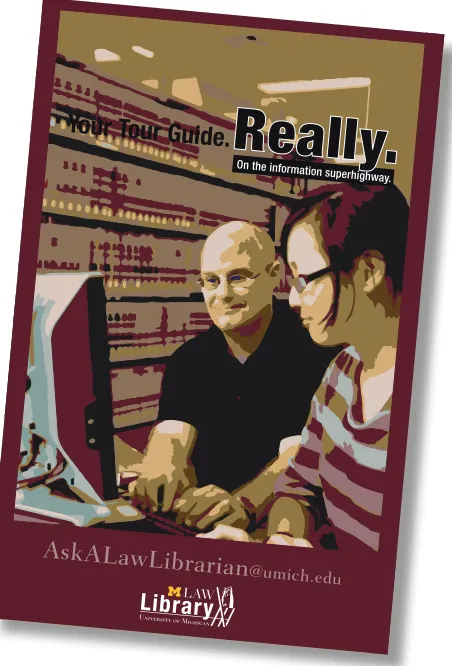
The Law School launched an educational campaign last year to illustrate the many ways librarians can assist students, and to remind people that technology hasn’t supplanted the need for librarians. “We’re information experts. Really. They just call us librarians,” states one of the posters from the campaign.
Shaking up that old image is a welcome change, notes Jocelyn Kennedy, until recently the head of the circulation services unit and a reference librarian at Michigan Law. She believes many people hold a misperception that stems from their childhood interactions with librarians. “Their memory of a librarian, right, is their elementary school librarian, who helped them choose CuriousGeorge.” Kennedy, who now is associate director at the library at the University of Connecticut School of Law, has never once helped a student find a copy of Curious George. Rather, she spends a lot of her time assisting students with finding information through digital resources.
Which makes it all the more maddening when people say to her, “Do they even need librarians anymore? Isn’t everything on the Internet?”
Driving Innovation
Garavaglia points out that, throughout time, librarians have managed information in many formats, including “oral history, stone tablets, papyrus, acidic paper that deteriorates,” and now digital information. In response to these changes, librarians changed how they did the work, but the “nature of the work” didn’t change. When you are a librarian, “you are a specialist in how to find and use information.”
She offers as an example the digital database Westlaw, with which she has been working for the last 30 years. The online legal research service collects primary legal materials, court opinions, laws, regulations, books about the law, journals, and secondary materials.
“When I first started using Westlaw, it was very unsophisticated. I was on the phone with them every day saying, ‘This is really annoying.’ And [Westlaw’s] development took place over many years, and those developers responded to the needs of the librarians.
“Programmers were putting this software out for people to use, but they didn’t know about the underlying resources they were making searchable. The knowledge of the materials and the research strategies, which came from librarian users, was critical to making those products what they are today. And that continues to this day. Now they hire librarians to help develop those products.”
t
t
t
Law Quadrangle
•
Spring 2011
2 3
Law librarians are “information and research professionals in an era when finding essential information is more important than ever,” according to a recent ABAJournal.com article written by Patrick Lamb, ’82, founder of the Valorem Law Group in Chicago. “Associates, who do most of the research in law firms, are not research or information professionals. … When you live in a value-fee world, someone who finds the right information efficiently is really valuable.”
The article prompted a spirited debate about the value of law-firm librarians in an age when much information is available online. “I’d hire a law librarian … if I could afford one,” said one commenter. “My sixteen-year-old daughter maintains my library,” wrote another.
Joyce Manna Janto, president of the American Association of Law Libraries (AALL) and deputy director of the University of Richmond School of Law Library, points out that the value of law- firm librarians shouldn’t be in doubt.
“I think in firms especially, the lawyers forget that the librarians are just as well educated as they are,” Janto notes. “They have no idea that we are able to go beyond the stereotypical ‘reference question’ and that the librarians are a good source for client development and client retention.
“It may have to do with the fact that our user base is so well educated. They seem to assume that if they can’t find it, it can’t be found,” she contends. “Then they’re amazed that we find that piece of information for them. They sometimes become embarrassed, ‘Oh I should have found that for myself.’
“Librarians are, or should be viewed as, the information professionals in any organization. It is our job, our responsibility, to find, categorize, analyze, and teach others how to find the information they need to do their jobs.” As a young associate at Harness, Dickey & Pierce, Jennifer Selby leveraged her understanding of the value of the firm’s librarian to get ahead in her job.
“At HDP, which was a medium-sized patent firm then, there was one librarian and no support staff,” recalls Selby, now a senior associate librarian at Michigan Law. “What some of the summer associates quickly learned (and I also took advantage of as a young associate) was that the librarian was a treasure trove of helpful information. Many times, she helped me craft effective searches for expensive online databases—like Lexis or Westlaw—saving me from looking bad by racking up too much in online searching costs.”
The firm’s librarian also helped Selby navigate the paper collection and “pointed me in the direction of a more obscure treatise, journal series, or looseleaf service that helped me find the answer to an obscure legal question.” Selby knows, though, that not all associates, or even partners, at firms are willing to go to the firm librarian for assistance. “I knew that others in my same position were not availing themselves of her expertise, either out of ignorance or really arrogance.”
The cost of such arrogance, Janto argues, is a loss of valuable time and money. At worst, it can lead to an attorney using incomplete or inaccurate information.
“There is so much information available, and it takes a trained researcher to sift through the dross to find the gold,” notes Janto. “As I tell my students, it only takes a few bucks and a little determination to become a content provider on the Internet. Many users, even well-educated lawyers, don’t always think to check the information they find on the Internet for currency, accuracy, and authenticity.”—FS
2 4
The Limits of Technology
For students of today, who all but came out of the womb doing Google searches, it may seem unlikely that much of the information they need isn’t retrievable using a Google search, even if the material is available free on the web. A variety of factors prevent a Google search from retrieving everything, including the structure of a website or its search interface, the need for a password, a resource’s use of a controlled vocabulary, the absence of the material from the Internet, or a bad search. Because of that, researchers who rely solely on Google run the risk of missing critical information.
“But even for what is on the Internet,” notes Kennedy, “when you do a Google search and you get 10 million hits … you would never be able to view more than 10,000 things. That’s just their limit. And you’re only going to look at the first 10 or 20 hits and think that you have found the information you need.”
[image:26.630.359.585.52.385.2]Librarian Kincaid Brown, ’96, notes that people want information in the fastest way possible. “Back when books were what was available, that was the fastest way to do it, but now, sometimes Google may be the fastest way to get to something. Where we librarians come in is, sometimes the book is faster. And we often know ahead of time which way will be faster. The book is right there on the shelf; you can get it right there instead of trying to figure out how to sort your 10,000 Google hits.”
It’s no accident that the reference librarians at the Michigan Law Library are all required to both have a master’s degree in library science and a J.D., and to have passed the bar exam.
“To move through this collection,” notes librarian Jennifer Selby, “you need to think like a librarian, and you need to think like a lawyer. When I was at a law firm, the people who remained at the law firm were the people who could get the information the fastest. I saw people waste thousands of dollars sitting on Westlaw trying to find their information and not knowing what they were doing. So, there is a real liability issue here when people don’t understand how this information is structured, and how best to get at it.”
The Mind of a Librarian
Changes in technology have given many people the impression that the “problem” of research has been solved. In some ways, though, technology has flooded researchers with so much information that, now more than ever, they need a guide to help them navigate the chaos.
Returning to the question at the beginning of this article, where does the digital age leave the librarian?
The answer: Even when a tool has been built to search this data, whether the tool was a card catalogue, the Dewey Decimal system, or a search tool like Google or Westlaw, you have always needed the expertise of a librarian to teach you and help you to use that tool effectively.
These search skills can’t be encoded fully into a tool. These skills, instead, are programmed into the librarians who oversee a collection. They come from the years of training and experience a librarian has moving through the very specialized knowledge of a law library. They come from the mind of a librarian.
Editor’s Note: After 38 years at the Law School, Law Library Director Margaret Leary will retire in July. Her book, Giving it All Away: The Story of william w. Cook