© 2015, IRJET ISO 9001:2008 Certified Journal Page 67
Computer Simulation and Modeling with Nemo 3-D and Quantum Dots
of Nano Materials
Stalin Subbiah
1, Suresh Subramanian
21
Research Scholar, Bharathiyar University, Coimbatore, Tamilnadu, India.
2
IS Analyst, Ahila University, Kingdom of Bahrain
---***---Abstract -
Over the past decades, computer modelingand simulation has become powerful tools for apprehending the properties and structures of a wide range of materials. This provides users with a contact free method for manipulation of objects that can be practical to Nano-scale viruses, living cells, particles and bacteria, by use of a laser apparatus known as an Optical Tweezers, (OT). Simulation is enabled by the elements of theoretical, numerical and software fundamental techniques of the model development of a Nanoelectronic Modelling tool (NEMO-3D) [1], further it is implemented using multi scale modeling on various High Performance Computing (HPC) setups. There are different multi scale models available for different HPC setups since for each simulation needs a model of an HPC setup[2], which has its advantages and disadvantages alongside it. Further, the use and application of quantum dots and optical band gaps in different scientific sectors has been of great importance.
During the research, academic journals and books were used. This is because they contained dire information on simulation and modeling of nano materials, which could not be easily found on any other literature materials. Useful academic websites were also used for this research. Nano materials have a lot of importance in different industries. This is mostly due to their large surface area and ability to contain fuel. Similarly, they are useful in the energy industry for the renewable energy. In the defense industry, nano materials are used in the manufacture of multi-layered body armors. Hence the simulation and modeling of nano materials is important in the field of nanotechnology. Governments and organization from different countries have invested lots of billions and gained interest in the field of nanotechnology due to its tremendous benefits, leading to enormous increase of interest in simulation and modeling of nano materials in the field of nanotechnology.
This research will examine the simulation of Nano-materials by computation simulation and modeling of Nano materials. This involves a system of computation software, packages and MATLAB, which has the
distributed jobs starts from macro to Nano sale, which indeed holds the effective and essential of the simulation at Nano scale. This allows prediction of the evolution time of the system. The method can be carried out on large-scale, and it is fast, safe, simple and low cost fabrication of Nano-material-based imitations.
Key Words:
Nanomaterials, Simulations, HighPerformance Computing (HPC), Quantum Dots
1. INTRODUCTION
© 2015, IRJET ISO 9001:2008 Certified Journal Page 68 and the difference in their properties, different methods
are used for their simulation depending on their suitability and the effectiveness. The complex nature of the Nano-materials has led to lots of researches carried out over the past decades, to come up with methods of simulating Nano-materials, despite their nature and uncompromising properties.
1.1.Computer Modeling, Simulation with NEMO
3-D, and Quantum Dots
[image:2.595.306.567.386.670.2]Several models were used on different simulation HPC setups using multi scale like MATLAB, WCCS and PVM. Message Passing Interface (MPI) has for a long time been a choice for NPI due to its open source in nature [4]. For a distributed computation performance, there was need for communication between the different nodes. This is in exemption of the message-passing library in different nodes were passed with the messages. To design cluster work MPI was used effectively to design the libraries. To find the computation efficiency tasks were assigned on different nodes whether it is for simulation analysis of a device. However, finite/dynamic element (FE/MD) hybrid methods were used to optimize code for multi-scale performance computation [5]. MPI .Net is an open source, easy-to-use implementation of MPI (Message Passing Interface) for the communication on Microsoft's products. Their implementation provided support for writing MPI programs using C, C++ programming languages [6], most of the items which were supported by .NET, especially using C# on Microsoft's. For the faster communication and to build the parallel programs which run on clusters and serialization of objects are supported by C# [7]. The below picture depicts the example of C# implemented program code for distribution of computations of Nano technology.
Fig 1: Program code of computations of Nano technology Source:citeseerx.ist.psu.edu/viewdoc/download?doi=10.1. 1.159.8496&rep=rep1&type=pdf
Easy management of clusters was allowed by WCCS. With WCCS the work between different nodes would be divided and distributed among them in a desired manner. Calculations were further broken to small jobs. The whole calculation was done using small jobs which were created for the specific parts. Cluster nodes were distributed with different jobs; which were scheduled to be executed on nodes. Based on the output of all nodes the results were compiled.
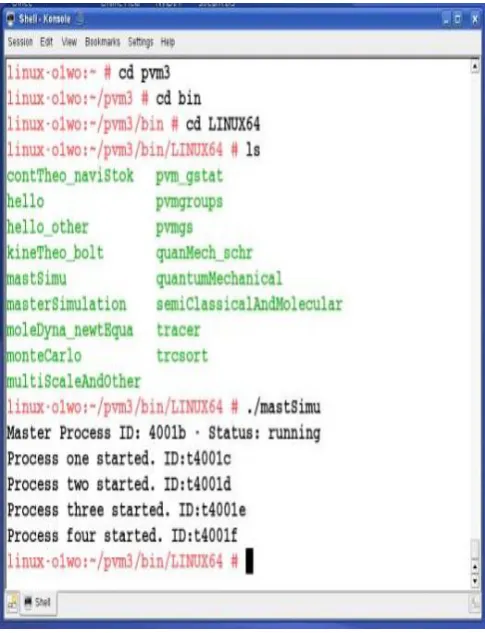
High Performance Compute (HPC) setups for a long time were extensively used the models such as PVM and MPI [8], and further it has been proven that PVM model is the mature model to work on HPC communication. Whenever, GNU gcc compiler was used for coding in C program, the virtual machine was used to execute the program and for the four types of computations was spawned. PVM console configuration utility was used for Virtual machine configuration.
[image:2.595.37.288.528.700.2]The multi scale modeling was as shown in the Fig.2 below.
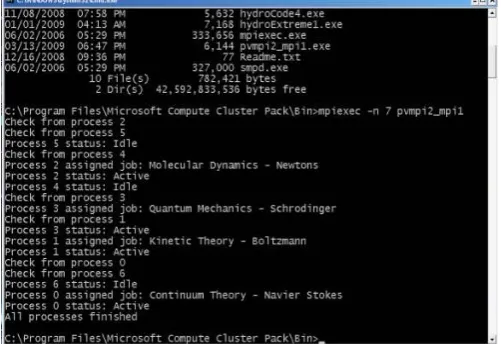
© 2015, IRJET ISO 9001:2008 Certified Journal Page 69 Fig 3: Result of the program code
Source:citeseerx.ist.psu.edu/viewdoc/download?doi=10.1. 1.159.8496&rep=rep1&type=pdf
MATLAB was used in some areas for high performance computing. In many areas, application of parallel MATLAB was substantiated. In Digital Signal Processing (DSP), Parallel MATLAB was used. MATLAB for HPC was more reliable for calculations [9]. Thus MATLAB is an efficient tool to work on HPC and distributive computing and further calculations for MATLAB HPC Distributed computing toolbox.
Function [ ] = pvmpi_matlab_distcomp1 ( )
jm = findResource('scheduler', 'type', 'jobmanager', 'name', 'jm', 'LookupURL', 'localhost');
job = createJob(jm);
set (job,'FileDependencies', {'quantum.m' 'molecular.m' 'kinetic.m' 'continuum.m'});
createTask(job, @continuum, 1,{}); createTask(job, @kinetic, 1,{}); createTask(job, @quantum, 1,{}); createTask(job, @molecular, 1,{}); submit(job);
waitForState(job, 'finished', 60); ans = getAllOutputArguments(job);
TABLE I: Calculations for MATLAB HPC Distributed computing toolbox.
Source:citeseerx.ist.psu.edu/viewdoc/download?doi=10.1. 1.159.8496&rep=rep1&type=pdf
The use of quantum dots (QDs) in almost all fields of atomistic simulation has been of undeniable importance in making improvements concerning the same and much more. The QDs are nanostructures (mostly in solid state) that provide internment of charge carriers that is; electrons and holes, in spatial 3-Don the Nano-scale. All the work performed by quantum dots based on semiconductors. Atomistic simulation for quantum dots in the size ranging on tens of nanometers cannot be neglected of the atomistic granulation. Impact on device performance and operation can depend on surface roughness, atomistic strain and unintentional dropping.
2. RESULTS
[image:3.595.38.281.107.424.2]© 2015, IRJET ISO 9001:2008 Certified Journal Page 70 By analyzing the system requirements of various setups,
PVM setup is found that is least system requirements, means one could create a cluster with low-end machines. However, MCCS had very high system requirements, and it has been found and proven that PVM HPC cluster is an efficient mechanism which could be setup and would able to communicate with other nodes using any accessible machines. Even though low-end machines brought an execution hit, whereas running the PVM tool running on any machine was proven successfully. MATLAB used to work on both 64-bit and 32-bit machines, with a minimum memory of 512 MB, whereas to get the efficient performance, one needed to run this program on high end machine.
In this research, efficiency analysis and resource requirement were used and tested at different phases. Among performed various tests; the following tests such as CPU usage test, memory and network utilization and usage resource was send. For doing the same job with mentioned same speed, it was found that MATLAB required high memory and CPU resources in comparison to others; whereas the PVM is proved that it requires the least performance. MCCS was found to present the best performance to resource ratio.
PVM provided the highest performance among the three, with MATLAB being a HLL because of its abstraction layers resulting to performing the slowest. While MCCS was found to deliver, a balanced performance and ease of use ratio. The test of MCCS was performed using C# programming language.
4.
RECOMMENDATIONS
In accordance with the research carried out on computation modeling and simulation of Nano materials, the results showed that MATLAB was efficient where calculations were involved. MCCS was found to present the best performance to resource ratio when resource requirement and efficiency analysis test were performed. PVM was recommended the best among the three because it required the least resources such as memory. It was found to also maintain the same speed as the rest lowered the speed, and it was also easy to use as well as cheap.
3. CONCLUSIONS
In conclusion, lots of research and experiments have been done to come up with an answer to the question whether Nano-materials can be simulated and modeled using
computer software and packages. Scientists through numerous researches have come up with simulation and modeling computational methods, which have been scientifically proven. As discussed above, Nano-materials have different properties due to their different shapes and size. As a result this poses a challenge in determination of their characteristics. Hence, a prior understanding of physics and chemistry is dire to the simulation processes. Even as there is emergence of simulation and modeling methods, just like any other process, computational simulation and modeling have merits and limitations, which are clearly discussed above. Computer simulation of Nano-materials as discussed emerges to be among the most effective method in the field of Nano technology, since as it is a requirement to weigh and put into consideration the advantages and limitations of a simulation method. The computational simulation and modeling method is cost effective, reliable, easy to use, low system requirement, and the process is safe and less risky while carrying out.
REFERENCES
[1] Marek K.., Gerhard K., “Atomistic simulations of long-range strain and spatial asymmetry molecular states of seven quantum dots”, Journal of Physics: Conference Series 38 (2006) pp 75–78.
[2] H. Wang, S. Potluri, M. Luo, A. Singh, S. Sur, and D. K. Panda, “MVAPICH2-GPU: Optimized GPU to GPU Communication for InfiniBand Clusters,” in Int’l Supercomputing Conference (ISC), 2011.
[3] Hamdi, M., Ferreira, A., “Multiscale design and modeling of nanorobots,” Proc. IEEE/RSJ International Conference on Intelligent Robots and Systems, IROS 2007, pp. 3821-3827, Oct. 29-Nov. 2 2007.
[4] Rohit P., Satyadhar J., “Distributive Computing for reliability analysis of MEMS devices using MATLAB,” Proc. ACM International Conference on Advances in Computing, Communication and Control, ICAC3, pp. 246-250, Jan. 23-24 2009, DOI=10.1145/1523103.1523155.
[5] Lutz H., Javier F., Enrique A., Alberto F. “Effects of Traffic Loads on Reinforced concrete Railroad culverts”, 11th International Conference on Vibration Problems, Lisbon, Portugal, 9-12 September 2013
[6] Cameron Hughes, Tracey Hughes, “Parallel and Distributed Programming Using C++,” Addison Wesley, August 25, 2003.
[7] Brian H., Sathish A., “Big Data Analytics Framework for
Improved Decision Making”,
http://worldcomp-proceedings.com/proc/p2014/ICM2818.pdf, September 2014
© 2015, IRJET ISO 9001:2008 Certified Journal Page 71 International Conference on Parallel Processing
Workshops, pp. 199 – 204, 6-9 Oct. 2003.
[9] Choy, R.; Edelman, A., “Parallel MATLAB: Doing it Right,” Proc. IEEE, Vol. 93, Issue 2, pp. 331 – 341, Feb. 2005.
[10] Jassim I., Coetzee C., Vermeer P.A., “A dynamic material point method for geomechanics”, Installation Effects in Geotechnical Engineering – Hicks et al. (eds) © 2013 Taylor & Francis Group, London, ISBN 978-1-138-00041-4 [11] Windows HPC Server 2008 Job Templates, Microsoft
Corporation, Published: June 2008, Revised September 2008.
[12] Lindsay, S.M., Introduction to Nanoscience, Oxford Universi[1] Nakano A. et al. “Multistage simulation of Nano-systems,” Proc. IEEE Computing in Science & Engineering, Volume 3, Issue 4, pp. 56-66, Jul/Aug 2001.ty Press, Oxford, UK, ISBN: 978-019-954420-2, 2010
[13] Nakano A. et al. “Multistage simulation of Nano-systems,” Proc. IEEE Computing in Science & Engineering, Volume 3, Issue 4, pp. 56-66, Jul/Aug 2001.
[14] Bliss, N.T. Kepner, J. Kim, H. Reuther, A., “pMATLAB: Parallel MATLAB Library for Signal Processing Applications,” Proc. IEEE International Conference on Acoustics, Speech and Signal Processing, ICASSP 2007., Vol. 4, pp. IV-1189-IV-1192, 15-20 April 2007.