© 2016, IRJET | Impact Factor value: 4.45 | ISO 9001:2008 Certified Journal
| Page 336
Electroencephalography (EEG) based automatic Seizure Detection and
Prediction Using DWT
Mr. I. Aravind
1, Mr. G. Malyadri
21
M.Tech Second year Student, Digital Electronics and Communication Systems
2
Associate Professor
, Digital Electronics and Communication SystemsKKR&KSR Institute of Technology and Sciences, Guntur, A.P, India
---***---Abstract -
Epilepsy exists one of the furthermost commonneurological and chronic diseases in childhood. Epilepsy patients understanding challenges in life due to protections they have to take in order to cope with this condition. When an attack occurs, it force cause injuries or expose the life of the patients or others, especially while they are using heavy machinery, e.g., driving cars. It needs a technique that can constantly monitor and evaluation the alertness level of drivers. Electroencephalogram (EEG) is one of the most useful and real useful tools in understanding and treatment of epilepsy. In this paper we presents a novel approach of seizure detection and predict the problem using Discrete Wavelet transform with 4-level transformation to find out whether the human body is normal or abnormal. A system is presented for detecting seizures from Electroencephalogram (EEG) data recorded from regular subjects and epileptic patients. The system is based on discrete wavelet transform with 4-level transformation analysis and approximate entropy (ApEn) of EEG signals. Seizure detection is accomplished in two steps. In the first step, EEG signals are decomposed by DWT to calculate estimate and detail constants. In the second stage, ApEn values of the estimate and detail coefficients are calculated using mat lab. The accuracy of seizure detection reached in this system is more than 90%.
Key Words: epilepsy, Electroencephalogram (EEG), DWT, seizure, mat lab, ApEn
1. INTRODUCTION
Human perceptive state monitoring machinery for preventing accidents behind the steering wheel has develop a major interest in the field of safety driving since drivers’ exhaustion is a causal issue in various accidents because of the marked drop in the drivers’ abilities of awareness, appreciation, and vehicle control abilities while sleepy. Epilepsy, which is categorized as a neurological syndrome that affects the brain, waves about 3% of the world population primary to a reduction in their efficiency and
imposing restrictions on their daily life [2]. Among numerous diagnostic and imaging methods, the EEG is by far the best used and effective methods in the daily clinical action. Given that it is non-invasive, is moderately accurate, and has low cost, it has been established as a necessary tool for clinicians and people who act with epilepsy [1]. Alike mobile phones, neural signals are always present in our daily lives. Certain the recent availability of low-cost wireless electroencephalography headsets [2, 11, 12] and programmable mobile phones accomplished of running refined machine learning algorithms, we can now edge neural signals to phones to deliver new mobile computing models.it is not successfully executed.
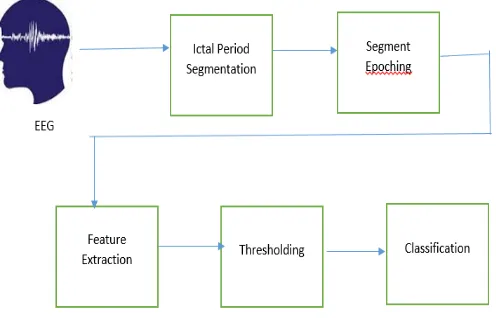
[image:1.595.310.558.562.721.2]Till now recently, seizures be situated identified only visually by an expert neurologist. Nevertheless, this method constitutes a laborious task mainly in the case of long term EEG recordings. So, automatic computer aided algorithms have advanced in order to reduce and automate this methodology and many seizure detection methods are reported in the international literature [4,5]. Figure 1 displays a diagrammatic representation of a seizure detection systems
© 2016, IRJET | Impact Factor value: 4.45 | ISO 9001:2008 Certified Journal
| Page 337
Several studies illustrates their solution to thedifficult of seizure detection in the context of a decision support system for the neurologist expert. As here are many types of seizures, this is sometimes a challenging task, taking into account the nature, chronological length and individualities of each seizure type. The seizure detection method can be made on a single channel or multichannel basis [4, 5]. Single channel seizure detection needs choosing the channel containing the strongest EEG signal collected from the neighboring point to the seizure spot. This selection process be determined by mainly on activity measures evaluated for the different channels rapidly such as the local variance. A best treatment to the seizure detection subject depends on integrating the information from all EEG signals available into the seizure detection process through data fusion, or multi-channel processing methods [6].
Concerning this direction, many EEG prediction algorithms have been proposed. Linear analysis has been usually used based on synchronization features as a primer and straightforward method. Even though these methods can expose in some cases the existence of epileptic seizures, predicts they have their limits if somebody takes the nature of physical human EEG data into account [6, 7].
2. METHODOLOGY
In this section, we discuss with classification of seizure detection and prediction methods.
Fig -2:
Classification of seizure detection and
prediction
.
2.1 Seizure Detection Methods
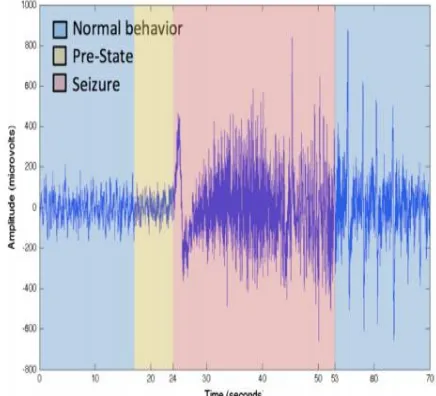
To identify EEG seizures, there is an essential to analyses discrete time sequences of EEG periods. This investigation can be able through histograms of the periods of EEG. Another methodology to deal with the EEG seizure detection method in time domain is to compute the signal energy in seizure and non-seizure periods. [9] A best treatment to the energy valuation approach is to estimate the energies of the signal sub-bands not the signal as an entire in order to build a more discriminative feature vector. A classification of EEG seizure detection methods into pattern recognition methods, parametric methods, , morphological analysis methods, decomposition methods, clustering methods, and data mining methods [10].Figure 3 shows an example of an EEG signal containing a seizure detection.
Fig -3:
EEG signal containing a seizure
2.2 Seizure Prediction
The Proposed work on the concern of time domain seizure prediction is better than time domain seizure detection due to the significance of the seizure prediction problem. We can identify the seizure prediction problem as a detection problem of the pre-ictal formal on seizure records. Comparable statistics to those used in seizure detection similar the zero crossing rate can be used for seizure prediction. A time domain rule based patient precise seizure prediction method which consists of three steps: pre-processing, feature extraction, and rule-based decision making.
3. IMPLEMENTATION
[image:2.595.323.541.304.502.2]© 2016, IRJET | Impact Factor value: 4.45 | ISO 9001:2008 Certified Journal
| Page 338
3.1 Discrete Wavelet transform
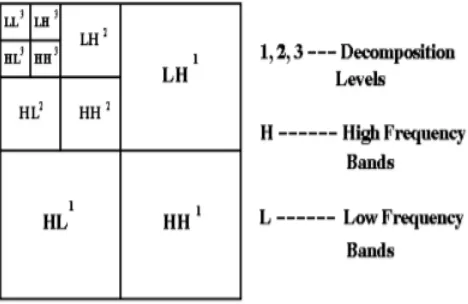
[image:3.595.315.533.122.198.2]DWT of image signals yields a non-redundant image representation, which offers recovered spatial and spectral localization of image formation, associated with other multi scale representations such as Gaussian and Laplacian pyramid. In recent times, DWT has attracted additional and more interest in image de-noising. The discrete wavelet transform can be understood as signal decomposition in a set of independent, spatially oriented frequency channels. The signal S is accepted through two complementary filters and appears as two signals, estimate and Details. This is named decomposition or analysis. The components can be accumulated back into the original signal without loss of information. This process is named reconstruction or synthesis. The mathematical operation, which implies analysis and synthesis, is called discrete wavelet transform and inverse discrete wavelet transform. Figure 4 shows 2D-DWT with 4-level decomposition.
Fig -4: 2D-DWT with 4-level decomposition
3.2 Wavelet Based Image De-noising
Preferably the resulting denoised image will not comprise any noise or added artifacts. De-noising of natural images degraded by Gaussian noise using wavelet transformation techniques is very effective because of its capability to capture the energy of a signal in few energy transform values. The approach of the DWT based image de-noising has the following three steps as shown in figure 5. 1. Transform the noisy image into orthogonal domain by discrete 2D wavelet transform. 2. Apply hard or soft thresholding the noisy detail coefficients of the wavelet transform 3. Perform inverse discrete wavelet transform to obtain the de-noised
image.
Fig -5: wavelet based image de-noising
4. EXPERIMENTS
Experiments quantitatively measuring the performance in practical application is difficult issue because the ideal image is usually unknown at the receiver site. So this system uses the following method for experiments. One original image is applied with Gaussian noise with dissimilar variance. The methods proposed for implementing image de noising using wavelet transform. . For attractive the wavelet transform of the image, freely available MATLAB routines are taken. the below figure 6.represents the EEG based seizure detection using DWT with specific internal time.
Fig-6: EEG based Seizure detection using DWT
5. RESULTS
[image:3.595.43.277.370.522.2]© 2016, IRJET | Impact Factor value: 4.45 | ISO 9001:2008 Certified Journal
| Page 339
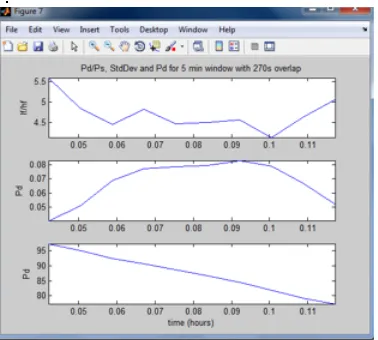
Fig 7: EEG FIR filteringPhotic stimulation (PS) is a very useful and important activation procedure in Pediatric EEG because of the activation of Generalized Spike-Wave activity. EEG Pd /Ps five minutes interval seizure detection graph below in figure 7.
Fig 7: EEG seizure detection with 5 mins Interval
6. CONCLUSION
In this paper, automatic seizure detection and prediction using Discrete Wavelet transform is analyzed. The experimentations were conducted to study the fitness of different wavelet bases and also different window sizes. Among all discrete wavelet bases, discrete wavelet transformation-4 level transformation gives better result than other methodology.
REFERENCES
[1] Fisher RS, van Emde Boas W, Blume W, Elger C, Genton P, Lee P, Engel J Jr (2005) Epileptic seizures and epilepsy: definitions proposed by the International League against
Epilepsy (ILAE) and the International Bureau for Epilepsy (IBE). Epilepsia 46(4):470–472
[2] National Institute of Neurological Disorders and Stroke. http://www.ninds. nih.gov/. Accessed 15 Sept 2014. [3] Emotive Systems. Emotiv - brain computer interface technology. http://emotiv.com.
[4] Acharya UR, Molinari F, Sree SV, Chattopadhyay S, Ng KH, Suri JS (2012) Automated diagnosis of epileptic EEG using entropies. Biomed Signal Process Contr 7(4):401–408 [5] Seakale’s V, Giurcaneanu CD, Xanthopoulos P, Zervakis ME, Tsiaras V, Yang Y, Karakonstantaki E, Micheloyannis S (2009) Assessment of linear and nonlinear synchronization measures for analyzing EEG in a mild epileptic paradigm. IEEE Trans Inform Tech Biomed 13(4):433–441.
[6] B Hunyadi, M Signoretto, WV Paesschen, JAK Suykens, SV Huffel, MD Vos, Incorporating structural information from the multichannel EEG improves patient-specific seizure detection. Clin. Neurophysiol. 123, 2352–2361 (2012) 6. J Rasekhi, MRK Mollaei, M Bandarabadi, CA Teixeira,A Dourado.
[7] Kantz H, Schreiber T (2004) Nonlinear time series analysis. Cambridge University Press, Cambridge.
[8] Paivinen N, Lammi S, Pitkanen A, Nissinen J, Penttonen M, Gronfors T (2005) Epileptic seizure detection: a nonlinear viewpoint. Comput Methods Programs Biomed 79 (2):151– 159.
[9] TP Runarsson, S Sigurdsson, On-line detection of patient specific neonatal seizures using support vector machines and half-wave attribute histograms, in The International Conference on Computational Intelligence for Modelling, Control and Automation, and International Conference on Intelligent Agents, Web Technologies and Internet Commerce (CIMCA-IAWTIC) (Vienna), pp. 673–677. 28–30 Nov 2005.
[10] AT Thala’s, MG Tsipouras, DG Tsalikakis, EC Karvounis, L Astrakas, S Konitsiotis, M Tzaphlidou, Automated epileptic seizure detection methods: a review study, in Epilepsy - Histological, Electroencephalographic and Psychological Aspects, ed. by D Stevanovic (InTech Europe, Rijeka, 2012), p. 276
[11] NeuroSky. Neurosky - experience the mindset. http://www.neurosky.com/.
[12] OCZTechnology. nia game controller OCZ technology. http://www.ocztechnology.com/products/ocz_
[image:4.595.39.228.358.528.2]© 2016, IRJET | Impact Factor value: 4.45 | ISO 9001:2008 Certified Journal
| Page 340
BIOGRAPHIES
Mr. I. Arvind received B.Tech degree in
Electronics & Communication
Engineering from Audisankara Institute of Technology, Gudur, A.P, India in 2014. He is currently pursuing M.Tech in Digital Electronics and Communication Systems (DECS) in KKR&KSR Institute of Technology and Sciences, Guntur, A.P, India. His area of interests are Image Processing and Signal Processing.