If the Redshift Depends on the Pressure then the
Acceleration of the Universe Can Be Explained
Victor R. Krym
Department of Mathematics and Mechanics, St.-Petersburg State University, St.-Petersburg, Russia Email: [email protected]
Received May 16, 2013; revised June 19, 2013; accepted July 22, 2013
Copyright © 2013 Victor R. Krym. This is an open access article distributed under the Creative Commons Attribution License, which permits unrestricted use, distribution, and reproduction in any medium, provided the original work is properly cited.
ABSTRACT
We propose a model where the Hubble's law is slightly changed. We propose new interpretation of the covariant diver-gence of the energy-impulse vector and this produce a new correction to redshift. Acceleration of the expansion of the Universe appeared as a pure observational effect. High values of the mass density are consistent with the experimental data on Supernova Ia within this FRW model without the cosmological constant
0
.Keywords: Relativistic Cosmology; FRW Models; Section Curvature; The Problem of Matter Creation; The Continuity
Equation
1. Introduction
The equation of continuity with the classical linear equation of state P
1
[1-6] where is thepressure,
P
is the density of matter and w 1 is
the coefficient, leads to negative pressure values for . The CDM model predicts effective value for which is negative [7,8]. Then for a small scale factor in the beginning of the Universe the total amount of matter in the Universe would be negligible. When the scale factor increased the matter appeared literally from nothing.
w
w0w a
We propose new correction to redshift which can be useful in cosmology. This explains the appeared acce- leration of the Universe. High values of the mass density are consistent with the experimental data on Supernova Ia within this model without the cosmological constant . We compared this model with the experimental data of the Supernova Cosmology Project Supernova Ia compilation. We assumed that 0 and
0
1.01 m
0
v
, hence 0 0m (yet and curvature
is positive). We assumed also that , where is the parameter of this model and is the redshift. We found the optimal values
1
0.01 0
w z
z
vz
0.02
0.05
v
and
0 5
km 66
s Mps
H
.
The quality of this regression was as high as it was in the CDM model. Yet the value of was much less in the absolute value than in the CDM model. The acceleration of the Universe appeared to be a pure ob- servational effect due to the negative pressure.
w
2. The Equation of Continuity
The Einstein equations with the cosmological constant
are
1
, , 0, ,3
2
R Rg T g , (1)
where
26 2
8
1.8659218 10 m kg
N
G c
the Einstein gravitational constant [9, p.~347],
11 3 2
6.6725985 10 m kg c
N
G
the Newton gravitational constant.
To solve these equations we should know the energy- momentum tensor T. For synchronous coordinates the
energy-momentum tensor is
T , 0, ,3Diag
, P, P, P
, (2)
where is the density of matter and is the pre- ssure of matter. The covariant divergence of the energy- momentum tensor is zero:
3
0
0 T
, 0, ,3 .If
0
, 3 0
0
3 0 1
s s s
T P
.Considering (22) we obtain
3a P 0
a
for the 0
s
T component. Assume that the pressure is
proportional to the density:
1
P .
for the dust matter this value is 1 and the value for radiation is 4 3 [9, p.~123]. Therefore
3 a 0
a
and
3 1 .
c a
(3)
Considering physical dimensions of values, the Equation (3) is better as
3 0 a a0
.
Hence
3 1 0 0
c a .
Let us compare this equation with the change of volu- me of the Universe for closed models. The Friedmann- Robertson-Walker metric in the cosmic time and in the polar coordinates is
2 2
2
2 2 2 2
2
d d
d
d sin d
1
s t
r
a t r
r
2
,(4)
where
0 r 1 , 0 , 0 2
and is the curvature parameter . The 3-volu- me element at is
0
const t
3 2 2detg a t r 1 r sin d d d r
.
The volume of the Universe at tconst is
3 2 2 3
1 2
3 2
0 0 0 1 2 sin d d d .
a r a
V r
r
(5)Since our Universe is homogeneous, the total amount of matter in the Universe at some tconst is
2 3 2 3 3 2 3 3
1 3/ 2 1 3/ 2 1 3 2 ,
w
a a a
V c a c c
(6)
where w 1 V
. Hence for and a sufficiently
small the total amount of matter in the Universe will be negligible:
0 w
0
when a0 and w0 . Cos-
mology with w0 violates the law of conservation of
matter (conservation of leptonic and baryonic numbers [10]). The idea that matter originated from radiation is not a good idea because is too large. The matter - antimatter asymmetry also cannot be explained in this way. Cosmology with negative pressure contain- ed a “smooth bounce” from the collapsing to expanding stage and this was also due to the same fact. Since the matter disappeared, the gravitation force was negligible and we obtained the smooth bounce with the horizontal tangent [11-13]. The only equation which is fully consis- tent with (5) and conservation of leptonic and baryonic numbers is
2
c
0 w
3
0 0
. a a
(7)
This is due to the equation V const. The Equation
(3) could work for the appropriate epoch only.
Let us try to interpret the covariant divergence of the
0,
p j 4-vector. If currents are negligible (as in the
comoving frame), then 0
p t
will get an additional nonzero component and will increase or decrease additionally. It seems reasonable because is the energy and its change is the redshift. Hence this equation should give a contribution to the redshift (and not bound the matter components). Since
0
p
0
p
3 0 0
3
s s s
a
T P
a
and
3 0 a a0
due to (5), this covariant divergence is 3
0 0
3
s s s
a
T P
a
where P is the pressure. Assume that
0
3aP p
a t
.
V (8)
Here
0
p E
V
is the energy density per unit volume. Integrating
3aP E
a
with P w, we obtain
3
0 0
.
w
E a
E a
(9)
Since the Hubble law is
observed
emitted
observed emitted
a t E
E a t
and both contributions seem to be multiplicative, we get
1 3 observed emitted
observed emitted
.
w
a t E
E a t
(10)
Hence the redshift depends on the matter equation of state. This correction to redshift 1 z Ee Eo may be
useful in cosmology.
3. Correction to the Distance Due to
Pressure
3.1. The Hubble Diagram
Recall the distance formula. Define -coordinate by
2
22
d d
1
r r
, 1.
Then arcsinr if 1 and asinhr if 1.
Hence rsinn
where
sin , 1 0 ,
sinn , 0 0 ,
sinh , 1 0 .
(11)
The Friedmann-Robertson-Walker metric in the cosmic time becomes
2 2 22 2 2 2 2 2
d d
d sinn d sin d
s c t
a t
.
The space part of the metric is
2
2
2
2
2 2
2
dl a t d sinn d sin d . If 0 and 0 then dla t
d and
tla . For a photon ds0, therefore c td a
t dand
0 0 0 0 0
2
0
d
d d d ,
e e e e
t a a a
t a a a
a a
t a a c
c c c
a t aa a H a H
(12) where
3
20 0m 0 0 0
HH a a a
Now we use our main hypothesis:
1 3 0
1
w
a z
a
. Then
1 1 3 0 1 w
a
z a
.
The value of w is the function of z, therefore
0
d w d
a
f z z
a
where
11 1 3
1 1 3 2
1 1
1 3 3
1 ln 1
1 3
w w
z
w
f z z
w w
z z
w
.
(13)
Finally
1 1 00 1
d ,
z fw z
c
z
a H z
(14) where
3 1 3
2 1 3 0 0 1 0 1
w w
m
H z H z z
(15) Suppose a source has an absolute luminosity , its luminosity (bolorimetric) distance is defined in terms of the measured flux
2 .
4 L
d
(16)
The measured flux is
2 2 2 0,
4 a r 1 z
(17)
one factor of
1z
arising from the decrease in totalenergy due to the red shift of the energy of the individual photons, and the other factor of arising from the increased time interval between the detection of in- coming photons due to the fact that two photons se- parated by a time
1z
t
at emission, will be separated by a time t0 at the time of detection, where
0 0
t a t a
[14, p.~41]. hence
0 1t t z
and
1
0sinn
L
d z a
.applying our main hypothesis (10) we get
1 1 3
0
1 w sinn
L
d z a .
recalling the definition of
2
0 2 2
0 0 c H a
we get
0
0 0
c a
H
for 1.
therefore the luminosity distance is
1
11 3 0 1
0
1 0
0 0
1 sinn z w d
w L
f z
c
d z z
H z H
H
(18) We compared this model with the experimental data of the Supernova Cosmology Project Supernova Ia compi- lation1. In general no more than two parameters can be
determined from these statistical problems [15]. We as- sumed that 0m 1.01 and 0, hence
0 1 0m 0
.01
(yet 0 and curvature is positive). We assumed also
,w z vz (19)
where is the parameter of this model. We found the optimal values
v
0.02
0.05
v
and
0 5
km 66
s Mps
H
.
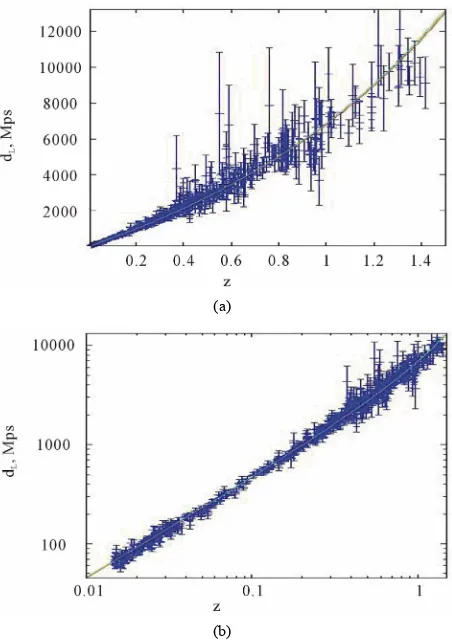
the Hubble diagram with these parameters is presented on the Figure 1. The quality of this regression is as high
as it is in the ΛCDM model. High values of the mass density are consistent with the experimental data on Supernova Ia within this model. Yet the value of is much less in the absolute value than in the ΛCDM model.
w
The Taylor expansion of the luminosity distance (18) is
0
0 2
0 0
3
d
12 2 2
d 4 0 .
m
z L
w c
z c
d z
H H
O z z
z
(20)
The optimal values for this simplified case for z0.3 are
0 2
km 69
s Mps
H
and
0 0.4
0
d
12 2 0.9
d
m
z
w
z
.
(a)
[image:4.595.312.538.83.403.2](b)
Figure 1. The hubble diagram.
3.2. Comparing with the Riess Expansion
In the flat Universe
0 0
we can compare (20)with the Equation (10) in [16, p.~25]:
20 0
1
1 1
2
L
cz
d q z
H
O z . (21)
therefore the retardation parameter
0 0
=0
d 6
2 d
m
z
w q
z
.
If the parameter introduced in this paper
0
0
d 1
d 6 2
m
z
w
z
,
we obtain acceleration. Hence the acceleration of the Universe appears as a pure observational effect due to the negative pressure.
3.3. Fate of the Universe
Note that we have chosen 0m 1.01 and 0 while interpreting the Supernova Ia experimental data. We had to make some assumptions on these parameters because large number of unknown parameters cannot be obtained from this simple regression. Yet since experi-
mental data are consistent with 0m 1.01 and 0,
then one can say that there is a solution of the Friedman equation wich accelerates for a short time in the beginn- ing but there is a limit for the scale factor a. We can
smoothly glue another solution where the Universe shrinks. The question of the fate of matter at the end of the Universe is the most complicated. We assume that the matter does not disappeared at the end of the Universe. The matter with some unknown critical density should reproduce the hydrogen and provide condition for ano- ther Big Bung. The remnants of the Big Bung are black holes. We assume that all their singularities are topo- logically equivalent and lead to the same space-time moment in the past where the collapsing stage of the previous Universe ends and the new Big Bung begins.
4. The Section Curvatures
For completeness let us review the Christoffel symbols for the Friedmann-Robertson-Walker metric (4) and the section curvatures. The Christoffel symbols for the timelike dimension (i,j = 1,2,3) are
0 0
00 0, 0 0 ,
i i i .
j j j ij ij
a a
g
a a
(22)
and , 00 . The Christoffel symbols for the spacelike dimensions are
0 0i 0
i 0
1 1 2 ,
11 1 2, 22 1
r
r r
r
2 ,
1 2
33 r 1 r sin
2 2 2
12 21 33
1
1 , sin 2 ,
2
r
3 3 3 3
13 31 1 ,r 23 32 cot .
these are all the nonzero components.
Let be linear independent vectors of the tangent space for the manifold at the point
, x
u vT N
N x. The
section curvature Ku v is defined as
2 , ,,
, , ,
u v
R u v v u K
u u v v u v
(23)
where is the Riemannian curvature map [17, p.~94]. Compared with the Riemannian case we have changed sign in this formula because the signature of our space is Lorentzian. With local coordinates
R
, , , , , i j k l ijkli j k l
R u v w z
R z w u v .Angle brackets mean scalar product. The denominator is the square of the area of the parallelogram based on the vectors and . If we choose another basis in the same two-dimensional plane
u v
defined by and v,
then the section curvature does not change. Hence the
value u v
u
K depends on the plane only. Therefore
the value Ku v is assigned K and is called the section curvature of the (pseudo)Riemannian manifold
at the point
N x in the two-dimensional direction .
In local coordinates the section curvature in the direction
− is
i j
2
ij ijji ii jj
R g g g
(no summation for ). The section curvature of the FRW space in the directions 0 - 1, 0 - 2, 0 - 3 is
, i j
a a
.
In general for any vectors u v, such as
0 0
u , u1u2u30, v00,
the section curvature Ku v a a. The section curvature
of the FRW space in the directions 1 - 2, 1 - 3, 2 - 3 is
2 2
a a
.
Also for any vectors v w, such as v00 and
0
w 0 (other components are arbitrary),
2
2v w
K a a .
Please note that for 0m 0 and the section
curvatures of the spacetime at present are zero. Indeed for the directions 1 - 2, 1 - 3, 2 - 3 the section curvatures
0
2 2
2
0 0 0 m
a H
H H H H
2
2
a a
2 2
.
It seems sensible that without matter the spacetime should be flat. The section curvatures for the directions 0 - 1, 0 - 2, 0 - 3 are a a qH2 where q a a2 is the retardation parameter. At present time
a
0 0
3 2
2 m
q .
In the absence of matter at present for it will be zero also.
0
5. Conclusion
We propose new correction to the Hubble's law which can be useful in cosmology. This correction and our assumption w z
vz produce a model which iscapable to explain the acceleration of our Universe. This model is also consistent with the parameters 0m 1.01
and 0 corresponding to nearly flat and topolo- gically closed Universe. The value 0m means
that the expansion of the Universe will change to shrinkage yet we should observe acceleration at present.
The assimmetry between matter and antimatter is also explained within this model. The matter does not appear from nothing at the beginning of the Universe; it is the same matter that worked at the previous cycle. The matter does not dissappear at the end of the Universe; it will just reproduce the hydrogen. The antimatter is not holes in the Dirac sea of states with negative energy; it is the matter with opposite set of quantum numbers. During the final state of the cycle (which is equally the first state of the new cycle) all properties of matter are equalized.
REFERENCES
[1] A. A. Friedmann, “Selected Works,” Moscow, Nauka, 1966 (in Russian).
[2] P. Coles and F. Lucchin, “Cosmology. The Origin and Evolution of Cosmic Structure,” 2nd Edition, John Wiley and Sons, 2002.
[3] P. J. E. Peebles, “Principles of Physical Cosmology,” Princeton University Press, Princeton, 1993.
[4] M. Dalarsson and N. Dalarsson, “Tensor Calculus, Rela- tivity and Cosmology,” Elsevier, Amsterdam, 2005. [5] S. Weinberg, “Gravitation and Cosmology. Principles and
Applications of the General Theory of Relativity,” John Wiley and Sons, Hoboken, 1972.
[6] B. Ratra and M. S. Vogeley, “Resource Letter: The Be- ginning and Evolution of the Universe”.
arXiv:0706.1565v2.
[7] R. Kessler, et al., “First-Year Sloan Digital Sky Survey-II (SDSS-II) Supernova Results: Hubble Diagram and Cos-
mological Parameters”. arXiv:0908.4274v1.
[8] P. Creminelli, M. A. Luty, A. Nicolis and L. Senatore, “Starting the Universe: Stable Violation of the Null En- ergy Condition and Non-Standard Cosmologies”. arXiv:hep-th/0606090v2.
[9] L. D. Landau and E. M. Lifshits, “Course of Theoretical Physics. V. 2. The Classical Theory of Fields,” Moscow, Nauka, 1988 (in Russian).
[10] L. Wolfenstein, T. G. Trippe and C.-J. Lin, “Tests of Con- servation Laws,” The Review of Particle Physics. urlhttp://pdg.lbl.gov.
[11] Y.-F. Cai, T. Qiu, Y.-S. Piao, M. Li and X. Zhang, “Bouncing Universe with Quintom Matter”.
arXiv:0704.1090v1.
[12] E. A. Bergshoeff, et al., “Cosmological D-Instantons and Cyclic Universes”. arXiv:hep-th/0504011v2.
[13] D. H. Lyth, “The Primordial Curvature Perturbation in the Ekpyrotic Universe”. {arXiv:hep-ph/0106153v3. [14] E. W. Kolb and M. S. Turner, “The Early Universe,” Ad-
dison Wesley, Boston, 1990.
[15] M. Szydlowski, A. Kurek and A. Krawiec, “Top Ten Ac- celerating Cosmological Models”. arXiv:0604327v2. [16] A. G. Riess, et al., “Type Ia Supernova Discoveries at
1
z from the Hubble Space Telescope: Evidence for Past Deceleration and Constraints on Dark Energy Evolu- tion”. arXiv:0402512v2.