ISSN: 2306-9007 Kamil & Nashat (2017) 1330
I
www.irmbrjournal.com December 2017I
nternationalR
eview ofM
anagement andB
usinessR
esearchVol. 6 Issue.4
R
M
B
R
The Impact of Information Technology on the Auditing
Profession-Analytical Study
OMER ALI KAMIL
College of Business Economics, Al-Nahrain University, Baghdad, Iraq Email : [email protected]
NASHAT MAJEED NASHAT
College of Business Economics, Al-Nahrain University, Baghdad, Iraq Email : [email protected]
Abstract
Information technology in terms of the means, methods and mechanisms plays into the auditing profession indirectly through accounting profession and directly through the same auditing profession as supplementing the accounting profession, and perhaps the effect of this sounds here and through this field of research on the auditing and auditors positively which being contributes to the reduction of some of the problems surrounding the auditing profession and reducing its impact, all through the contribution of information technology in the development of the audit profession and make it keep up with the developments of the era and enable it to face the challenges that are facing the profession and reduce the expectations gap of audit and processing the negative effects and reduce the risk of audit and make it more effective and efficient.
Key Words: Information Technology, Expectations Gap, Audit Risk, Audit Fees, Audit Standards.
Introduction
Perhaps it is obvious to recall that the auditing profession was born and will continue to be a social profession serve the community in which they operate and are affected by it as consistently affect or uneven unchanged if the accounting profession, which is the act of making the auditing profession reaction to it. Among the most important variables or influences that pervades society and affect the auditing profession is information technology (IT) variable that is compressor affect the audit just before impact on the accounting everything that surrounds this changing of the means, methods and mechanisms that will change in the approach, method or means or auditing techniques as a science and as a profession, but, of course, it does not change the objectives.
From the foregoing it generated the idea of research, which dealt with information technology as an independent variable and the auditing profession as a variable certified (continued) attempt to prove that the first impact on the second and areas of influence and the degree of this effect and its impact on the auditors as professionals auditing profession and prove positive the effect of the fact that the search focused on the positive side effect technological audit did not address the negative side of it and on the dangers of technology of forgery and fraud many and varied and wide and methods offered by information technology and the adverse impact on the auditing profession and the work of the auditors, which represent plus for this profession challenge.
ISSN: 2306-9007 Kamil & Nashat (2017) 1331
I
www.irmbrjournal.com December 2017I
nternationalR
eview ofM
anagement andB
usinessR
esearchVol. 6 Issue.4
R
M
B
R
censorship may expand or narrows depending on the degree of technological development in the country and the level of intervention of information technology in the accounting and auditing professions.
Is this search for the imposition of that, "the information technology and clear and effective impact in the audit as a science and as a profession reflection of the impact on accounting and this is a positive impact through the development of the audit profession and help auditors in their work."
The research aims to prove the positive impact of information technology in the audit by reducing audit expectations gap and the risk of audit and audit fees and to increase and develop auditing standards and help auditors in their work checksum.
The research sample of some of the directors and auditors of accounts in some Iraqi banks and the Iraqi market for securities made up. The researcher depends (inductive analytical), which does not stop at collecting information to describe the phenomenon, but he goes to analyze and detect relationships between dimensions, but this approach eligibility and clear in such research, being allows the researcher Description field analysis.
Independent variable Continue variable
Figure 1. Scheme default search
Information Technology - Theoretical Background
The impact of computer use on the internal control system:
The manipulation by computer is one of the nightmares that disturbed departments, and that the prevalence of this type of crime caused mostly occurrence of inadequate internal controls in place for those uses modern computer systems to systems and methods arise from so many regulatory gaps. It also highlights the importance of the system of internal control systems implemented by the computer for being the most
Documentation Expectations
Gap
Response
Audit Information Technology Risk
audit Amount of
information
Physical components
Information properties
Data security Audit
fees
ISSN: 2306-9007 Kamil & Nashat (2017) 1332
I
www.irmbrjournal.com December 2017I
nternationalR
eview ofM
anagement andB
usinessR
esearchVol. 6 Issue.4
R
M
B
R
important and dangerous than it is under the implemented systems manually for the following reasons: (Juma, previous source, pp.127-172).
1. loss of audit trails: the use of computers has led to the disappearance of many elements of the visual audit trails necessary to keep track of financial operations, starting from the original documents until the account balances and vice versa.
2. The possibility of modification in the accounting data without leaving a material effect: You can modify the data in the computer without leaving a material effect in manual systems requires ratification by the general daily log and install the number of pages, and there are also controls to prevent itching and write-offs and Overstuffing between the lines but that the electronic systems can access to databases and make changes without leaving any physical trace.
3. The possibility of cheating and fraud: Can the possibility of fraud and fraud by a single person in the electronic systems, while in manual data processing system it is difficult to penetrate the system without the help of others complicity as the all stages of financial transactions are recorded, documented and carried forward through the records manually by As several people in the financial system that is by computer, all phases of operations are in the computer systems electronically and therefore it makes it easier for the fraudster make manipulation of data and information alone without the need to help others often.
4. difficulty of discovery: difficult to detect fraud by computer as the vast amount of information stored in the computer system, as well as unforeseen tracks the accounting process is wasted follow these routes and therefore more difficult to detect cases.
5. Remote access to the computer: Computer crimes have increased in recent times, by penetrating existing regulations from others and remotely for the purpose of converting huge amounts of money to other accounts, for example.
6. Operation of the data inside the computer: all data processes run concentration inside the computer leads to the absence of an important element of the most important elements of internal control, a division of duties and responsibilities, as well as the use of more than a way of matching and checking among the staff.
Risks of Electronic Commerce:
Although the benefits it brings e-commerce, but that the data and information under the operation of the electronic data are exposed to many dangers systems overshadow the internal control systems and most important:
1. Risks associated feature disappearance of paper documents: with e-commerce now accounting data is tidy and unreadable, and the attendant risks of ease of committing fraud and manipulation, not only that but also the difficulty of detecting and next to it can be accompanied by data errors or a defect in the entry process the main memory or be operated incorrectly in the absence of effective oversight Procedures with it.
ISSN: 2306-9007 Kamil & Nashat (2017) 1333
I
www.irmbrjournal.com December 2017I
nternationalR
eview ofM
anagement andB
usinessR
esearchVol. 6 Issue.4
R
M
B
R
3. The risks associated with the protection of information: the risks and proceed to the possibility of data theft or enter into programs in order to achieve personal benefits or exploit this information against the unit represented by (Hassoun and al-Qaisi, 1991, p. 156).
4. Risks for both the seller and the buyer: such as dealing with fake companies and the use of counterfeit cards due to the weakness of the internal control system and the never continuation developments subsequent developments.
5. Risks associated virus computer: the risk of computer viruses that it caused many problems in the data and programs as they are used to destroy part of the software so that it cannot be recovered.
6. risk reincarnation: low cost to build a website and easily copied pages of websites makes it very easy to build illegal sites posing interface real sites to fool the visitors to give their personal information credit their own cards, believing that Wears sites are sites for companies respectable (Alngide and al-naiem, 2002, p. 42).
Effect of Information Technology on the Audit
Can limit the impact of information technology as a variable independent audit as a variable is supported continued through four aspects:
The effect of information technology on the expectations gap:
Expectations Gap:
The expectations gap is known as "the contrast between what is expected to achieve auditors (auditors) and the actual performance of them" (Aladnana: 2010,p. 4). Also it is known as "the gap between Suggest the audit with respect to the task of auditor standards and the expectations of users of financial statements about the Observer" (fatha: 1997,p.500).
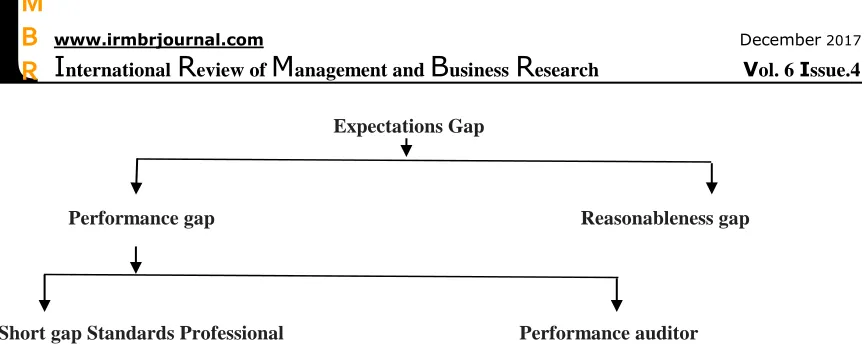
Meaning they divide or gap or difference and the contrast between reality and expected with respect to the audit profession, and can generally be classified expectations gap in auditing presidents into two classes: (Al-Qarni: 2009,p.147).
1. Reasonableness gap: arise as a result of the discrepancy between what society expects from the auditor's done and what can be reasonably achieved.
2. Performance gap: arise as a result of the disparity between the reasonable expectations of the community of what should be done by the auditor and the actual performance. And classified this gap (performance) to:
a. Gap created as a result of lack of professional standards of scrutiny.
b. Gap created as a result of deficiencies in the performance of the observer the same accounts.
ISSN: 2306-9007 Kamil & Nashat (2017) 1334
I
www.irmbrjournal.com December 2017I
nternationalR
eview ofM
anagement andB
usinessR
esearchVol. 6 Issue.4
R
M
B
R
Expectations Gap
Performance gap Reasonableness gap
Short gap Standards Professional Performance auditor
Figure 2. The special audit expectations gap Classifications
Raised IT
Perhaps globalization and the information revolution, technological and communicational , Pushed most of the installations and units economical to use of information technology in the management and implementation of its business and address the financial and non-financial data as help in building a successful and help them to build a special relationship with their customers and increase market share and improve its productivity in quantity and quality in such a dynamic environment, it has put these developments in technology developments information auditing profession in front of a major challenge for the development of tools and methods to continue to provide high quality services High, so the back of what is known as e-checks or scrutiny of computerized systems, and this technology will help the auditing profession to overcome some aspects , Human limitations in the case of the exercise of professional judgment and appropriate to express an opinion, so the corner-mail audit as well as the pillars of traditional audit and routine is the use of information technology in the audit process to help checker across different audit phases of planning, control and documentation (Shanti: 2011,p.338), and this is what prove shows the impact of information technology on the auditing profession as a result of audit work and regulatory and means adopted to achieve and to achieve this result.
It can also be emphasized that the electronic operation of the data helps the auditor to achieve better audit objectives through to achieve the following advantages: (Aalboni: 2011,p.7)
1. Helps through the speed of proof in the output of financial and non-financial information, and this detect errors quickly and enables instant correction compared to manual operation.
2. E-operation helps the auditor to use analysis techniques in comparisons and ratios and produces indicators and parameters that help in monitoring and evaluating performance quickly.
3. Electronic data operation helps the auditor in the application of the internal information network system and the external information network in the control of the internal and external branches of the enterprise. 4. The auditor can use the methods of advanced operations research in analysis and evaluation and in the presentation of reports such as statistical analysis, means of control, self-control, statistical sampling method and system analysis method.
5. Electronic operation helps in the speed of retrieval of data and information stored in the memory of the computer or on memory modules and storage, and this can review some of the observations.
6. The auditor assists in the use of the computer's capabilities in carrying out the audits by establishing auditing and auditing programs that may be programs that are ready or prepared for a particular purpose or programs.
ISSN: 2306-9007 Kamil & Nashat (2017) 1335
I
www.irmbrjournal.com December 2017I
nternationalR
eview ofM
anagement andB
usinessR
esearchVol. 6 Issue.4
R
M
B
R
1. The Internet can be used to present and publish audit reports to TNCs, which are often published in newspapers and magazines and there is no risk of being consulted. It can also bring many benefits. , And helps the prospective investor to obtain quick and comprehensive information before making an investment decision.
2. The advantages of presenting and publishing audit reports to transnational corporations through the Internet are as follows:
The speed of communicating the information in the reports to its users around the world, which makes it more useful.
- The low cost of delivering audit reports to their users.
- Expanding news about the company and bringing in new investors.
- Know the impact of these reports on the company's stock prices in global stock markets.
3. A set of controls and guidelines should be developed in the use of the Internet service in the presentation and publication of audit reports, whether periodic or attached to the financial statements at the end of the financial year, and to exercise caution and avoid ways that may harm companies and enterprises, and uses a firewall for protection.
Based on the foregoing, we find that information technology with all its means, mechanisms and techniques has raised many, large and wide auditing profession in terms of auditing methods, audit process, results of audit work and reports, and presenting these reports and benefiting from them by its users, which helps reduce the gap expectations audit and reduce in terms of improving the actual performance of auditors Development and assistance in increasing the size of its audited samples and communicating its results of audit reports to its users better, faster and easier.
Impact of information technology on audit risk:
Audit risk
The American Institute of Certified Public Accountants (AICPA) in Standard No. (47), Audit Risk (AR) is the risk that the auditor may fail to properly and appropriately give an opinion on financial statements that contains material misstatement. Audit risk is also defined as the possibility of an audit opinion being misstated in the audited financial statements due to a failure the auditor in identifying material errors that may exist in such statements, or the possibility of the auditor expressing an unqualified opinion on financial statements that contain material misstatement. Audit risk is an important factor to be taken into account by the auditor, whether in the planning of an audit, the determination of audit procedures, or when evaluating audit evidence. The Institute of Chartered Accountants of America has stressed the need to assess risk when planning to check in standard No. (47) , That the auditor should plan the audit so that the audit risk is minimal and appropriate for a proper opinion in the audited financial statements and the risk may be assessed quantitatively or quantitatively*.
The audit risk also refers to residual risks arising from the auditor's issuance of an unqualified report due to the failure of the auditor to disclose any material misstatement, either due to error or fraud. These risks consist of inherent or material risks
Inherent Risk (IR), Control Risk (CR), Detection Risk (DR), and can be calculated as follows: **
ISSN: 2306-9007 Kamil & Nashat (2017) 1336
I
www.irmbrjournal.com December 2017I
nternationalR
eview ofM
anagement andB
usinessR
esearchVol. 6 Issue.4
R
M
B
R
The effects of information technology:
The impact of information technology on the audit profession through audit risk is reflected in the field of internal control, where information technology changes in the direction of improving control and auditing and reducing risk through: (Ahmed: 2011,p. 70).
a. Instead of manual monitoring, the main feature of IT is to monitor day-to-day computer performance with operating activities and to replace manual procedures with programmed controls that allow for the possibility of checking and matching each control so as to reduce the human errors that may occur in manual systems. as a result of the risk of audit risk.
b. Providing high quality information: IT systems provide the Department of Economic Unity with supervision and users with quality information faster than manual control systems, greater information and greater analysis, thereby reducing audit risk.
Recent developments confirm that computer-generated documents and electronic evidence differ from paper proofs (traditional method) in terms of the difficulty of alteration and falsification, their adequacy to demonstrate credibility, completeness of documents, the manual of certification, ease of use, clarity and organization. (Dahmash and Abu Button: 2005,p. 6).
The impact of information technology on electronic data operation (EIT) on the methodology of auditing and control is directly reflected in the size and nature of audit risks indirectly in the following areas: (Eilabouni: previous source: 7-8).
1. A change in the level of scientific and practical qualification of the auditor, as he must be knowledgeable and experienced in the following:
*http://infotechaccountants.com/forums/page/index.html/
• The basics of computers.
• The basics of data entry to the computer. • Software basics and languages.
• Basics of interpreting outgoing information.
2. Comprehensive planning of the audit and control operations using implementation.
3. A clear and significant change in the audit and control programs and processes, with emphasis on the following:
Checking the entries in the documents and their related money. Checking incoming data to ensure their integrity.
Checking the software that includes the mechanism of running the data. Secure and ensure the safety of the computers used.
Check outgoing information.
4. Change in evidence supporting the validation of data, as well as traditional evidence, and can use updated evidence such as:
Evidence Self-control and control evidence. Evidence Self-proof of conformity.
Evidence of abnormal data and abnormal information. Evidence of multi-faceted analysis, aspects and concepts. clues Border evidence
ISSN: 2306-9007 Kamil & Nashat (2017) 1337
I
www.irmbrjournal.com December 2017I
nternationalR
eview ofM
anagement andB
usinessR
esearchVol. 6 Issue.4
R
M
B
R
5. Change in the periodicity of the audit reports and the periods of their numbers. The use of EDI shortens the period of preparation and submission of these reports and the use of modern means of presentation and disclosure.
It is clear from the foregoing that general information technology and electronic data operation (EDP) have particular or significant impact on the risks of audit, both quantitatively and qualitatively, in the direction of reducing or minimizing these risks by assisting IT with all its means, mechanisms and capabilities to reduce the likelihood of audit errors and increase The possibility of detecting material errors on the other hand, thereby reducing overall audit risk.
Impact of Information Technology on Audit Fees:
Audit Fees
Audit fees are defined as the amounts or fees charged by the auditor or auditor for performing the audit of the accounts of the audited economic unit. Fees are determined by contract between the audited economic unit and the auditor according to the time it takes and the service required And the extent of the need for the audit process for the assistants (Bishops: 2013,p. 85). If the audit process requires effort and time by the auditor, there are fixed and variable fees and other conditional.
There are a number of things that must be taken into consideration when determining audit fees, most notably: (Najm: 2012,p. 46).
1. The time required to complete the required work.
2. Number of staff (assistants) who will assist the auditor (auditor) and the wages required for each category (assistant auditor, auditors, beginners).
3. The required work of the auditor and the necessary skill and if there are additional services required, such as tax consultations or other administrative matters.
4. Direct costs of the audit process such as wages and travel expenses to audit the work of branches and expenses of stationery and so on.
5. Audit office reputation and years of experience.
6. Audit time required at the end of the fiscal year or at another time. 7. The customer's ability to pay and the importance of the auditor's report.
The effects of information technology
(Jahmani: 1999,p. 499) states that "the process of determining the fees of the transaction is one of the most complex processes facing both the auditor and the client concerned because they are linked to several interrelated and conflicting factors." The most important of these is the time factor, The auditing profession assigned to the audit and the type of audit work to be performed and its financial cost to the auditor as well as other factors associated with the customer under scrutiny. All these should be taken into consideration when fixing the audit fee to be appropriate, logical and appropriate. There is no doubt that information technology has a clear impact onSome, if not all, of the factors mentioned above affecting the question of determining audit fees such as the impact of information technology on the time or period of the audit process in the direction of reducing it, the number and size of the audit team used to perform the audit work in the direction of reducing it, Ultimately leading to a reduction or reduction of audit fees to reduce audit work and financial value due to the IT impact.
Impact of information technology on audit standards
ISSN: 2306-9007 Kamil & Nashat (2017) 1338
I
www.irmbrjournal.com December 2017I
nternationalR
eview ofM
anagement andB
usinessR
esearchVol. 6 Issue.4
R
M
B
R
examination for the purpose of expressing an opinion in the financial statements of an enterprise, regardless of its size, purpose and legal form In the absence of a legislative text issued by the State or by any competent local authority "(periodic: 2003,p.73). In this regard, the bishops say that auditing standards - Or sometimes called by evidence - different from the practices or practices that occur in terms of the first are the types or measures to examine the quality and degree and level of performance for the second and the first related to the nature of audit and objectives and quality of the profession of the auditors, while the second is only the steps of scrutiny done by The auditor in his audit work, and despite this difference, they are related in that the audit procedures should be appropriate to the auditing standards (Metropolitans: 2013,p. 44). It is clear that the audit standards should be consistent with the auditory reality in order to restrict audit procedures and practices.
The effects of information technology
Based on the need to harmonize audit standards, whether international, regional or local, with the best practices, applications and audit procedures to be carried out and implemented by the auditors, it is necessary to adapt these standards to the dynamic changes and developments witnessed by the professional society, most notably the emergence and development of technology Information affecting the audit profession through the development of existing standards and even the emergence of new standards at the international level dedicated to the computerized information systems environment in response to The increasing role of information technology, the evolution of its means and the growing impact of the audit profession in developed countries in particular and the world in general. Six international auditing standards were issued in this regard as listed below:
1. International Auditing Standard (401) entitled "Auditing the Environment of Computer Information Systems".
2. International Auditing Standard (1001) entitled "The Environment of Computerized Information Systems - Independent Personal Computer Systems".
3. International Auditing Standard (1002) entitled "The Environment of Computerized Information Systems - Direct Computer Systems".
4. International Auditing Standard No. 1003, "The Environment of Computerized Information Systems - Database Systems".
5. International Auditing Standard (1008) entitled "Risk Assessment and Internal Control - Characteristics and Considerations of Computer Information Systems".
6. International Auditing Standard No. 1009, "Computer-Aided Verification Methods".
The issuance of these six international auditing standards is a clear reaction to the evolving and growing role and impact of information technology in the audit profession to assist auditors in performing their audit functions in an increasingly technological impact environment.
The fourth subject, test the search hypothesis
ISSN: 2306-9007 Kamil & Nashat (2017) 1339
I
www.irmbrjournal.com December 2017I
nternationalR
eview ofM
anagement andB
usinessR
esearchVol. 6 Issue.4
R
M
B
R
And by collecting questionnaire forms distributed to the sample of the research represented by(22) as stated above and after collecting and analyzing the results at the level of the form for each person of the sample and applying the equation of the degree of effectiveness to the total answers of the paragraphs of each questionnaire by dividing the total of the answers with yes, each of which weight (4) on the total of the standard values (40) The total weight of the 10 questions for the questionnaire is a weight of (4) for each question , And neglecting the answers, whether they are weight bearing zero as being contrary to the hypothesis of the search results were reached listed in the following table:
"Table (1) - Analysis of the responses of the research sample and calculation of the degree of effectiveness of each questionnaire"
Question number
Total standard values (Weights)
Total answers yes
Total answers
are no
Degree of effectiveness = Total number of responses yes / total of standard values (weights) * 100%
1 04 82 18 %04
8 04 82 18 %04
3 04 80 11 % 14
0 04 82 18 %04
5 04 38 2 % 24
1 04 82 18 % 04
0 04 31 0 % 04
2 04 04 - % 144
0 04 04 - % 144
14 04 04 - % 144
11 04 80 11 % 14
18 04 04 - % 144
13 04 38 2 % 24
10 04 31 0 % 04
15 04 82 18 %04
11 04 38 2 % 24
10 04 04 - %144
12 04 04 - % 144
10 04 82 18 % 04
84 04 04 - % 144
81 04 38 2 % 24
88 04 31 0 % 04
In order to test the hypothesis of the research, we used statistical measures to analyze the data produced by the questionnaire. These measures are:
1. Percentage: This measure is easy to understand and clear, and has been used at the level of the set of questions, as the percentage increases as this indicates the importance of the paragraph.
2. Computational mean: This measure helps to determine the compatibility of sample responses with the movement of the scale in order to study and analyze the impact of IT on the audit profession. The greater the mean (or 2.0), the higher the mean of the sample's responses, and the following is used to extract the arithmetic mean:
ISSN: 2306-9007 Kamil & Nashat (2017) 1340
I
www.irmbrjournal.com December 2017I
nternationalR
eview ofM
anagement andB
usinessR
esearchVol. 6 Issue.4
R
M
B
R
We find that the overall effectiveness of all the answers to the sample of research exceeded , which confirms the hypothesis of research and proves the impact of information technology on the audit profession.
Conclusions
Through the above, some conclusions or conclusions can be summarized which can be summarized as follows:
1. Information technology contributes to the development of the auditing profession and to reducing some of the problems and negative aspects that accompany this profession through the positive impact of the means and mechanisms of information technology on this profession.
2. IT works to reduce the expectations gap in the audit by using methods, mechanisms and techniques that help increase the size of the audit samples, increase the speed of the audit work, accuracy and deliver the audit results faster and easier for the users, thus reducing the feasibility and performance gaps that constitute the audit forecast gap.
3. Information technology affects the reduction of audit risk through electronic data processing and electronic auditing, which helps auditors reduce the likelihood of errors in audit work and increase the probability of discovery, which in turn leads to a reduction in audit risk.
4. IT contributes to the reduction of audit fees by contributing to reducing the size of the audit team, which is based on the work and the time consumed in the performance of the audit work, which ultimately leads to pressure on the cost or cost of the audit.
5. The impact of information technology on auditing as a science and profession through auditing standards. The phenomenon of information technology has added six (6) international auditing standards in the field of computerized information systems. This is evidence of the impact of this phenomenon on auditing.
6. The research sample confirmed the positive impact of information technology on the auditing profession through the high degree of efficiency represented by more than ( ), which results from the analysis of the responses and opinions of the sample in relation to testing the hypothesis of the research and to reinforce the above conclusions.
References
Ahmed, ManhalMajid, Re-engineering of the Audit Profession in the Information Technology Context - A Pilot Study to Survey the Opinions of a Selected Sample of Auditors in Iraq - Dissertated Dissertation - University of the World's Centennialments - 2011.
Al-Jubouri, Ithmar Mahdi Fadel, (Effect of the use of information systems on the effectiveness of banks' performance / applied study of a sample of Iraqi private banks), a study presented to the Higher Institute of Accounting and Financial Studies / Baghdad, 2010.
Al husban, Atallah Ahmed Sweilem, (Internal Control and Auditing in the Information Technology Environment), First Edition, Jordan-Amman, Al-Raya Publishing and Distribution, 2009.
Al-Hassoun, Adel and Al-Qaisi, Khalid, (Accounting Systems), House of Public Cultural Affairs, Baghdad, 1991.
Al-Dahrawi, Kamal al-Din Mustafa, ("Contemporary Introduction to Accounting Information Systems"), Second Edition, Egypt - Alexandria, University House, 2005.
Al-Dor Omar Ali Kamel, The Role of Auditing Standards in Reducing the Expectancy Gap, Al-Mansour Magazine, Issue 14, Year 10, 2010, Baghdad, Iraq, pp 123-138.
ISSN: 2306-9007 Kamil & Nashat (2017) 1341
I
www.irmbrjournal.com December 2017I
nternationalR
eview ofM
anagement andB
usinessR
esearchVol. 6 Issue.4
R
M
B
R
Juma, Ahmed Helmy, (Modern Auditing and Emphasis: Problems, Responsibilities, Services and Tools), First Edition, Jordan-Amman, Safa Publishing House, 2009.
Jahmani, Omar, Factors Affecting the Determination of Legal Auditor Fees: A Field Study on Shareholding Companies Listed in the Amman Financial Market, Al Najah Journal of Research (Human Sciences), Volume 13, No. 2, 1999, pp. 494-521.
Al-Sharida, Nadia Abdul-Jabbar Mohammed, "Requirements for the application of information and communication technologies and their role in strengthening the accounting information systems and internal control field study on a sample of financial units at the University of Baghdad"), a study presented to the College of Management and Economics, Baghdad, 2010.
Al-ShammariNazem Mohammed Nouri and Abdul-Fattah Zuhair, (Electronic Banking: Tools, Applications and Impediments of Expansion), First Edition, Jordan-Amman, Dar Wael Publishing, 2008.
Al-Shanti, Ayman Mohamed Nimer, The Role of Information Technology in the Development of the Auditing Profession - An Empirical Study on Audit Offices in the Hashemite Kingdom of Jordan, Journal of the College of Baghdad for Economic Sciences, University, No. 27, 2011, pp. 325-354. Al-Taei, Muhammad A. Al-Faraj, (Introduction to Management Information Systems), First Edition,
Jordan-Amman, Wael Publishing House, 2005.
Al-Ani, MezherShaaban, ("Management Information Systems: A Technological Perspective"), Dar Wael Publishing, 2009.
Abdullah, Khalid Amin, (Banking Operations and Modern Accounting Methods)), Fourth Edition, Jordan - Amman, Dar Wael Publishing, 2003.
Al-gham, Ibrahim Mohamed Hassan, Information Technology and Knowledge Management and its Impact on the Strategic Option, A Comparative Analytical Study of the Performance of a Sample of Iraqi Bank Managers, PhD Thesis Presented to Mustansiriya University, Faculty of Management and Economics, 2007.
Adnanani, Mohamed Hadi, The Effect of Corporate Governance Mechanisms on the Expectations Gap in the Professional Practice Environment in Iraq, 2010, published study, Baghdad, Iraq.
Al-Allaq, Bashir Abbas, Internet Marketing, Al-Warraq Publishing, Amman: 2002.
Al-KaddoumiThaer, BarakatSamer, (Financial and Banking Information Systems)), First Edition, Egypt - Cairo, United Arab Marketing and Supply Company, 2010.
Al-Qarni, Ahmed Abdelkader, "The Prospects Gap in Public Auditing: The Case of Saudi Arabia," Arab Journal of Administrative Sciences, Volume 16, No. 2, May 2009, Kuwait University, pp. 143 - 171. Al-Lami, GhassanQasimDawood, ("Technology Management: Concepts and Approaches to Applied
Process Technologies"), Jordan - Amman,8440.
Al-matarnaGhassanFalah, Introduction to Contemporary Auditing, Zamzam Publishers and Distributors, Amman, Jordan, First Edition, 2013.
Al-Nujaidi, YaqoubYousef, Al-Naaim, Faysal Mohammed, (e-Commerce Principles and Principles), Arab Science House, Lebanon, 2002.
Alvin A. Arens , Randal G. Elder , Marks Beasiey, 2008 ))Auditing And Assurance Services An Integrated Approach)) , Twelfth Edition , prentice Hall .
Alter,Steven,Informatio System,4th ed of e-business,internqtion Business Prentice Hall ,N.Y, 2002. Dahmash, Naim and Abu Zer, AfafIshaq, Internal Controls and Auditing in the IT Environment, The Fifth
Annual International Scientific Conference of the Faculty of Economics and Administrative Sciences, Al Zaytoonah University, Amman, Jordan, 2005.
Dulaimi, IhsanAllawi Hussein, Analysis of the relationship of information technology to the effectiveness of human resources management and its impact on the building of core competencies, field study in selected sample of faculties of Baghdad University, PhD thesis presented to Baghdad University - Faculty of Management and Economics - 2006.
Daft, Richard L, Organizational Theory and Design, 8th ed , Thomson, 2004.
ISSN: 2306-9007 Kamil & Nashat (2017) 1342
I
www.irmbrjournal.com December 2017I
nternationalR
eview ofM
anagement andB
usinessR
esearchVol. 6 Issue.4
R
M
B
R
Fatwa, Riad, "Auditor's Responsibility to the Financial Statements", in: Lectures of the Third International Scientific Conference "International Auditing Standards and Their Importance in Lebanon", Association of Certified Public Accountants in Lebanon, Beirut, November 1997, pp.500 - 512.
Kandilji, Amer Ibrahim, Al-Samarrai, ImanFadel, Information Technology and Applications, Al-Warraq Publishing and Distribution, Amman, 2002.
Najem, MahaRizk, Factors Affecting Determining the Fees of External Auditors in the Gaza Strip, Master Thesis, Islamic University, Gaza, 2012.
SamarraiAymanFadel, ZoghbiHaitham Mohammed, (Administrative Information Systems), First Edition, Jordan - Amman, Dar Safa Publishing and Distribution, 2004.
Safar, Ahmed, ((electronic banking in the Arab countries)), Lebanon - Tripoli Modern Book Foundation Publishers, 2006.
Wafi,BadraNizar Khalil, ("Auditing of electronic accounting systems for hospitals, applied research in the hospital of specialized surgeries"), a study presented to the Arab Institute of Certified Public Accountants / Baghdad, 2009.
Waller,L,Derek, Operation Management A supply Chin approach 2th ed, Thomson publishing, Co, New York, 2002.