Available at www.ijsred.com
Application of Graphical User Interface (GUI) for Sizing a
Stand-alone Hybrid, Wind and Photovoltaic System for Teaching and
Learning
Muhammad FaizKamarulBahrin, Mohamad AzroyZainuddin,Ahmad Azim Mat Rabi,
Ahmad Fateh Mohamad Nor
Green and Sustainable Energy (GSEnergy) Focus Group, Faculty of Electrical and Electronic Engineering,UniversitiTun Hussein Onn Malaysia, 86400 Parit Raja,BatuPahat, Johor, Malaysia
Email: [email protected]
---
************************
---Abstract:
The research presented in this paper focuses on the development of a Graphical User Interface (GUI) platform that can be used to perform the sizing procedures of a stand-alone hybrid wind and photovoltaic (PV) system for teaching and learning application. The designed GUI platformhas the ability to calculate the load requirements and then determine the suitable size of every components in the stand-alone hybrid wind and photovoltaic system. These components includethe wind turbine, PV array, inverter,charge controller, and battery-bank so that the system is able to produce sufficient energy to meet the load requirements. System sizing is one of the most if not the most important aspect in any stand-alone renewable energy system. This is due to the fact that if the system is not being sized carefully, it might result in producing more energy or even worse, less energy than the load demand. GUI is used to present all of the procedures system sizing procedures to make it much easier to understand by the users with minimal knowledge of renewable energy. The GUI is done by using MATLAB Software. The GUI platform is targeted for teaching and learning purposes especially for undergraduate engineering students, postgraduate research students as well as junior engineers.
Keywords —GUI, Renewable Energy, PV System, Wind System, Hybrid System.
---
************************
---I. INTRODUCTION
Renewable energy (RE) can be defined as the energy that is produced from sources that do not diminish over time. These sources include wind, solar, geothermal, biomass, and hydropower[1]. RE is seen as the solution to non-renewable sources such as fossil fuels that have been used conventionally to generate electricity[2].Not only the fossil fuel will eventually will be used up completely, the generation of electricity from fossil
one of the factor of greenhouse effect [3]. RE especially solar energy on the contrary is more environmental friendly and do not release any dangerous gases during the process of generating electricity [4]. In addition, RE sources such as solar and wind are very suitable to be installed in remote areas and also archipelagos. The solar panel and the wind turbine can be installed in those areas. Solar energy can be defined as the electrical energy generated from the sunlight with the help of
wind via wind turbine. Due to the benefits of RE, governments from many countries around the world have supported the usage of RE in their respected countries[6]–[9].However, there are a few issues regarding solar and wind power. The first issue is that the sunlight is only available during the sunny days. To overcome this issue, the wind power can combined with the solar system to form a hybrid system. Wind can be available during night time and cloudy or rainy days. The second issue is that for a stand-alone hybrid, wind and PV system, the sizing process of the system is very important [10]. This is due to the fact that if the system is not being sized carefully, it might result in producing more energy or even worse, less energy than the load demand[11]. Not only that the sizing process involves a very detail calculation procedures. The third issue is the lack of knowledge among most of the people regarding the sizing procedures[12].In order to overcome the second and third issue, a Graphical User Interface (GUI) platform that has the ability to perform the sizing procedures of a stand-alone hybrid, wind and solar system are developed. In addition, this GUI is designed to be user friendly and informative so that the users especially with minimal knowledge of RE can learn and perform the sizing procedures. GUI is a very popular method that has been used by previous researchers such as [13]–[16] for teaching and learning application especially in the field of engineering, science and mathematics.
II.METHODOLOGY
A. Main Menu
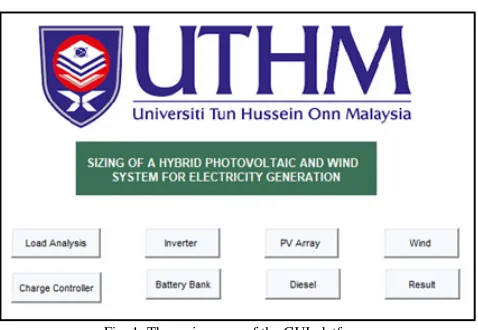
The first part of the GUI platform is the main menu as depicted in Fig. 1. From the main menu the user can choose to start the procedure sizing such as the load analysis, sizing PV array, sizing wind turbine etc.
Fig. 1 The main menu of the GUI platform
B. Load Analysis
The calculation for the load analysis will produce three important values. The first value is the total daily energy consumption, the second value is total AC power demand while the third value is weighted operating time. The equations and steps used for this purposes are listed below.
Step 1: The first value is total daily energy consumption.
∑ ∑ Eq. 1
Where,
∑EAC = Total daily energy consumption (Wh/day) Q = Quantity of electrical appliances
PR = Power rating of electrical appliances in watt
T = Operating time of electrical appliances in hour per day
ηinv = Percentage of inverters efficiency
Step 2: The second value is the total AC power demand. This calculation very important for inverter selection.
∑ Eq. 2
Where,
PAC = Total Ac power demand in watt Q = Quantity of electrical appliances
Available at www.ijsred.com
Step 3: The third value is weighted operating time. This calculation is used for battery sizing section.
⋯
⋯ Eq.3
Where,
top = Weighted average operating time (hr/day) E1 = Energy required for load 1 (Wh/day) t1 = Operating time for load 1 (hr/day) E2 = Energy required for load 2 (Wh/day) t2 = Operating time for load 2 (hr/day)
En = DC energy required for load nth (Wh/day) tn = Operating time for load nth (hr/day)
In the designed GUI platform, Step 1 until Step 3 can be done at the load analysis GUI window. The window is illustrated in Fig. 2.
Fig. 2Load analysis GUI window
C. Inverter Sizing
In this section, the size of the inverter is being determined. Inverter is used to convert direct current (DC) produced by the PV array to alternating current (AC). The size of the inverter can be determined by multiplying the PAC value with 1.25 [11]. The value of 1.25 is to consider the small load changes. Fig.3 shows the GUI window for inverter sizing purposes.
Fig. 3Inverter GUI window
D. PV Array Sizing
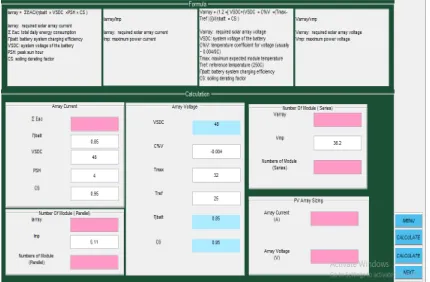
This step is solely to determine the number of PV panel to be connected (both series and parallel). Eq.4 [12] is used for this step.
!! "
∑$%&
ƞ()** +,-& ./ 0
Eq.4
Where,
Iarray =required solar array current (A) ∑EAC = total daily energy consumption (Wh/day)
ƞbatt = battery system charging efficiency VSDC = system voltage of the battery PSH = peak sun hours (hr/day) Cs = soiling derating factor
E. Wind Turbine Sizing
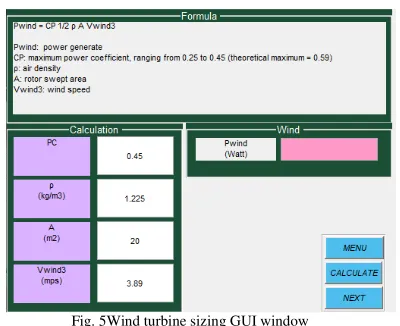
The equation for calculating the power from wind turbine is stated in Eq.5 [17].
Power Cp ρ 9:; Eq.5
Where,
P = Power outputs, watts
Cp = Maximum power coefficient, ranging from 0.25 to 0.45, dimension less (theoretical maximum = 0.59)
ρ = Air density, kg/m3 A = Rotor swept area, m2 or Vw = Wind speed, mps
Fig.5 shows the interface window for sizing wind turbine. Similarly, the users just need to enter the required value obtained from previous steps etc.
Fig. 5Wind turbine sizing GUI window
F. Sizing Charge Controller
Charge controller’s function is to make sure that the battery is not being overcharged by the PV array, wind turbine or both. The size of the charge controller can be determine by multiply the maximum current from the PV or wind with 1.25 (similar to inverter sizing, this value is for small load changes consideration). Fig.6 shows the GUI window for this step.
Fig. 6Charge controller sizing GUI window
G. Battery Bank Sizing
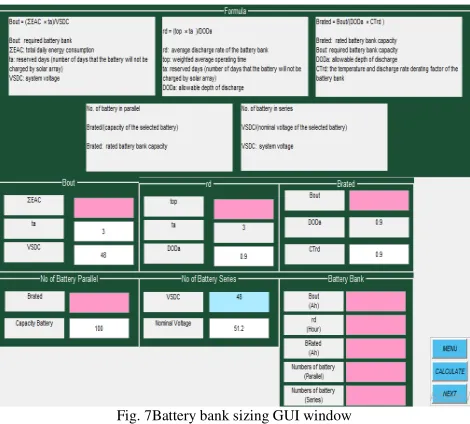
An importing part of battery sizing is determining the storage capacity. According to [17], usually 12 V battery bank voltage is used for system up to 1 kW while 24 V and 48 V of battery voltage are used for system up to 2 kW and 5 kW respectively. The calculation for determining the battery capacity has three steps is shown below. Fig.7 shows the GUI window for this step.
Step 1: This formula is used to calculate the required capacity of the battery bank.
< = ∑
>.? Eq.6
Where,
Bout = Required battery bank capacity (Ah) ∑EAC = Total daily energy consumption
ta = Reserved days (number of days that the battery will not be charged by the wind system)
VSDC = System voltage
Step 2: This formula is used to calculate the average discharge rate of the battery bank.
@A BC
Available at www.ijsred.com
Where,
rd = Average discharge rate of the battery bank (hr)
top = Weighted average operating time (hr/day) ta = Reserved days (number of days that the
battery will not be charged by wind system) DODa = Allowable depth of discharge
Step 3: This formula is used to determine the rated capacity of the battery bank.
<@E FA GBH
?D? ,!J Eq.8
Where,
Brated = Rated battery bank capacity (Ah) Bout = Required battery bank capacity (Ah) DODa = Allowable depth of discharge CT,rd = The temperature and discharge rate derating factor of the battery bank.
Fig. 7Battery bank sizing GUI window
III. RESULTSANDDISCUSSION
The sizing steps in Section II are apply to size a stand-alone hybrid, wind and PV system in an island. The island is Aseana Beach Resort PulauBesar, Johor. Table I shows the load detail for the resort.
TABLEI
ELECTRICAL LOAD POWER CONSUMPTION FOR ONE ROOM
Electrical Loads
Quantity, Q
Power Rating, PR (Watt)
Operating Time, t (hour/day)
Energy Consumption,
E, (Q×PR×t) (Watt hour/day) Fluorescent
Lamp 3 32 12 1152
Globe Lamp 2 6 6 72
Television 1 138 8 1104
Mobile
Phone
Charger
1 5 3 15
Power Bank
Charger 1 5 10 50
The sizing results are depicted in Fig.8.
modules in parallel and 2 modules in series). In addition the size of the wind turbine is approximately 325 W. These two components are main for this hybrid system.
IV. CONCLUSIONS
The results have shown that the developed GUI platform has the ability to size a stand-alone hybrid, wind and PV system. All of the sizing procedures and equations has been integrated with the GUI. In addition, the interface as well as the information at the GUI is very useful for the user to enhance their knowledge in this topic. For future research works, it is suggested to expand the ability of this GUI platform so that the approximate cost of the system can also be calculated by the GUI platform.
ACKNOWLEDGMENT
The authors are grateful to the Green and Sustainable Energy (GSEnergy) Focus Group, Faculty of Electrical and Electronic Engineering, UniversitiTun Hussein Onn Malaysia (UTHM) for providing conducive research platform.
REFERENCES
[1] S. Chandramohan, “Generation of Electric Power based on Footsteps,” International Journal of Scientific Research and
Engineering Development, vol. 2, no. 2, pp. 659–662, 2019.
[2] K. P. Sanjay, B. V. Popat, J. Priyanka, L. S. Dadaso, and H. A.V, “A Module to Harness Solar for Hybrid System,” International
Journal of Scientific Research and Engineering Development, vol. 2,
no. 2, pp. 638–641, 2019.
[3] A. Pradhan and B. Panda, “Experimental Analysis of Factors Affecting the Power Output of the PV Module,” International
Journal of Electrical and Computer Engineering (IJECE), vol. 7, no.
6, pp. 3190–3197, 2017.
[4] E. M. H. Arif, J. Hossen, G. R. Murthy, M. Z. H. Jesmeen, and J. E. Raja, “An efficient microcontroller based sun tracker control for solar cell systems,” International Journal of Electrical and
Computer Engineering (IJECE), vol. 9, no. 4, pp. 2743–2750, 2019.
[5] D. S. Kumar et al., “A Practical Approach to Design and
Development of Solar Powered Low Cost , Efficient and Eco-Friendly Electric Vehicle Abstract :,” International Journal of
Scientific Research and Engineering Development, vol. 2, no. 4, pp.
362–385, 2019.
[6] M. A. M. Ramli, A. Hiendro, K. Sedraoui, and S. Twaha, “Optimal sizing of grid-connected photovoltaic energy system in Saudi Arabia,” Renewable Energy, vol. 75, pp. 489–495, 2015.
[7] R. Kardooni, S. Yusoff, and F. Kari, “Renewable energy technology acceptance in Peninsular Malaysia,” Energy Policy, vol. 88, pp. 1– 10, 2016.
[8] A. Kumar, N. Kumar, P. Baredar, and A. Shukla, “A Review on Biomass Energy Resources, Potential, Conversion and Policy in India,” Renewable and Sustainable Energy Reviews, vol. 45, pp. 530–539, 2015.
[9] S. Zhou, D. C. Matisoff, G. A. Kingsley, and M. A. Brown, “Understanding Renewable Energy Policy Adoption and Evolution in Europe: The Impact of Coercion, Normative Emulation, Competition, and Learning,” Energy Research & Social Science, vol. 51, no. 5, pp. 1–11, 2019.
[10] M. M. Ahmed and M. Sulaiman, “Design and proper sizing of solar energy schemes for electricity production in Malaysia,” in
Proceedings. National Power Engineering Conference, 2003.
PECon 2003., 2003, pp. 268–271.
[11] M. Sulaiman, A. F. M. Nor, and R. Omar, “A GUI Based Teaching and Learning Software for System Sizing of A Stand Alone Hybrid Solar Electricity System,” MAGNT Research Report, vol. 3, no. 6, pp. 72–85, 2015.
[12] J. P. Dunlop, Photovoltaic Systems, 2nd ed. Illinois: American Technical Publishers, Inc., 2010.
[13] I. Burhan, R. Othman, and A. A. Azman, “Development of Electro Pneumatic Trainer Embedded with Programmable Integrated Circuit (PIC) and Graphical User Interface (GUI) for Educational Applications,” in IEEE International Conference on Automatic
Control and Intelligent Systems (I2CACIS), 2016, pp. 1–6.
[14] N. F. Naim et al., “Interactive Learning Software for Engineering Subjects Based on MATLAB-GUI,” Journal of Telecommunication,
Electronic and Computer Engineering, vol. 8, no. 6, pp. 77–81,
2016.
[15] H. Ratu, P. Negara, V. Mandailina, and L. Sucipto, “Calculus Problem Solution And Simulation Using GUI Of Matlab,”
INTERNATIONAL JOURNAL OF SCIENTIFIC & TECHNOLOGY
RESEARCH, vol. 6, no. 9, pp. 275–279, 2017.
[16] R. Moharil, P. Yeole, S. Gupta, and A. Kumar, “CSIT: An Open Source and interactive GUI based tool for learning and analyzing Control Systems,” in 11th International Conference on Intelligent
Systems and Control (ISCO), 2017, pp. 55–58.
[17] A. Kalmikov, “Wind Power Fundamentals,” in Wind Energy
Engineering A Handbook for Onshore and Offshore Wind Turbines,