@IJAPSA-2017, All rights Reserved Page 89
OUTLETS IN MADURAI
Malarkannan. S.P1, Ramesh. R2 and Kathirchelvan. M3
1
Ph.D scholar, Faculty of Agriculture and Animal Husbandry, Gandhigram Rural University, Dindigul
2
Research Scholar, M.Sc Dairy Science and Rural Management, Arul Anandar College, Karumathur
3
Associate professor and Head, Farmers Training Centre, TANUVAS, Tiruvarur
I. INTRODUCTION
Milk has all essential nutrients for life and serves as a medium for the growth of microorganisms and because of this nature it is used to produce variety of fermented milk products. These fermented dairy products are reported to be more nutritious than milk. Dahi or curd is a very popular indigenous fermented milk product traditionally prepared at home. Curd accounts for around 90 percent of the total cultured milk products produced in India. Among the various fermented milk products, the international market for curd and chilled desserts has improved remarkably because of their high nutritional value and therapeutic benefits (Murugan et al. 2013) much needed for a healthy life.
Dahi is prepared from the fluid milk of buffalo or cow or from standardized milk (4.5% fat). Dahi is highly palatable and easily digestible by our human digestive system. Curd contains all macronutrients like protein, carbohydrates, fat and minerals like calcium and phosphorus. (Sivakumar et al., 2010). One of the most important group of acid producing bacteria in the food industry is the lactic acid bacteria (LAB), which are called as lactic starter culture. These lactic starter cultures have been used for the preparation of dahi by traditional fermentation method (Renuka et.al., 2012). Lactic acid bacteria (LAB) have attained significance importance in the dairy industry for their widespread use in the production of fermented foods (Farn warth, 2005). These starter cultures are characterized by hygienic safety, better organoleptic properties and perhaps possess the probiotic qualities (Savadogo et .al., 2006).
The presence of pathogens (Salmonella and Listeria monocytogenes) and indicators of hygiene deficiencies (Staphylococcus aurous and Escherichia coli) are associated with spoilage of dairy products quality and also creates health problems in human being (Sivakumar et al., 2010). Hence it becomes essential to understand the quality of dairy products available in the market before their use for human consumption. However, information on the presence of Lactobacillus species in locally available dahi is scanty. Hence, the present study was undertaken to assess the microbial quality of dahi available in the local market of Madurai by assessing the total bacterial count, coliforms, yeast and moulds count.
II. MATERIALS AND METHODS
Dahi samples were collected from various local vendors and restaurants of Madurai city. The
collected samples were maintained at 4◦C until analysis and cold chain was maintained for all the
samples. For the isolation and enumeration of the Lactic Acid Bacteria from Curd the Man’s Rogosa and Sharpe (MRS) agar and MRS broth were obtained as dehydrated media from M/s. Hi-Media
Laboratories, Mumbai. Sterile MRS broth was added to dahi samples and incubated at 37 0C for 24
hours. Isolation of LAB was carried out by inoculating processed curd samples into MRS agar plate
and incubated at 37 0C for 42 - 48 hours. Colonies were randomly selected from each MRS agar
@IJAPSA-2017, All rights Reserved Page 90 media to propagate until pure cultures obtained. The isolates were also subjected to biochemical tests such as gram staining, motility, catalase and methyl blue reduction tests for identification as per Barrow and Feltham (1993).
For enumeration of total bacterial count, nutrient broth and plate count agar were used. The coliform count in dahi samples were enumerated by using Mac Conkey agar and yeast and mould count by using potato dextrose agar. Sensory evaluationof the samples was enumerated as per the procedure of Rewati and Suman (2013).
The fat content of in the sample was determined by Gerber’s method as described by Pearson (1976). Solid Not Fat (SNF) content of the samples was were estimated as per procedure of Indian Standards,(I0083), (1982).The pH of the samples was measured by Electronic digital type pH meter and titratable acidity of the samples was carried out as per the procedure of AOAC (1990). Total solids of milk was estimated as per the procedure of AOAC (1990). The moisture and ash contents of the dahi samples were estimated by the methods of AOAC (2003) and El-Bakri et al. (2009), respectively.
III. RESULT AND DISCUSSION
Isolation identification of lactobacillus
The curd samples collected from Madurai and local area were utilised for the isolation of lactic acid bacteria. Among the twenty isolates, the nine isolates only selected for research work based on the strain actively and the cultures were selected based on their size, shape, colour, margin and elevation.
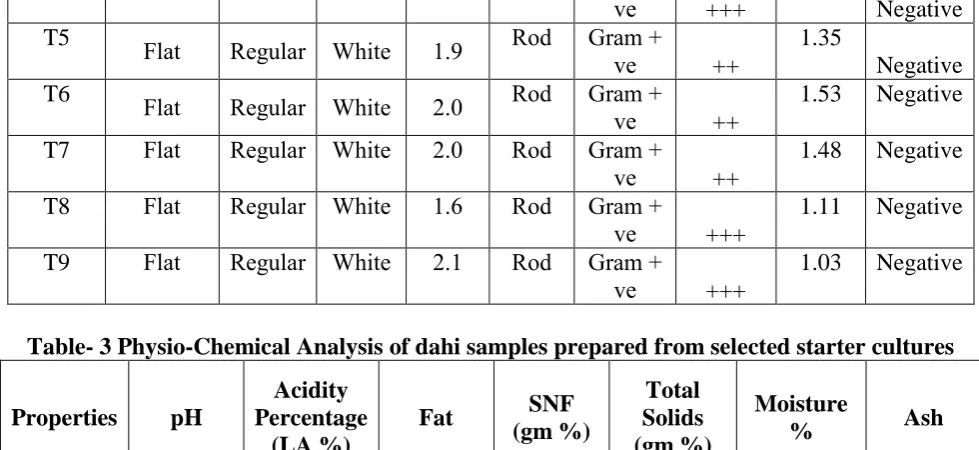
The nine cultures were fixed as treatments (T1 to T9). Among the isolates only three isolates namely T4, T8 and T9 had virulent and active strain. These strains were phenotypically characterized on the basis of their morphological, cultural and biochemical characteristics and under gram staining the cell morphology was found to be rod shaped and some of them coccid shaped (Renuka et al., 2012).Among the twenty isolates, the virulent strains were examined for morphological characters like margin, elevation, size, shape and the three virulent strains were measuring 1.9 mm in size for T4, 2.1mm for T8 and 2.1mm for T9, respectively. These results were similar to the report of Sanjeeb Kumar Mandal et al. (2013).
The curd samples were subjected to gram staining method to find out type of microbes present. All the microbes irrespective of colony were identified as gram positive having either rod or cocci shapes. The bacteria belong to T1, T2, T3, T5, T6, T10, T11, T12, T14, T15, T16, T19 and T20 samples were rod shaped bacteria and samples of T4, T8, T9, T13, T17 and T18 were cocci shaped. The results are shown in table 1 indicating that these organisms are of gram positive, rod shaped and belong to the genus of Lactobacillus species. Guessas and Kihal (2004) isolated lactic acid bacteria from goats milk in Algerian arid zone and reported that all isolated were gram positive.
The results for motility showed that the bacteria belong to all the samples were non-motile and their growth in the medium was in a confined stab line instead of making the whole medium turbid. The results given in table 3 indicate that bacteria belong to Lactobacillus species were non motile and these findings were similar to the report of Ahmed and Kanwal (2004). The most useful diagnostic test for Lactobacillus is catalase test and all the nine isolates of virulent strains were negative for catalyse test. Goyal et al., (2012) reported that absence of catalase enzyme showed that identified bacteria were from lactobacillus species.
The MBRT test of all the dahi samples found a reduction time (Hours) of 1.32, 1.59, 1.42, 1.15, 1.35, 1.53, 1.48, 1.11 and 1.03 for samples of T1, T2, T3, T4, T5, T6, T7, T8 and T9, respectively. The samples of T4, T8 and T9 were showed lower reduction time of 1.15, 1.11, and 1.03 hours, respectively. The sample T2 showed a higher reduction time 1.59 hours. The results are shown in table 5 indicating that organisms belong to the former three samples are virulent in nature. The results were similar to the report of Sivakumar et al. (2010).
@IJAPSA-2017, All rights Reserved Page 91 variants showed no significant difference between samples and this result was similar to the report of Varnam and Sutherland (1994).
With regard to the pH values, the samples T4, T8 and T9 showed maximum pH values of 4.52, 4.56 and 4.57, respectively while the sample T2 showed a minimum pH of 4.01. Statistical analysis of the data revealed no significant difference in pH of all samples of dahi which was in accordance with the report of Salji et al. (1985).
The fat percentages of T1, T2, T3, T4, T5, T6, T7, T8 and T9 dahi samples were estimated as4.2, 3.9, 4.1, 4.3, 4.1, 4.2, 4.0, 4.4 and 4.5, respectively. The maximum fat percentage was recorded in the treatment T4 (4.3), T8 (4.4) and T9 (4.5) while the minimum was estimated for T2 (3.9). The differences in the fat content of different dahi samples might be due to the lack of quality control standardization of milk for dahi production, adulteration of milk etc. (Rashid and Miyamoto 2005).
The variation in SNF content was noticed between dahi samples, which may be due to failure of standardization of raw milk during processing.
The highest total solids content of 12.6, 12.6 and 13.0 was observed for T4, T8 and T9, respectively. Further the sample T2 revealed lower total solids content of 11.2. Statistical analysis of the data revealed no significant difference in total solids content of different dahi samples (table-10).Preparation of dahi from the standardized or un standardized milk leads to much variation in the total solids content of market dahi samples (Sarkar et al. 1996).The maximum level of ash content was recorded for the treatment T9 (1.7) T8 (1.1) followed by T4 (1.0). Analysis of the data revealed no significant difference in ash percentage of all samples of dahi and the result was similar to the report of El-Bakri and El-Zubeir (2009). The moisture percentage of samples of T4, T8 and T9 showed lower moisture percentage of 87.4, 87.4 and 87.0, respectively while the highest moisture percentage 88.1was observed for T2. Statistical analysis of the data revealed no significant variation in moisture percentages among the dahi samples.
The sensory attributes such as smell and taste, body and consistency, colour and texture of the nine samples were evaluated by a panel of six judges. The score for smell and taste ranged from 30 to 46. The variations in smell and taste score of dahi samples usually depends on types of milk, starter culture and manufacturing process involved. The results obtained in the present investigation was in close agreement with the reports of Younus (1998) and Rangappa and Achaya (1974). The body and consistency scores showed highest valve for T4 (28), T8 (28) and T9 (28) and minimum value score was observed in T2 (21). As reported by Shukla and Sain, (1986) the body and consistency score of dahi samples could be improved by adding gelatine during preparation. (Shukla
and Sain 1986). The minimum score for color and texture of 4 was recorded in T2 and maximum
score of 8 recorded for T8 and T9. The variation was mainly influenced by sugar level, not by culture or by their interactions. The result of present study agrees with the findings of Begum (2004) who reported that colour and texture score of dahi prepared from whole milk was higher than other samples.
The highest total bacterial count was recorded in T4 (5.92 × 10 6), T8 (5.90× 10 6) and T9 (5.93 × 10 6) while lowest count was noticed in dahi sample T2 (5.76 × 10 6) indicating that these samples have active bacteria. The present investigation was supported by the result of Adeyl (1998)
and Haj et al (2007). The coliform counts were lowest in dahi samples of T4 (1.01 X 101), T8 (1.01
X 101) and T9 (1.03 X 101) while highest count was observed for T1 (1.41 X 101). It might be probably due to contamination at storage and display/sale outlet. Similar results have also been reported by Lopez et al. (1997). The yeast colonies were observed in all the dahi samples and highest yeast and mould were observed for T4 (0.73), T8 (0.46 and T9 (0.22).Presence of yeast and moulds in the samples were the indication of contamination. Contamination of the samples might have happened due to the traditional method of culture maintenance or post processing contamination (Tarakci and Kucukoner, 2003).
@IJAPSA-2017, All rights Reserved Page 92 Table - 1. Colony Character
SAMPLES COLLECTED
AREA
SAMPL ES
ELEVATIO
N MARGIN COLOUR
SIZE (MM)
SHAPE
Aarapalayam T1 * Flat Regular White 2.0 Rod
Kalavasal T2 Flat Regular White 1.6 Rod
Peeriyarnelayam T3 * Flat Regular White 2.1 Rod
Annanager T4 Raised Irregular Yellowish 2.2 cocci
Koripalayam T5 Flat Regular White 1.9 Rod
Mattuthavani T6 Flat Regular White 1.9 Rod
Puthur T7 * Flat Regular White 2.0 Rod
Nellupedai T8 * Raised Irregular Yellowish 2.2 cocci
Theppakkulam T9 Raised Irregular Yellowish 2.3 cocci
Nareemedu T10 * Flat Regular White 2.0 Rod
Mapalayamm T11 Flat Regular White 1.6 Rod
Palankanaththam T12 * Flat Regular White 2.1 Rod
Oththakadai T13 Raised Irregular Yellowish 2.2 cocci
Thammukkam T14 Flat Regular White 1.9 Rod
Sokkikulam T15 Flat Regular White 1.9 Rod
Sellur T16 * Flat Regular White 2.0 Rod
Arasaradi T17 Raised Irregular Yellowish 2.2 cocci
Ponmeni T18 Raised Irregular Yellowish 2.3 cocci
Meenakshipuram T19 * Flat Regular White 2.0 Rod
Therkuvasal T20 * Flat Regular White 1.6 Rod
*indicating that following isolate were selected randomly for preparation of dahi and further analysis
Table- 2 Isolation of Lactobacillus
Sample Elevation Margin Colour Size
(mm)
Shape Gram Staining
Motility MBRT (hrs)
Catalase
T1
Flat Regular White 2.0 Rod Gram + ve
++
1.32
Result T2
Flat Regular White 1.6 Rod Gram + ve
+
1.59
Negative
T3 Flat Regular White 2.1 Rod Gram +
ve ++
1.42
Negative
@IJAPSA-2017, All rights Reserved Page 93
ve +++ Negative
T5
Flat Regular White 1.9 Rod Gram + ve
++
1.35
Negative T6
Flat Regular White 2.0 Rod Gram + ve
++
1.53 Negative
T7 Flat Regular White 2.0 Rod Gram +
ve ++
1.48 Negative
T8 Flat Regular White 1.6 Rod Gram +
ve +++
1.11 Negative
T9 Flat Regular White 2.1 Rod Gram +
ve +++
1.03 Negative
Table- 3 Physio-Chemical Analysis of dahi samples prepared from selected starter cultures
Properties pH
Acidity Percentage
(LA %)
Fat SNF
(gm %)
Total Solids (gm %)
Moisture
% Ash
MEAN± SE 4.26± 0.07* 0.9± 0.032* 4.18± 0.14* 4.18± 0.14* 12.39± 0.43* 87.61± 3.01* 1.37± 0.05* *Within the treatments are statistically significant.
Table – 4 Sensory evaluations of dahi samples prepared from selected starter cultures Properties Smell and taste
( 50) Body and Consistency ( 30) Colour ( 10) Texture ( 10)
MEAN ± SE 41.2±1.42* 25.2±0.87* 6.8±0.24* 7.0±0.25*
*Within the treatments are statistically significant
BIBLIOGRAPHY
[1] Adeyl, F. M. M., (1998). Studies on the physical, chemical and microbiological qualities of misti dahi of different district of Bangaladesh. M. Sc thesis, Bangaladesh Agricultural University, Bangaladesh.
[2] Ahmed T, Kanwal R, (2004). Biochemical characteristics of lactic acid producing bacteria and preparation of camel milk cheese by using starter culture, Pak. Vet. J. Volume 24.
[3] AOAC (1990). Official Methods of Analysis of the Association of Official Analytical Chemists, 15th edition, Virginia 22201, Arlington.
[4] AOAC (2003). Official Methods of Analysis of the Association of Official Analytical Chemists, International. 17th edition. Gaithersburg, MD, USA, Association of Analytical Communities.
[5] Begum, J. ( 2004). Qualitative characteristics of dahi prepared from non-fat dry milk fortified with vegetable oil. M.S Thesis, Department of Dairy Science, Bangladesh Agricultural University, Bangladesh.
[6] Barrow. G. I. and R. K. A. Feltham.( 1993). “Cowan and Steel”s manual for the identification of medical bacteria, Cambridge University Press, Cambridge.
[7] El-Bakri JM and El-Zubeir IEM. (2009). Chemical and microbiological evaluation of plain and fruit yoghurt in Khartoum State, Sudan. International journal ofdairy technology, vol 4: 17- 21
[8] Farn warth E.R.(2005). Kefir a complex probiotic. J.Nutraceuticles,Functional and Medical Foods, vol 4: pp 93- 117
[9] Goyal R, Dhingra H, Bajpai P, Joshi N. (2012). Characterization of the lactobacillus isolated from different curd samples. African journal of biotechnology, 14448-14452.
[10]Guessas, B. and Kihal, M. (2004). Characterization of lactic acid bacteria isolated from Algerian arid zone raw goats’ milk. Afr.J.Biotechnol.3.pp:339-342.
[11]Haj, M.H.M., O.A. O. El- Owni and I.E.M. El – Zubeir., (2007). Assesment of chemical and microbiological qualiy of stirred yoghurt in Khartoum state, Sudan. Res. J. Anim. Vet. Sci., 2 pp 56 – 60
@IJAPSA-2017, All rights Reserved Page 94
[13]Lopez.M. C., L. M. Medina, M. G. Cordoba and R. Jordano, 1997. Evaluation of the microbiological quality of yoghurt ice cream’. Alimentaria. 35: 39-45. CAB Abst. (1996-1998/07
[14]Murugan,M., Suganya,K., and Murugan,T (2013). Isolation and Characterization of probiotic lactic acid bacteria from milk and curd samples. International Journal of Pharma and Bio Science 4(1): pp 317 - 324.
[15]Pearson, D., (1976). Chemical Analysis of Foods, Churchill Living Stone, Edinburgh, London. Pp:108
[16]Rangappa, K.S. and Achaya, K.T. (1974). Indian Dairy Products. 2nd edition, Asia publishing house, Bombay. pp. 119 – 124.
[17]Rashid MH and Miyamoto TM (2005). Quality evaluation of traditional fermented milk "Dahi" in Bangladesh. Milk Sci. 54: 1-9.
[18]Richter ,R.L.(1980). A review of cultured dairy products, quality cultures and kurds klinic. Cult.Dairy Product. J. Vol 15 pp 13-15.
[19]Renuka Goyal, Harish Dhingra, Pratima Bajpai and Navneet Joshi (2012). Characterization of the Lactobacillus isolated from different curd samples. African Journal of Biotechnology Vol. 11(79), pp. 14448-14452
[20]Rewati Raman Bhattari and Suman Kumar Lal Das., (2013) Scientific study on indigenous technology of dahi making of eastern Nepal. Journal of Food processing Technology. Vol 4. Pp 253 - 256
[21]Sanjeeb Kumar Mandal and Suneetha Vuppu (2014). Preliminary Studies On Probiotic Potential Of Selected Lactobacillus Vit Ssv Strains Screened From Curd Samples Of Vellore, Bihar, Haryana and Varanasi. Int J Pharm Bio Sci 4(2): (p) 193 – 200
[22]Salji, J. P., Fawal, A. K. Saadi, S. R. Ismail A. A. and Mashhadi, A. (1985). Effect of processing andcompositional parameters of quality of plain liquid yoghurt. Milchwissen chaft. 40: 734-736. FSTA., 18: P143 (1986).
[23]Sarkar, S., Kuila R. K. and Misra, A. K. (1996). Organoleptic, microbiological and chemical quality of misti dahi sold in different districts of West Bengal. Ind. J. Dairy Sci., 49: 54-61. CAB Abst. (1996-1998/07).
[24]Savadogo Aly, Outtara Cheik A.T, Bassole Imael H.N, Traore S. Alfred. (2006). Bacteriocins and Lactic acid Bacteria. African Journal of Biotechnology. Vol. 5 (9) 678-683.
[25]Shukla, F.C. and Sain, S.C. 1986. Indian Dairy Associaiton, (N.Z.) Seminar held at Karnal in February.
[26]Sivakumar,N and Kalaiarasu,S. (2010). Microbiological approach of curd samples collected from different locations of Tamilnadu, India. International Journal of Current Research Vol.2(10), pp. 027-030.
[27]Tarakci. Z and Kucukoner, E. (2003).physical, chemical, microbiological and sensory characteristics of some fruit flavoured yoghurt.YYU Vet falk derg, 14 (2) :10-14
[28]Varnam, A. H. and J. P. Sutherland. (1994). Milk and Milk Products: Technology, Chemistry and Microbiology. Chapman and Hall, London. P: 351-364