COMPUTER SCIENCE & TECHNOLOGY
www.computerscijournal.org
September 2013, Vol. 6, No. (3): Pgs. 315-320 An International Open Free Access, Peer Reviewed Research Journal
Published By: Oriental Scientific Publishing Co., India.
INTRODUCTION
Bacteria are present in everywhere, and are tiny single-cell microorganism. Scanning Electron Microscopic (SEM) is a well-known and advanced technique to visualize the external appearance of bacteria1 and these images are
need to be analyzed for various purposes such as measurement of size and shape and, morphological identification. Automatic segmentation methods make this process easier and faster than the manual processes.
Segmentation is a fundamental step in computer image analysis. The edge detection
An Efficient Edge Detection Method Based on
Bit-plane Slicing for Bacterial Images
P. KALAVATHI
Department of Computer Science and Applications,
Gandhigram Rural Institute – Deemed University, Gandhigram - 624 302, India.
(Received: July 29, 2013; Accepted: August 15, 2013)
ABSTRACT
Bit-plane slicing is a method which divides the image into many binary image planes and categorizes the image data into most significant and least significant information. In this paper a new edge detector using the most significant image data to detect the edges in the bacterial images is developed. This proposed method finds the edges in the higher order bit-planes using contouring technique and combines these edges to get the final edge image. The edges obtained by the proposed method are more accurate than the existing method. The experimental result obtained by the proposed edge detector is compared with the popular edge detectors Canny, Log, Prewitt, Robert and Sobel and have produced best results.
Key words: Edge detectors, Bit-plane slicing, Bacterial image, Segmentation.
technique is one of the methods for bacterial image segmentation which preserve the structural properties of the image that can be used for further processing. There are many edge detection techniques are available in the literature2-3. Among
them Canny, Laplacian of Gaussian (Log), Prewitt, Robert and Sobel are the most commonly used edge detectors. Canny4 is a well known edge
detector still used in research. Canny edge detector uses a multi-stage algorithm to detect edges in the image. It results with fine edges after suppressing the noises present in the image. The Log 5 uses a
laplacian of an image highlights rapid intensity change in the image region. This Log edge detector is also referred as zero crossing edge detection. Prewitt6 is a discrete differentiation operator that
computes an approximation of the image gradient to detect both horizontal and vertical edges. The Roberts edge detector proposed by Lawrence Robert in 19657 that detects the regions of high
spatial gradient as an edge by performing a simple two dimensional gradient measurement on an image. Sobel edge detector8 is an edge detection
method which finds edges in the image using the derivative approximation and returns edge at those points where the gradient is maximum.
In this a paper, an efficient edge detection using contouring method based on bit-plane slicing is developed. This proposed method was evaluated using 25 bacterial images obtained from the internet. The resultant edge images by the proposed method are compared with the edge images obtained by the existing edge detectors such as Canny, Log, Prewitt, Robert and Sobel. The remaining part of the paper is organized as follows: Section 2, the methodological details of the proposed method is given. The results and discussion are given in Section 3 and the conclusion is given in Section 4
METHOD
Some of the image processing applications such as compression require to know the contributions of individual bits made to the total image. Bit-plane slicing is a method to slice the image into different planes known as bit-planes. In general, 8-bit pixels are processed and the 8-bit image is divided into 8-bit planes. The 0th plane is
the least significant bit-plane (LSB) and the 7th
plane is the most significant bit-plane (MSB) and the bit-plane slicing of 8-bit image is illustrated in Fig.1.
In bit-plane slicing, each plane has a value zero representing gray level 0 and one representing gray level 255 for 8-bit gray Scale images. Usually, the higher order bit-planes (4th
to 7th) contains more visually significant data (edge
information) and the lower order bit-planes (0th to
3rd) contains more detailed information (fine details
and noises) about the image. Since, the higher order bit contains the edge information and therefore, in the proposed method the higher order two bit-planes (6th and 7th) are used to detect the
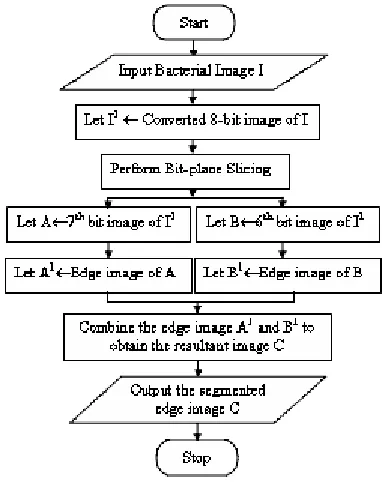
edges of the bacterial image. The overall flowchart of this proposed method is given in Fig. 2 and is illustrated in Fig. 3.
Fig. 1: Bit-Plane Slicing
Fig. 2: Flowchart of the Proposed Method The input bacterial image is first converted into 8-bit gray scale image and then the bit-plane slicing is performed to get the bit-plane images. In this approach the 7th and 6th bit planes
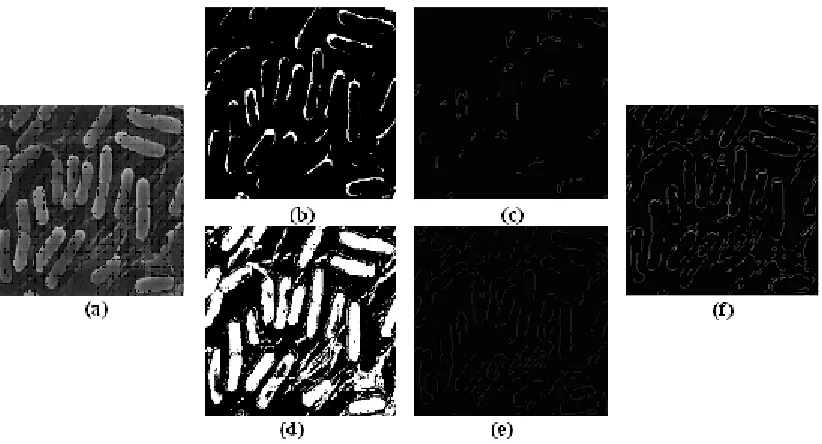
image (Fig. 3(a)) is shown in Fig. 3(b) and 3(d) respectively. To detect the edges in the bit-plane images, the contour lines are drawn using the contouring algorithm [9]. In this algorithm, the input image is treated as a regularly spaced grid with each edge element connected to its nearest neighbors. Then, the algorithm scans this matrix to the contour level values (in this method the contour level is 1, since there are only black and white pixels are present in the image representing background and foreground information respectively). If a contour level falls within a cell, the algorithm performs a linear interpolation to locate the point at which the contour crosses the edge of the cell. Then, it connects these points to produce the edge image. Finally the edge images are combined to produce the output image. For the selected sample image in Fig. 3(a), the edge images are shown in Fig. 3(c) and 3(e) for 6th
bit-plane (Fig. 3(b)) and 7th bit-plane (Fig. 3(d)) images
respectively. The edge in the bit-plane images are combined to produce the resultant edge image and is shown in Fig. 3(f).
RESULTS AND DISCUSSION
The performance of the proposed method is evaluated using the bacterial images obtained from the internet. The resultant edge image of the original and bit-plane images are compared with the existing popular edge detectors Canny, Log, Prewitt, Robert, Sobel and the proposed contour edge detector method. The edges of the selected sample original image and the bit-plane images for the existing and the proposed methods are shown in Fig. 4 and Fig. 5 respectively. It is evident from the Fig. 4 and Fig. 5 is that the edges produced by the proposed contour edge detector and the existing method have produced best result on bit-plane sliced images than the original image. Moreover, the edge images obtained by the proposed contour edge detector are better than the existing methods (Image 4, Image 5 and Image 6 in Fig. 4 and Fig 5). Thus, from these results, it is observed that the bit-plane slicing approach may also play as a vital role in image segmentation.
Fig. 3: Process of Edge Detection based on Bit-Plane Slicing; (a) Original Image (b) 6th Bit-Plane Image (c) Detected Edges in 6th Bit-Plane Image (d) 7th Bit-Plane Image
CONCLUSION
In this paper, a simple, automatic and efficient edge detector based on bit-plane slicing is proposed and is applied to detect the edges of the bacterial images. The edges are detected more accurately by the contour method than the existing
popular edge detectors. Further, the proposed and the existing method detected the edges more accurately in the bit-plane sliced images than the original image. In future this proposed method may be extended to detect edges on all kinds of gray scale images.
REFERENCES
1. Kaláb, A.F., Yang, Chabot, D., Conventional Scanning Electron Microscopy of Bacteria, In Focus Magazine, 10 (2008).
2. Gonzalez, R.C., Woods, R.E., Digital Image Processing. Upper Saddle River, NJ: Prentice-Hall, 572-585 (2001).
3. Sonka, M., Hlavac, V., Boyle, R., Image Processing Analysis and Machine Vision, 2nd Edition, Brooks Cole Publishing
Company, Pacific Grove, CA (1999). 4. Canny, J., A computational approach to
edge detection, Pattern Analysis and Machine Intelligence, IEEE Transactions on, PAMI, 8(6):679–698 (1986).
5. Marr, D., Hildrith, E., Theor y of Edge Detection, Proc. Royal Society of London,
207: 187–217 (1980).
6. Prewitt, J.M.S., Object Enhancement and Extraction, in Picture Processing and Psychopictorics, B.S. Lipkin & A. Rosenfield Eds., Academic Press (1970).
7. Roberts, L., Machine Perception of 3-D Solids, Optical and Electro-Optical Information Processing, MIT Press (1965). 8. Sobel, I., An Isotropic 3×3 Gradient Operator, Machine Vision for Three – Dimensional Scenes, Freeman, H., Academic Pres, NY, 376-379 (1990). 9. Snyder, W.V. Algorithm 531, Contour Plotting