R E S E A R C H A R T I C L E
Open Access
Bowel problem management among nursing
home residents: a mixed methods study
Susan Saga
1,2*, Arnfinn Seim
2, Siv Mørkved
2,3, Christine Norton
1,4and Anne Guttormsen Vinsnes
1Abstract
Background:Bowel problems such as constipation, diarrhoea and faecal incontinence (FI) are prevalent conditions among nursing home residents and little is known about nursing management. This study aimed to elucidate how Norwegian registered nurses (RNs) manage bowel problems among nursing home residents.
Methods:A mixed methods approach was used combining quantitative data from a population-based cross-sectional survey and qualitative data from a focus group interview. In the cross sectional part of the study 27 of 28 nursing homes in one Norwegian municipality participated. Residents were included if they, at the time of data collection, had been a resident in a nursing home for more than three weeks or had prior stays of more than four weeks during the last six months. Residents were excluded from the study if they were younger than 65 years or had a stoma (N = 980 after exclusions). RNs filled in a questionnaire for residents regarding FI, constipation, diarrhoea, and treatments/ interventions. In the focus group interview, 8 RNs participated. The focus group interview used an interview guide that included six open-ended questions.
Results:Pad use (88.9%) and fixed toilet schedules (38.6%) were the most commonly used interventions for residents with FI. In addition, the qualitative data showed that controlled emptying of the bowels with laxatives and/or enemas was common. Common interventions for residents with constipation were laxatives (66.2%) and enemas (47%), dietary interventions (7.3%) and manual emptying of feces (6.3%). In addition, the qualitative data showed that the RNs also used fixed toilet schedules for residents with constipation. Interventions for residents with diarrhoea were Loperamide (18.3%) and dietary interventions (20.1%). RNs described bowel care management as challenging due to limited time and resources. Consequently, compromises were a part of their working strategies.
Conclusions:Constipation was considered to be the main focus of bowel management. Emptying the residents’ bowels was the aim of nursing intervention. FI was mainly treated passively with pads and interventions for residents with diarrhoea were limited. The RNs prioritized routine tasks in the nursing homes due to limited resources, and thereby compromising with the resident’s need for individualized bowel care.
Keywords:Constipation, Diarrhoea, Faecal incontinence, Nursing homes, Cross-sectional survey, Focus groups
Background
Faecal incontinence (FI) and constipation are prevalent conditions among nursing home residents [1,2]. The conditions cause difficulty with hygiene, skin problems, pain and discomfort, as well as having serious implications for residents’ dignity [3]. Bowel problems are a profes-sional challenge for nursing home staff. In addition, FI is
associated with high costs related to pad use, time spent by staff to wash and change patients, laundry expenses, skin damage and infections. A nursing home is a place of residence for people with health problems and significant deficiencies in activities of daily living (ADL), requiring medical or nursing care. Nursing home residents could be described as“frail older persons who have impaired phys-ical activity, mobility, muscle strength, cognition, nutri-tion, and endurance” [2]. Nursing home residents are a particularly vulnerable population as they have lost the independence to live in the community through illness, disability and frailty. At the same time, recognition of the * Correspondence:[email protected]
1
Faculty of Nursing, Sør-Trøndelag University College, Postbox 2320, 7004 Trondheim, Norway
2
Department of Public Health and General Practice, Norwegian University of Science and Technology, Postbox 8905, 7491 Trondheim, Norway Full list of author information is available at the end of the article
unique skill of nursing home staff is low [4]. Life expect-ancy will increase in the in the coming decades, however often with accompanying morbidities [5]. These demo-graphic changes will constitute a significant challenge for the health care systems involved, particularly nursing homes. RNs spend a lot of time managing residents’bowel problems in nursing homes and they have a key role in the assessment, prevention and management of bowel problems. However, there is little evidence on how RNs actually manage bowel problems and the quality of the interventions performed.
Bowel problems in nursing home residents
FI is “the involuntary loss of liquid or solid stool that is a social or hygienic problem”[1]. Previous studies on FI in nursing home residents suggest a prevalence between 33.3% and 66.8% [6-9]. Constipation is defined as an abnormality of stool bulk, hardness or frequency and might be associated with straining [10]. It is however common to take laxative use as a marker for constipa-tion in clinical studies. Prevalence of constipaconstipa-tion is reported as between 50-74% in institutionalized elderly people in an evidence-based review [11]. Chronic diar-rhoea is defined as the frequent passage of unformed stool for more than three weeks [12]. The prevalence of diarrhoea in nursing homes is rarely reported in scientific work and is mostly associated with studies on Clostridium difficile. Clostridium difficile-associated diarrhoea has been identified in 3.4% to 21.7% of nursing home residents [13-15]. In a population-based Norwegian cross-sectional study, RNs reported that 42,3% of residents had involun-tary leakage of faeces once a week or more often, 41.0% of the nursing home residents were constipated when laxa-tive use was included as a marker, and the prevalence of diarrhoea was 17.3% [9].
Bowel symptoms such as constipation and diarrhoea are related to FI, as well as laxative use [1]. Among frail elderly people, FI is also associated with reduced mobil-ity, cognitive impairment, co-morbidmobil-ity, urinary incon-tinence [16] and length of stay in the nursing home [9]. Constipation among elderly people is related to loss of mobility, medications, underlying diseases, impaired ano-rectal sensation, and ignoring calls to defecate [17]. Low fibre intake and limited fluid intake have also been impli-cated as causes of constipation, but there is little evidence from the literature to support this [18]. Diarrhoea is related to infections, faecal impaction/constipation, co-morbidity or side effect of medications [19].
Clinical guidelines for both community dwelling and frail elderly patients with FI, constipation or diarrhoea are available [1], but not for the group of institutionalized eld-erly. Bowel problems among nursing home residents are multifaceted conditions which are often inter-related, and treatment and care for these conditions will often require
a multifactorial intervention approach. The International Consultation on Incontinence (ICI) recommends that all patients in nursing homes should be assessed for faecal incontinence [1]. Treatment and care for residents with bowel problems should be directed to underlying causes and be evidence-based. The ICI’s recommendations for frail elderly with constipation which has not responded to lifestyle modifications such as toileting as needed, diet and mobility are to achieve an effective bowel clearance by using a combination of laxatives and enemas, followed by maintenance therapy with laxatives or suppositories [1,16]. A previous study has demonstrated that chronically con-stipated patients improved or became symptom free by using supplemental fiber [20]. There is however no evi-dence that increased fluid intake improves constipation symptoms [17,18]. Loperamide has shown good effect in chronic diarrhoea, but should be used with caution due to possible mis-interpretation of spurious diarrhoea caused by faecal impaction [1]. Also, dietary measures such as soluble dietary fibre [1] and probiotic yogurt drinks [21] are recommended.
There are few published trials of treatment for FI in older people, and the few existing studies mostly have small numbers and problematic methodology [1]. Con-servative treatment such as bowel training [22], biofeed-back treatment [23] and pelvic floor training [24] has shown some effect among frail elderly patients with FI. Other conservative treatment methods used, but with a more uncertain effect, are rectal irrigation, electric stimu-lation and using pads or an anal plug. In addition, it is im-portant to modify stool consistency [25]. Detailed medical history on medications and co-morbid problems, rectal examination, colonoscopy and physiological tests may identify organic and functional causes. However, in frail older people, there is usually more than one mechanism, requiring an individualized but multifactorial treatment approach. The importance of identifying treatable causes is strongly emphasized, in addition to assessing the pa-tients’cognitive and functional level [1].
RNs manage bowel problems among nursing home resi-dents, in order to understand their clinical reasoning and decision making processes. This work is part of a larger research programme that aims to examine preva-lence, correlates and management of FI among nursing home residents in Norway [9,27].
Methods
In order to obtain information about how RNs manage bowel problems among nursing home residents, cross-sectional data were collected. RNs filled in a question-naire regarding bowel interventions for all nursing home residents in one Norwegian municipality. In addition, in order to shed some light on the quantitative data, a qualitative focus group interview with RNs was used. A focus group interview is a technique used to obtain dynamic and interactive discussion to clarify the infor-mants’ perceptions and experiences and is especially useful to reveal shared understanding and practice [28]. Using a mixed method approach, descriptive data from the population based cross-sectional study, was com-bined with rich qualitative data from a focus group interview to offer a more comprehensive picture of RNs’ bowel management practices in nursing homes [29]. This study was carried out in accordance with Declaration of Helsinki and The Regional Committee for Medical and Health research Ethics, REC South East, approved the study (2009/1225). No consent from residents or their next of kin was required by the ethical committee because all the resident information gathered was de-identified and anonymous to the researcher. The participants in the focus group interview gave their written informed consent to participate in the study.
Setting
The cross-sectional study was performed in nursing homes in Trondheim municipality, Norway during June 2010 and the focus group interview was conducted in April 2013. Population-wise, Trondheim is the third lar-gest municipality in Norway, and comprises both urban and rural areas. In Norway, the municipalities have a statutory obligation to provide nursing home services to those who need it [30]. As of 2010, there were 28 nurs-ing homes in Trondheim. Most of them were run and owned by the municipality. However, there were also a few non-profit private providers. The nursing homes have RNs on duty 24-hours a day, and approximately 25% of the staff on each shift were registered nurses, 50% were licensed practical nurses and 25% were un-skilled labour. Additionally, a physician is employed and has medical responsibility for the nursing home resi-dents, but is only available for a few hours a week [31]. The staff-to-resident ratio was approximately 1:4 in most nursing homes on the day shift, 1:8 on the evening shift
and fewer on the night shift. The total number of nurs-ing home residents in the municipality was 1322 at the time of the study.
Sample/participants
Sample 1–nursing home residents
In the cross-sectional study all 28 nursing homes in one Norwegian municipality were invited to participate. Resi-dents who were resident in a nursing home at the time of data collection were included if they had been a resi-dent for more than three weeks or had prior stays of more than four weeks during the last six months. Resi-dents younger than 65 years or who had a stoma were excluded from the study after data collection.
Sample 2–RNs
The participants for the focus group interview were re-cruited through convenience sampling, and included 7 women and one man from 7 different municipal nursing homes. Mean age of the informants in the focus group was 40.9 years (range 26–61 years), mean years of work experience were 10.4 (range 3–40 years). Four of the RNs had postgraduate education in elderly care; only two of the RNs stated that they had received some degree of training regarding FI.
Data collection
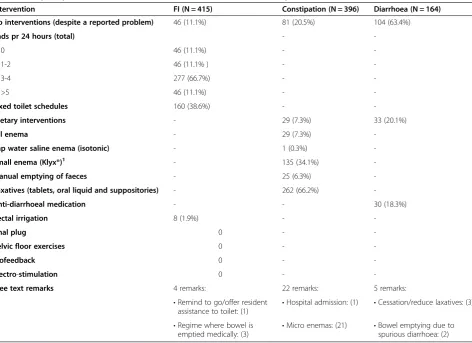
The cross-sectional study aimed to survey the nursing management of FI, constipation and diarrhoea. There were no existing survey instruments or questionnaires translated and validated in Norwegian for this purpose. Consequently, a questionnaire specifically designed for this study was developed to obtain information about: the residents’ admission date, type of care, birth year, sex, stoma, medical diagnosis, medications, cognitive impairment, FI, urinary incontinence, constipation, diar-rhoea, and bowel management (FI, constipation and diarrhoea). An interdisciplinary expert group developed the questionnaire. The questionnaire was pilot tested in one nursing home unit [9,27]. To obtain information about the residents’ functional level, the validated Barthel’s ADL index was included [32]. RNs with com-prehensive oversight of each patient filled in a question-naire for each nursing home resident. The municipality received payment as a compensation for the time used for data collection. The methods for the questionnaire study are more thoroughly described elsewhere [9]. Questions regarding bowel interventions were based on recommendations from the consensus literature [1], pre-vious studies [16-18,20-24] and common practice in Norwegian nursing homes and response options are presented in Table 1.
the focus group study. The head nurses selected RNs for the study according to convenience. The group met once at the local University College and the interview lasted for one and a half hours using an interview guide that included six open-ended questions:
1. Can you tell us about yourself and your role in the nursing home?
2. What do you do during your work day when you find that a resident has problems with hard and irregular bowel movements?
3. What do you do during your work day when you find that a resident has problems with diarrhoea or loose stools?
4. What do you do during your work day when you find that a resident has problems controlling bowel movements?
5. How can we make things better? (Specific expectations) 6. Is there anything that we have not discussed that
you think is important to mention?
These topics were guided by the previous question-naire responses. Two nurse researchers, both female and
from the local Faculty of Nursing, facilitated the focus group interview: A PhD student (SS) moderated the group, which included keeping the discussion on track, ensuring that everyone took part, and balancing the par-ticipants’contributions. The other researcher, a Professor (AGV), was present as an observer with responsibility to ensure that all six questions were discussed [28]. Both researchers had prior experience of conducting research interviews or focus group interviews.
Data analysis
Statistical methods included estimating prevalence in percentages, chi-square test and other descriptive statis-tics. Statistical calculations were performed using PASW® statistics 19 for Windows (SPSS Inc., Chicago, Illinois USA).
The methodological orientation used to underpin the qualitative part of the study was a descriptive content ana-lysis [33]. The focus group interview was audio-recorded and transcribed verbatim, retaining frequent repetitions, pauses, and emotional expressions [33]. In order to ac-quire an overview of themes and a general impression, the transcripts were first read through several times by two
Table 1 Frequency of interventions for residents (N = 980) with FI, constipation and diarrhoea
Intervention FI (N = 415) Constipation (N = 396) Diarrhoea (N = 164)
No interventions (despite a reported problem) 46 (11.1%) 81 (20.5%) 104 (63.4%)
Pads pr 24 hours (total) -
-0 46 (11.1%) -
-1-2 46 (11.1% ) -
-3-4 277 (66.7%) -
->5 46 (11.1%) -
-Fixed toilet schedules 160 (38.6%) -
-Dietary interventions - 29 (7.3%) 33 (20.1%)
Oil enema - 29 (7.3%)
-Tap water saline enema (isotonic) - 1 (0.3%)
-Small enema (Klyx®)1 - 135 (34.1%)
-Manual emptying of faeces - 25 (6.3%)
-Laxatives (tablets, oral liquid and suppositories) - 262 (66.2%)
-Anti-diarrhoeal medication - - 30 (18.3%)
Rectal irrigation 8 (1.9%) -
-Anal plug 0 -
-Pelvic floor exercises 0 -
-Biofeedback 0 -
-Electro-stimulation 0 -
-Free text remarks 4 remarks: 22 remarks: 5 remarks:
•Remind to go/offer resident assistance to toilet: (1) •
Hospital admission: (1) •Cessation/reduce laxatives: (3)
•Regime where bowel is emptied medically: (3)
•Micro enemas: (21) •Bowel emptying due to spurious diarrhoea: (2) 1
researchers independently (SS & AGV). The analysis then moved into meaning condensation and coding. Themes were partly identified in advance from the topic guide and partly derived from the data. The subsequent codes and sub-codes were categorized into an index manually. Finally, by comparing and contrasting the content in each category, meaning categorization was achieved [33]. In order to ensure the trustworthiness of the analysis, the coding process was cross-validated by the same two re-searchers who took part in the interview. In this mixed-methods study, an explanatory design was used where the development of a qualitative design was based on the quantitative results [29]. The data analyses were per-formed separately, and the findings were not compared until the interpretation stage. Although inferences were drawn after each phase (quantitative and qualitative), a meta-inference was drawn at the end of the interpret-ation phase, when the inferences from both designs were compared.
Results
Cross-sectional data
Of the 28 nursing homes in a Norwegian municipality, 27 nursing homes participated. After exclusions 980 resi-dents were included, a 90.3% overall response rate for the total municipal nursing home population (Figure 1). Mean age of the residents was 85.5 years (SD 7.3, range 65–107 years); 73.9% women and 26.1% men; 92.5% in long-term care and 7.5% in short-term care. The latter included rehabilitation and respite stays. Mean duration
of stay was 881.9 (SD 871.0) days in long-term care, and 51.1 (SD 56.6) days in short-term care. Cognitive impair-ment was reported in 80.3% of the residents, and mean score on Barthel’s ADL index was 9.5 (SD 5.6). The RNs reported that 42.3% of residents had involuntary leakage of feces a few times a month or more often; 41% had constipation-related problems (including laxative use) according to the RNs’ assessment; 17.3% had diarrhoea or loose stool. Detailed results have been reported previ-ously [9]. A total of 74.4% of the residents with FI used pads for FI, urinary incontinence or both; 59.3% of all the nursing home residents received oral laxatives regu-larly and 1.2% received micro enemas reguregu-larly.
Among the nursing home residents with constipation 66.2% received laxatives (tablets, oral liquids and supposi-tories), 34.1% were given enemas with 120 ml or 240 ml docusate sodium and sorbitol, 0.3% were given isotonic sa-line enemas (with tap-water), and 7.3% were given oil en-emas for constipation. Nutritional interventions were used in 7.3% of the residents, while manual emptying of the bowels was used for 6.3%. No interventions were reported for 20.5% of the residents with constipation (Table 1). Additionally, there were 21 open responses regarding use of micro enemas (5.3%) for residents with constipation.
Loperamide was given to 18.3% and dietary interven-tions were carried out for 20.1% of the residents with diarrhoea. No interventions were carried out for 63.4% of the residents with diarrhoea or loose stool. Addition-ally, there were 5 open responses regarding diarrhoea, 3 of which concerned cessation or reduction of laxatives
Declined to participate: 1 NH institution: 80 1 single NH unit: 30
1322 registered NH* patients in Trondheim (june 2010)
1022 questionnaires collected
980 cases
Cases not included: Short length of NH stay: 189 Inadequate questionnaire: 1
Exclusions: Age <65 years: 23 Exclusions:
Stoma: 19
and 2 remarks on the need to empty the residents’ bowels due to spurious diarrhoea.
Most of the interventions for FI were related to pad use; 88.9% of residents with FI used one pad or more per 24 hours. Pads were used for both urinary and FI. Other interventions for FI were fixed toilet schedules, which were used in 38.6% of residents with FI and rectal irrigation used in 1.9%. No interventions were carried out for 11.1% of the residents with FI. Anal plugs, pelvic floor exercise, bio-feedback and electro stimulation were also response options in the questionnaire, but did not generate any responses. In addition, 4 open remarks were made regarding FI. Three of these remarks men-tioned that the residents’ bowel was emptied medically in order to maintain control and avoid accidents. The remaining remarks reported the need to remind resi-dents to go to the toilet, or to offer toileting assistance.
Focus group data
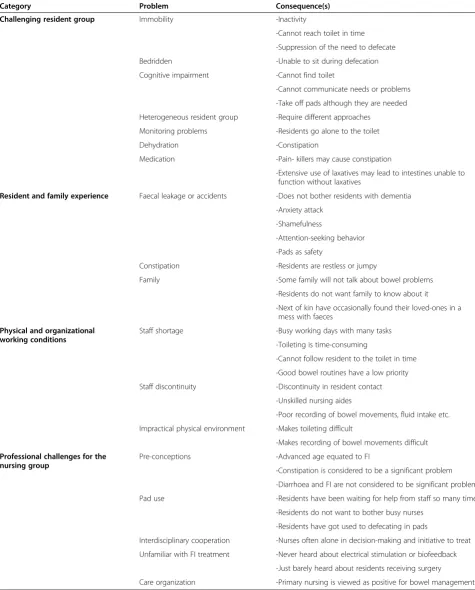
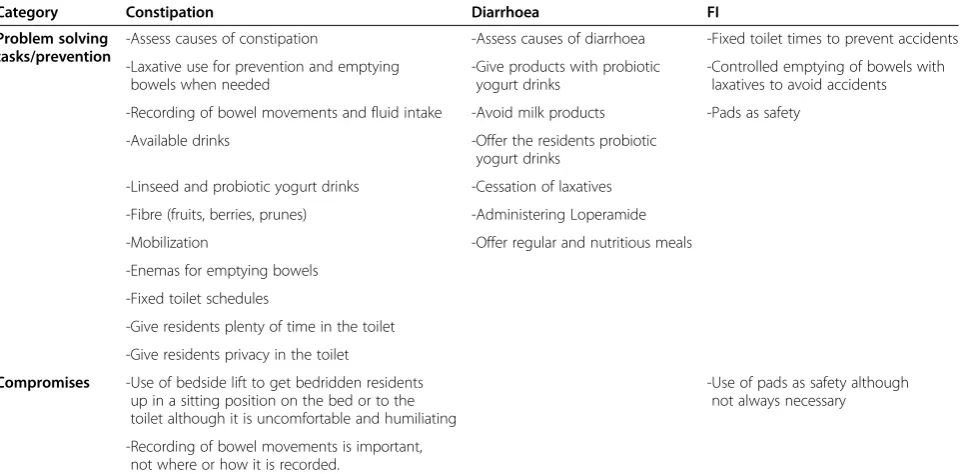
From the survey responses six questions were developed (Box 1). The RNs were asked to talk about their experi-ences with bowel problems and FI among nursing home residents. Two overarching domains emerged from the focus group; firstly, the RNs described the challenges of providing good bowel care for this resident group (Table 2). Secondly, they described different solutions for managing bowel problems among nursing home residents (Table 3). Verbatim quotes are presented in italics.
Challenges in bowel management
In the “challenges in bowel management” domain, four categories were generated: 1) challenging resident group, 2) resident and family experience, 3) physical and organi-zational working conditions and 4) professional challenge (Table 2).
Challenging resident group
“It is very difficult in our nursing home because there is a lot dementia. (…) More than 80 percent have dementia diagnoses at different levels,so it’s not so easy for them to explain themselves” (participant 2). The RNs described a situation where many residents were cognitively and/or physically impaired or had psychiatric diagnoses, thus requiring different approaches to bowel care: residents with dementia were unable to find the toilet or unable to communicate needs and residents with physical im-pairment had difficulties reaching the toilet in time. The RNs also experienced difficulty in obtaining an overview of bowel habits for residents who went to the toilet inde-pendently. The RNs experienced constipation as a con-siderable problem among nursing home residents which they felt was due to long-term use of laxatives, dehydration, pain-killers, inactivity, suppression of the need to defecate, or inability to sit during defecation.
Resident and family experience
“Then there’s the elderly residents with progressing de-mentia, they do not react at all. (…) They do not even know that they hold stool. If you do not notice the smell,
they [the residents]do not respond to it” (participant 8). Some RNs believed that residents with dementia did not care if they had faecal leakage, but other had experi-enced that residents felt shame or had anxiety attacks after faecal accidents. One RN felt that faecal accidents sometimes were a way of getting the staffs attention. The RNs described that some residents used pads for safety while others were ashamed to wear pads. One RN was concerned about residents being unable to commu-nicate, feeling that restless or jumpy residents are often constipated. The RNs reported that many residents had reservations regarding staff talking about their bowel problems with their families. They also felt that the fam-ilies were reluctant to discuss the topic, unless some of the next-of-kin were nurses themselves.
Physical and organizational working conditions
“I also think that there shouldn’t be too many people
[working] with the resident within a given time. Then you’ll have a better overview (…); [It is better if] there are full time nurses or other professionals present on a daily basis, making observations together and managing to follow up on them” (participant 3). The RNs stressed that there were too few staff, too many were unskilled and that they experienced a discontinuity in resident contact. The RNs felt that they spent a lot of time toilet-ing residents, but still were not able to follow residents to the toilet in time and that recording bowel move-ments was not prioritized. The RNs also experienced that an unsuitable physical environment was a hindrance to good bowel care and accurate record-keeping: “Our buildings are so awkward, if you have to run to the first floor…maybe you are far over there, then you have to go back here,then you have to go to the third floor,and then you have to go somewhere to record it…it may easily be forgotten”(participant 7).
Professional challenges for the nursing group
Table 2 Typology of RNs’experience of bowel care management: challenges in bowel management
Category Problem Consequence(s)
Challenging resident group Immobility -Inactivity
-Cannot reach toilet in time
-Suppression of the need to defecate
Bedridden -Unable to sit during defecation
Cognitive impairment -Cannot find toilet
-Cannot communicate needs or problems
-Take off pads although they are needed
Heterogeneous resident group -Require different approaches
Monitoring problems -Residents go alone to the toilet
Dehydration -Constipation
Medication -Pain- killers may cause constipation
-Extensive use of laxatives may lead to intestines unable to function without laxatives
Resident and family experience Faecal leakage or accidents -Does not bother residents with dementia
-Anxiety attack
-Shamefulness
-Attention-seeking behavior
-Pads as safety
Constipation -Residents are restless or jumpy
Family -Some family will not talk about bowel problems
-Residents do not want family to know about it
-Next of kin have occasionally found their loved-ones in a mess with faeces
Physical and organizational working conditions
Staff shortage -Busy working days with many tasks
-Toileting is time-consuming
-Cannot follow resident to the toilet in time
-Good bowel routines have a low priority
Staff discontinuity -Discontinuity in resident contact
-Unskilled nursing aides
-Poor recording of bowel movements, fluid intake etc.
Impractical physical environment -Makes toileting difficult
-Makes recording of bowel movements difficult
Professional challenges for the nursing group
Pre-conceptions -Advanced age equated to FI
-Constipation is considered to be a significant problem
-Diarrhoea and FI are not considered to be significant problems
Pad use -Residents have been waiting for help from staff so many times
-Residents do not want to bother busy nurses
-Residents have got used to defecating in pads
Interdisciplinary cooperation -Nurses often alone in decision-making and initiative to treat
Unfamiliar with FI treatment -Never heard about electrical stimulation or biofeedback
-Just barely heard about residents receiving surgery
RNs described a process during which defecating in pads gradually became a habit, signifying a shift in the personal boundaries of the residents when admitted to a nursing home: “Unfortunately, I usually say that if people do not use pads when they come to us, just give us a month or two. Then they have become pad users for both one and the other[urine and feces]. (…)…It becomes a habit to be sitting with a pad”(participant 2). The RNs also described how the GPs often entrusted the RNs with the initiative to start treatment for constipated residents. “Our physician tells us to decide. We are more experienced than she is. So,
we just inform her[the physician]about what we think is best”(participant 4). They described poor interdisciplinary collaboration regarding bowel problems and FI in general. The RNs had never learned about electro-stimulation or biofeedback and surgical interventions as possible treat-ment alternatives for FI. The RNs believed that organi-zation of daily work routines according to primary nursing principles would have had a useful impact on bowel management.
Solutions
In the “Solutions” domain, two categories were gener-ated: 1) problem solving tasks/ prevention, and 2) com-promises (Table 3).
Prevention and problem solving tasks
“If [the resident] has been constipated for a long time… perhaps give them a micro enema…or give them laxative tablets on a regular basis. We are using Toilax® [ stimu-lant laxative] a lot” (participant 8). The RNs were very concerned about prevention of constipation and their
ability to record bowel movements and fluid intake during their daily routines. Laxative use, easy accessible drinking water, fibre and mobilization were also com-mon acom-mong the RNs’approach to prevent constipation. All the RNs described extensive use of laxatives and medicated enemas. Fixed toilet schedules during the day were mentioned by some informants. Two RNs stressed the residents’ need for sufficient time and privacy in the toilet in order to be able to empty their bowels. Dietary in-terventions and sufficient fluids were mentioned, as well as the importance of assessing the causes of constipation.
The group stressed the importance of assessing the causes ofdiarrhoea, but reported that this was not always done. Cessation of laxatives, administering Loperamide, giving probiotic yogurt drinks instead of milk and regular and nutritious meals were mentioned as possible measures to improve diarrhoea. For prevention of FI the RNs felt that fixed toilet schedules had a good effect. They could also prevent accidents by using laxatives to control when bowels were emptied:“I think it is very important to have fixed toileting schedules(…).Then you can also regulate it
(…)by laxatives. That you are sort of able to regulate(…)
to a certain extent(…) when they’re going to be emptied
[the bowels]…to prevent(…)it from going wrong” (partici-pant 3). The RNs said that pad use was the most common way to prevent accidents.
Compromises
“I have also been involved in(…)that we have suspended
[the residents in a hoist]. It is not our first option, but
(…)if one is not successful when trying[to empty the res-ident’s bowels],you do everything you can. But anyway,I
Table 3 Typology of RNs experience of bowel care management: solutions
Category Constipation Diarrhoea FI
Problem solving tasks/prevention
-Assess causes of constipation -Assess causes of diarrhoea -Fixed toilet times to prevent accidents
-Laxative use for prevention and emptying bowels when needed
-Give products with probiotic yogurt drinks
-Controlled emptying of bowels with laxatives to avoid accidents
-Recording of bowel movements and fluid intake -Avoid milk products -Pads as safety
-Available drinks -Offer the residents probiotic yogurt drinks
-Linseed and probiotic yogurt drinks -Cessation of laxatives
-Fibre (fruits, berries, prunes) -Administering Loperamide
-Mobilization -Offer regular and nutritious meals
-Enemas for emptying bowels
-Fixed toilet schedules
-Give residents plenty of time in the toilet
-Give residents privacy in the toilet
Compromises -Use of bedside lift to get bedridden residents up in a sitting position on the bed or to the toilet although it is uncomfortable and humiliating
-Use of pads as safety although not always necessary
think that getting up in a sitting position…none of us lie down when we are going to…[defecate] either. (…) At least being able to lean forward and press instead of lying on your back”(participant 5). Some RNs explained how they gave bedridden or immobile residents a laxa-tive and then, after a while, suspended the resident above the bed over a bedpan using the bed-side lift. The sling made it possible for the resident to come up into a sitting position over the bed without heavy lifting. Some of the informants expressed that this practice was undig-nified for the resident. The RNs also described residents using pads although they did not need them. “If they’re wearing pads (…) then they can wait a while longer”
(participant 1).
Discussion
The quantitative data demonstrated that the use of pads and fixed toilet schedules were the most commonly used interventions for FI (Table 1). Additionally, the qualita-tive data showed that controlled emptying of the bowels (using laxatives and/or enemas) was used (Table 3). These findings are in accordance with results from the few studies existing on this topic; namely that toileting and pads were commonly used by the nursing home staff [26]. In the questionnaire used in this study, the RNs answered questions regarding what kinds of remed-ies/interventions were used for incontinence, thereby including both urinary and FI. However, in the focus group interview we did not focus on urinary incontin-ence. Pads were used for both urinary and FI and it is not likely that the RNs would be able to differentiate pad usage between the two. In addition, it seems likely that the RNs did not only have defecation in mind when the residents were toileted at fixed schedules, but also blad-der emptying. This reveals that nursing is complex to measure and that it is not always easy to isolate specific nursing actions.
Regarding constipation, the quantitative data demon-strated that laxative use and enemas were common measures, as well as dietary interventions and manual emptying of faeces. In addition, the qualitative data showed that the RNs also used fixed toilet schedules to prevent constipation. Regarding diarrhoea, the quantita-tive data demonstrated that the RNs mainly managed the residents’diarrhoea with Loperamide and dietary in-terventions. The qualitative data demonstrated the RNs’ reflections and considerations that were a part of their daily life regarding residents’ bowel problems; the im-portance of assessing probable causes of constipation and diarrhoea and the recording of bowel movements in residents with constipation. In addition, the RNs de-scribed bowel care management as challenging due to a challenging resident group, the impact of residents’and families’experience, physical and organizational working
conditions and a professional challenge to nurses (Table 2). Over 60% of the residents with diarrhoea or loose stool had no reported interventions directed towards this prob-lem. FI was mainly treated passively with pad use. The qualitative data revealed that the RNs did not consider diarrhoea or FI to be significant problems, despite the high prevalence of both as shown in the quantitative data. However, constipation was considered to be a great prob-lem and both the quantitative and qualitative data showed that most of the RNs’effort was directed towards solving this problem. There seemed to be a shared understanding that emptying resident’s bowels to prevent constipation was the main concern of the RNs. How this was done was less important, consequently leading to compromises in nursing ethical standards such as maintaining residents’ dignity.
The staff identified a challenging resident group and did not feel that they had enough time, resources and the physical and organizational conditions necessary to meet all the residents’different needs. The RNs were doing their best to manage the resident’s needs within limited time and resources. Nevertheless, all nursing activities are per-formed within a physical and organizational framework and to have a personalized care approach requires that this is founded in the institutional leadership [34]. The man-agement of bowel problems and FI will therefore require an institutional commitment. The care quality is depen-dent on the competence of the staff and the standards they set. RNs are in charge of the nursing care given in nursing homes through guidance of other skilled and unskilled staff, including bowel care. In the setting for this study, only 25% of caring staff were RNs and this may pose a limitation for the quality of the care. In the meanwhile, pads are the most widely used intervention for FI; a very passive solution which may enhance the resident’s experi-ence of being infantilized, and compromise their feeling of well-being. Not being able to control one’s bowel will likely undermine self-esteem and sense of dignity. The RNs in our study were also concerned about not being able to help residents to the toilet in time would make res-idents incontinent. Even if the resres-idents felt the need and asked for help from the staff, they did not necessarily get help when they needed it. Robinson found in a qualitative study of nursing home residents that fear of being alien-ated by caregivers because of extra care required by toilet-ing led to residents preferrtoilet-ing or accepttoilet-ing the use of pads [35]. According to the RNs in our study, pads were con-sidered a safety mechanism by both RNs and the residents who would ask for them. This dissonance causes stress because it leads to an ethical dilemma between what you think you should do and what you actually do.
RNs are responsible for the care given, and thereby qual-ity of care in the nursing homes, RNs unique contribu-tion is that they set the standard of care by their priorities, decisions and standards. It is their mandate to provide professional guidance to both skilled and un-skilled staff. FI is a costly and debilitating condition, it is therefore important to prolong and maintain such an important function as continent emptying of bowels, which should be the RNs’ aim for good bowel care. In order to achieve this, an individual assessment is import-ant. RNs should identify treatable causes of constipation, diarrhoea and FI, such as modifying stool consistency [16]. Although clear clinical guidelines are missing, it is of great importance that RNs implement existing evidence-based practice [1,16-18,20-25]. It is also im-portant that RNs prioritize care needs differently, recog-nising the value of residents’ continence and providing toilet assistance in a timely manner. Education of health care workers should embed both a sense of value in identifying bowel problems, as well as a confidence that the conditions are treatable. This in turn depends upon institutional leadership that recognizes the importance of continence and bowel health. Toileting is time-consuming and requires resources. More importantly, continence and bowel care requires clinical competence in this specific field. Educational institutions for nurses should take responsibility for providing future nurses with sound knowledge of relevant care practices.
Although there is a need to establish new reliable knowledge regarding the management of FI among nurs-ing home residents, there are few published trials of treatment of FI among nursing home residents, and no trials on prevention. The existing studies have small numbers, problematic methodology, and are all non-blinded [1]. This evidence on how RNs’ are actually managing FI in nursing homes will be an important con-tribution in the planning of future studies of interven-tions regarding FI or other bowel problems in nursing home.
Strengths and limitations
In management of bowel problems it is important to focus on prevention as well as finding the best solutions for the problems that have evolved. However, this study focuses only on management when the resident already has bowel problems. Nevertheless, the RNs in the focus group interview were concerned about prevention of bowel problems, in particular prevention of constipation. The prevention perspective of bowel problems is there-fore present in this study, although this was not the intended aim of the study. Due to multiple morbidity and high prevalence of cognitive impairment in the targeted population, proxy data from RNs was used in this study.
The strength of this study is the robust population-based cross-sectional methodology. The quantitative data showed that management was inadequate and re-stricted to a few methods of handling bowel problems in nursing home residents. In order to shed light on the quantitative findings we conducted a focus group inter-view with RNs. Management of bowel problems among nursing home residents is a matter of interaction be-tween co-workers, and in a focus group interview the shared experience, perception and views would be high-lighted. The qualitative focus group design was intended to gain a broader understanding of RNs’care for nursing home residents’FI, and we wanted a dynamic and inter-active discussion in order to clarify their perceptions. Despite the limitation of having only one focus group interview, the strength of this study was its use of mixed methods. By using a combination of quantitative data enlightened by qualitative data, rich data were provided on how RNs manage bowel problems in nursing homes. The participants for the focus group interview were a convenience sample. It is however unlikely that the sam-pling is biased: the participating RNS were not chosen or selected based on characteristics, interests or views. They were the RNs on duty on the day of the interview. The participating RNs are therefore likely to be repre-sentative of the other RNs working in the nursing homes in the municipality.
Nursing homes are heterogeneous across the world and international comparisons are difficult to make [36]. Nevertheless, we believe that this nursing home study from one Norwegian municipality has an international interest and concern. Despite variations in nursing home organization and practice across the world, nursing home residents are frail elderly in need of professional care. The high prevalence of bowel problems is one of the characteristics of this group. RNs throughout the world are familiar with limited time and resources in their practice. Therefore, despite local/national practice variations, we believe that most of the practices de-scribed in this study will be applicable to nurses in other countries.
Conclusions
residents with diarrhoea or loose stool. The RNs per-formed repetitive, but not often successful tasks in man-aging the residents’bowels. This calls for a new approach for bowel management for older residents in nursing homes. In the context of an increasing ageing population in western countries, investing in the professional develop-ment of registered nurses and physicians within the field of incontinence and bowel management may yield signifi-cant improvements in dignified and effective care prac-tices. This however requires an awareness of the problem, as well as a commitment to improvement in care practices amongst institutional authorities.
Abbreviations
ADL:Activities of daily living; FI: Faecal incontinence; ICI: The International Consultation on Incontinence; RN: Registered nurse.
Competing interests
The authors declare that they have no competing interests.
Authors’contributions
SS participated in the design of the study, carried out the data collection for both the cross-sectional study and the focus group interview, performed both the statistical and qualitative analyses, made the interpretation of results and drafted the manuscript. AS participated in the design of the study, performed the statistical analysis and participated in the interpretation of results. SM participated in the design of the study and in the interpretation of results. CN participated in the design of the study and in the interpretation of results. AGV participated in the design of the study, data collection for the qualitative focus group interview, performed qualitative analysis and participated in the interpretation of results. All authors revised the manuscript and read and approved the final manuscript.
Acknowledgements
This work was supported with grants from The Norwegian Nurses Organisation. The authors wish to thank Trondheim municipality, Norway and the RNs who kindly filled in the questionnaires, thus making this study possible. A special thank goes to the RNs who willingly shared their experiences and views in the focus group interview. We would also like to thank Signe Nyrønning at Søbstad community hospital and teaching nursing home for pilot testing of the questionnaire.
Author details
1Faculty of Nursing, Sør-Trøndelag University College, Postbox 2320, 7004
Trondheim, Norway.2Department of Public Health and General Practice,
Norwegian University of Science and Technology, Postbox 8905, 7491 Trondheim, Norway.3Clinical Service, St. Olavs Hospital, Trondheim University
Hospital, 7006 Trondheim, Norway.4Florence Nightingale Faculty of Nursing
and Midwifery, King’s College London, 57 Waterloo Road, London SE1 8WA, UK.
Received: 26 May 2014 Accepted: 5 November 2014
References
1. Norton C, Whitehead W, Bliss D, Harari D, Lang J:Conservative and Pharmacological Management of Faecal Incontinence in Adults.In
Incontinence.4th edition. Edited by Abrams P, Cardozo L, Khoury S, Wein A. Plymouth: Health Publications Ltd; 2009:1322–1386.
2. DuBeau CE, Kuchel GA, Johnson T 2nd, Palmer MH, Wagg A:Incontinence in the frail elderly: report from the 4th International Consultation on Incontinence.Neurourol Urodyn2010,29:165–178.
3. MacDonald CD, Butler L:Silent no more: elderly women’s stories of living with urinary incontinence in long-term care.J Gerontol Nurs2007, 33:14–20.
4. Rolland Y, Aquino JP, Andrieu S, Beard J, Benetos A, Berrut G, Coll-Planas L, Dartigues JF, Dong B, Forette F, Franco A, Franzoni S, Hornez T, Metais P, Ruault G, Stephan E, Swagerty D, Tolson D, Volicer L, Vellas B, Morley J:
Identification of the main domains for quality of care and clinical research in nursing homes.J Nutr Health Aging2011,15:410–424. 5. Kinsella K, He W:An Aging World: 2008. U.S. Census Bureau, International
Population Reports, P95/09-1.Washington, DC: Government Printing Office; 2009.
6. Wang J, Kane R, Eberly L, Virnig B, Chang L:The effects of resident and nursing home characteristics on activities of daily living.J Gerontol A Biol Sci Med Sci2009,64:473–480.
7. Schnelle JF, Simmons SF, Beuscher L, Peterson EN, Habermann R, Leung F: Prevalence of constipation symptoms in fecally incontinent nursing home residents.J Am Geriatr Soc2009,57:647–652.
8. Harrington C, Carillo H, Lacava C:Nursing facilities, Staffing, Residents and Facility Defiencies, 1999 through 2005.San Francisco: University of California, Department of Social and Behavioral Sciences; 2006.
9. Saga S, Vinsnes AG, Mørkved S, Norton C, Seim A:Prevalence and correlates of fecal incontinence among nursing home residents: a population-based cross-sectional study.BMC Geriatr2013,13:87. 10. Longstreth GF, Thompson WG, Chey WD, Houghton LA, Mearin F, Spiller RC:
Functional bowel disorders.Gastroenterology2006,130:1480–1491. 11. Leung L, Riutta T, Kotecha J, Rosser W:Chronic constipation: an
evidence-based review.J Am Board Fam Med2011,24:436–451.
12. Avunduk C:Manual of Gastroenterology: Diagnosis and Therapy.4th edition. Philadephia: Lippincott Williams & Wilkins; 2008.
13. Al-Tureihi FI, Hassoun A, Wolf-Klein G, Isenberg H:Albumin, length of stay, and proton pump inhibitors: key factors in Clostridium difficile-associated disease in nursing home patients.J Am Med Dir Assoc2005, 6:105–108.
14. Lautenbach E, Han J, Santana E, Tolomeo P, Bilker WB, Maslow J:Colonization with extended-spectrum beta-lactamase-producing Escherichia coli and Klebsiella species in long-term care facility residents.Infect Control Hosp Epidemiol2012,33:302–304.
15. Laffan AM, Bellantoni MF, Greenough WB 3rd, Zenilman JM:Burden of Clostridium difficile-associated diarrhea in a long-term care facility. J Am Geriatr Soc2006,54:1068–1073.
16. Harari D:Faecal incontinence in older people.Rev Clin Gerontol2009, 19:87–101.
17. Rao SS, Go JT:Update on the management of constipation in the elderly: new treatment options.Clin Interv Aging2010,5:163–171.
18. Gandell D, Straus SE, Bundookwala M, Tsui V, Alibhai SM:Treatment of constipation in older people.CMAJ2013,185:663–670.
19. Giridhar U, Dharmarajan T, Pithumoni C:Diarrhea in older adults.In
Geriatric Gastroenterology.Edited by Pitchumoni C, Dharmarajan T. New York: Springer; 2005:63–82.
20. Voderholzer WA, Schatke W, Muhldorfer BE, Klauser AG, Birkner B, MullerLissner SA:Clinical response to dietary fiber treatment of chronic constipation.Am J Gastroenterol1997,92:95–98.
21. Malaguarnera G, Leggio F, Vacante M, Motta M, Giordano M, Bondi A, Basile F, Mastrojeni S, Mistretta A, Malaguarnera M, Toscano MA, Salmeri M: Probiotics in the gastrointestinal diseases of the elderly.J Nutr Health Aging2012,16:402–410.
22. Bates-Jensen BM, Alessi CA, Al-Samarrai NR, Schnelle JF:The effects of an exercise and incontinence intervention on skin health outcomes in nursing home residents.J Am Geriatr Soc2003,51:348–355. 23. Whitehead WE, Burgio KL, Engel BT:Biofeedback treatment of fecal
incontinence in geriatric patients.J Am Geriatr Soc1985,33:320–324. 24. Burgio KL, Locher JL, Goode PS:Combined behavioral and drug therapy
for urge incontinence in older women.J Am Geriatr Soc2000,48:370–374. 25. Norton C, Thomas L, Hill J, Guideline Development G:Management of
faecal incontinence in adults: summary of NICE guidance.BMJ2007, 334:1370–1371.
26. Roe B, Flanagan L, Jack B, Shaw C, Williams K, Chung A, Barrett J: Systematic review of descriptive studies that investigated associated factors with the management of incontinence in older people in care homes.Int J Older People Nurs2013,8:29–49.
27. Saga S, Vinsnes AG, Morkved S, Norton C, Seim A:What characteristics predispose to continence in nursing home residents?: A population-based cross-sectional study.Neurourol Urodyn, in press.
28. Krueger RA, Casey MA:Focus Groups: A Practical Guide for Applied Research.
4th edition. Angeles: Calif: Sage; 2009.
30. Helse- og omsorgsdepartementet:Lov om kommunale helse- og omsorgstje-nester m.m. (helse- og omsorgstjenesteloven).Oslo: Helse- og omsorgsdepar-tementet; 2010.
31. Kværner K:Fastlegers oppfatning av samarbeidet med sykehjem. Tidsskr Nor Laegeforen2005,125:1012–1014.
32. Mahoney FI, Barthel DW:Functional Evaluation: The Barthel Index. Md State Med J1965,14:61–65.
33. Kvale S, Brinkmann S:Interviews: Learning the Craft of Qualitative Research Interviewing.2nd edition. Los Angeles: Calif: Sage; 2009.
34. McCormack B, McCance TV:Development of a framework for person-centred nursing.J Adv Nurs2006,56:472–479.
35. Robinson JP:Managing urinary incontinence in the nursing home: residents’perspectives.J Adv Nurs2000,31:68–77.
36. Nakrem S, Vinsnes AG, Harkless GE, Paulsen B, Seim A:Nursing sensitive quality indicators for nursing home care: international review of literature, policy and practice.Int J Nurs Stud2009,46:848–857.
doi:10.1186/s12912-014-0035-9
Cite this article as:Sagaet al.:Bowel problem management among
nursing home residents: a mixed methods study.BMC Nursing
201413:35.
Submit your next manuscript to BioMed Central and take full advantage of:
• Convenient online submission
• Thorough peer review
• No space constraints or color figure charges
• Immediate publication on acceptance
• Inclusion in PubMed, CAS, Scopus and Google Scholar
• Research which is freely available for redistribution
![Figure 1 Flow chart of inclusions and exclusions. *Nursing home. Saga et al. [9].](https://thumb-us.123doks.com/thumbv2/123dok_us/9220671.1917188/5.595.56.541.468.715/figure-flow-chart-inclusions-exclusions-nursing-home-saga.webp)