METHODOLOGY
Hemoglobin as a probe for estimation
of nitric oxide emission from plant tissues
Neha Singh and Satish C. Bhatla
*Abstract
Background: Plant roots contribute significant amount of nitric oxide (NO) in the rhizosphere as a component of NO in the ecosystem. Various pharmacological investigations on NO research in plants seek to quench endogenous NO by using externally applied NO quenchers, mainly 2-phenyl-4,4,5,5,-tetramethylimidazoline-1-oxyl 3-oxide (PTIO) and its more soluble form-carboxy-PTIO (cPTIO). Owing to serious limitations in its application cPTIO is no more a desired compound for such applications.
Result: Present work highlights the significance of using hemoglobin in the bathing solution to not only release endogenous NO from plant tissue but also to quench it in a concentration-dependent manner.
Conclusion: The protocol further demonstrates the diffusibility of NO from intracellular locations in presence of externally provided hemoglobin. The proposed method can have widespread applications as a substitute to debat-able and currently used cPTIO as a NO scavenger.
Keywords: Hemoglobin, Nitric oxide, NO scavenger, Methemoglobin, MnIP-Cu
© The Author(s) 2019. This article is distributed under the terms of the Creative Commons Attribution 4.0 International License (http://creat iveco mmons .org/licen ses/by/4.0/), which permits unrestricted use, distribution, and reproduction in any medium, provided you give appropriate credit to the original author(s) and the source, provide a link to the Creative Commons license, and indicate if changes were made. The Creative Commons Public Domain Dedication waiver (http://creat iveco mmons .org/ publi cdoma in/zero/1.0/) applies to the data made available in this article, unless otherwise stated.
Background
Plants constitute an important source of biological NO emission in the terrestrial ecosystem [1, 2]. Following the first observation of NO emission from herbicide-treated soybean leaves into the atmosphere [3], several studies have focused on NO emissions from detached plant tis-sues, cell suspensions and mitochondria [2, 4–7].
NO is a gaseous, lipophilic biomolecule which acts as a free radical with ability to diffuse across cell membranes, through the cytoplasm and migrate intracellularly as well as from cell to cell across the apoplast. It diffuses at a rate of 50 μm s−1. Its solubility is 1.9 mM in aqueous solutions
at 1 atm pressure. Half-life of NO in biological systems is reasonably short, less that 10 s. The rapid movement and removal of cellular NO, makes it an ideal signaling molecule for cell to cell communication in plant tissues both in normal growth conditions and under stress [3,
8–12]. It is a versatile molecule that can migrate and act concurrently in different cellular compartments and in
opposite directions. NO is biosynthesized in plants via multiple routes which are broadly classified as reduc-tive and oxidareduc-tive pathways. It is produced through both enzymatically in plastids, mitochondria, chloroplasts, and non-enzymatically in the apoplast [6, 13–19].
Pharmacological investigations on the modulation of plant growth and development by NO routinely employ PTIO and its more soluble form-cPTIO as a means to quench tissue NO. Of late, it has been reported that cPTIO usage as a NO scavenger exhibits duality in its action [20]. Depending on concentration, cPTIO can, at times, even contribute to further NO production, rather than serving as a NO quencher. cPTIO oxidizes NO by forming ·NO
2 radical (NO + cPTIO →·NO2 + cPTI),
which in turn can react with NO to form N2O3
(·NO
2+ NO → N2O3). Thus, a reliable substitute NO
quencher is required for various applications. Our recently published observations provided some evidence for the probable role of hemoglobin added in the growth medium on its ability to quench endogenous NO in sun-flower seedlings [21, 22].
Ubiquitous occurrence of non-symbiotic hemoglobin (Hb) suggests that it serves important functions in the
Open Access
*Correspondence: [email protected]
regulation of plant metabolism [23–31]. Endogenous hemoglobin primarily transports oxygen to various regions. Hbs reversibly bind with oxygen and their rates of binding and dissociation differ depending on the type of Hb. It also binds and scavenges NO and regulates its bioavailability in the tissues. In Arabidopsis thaliana, non-symbiotic class 1 and 2 Hbs reduce nitrite to NO, and this reaction rate increase linearly with [H+] increas-ing [32]. NO thus produced exhibits a strong affinity for the ferrous heme, leading to the formation of iron-nitrosyl-heme complex (Fe(II)-NO) as the final reaction product [33]. Hemoglobin scavenges NO through diox-ygenation reaction where NO reacts with oxygenated hemoglobin (OxyHb; HbO2) to produce methemoglobin
(MetHb; in which heme iron is in ferric state) and nitrate. This reaction occurs at the rate of 6–8 × 10⁷ M−1 s−1
[34].
Deoxygenated hemoglobin i.e. hemoglobin with fer-rous heme iron, can also bind NO [35, 36]. Under these conditions, NO is no longer available for physiological functions in the tissues.
These observations form the basis of current investiga-tions to demonstrate the application of hemoglobin in the bathing medium as an effective scavenger of NO released from live plant tissue. The evidence from the present work demonstrates the ability of hemoglobin to scavenge NO from all cellular and apoplastic components of the tissue system. The methodology thus proposed offers an alternative approach to scavenge endogenous NO in vari-ous pharmacological studies in plants.
Materials and methods Plant growth conditions
Sunflower seeds (Helianthus annuus L., var. KBSH 54) were washed with a liquid detergent (teepol) under run-ning tap water, disinfected using 0.005% mercuric chlo-ride and again washed under running tap water for 1 h. Seeds were then imbibed in distilled water for 2 h and placed on moist germination sheets irrigated with half-strength Hoagland nutrient solution. Seedlings were grown up to 2 days in dark at 25 °C. Sunflower seedlings showing uniform growth pattern were selected for vari-ous analyses.
Analysis of relative NO quenching ability of hemoglobin
Concentrated stock solution of hemoglobin (Sigma-aldrich, USA) was prepared fresh in distilled water for
HbFe(II)O2+NO→MetHb+NO− 3
HbFe(II)+NOFast⇄
Slow
HbFe(II)NO
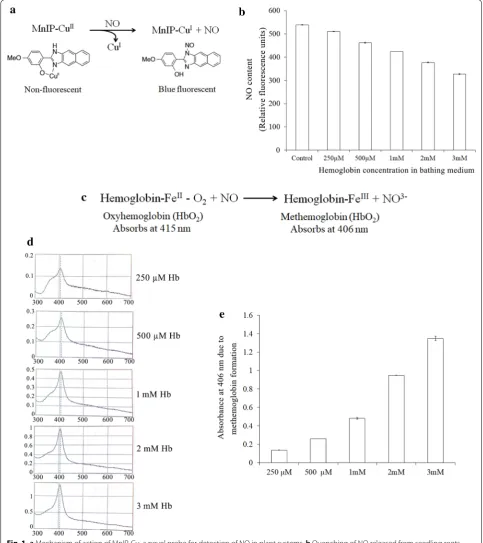
immediate use. To estimate the NO quenching ability of exogenously applied hemoglobin, 2 d old seedling roots were incubated for 30 min in dark in the absence or pres-ence of variable concentrations of hemoglobin ranging from 250 μM to 3 mM. Each tube contained three seed-lings. NO released from seedling root in the bathing solu-tion was analyzed using MnIP-Cu (a copper derivative of 4-methoxy-2-(1H-naphtho (2,3-d) imidazol-2-yl) phenol; MNIP-Cu [37]. Seedling roots dipped only in distilled water were served as control. Following incubation, the bathing solution from each tube was taken for estima-tion of NO released in soluestima-tion by treating with 2.5 µM of MnIP-Cu. NO released was monitored spectrofluoro-metrically (ex. 385 nm, em. 492 nm) and relative change in fluorescence was plotted to evaluate relative extent of NO released from tissue and quenched by variable con-centrations of hemoglobin in solution.
Estimation of methemoglobin formation
Methemoglobin formation as a result of reaction between NO released from seedling roots and hemoglobin present in the solution was monitored spectrophotometrically at 406 nM. Oxygenated hemoglobin absorbs at a wave-length of 415 nM and its reaction with NO lead to the formation of methemoglobin which shifts the absorbance of the product (metHb) to 406 nM.
Visualization of NO in seedling roots in the absence or presence of hemoglobin
To further validate the scavenging ability of exogenously provided hemoglobin, seedling roots were dipped in dis-tilled water containing variable concentrations of hemo-globin (2–3 mM) for 30 min in dark. Seedling roots dipped in distilled water served as control. After incu-bation, seedling roots were then incubated in 50 µM of MnIP-Cu for 45 min (ex. 385 nm, em. 492 nm). Using confocal laser scanning microscopy (CLSM; Leica, Ger-many), root tips were visualized for NO localization both in the absence or presence of hemoglobin.
Detection of nuclei in seedling roots using CLSM
Seedling roots were incubated with 4,6-diamidino-2-phe-nylindole (DAPI; 2 µg ml−1 in distilled water) for 2 min to
localize nuclei using CLSM (ex. 360 nm and em. 460 nm).
Co‑localization of NO and mitochondria in the seedling roots
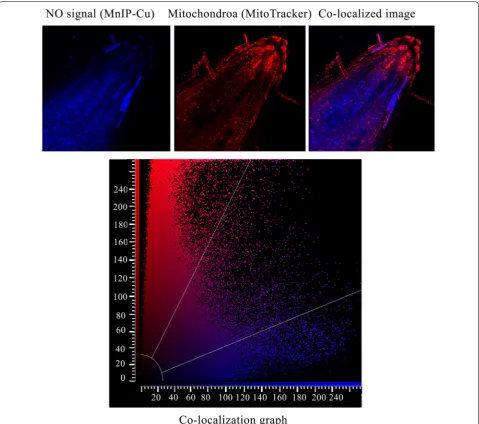
and at ex. 554 nm; em. 576 nm for mitochondria. Co-localization rate and mean intensity of co-Co-localization of NO and mitochondrial signal were calculated using soft-ware LAS-AF, version 2.7-9723.3.
Statistical analysis
All experiments were performed at least thrice and sta-tistically analyzed by SPSS 22.0 statistical program (SPSS Inc, Chicago, IL, U.S.A.) using One-Way ANOVA.
Results
A novel fluorescence probe (a copper derivative of 4-methoxy-2-(1H-naphtho (2,3-d) imidazol-2-yl) phe-nol; MNIP-Cu; Fig. 1a) developed in the author’s labora-tory in recent past for spectrofluorometric quantification and visualization of NO in live cells [37], has been used in the present work to examine the NO quenching abil-ity of hemoglobin provided in the bathing medium. NO released from 2 d old, dark-grown sunflower seed-ling roots were monitored in the absence or presence of variable concentrations of hemoglobin (250 µM–3 mM) in the bathing solution. Since hemoglobin in solution binds with NO released from roots, resulting in meth-emoglobin (Hb-FeIII) formation and conversion of NO
to NO3−, a Hb concentration-dependent decrease in the availability of free NO in solution is evident (Fig. 1b, c). Three millimoles of Hb leads to quenching of as much as 40% of NO released from roots as compared to control, thereby demonstrating the ability of externally available Hb to serve as a quencher of NO released from the tissue.
Exogenous Hb (λmax 415 nM) per se does not cross cell
membranes (being a high molecular mass molecule of 64.5 kDa) but it can easily bind diffusible endogenous NO in a concentration (250 µM to 3 mM)-dependent manner and make it inaccessible as a free molecule in the bathing medium (forming methemoglobin; λmax 406 nM) (Fig. 1d,
e). This observation on Hb as a NO quencher carries significance for pharmacological investigations in plant cells where, so far, cPTIO have been extensively used as NO quenchers. Figures 2 and 3 provide detailed evi-dence for quenching of endogenous NO from sunflower seedlings root cells in response to externally provide Hb (2–3 mM). In addition to cytoplasm and apoplast, NO has also been localized in nuclei and mitochondria. The ability of exogenous Hb to trigger migration of NO from all these intracellular locations thus proves its (Hbs) scav-enging ability (for NO) from all intracellular locations of the plant cells/tissues exposed to various pharmacologi-cal investigations.
Discussion
Hemoglobin is one of the hemoproteins, and NO is con-sidered as a major regulatory component of the func-tion of hemoproteins. NO can either activate or inhibit the activities of various hemoproteins by binding at the metallic center of heme. Furthermore, it is the oxidation state and the coordination environment of the iron center in the hemoproteins which determines the kinetics of NO binding with them [38]. Hexacoordination of heme molecule in non-symbiotic hemoglobin in plants ena-bles it to bind with NO and scavenge it during hypoxic stress conditions [26]. Non-symbiotic hemoglobins pos-sess ligand-binding characteristics different from that of symbiotic hemoglobins. Non-symbiotic Hbs exhibit high rate of oxygen binding than its rate of dissociation com-pared to symbiotic Hb, which possess high rate of oxy-gen binding as well as its dissociation. This difference in ligand-binding efficiency of the two proteins is due to dif-ferences in heme-coordination state. Thus, in non-symbi-otic Hb, heme molecule is hexacoordianted compared to symbiotic Hb where it is pentacoordinated. Hemoglobin binds with both NO and O2 depending on the
coordina-tion state of heme molecule and performs the funccoordina-tions of either transportation of O2 or turnover/scavenging of
NO. Symbiotic and erythrocyte hemoglobin is pentaco-ordinated which allows reversible binding of O2. Thus,
they are capable of O2 transport and storage. However,
non-symbiotic Hbs are hexacoordinated and exhibit very high avidity for O2. It exist as oxyhemoglobin under most
physiological conditions and can efficiently scavenge NO via NO-dioxygenase activity [39–43]. Non-symbiotic hemoglobin expression is affected by a variety of stress conditions, such as hypoxia, cold stress and levels of cel-lular ATP [26, 27, 31]. In Arabidopsis, non-symbiotic Hb (AHb1) exhibits NOD activity in the presence of oxygen (Fig. 4). It removes NO using NADPH as electron donor leading to generation of nitrate and ferric hemoglobin, known as methemoglobin (metHb) [44]. High expression of nsHb in plants exhibits lot of significance as it enables plants to regulate high levels of NO, formed as a result of stress conditions, either by converting NO to nitrate via dioxygenation reaction or by forming nitrosylhemo-globin. Furthermore, it has been suggested that plant lines expressing high levels hemoglobin can prove to be better adapted to both normal and stress conditions [43].
Oxygenated hemoglobin (HbO2) is considered as a
[21]. The reaction between NO and HbO2 is rapid,
stoi-chiometric and leads to formation of methemoglobin and nitrate (NO3−) [45]. Due to its size (64.5 kDa), HbO
2 does
not cross cell membranes but can facilitate free diffusion
of endogenous NO and its subsequent scavenging in the bathing medium (present work). Furthermore, HbO2
works well with the externally applied NO donor which generate NO even in the extracellular compartments,
such as NONOates than those which needs intracellular bioactivation to release NO, like organic nitrates. Also, HbO2 does not inhibit transnitrosation reactions.
Conclusion
In view of the above-stated features of hemoglobin and current observations, it is a more reliable alter-native to cPTIO as a NO scavenger of tissue NO in
pharmacological investigations in plant systems. It (Hb) works efficiently in a concentration-dependent manner in efficiently quenching NO from plant tissues unlike cPTIO, which behaves differently (as NO quencher or as a source of NO) depending on its concentration in the medium. Thus, hemoglobin can be used as an effi-cient probe for estimation of NO emission from living tissues.
Abbreviations
NO: nitric oxide; PTIO: 2-phenyl-4,4,5,5,-tetramethylimidazoline-1-oxyl 3-oxide; c-PTIO: carboxy-PTIO; MnIP-Cu: copper derivative of 4-methoxy-2-(1H -naph-thol (2,3-d) imidazol-2-yl) phenol; nsHb: non-symbiotic hemoglobin; metHb: methemoglobin.
Authors’ contributions
Planning: Both the authors; Experimental work: NS; Writing of manuscript: both the authors. Both authors read and approved the final manuscript.
Acknowledgements
The authors are grateful to Joint UGC-Israel Science Foundation Research Project [F. No. 6-9/2017(IC)] for providing research funds.
Competing interests
The authors declare that they have no competing interests.
Consent for publication Not applicable.
Ethics approval and consent to participate Not applicable.
Publisher’s Note
Springer Nature remains neutral with regard to jurisdictional claims in pub-lished maps and institutional affiliations.
Received: 21 January 2019 Accepted: 15 April 2019
References
1. Wildt J, Kley D, Rockel A, Rockel P, Segschneider HJ. Emission of NO from several higher plant species. J Geophys Res Atmos. 1997;102:5919–27. 2. Chen J, Wu FH, Liu TW, Liu TW, Chen L, Xiao Q, Dong XJ, He JX, Pei ZM, Zheng HL. Emissions of nitric oxide from 79 plant species in response to simulated nitrogen deposition. Environ Pollut. 2012;160:192–200. 3. Klepper LA. Nitric oxide (NO) and nitrogen dioxide (NO2) emissions from
herbicide-treated soybean plants. Atmos Environ. 1979;13:537–42. 4. Lea US, Ten Hoopen F, Provan F, Kaiser WM, Meyer C, Lillo C. Mutation of
the regulatory phosphorylation site of tobacco nitrate reductase results in high nitrite excretion an NO emission from leaf and root tissue. Planta. 2004;219:59–65.
5. Planchet E, Jagadis Gupta K, Sonoda M, Kaiser WM. Nitric oxide emission from tobacco leaves and cell suspensions: rate limiting factors and evidence for the involvement of mitochondrial electron transport. Plant J. 2005;41:732–43.
6. Gupta KJ, Stoimenova M, Kaiser WM. In higher plants, only root mito-chondria, but not leaf mitochondria reduce nitrite to NO, in vitro and in situ. J Exp Bot. 2005;56:2601–9.
7. Chen J, Xiao Q, Wu FH, Pei ZM, Wang J, Wu YG, Zheng HL. Nitric oxide emission from barley seedlings and detached leaves and roots treated with nitrate and nitrite. Plant Soil Environ. 2010;56:201–8.
8. Pfeiffer S, Mayer B, Hemmens B. Nitric oxide: chemical puzzles posed by a biological messenger. Angew Chem Int Ed Engl. 1999;38:1714–31. 9. Neill SJ, Desikan R, Clarke A, Hancock JT. Nitric oxide signaling in plants.
New Phytol. 2003;159:11–35.
10. Lamattina L, Garcıa-Mata C, Graziano M, Pagnussat G. Nitric oxide: the versatility of an extensive signal molecule. Annu Rev Plant Biol. 2003;54:109–36.
11. Shapiro AD. Nitric oxide signaling in plants. Vitam Horm. 2005;72:339–98. 12. Corpas FJ, Barroso JB, Carreras A, Valderrama R, Palma JM, del Río LA.
Nitrosative stress in plants: a new approach to understand the role of NO in abiotic stress. In: Lamattina L, Polacco JC, editors. Nitric oxide in plant growth, development and stress physiology. Plant cell monographs, vol. 5. Berlin: Springer; 2006.
13. Guo FQ, Okamoto M, Crawford NM. Identification of a plant nitric oxide synthase gene involved in hormonal signaling. Science. 2003;302:100–4. 14. Bethke PC, Badger MR, Jones RL. Apoplastic synthesis of nitric oxide by
plant tissues. Plant Cell. 2004;16:332–41.
15. Corpas FJ, Barroso JB, del Río LA. Enzymatic sources of nitric oxide in plant cells: beyond one protein-one function. The New Phytologist. 2004;162:246–8.
16. Guo FQ, Crawford NM. Arabidopsis nitric oxide synthase1 is targeted to mitochondria and protects against oxidative damage and dark-induced senescence. Plant Cell. 2005;17:3436–50.
17. Gupta KJ, Kaiser WM. Production and scavenging of nitric oxide by Barley root mitochondria. Plant Cell Physiol. 2010;51:576–84.
18. Gupta KJ, Fernie AR, Kaiser WM, van Dongen JT. On the origins of nitric oxide. Trends Plant Sci. 2011;16:160–8.
19. Recalde L, Vázquez A, Groppa MD, Benavides MP. Reactive oxygen species and nitric oxide are involved in polyamine-induced growth inhibition in wheat plants. Protoplasma. 2018;255:1295.
20. Arita NO, Cohen MF, Tokuda G, Yamasaki H. Fluorometric detection of nitric oxide with diaminofluoresceins (DAFs): applications and limitations for plant NO research. Plant Cell Monogr. 2006;5:269–80.
21. Singh N, Bhatla SC. Signaling through reactive oxygen and nitrogen spe-cies is differentially modulated in sunflower seedling root and cotyledon in response to various nitric oxide donors and scavengers. Plant Signal Behav. 2017;12:e1365214.
22. Singh N, Bhatla SC. Nitric oxide regulates lateral root formation through modulation of ACC oxidase activity in sunflower seedlings under salt stress. Plant Signal Behav. 2018;13:1–7.
23. Hebelstrup KH, Hunt P, Dennis E, Jensen SB, Jensen EØ. Hemoglobin is essential for normal growth of Arabidopsis organs. Physiol Plant. 2006;127:157–66.
24. Bhattacharya S, Sen A, Thakur S, Tisa LS. Characterization of haemoglobin from Actinorhizal plants—an in silico approach. J Biosci. 2013;38:777–87. 25. Dordas C, Rivoal J, Hill RD. Plant haemoglobins, nitric oxide and hypoxic
stress. Ann Bot. 2003;91:173–8.
26. Dordas C, Hasinoff BB, Igamberdiev AU, Manac’h N, Rivoal J, Hill RD. Expression of a stress-induced hemoglobin affects NO levels produced by alfalfa root cultures under hypoxic stress. Plant J. 2003;35:763–70. 27. Dordas C, Hasinoff BB, Rivoal J, Hill RD. Class-1 haemoglobins, nitrate
and NO levels in anoxic maize cell-suspension cultures. Planta. 2004;219:66–72.
28. Vigeolas H, Huhn D, Geigenberger P. Nonsymbiotic haemoglobin-2 leads to an elevated energy state and to a combined increase in polyunsatu-rated fatty acids and total oil content when overexpressed in developing seeds of transgenic Arabidopsis plants. Plant Physiol. 2011;155:1435–44. 29. Hebelstrup KH, Shah JK, Igamberdiev AU. The role of nitric oxide and
haemoglobin in plant development and morphogenesis. Physiol Plant. 2013. https ://doi.org/10.1111/ppl.12062 .
30. Kuruthukulangarakoola GT, Zhang J, Albert A, Winkler B, Lang H, Buegger F, Gaupels F, Heller W, Michalke B, Sarioglu H, Schnitzler JP, Hebelstrup KH, Durner J, Lindermayr C. Nitric oxide-fixation by non-symbiotic haemoglo-bin proteins in Arabidopsis thaliana under N-limited conditions. Plant Cell Environ. 2017;40:36–50.
31. Vishwakarma A, Kumari A, Mur LAJ, Gupta K. A discrete role for alternative oxidase under hypoxia to increase nitric oxide and drive energy produc-tion. Free Radic Biol Med. 2018. https ://doi.org/10.1016/j.freer adbio med.2018.03.045.
32. Tiso M, Tejero J, Basu S, Azarov I, Wang X, Simplaceanu V, Frizzell S, Jayara-man T, Geary L, Shapiro C, Ho C, Shiva S, Kim-Shapiro DB, Gladwin MT. Human neuroglobin functions as a redox-regulated nitrite reductase. J Biol Chem. 2011;286:18277–89.
33. Tiso M, Tejero J, Kenney C, Frizzell S, Gladwin MT. Nitrite reductase activity of non-symbiotic hemoglobins from Arabidopsis thaliana. Biochemistry. 2012;51:5285–92.
34. Kim-Shapiro DB, Schecter AN, Gladwin MT. Unrevealing the reactions of nitric oxide, nitrite, and hemoglobin in physiology and therapeutics. Arterioscler Thromb Vasc Biol. 2006;26:697–705.
35. Cassoly R, Gibson QH. Conformation, co-operativity and ligand binding in human hemoglobin. J Mol Biol. 1975;91:301–13.
36. Cooper CE. Nitric oxide and iron proteins. Biochim Biophys Acta. 1999;1411:290–309.
37. David A, Yadav S, Baluška F, Bhatla SC. Nitric oxide accumulation and protein tyrosine nitration as a rapid and long distance signalling response to salt stress in sunflower seedlings. Nitric Oxide. 2015;50:28–37. 38. Arora D, Jain P, Singh N, Kaur H, Bhatla SC. Mechanisms of nitric oxide
crosstalk with reactive oxygen species scavenging enzymes during abiotic stress tolerance in plants. Free Radic Res. 2015;50:291–303. 39. Hill RD. What are hemoglobins doing in plants? Can J Bot.
1998;76:707–12.
40. Igamberdiev AU, Hill RD. Nitrate, NO and haemoglobin in plant adapta-tion to hypoxia: an alternative to classic fermentaadapta-tion pathways. J Exp Bot. 2004;55:2473–82.
41. Igamberdiev AU, Baron K, Manac’h-little N, Stoimenova M, Hill RD. The haemoglobin/nitric oxide cycle: involvement in flooding stress and effects on hormone signalling. Ann Bot. 2005;96:557–64.
42. Gupta KJ, Hebelstrup KH, Mur LAJ, Igamberdiev AU. Plant hemoglobins: important players at the crossroads between oxygen and nitric oxide. FEBS Lett. 2011;585:3843–9.
43. Riquelme A, Hinrichsen P. Non-symbiotic hemoglobin and its relation with hypoxic stress. Chil J Agric Res. 2015. https ://doi.org/10.4067/S0718 -58392 01500 03000 09.
44. Perazzolli M, Dominici P, Romero-Puertas MC, Zago E, Zeier J, Sonoda M, Lamb C, Delledonne M. Arabidopsis nonsymbiotic hemoglobin AHb1 modulates nitric oxide bioactivity. Plant Cell. 2004;16:2785–94. 45. Doyle MP, Hoekstra JW. Oxidation of nitrogen-oxides by bound dioxygen