5368 DEVELOPMENT AND VALIDATION OF NOVEL RP-HPLC METHOD FOR SIMULTANEOUS ESTIMATION OF ELBASVIR AND GRAZOPREVIR IN BULK AND
PHARMACEUTICAL DOSAGE FORMS
M Deepa1*, K Ravindra Reddy2 and SV Satyanarayana3
1Research Scholar, JNTUA, Ananthapuramu, Andhra Pradesh-516003, India. 2PRRM College of Pharmacy, Utukur, Kadapa, Andhra Pradesh, India.
3Department of Chemical Engineeering, JNTUA, Ananthapuramu, Andhra Pradesh India
*Corresponding author E-mail
:
[email protected]ARTICLE INFO ABSTRACT
Key Words
Elbasvir, Grazoprevir, RP-HPLC ,
method development, Validation
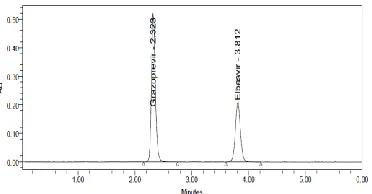
A rapid, simple and precise RP-HPLC method has been described for simultaneous estimation of antiviral drugs namely Elbasvir and Grazoprevir in bulk and tablet dosage forms by make use of waters symmetry Shield C18 column , 4.6×250 mm, 5.0 µm with mobile phase consisting of 0.1 % Ortho Phosphoric acid (pH 2.2) : Acetonitrile, (45:55, v/v) premixed. The flow rate was maintained at 0.9ml/min. The column effluents were monitored by using PDA detector at 260 nm. The retention times of Grazoprevir and Elbasvir was found to be 2.311 min and 3.848 min. The correlation coefficients of Elbasvir and Grazoprevir was 0.999 with equation y=21841x + 1868 for grazoprevir and y=22881x + 3308 for Elbasvir. The performance of the developed method has been validated in terms of accuracy, specificity, linearity, precision and robustness according to ICH guidelines. Recovery of the method was found to be 98-102%. The detector response was found to be linear over a concentration range of 12.5–150 µg/mL for both the drugs. The described method can be successfully employed for the quality control analysis of Elbasvir and Grazoprevir in formulations.
1. INTRODUCTION:
Grazoprevir is a second generation NS3/4a protease inhibitor used to inhibit viral HCV replication. It is mainly used in the treatment of chronic hepatitis C of the genotypes 1 and 4 for adults. Its molecular formula is C38H50N6O9S and molecular mass is 766.90 g/mol.It is insoluble in water and is slightly hygroscopic. Elbasvir is a NS5a protein inhibitor used to inhibit viral HCV replication complex. Its molecular formula is C49H55N9O7 and molecular mass of
882.02 g/mol.It is practically insoluble in water and is slightly hygroscopic.[1-3].
Literature review revealed that this drug combination has been approved by FDA in the year 2016 and very few RP-HPLC methods have been available for the simultaneous estimation of these drugs in bulk and pharmaceutical dosage forms. Hence a new HPLC method for simultaneous determination of elbasvir and grazoprevir in bulk and pharmaceutical
An Elsevier Indexed Journal ISSN-2230-7346
5369 dosage forms has been developed and
validated according to ICH guidelines.
2. MATERIALS AND METHODS 2.1. Materials and Methods
Elbasvir and Grazoprevir were obtained from sinfa chemicals as gift sample. All the chemicals and reagents employed such as ortho phosphoric acid, methanol, acetonitrile were of analytical grade and were procured from sd fine, qualigens and merck chemicals, India.
2.1.1. HPLC instrumentation and Chromatographic conditions
The experiments were carried out on the chromatographic system AGILENT consisting of HPLC Pump, auto sampler and PDA detector. The partial loop injection volume was 10µL. Chromatographic separations were performed on waters symmetry shield, C18, 4.6×250 mm, 5.0 µm column with UV detection at 260 nm. The flow rate was 0.9 mL/min and the column temperature was set at 30 0C and the injection volume was 10µL. Empower software was used for data collection and analysis [4, 5].
2.1.2. Selection and preparation of mobile phase Various mobile phases containing orthophosphoric acid and acetonitrile in different ratios were tried by different columns, flowrates. Good symmetrical peaks, resolution and retention time was observed with mobile phase 0.1 % orthophosphoric acid: acetonitrile, (55:45, v/v) premixed. The mobile phase was sonicated for 10min and filtered through 0.45µm membrane filter.
2.1.3. Preparation of standard stock solution
Accurately weighed 5 mg& 10 mg of elbasvir and grazoprevir working standards were transferred into a 10mL clean dry volumetric flask respectively and 5mL of diluent was added and sonicated for 30 minutes and made up the final volume
with diluents to get a concentration of 100 μg/mL of grazoprevir and 50μg/mL of elbasvir. From the above stock solutions, 1mL was pipetted out in to a 10mL volumetric flask and then made up to the final volume with diluent.
2.1.4. Selection of wavelength
Ideal wavelength is the one that gives good response for the drugs that are to be detected. UV spectra of both the drugs showed that Grazoprevir and Elbasvir absorbed appreciably at 260 nm.So detection was carried out at 260 nm.
2.1.5. Solutions for the estimation of linearity and accuracy
For the estimation of accuracy and linearity eight solutions containing Elbasvir and grazoprevir were prepared in the concentration range of 12.5–150 µg/mL in the mixture of acetonitrile and water (50:50 v/v). These solutions were further sonicated for 30 min and were stirred using the magnetic stirrer for 2 h. The accuracy of Elbasvir and grazoprevir is estimated by performing the recovery experiment at 50%, 100% and 150% of the label claim of the drug and the linearity of the method was estimated by plotting a calibration graph and slope of the method has been found out.
2.1.6. Solutions for the precision estimation
A quantity of tablet content corresponding to 5 mg of grazoprevir and 10 mg of elbasvir were placed into a 100 mL volumetric flask and extracted with the mixture of acetonitrile and water (50:50 v/v) followed by sonication and filtration. The final volume was made to the mark with the same solvent and the solution was
Filtered. From that stock solution, six solutions containing 150µg/mL of elbasvir and grazoprevir were prepared.
5370 were conducted using the optimized assay
conditions. Important validation parameters including specificity, accuracy, precision, linearity, detection limit and quantification limit were evaluated [6-8].
2.2.1. System suitability Test
In a view to ensure its effectiveness and to verify reproducibility certain system suitability test parameters were monitored by repetitively injecting the drug solution into the HPLC at the start of study of each validation parameter since these tests are an essential part of chromatographic analysis method and are ferformed to evaluate the behavior of chromatographic system such as capacity factor (k1), plate number (N) and Tailing factor (T).
Acceptance criteria
•Asymmetry <1.0
•Theoretical plates >2000 • RSD <2.0%
2.2.2. Specificity:
Specificity was performed by comparing the chromatograms of both the drugs with recorded chromatogram of placebo and blank. In all tested conditions interference of peaks was determined.
2.2.3. Limit of detection and limit of Quantification
LOD is the lowest amount of analyte that can be detected, but not necessarily quantitated and LOD is the lowest amount of analyte in a sample that can be quantitatively determined with suitable precision and accuracy.
The limit of detection of instrumental procedures is carried out by determining the signal-to-noise ratio. A signal-to-noise ratio of 2:1 or 3:1 is generally accepted
LOD = 3.3 σ/S
LOQ was calculated using the following formula
LOQ = 10 σ/S
2.2.4. Precision and intermediate precision[9]
The degree of repeatability of an analytical method under normal conditions is precision. The precision of the method was determined by repeatability (intraday) and intermediate precision (interday) and reported as % RSD for a statistically significant number of replicate measurements. Repeatability (intra-day):
The intra-day precision for the determination of Elbasvir and grazoprevir was carried out by analyzing dosage form sample solutions prepared at 100% of test concentration stated in the method (0.1 mg/mL) using the proposed method, within the same laboratory, using the same analyst, with the same equipment, on the same day .
Intermediate precision (inter-day):
The inter-day precision for the determination of Elbasvir and grazoprevir was carried out as under repeatability but on three consecutive days, at each day the determination was done twice (n =6).
2.2.5. Accuracy: Accuracy of the method was determined by applying the proposed method to synthetic mixture containing known amount of each drug to 50%, 100% and 150% of the label claim. The test results were compared with the standard values and % recovery was calculated. Accuracy of the method was confirmed by recovery studies.
2.2.5. Linearity:
Linearity studies were performed in the concentration range of 12.5-75 μg/mL for Grazoprevir (corresponded to 50% to 150 %, respectively, of the test solution concentration) and 25-150 μg/mL for Elbasvir (corresponded to 50% to 150 %, respectively, of the test solution concentration).
5371 Elbasvir and Grazoprevir various parameters
were modified. Variation in flow rate by ±0.2 ml/min. Variation in temperature by ±0.5ºC. Variation in Organic phase concentration by ± 10 %
RESULTS AND DISCUSSION 3.1. Method development and validation :
3.1.1. Method development [10-12]
The main objective of the present study is to develop simple, accurate, precise method for quantitative determination of Elbasvir and Grazoprevir in bulk and pharmaceutical dosage forms. For the developed method in order to obtain good symmetrical peaks, better resolution and less retention time various mobile phases containing Orthophosphoric acid and acetonitrile in different ratios were tried by different columns and flowrates. In HPLC methd mobile phase comprising of premixed 0.1 % Ortho Phosphoric acid : Acetonitrile, (55:45,v/v) resulted in high sensitivity ,short analysis time and good peak symmetry.
3.2. Method Validation:
3.2.1. Specificity:From Specificity test it was evident that there is no interference of placebo at the retention time of Elbasvir and Grazoprevir. Interference from blank and placebo was not observed at any peak of interest.
Acceptance Criteria: The % relative standard deviation of Elbasvir and Grazoprevir individual, from the six units should be not more than 2.0%. The individual assays of Elbasvir and Grazoprevir were found to be not less than 98% and not more than 102.0%.
3.2.2. Limit of detection and quantitation:
The lowest amount of analyte that can be detected and quantified was calculated by
employing suitable formula and the chromatograms were recorded.
3.2.3. Linearity: Different concentrations of elbasvir and grazoprevir were prepared and linearity graph was plotted with concentaration on X-axis and peak area on Y-axis.
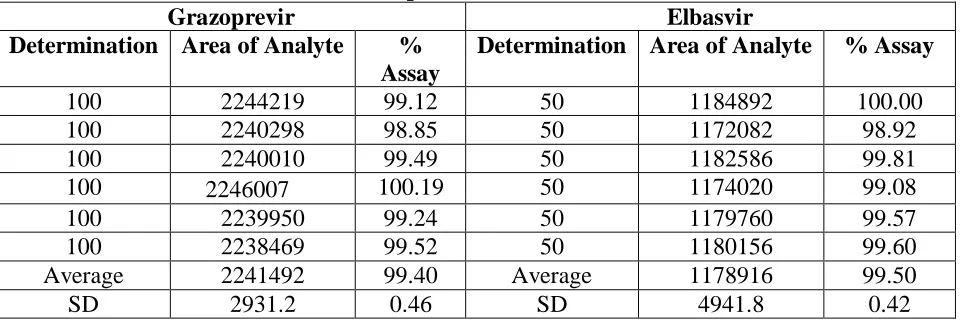
3.2.4. Precision: Repeatability of the method was assessed by injecting multiple injections of the sample in same concentration and interday and intraday precision was performed.
3.2.5. Accuracy: Accuracy of the method was confirmed by recovery studies by standard addition method and the results obtained were tabulated.
Acceptance Criteria:
The mean % recovery of the Elbasvir and Grazoprevir at each spike level was found to be not less than 98.0% and not more than 102.0% for both the
drugs separately.
5372 CONCLUSION: The proposed simple,
accurate, precise RP-HPLC method can quantitatively determine both the antiviral drugs Elbasvir and Grazoprevir in bulk and pharmaceutical dosage forms with good resolution, peak symmetry and shoter analysis times. The method was validated for accuracy, linearity, precision, accuracy,
specificity and robustness and the results obtained clearly demonstrates that this method provides appropriate information for monitoring the quality of bulk samples and identifies the samples even at low concentrations.
Table 1: Optimized chromatographic conditions Parameters Optimized conditions
Mobile Phase 0.1 % Ortho Phosphoric acid (pH 2.2) : Acetonitrile, (45:55, v/v) premixed
Column Waters Symmetry Shield, C18, 4.6×250 mm, 5.0 µm
Flow Rate 0.9 ml/Min Temperature 30˚C Injection Volume 10µl Run time 6 min Detector PDA
Table 2: Linearity Results of Grazoprevir and Elbasvir
Grazoprevir Elbasvir
Concentration of
drug(µg/mL) Peak Area
Concentration of
drug(µg/mL) Peak Area
12.5 286145 25 555601
25 563560 50 1115990
37.5 866694 75 1662623
50 1180049 100 2262279
62.5 1434926 125 2748639
75 1698143 150 3252043
Table 3: Data of Repeatability using Multiple Determinations at the Test Concentration for Grazoprevir and Elbasvir
Grazoprevir Elbasvir
Determination Area of Analyte % Assay
Determination Area of Analyte % Assay
100 2244219 99.12 50 1184892 100.00
100 2240298 98.85 50 1172082 98.92
100 2240010 99.49 50 1182586 99.81
100 2246007 100.19 50 1174020 99.08
100 2239950 99.24 50 1179760 99.57
100 2238469 99.52 50 1180156 99.60
Average 2241492 99.40 Average 1178916 99.50
5373 Table 4: Recovery Result for Elbasvir
Analyte Level
Analyte Peak Area
Nominal Concentration
Actual Concentration
Individual % Recovery
Mean %
Recovery % RSD
Level 1
1714244 25 24.7754 99.10
99.60 0.43 1718715 25 24.97081 99.88
1718324 25 24.95372 99.81
Level 2
2286191 50 49.77199 99.54
99.96 0.57 2298321 50 50.30213 100.60
2288387 50 49.86797 99.74
Level 3
2864963 75 75.06687 100.09
100.05 0.22 2860304 75 74.86325 99.82
2867680 75 75.18561 100.25
Table 5: Recovery Result of Grazoprevir
Analyte Level
Analyte Peak Area
Nominal Concentration
Actual Concentration
Individual % Recovery
Mean % Recovery
% RSD
Level 1
3283739 50 49.49192 98.98
99.28 0.29
3289931 50 49.77542 99.55
3287308 50 49.65533 99.31
Level 2
4406492 150 100.8977 100.90
100.00 0.82 4371719 150 99.30557 99.31
4382254 150 99.78792 99.79
Level 3
5461965 100 149.223 99.48
99.50 0.21 5469805 100 149.5819 99.72
5455996 100 148.9497 99.30
Table 6: Robustness data
FACTORS ELBASVIR (Rt min)
GRAZOPREVIR (Rt min) A. Flow rate (mL/min)
O.7 mL 3.77 2.30
1.1 mL 3.78 2.31
B. Temperature (ºC)
25 ºC 3.79 2.31
35 ºC 3.80 2.31
C. Organic phase composition
5374 Figure1: Structure of Grazoprevir
N N H N
O H3C
CH3
NHO OCH3
N O
HN N
N O
NH O O
Figure 2: Structure of Elbasvir
Figure 3: Chromatogram of Elbasvir and Grazoprevir obtained under optimised conditions
5375
Figure 6: Chromatograms for Limit of Detection and Limit of Quantification
Figure 7: Calibration curve for Elbasvir and Grazoprevir
5376
Figure 9: Chromatograms for Accuracy (100%) standard
Figure 10: Chromatograms for Accuracy (150%) standard
Figure 11: Effect of Variation of Flow Rate Figure 12: Effect of Variation of Flow Rate (0.7 ml/min ) (1.1 ml/min )
Figure 13: Effect of Variation of Column temp Figure 14: Effect of Variation of Column temp
5377 ACKNOWLEDGEMENT
The authors wish to thank the management and Principal of Annamacharya College of pharmacy, for providing the infrastructure for the supporting of this research work. .
REFERENCES
1. DE. Nadig, Preparation of Drug Samples for Analysis , L. Ohannesian and AJ. Streeter, Handbook of Pharmaceutical Analysis, 2002; 75-102.
2. International conference on harmonization, Q2 (R1) (November 2005), Validation of analytical procedures: Text and Methodology. 3. Indian pharmacopoeia (2010), The
Indian pharmacopoeia Commission, Ghaziabad.
4. United State Pharmacopoeia 30- NF 25, 2007.
5. British Pharmacopoeia, vol.1 & 2, The British Pharmacopoeia Commission, London, 2009.
6. D. Saimalakondaiah, V. Ranjeet Kumar, T. Rama Mohan Reddy, A. Ajitha, V. Uma Maheshwara Rao, Stability Indicating HPLC Method Development and Validation, International Journal of Pharma Research & Review, Oct 2014; 3(10):46-57.
7. Ravichandran, Shalini, Sundram , Harish Rajak, Validation of Analytical methods– strategies & importance, International Journal of Pharmacy and Pharmaceutical Sciences ,Vol 2, Suppl 3,2010.
8. Madana Gopal, Stabiliy – indicating validated RP-UPLC method for simultaneous determination of elbasvir and grazoprevir in Bulk and pharmaceutical dosage form, International Journal of Pharmaceutical Sciences Review and Research,2017;44(2):43-48
9. Haritha Potluri, Sreenivasa Rao Battula ,Picogram Level Quantification of Grazoprevir and Elbasvir with Deuterated Internal Standards in Human Plasma Samples by LC–ESI-MS/MS, Indian Journal of pharmaceutical education and research,2016;50 (4):12-619.
10.Sumalatha Nallagundla, Nallagundla H S Reddy, Vishal Vemula, Bharath Kumar, Analytical Method Development and Validation of Elbasvir and Grazoprevir in Bulk and Tablet Formulations by Rp- HPLC, International Journal of Pharmaceutical Science Invention 2017 ,6 (8) , 01-05.
11.Akram MD, Umamahesh M Ramachari T. A New Validated RP-HPLC Method for the Determination of Elbasvir and Grazoprevir In Its Bulk and Pharmaceutical Dosage Forms. International Journal of Chemistry & Pharmaceutical Analysis 2017;4(3), 1307.