6399 FORMULATION AND IN VITRO EVALUATION OF SERTACONAZOLE LOADED
SOLID LIPID NANOPARTICLE IN ALOE VERA GEL
Soumen Pal1*, Ashish Dixit2
1Translam Institute of Pharmaceutical Education and Research, Meerut, 250001,UP . 2Department of Pharmaceutics, Translam Institute of Pharmaceutical Education &
Research, Meerut 250001, Uttar Pradesh, India.
*Corresponding author E-mail:[email protected]
ARTICLE INFO ABSTRACT
Key Words
Sertaconazole, Aloe-Vera gel, Solid-lipid Nanoparticle, Solvent Emulsification Method.
.
In the present research, the solid lipid nanomolecules of an anti-fungal drug is prepared and the drug sertaconazole loaded micromolecules was poured into the aloe vera gel matrix to enhance the penetration of drug through the skin.The solid lipid nanomolecules of sertaconazole (SLN-SERT) is formulated by solvent emulsification method to ensure better entrapment efficiency and continuous distribution of drug. From the source of WHO “Portal of health products & essential medicine”, some therapeutic capabilities & excellent treatment was shown by aloe vera gel. The in vitro evaluation of SLN-SERT gel showed brilliant spreadibility, adhesiveness & simplicity in application as well as better in vitro drug release profile than normal anti-fungal cream. The stability of gel formulation was also found to be stable at low temp upto 2°C as well as high temp till 40°C. Finally, the aloe vera gel formulation containing SLN-SERT for topical drug delivery proves to be promising carrier for the delivery of the drugs for skin targeting in contagious disease . The formulations were found to be safe, compatible with enhanced penetration of drug in to the skin achieved.
INTRODUCTION
Fungal infections are a standout amongst the most widely recognized reasons for skin disease. Occurrence of parasitic disease is expanding around the world. Oral treatment of contagious contamination has related with lethal impact, long span of treatment and narrow mindedness by the patient while topical treatment for shallow parasitic diseases is related with poor dissolvability of medications, disturbance to skin and less porousness through skin. Contingent upon attributes of the living beings and host,
contagious diseases are ordered into three kinds: shallow, subcutaneous and fundamental. Shallow contamination brought about by a dermatophyte is named dermatophytosis and are restricted to the stratum corneum, hair and nails. [1] Approximately 1-2% of the total population is influenced by dermatophytosis. Contagious diseases are progressively normal and increasingly serious in individuals on anti-microbials, corticosteroids, immunosuppressant medications and contraceptives treatment.
6400
Event of shallow parasitic contamination increments with change in age, atmosphere and malady state. [2].
Sertaconazole nitrate (SERT), is an imidazole/triazole type of antifungal drug used to treat fungal skin infection. It is available as a topical cream as it has negligible bioavailability. Sertaconazole impedes an ergosterol union by correlation of the 14-α demethylase of P-450. The absence of the basic parts of ergosterol constructions makes it possible to penetrate and release the substance of cells. [3] Solid1lipid1nanomolecules (SLN) was created as a1colloidal transporter in the mid 1990s as an elective framework to1existing conventional vector, for example, emulsions,liposomes, nisomes and polymeric nanomolecules. Solid1lipid1nanomolecules have a greater advantage than any other carrier system. Labels in solid Lipid have more drugs. Solid1lipid1nanomolecules are made of lipids in solid form at the room1temperature and surfaces (emulsifiers) to stabilize SLN. [4-5]. Aloe1vera can possibly treat skin sicknesses. Aloe Barbados aloe is a typical name and has a place with the Xanthorrhoeaceae family. Aloe Vera quickens twisted mending by1improving blood course through the territory and forestalling cell demise all through the injury. As per an information source from the World Health Organization "Portal of health products and essential medicine", Aloe vera gel has shown some medical capabilities and a brilliant cure. This healing mechanism is called aloe vera wound as it stimulates the activity of macrophages and fibroblasts with an increase in collagen synthesis and proteoglycan. [6-12]
MATERIAL AND METHOD
Material: Sertaconazole was a blessing gift by Dermia ConticarePvt. Ltd, Chandigarh. OLML was liberal blessing from Chemhouse Marketing, Mumbai.
TPGS was bought from V.B. Medicare, Hosur, Tamil Nadu. Stearylamine was acquired from TCI Chemicals, Chennai, and other synthetic compounds, for example, Tween 80, acetone, DMSO and were of diagnostic evaluation and from RFCL Limited Company (New Delhi, India).
Method [12-15]
Preformulation Studies
Preformulation study on solubility & other optimization study were held by studing drug release profile of various formulations with different concentration of ingredients as given below & a suitable amount of diffenent variables were selected.
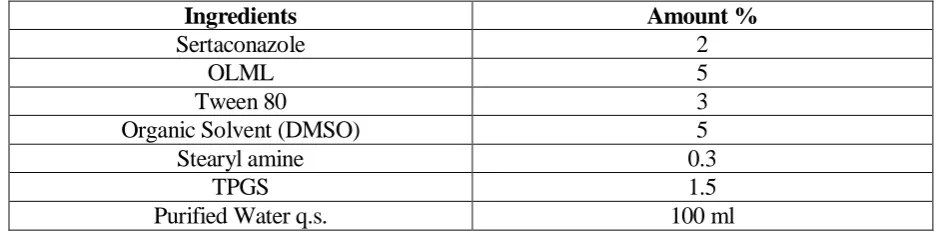
Pre formulation study of composition of various ingredients was studied via test lot formulations, data is given at the table 1 and the general compositions were General Compositions are as given below at the table 2
Method of preparation of Solid-lipid Nanoparticle of Sertaconazole
6401 Table 1: Pre formulation test lot with various concentration of Composition
Table 2: General Composition for the preparation of Sertaconazole SLN.
Ingredients Amount %
Sertaconazole 2
OLML 5
Tween 80 3
Organic Solvent (DMSO) 5
Stearyl amine 0.3
TPGS 1.5
Purified Water q.s. 100 ml
Evaluation parameters of prepared sertaconazole SLN gel
Rheological1measurement
Spreadability: The advanced evaluation based on SLN was carried out on the basis of a systematic sample, film production capacity, level of coherence and tangibility. Sustainability is one of the significant criteria for a timely measurement structure as it speaks with the solidity and cooperation of molecules. This exam covers the use of a wooden area and a slide group with a rectangular wooden square attached to the slide. In a similar device with a rope, another moving
slip with a container through the pulley is attached. The time required for full glass to slip completely from the fixed slide was found when SLN gelatin was placed between slides. For the time necessary to completely isolate two glasses during the test, the vitality was determined quantitatively.
S = 𝑀×𝐿
𝑇
Where, 1S = Spreadability, M = Weight tide to the upper glass slide, L = Glass slide length, T = The time longer expands the separated slide.
Formulati on
Drug %
Lipid % (OLM
L)
Surfactan t%
Organic Solvent TPG S%
Steary l amine
%
DDW
DMS O
ACET ONE
F1 2 5 100ml
F2 2 5 1 100ml
F3 2 5 3 100ml
F4 2 5 6 100ml
F5 2 5 3 1.5 100ml
F6 2 5 3 5 100ml
F7 2 5 3 1.5 100ml
F8 2 5 3 5 100ml
F9 2 5 3 5 0.5 100ml
F10 2 5 3 5 1.5 100ml
F11 2 5 3 5 3 100ml
F12 2 5 3 5 1.5 0.2 100ml
6402 In Vitro drug release study: An in
vitro1drug release1study was conducted on scattered 1cells utilising acetic acid cellulose1films. 6.8 pH and methanol (60:40) were used to support phosphate as a dispersed medium and recently joined a film 30 minutes before sending the sample.6.8 pH and methane phosphate mixture (10 ml) were formed in a fraction of containers of thin cell cells. The mixed compartment of the garbage did not stop using attractive crops and the temperature1was kept at 37 ° C with a water shower. The analysis started1with a uniform use of 0.5 g of 1SLN gel on the outside of a1cellulose acid derivative film in terms of contributors. Inspections were performed after 0, 1, 2, 4, 8, 12, 24, 36 and 48 hours and all new test samples included the new dispersion medium. These examples have changed and deteriorated. Spectrophotometrically visible UV.
In vitro Antifungal activity: A study on the antifungal activity in vitro against Candida albicans species was carried out using the fertilizer method on diffuse agar. Sabouraudagarrose (SDA) was utilized to set up the culture and brooding of fungal species. The cultivated soil was arranged and sterilised. Fresh societies of C. albicans were arranged and kept up at 37 ± 2 ° C for 48 hours in dim conditions. Sanitized SDA plates were readied and a round fossa with sterile silence was performed in an aseptic zone. All the formulations (white gel, SLN gelatin, typical gelic drug and popularized preparing) were blended well with the medium and filled the dump made on an agar plate under sanitized conditions. The plates were dried and brooded at 37±2°C for 48 hours. The zone of denial was estimated toward the finish of the brooding.
RESULT AND DISCUSSION:
Rheological measurement: Spreadability
A study on the1formation of the SLN-SERT formulation was conducted
and showed that it was tangible, emotion, ease of application and film formation capacity compared to simple gel. The tangible value of SLN-SERT was found. 4.3 ± 0.16 gm.cm/sec and for simple gel base 3.97 ± 01 gm.cm/sec. Visibility was found slightly larger for SLN-SERT compared to a simple gel suggesting that the formation matrix contains solid lipid nanomolecules.
In vitro drug release study on test lots
An in1vitro drug emission study
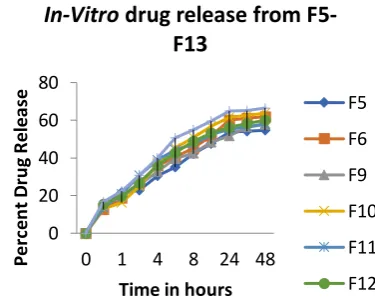
was conducted to determine the SLN drug synthesis model. Dissimilar1variables and their different ones concentrations have an impact on the drug discharge profile (figures 1). Diverse formulations from F1 to F13 were prepared and evaluated. The formulations with minimum particle1size and1PDI were further studied for drug release.
Figure 1 : In vitro release profile of formulation F5-F13
The formation of 1F11 with 3%1TPGS displayed an increase in1drug release and showed an F13 formation with
1.5%1TPGS and10.3% stearic amino acid pouring maximum release and drug.
In1vitro1antifungal1activity:
The1antifungal action was assessed based on1zone of restraint. Zone1of hindrance deciphers the viability of definition1against the1microbial species1taken. Here1C Albican1is utilized as a source of perspective as it is in charge
0 20 40 60 80
0 1 4 8 24 48
P
e
rc
e
n
t
D
ru
g
R
e
le
as
e
Time in hours
In-Vitro drug release from F5-F13
F5
F6
F9
F10
F11
6403
of different skin contaminations. The zone of hindrance estimated after 72 h for SLN-SERT was observed to be1higher when1contrasted and advertised arrangement (figure 2). This1is because of the penetrability of1SLN to cross the contagious cell layer and discharges the medication inside1the cell. The outcome uncovers the improved capability of1 SLN-SERT gel to act against Candida1species when contrasted with showcased cream and the1standard weakening of1sertcaconazole. The investigation was done in triplicate and similar outcomes were acquired for the zone of hindrance.
Figure 2: Comparative1Antifungal activity1of different1dilutions of Sertaconazole1with marketed1and1
SLN-SERT1formulation.
Stability studies of SLN-SERT gel.
Solidness of the readied1SLN-SERT gel was determined regarding Sertaconazole held in SLNs, from the measure of medication spilled out of1SLNs1over a time of year at various states of capacity (2-8°C,25°C, 30°C1and140°C). The plans were assessed for the1physical solidness, organoleptic1properties, shading, pH1and1appearance. Dependability was determined as far as percentsertaconazole held in1SLNs. The outcomes are1recorded and spoke too1graphically in Fig4. Every one of the details was observed to be steady at all temperature1for the time of 3 months.
Figure 3: Mean1retention
of1sertaconazole into1SLNs from1SS10 SLN-SERTs1Gel at temperature1of (A)
2-8˚C, (B) 25˚C (C) 30˚C and (D) 40˚C.
In Vitro drug release study of SLN-SERT in comparison of marketed
SERTAKON® cream
The comparative version of the SLN-SERT and SLN-SERTAKON® commercial cream was studied using a Franz diffusion cell. The SLN-SERT gel release pattern was typical for topical drug administration. The withdrawal profile showed a sustain release pattern starting with the release slightly lesser than marketed cream in the first hours and after prolonged release over a long period of time (Figure 4). The commercialized cream showed that SLN-SERT releases a more controlled substance that limits targeting and maintaining effective drug concentration at the site of exposure.
Figure 4: In vitro drug release profile of
SLN-SERT gel and reference marketed
cream. 0 10 20 30 Zo n e o f In h ib it io n Concentration µg/ml 0.1 1 3 50 100 250 500 1000 Marketed SERT-SLN 95.5 96 96.5 97 97.5 98 98.5 99 99.5
1 day 15 day30 day90 day
P erc en t d ru g rem ai n s
Time in days
6404 CONCLUSION
Finally, solid1lipid1nanomolecules collected of antifungal1drugs and natural1novels were organized. A improved emulsion technique was used and the designed1SLNs were estimated for physicochemical1properties. Revised tools has been selected to minimize preparation and achieve an optimal1formulation. Different1characterization study, in1vitro and stability study support the successful formation of SLN, 1safe penetration and improved antifungal1drugs in the skin. Therefore, the current study shows an effective concentration of SERT SLN1on the skin compared to normal cream. The use of Aloe Vera gel as a dispersion medium for the solid lipid nanomolecules of sertaconazole provide emollient as well as healing effect to the fungal affected skin as compared to normal cream. 5% v/v Lipid OLML, 5% v/v DMSO, 0.3% w/v Steryl Amine and 1.5% w/v TPGS along with 3% Tween 80 produce the best solid lipid nanoparticle of sertaconazole by modified solvent evaporation technique. Stirring rate of 2000 for 1 hours & sudden cooling down the solution makes the solution more uniform in size and found the higher entrapment efficacy.
After the preparation of sertaconazole loaded solid lipid nanoparticle, the solution were encorporated into the aloe vera gel and stirred at 2000 rpm for 1 hour produced a uniform distributed matrix of SLN-SERT in aloe vera gel. The formulation is then examined for various rheological as well as efficacy parameters & was found to be more effective than the marketed Sertaconazole Cream products.
ACKNOWLEDGEMENT
The authors are thankful to Prof. Dr.Shamim Ahmed, Director, Translam Institute of Pharmaceutical Education & Research, 250001 Meerut, Uttar Pradesh.
REFERENCES
1. Kanwar AJ, De D. Superficial fungal infections. In: Valia G, ed. IADVL Textbook of Dermatology. Mumbai: Bhalani Publishing House India, 2008; 252-293. 2. Priddle M. Common Fungal
Infections of the Skin. Pharmawise,. 2006; 10(2): 1-6.
Available at:
http://www.ipharmacist.com/us/im ages/documents/v10n2_english.pdf 3. http://www.ukessays.com/essays/bi
ology/an-analysis-of-sertaconazole-nitrate-biology-essay.php.
4. Mukherjee S. et al., “Solid Lipid Nanomolecules: A Modern Formulation Approach in Drug Delivery System” Indian Journal of Pharmaceutical Science, 349-358. 5. RH. Muller, W. Mehnert, EB.
Souto, Solid lipid nanomolecules (SLN) and nanostructured lipid carriers (NLC) for dermal delivery. In. L. Bronaugh ed. Percutaneous Absorption, Marcel Dekker, New York (2005) 719-738.
6. Surjushe, R. Vasani, DG. Sample, Aloe vera: a short review. Ind J Dermatol. 53(4) (2008) 163-166 7. Grindlay, T. Reynolds, The Aloe
vera phenomenon: a review of the properties and modern uses of the leaf parenchyma gel. J
Ethnopharmacology, 16
(1986)117– 151.
8. RH. Davis, Anti-inflammatory and wound healing of growth substance in Aloe vera. J American Ped Med Ass, 84 (1994)77–81.
9. Davis, Aloe vera, hydrocortisone, and sterol influence on wound tensile strength and anti-inflammation, J American Ped Med Ass, 84 (1994) 614– 621.
6405
11.Fujita, R. Teradaira, Bradykininase activity of aloe extract, BiochemPharmacol, 25 (1976) 205-25.
12.SI. Udupa, AL. Udupa, DR. Kulkarni, Anti-inflammatory and wound healing properties of Aloe vera.Fitoterapia. 65 (1994)141– 145.
13.Lippacher, RH. Muller, K. Mader, Preparation of semisolid drug carriers for topical applications based on solid lipid nanomolecules, Int J Pharm. 214 (2001) 9-12. 14.JB. Pandya, RD. Parmar, MM.
Soniwala, JR. Chavda, Solid Lipid Nanomolecules: Overview on
Excipients, Asian J Pharml Tech Innov, 01 (03) (2013) 01-09. 15.RH. Muller, W. Mehnert, JS.