6715
ESTIMATION OF ZIPRASIDONE BY A NEWLY DEVELOPED AND VALIDATED
ANALYTICAL METHOD USING RP–HPLC WITH UV DETECTION
Swetha Sri. R* Sumakanth. M, Bhavya Sri. K, Shradda Kiran
RBVRR Women's college of Pharmacy, Barkatpura, Hyderabad, Telangana-500035, India
*Corresponding author E-mail:[email protected]
ARTICLE INFO
ABSTRACT
Key Words
Ziprasidone (ZPS), HPLC, Estimation,
Validation.
A simple, sensitive, accurate, precise and reproducible high performance liquid chromatographic method was developed for the estimation of Ziprasidone hydrochloride in bulk drug and capsule dosage form. In this method, chromatography was carried using Sunsil C18 (x 150x4.6mm, 5µ) column using a
mixture of water: methanol (55:45) as the mobile phase at a flow rate of 1.0 ml/min, and the detection wavelength was 261 nm. The linearity was observed in the range of 2-10 μg/ml with a correlation coefficient of 0.999. The proposed method was validated for its linearity, accuracy, precision and robustness and found to be simple, rapid, accurate, and precise. LOD and LOQ values were found to be 0.09 μg/ml and 0.29 μg/ml respectively. Hence can be applied for routine quality control analysis of Ziprasidone hydrochloride in capsule dosage forms.
INTRODUCTION
Ziprasidone1is a novel antipsychotic agent and is indicated for the treatment of schizophrenia, as monotherapy for the acute treatment of bipolar manic or mixed episodes, and as an adjunct to lithium or valproate for the maintenance treatment of bipolar disorder. Chemically, it is 5-[2-[4-(1, 2-benzisothiazol-3-yl)-1-piperazinyl] ethyl]-6-chloro-1, 3-dihydro-2H-indol-2-one (Fig.1). The action of Ziprasidone is mediated through a combination of dopamine type 2 (D2) and serotonin type 2 (5HT2) antagonisms. Ziprasidone exhibited high in vitro binding affinity for the dopamine D2 and D3, the serotonin 5HT2A, 5HT2C, 5HT1A, 5HT1D, and α1-adrenergic receptors and moderate affinity for the histamine H1 receptor. Ziprasidone is functioned as an antagonist at the D2, 5HT2A, and 5HT1D receptors, and as an agonist at the 5HT1A receptor. Ziprasidone inhibited synaptic reuptake of serotonin and norepinephrine. A few spectrophotometric2-3,
HPLC4-7, LC-MS8-10 and capillary
electrophoresis 11,12 methods were reported
earlier for the determination of Ziprasidone Hcl in bulk and pharmaceutical formulations. In the present study the authors report a rapid, sensitive, accurate and precise HPLC method for the estimation of Ziprasidone Hcl in bulk samples and in capsule dosage forms.
Fig.1: Chemical structure of Ziprasidone Materials and methods
Instrument: The Analysis of the drug was carried out on WATERS hplc system equipped with a sunsil C18 (4.6mm x 150,5 µ)column with 1525 Binary pump and 2487 dual absorbance detector.Software used was Empower 3.0.
6716 Chemicals and solvents: Ziprasidone
hydrochloride was supplied by TCI chemicals Ltd., Hyderabad. Commercial capsules of ziprasidone were procured from local market, which were manufactured by sun pharma laboratories Ltd, Sikkim. HPLC grade methanol and water purchased from Lichrosolv (Merck) were used throughout the study.
Preparation of mobile phase and diluent: Measured quantities of HPLC grade water and Methanol were filtered through 0.45 µ filter under vacuum and degassed in digital ultrasonicater for 10 minutes. Filtered and sonicated HPLC grade methanol was used as Diluent.
Standard preparation: Stock I: Accurately weigh and transfer 10 mg of Ziprasidone working standard into a 10ml clean dry volumetric flask,add about 7ml of Methanol, sonicate to dissolve and removal of air completely and make volume up to the mark with the same.(1000µg/ml) Stock II: Pipette out 1ml stock solution into a 100ml volumetric flask, dilute up to the mark with diluent.(10µg/ml)
Results and Discussion
Selection of wavelength: Establishing a maximum absorbance was the initial step which was observed at 261nm using UV spectrophotometer (Figure2).
Fig. 2: UV Spectrum of Ziprasidone Hcl
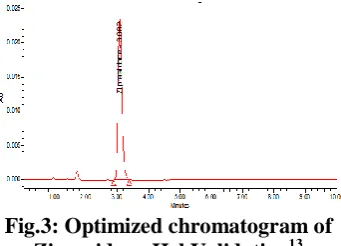
Method Development: Optimized chromatographic conditions were established on a trial and error basis by varying organic and aqueous phase. The column was equilibrated by pumping the mobile phase consisting water: methanol (55:45%v/v) for at least 30 min prior to the injection of the drug solution at a flow rate of 1 ml/min. The column oven temperature being ambient, detection of ZPS was monitored at 261 nm. The run time was set to 10min. Under these optimized chromatographic conditions a sharp peak meeting all the system suitability criteria was retained at 3.08 min. The optimized chromatogram was shown in Figure 3.
Fig.3: Optimized chromatogram of Ziprasidone Hcl Validation13
System Suitability: Five replicate injections of standard solution (5μg/ml) were injected into the chromatographic system. The system suitability parameters like theoretical plates, resolution and asymmetric factor were evaluated and the values are depicted in Table 1.
RepeatabilityPrecision of the method was determined by measuring the %RSD of six replicate injections of stock II solution. Values obtained are presented in table 2.
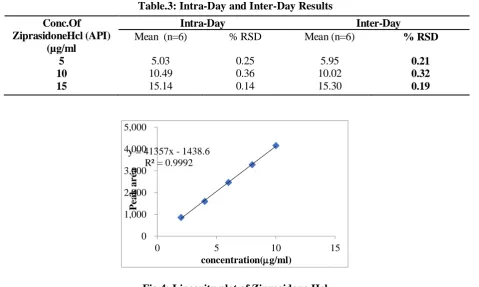
Intraday &Inter day: Solutions containing various concentrations of Ziprasidone Hcl was carried out to check intra-day and inter-day variation of the method and the results are furnished in Table 3.High values of mean assay and low values of standard deviation (% RSD < 2.0) within a day and day to day variations revealed that the proposed method is precise.
Linearity and Range
Linearity of the method was performed by preparing serial dilutions of standard Ziprasidone Hcl solution(stock II) to obtain a final concentration ranging from 2-10 μg/ml. Peak areas obtained were tabulated (Table 4) , a straight line obtained in the calibration curve (Fig 4) shows the method is linear. Regression analysis (r2=0.999) by the least square method meets acceptance criteria. This regression equation was later used to estimate the amount of Ziprasidone hydrochloride in capsule dosage forms.
6717 Table 1: System Suitability Results for Ziprasidone Hcl
Precision
Table.2: Repeatability results for ziprasidone HCL
Table.3: Intra-Day and Inter-Day Results
Fig.4: Linearity plot of Ziprasidone Hcl y = 41357x - 1438.6
R² = 0.9992
0 1,000 2,000 3,000 4,000 5,000
0 5 10 15
P
e
ak
ar
e
a
concentration(g/ml)
Replicate Retention time Peak Area USP plate count USP Tailing
1 3.08 204753 4506 1.3
2 3.08 204331 4674 1.2
3 3.07 204753 4298 1.2
4 3.08 204331 4032 1.0
5 3.08 204753 4812 1.3
Mean 3.078 204584.2
Std. Dev 0.0045 231.1389
% RSD 0.15 0.11
Replicate Rt Peak Area USP plate count USP Tailing
1 3.082 404754 4755 1.3
2 3.082 407332 4814 1.3
3 3.082 404754 4822 1.3
4 3.082 407332 4709 1.3
5 3.082 404754 4704 1.3
6 3.082 404754 4704 1.3
Mean 3.082 405613.33
Std. Dev 1215.281
% RSD 0.30
Conc.Of ZiprasidoneHcl (API)
(µg/ml
Intra-Day Inter-Day
Mean (n=6) % RSD Mean (n=6) % RSD
5 5.03 0.25 5.95 0.21
10 10.49 0.36 10.02 0.32
6718 Table.4: Linearity data
Accuracy
Table.5: Accuracy Results
Spike level Replicates Amount spiked (ppm)
Amount Found (ppm)
Peak Area % Recovery Mean
%Recovery
50% Replicate 1 2 2.03 249991 100.54
100.0
Replicate 2 2 1.92 248236 99.48
Replicate 3 2 1.91 248722 99.78
100% Replicate 1 4 3.69 331176 99.43
100.0
Replicate 2 4 3.79 332098 99.98
Replicate 3 4 3.81 332140 100.01
150% Replicate 1 6 5.78 413214 99.22
99.44
Replicate 2 6 5.82 414987 99.93
Replicate 3 6 5.76 413054 99.16
LOD and LOQ Assay
Preparation of sample solution: Take average weight of 10 capsules and transfer them in a mortar, 10mg equivalent of Ziprasidone sample was weighed and transferred into a 10mL clean dry volumetric flask and add about 7mL of diluent and sonicate to dissolve it completely and make volume up to the mark with the same diluent. Pipette out 0.5ml stock solution was taken in a 100ml of volumetric flask dilute up to the mark with diluents. (5µg/ml)
Label claim = 206361/ 204754× 10/1000× 1000/68.675 × 100/100 × 275/40× 100
= 100.2% CONCLUSION
A delicate and specific, sensitive RP-HPLC strategy has been created and approved for the investigation of Ziprasidone Hcl API. Facilitate the proposed RP-HPLC strategy has amazing affectability, exactness and reproducibility.
Acknowledgement:
The authors would like to thank TCI chemicals Ltd., Hyderabad, for providing Ziprasidone Hydrochloride as gift sample.
REFERENCES
1. Sudha rani ,venkata reddy et al: A reverse phase HPLC method is described for the determination of Ziprasidone HCl mono hydrate in bulk and pharmaceutical dosage forms, European journal of chemistry 2006; 3(4):169-172.
2. Abhay R.shirode et al: A new isocratic simple and rapid reverse phase high performance liquid chromatographic (RP-HPLC) method was developed and successively validated for the estimation of ziprasidone hydrochloride monohydrate (ZHM),International journal of pharmaceutical sciences and drug research 2016; 8 (2):121-127. 3. Gnana ruba priya, M.kali kolan ,
S.asadulla, S. Rajesh et al: A reverse phase HPLC method is described for the determination of Ziprasidone HCl capsule by analytical methanol, International journal of pharmaceutical sciences and Research 2011; 2 (9):2325-2327.
S.NO Conc.(g/ml) AveragePeak Area
1 2 85535
2 4 159277
3 6 246375
4 8 327185
6719
4. Sri. Manikonda M, Bayyavarapu D, Prabahar EA, Ramarao N. et al : Method Development and Validation for the Estimation of Ziprasidone Hydrochloride in Pellets by RP-HPLC. International Journal of Pharmaceutical Research and Novel Sciences2014; 1(1):53-59.
5. Rao KS, Keshar NK, Choudhury PR, Rao MEB, Pattnaik AK et al : RP-HPLC method for the estimation of ziprasidone. Inernational Journal of Pharma Medicines & Biological Sciences 2013; (1):45-52.
6. Bhaskar, Shrivastava P. et al: Development and Validation of an HPLC Method for Determination of Ziprasidone and its Impurities in Pharmaceutical Dosage Forms. Journal of AOAC International 2011; 94(3): 1-10.
7. Pavlovic M, Malesevic M. et. al : Development and Validation of Stability Indicating RP-HPLC Method for the Estimation of Ziprasidone in Capsule Dosage Form. International Research Journal of Pharmacy 2012; 3(2): 222-225.
8. Shirode AR, Deodhar MS, Kadam VJ. et al: RP-HPLC and HPTLC Methods for Simultaneous Estimation of Metformin Hydrochloride and Vildagliptin from Bulk and Marketed Formulation: Development and Validation. British Journal of Pharmaceutical Research 2014; 20: 2370-2386.
9. Anand kumar Y, Anitha M, Hemanth A andSrinivas S et al: Development of Rapid UV Spectrophotometric Method For Estimation Of Ziprasidone Hydrochloride In Bulk And Formulations, Digest Journal ofNanomaterials and Biostructures 2010; 5: 279-283.
10. Chudasama, Channabasavaraj, Pandya CB, Mani TT et al: Development and Validation of a rapid RP-HPLC method for the estimation of Ziprasidone hydrochloride monohydrate in bulk and its capsule dosage forms. International Journal of Pharmaceutical Sciences Review and Research 2010; 4(3):193-197
11. Ramanaiah G, Ramachandran D, Srinivas G, Srilakshmi V, Rao P.et al ; Development and Validation of a Rapid RP-HPLC Method for the Estimation of Ziprasidone Hydrochloride Monohydrate in Drug Substance and its Dosage Forms. International Journal of Pharmacy and Pharmaceutical Sciences 2012; 4(2):623-625.
12. Kishore and Hanumantharao et al
(2010)A Validated
Spectrophotometric Methods For The Determination of Ziprasidone Hydrochloride In Bulk And Pharmaceutical Formulations, International Journal of Chemical and Analytical Science 2010; 1(7):151-153.