3-difference cordial labeling of some cycle related
graphs
R. Ponraj,
∗1and M.Maria Adaickalam
†21Department of Mathematics, Sri Paramakalyani College,Alwarkurichi-627 412, India.
2Department of Mathematics, Kamarajar Government Arts College, Surandai-627859, India.
ABSTRACT ARTICLE INFO
Let G be a (p, q) graph. Let k be an integer with 2 ≤ k ≤ p and f from V(G) to the set {1,2, . . . , k} be a map. For each edgeuv, assign the label|f(u)−f(v)|. The function f is called a k-difference cordial label-ing of G if |vf(i)−vf(j)| ≤ 1 and |ef(0)−ef(1)| ≤ 1
wherevf(x) denotes the number of vertices labelled with
x(x∈ {1,2. . . , k}), ef(1) and ef(0) respectively denote
the number of edges labelled with 1 and not labelled with 1. A graph with a k-difference cordial labeling is called ak-difference cordial graph. In this paper we investigate the 3-difference cordial labeling of wheel, helms, flower graph, sunflower graph, lotus inside a circle, closed helm, and double wheel.
Article history:
Received 20, October 2015 Received in revised form 28, January 2016
Accepted 10, March 2016 Available online 10, April 2016
Keyword: Path, cycle, wheel, star.
AMS subject Classification: Primary 05C78,
∗Corresponding Author:R. Ponraj, Email:[email protected]; †E-mail: [email protected]
1
Introduction
Graphs considered here are finite and simple. Recently Ponraj, Maria Adaickalam and Kala [3] have introduced thek-difference cordial labeling of graphs. In [3], they investigate thek-difference cordial labeling behavior of star,mcopies of star etc. Also they discussed the 3-difference cordial labeling behavior of path, cycle, complete graph, complete bipar-tite graph, star, bistar, comb, double comb, quadrilateral snake, C4(t), S(K1,n), S(Bn,n).
In [4, 5], Ponraj and Maria Adaickalam studied the 3-difference cordial labeling behavior of union of graphs with the star, union of graphs with splitting graph of star, union of graphs with subdivided star, union of graphs with bistar,Pn∪Pn, (Cn⊙K1)∪(Cn⊙K1),
Fn∪Fn,mC4, K1,n⊙K2, Pn⊙3K1, splitting graph of a star, double fan DFn and some
other graphs. In this paper we investigate 3-difference cordial labeling of wheel, helms, flower graph, sunflower graph, lotus inside a circle, closed helm, and double wheel. Terms not defined here follows from Harary [2] and Gallian [1].
2
3
-Difference cordial labeling
Definition 2.1. LetGbe a (p, q) graph. Letf fromV(G) to{1,2, . . . , k}be a map. For each edge uv, assign the label |f(u)−f(v)|. The map f is called a k-difference cordial labeling ofGif|vf(i)−vf(j)| ≤1 and|ef(0)−ef(1)| ≤1 wherevf(x) denotes the number
of vertices labelled with x, ef(1) and ef(0) denote the number of edges labelled with 1
and not labelled with 1, respectively. A graph with ak-difference cordial labeling is called a k-difference cordial graph.
Theorem 2.1. If n≡0,1 (mod 3), then the wheel Wn is 3-difference cordial.
Proof. Let n = 3t+r where 0 ≤ r < 3 and r = 2. Let6 Wn = Cn+K1 where Cn is the
cycle u1u2. . . unu1 and V(K1) = {u}. Assign the label 1 to the central vertex u. Then
assign the labels 2,3,1 to the vertices u1, u2, u3 respectively. Then we assign the labels 2,3,1 to the next three vertices u4, u5, u6 resepctively. Continuing this way to assign the next six vertices and so on. Each time we have labeled three vertices. If r = 0 then we have labeled all the vertices. Otherwise, assign the label 2 to the last vertex. Note that in this process the vertex un received the label 1 or 2 according as n≡0 (mod 3) or n≡ 1
(mod 3). Clearly ef(0) =ef(1) =n and the vertex condition is given in table 1.
Nature of n vf(1) vf(2) vf(3)
n≡0 (mod 3) n 3 + 1
n 3
n 3
n≡1 (mod 3) n+2 3
n+2 3
n−1 3
Next we investigate the helm graph. The helm Hn is the graph obtained from the wheel
by attaching the pendent edge at each vertex of the cycle Cn.
Theorem 2.2. Helms are 3-difference cordial.
Proof. LetWn=Cn+K1 be the wheel where Cn is the cycle u1u2. . . unu1 and V(K1) = {u}. Let V(Hn) =V(Wn)∪ {vi : 1≤i ≤n} and E(Wn)∪ {uivi : 1≤i≤ n}. Note that
Hn has 2n+ 1 vertices and 3n edges.
Case 1. n≡0 (mod 3).
Subcase 1a. n ≡0 (mod 6).
Let n = 6t. Assign the labels 2,3,1,2,2,1 to the first six vertices u1, u2, u3, u4, u5, u6 of the cycle Cn. Then assign the labels 2,3,1,2,2,1 to the next six vertices u7, u8. . . u12
respectively. Proceeding like this, until we reach vertex un. Note that the vertex un
received the label 1. Now our attention turn to the vertices vi (1 ≤ i ≤ n). Assign the
labels 2,3,1,3,3,1 to the pendent vertices v1, v2, v3, v4, v5, v6 respectively. Then assign the
labels 2,3,1,2,2,1 to the next six pendent vertices v7, v8. . . v12 respectively. Continuing this way, until we reach the vertex vn. It is easy to verify that the vertex vn received the
label 1. Finally assign the label 2 to the vertex u.
Subcase 1b. n≡3 (mod 6).
As in subcase 1a, assign the label to the verticesu, ui, vi(1≤i≤n−3). Finally assign the
labels 2,3,1 and 2,3,1 to the verticesun−2, un−1, unandvn−2, vn−1, vnrespectively. We now
give the edge and vertex condition of the labeling for subcase 1 and 2. vf(1) =vf(3) = 23n
and vf(2) = 23n+ 1
Values of n ef(0) ef(1)
n≡0 (mod 6) 3n 2
3n 2
n≡3 (mod 6) 3n+1 2
3n−1 2
Table 2:
Case 2. n≡1 (mod 3).
Subcase 2a. n ≡4 (mod 6).
Fix the labels 2,2,3,3 to the vertices u1, u2, u3, u4 respectively. Then assign the labels
2,1,3,2,2,3 to the next six vertices u5, u6. . . u10 respectively. Assign the labels 2,1,3,2,2,3
to the next six vertices u11, u12. . . u16 respectively. Continuing this way assign the label
to the next six vertices and so on. Next fix the labels 1,1,1,3 to the vertices v1, v2, v3, v4
respectively. Then assign the labels 2,1,3,1,1,3 to the next six verticesv5, v6. . . v10 respec-tively. Assign the labels 2,1,3,1,1,3 to the next six verticesv11, v12. . . v16respectively. Con-tinuing this way assign the label to the next six vertices and so on. Finally assign the label 2 to the vertex u. The vertex condition of this labeling is vf(1) = vf(2) = vf(3) = 2n3+1
Subcase 2b. n≡1 (mod 6).
As in subcase 2a, assign the label to the vertices u, ui, vi (1≤ i≤n−3). Finally assign
the labels 2,1,3 and 2,1,3 to the vertices un−2, un−1, un and vn−2, vn−1, vn respectively.
Values of n ef(0) ef(1)
n≡4 (mod 6) 3n 2
3n 2
n≡1 (mod 6) 3n+1 2
3n−1 2
Table 3:
Case 3. n≡2 (mod 3).
Subcase 3a. n ≡5 (mod 6).
First fix the labels 1,3,2,2,3 to the vertices u1, u2, u3, u4, u5 respectively. Then assign the
labels 2,3,1,2,2,3 to the next six verticesu6, u7. . . u11 respectively. Then assign the labels
2,3,1,2,2,3 to the next six vertices of the cycle. Proceeding like this, assign the label to the next six vertices and so on. Clearly in this process the last vertexun received the label 3.
Next fix the labels 2,1,1,1,3 to the vertices v1, v2, v3, v4, v5 respectively. Then assign the labels 2,3,1,1,1,3 to the next six vertices v6, v7. . . v11 respectively and assign the labels 2,3,1,1,1,3 to the next six vertices. Continuing this way we assign the label to the next six vertices and so on. It is easy to verify that that the last vertex vn received the label
3. Finally assign the label 2 to the vertex u.
Subcase 3b. n≡2 (mod 6).
As in subcase 3a, assign the label to the vertices u, ui, vi (1≤ i≤n−2). Finally assign
the labels 2,3 and 2,3 to the vertices un−1, un and vn−1, vn respectively.
In both subcases the vertex is vf(1) =vf(2) = 2n3+2, vf(3) = 2n−31 and edge condition is
in table 4.
Values of n ef(0) ef(1)
n≡2 (mod 6) 3n 2
3n 2
n≡5 (mod 6) 3n−1 2
3n+1 2
Table 4:
Next is the flower graph. A flower is the graph obtained from a helm Hn by joining each
pendent vertices to the central vertex of the helm. It is denoted by F ln.
Theorem 2.3. The flower graph F ln is 3-difference cordial.
Proof. Take the vertex and edge set of the helm as in theorem 2.2.
Assign the labels 1,3,2 to the first three vertices u1, u2, u3 respectively of the cycle Cn.
Then assign the labels 1,3,2 to the next three vertices u4, u5, u6 respectively to the cycle.
Proceeding in this way, assign the labels 1,3,2 to the next three vertices of the cycle and so on. Clearly in this process the last vertex un received the label 2. Now consider the
verticesvi. Assign the labels 2,3,1 to the verticesv1, v2, v3 respectively. Next we assign the
labels 2,3,1 to the verticesv4, v5, v6 respectively. Continue in this pattern assign the labels
to the next three vertices respectively and so on. It is easy to verify that in this process the vertex vn received the label 1. Finally assign the label 3 to the central vertex vertex
u. The fact that this labeling is a 3-difference cordial follows from ef(0) = ef(1) = 2n
and vf(1) =vf(2) = 23n, vf(3) = 2n3+3.
Case 2. n≡1 (mod 3).
Assign the labels to the vertices u, ui, vi (1 ≤ i ≤ n −1) as in case 1. Next assign the
labels 1,2 to the vertices un, vn respectively. Clearly in this case, ef(0) =ef(1) = 2n and
vf(1) =vf(2) =vf(3) = 2n3+1.
Case 3. n≡2 (mod 3).
Let n = 3t+ 2. Assign the labels 1,2,3 to the vertices u1, u2, u3 respectively. Next we assign the labels 1,2,3 to the next three vertices u4, u5, u6 respectively. Continuing this
process, until we reach the vertex u3t. Note that in this process the vertex u3t received
the label 3. Then assign the labels 1,2 to the vertices u3t+1, u3t+2 respectively. Now our
attention turn to the verticesvi. Fix the labels 3,1 to the vertices v1, v2 respectively. Next
we assign the labels 2,3,1 to the next three vertices v3, v4, v5 respectively. Next assign the labels 2,3,1 to the next three vertices v6, v7, v8 respectively. Proceeding like this, we assign the label to the next three vertices and so on. Clearly the vertex vn received the
label 1. Finally assign the label 3 to u. The vertex and edge condition of this labeling is given below ef(0) =ef(1) = 2n and vf(1) =vf(3) = 2n3+2, vf(2) = 2n−3 1.
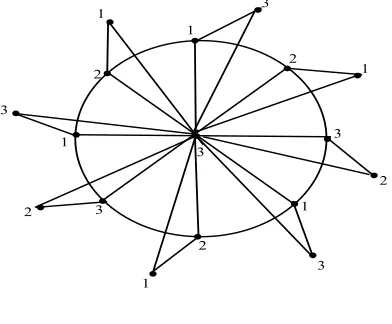
Illustration 1. A 3-difference cordial labeling of the flower graph F l8 is in Figure 1.
The sunflower graphSn is obtained by taking a wheelWn=Cn+K1 whereCnis the cycle
u1u2. . . unu1, V(K1) = {u} and new vertices v1, v2. . . vn where vi is join by the vertices
ui, ui+1 (mod n).
Theorem 2.4. The sunflower graph Sn is 3-difference cordial.
Proof. Case 1. n≡0 (mod 3).
Assign the labels 1,3,2 to the vertices u1, u2, u3 respectively. Next we assign the labels
1,3,2 to the next three vertices u4, u5, u6 respectively. In this sequence, assign all the
vertices of the cycle Cn. Clearly the last vertex un of the cycle received the label 2. Next
we move to the vertices vi. Assign the labels to the vertices vi(1 ≤ i ≤ n) in the same
technique as in ui(1 ≤ i ≤ n). That is assign the labels 1,3,2 to the vertices v1, v2, v3
and 1,3,2 to the vertices v4v5, v6 respectively. Proceeding like this, assign the next three
vertices and so on. Finally assign the label 2 to the central vertex u.
Case 2. n≡1 (mod 3).
Fix the labels 1,3,1,3 to the vertices u1, u2, u3, u4 respectively. Now we assign the labels
1,3,2 to the next three vertices u5, u6, u7 respectively. Then assign the labels 1,3,2 to the next three vertices u8, u9, u10 respectively. Continuing this way, assign the label to the next three vertices and so on. Clearly in this process the vertex un received the label 2.
Now our attention turn to the vertices vi. Fix the label 2 to the vertex v1. Then assign
the labels 3,1,2 to the next three verticesv2, v3, v4 respectively. Next we assign the labels
3,1,2 to the next three vertices v5, v6, v7 respectively. Proceeding like this way, until we
reach the vertex vn. Note that 2 is the label of the last vertex vn. Finally assign the label
2 to the central vertex.
Case 3. n≡2 (mod 3).
In this case fix the labels 1,3 to the verticesu1 andu2 respectively. Then assign the labels
1,3,2 to the next three vertices u3, u4, u5 respectively. Now we assign the labels 1,3,2 to
the next three vertices u6, u7, u8 respectively. Continuing this pattern, until we reach the
vertex un. It is obvious that, the label of the last vertex unis 2. Next our attention move
tovi. Fix the labels 3,2 to the verticesv1, v2 respectively. Then we assign the labels 1,3,2
to the next three verticesv3, v4, v5 respectively. Now we assign the labels 1,3,2 to the next
three vertices v6, v7, v8 respectively. Proceeding like this we reach the vertex vn. Clearly
2 is the label of the last vertex vn. Finally assign the label 2 to the central vertex. The
vertex and edge condition of this labeling is in table 5. In all the casesef(0) =ef(1) = 2n.
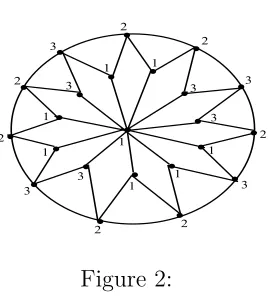
We now investigate the graph lotus inside a circle. The lotus inside a circleLCnis a graph
obtained from the cycle Cn :u1u2. . . unu1 and the star K1,n with central vertexuand the
Values of n vf(1) vf(2) vf(3)
n≡0 (mod 3) 2n 3
2n+3 3
2n 3
n≡1 (mod 3) 2n+1 3
2n+1 3
2n+1 3
n≡2 (mod 3) 2n−1 3
2n+2 3
2n+2 3
Table 5:
Proof. Case 1. n≡0 (mod 3).
Assign the label 1 to the vertices u3i−2, v3i−2(1≤ i≤ n
3). Then assign the label 3 to the
vertices u3i−1, v3i−1(1≤ i≤ n
3) and assign the label 2 to the vertices u3i, v3i(1≤ i≤ n 3).
Finally assign the label 2 to the central vertex u.
Case 2. n≡1 (mod 3).
First we fix the label 3 to the vertex v1. Then assign the labels 1,1,3 to the next three
vertices v2, v3, v4 respectively. Now we assign the labels 1,1,3 to the next three vertices
v5, v6, v7 respectively. Continuing in this pattern, unitl reach the vertex vn. Clearly vn
received the label 3. Now we move to the cycle vertices ui. Fix the label 2 to the vertex
u1. Then assign the labels 2,2,3 to the next three vertices u2, u3, u4 respectively. Then we
assign the labels 2,2,3 to the next three vertices u5, u6, u7 respectively. Proceeding like
this, until we reach the last vertex un. Then un received the label 3. Finally assign the
label 1 to the central vertex u.
Case 3. n≡2 (mod 3).
Fix the labels 2,3 to the vertices u1 and u2 respectively. Then we assign the labels 2,2,3 to the next three vertices u3, u4, u5 respectively. We assign the labels 2,2,3 to the next three verticesu6, u7, u8 respectively. Continuing this way, we reach a last cycle vertex un.
Clearly un received the label 3. Now we move to the vertices vi(1 ≤ i ≤ n). Fix the
labels 3,1 to the vertices v1 and v2 respectively. Then we assign the labels 1,1,3 to the
next three vertices v3, v4, v5 respectively. Next we assign the labels 1,1,3 to the next three
vertices v6, v7, v8 respectively. Proceeding like this, we assign the next three vertices and so on. Clearly 3 is the label of the last vertex vn. Finally assign the label 1 to the central
vertex u. Then f is a 3-difference cordial labeling follows from ef(0) = ef(1) = 2n and
the table 6.
Values of n vf(1) vf(2) vf(3)
n≡0 (mod 3) 2n 3
2n+3 3
2n 3
n≡1 (mod 3) 2n+1 3
2n+1 3
2n+1 3
n≡2 (mod 3) 2n+2 3
2n−1 3
2n+2 3
Table 6:
Figure 2.
Figure 2:
Next investigation is about closed helm. Closed helm is the graph obtained from a helm by joining each pendent vertex to form a cycle.
Theorem 2.6. Closed helm CHn is 3-difference cordial.
Proof. Let V(CHn) = {u, ui, vi : 1 ≤ i ≤ n} and E(CHn) = {uui, uivi : 1 ≤ i ≤
n} ∪ {uiui+1, vivi+1, u1un, v1vn : 1≤i≤n−1}.
Case 1. n≡0 (mod 3).
Assign the labels 2,2,3 to the first three vertices u1, u2, u3 respectively. Then assign the
labels 2,2,3 to the next three verticesu4, u5, u6 respectively. Proceeding like this we assign
the next three vertices and so on. In this process, the last vertex un received the label 3.
Next we move to the vertices vi and u. Assign the labels 1,1,3 to the first three vertices
v1, v2, v3 respectively. Next we assign the labels 1,1,3 to the next three vertices v4, v5, v6
respectively. Continuing this process until we reach the last vertex vn. It is clear that 3
is the label of the last vertex vn. Finally assign the label 1 to the central vertexu.
Case 2. n≡1 (mod 3).
Assign the labels to the vertices u, vi, ui(1≤i≤n−1) as in case 1. Next we assign the
labels 2 and 3 to the vertices un and vn respectively.
Case 3. n≡2 (mod 3).
As in case 2, assign the labels to the vertices u, vi, ui(1 ≤ i ≤ n−1). Then we assign
the labels 2 and 3 to the vertices un and vn respectively.The fact that this labeling f is a
3-difference cordial labeling follows from the edge condition ef(0) = ef(1) = 2n and the
vertex condition given in table 7.
The graph (Cn ∪ Cn) + K1 is called the double wheel. It is denoted by DWn. Let
V(DWn) = V(Wn)∪ {vi : 1 ≤ i ≤ n} and edge set E(DWn) =E(Wn)∪ {uvi : 1≤ i ≤
Values of n vf(1) vf(2) vf(3)
n ≡0 (mod 3) 2n 3 + 1
2n+3 3
2n 3
n ≡1 (mod 3) 2n+1 3
2n+1 3
2n+1 3
n ≡2 (mod 3) 2n−1 3
2n+2 3
2n+2 3
Table 7:
Theorem 2.7. The double wheel DWn is 3-difference cordial.
Proof. Case 1. n≡0 (mod 3).
Assign the labels 1,1,3 to the first three vertices u1, u2, u3 respectivly. Then assign the
labels 2,2,3 to the next three vertices u4, u5, u6 respectively. Next we assign the labels
1,1,3 to the next three verticesu7, u8, u9 respectively and assign the labels 2,2,3 to the next
three vertices u10, u11, u12 respectively. Continuing this process we assign the next three
vertices and so on. Note that in this case the last vertex unreceived the label 3. Next our
attention move to the verticesvi. Assign the labels 2,2,3 to the first three verticesv1, v2, v3
respectivly. Then assign the labels 1,1,3 to the next three vertices v4, v5, v6 respectively. Then assign the labels 2,2,3 to the next three vertices v7, v8, v9 respectively and we assign
the labels 1,1,3 to the next three vertices v10, v11, v12 respectively. Proceeding like this we
assign the next three vertices and so on. In this case 3 is the label of the last vertex vn.
Finally assign the label 2 to the central vertex u.
Case 2. n≡1 (mod 3).
Subcase 2a. n ≡1 (mod 6).
Fix the label 1 to the vertex u1. Then assign the labels 2,2,3,1,1,3 to the next six vertices
u2, u3, u4, u5, u6, u7 respectively. Next we assign the labels 2,2,3,1,1,3 to the next six
vertices u8, u9, u10, u11, u12, u13 respectively. Proceeding like this we assign the next six
vertices and so on. In this case the last vertex un received the label 3 according as
n ≡ 4 (mod 6) and n ≡ 1 (mod 6). Next we move to the vertices vi. Fix the label
3 to the first vertex v1. Then we assign the labels 1,1,3,2,2,3 to the next six vertices
v2, v3, v4, v5, v6, v7respectively. Next we assign the labels 1,1,3,2,2,3 to the next six vertices
v8, v9, v10, v11, v12, v13respectively. Continuing this way we reach the last vertexvn. Finally
assign the label 2 to the central vertex u.
Subcase 2b. n≡4 (mod 6).
Assign the label to the verticesu, ui, vi(1≤i≤n−3) as in subcase 2a. Finally assign the
labels 2,2,3 respectively to the verticesun−2, un−1, unand 1,1,3 to the verticesvn−2, vn−1, vn
respectively. Obviously this labeling pattern is a 3-difference cordial labeling.
Case 3. n≡2 (mod 3).
Assign the labels to the vertices u, ui, vi(1 ≤ i ≤ n−2) as in case 1. Then assign the
labels 1,3 and 1,3 to the vertices un−1, un and vn−1, vn respectively. The edge condition
for these three condition is ef(0) =ef(1) = 2n and the vertex condition given in table 8.
Values of n vf(1) vf(2) vf(3)
n ≡0 (mod 3) 2n 3
2n 3 + 1
2n 3
n ≡1 (mod 3) 2n+1 3
2n+1 3
2n+1 3
n ≡2 (mod 3) 2n+2 3
2n−1 3
2n+2 3
Table 8:
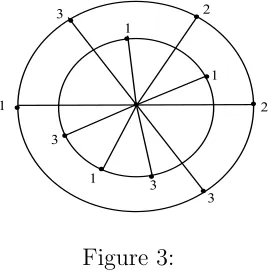
Illustration 3. A 3-difference cordial labeling of DW8 is given in figure 3.
Figure 3:
Acknowledgement. The authors are very much grateful to the reviewers for rendering their help in correcting the manuscript and also for their critical suggestions and comments regarding the manuscript.
References
[1] J.A.Gallian, A Dynamic survey of graph labeling, The Electronic Journal of Combi-natorics, 18 (2015) #DS6.
[2] F.Harary, Graph Theory, Addision Wesley, New Delhi (1969).
[3] R.Ponraj, M.Maria Adaickalam and R.Kala, k-difference cordial labeling of graphs, (submitted).
[4] R.Ponraj and R.Kala, 3-difference cordial labeling of some union of graphs, (submit-ted).