DEMOGRAPHIC RESEARCH
VOLUME 31, ARTICLE 33, PAGES 1007
−
1042
PUBLISHED 7 NOVEMBER 2014
http://www.demographic-research.org/Volumes/Vol31/33/ DOI: 10.4054/DemRes.2014.31.33
Research Article
Changing partner choice and marriage
propensities by education in post-industrial
Taiwan, 2000
−2010
Yen-hsin Alice Cheng
©2014 Yen-hsin Alice Cheng.
This open-access work is published under the terms of the Creative Commons Attribution NonCommercial License 2.0 Germany, which permits use, reproduction & distribution in any medium for non-commercial purposes, provided the original author(s) and source are given credit.
1 Introduction 1008
2 Social change and family in Taiwan 1009
3 Women’s socioeconomic status and marriage 1010
4 Social exchange theory and assortative mating 1012
5 Research design 1015
5.1 Data 1015
5.2 Measures of marriage 1016
6 Results 1017
6.1 Changing educational patterns of marriage 1017
6.2 Changes due to availability of eligible partners or to magnitude of
marriage attraction 1020
7 Potential explanations for the differential retreat from marriage 1021
8 The role of cohabitation in an era of marriage decline 1029
9 Discussion 1029
Acknowledgements 1034
References 1035
Changing partner choice and marriage propensities by education in
post-industrial Taiwan, 2000−2010
Yen-hsin Alice Cheng1
Abstract
BACKGROUND
Very little is known about recent marriage differentials by education in times of marriage decline and economic restructuring in East Asia.
OBJECTIVE
This study aims to contribute to family research in Asia by investigating educational variations in retreat from marriage and mate selection in Taiwan.
METHODS
This study applied Schoen's (1988) harmonic-mean two-sex marriage propensity approach to nationwide marriage registration data to examine the changing marriage patterns by education in Taiwan between 2000 and 2010.
RESULTS
The findings show that the drop in marriage rates is particularly drastic among the least educated. Marriage has become more prevalent and affordable for better-educated Taiwanese. Additionally, the proportion of educationally homogamous marriages has increased, and the share of female-hypergamous marriages of all heterogamy also increased from 2000 to 2010. Decomposition analyses show that these changes are mainly due to decreased marriage propensities, not to the availability of eligible partners. Educational and sex variations in marriage intentions, gender-role and marriage values, and the changing economic structure and financial well-being of young adults were investigated as potential causes.
CONCLUSIONS
Period marriage differentials by education have reversed from negative to positive in post-millennium Taiwan. A continued reliance on men‟s economic resources is also observed. Differences in gender-role values and economic well-being across social groups are plausible reasons for these family changes.
COMMENTS
More research is needed to unravel the impact of education on men and women‟s family formation prospects and how social inequality may be reinforced and reproduced through matrimony in Asia.
1. Introduction
2. Social change and family in Taiwan
The transformations of Taiwan from an agriculture-based to an industrialized economy and further to capital- and skill-intensive industries have formed the backdrop to large-scale social changes. One vivid example is reflected in family behaviors. In the first half of the twentieth century less than 1% of women were never married by age 50. The level of never-married men was slightly higher, but only about 2% to 5% of men were still single before turning 50. The proportion of ever married women by age 50 stayed at about 99% until 1980 and then declined for more than three decades. Another phase of accelerated marriage decline is observed after the millennium, after Taiwan became a post-industrial society in the late 1990s. By 2010 about 10% of men and 12% of women in their late forties have never been married, which is a substantial change from the previous universal marriage pattern. All these changes have been accompanied by advancement in women‟s socioeconomic status. Since the 1970s, educational expansion has taken place along with industrialization in Taiwan. Increasingly more women have advanced to tertiary education after finishing high school. The proportion of female students among all college students rose from 21% in 1960 to 36% in 1970 and further to 50% in 2010 (Ministry of Education 2012). The improvement in human capital among women has propelled a surge in labor force participation rates at prime working ages − a tremendous increase from 56% to 84% at ages 25 to 29 and from 55% to 77% at ages 30 to 34 between 1987 and 2010(DGBAS 1987−2010). Men and women in their twenties are the first groups to respond to the broader social and economic changes by postponing family formation events (Thornton and Lin 1994). In 1980 unmarried men and women were minorities among individuals in their early thirties − only 13.5% of men and 7.7% of women aged 30 to 34 were never married. As of 2010, over half (54.1%) of men and more than one-third (37.2%) of women in their early thirties have not entered a marital union (Ministry of the Interior 2011).
The phenomenon of Taiwanese young adults marrying less and later has been a focus of public and academic discussion for years. While it is not naively assumed that the retreat from marriage is even across social classes, the attention has largely focused on well-educated middle-class women, and the less educated are often absent from debates on how marriages can be promoted or saved. The fact that well-educated women are being „too picky‟ about their ideal partners (also known as the preference for a hypergamous marriage2) is often referenced as one of the main causes of rising singlehood. This may seem to line up well with the Second Demographic Transition theory, which maintains that the better educated lead the trend of forming fewer marital
2
unions and having fewer children. Nonetheless, the advent of post-industrialization and a globalized economy in Taiwan since the late 1990s has resulted in massive outsourcing of manufacturing factories and manual jobs to developing countries in South Asia and China, as well as an expanding service sector that attracts ever-growing numbers of female workers into the labor market. Heightened unemployment rates, widening income inequality between classes, and a changing labor force structure by sex in a service-based economy are the new social realities. As less-educated men have lost their jobs and more women have entered the labor market than ever before, the sex gap in earning capacity has converged substantially when compared to previous decades (DGBAS 2013). These changes inevitably affect individual life chances such as social mobility and family formation among the younger generations of Taiwanese men and women, who were coming of age at the turn of the millennium. In fact, it has been documented in the literature that demographic behaviors differ across class lines in a post-industrialized context (Cherlin 2010; Esping-Andersen 1999; Furstenberg 2008; McLanahan 2004). The socioeconomically disadvantaged are often the ones that experience more dramatic changes in family behaviors, as a large proportion of them have gone through job loss and economic instability, which make union formation an unaffordable dream (Esping-Andersen 1999, 2009). The least-educated Taiwanese men and women are more likely to have retreated from marriage than their better-educated counterparts as income inequality has worsened in recent years. Furthermore, it is very likely that the better educated are increasingly marrying each other because the high living standards to be sustained in a modern society requires financial inputs from both partners, leading to more educational homogamy. Yet studies focusing on socioeconomic differentials in family behaviors during the past two decades have been very scanty. Marriage patterns in contemporary Taiwan have crucial implications for social mobility and for the adults and children involved in these families. Hence, it is imperative that researchers acquire a comprehensive understanding of the shifting patterns of nuptiality along social lines in Taiwan.
3. Women’s socioeconomic status and marriage
“economic independence hypothesis.” This line of argument emphasizes that the breadwinner-housekeeper division of labor within a marital union creates “gains to trade”, and thus marriage is a rational choice for two individuals who wish to build a joint economic unit that maximizes productivity. It follows that the gains from marriage are largely reduced when women gain more ground in higher education and the labor market and become less dependent on their spouses‟ income. In turn, the opportunity costs of marriage increase, so that gainfully employed women tend to have a lower incentive to establish a family, and less time for childrearing and domestic work.
Another perspective, proposed by Oppenheimer, stresses the important contribution of women‟s earnings in contemporary families (Oppenheimer 1997). While in traditional families men are normally the sole breadwinners providing economic resources, Oppenheimer maintains that gender specialization can be a risky strategy for a family coping with economic uncertainty and financial shock. By contrast, when both partners contribute independently to a joint pool of earnings, a form of economic interdependency arises out of economies of scale. In modern societies where consumer prices have increased much faster than wage levels, dual-earner families certainly enjoy economic advantages over single-earner families in securing a better standard of living. In turn, the fact that women are better educated and are becoming economically independent should make them more attractive marriage partners, and should raise their likelihood of marriage.
in the Netherlands who were born in the cohorts of the 1920s to 1960s were more likely to remain single than their less-educated peers (Dykstra and Poortman 2010). A similar negative association between education and the chance of marriage is also found in several Eastern and Southern European countries (Kalmijn 2013).
In Asia, research on the social gradient of marriage has been scanty. The few existing studies on Japan show that well-educated Japanese women are less likely to enter a marriage than their less-educated counterparts (Raymo 2003; Raymo and Iwasawa 2005). While the findings support the economic independence hypothesis, the authors put forward a “marriage market mismatch hypothesis” to offer a context-specific explanation for this phenomenon. Raymo and Iwasawa (2005) found that a substantial decline in marriage among college-educated Japanese women is due to a shift in marriage market composition (i.e., fewer suitable educated partners). It underscores women‟s continued economic reliance on men in a social context where heightened housing and living costs are challenging for young couples, and there are still obstacles to gender equality and balancing work and family. Another relevant study on marriage in post-reform-era China shows that while more education is associated with earlier entry into marriage in places where housing prices are high, better-educated people marry later in places with low housing prices (Yu and Xie 2013).
4. Social exchange theory and assortative mating
Alongside the theoretical debates about the influence of women‟s socioeconomic attainment on marriage patterns, how individuals select their future partners is key to who marries whom. In both Becker‟s and Oppenheimer‟s arguments an exchange of characteristics between partners forms the basis of a marriage. Whether it is a breadwinner looking for a homemaker to establish a family, or two breadwinners who wish to reap economies of scale for a modern standard of living, rewards from marriage are expected through matching and exchanging valuable traits and resources between the two parties.
improves, well-educated women may be less confined to marrying the typical breadwinner male partners, who tend to be older and better educated than themselves, and instead have a wider range of choice of potential partners. In turn, a trend toward educational hypogamy may become more prevalent as women move up the social ladder. On the other hand, it is also possible that high living costs in modern societies not only make women‟s earnings valuable in a marriage but also cause a continued reliance on men‟s economic resources as a key criterion for establishing a family, and thus hypergamy still prevails.
Prior research in the U.S. has reported evidence of increasing resemblance of spouses in terms of educational attainment from 1930 to 1980 (Mare 1991). More recently, Schwartz and Mare (2005) showed a continued rise in educational homogamy from 1960 to 2003. College graduates in particular are becoming more likely to marry a partner with similar education than to marry someone with lower education, and the least educated have become much less likely to marry up (Schwartz and Mare 2005). A comparative study of 65 nations indicated that lower levels of educational homogamy are usually observed in times of low and high economic development − an inverted U-shaped pattern. In particular, Confucianism tends to be associated with higher levels of educational homogamy than Protestant culture (Smits, Ultee, and Lammers 1998).
In Asia, a recent study on South Korea shows that educational homogamy has increased for marriage cohorts from the 1960s and later. Despite women‟s rapidly rising educational profile, hypergamous marriages still dominate heterogamous unions (Park and Smits 2005). Across East Asia, Smits and Park (2009) showed that in ten countries the trend of educational assortative mating declines with increasing modernization. Educational homogamy is lower in countries with stronger Confucian influence and for women in cohorts with higher employment rates (Smits and Park 2009). To sum up, marriage behaviors are shaped not only by an individual‟s social status, partner availability, and gender relations but also by the broader economic context of a society.
investigate marriage patterns revealed in survey data, but none of them directly tackle the question of whether the education-marriage nexus is positive or negative for women. Furthermore, more recent research has not investigated the implications of post-millennium social change and economic restructuring.
It is likely that the negative educational gradients found in Japan also describe the marriage differentials in Taiwan, and that hypergamy is still a more prevalent form of heterogamy, as in South Korea, given that these societies share many similar social circumstances and cultural values. However, post-industrialization has also caused job loss among the least educated men, and in Taiwan more women are entering into the service sector. This has led to less-educated men occupying a relatively disadvantaged position in the marriage market. Thus, whether more education among women is associated with more marriages and whether there has been a rise and fall of educational hypergamy in contemporary Taiwan remain open questions. Hence, this study will test two sets of competing research hypotheses:
H1a: More education is associated with more marriages for well-educated women
H1b: More education is associated with fewer marriages for well-educated women
H2a: With women‟s improved socioeconomic status, the proportion of educational hypogamous marriages of all heterogamy is hypothesized to increase
H2b: With a continued dependence on men‟s economic resources, educational hypergamy is hypothesized to still dominate heterogamous unions.
Applying Schoen‟s (1988) harmonic-mean two-sex marriage propensity approach to analyze detailed nationwide marriage registration data for 2000‒2010 by age and education, this study will examine three research questions:
(1) How have marriage behaviors and partner choice varied across educational groups in Taiwan since the millennium?
(2) Are these changes due to changes in eligible partners or marriage propensities? (3) What are the potential causes of the educational differentials in marriage
behaviors observed in post-millennium Taiwan?
5. Research design
5.1 Data
To investigate the changing educational patterns of marriage, a set of detailed nationwide marriage-match data by grooms‟ and brides‟ age and education for marriages was requested from the Department of Household Registration in Taiwan. These age- and education-specific marriage-match data are only available for the years after 1998. This study uses data from the years 2000 and 2010. Among a population of 23 million there were about 183,000 and 133,000 marriages formed in Taiwan in 2000 and 2010, respectively. A total of 841 (29x29) cells of marriage-match data (23 age categories for brides and grooms from age -18, 18,…, 34, 35−39, 40−44, 45−50, 50−54, 55−60, 60−64, 65+) presented in cross-tabulation format were provided. These marriage counts include marriages of all orders3 and are used as the numerators for calculating age-specific marriage rates for both men and women. The education of brides and grooms is categorized into four groups: less than high school, high school, junior college, and college and above. Individuals who did not finish an educational level are grouped in the next lower category. There are 16 spreadsheets (4 education categories for both brides and grooms yield a total of 16 education combinations) with these 29x29 marriage-match data for both years 2000 and 2010. About 2.2% of all marriages involved one man or woman aged 65+ in 2000, and this was 1.55% in 2010.
As for the denominators, the exposure marriageable population data for the analyses of marriage patterns by age and education after 2000 were calculated using the 2000 and 2010 Census data. Since the numerators are marriages of all orders, the exposure populations are individuals who are single, divorced, and widowed in the census data. Twenty-nine age categories (i.e., one-year age intervals from 18 to 39, 5-year age intervals from 40−44 to 60−64, and two open intervals for ages younger than 18 and ages 65 and older) were used for the calculations of age-specific marriage rates and marriage propensities.
3 The proportions of remarriages are quite low (about 10% of all marriages) for men and women under age 45
5.2 Measures of marriage
In this study marriage behaviors are described by using the harmonic-mean two-sex marriage propensity approach proposed by Schoen (1988). This approach has been applied to several studies on marriage patterns (Okun 2001; Qian 1998; Qian and Preston 1993; Raymo and Iwasawa 2005; Schoen and Cheng 2006; Schoen and Wooldredge 1989). The merit of this method is that it can simultaneously consider the joint availability of unmarried men and women of specific traits, e.g., age and education, to facilitate comparison of marriage behaviors between groups that are free of compositional distortion. As a marriage often involves individuals of a different age and educational level, it is necessary to take into account the unmarried populations that are exposed to a specific type of marriage match. This is particularly important as the unmarried population of a certain educational level can vary greatly across years, due to the rapid educational expansion that has taken place in many modern societies. This type of two-sex problem is treated with procedures that make use of age-specific occurrence-exposure marriage rates for both men and women to measure the „force of attraction‟ for marriage (Schoen 1988). Force of attraction is defined as a specific marriage rate calculated from the harmonic mean of single men and women for a certain type of age or education match. It shows the rate of encounters between men and women of certain traits, and the share of such encounters that leads to marriage.
Occurrence-exposure rates are calculated by dividing the number of marriages between grooms and brides of specific traits by the population at risk of such a match. First, let Mm (x,a) be the marriage rate for men between age x and x+a, such that
Mm (x,a) = C (x,a) / Pm (x,a) (1)
where C(x,a) represents the number of marriages involving men in age x to x+a and Pm
(x,a) is the unmarried male exposure population (i.e., never married, divorced, and widowed) in age x to x+a. Analogously for women, let Mf (y,b) be the marriage rate for
women between age y and y+b. It follows that
Mf (y,b) = C (y,b) / Pf (y,b) (2)
where Pf (y,b) is the unmarried female exposure population in age y to y+b. Marriage
propensity between men with trait set A (e.g., 29-year-old college graduate) and women with another trait set B (e.g., 31-year-old junior college graduate) can therefore be represented by U (A;B) and is calculated as
Both a and b in Eq. 3 are the widths of the male and female age intervals respectively. Mm (A;B) is the male marriage rate for marriages between men with trait set
A and women with trait set B, while Mf (A;B) is the comparable female marriage rate.
Hence, marriage propensity U (A;B) is the sum of occurrence-exposure trait-specific marriage intensities that show the magnitude of marriage attraction between single men and single women of certain age and educational characteristics, independent of the population composition. The total propensity of a certain education match is the sum of propensities across all age matches within that specific type of education match. An age interval length of five was assigned to the oldest open age categories when using Eq. 3 to calculate marriage propensities.
This study further explores two additional marriage scenarios in 2010 by holding the force of attraction constant at the 2000 level and by holding the structure of eligible partners constant at the composition observed in 2000. These two sets of analyses facilitate the investigation of changes in marriage behaviors that are due to different structures of eligible partners and to changing magnitudes of marriage attraction across groups over the one-decade period.
6. Results
6.1 Changing educational patterns of marriage
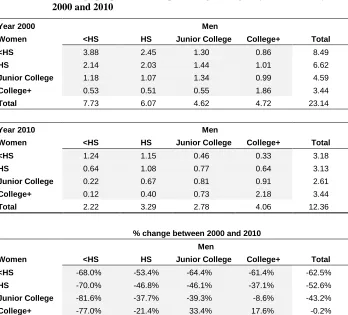
also found for marriages between a college-educated bride and a junior-college-educated groom from 2000 to 2010. The comparable percentage change for marriages between junior-college-educated brides and college-educated grooms only shows a -8.6% decrease in the same period. Unions formed between men and women of other educational combinations show a much stronger decline over this decade.
Table 1: Marriage propensities and percentage changes by education in years 2000 and 2010
Year 2000 Men
Women <HS HS Junior College College+ Total
<HS 3.88 2.45 1.30 0.86 8.49
HS 2.14 2.03 1.44 1.01 6.62
Junior College 1.18 1.07 1.34 0.99 4.59
College+ 0.53 0.51 0.55 1.86 3.44
Total 7.73 6.07 4.62 4.72 23.14
Year 2010 Men
Women <HS HS Junior College College+ Total
<HS 1.24 1.15 0.46 0.33 3.18
HS 0.64 1.08 0.77 0.64 3.13
Junior College 0.22 0.67 0.81 0.91 2.61
College+ 0.12 0.40 0.73 2.18 3.44
Total 2.22 3.29 2.78 4.06 12.36
% change between 2000 and 2010
Men
Women <HS HS Junior College College+ Total
<HS -68.0% -53.4% -64.4% -61.4% -62.5%
HS -70.0% -46.8% -46.1% -37.1% -52.6%
Junior College -81.6% -37.7% -39.3% -8.6% -43.2%
College+ -77.0% -21.4% 33.4% 17.6% -0.2%
Total -71.3% -45.7% -39.8% -14.0% -46.6%
observed among the less educated (refer to Appendix 1). The rise and fall of marriage propensities by education are mainly driven by delayed and increased union formation among the better educated. As can be seen in the panels for both men and women in Appendix 2, gains in marriage propensities (i.e., differences between 2000 and 2010 observed marriage propensities by education) for the better educated (i.e., particularly m4-f4 and m3-f4 pairings) in 2010 are clustered in unions formed in the thirties and early forties. The picture for all the other types of educational match is consistent across all ages for both sexes in this one-decade period: a uniform shying away from matrimony. One point to be noted is that even though the mean level of education in Taiwan has improved over the years for both sexes, in 2010 about 19% of men and 17% of women aged 20 to 49 did not have a high school degree. High school was the highest completed degree for about 39% of men and women in the same age range. Therefore, the group that experienced a substantial decline in marriage is a non-negligible proportion of the entire population.
6.2 Changes due to availability of eligible partners or to magnitude of marriage
attraction
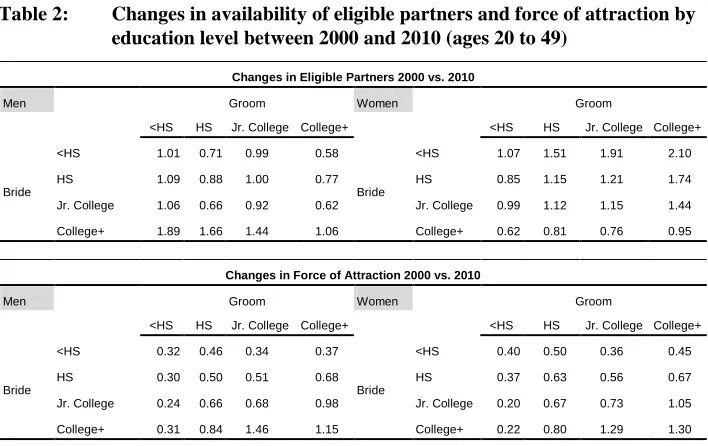
The next set of analyses aims to explore the marriage patterns by looking at how the shift in educational gradient of marriage reflects changes in the availability of eligible partners or changes in the force of attraction. To investigate the former, the number of marriages that would have occurred in 2010 was calculated by holding the force of attraction observed in 2000 constant. Hence, the ratios of the predicted 2010 marriage rates (by sex and age group) to the actual marriage rates observed in 2000 measure the change in the availability of eligible partners between 2000 and 2010. On the other hand, the ratios of the actual 2010 marriage rates to the predicted marriage rates observed in 2010 measure the change in the force of attraction between 2000 and 2010. These ratios were averaged across prime age groups from 20 to 49 to acquire a summary measure for a given education match. A mean value greater than 1 indicates a positive change in eligible partners or force of attraction. These procedures were carried out for both sexes, and the findings are presented in Table 2.
Table 2: Changes in availability of eligible partners and force of attraction by education level between 2000 and 2010 (ages 20 to 49)
Changes in Eligible Partners 2000 vs. 2010
Men Groom Women Groom
<HS HS Jr. College College+ <HS HS Jr. College College+
Bride
<HS 1.01 0.71 0.99 0.58
Bride
<HS 1.07 1.51 1.91 2.10
HS 1.09 0.88 1.00 0.77 HS 0.85 1.15 1.21 1.74
Jr. College 1.06 0.66 0.92 0.62 Jr. College 0.99 1.12 1.15 1.44
College+ 1.89 1.66 1.44 1.06 College+ 0.62 0.81 0.76 0.95
Changes in Force of Attraction 2000 vs. 2010
Men Groom Women Groom
<HS HS Jr. College College+ <HS HS Jr. College College+
Bride
<HS 0.32 0.46 0.34 0.37
Bride
<HS 0.40 0.50 0.36 0.45
HS 0.30 0.50 0.51 0.68 HS 0.37 0.63 0.56 0.67
Jr. College 0.24 0.66 0.68 0.98 Jr. College 0.20 0.67 0.73 1.05
College+ 0.31 0.84 1.46 1.15 College+ 0.22 0.80 1.29 1.30
Note: A value greater than 1 indicates a positive change in eligible partners or force of attraction, and a value smaller than 1 a negative change between 2000 and 2010.
To sum up, the marriage decline that took place between 2000 and 2010 was accompanied by a reversal of educational gradient in marriage propensities, from negative to positive, for both men and women. Educational homogamy increased, and the proportion of educational hypergamy also increased within heterogamous unions. All of these patterns were mainly driven by changes in marriage propensities, rather than compositional shifts in the availability of eligible partners.
7. Potential explanations for the differential retreat from marriage
1998 to 2006 for both men and women. Single men with tertiary education4 were nearly two times more likely (OR=1.75, p<.0001, Model 1) than the least educated single men to indicate a future marriage plan, whereas single women with similar education were three times more likely (OR=3.02, p<.0001, in Model 3) than the least educated to express a marriage intention, holding all other covariates constant. Such a positive educational gradient has become stronger over time. A closer look at data from separate years indicates that such a gradient only emerged after the millennium (in the 2002 and 2006 TSTS, but not the 1998 survey), which is also reflected in the significant interaction terms of education and survey year shown in Models 2 and 4. When considered with the macro-level marriage trend presented earlier, the best educated men and women are not only marrying more, but also have stronger motivation to enter a marital union than their less-educated counterparts. Such a low marriage intention among the least educated is likely to further bring down their already low marriage rates in the future.5
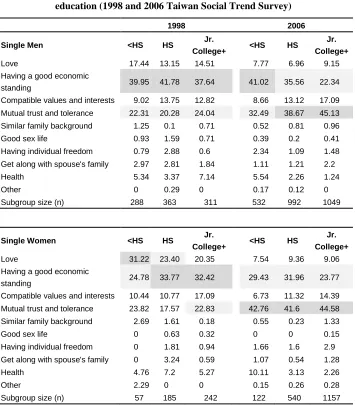
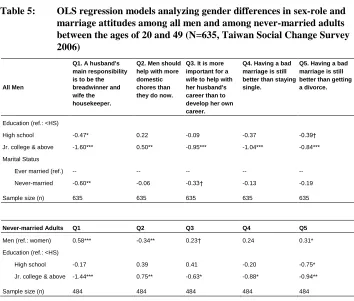
Additional analyses were carried out to explore the perceived key factor for a happy marriage. The results in Table 4 show a convergence of value in the most selected factor for both single men and women between 1998 and 2006. Before the millennium many more single men and women stressed the importance of economic standing as the foundation for a happy marriage. Even though in 2006 a quarter to two-fifths of never-married single men and women still think that a good economic standing is important for a happy marriage, a lot more of them endorse “mutual trust and tolerance” across all groups. While men and women seem to become similar in terms of their perceptions of a happy marriage, their attitudes toward sex roles and marriage still differ substantially. For the five attitudinal variables examined in Table 5, men with lower education are particularly slow to adapt to an egalitarian gender relation. Holding age and marital status constant, men with tertiary education are significantly more likely than their least educated counterparts to adopt liberal sex-role and marriage attitudes. Better-educated men are less likely to agree with a traditional division of labor between men and women, to think that a woman should put her husband‟s career before her own, and to believe a bad marriage is better than being single or divorced. They are more likely than the least educated men to believe that men should help with more household chores than they do now. In another set of analyses, single women are more liberal than single men on four of the five items after age and education are controlled for, revealing a discrepancy in sex-role and marriage values between the two sexes (results shown in the bottom panel of Table 5).
4 The response categories for education in the TSTS data vary between 1998 and later years. Junior college and
college are collapsed into one response category for 2002 and 2006 to make the models comparable. The TSTS terminated in 2006, so models for years beyond 2006 cannot be presented.
5 The expansion of education in Taiwan might lead one to think that the proportion of adults without a high
Table 3: Odds ratios predicting marriage intention among never-married men and women ages 25 to 49 by education (Stacked file of Taiwan Social Trend Survey, 1998, 2002, and 2006)
Model 1 Men
Model 2 Men
Model 3 Women
Model 4 Women
Survey Year (ref. 1998)
2002 0.51 *** 0.44 *** 0.62 ** 0.36 *
2006 0.51 *** 0.30 *** 0.58 *** 0.27 **
Age (ref. age 30-34)
25-29 -- -- -- --
30-34 1.04 1.03 0.71 ** 0.71 **
35-39 0.80 † 0.79 * 0.40 *** 0.40 ***
40-44 0.50 *** 0.51 *** 0.25 *** 0.24 ***
45-49 0.30 *** 0.30 *** 0.20 *** 0.21 ***
Education (ref. <HS)
High school 1.35 ** 0.95 1.85 ** 1.25
Jr. college and above 1.75 *** 1.14 3.02 *** 1.63
Education x Survey Year
(ref. <HS & 1998)
HS*2002 1.32 1.60
Jr. college+ *2002 1.26 2.13 †
HS*2006 1.92 * 2.04
Jr. college+ *2006 2.28 ** 2.70 *
Sample size N 6128 6128 3888 3888
† p<.10; * p<.05; ** p<.01; *** p<.001
Table 4: Response distributions of the most important factor for a happy marriage reported by never-married respondents ages 25 to 49 by education (1998 and 2006 Taiwan Social Trend Survey)
1998 2006
Single Men <HS HS Jr.
College+ <HS HS
Jr. College+
Love 17.44 13.15 14.51 7.77 6.96 9.15
Having a good economic
standing 39.95 41.78 37.64 41.02 35.56 22.34
Compatible values and interests 9.02 13.75 12.82 8.66 13.12 17.09
Mutual trust and tolerance 22.31 20.28 24.04 32.49 38.67 45.13
Similar family background 1.25 0.1 0.71 0.52 0.81 0.96
Good sex life 0.93 1.59 0.71 0.39 0.2 0.41
Having individual freedom 0.79 2.88 0.6 2.34 1.09 1.48
Get along with spouse's family 2.97 2.81 1.84 1.11 1.21 2.2
Health 5.34 3.37 7.14 5.54 2.26 1.24
Other 0 0.29 0 0.17 0.12 0
Subgroup size (n) 288 363 311 532 992 1049
Single Women <HS HS Jr.
College+ <HS HS
Jr. College+
Love 31.22 23.40 20.35 7.54 9.36 9.06
Having a good economic
standing 24.78 33.77 32.42 29.43 31.96 23.77
Compatible values and interests 10.44 10.77 17.09 6.73 11.32 14.39
Mutual trust and tolerance 23.82 17.57 22.83 42.76 41.6 44.58
Similar family background 2.69 1.61 0.18 0.55 0.23 1.33
Good sex life 0 0.63 0.32 0 0 0.15
Having individual freedom 0 1.81 0.94 1.66 1.6 2.9
Get along with spouse's family 0 3.24 0.59 1.07 0.54 1.28
Health 4.76 7.2 5.27 10.11 3.13 2.26
Other 2.29 0 0 0.15 0.26 0.28
Table 5: OLS regression models analyzing gender differences in sex-role and marriage attitudes among all men and among never-married adults between the ages of 20 and 49 (N=635, Taiwan Social Change Survey 2006)
All Men
Q1. A husband's main responsibility is to be the breadwinner and wife the housekeeper.
Q2. Men should help with more domestic chores than they do now.
Q3. It is more important for a wife to help with her husband's career than to develop her own career.
Q4. Having a bad marriage is still better than staying single.
Q5. Having a bad marriage is still better than getting a divorce.
Education (ref.: <HS)
High school -0.47* 0.22 -0.09 -0.37 -0.39†
Jr. college & above -1.60*** 0.50** -0.95*** -1.04*** -0.84***
Marital Status
Ever married (ref.) -- -- -- -- --
Never-married -0.60** -0.06 -0.33† -0.13 -0.19
Sample size (n) 635 635 635 635 635
Never-married Adults Q1 Q2 Q3 Q4 Q5
Men (ref.: women) 0.58*** -0.34** 0.23† 0.24 0.31*
Education (ref.: <HS)
High school -0.17 0.39 0.41 -0.20 -0.75*
Jr. college & above -1.44*** 0.75** -0.63* -0.88* -0.94**
Sample size (n) 484 484 484 484 484
† p<.10; * p<.05; ** p<.01; *** p<.001
Note: Each statement is measured on a scale of 1 to 7, with higher values indicating stronger approval. All regression models control for a respondent's age in 5-year age groups. Ever married respondents include those who are currently married, divorced, and widowed.
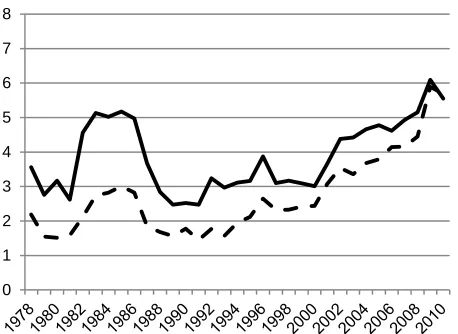
have been declining for workers in all social groups (DGBAS 1987−2010). Despite Taiwan‟s sustained economic growth (averaging 4.10% annually) in gross domestic product (GDP) from 2000 to 2010, employee compensation as a proportion of GDP declined from 51.7% in 1990 to 44.6% in 2010, which is an all-time low since 1990 (DGBAS 2010). That is, the profits and gains have not been justly distributed to laborers and employees in the era of post-industrialization, which is vividly reflected in the percentile distribution of disposable income for both men and women. According to the annual Survey of Family Income and Expenditure, even though income improved between 1995 and 2000 for the 20th, 50th, and 90th percentiles for both sexes, barely any increase in disposable income at the 20th and 50th percentiles is observed in the following decade of 2000-2010. The only group that experienced substantial income gain during this period was the most advantaged high-income earners in the 90th income percentile (DGBAS 1995−2010). In other words, wage levels have stagnated and even declined for over a decade in the face of continuous annual inflation, and the majority of Taiwanese laborers, particularly those from the lower class, are feeling that economic stress.
Figure 1: Unemployment rates by sex and education in Taiwan, 1978−2010
0 1 2 3 4 5 6 7 8
Unemployment rates (%) among HS men and women
Men
Women 0
1 2 3 4 5 6 7 8
Unemployment rates (%) among <HS men and women
Men
Figure 1: (Continued)
Unemployment rates (%) among junior college men and women
Unemployment rates (%) among college+ men and women
Source: Data acquired from the Directorate-General of Budget, Accounting, and Statistics, Executive Yuan, Taiwan. http://www.dgbas.gov.tw/ct.asp?xItem=18843&ctNode=4943.
0 1 2 3 4 5 6 7 8
Men
Women
0 1 2 3 4 5 6 7 8
Men
8. The role of cohabitation in an era of marriage decline
Family literature in the West often discusses how marriage decline is accompanied by a surge in the prevalence of co-residential unions (Bumpass, Sweet, and Cherlin 1991; Heard 2011; Kalmijn 2007). While cohabitation is relatively less common and still stigmatized in Asian countries (Jones 2007), the prevalence of cohabitation in Taiwan is rising over time (Lesthaeghe 2010). However, questions about marital status in major large-scale social surveys and the censuses often group the currently cohabiting and married individuals as one category, and they are indistinguishable in the dataset. Among the very few datasets that specifically asked about the experience of cohabitation are the 1998 and 2004 KAP surveys.6 Descriptive analyses (results not shown) using these two rounds of KAP indicate that cohabitation as a union type increased between 1998 and 2004. For single women aged 20 to 49, cohabitation became more prevalent among the younger generations and among the less educated. The increase in cohabitation among married women differs very little across cohorts and education. It is very likely that part of the decline in marital unions was substituted by cohabiting unions, especially if the prevalence of cohabitation among the unmarried population increased more among the less educated than the better educated in the KAP data. Although there is evidence showing an increasing prevalence of co-residential unions over time, cohabitation could have very different meanings for different social groups. On the one hand, it could be that cohabitation has replaced marriage among the less educated and the total union formation intensities are actually not decreasing when cohabitation is taken into account. On the other hand, cohabitation could also be rising among the better educated but serving only as a „test-run‟ for marriage. These are two untestable hypotheses at this point. As panel surveys that include comprehensive records and measures of cohabitation are still lacking in Taiwan, the extent to which cohabitation has become a substitute of or a prelude to marriage awaits more empirical investigation in future research.
9. Discussion
This study set out to investigate the changing partner choice and differential marriage propensities by education in an era of marriage decline in post-millennium Taiwan.
6 The KAP (Knowledge, Attitude, and Practice) survey is a collaboration between the Population Studies
Results of this study indicate that while all educational groups experienced marriage decline between 2000 and 2010, the drop is particularly drastic among the least educated. Because of their relatively mild decrease in marriage propensities, in 2010 men and women with tertiary education became more likely to marry than their less-educated counterparts. The most recent education-marriage patterns observed support hypothesis H1a where more education is associated with stronger marriage intensities among women. This is a reversal of the negative educational differentials in marriage intensity revealed by the 2000 data. As in many Western societies, Oppenheimer‟s theory appears to line up better with the most recent marriage patterns by education in Taiwan. Women with more socioeconomic resources are marrying more, especially with men who have similar levels of education.
As for the patterns of partner choice, a larger share of educational homogamy is observed in 2010 than in 2000, mainly driven by an increase in homogamy among the better educated. In addition, hypothesis H2b is supported: the proportions of educationally hypergamous marriages of all heterogamy also increased between 2000 and 2010. These findings show that in an era of growing economic uncertainty the better educated are increasingly more likely to marry a partner with similar background. For better-educated women, marrying down with men without any tertiary education has become a less feasible choice, despite their own rising financial independence. Thus, although improvement in women‟s socioeconomic attainment in Taiwanese society could open up broader possibilities for spouse selection, the marriage patterns observed suggest that a continuing preference for men‟s economic resources in a post-industrialized context is likely to further perpetuate the traditional pattern of hypergamy. While prior research by Chu and Yu (2010) showed a decline of homogamy between the pre-1970s and 1990s cohorts, the findings here suggest a rise in homogamy during the post-2000 period. These results resonate with the assortative mating patterns of Korean adults in recent marriage cohorts − the rise and fall of homogamy has followed a U-shaped pattern across cohorts, and hypergamy dominates all heterogamous marriages (Park and Smits 2005).
education has played a very small role in explaining the overall retreat from matrimony in East Asian countries (Jones and Gubhaju 2009). In fact, although improvements in the socioeconomic status of women are often argued to cause retreat from marriage, in Taiwan the best-educated women seem to become more desirable partners and show stronger intentions and behaviors to establish new families.
This study observed changes in marriage market composition in Taiwan between 2000 and 2010, similar to Raymo and Iwasawa‟s (2005) decomposition analyses. However, while the marriage decline among better-educated Japanese women is driven by a shortage of marriageable men, college-educated Taiwanese women actually had a higher propensity to marry (with similarly educated men), despite facing a smaller pool of eligible men. Raymo and Iwasawa have partly attributed the decline in marriage among better-educated Japanese women to the difficulty in combining work and family. The employment situation of married women in Taiwan appears more promising than in Japan, as a recent study showed that employment rates of married mothers with preschool-aged children in Taiwan have increased from 34% in 1983 to 62% in 2006 (Jao and Li 2012). In spite of limited state-supported childcare, motherhood (or marriage)7 and employment seem to have become complements rather than substitutes across cohorts of married women in Taiwan, which may not be the case in the Japanese context revealed in Raymo and Iwasawa‟s 2005 research.
In contrast to well-educated women, the majority of Taiwanese women with less than college education faced a surplus of eligible partners at most education levels, yet their propensity to marry showed a dramatic decline from 2000 to 2010. The analyses presented earlier suggest that the slower attitudinal changes among less-educated men might have caused their female counterparts to hesitate over the idea of marriage. On the other hand, it is also likely that men have come to appreciate the earning capacity of better-educated women, and thus the less-educated women are having problems marrying up with better-educated men.
This study further explores the compositional changes of the exposure population by education. The findings suggest that an important explanation for the tremendous decline in marriage propensity among the less educated is likely due to divorce and remarriage patterns. Given the negative educational gradient in divorce that has emerged since the 1990s (Chen 2012) and the fact that remarriage rates have been much lower among the less-educated men and women8, the proportion of divorced individuals among the less-educated population at risk of marriage has been expanding constantly over the years. Recent vital statistics show that the proportions of divorced individuals at prime marrying ages are particularly high among the less-educated men and women, and this
7 Only about 4% of all births in Taiwan were non-marital childbearing in 2010.
8 Author‟s own calculations based on vital statistics data on remarriages released by the Department of
trend has been increasing since 2000. Such an expansion in the marriageable population has suppressed the overall marriage intensities among the less educated. Along with a rapid drop in number of marriages among the less educated shown in Appendix 1, which is faster than the speed of educational upgrading over the past decade, a rapid decline in marriage intensities among the more disadvantaged population in Taiwan has become an inevitable reality. By contrast, the growth in marriages involving college-educated men and women between 2000 and 2010 was substantial (130% for men and 158% for women), outpacing the growth in college-educated male and female population. This is why compositional changes have played a small role in explaining the new patterns observed.
As wages have stagnated and unemployment rates have reached record-high levels, the deteriorating economic well-being of young employees is a structural cause of the recent dramatic decline in marriage rates and the reversal of educational differentials in marriage. Over the past two decades disposable income at most distribution percentiles has declined, except for the richest. The undesirable consequences of industrial outsourcing and income inequality in a post-industrial society have had a tremendous impact on the lives of many young individuals. This is congruent with findings in the United States, where the effects of men‟s education and economic characteristics on marriage likelihood have become more salient for the 1961-65 cohort than for the 1950-54 cohort. In other words, the role of men‟s economic standing in entry into marriage remains crucial as women‟s earning capacity rises (Sweeney 2002). Similarly, findings reported for the Antipodean countries of Australia and New Zealand also reveal deteriorating union formation prospects for less-educated low-income men (Heard 2011). In fact, a similar plight among low-skilled disadvantaged men has been documented in many countries experiencing globalization and a deregulated economy in a post-industrial context (Blossfeld and Buchholz 2009; Blossfeld et al. 2006; Esping-Andersen 2009). While governments in Taiwan and in Singapore are coordinating matchmaking social activities to raise the marriage rates of middle-class college graduates (CNBC 2012), public policy should also focus on the welfare of the disadvantaged sector of the population.
and women, particularly the less educated, can see a convergence in their views on an ideal intimate relationship and a happy marriage. Both family formation and union stability can be expected to increase when such a consensus is reached (Goldscheider, Oláh, and Puur 2010). These findings also resonate with Schoen‟s (2011) recent arguments that the role of “gender competition” in linking socioeconomic and ideational developments to contemporary family changes is crucial, and that the delay in the second stage of the gender revolution is likely due to a pushback from men. Overall, before a reconciliation between men and women can be reached regarding acceptable arrangements in domestic division of labor and a common expectation for marriage, the trend toward further decline in marriage rates seem to be inevitable in the years to come, although part of this downward pressure can certainly be offset by improvements in economic opportunities.
The majority of research on marriage decline has focused on women‟s changing values and attitudes, but the analysis here shows that across all social groups men, too, are embracing new ideas about the fundamental pillars of a happy marriage. As discussed earlier, it is the discrepancy in gender-role and marriage attitudes between men and women that appears to make marriage an unattractive life choice for many young adults in Taiwan, and perhaps in many other parts of East Asia as well. As marriage is a result of dyadic interactions and negotiations between the two sexes, men‟s desires and beliefs certainly contribute to the redefinition of dyadic relationship and family formation and should not be omitted in research on contemporary family change (Le Bourdais and Lapierre-Adamcyk 2004; Schoen 2011).
One thing to be noted is that since the 1990s foreign spouses have played a crucial part in the Taiwanese marriage market.9 The impact of such a social phenomenon on the analyses presented earlier is that the marriage rates/propensities were underestimated to different extents, because these marriages were counted in the numerators but the foreign women (and men to a much lesser extent) at risk of marriage were not included in the exposure population. The actual marriage propensities for unions that involve spouses with high-school-or-less education should have been lower because the majority of foreign spouses did not have any tertiary education (e.g., about 95% of Southeast Asian and 85% Mainland Chinese spouses received high school or lower education in 2008). In other words, the positive educational gradient in marriage intensities observed in 2010 would have been more pronounced if the information regarding country of origin had been available and the eligible foreign women and men at risk of marriage had been included as part of the marriageable population.
9 About 25% and 16% of the marriages registered in 2000 and 2010 were formed between a Taiwanese and a
foreign spouse. The great majority of these foreign marriage migrants did not have citizenship at the time of marriage9 and the majority of them are foreign brides (i.e., 93% and 82% of foreign spouses were female in
This study is one of the few studies that explore marriage differentials by education in Asia. In the decade after the millennium marriage propensities have increased for unions between better-educated men and women and decreased for other unions that involve less-educated individuals. Even though in 2010 the percentage of ever married by age 50 is still higher among less-educated women than the better educated, the social differential in life-time ever married rates could reverse in the future if the positive educational gradient in marriage intensities observed in 2010 persists over a longer period of time. In Japan a recent panel study on 1,500 women born in 1959 to 1979 (surveyed in 1993 to 2008) showed an emerging positive association between women‟s earnings and marriage probabilities among the 1970s cohorts (Fukuda 2013). The analyses here show additional evidence of a positive social gradient in marriage from a period perspective in an advanced East Asian economy. These findings go along with the expanding social divide that has been shown in many developed societies in recent years (Furstenberg 2008; Kalmijn 2013; Meier and Allen 2008; Smits and Park 2009) where education is increasingly associated with more favorable life outcomes, and such a social inequality further penetrates into the well-being of the next generation (McLanahan 2004). Finally, as societies go through the process of post-industrialization it remains an open question whether more East Asian countries will show a positive educational gradient in marriage likelihood and further improve on gender equity in school, work settings, and inside the family. More research is certainly needed to unravel the impact of education on men and women‟s family formation prospects and how matrimony in Asia might reinforce and reproduce social inequality.
10. Acknowledgements
References
Becker, G.S. (1991). A Treatise on the Family. Cambridge, MA: Harvard University Press.
Blossfeld, H.-P. and Buchholz, S. (2009). Increasing Resource Inequality among Families in Modern Societies: The mechanisms of growing educational homogamy, changes in the division of work in the family and the decline of the male breadwinner model. Journal of Comparative Family Studies 40(4): 603−616.
Blossfeld, H.-P., Klijzing, E., Mills, M., and Kurz, K. (2006). Globalization, Uncertainty
and Youth in Society: The losers in a globalizing world. London/New York:
Routledge.
Bumpass, L.L., Sweet, J.A., and Cherlin, A. (1991). The Role of Cohabitation in Declining Rates of Marriage. Journal of Marriage and Family 53(4): 913−927.
doi:10.2307/352997.
Chen, W.-C. (2012). The Changing Pattern of Educational Differentials in Divorce in the Context of Gender Egalitarianization: The Case of Taiwan. Population Research
and Policy Review 31(6): 831−853. doi:10.1007/s11113-012-9250-9.
Cherlin, A.J. (2010). Demographic Trends in the United States: A Review of Research in the 2000s. Journal of Marriage and Family 72(3): 403−419.
doi:10.1111/j.1741-3737.2010.00710.x.
Chu, C.C. and Yu, R.-R. (2010). Understanding Chinese Families: A comparative study
of Taiwan and southeast China. Oxford, UK: Oxford University Press.
CNBC (2012). Governments Organize Matchmaking as Asia‟s Birth Rates Fall [electronic resource]. http://www.cnbc.com/id/49471704.
Davis, K. (1941). Intermarriage in Caste Societies. American Anthropologist 43(3): 376−395. doi:10.1525/aa.1941.43.3.02a00030.
DGBAS (1987−2010). Yearbook of Manpower Survey Statistics: 1987−2010. Taipei, Taiwan: Directorate General of Budget, Accounting and Statistics, Executive Yuan.
DGBAS (2010). Statistics Report of DGBAS, No. 99-010. Taipei, Taiwan: Directorate General of Budget, Accounting and Statistics, Executive Yuan.
DGBAS (2013). Statistical Database for Earnings and Productivity [electronic resource]. Taipei, Taiwan: Directorate General of Budget, Accounting and Statistics, Executive Yuan.
http://win.dgbas.gov.tw/dgbas04/bc5/EarningAndProductivity/Default.aspx.
Dykstra, P.A. and Poortman, A.-R. (2010). Economic Resources and Remaining Single: Trends over time. European Sociological Review 26(3): 277−290.
doi:10.1093/esr/jcp021.
Esping-Andersen, G. (1999). Social Foundations of Postindustrial Economies. New York, NY: Oxford University Press. doi:10.1093/0198742002.001.0001.
Esping-Andersen, G. (2009). The Incomplete Revolution: Adapting welfare states to
women's new roles. Cambridge, UK: Polity.
Fukuda, S. (2013). The Changing Role of Women‟s Earnings in Marriage Formation in Japan. The Annals of the American Academy of Political and Social Science
646(1): 107−128. doi:10.1177/0002716212464472.
Furstenberg, F.F. (2008). The Intersections of Social Class and the Transition to Adulthood. New Directions for Child and Adolescent Development 2008(119): 1−10. doi:10.1002/cd.205.
Goldscheider, F., Oláh, L.S., and Puur, A. (2010). Reconciling Studies of Men‟s Gender Attitudes and Fertility: Response to Westoff and Higgins. Demographic Research
22(8): 189−198. doi:10.4054/DemRes.2010.22.8.
Goldstein, J.R. and Kenney, C.T. (2001). Marriage Delayed or Marriage Forgone? New Cohort Forecasts of First Marriage for US Women. American Sociological
Review 66(4): 506−519. doi:10.2307/3088920.
Heard, G. (2011). Socioeconomic Marriage Differentials in Australia and New Zealand.
Population and Development Review 37(1): 125−160. doi:10.1111/j.1445-2197.
2011.05898.x.
Jao, Y.-H. and Li, J.-C.A. (2012). Trends in the Employment of Married Mothers of Preschool-Aged Children in Taiwan. Chinese Sociological Review 44(4): 5−26.
Jones, G.W. (2005). The "Flight from Marriage" in South-East and East Asia. Journal of
Jones, G.W. (2007). Delayed Marriage and Very Low Fertility in Pacific Asia.
Population and Development Review 33(3): 453−478. doi:10.1111/j.1728-4457.
2007.00180.x.
Jones, G.W. and Gubhaju, B. (2009). Factors Influencing Changes in Mean Age at First Marriage and Proportions Never Marrying in the Low-Fertility Countries of East and Southeast Asia. Asian Population Studies 5(3): 237−265.
doi:10.1080/17441730903351487.
Kalmijn, M. (2007). Explaining Cross-national Differences in Marriage, Cohabitation, and Divorce in Europe, 1990–2000. Population Studies 61(3): 243−263.
doi:10.1080/00324720701571806.
Kalmijn, M. (2013). The Educational Gradient in Marriage: A comparison of 25 European countries. Demography 50(4): 1−22. doi:10.1007/s13524-013-0229-x.
Le Bourdais, C. and Lapierre-Adamcyk, É. (2004). Changes in Conjugal Life in Canada: Is cohabitation progressively replacing marriage? Journal of Marriage and
Family 66(4): 929−942. doi:10.1111/j.0022-2445.2004.00063.x.
Lee, M.-L. (1994). Changes in the Marital Status of the Taiwanese Population Since the Twentieth Century. Journal of Population Studies (in Chinese) 16: 1−15.
Lesthaeghe, R. (2010). The Unfolding Story of the Second Demographic Transition.
Population and Development Review 36(2): 211−251. doi:10.1111/j.1728-4457.
2010.00328.x.
Mare, R.D. (1991). Five Decades of Educational Assortative Mating. American
Sociological Review 56(1): 15−32. doi:10.2307/2095670.
McLanahan, S. (2004). Diverging Destinies: How children are faring under the second demographic transition. Demography 41(4): 607−627. doi:10.1353/dem.2004.00
33.
Meier, A. and Allen, G. (2008). Intimate Relationship Development during the Transition to Adulthood: Differences by social class. New Directions for Child
and Adolescent Development 2008(119): 25−39. doi:10.1002/cd.207.
Merton, R.K. (1941). Intermarriage and the Social Structure: Fact and theory. Psychiatry
4(3): 361−374.
Ministry, of the Interior (2011). 2010 Statistical Yearbook of the Republic of China. Taipei, Taiwan: Ministry of the Interior.
Okun, B.S. (2001). The Effects of Ethnicity and Educational Attainment on Jewish Marriage Patterns: Changes in Israel, 1957–1995. Population Studies 55(1): 49−64. doi:10.1080/00324720127678.
Ono, H. (2003). Women's Economic Standing, Marriage Timing, and Cross-National Contexts of Gender. Journal of Marriage and Family 65(2): 275−286.
doi:10.1111/j.1741-3737.2003.00275.x.
Oppenheimer, V.K. (1997). Women's Employment and the Gain to Marriage: The Specialization and Trading Model. Annual Review of Sociology 23: 431−453.
doi:10.1146/annurev.soc.23.1.431.
Park, H. and Smits, J. (2005). Educational Assortative Mating in South Korea: Trends 1930–1998. Research in Social Stratification and Mobility 23: 103−127.
doi:10.1016/S0276-5624(05)23004-4.
Qian, Z. (1998). Changes in Assortative Mating: The Impact of Age and Education, 1970−1990. Demography 35(3): 279−292. doi:10.2307/3004036.
Qian, Z. and Preston, S.H. (1993). Changes in American Marriage, 1972 to 1987: Availability and forces of attraction by age and education. American Sociological
Review 58(4): 482−495. doi:10.2307/2096072.
Raymo, J.M. (2003). Educational Attainment and the Transition to First Marriage among Japanese Women. Demography 40(1): 83−103. doi:10.1353/dem.2003.0008.
Raymo, J.M. and Iwasawa, M. (2005). Marriage Market Mismatches in Japan: An alternative view of the relationship between women's education and marriage.
American Sociological Review 70(5): 801−822. doi:10.1177/0003122405070005
04.
Retherford, R.D., Ogawa, N., and Matsukura, R. (2001). Late Marriage and Less Marriage in Japan. Population and Development Review 27(1): 65−102.
doi:10.1111/j.1728-4457.2001.00065.x.
Santow, G. and Bracher, M. (1994). Change and Continuity in the Formation of First Marital Unions in Australia. Population Studies 48(3): 475−496. doi:10.1080/003
2472031000147986.
Schoen, R. (1988). Modeling Multigroup Populations. New York, NY: Plenum Press.
Schoen, R. (2011). Gender Competition and Family Change. Genus 66(3): 95-120.
Schoen, R. and Cheng, Y.A. (2006). Partner Choice and the Differential Retreat From Marriage. Journal of Marriage and Family 68(1): 1−10. doi:10.1111/j.1741-373
7.2006.00229.x.
Schoen, R. and Wooldredge, J. (1989). Marriage Choices in North Carolina and Virginia, 1969−71 and 1979−81. Journal of Marriage and the Family 51(2): 465−481.
doi:10.2307/352508.
Schwartz, C.R. and Mare, R.D. (2005). Trends in Educational Assortative Marriage from 1940 to 2003. Demography 42(4): 621−646. doi:10.1353/dem.2005.0036.
Smits, J. and Park, H. (2009). Five Decades of Educational Assortative Mating in 10 East Asian Societies. Social Forces 88(1): 227−255. doi:10.1353/sof.0.0241.
Smits, J., Ultee, W., and Lammers, J. (1998). Educational Homogamy in 65 Countries: An explanation of differences in openness using country-level explanatory variables. American Sociological Review 63(2): 264−285. doi:10.2307/2657327.
Sweeney, M.M. (2002). Two Decades of Family Change: The Shifting Economic Foundations of Marriage. American Sociological Review 67(1): 132−147.
doi:10.2307/3088937.
Thornton, A. and Lin, H.-S. (1994). Social Change and the Family in Taiwan. Chicago, Illinois: University of Chicago Press.
Tsai, S.-L. (1994). Assortative Mating in Taiwan (in Chinese). Journal of Social Sciences
and Philosophy 6(2): 335−371.
Tsai, S.-L. (1996). The Relative Importance of Ethnicity and Education in Taiwan‟s Changing Marriage Market. Proceedings of the National Science Council,
Taiwan, Part C: Humanities and Social Sciences 6(2): 301−315.
Tsay, R.-M. (1996). Who Marries Whom? The associations between wives' and husbands' educational attainment and class in Taiwan. Proceedings of the
National Science Council, Taiwan, Part C: Humanities and Social Sciences 6(2):
258−277.
Tsuya, N.O. and Bumpass, L.L. (2004). Marriage, Work, and Family Life in
Comparative Perspective: Japan, South Korea, and the United States. Honolulu,
HI: University of Hawaii Press.
Yu, J. and Xie, Y. (2013). Changes in the Determinants of Marriage Entry in Post-Reform Urban China. Population Studies Center Research Report No.
Appendices
Appendix 1: Number of marriages formed by men and women in different educational groups between 2000 and 2010
Men Women
Year <HS HS Jr. College College+ <HS HS Jr. College College+
2000 74303 60579 25241 22905 61363 69550 31815 20300
2010 20442 41269 19530 52581 22593 38043 20899 52287
Appendix 2: Changes in marriage propensities by age and educational matches between 2000 and 2010†