DEMOGRAPHIC RESEARCH
VOLUME 30, ARTICLE 51, PAGES 1413
−
1444
PUBLISHED 8 MAY 2014
http://www.demographic-research.org/Volumes/Vol30/51/ DOI: 10.4054/DemRes.2014.30.51
Research Article
Children’s union status and contact with mothers:
A cross-national study
Jenjira Yahirun
Dana Hamplová
This publication is part of the Special Collection on “New Relationships from a Comparative Perspective,” organized by Guest Editors Anne-Rigt Poortman and Belinda Hewitt.
2014 Jenjira Yahirun & Dana Hamplová.
This open-access work is published under the terms of the Creative Commons Attribution NonCommercial License 2.0 Germany, which permits use, reproduction & distribution in any medium for non-commercial purposes, provided the original author(s) and source are given credit.
1 Introduction 1414
2 Literature review 1414
3 Hypotheses 1420
4 Data and sample 1420
5 Measures 1422
5.1 Dependent variable – contact with mother 1422 5.2 Explanatory variable – offspring’s union status 1423
5.3 Control variables 1423
6 Methods 1424
7 Sample description 1425
8 Multivariate results 1429
9 Conclusion 1434
10 Acknowledgements 1437
Children’s union status and contact with mothers:
A cross-national study
Jenjira Yahirun1
Dana Hamplová2
Abstract
BACKGROUND
In North America and Europe, population aging challenges the institutions responsible for elder care. In these environments, older individuals rely on offspring to provide social, instrumental, and financial support. However, reliance on offspring, and offspring’s provision of support, depends on several factors.
OBJECTIVE
In this paper, we examine how offspring’s union status is associated with maternal contact, distinguishing between offspring who are married, cohabiting, or single.
METHODS
We use data from the U.S. Health and Retirement Survey and the Survey of Health, Aging, and Retirement in Europe to compare the association between adult children’s union status and contact with mothers. Our sample consists of 9779 mothers and 20,795 of their adult children across 15 countries. We employ multi-level analyses to account for variation in contact across and within family units and country contexts.
RESULTS
We find that across all countries, cohabiting offspring have the least contact with mothers compared to married or single offspring. However, the effects of marriage are not universal and vary greatly across countries. In some countries, marriage is associated with less contact with mothers; in others, marriage binds generations together and intergenerational contact is greater than when offspring are single. Differences between married and cohabiting offspring also vary across contexts. We interpret these findings in light of cross-national variation in norms of parental obligations, public support for the elderly, and kin relationships in weak versus strong family systems.
1 University of Texas, Austin, U.S.A.. E-Mail: [email protected].
1. Introduction
Population aging in North America and Europe has increased the time that individuals spend as mothers, fathers, daughters, and sons. In these demographic contexts the potential for intergenerational contact and support between generations is great. Later life in particular is a time when parents, once the primary contributors of emotional, financial, and instrumental support to children, are now more likely to receive, rather than provide, support to offspring (Bianchi et al. 2008). Yet parents’ reliance on offspring, and adult children’s ability to provide care to parents, is influenced by several factors. In particular, support to older parents may depend on the adult children’s relationships with new family members.
In this paper we examine the association between adult children’s union status and ties to older mothers in Europe and the United States using cross-national data. We distinguish between offspring who are married, cohabiting, or single and explore how these different partnership contexts are associated with maternal contact. We focus on contact not only because it reflects a central dimension of intergenerational ties, but also because it provides the foundation for other types of parent-child transfers, such as financial and instrumental support (Silverstein et al. 1997).
Our paper proceeds as follows. First, we summarize previous research on the relationship between children’s union status and contact with parents. We then discuss theories that may explain cross-national variations in this link. We continue with a delineation of our research questions and hypotheses, followed by a summary of the data, methods, and measures used to address our research questions. We present our results and conclude with a discussion of the relevance of context in studies of union status and intergenerational relationships.
2. Literature review
dyadic quality and the time and resources needed to maintain these partnerships, often to the detriment of other social ties, has prompted many scholars to characterize modern marriage as a “greedy” institution (Coser 1974).
In fact, a growing body of research from several countries suggests that married individuals tend to have weaker ties to the family of origin than those who are single. Married offspring are less likely to provide practical and instrumental help or emotional support, and they are less likely to live with, or maintain frequent phone, e-mail, or face-to-face contact with parents compared to single counterparts (Bucx et al. 2008; Spitze et al. 1994; Waite and Harrison 1992). Several structural explanations have been put forth to explain why married offspring spend less time with parents than their single counterparts. Married individuals are more likely to work full-time, to be parents of young children who require much attention, and to spend time doing housework than those who are single. However, accounting for these characteristics does not close the gap in married versus single offspring’s ties to parents (Sarkisian and Gerstel 2008). In addition, marital duration has little effect on parent-child contact, with evidence suggesting that ties to parents do not “bounce back” after an initial honeymoon stage (Musick and Bumpass 2012).
However, it is possible that the tendency of married couples to withdraw from the family of origin is not universal; marriage may be greedier in certain places compared to others (Sarkisian and Gerstel 2008: 373). Some scholars have pointed to American exceptionalism in both the ideals of marriage and the self-sufficient ideal of nuclear families (Coontz 1992; Cherlin 2009; Giddens 1992). One way to understand cross-national variation in the effects of marriage on intergenerational relationships is to distinguish between strong family and weak family systems (Reher 1998; Zuanna and Micheli 2004). In contexts where the weak family system is predominant, for example in Central or Western Europe or the United States, ties between parents and children become less important in adulthood and adult children tend to focus on their conjugal union and nuclear family. In contrast, the strong family system, present for example in Southern Europe, is characterized by marked temporal continuity in ties between parents and offspring.
Thus, adult children’s marital status might exercise very different influences on contact with parents, depending on the type of family system in which s/he is embedded. It is likely that marriage functions as a greedy institution in the context of the weak family system where couples withdraw to establish themselves as a social union and marriage involves an intense physical and emotional bond that takes time away from other social relationships. On the other hand, such effects might be much less pronounced in countries with a strong family system.
has increased in North America and Western Europe (Caspar and Bianchi 2002; Kiernan 2002). Although rates and the meaning of cohabitation vary greatly, it is now well-established in many countries as an acceptable alternative to or transition to marriage (Cherlin 2009; Heuveline and Timberlake 2004; Seltzer 2000; Bumpass, Sweet and Cherlin 1991). For reasons similar to those who are married, individuals in cohabiting unions are less likely to spend time with and have less contact with parents than those who are single (Bucx et al. 2008; Musick and Bumpass 2012). Offspring in cohabiting unions are more likely to be engaged in time-consuming activities (e.g., parenthood, full-time work) that also may detract from time spent with parents compared to those without partners (Seltzer 2000).
Yet research comparing intergenerational contact among married versus cohabiting offspring provides fewer consistent results. Some evidence for selection suggests that weak parent-child ties may lead offspring to enter into cohabitating unions, rather than marriage. For example, single children who have less contact with parents are more likely to enter into cohabiting unions, rather than marital unions (Musick and Bumpass 2012).
However, there are reasons why cohabiting children may have less contact with parents than their married counterparts that go beyond issues of selection. Marriage, as an institutionalized union, creates a multitude of social roles for those parties involved. One crucial role is that of daughter/son-in-law, where developing and fostering cross-couple kinship ties is crucial to the development of this new position. Unlike marriage, ambiguity surrounding the role of the cohabiting partner may translate into a weaker obligation to a partner’s parents compared to those who are married. Because couples tend to socialize together, the lack of obligation to a partner’s parents may also decrease intergenerational contact with one’s own parents.
On the other hand, there are several reasons why the opposite may also be true and why cohabiting offspring may have more contact with parents than married counterparts. First, the institutionalization of marriage highlights norms and legal structures that commit individuals in the union to one another in a manner that differs from cohabitation (Cherlin 2004). The public nature of marriage translates to greater “enforceable trust” among family and friends that encourages long-term joint investments in the development of family life together, often to the detriment of maintaining ties with friends and members of the family of origin (Cherlin 2000). This has been confirmed in previous studies, in which married couples report a higher degree of commitment and better relationship quality than cohabiting couples (Brown and Booth 1996; Nock 1995). In this way, marriage may be greedier than cohabitation because of its explicit and institutionalized focus on drawing the couple inward.
Italy this effect was largely reduced once geographic proximity was taken into account (Hogerbrugge and Dykstra 2009; Nazio and Saraceno 2010). Studies from the United States and Norway, however, find that offspring in cohabiting and marital unions are no different with respect to parental contact (Daatland 2007) even after selection into union type is taken into account (Musick and Bumpass 2012).
To understand cross-national variation in these differences, it is helpful to draw again on the framework of strong family versus weak family systems. In the former context, the familial group more than the individual tends to predominate in socialization of the young (Reher 1998). In weak family system contexts, the value of the individual and individualism is greater and family solidarity is less crucial. It is no surprise that the geography of these systems overlaps with the geography of cohabitation. Specifically, individualistic norms in countries where weak family systems dominate are a well-known correlate for the spread of cohabitation (van de Kaa 1987). In Italy, prior research suggests that one reason for the delayed diffusion of cohabitation among young adults is the desire to avoid upsetting parents, who are also likely to disapprove of non-marital cohabitation (Billari and Rosina 2005; Rosina and Fraboni 2004). In contexts where family ties are strong, and rates of cohabitation are low, individuals in cohabiting unions may have less contact with parents than those who are married in part because of parental disapproval (Schroeder 2008). Conversely, in contexts where family systems are weak and cohabitation is also more common (Nazio and Blossfeld 2003), we would expect no difference between cohabiting and married offspring because cohabitors take on social roles similar to those of married individuals (Nazio and Saraceno 2013).
strong welfare state provisions (Daatland and Lowenstein 2005) and others finding strong evidence for an inverse relationship between the two (Haberkern and Syzdlik 2010; Suanet, Groenou, and Tilburg 2011). Either way, it is likely that variation in norms of intergenerational support as well as welfare state differences in levels of public support to the elderly will affect offspring’s contact with parents.
Finally, several other factors are well-known predictors of parent-child contact. Parents’ age, health, and socioeconomic resources are well-known factors that influence contact between the generations. Poor parental health tends to decrease distance between generations and increase contact between parents and children (Silverstein 1995). Some studies, however, find that once parental health is controlled for, age may actually decrease contact between parents and offspring (Sarkisian and Gerstel 2008).
Parents’ educational and financial resources may also signal the need for children’s support. Parents with less education typically receive more support from adult offspring than do those with more resources (Jayakody 1998). Attitudes regarding obligations to care for the elderly are largely determined by whether the parent has other economic resources at their disposal (Kalmijn and Saraceno 2008). Thus, parents with more income and those who are still active in the labor force are less likely to rely on adult children for financial or social support compared to those with fewer financial resources. At the same time, adult children might have more incentives to keep in touch with parents who are well-off. Thus, the lower need for support on the part of parents might not necessarily translate to fewer contacts.
Access to a broader social support network – for example, spouses or other children – may also influence the level of contact between parents and offspring. Marital status in particular is an important determinant of parent-child ties. For older parents, the loss of a spouse through widowhood is an event that triggers an increase in transfers from children, particularly to mothers (Roan and Raley 1996; Silverstein 1995). Yet divorce appears to have the opposite effect by weakening intergenerational ties. The timing of divorce may also matter, with divorce later on less detrimental to parent-child ties than divorce earlier in life (Lin 2008; Kalmijn 2007; Pezzin et al. 2008).
In addition to parental resources, a host of other characteristics also shape whether children maintain close contact with mothers. Offspring’s gender, socioeconomic resources, as well as commitment to other kin (e.g., minor children) are known factors that affect ties to older parents. Gender plays a particularly strong and consistent role in influencing ties with parents, with daughters taking the lead role as kinkeepers. Following marriage, women experience more frequent face-to-face and mail/phone contact with parents than do men. Married daughters tend to live closer to their parents than they do to their in-laws, and men have more contact with their in-laws than vice versa (Lee, Spitze and Logan, 2003). Relationships with parents improve when daughters marry, but single men tend to have closer relationships with mothers than married men (Kaufman and Uhlenburg 1998). In the United States, the wife's mother is nearly four times as likely as the husband's mother to live with the couple when both mothers have health problems (Soldo, Wolf and Henretta 1999). Based on this research, many scholars argue that a daughter’s ties to her natal family are more resilient than sons’ ties, and thus marriage may not be as greedy for women as it is for men (Merrill 2011).
Educational and financial resources of children also play an important role in the strength of parent-child ties. In general, education tends to increase the physical distance between parents and children and also decreases face-to-face contact (Compton and Pollak 2009; Kalmijn 2006). One reason is that highly educated children may live further away from parents because of lucrative job opportunities that take them away from parents’ location. However, non-facto-face forms of contact (e.g., via mail, e-mail or phone) tend to increase with education, suggesting a potential compensation among highly educated children who live further away from parents. Income, to the extent that it is correlated with education, exerts a similar effect on parental contact.
Offspring’s participation in the labor force is a strong determinant of time spent with parents. Previous research finds that paid participation in the workforce decreases care to aging parents. However, differences also exist between those who are employed full-time versus those who are employed part-time. Part-time workers tend to have more contact with parents than those who are employed full time (Sarkisian and Gerstel 2008). The substantial gender gap in care for older parents is frequently attributed to the fact that women are less likely to be employed full-time compared to men (Sarkisian and Gerstel 2004; Dentine and Clarkberg 2002).
received from parents and intensifies relationships between the generations (Cooney and Uhlenberg 1992; Cox and Stark 2005; Merril 2011).
3. Hypotheses
Our study extends previous research on the relationship between intergenerational ties and union status in two important ways. First, we include individuals who are married as well as those in non-marital cohabiting unions and compare them to offspring who are single. Second, we compare the associations between union status and parental contact across 15 countries. Cross-national comparisons allow us to explore whether the effects of marriage and cohabitation are universally similar across countries, or whether countries differ in the extent to which various union types divert offspring’s time away from parents.
Based on prior research, we predict that offspring in all unions – married or cohabiting - will have less contact with parents than single individuals. We hypothesize that this negative association will be universal across countries, but that the size of the gap may differ by context. However, it is unclear whether married offspring will have more or less contact with parents than those who cohabit, as this is also likely to vary greatly across countries. In Northern Europe where weak family systems are prevalent, we predict that no differences will be evident. However, in Southern Europe, where strong family systems dominate, we expect cohabiting offspring to have less contact with mothers than married individuals. Other European countries are likely to emerge somewhere in the middle.
4. Data and sample
wave of data collected in 2012. Similar to SHARE, the HRS is administered to a sample that is approximately nationally representative of individuals ages 50 or older. Although the initial HRS sample consisted of individuals born between 1931 and 1941, various cohorts of individuals born in earlier and later years have since been added to the sample.
SHARE respondents are selected by random sampling procedures available in each participating country. For most countries, the sample consists of a baseline sample drawn in the first wave and a refreshment sample to ensure cross-sectional representativeness. The data are representative for a non-institutionalized population aged 50 and over. The HRS sample is selected under a multi-stage area probability sample design. A comparison of the HRS sample with administrative data for selected sub-populations shows that the deviation of the survey data from the registers is very small (Meijer and Karoly 2013). Given the fact that neither of the datasets is representative of institutionalized populations, individuals who were not interviewed in private households are not included in the analysis.
The HRS and SHARE data provide information not only on the sociodemographic and health characteristics of the older respondent, but also on each offspring’s gender, age, educational attainment and school enrollment, marital status, parenthood status, and employment status. In the HRS, measures are collected for each of the respondent’s children; in the SHARE data, information is only collected for up to four children. However, because less than 2% of SHARE respondents have more than four children, this limitation does not substantially distort the representativeness of our data. In the SHARE data, information on contact with parents was collected in Wave 1 (11 European countries plus Israel) and Wave 2 (14 countries); in the HRS Rand Family A file, this information is available in 1998, 2000, and 2002.
that our results should not be generalized for all older mothers, but only those without any step-children.
We further limit out sample to children who are aged 25 or older and who do not coreside with mothers. In both the HRS and SHARE, questions about contact to children were limited to those children who did not coreside with the respondent. However, we include an indicator for whether or not a child’s mother lives with any of her other children, regardless of age. With respect to missing data, children who had missing values on the dependent variable of contact with mother were dropped from the analytical sample. In addition, children who had missing values on all of the independent variables were also dropped from the sample. Finally, missing values were imputed using multiple imputation.
The sizes of SHARE country samples are substantively lower than the size of the HRS sample. To avoid the disproportional influence of the U.S. data on the estimates due to the large sample size, 10% of the original sample was randomly selected for the analysis (615 of the U.S. mothers). To ensure that this selection did not distort the results of the analysis, the distribution of all analyzed variables in the 10% sub-sample and the full U.S. sample was compared. Moreover, all models were re-estimated using the full sample while applying weights to compensate for the unequal sample sizes. As both approaches yielded very similar results, only the estimates using the subsample are reported in the tables. The decision to report the results using the sub-sample rather than to apply weights to the full sample is based on the fact that we use three-level multilevel models. In these models, weights are treated differently from the standard regression and they might in some situations introduce bias in the estimates (for more see Stata Reference Manual, Release 12).
The sample sizes range from 885 mothers in the Czech Republic to 292 mothers in Ireland; in total our sample consists of 9779 mothers and 20,795 of their adult children in 15 countries.
5. Measures
5.1 Dependent variable – contact with mother
year. HRS responses higher than 365 were recorded as “daily”, (i.e. 365 contacts per year). The SHARE respondents were asked: “During the past twelve months, how often did you (or your husband/partner) have contact with [child’s name], either personally, by phone or mail?” The possible responses ranged from daily (1) to never (7). Given the unequal distance between response categories, the categorical variable was transformed into a linear variable representing the number of contacts per year (for a similar treatment, see Geurts et al. 2009). The transformation was conducted in the following manner: Those who choose the options daily, weekly, about every two weeks, about once a month and never were assigned the corresponding number of contacts directly (e.g. 365 for “daily”, 52 for “weekly”, 26 for “every two weeks”, 12 for “monthly”, and 0 for “never”). The respondents who selected the response “several times a week” or “less than once a month” were distributed randomly within the logical interval.3 A sensitivity analysis was conducted to make sure that the results were not influenced by this transformation.4 Given the skewed distribution of the contact variable (most mothers have frequent contacts with their children), a value of 1 was added to the measure and the new variable was transformed by taking its natural log (see Geurts et al. 2009). The transformed (logged) dependent variable ranges from 0 to 5.9.
5.2 Explanatory variable – offspring’s union status
Offspring’s union status is the key explanatory variable in our analysis. We distinguish between adult children who are 1) single, i.e. not living with a spouse/partner, from those who are 2) married or 3) cohabiting. Partners in registered partnerships are considered to be cohabiting (if applicable in the given country). Because the parent is the respondent in our data, we could not distinguish whether offspring were currently in first, second or higher order unions, nor do we have information on union duration.
5.3 Control variables
Our models control for a set of mother’s and offspring’s characteristics that have previously been shown to influence intergenerational contacts. Mother’s age is measured at the time of the interview (centered at age 50). Mother’s marital status
3 Respondents who answered “several times a week” were randomly distributed within the interval 53-364 contacts per year, i.e. the number of contacts was larger than once a week (52) and smaller than 365 (daily). Those who selected “less than once a month” were randomly distributed within the interval 1-11. To generate the random integers, the Stata command runiform was used. The random distribution of contacts within the interval was used for 33% of reported children.
distinguishes between mothers who are single or in a coresidential union, irrespective of the legal status of the union.5 Mother’s household income is expressed in income deciles. Mother’s labor force status distinguishes between those who work full-time (35 hours or more), part-time (< 35 hours per week), or are out of the labor force. The number of offspring refers to the total number of mother’s offspring she reports in the given year. Mother’s health is a dummy variable measuring the presence of any ADL (Activities of Daily Living) limitations. The HRS and SHARE measures of ADLs differ but both datasets include information on difficulties in bathing, dressing, eating, walking across the room, and getting in/out of bed. The dummy variable distinguishes between those who do not suffer any ADL limitations from individuals who report at least one limitation.
Next, we also include information on each offspring the mother reported. The offspring’s age is measured in years (centered at age 40). The gender is a dummy variable for daughters (coded 1) versus sons (coded 0). Labor force participation of the offspring differentiates between individuals who are engaged in full-time work, part-time work, or are out of the labor force. Finally, parental status identifies those offspring who have at least one child versus those who are childless.
We should note that education was not included among our controls. The main reason for this exclusion is that we are combining two different datasets that do not use comparable measures of education. The HRS data provide offspring’s education in years, whereas SHARE Recorded education as ISCED categories. The transformation between ISCED codes and years of education is, however, ambiguous in some countries as the same ISCED code may correspond to different years of education (e.g. Ireland, see SHARE release guide 2-3-1). To use a categorical measure such as primary, secondary, or tertiary education is also problematic because the educational structure of these societies largely differ, especially in older cohorts. For example, less than 1% of Austrian and German mothers reported education that is classified as ISCED-1 compared to nearly 60% of Spanish mothers. Due to these differences, the categorical measure might be conflated with the country effect. In other words, the possible effect of lower education would be likely to capture differences between the German and Spanish mothers rather than the effect of education per se.
6. Methods
This paper adopts a multilevel framework with three levels where the unit of analysis is the mother-child dyad. Each child is nested within a mother, and families (a mother and
all her children) are nested within countries. Mixed effect regressions (-xtmixed- in Stata 11) are employed, incorporating both fixed and random effects and allowing for the inclusion of random deviations associated with country and family membership. Unlike standard ordinary least square regressions, this method accounts for similar responses among siblings and individuals residing in the same country. The random effects are not directly estimated but may be assigned specific values using best linear unbiased predictions (see Manual Stata 11, volume XT, s. 308).
As the dependent variable is logged, we report a percentage change in the number of contacts (for more, see Wooldridge 2009) because a simple exponentiation of the estimated value might lead to bias (Manning 1998). The percentage change in the outcome variable conditional on X is calculated as:
%∆y = 100 x [exp (β) ∆x – 1]. (1)
7. Sample description
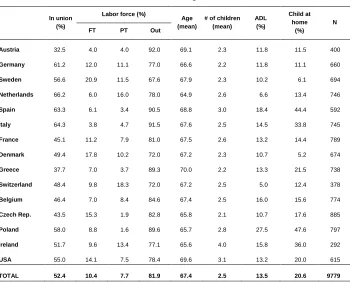
Table 1 presents descriptive statistics for mothers in the analytical sample. The mean age of mothers was 67.4 at the time of the interview. Around half of all mothers were married or lived with a partner (52%). The proportion of partnered mothers was highest in Italy, Spain, and the Netherlands (63-66%) and lowest in Austria (32%). Over 80% of respondents were not in the labor force, but significant differences exist across countries. Mothers in Southern Europe, Poland, and Austria were most likely to be out of the labor force. By contrast, Swedish, Swiss, and Danish mothers were most likely to work either full time or part time. On average, 13.5% of all mothers reported at least one ADL condition. The highest prevalence of an ADL condition was reported by Polish mothers (27%), whereas the lowest was found in Swiss and Dutch mothers (under 10%). Mothers had 2.5 children on average. Relatively high fertility was observed only in Ireland (4.0 children per mother) and partly in the United States and Spain (3.1 and 3.0 children per mother, respectively); in all other European countries, the average number of total children was under 3. Approximately one-fifth of mothers had at least one child still living at home. Parent-child co-residence was highest in Poland and Spain (48% and 44%) and Italy and Ireland (34% and 36%). By contrast, only 5% of elderly Danish and Swedish mothers coreside with a child.
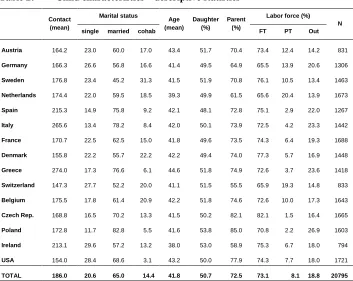
in Sweden (31%), Denmark (22%), Belgium and Switzerland (20%), but rather marginal in the United States (3%), Poland (6%), or Southern Europe (6-9%). Being single is most common in Ireland (30%) and the United States (28.4) and least common in Southern Europe, Poland, and the Czech Republic. Nearly three quarters of offspring are parents themselves (73%) and employed full-time (73%).
Table 1: Mother’s characteristics – descriptive statistics
In union (%)
Labor force (%)
Age (mean)
# of children (mean)
ADL (%)
Child at home
(%) N
FT PT Out
Austria 32.5 4.0 4.0 92.0 69.1 2.3 11.8 11.5 400
Germany 61.2 12.0 11.1 77.0 66.6 2.2 11.8 11.1 660
Sweden 56.6 20.9 11.5 67.6 67.9 2.3 10.2 6.1 694
Netherlands 66.2 6.0 16.0 78.0 64.9 2.6 6.6 13.4 746
Spain 63.3 6.1 3.4 90.5 68.8 3.0 18.4 44.4 592
Italy 64.3 3.8 4.7 91.5 67.6 2.5 14.5 33.8 745
France 45.1 11.2 7.9 81.0 67.5 2.6 13.2 14.4 789
Denmark 49.4 17.8 10.2 72.0 67.2 2.3 10.7 5.2 674
Greece 37.7 7.0 3.7 89.3 70.0 2.2 13.3 21.5 738
Switzerland 48.4 9.8 18.3 72.0 67.2 2.5 5.0 12.4 378
Belgium 46.4 7.0 8.4 84.6 67.4 2.5 16.0 15.6 774
Czech Rep. 43.5 15.3 1.9 82.8 65.8 2.1 10.7 17.6 885
Poland 58.0 8.8 1.6 89.6 65.7 2.8 27.5 47.6 797
Ireland 51.7 9.6 13.4 77.1 65.6 4.0 15.8 36.0 292
USA 55.0 14.1 7.5 78.4 69.6 3.1 13.2 20.0 615
TOTAL 52.4 10.4 7.7 81.9 67.4 2.5 13.5 20.6 9779
Source: SHARE 2004, HRS 2002.
have the least frequent contact with their children (147, 156, and 154 contacts per year respectively).
Table 2: Child characteristics – descriptive statistics
Contact (mean)
Marital status
Age (mean)
Daughter (%)
Parent (%)
Labor force (%) N
single married cohab FT PT Out
Austria 164.2 23.0 60.0 17.0 43.4 51.7 70.4 73.4 12.4 14.2 831
Germany 166.3 26.6 56.8 16.6 41.4 49.5 64.9 65.5 13.9 20.6 1306
Sweden 176.8 23.4 45.2 31.3 41.5 51.9 70.8 76.1 10.5 13.4 1463
Netherlands 174.4 22.0 59.5 18.5 39.3 49.9 61.5 65.6 20.4 13.9 1673
Spain 215.3 14.9 75.8 9.2 42.1 48.1 72.8 75.1 2.9 22.0 1267
Italy 265.6 13.4 78.2 8.4 42.0 50.1 73.9 72.5 4.2 23.3 1442
France 170.7 22.5 62.5 15.0 41.8 49.6 73.5 74.3 6.4 19.3 1688
Denmark 155.8 22.2 55.7 22.2 42.2 49.4 74.0 77.3 5.7 16.9 1448
Greece 274.0 17.3 76.6 6.1 44.6 51.8 74.9 72.6 3.7 23.6 1418
Switzerland 147.3 27.7 52.2 20.0 41.1 51.5 55.5 65.9 19.3 14.8 833
Belgium 175.5 17.8 61.4 20.9 42.2 51.8 74.6 72.6 10.0 17.3 1643
Czech Rep. 168.8 16.5 70.2 13.3 41.5 50.2 82.1 82.1 1.5 16.4 1665
Poland 172.8 11.7 82.8 5.5 41.6 53.8 85.0 70.8 2.2 26.9 1603
Ireland 213.1 29.6 57.2 13.2 38.0 53.0 58.9 75.3 6.7 18.0 794
USA 154.0 28.4 68.6 3.1 43.2 50.0 77.9 74.3 7.7 18.0 1721
TOTAL 186.0 20.6 65.0 14.4 41.8 50.7 72.5 73.1 8.1 18.8 20795
Source: SHARE 2004, HRS 2002.
year on average; the lowest difference was observed in Italy (difference of 5 contacts per year). In other countries, however, married children have more frequent contact with parents than single children (Ireland, Poland, Spain, Switzerland, and Sweden). Similarly, the overall average across countries conceals differences among those who cohabit versus those who are married. In 11 of the 15 countries, cohabitors reported a greater number of contacts with mothers than those who are married. Yet in Ireland, Switzerland, Sweden and the United States, married offspring had more contact with mothers than did cohabitors.
Table 3: Adult children’s contacts with mothers, mean
Single Married Cohabitation
Austria 176.2 157.8 170.7
Belgium 182.0 173.6 175.7
Czech Rep. 195.3 163.2 165.9
Denmark 159.6 148.7 170.1
France 187.4 164.6 171.4
Germany 175.1 161.3 169.5
Greece 289.8 270.4 274.0
Ireland 194.5 226.4 197.0
Italy 269.8 264.5 269.6
Netherlands 198.3 166.9 170.2
Poland 145.5 175.1 196.0
Spain 204.9 215.4 230.7
Sweden 176.0 178.2 175.6
Switzerland 135.0 153.8 147.1
USA 162.4 151.4 131.7
TOTAL 187.2 186.7 180.5
Source: SHARE 2004, HRS 2002.
8. Multivariate results
The descriptive statistics show only raw distributions without controlling for mothers’ and children’s characteristics that may also influence parent-child contact. Therefore, multivariate models are estimated. Given the hierarchical nature of the data, all models include random intercepts for the country and for the mother. In other words, all of our estimates control for similarities between children of the same mother and similarities between respondents from the same country. All reported models use the independent covariance structure. That is, all the covariances between the random effects are assumed to be zero and are not estimated. We also note that alternative covariance structures of the random effects were tested but they did not improve the fit of the model.
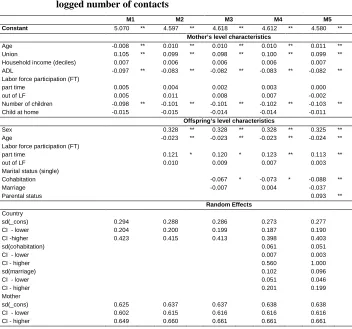
Table 4 presents our results. Covariates are added into the models in a stepwise manner. Model 1 includes all mother-level traits, including mother’s age, partner status, income, presence of any limiting ADL conditions, labor force participation, number of children, and whether any children are currently residing with her. This model suggests that the frequency of maternal contact is not influenced by mother’s socioeconomic characteristics such as household income or labor force participation. It is however associated with her age, union status, health, and her total number of children. In this model, the mother’s age is negatively associated with intergenerational contact, similar to previous findings that also control for mother’s health (Sarkisian and Gerstel 2008). Surprisingly, mothers in unions have more contact with offspring than those who are single, and poor health decreases contact between generations. Both of these findings contradict the majority of previous work, which had found that unmarried mothers have more contact with offspring than married mothers and that poor health increases proximity as well as intergenerational contact (Silverstein 1995). However, prior work using SHARE data found that poor parental health was associated with less daily contact but greater weekly contact between generations (Hank 2007). It is possible that the operationalization of our outcome measure here cannot detect this nuance.
from the same family and country are not independent and the random intercepts cannot be omitted from the model.
Table 4: Coefficients from mixed effect regressions, dependent variable – logged number of contacts
M1 M2 M3 M4 M5
Constant 5.070 ** 4.597 ** 4.618 ** 4.612 ** 4.580 **
Mother’s level characteristics
Age -0.008 ** 0.010 ** 0.010 ** 0.010 ** 0.011 **
Union 0.105 ** 0.099 ** 0.098 ** 0.100 ** 0.099 **
Household income (deciles) 0.007 0.006 0.006 0.006 0.007
ADL -0.097 ** -0.083 ** -0.082 ** -0.083 ** -0.082 **
Labor force participation (FT)
part time 0.005 0.004 0.002 0.003 0.000
out of LF 0.005 0.011 0.008 0.007 -0.002
Number of children -0.098 ** -0.101 ** -0.101 ** -0.102 ** -0.103 **
Child at home -0.015 -0.015 -0.014 -0.014 -0.011
Offspring’s level characteristics
Sex 0.328 ** 0.328 ** 0.328 ** 0.325 **
Age -0.023 ** -0.023 ** -0.023 ** -0.024 **
Labor force participation (FT)
part time 0.121 * 0.120 * 0.123 ** 0.113 **
out of LF 0.010 0.009 0.007 0.003
Marital status (single)
Cohabitation -0.067 * -0.073 * -0.088 **
Marriage -0.007 0.004 -0.037
Parental status 0.093 **
Random Effects Country
sd(_cons) 0.294 0.288 0.286 0.273 0.277
CI - lower 0.204 0.200 0.199 0.187 0.190
CI -higher 0.423 0.415 0.413 0.398 0.403
sd(cohabitation) 0.061 0.051
CI - lower 0.007 0.003
CI - higher 0.560 1.000
sd(marriage) 0.102 0.096
CI - lower 0.051 0.046
CI - higher 0.201 0.199
Mother
sd(_cons) 0.625 0.637 0.637 0.638 0.638
CI - lower 0.602 0.615 0.616 0.616 0.616
CI - higher 0.649 0.660 0.661 0.661 0.661
Source: SHARE 2004, HRS 2002.
N (country) = 15, N (mother) = 9779, N (child) = 20795
daughters, younger children, and those employed part-time keep in touch more frequently than sons, older children, and children who are employed full-time or not in the labor force. The effect of a child’s gender is especially pronounced, with daughters having more contact with mothers than sons.
Model 3 enters the main independent variable – children’s marital status. In general, married and single children do not differ from each other with respect to the frequency of contacts with their mothers. However, cohabiting children seem to keep in touch less often than do single offspring, and this finding holds even if we control for the adult child’s age, gender, or employment status. The coefficient for cohabitation is larger than the coefficient for marriage, which would suggest that cohabiting children tend to have fewer contacts with their mothers than do their married counterparts. However, the comparison of the 95% confidence intervals do not confirm that the difference between marriage and cohabitation is significant (-0.050 to 0.035 for marriage and -0.123 to -0.010 for cohabitation; confidence intervals are not reported in the table). This model however treats offspring’s marital status as a fixed effect, i.e. its value is fixed across all countries and any potential country-specific deviation is not taken into account.
Therefore, Model 4 adds in random effects for both marriage and cohabitation and tests for the possibility that the effect of union status varies across countries. Both random parameters are indeed significant, which we see from the lower and upper end of the confidence intervals (0.007 to 0.560 for cohabitation; 0.051 to 0.201 for marriage). Finally, Model 5 controls for parental status of the offspring and clearly demonstrates that the effect of being a parent is positive but the overall conclusions concerning the effect of union status are unchanged.
Model 4 predicts that 95% of random coefficients for marriage are expected to lie between -0.196 and 0.203 (0.004±1.96*0.102)6. In Model 5, the interval narrows to -0.225 and 0.151. Thus, although the overall effect of marriage on the frequency of contacts is negative, there are large differences across countries and in some cases, married children have more contacts with their mothers than their single counterparts. In other words, marriage might be a greedy institution in some countries but the tendency is not universal. The conclusion concerning cohabitation is similar even though the random coefficients are unlikely to be above zero. Model 4 suggests that 95% of random coefficients for cohabitation are to be found between -0.193 and 0.047. Model 5 decreases the range and indicates that 95% of the random coefficients are between -0.188 and 0.012 when parenthood is taken into account.
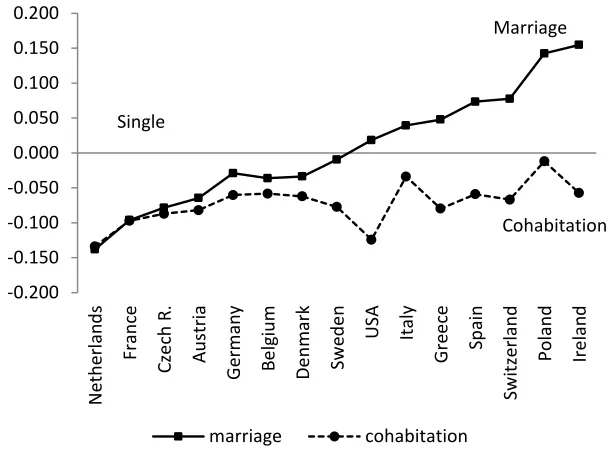
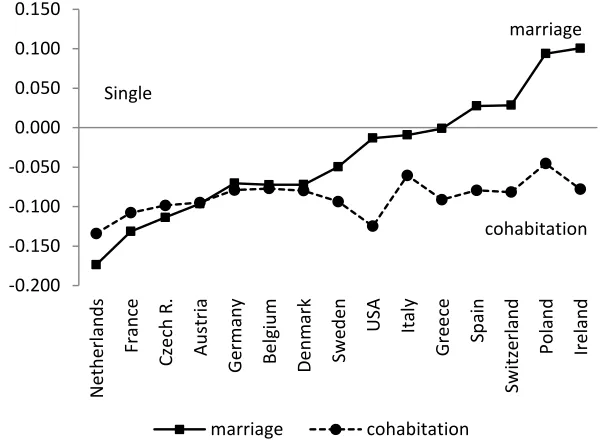
To understand the cross-country differences in more detail, we estimate best linear unbiased predictions (BLUPs – see Method section) of the random effects. Figures 1 and 2 report the estimated coefficients for marriage and cohabitation.
Figure 1 demonstrates that when not controlling for parenthood (see Model 4), married children have fewer contacts with their parents than their single counterparts in approximately half of the countries (single offspring are represented by the x-axis), which include countries in Central and Northern Europe. In the other half of cases, an adult child’s marriage increases the frequency of contacts compared to those who are single, which includes Southern European countries (Spain, Greece, and Italy), Poland, Ireland, Switzerland, and the United States. Figure 2 illustrates that once parental status is controlled, the gap between married and single children nearly disappears in the United States, Italy, and Greece. However, marriage can still be considered a greedy institution in Scandinavia (Sweden, Denmark), Central Europe (Germany, Austria, and the Czech Republic), Belgium, the Netherlands, and France, where the coefficient remains negative in relation to single offspring. Unlike the previous country cluster, the difference between married and single children even increases once parental status is taken into account (Figure 2).
Figure 1: Estimated values of random coefficient for marriage and cohabitation (BLUPs), without parenthood
Source: SHARE 2004, HRS 2002.
Single Marriage Cohabitation -0.200 -0.150 -0.100 -0.050 0.000 0.050 0.100 0.150 0.200 Ne the rla nds Fr an ce Cz ech R. Au st ria G er ma ny Be lgi um De nma rk Sw ed
en USA
As for the coefficient for cohabitation, Figure 1 illustrates its consistently negative association with parental contacts compared to those who are single. Children who cohabit have less contact with their parents than do single children in all 15 countries although some differences in the strength of the effect were found. In most cases, the negative association between cohabitation and intergenerational contacts is even slightly larger if parental status is taken into account (Figure 2). Finally, we see from Figure 2 that for the most part cohabitating children also tended to have less contact with mothers than do their married counterparts. The Netherlands, France, and the Czech Republic are the exceptions, where married children keep in touch less frequently than cohabiting offspring once parenthood is included in the model. In Scandinavia, Germany, and Belgium the gap between married and cohabiting nearly disappears if parental status is taken into account. However, the gap is large for the remaining countries: the U.S., countries in Southern Europe, Switzerland, Poland, and Ireland.
Figure 2: Estimated values of random coefficient for marriage and cohabitation (BLUPs), with parenthood
Source: SHARE 2004, HRS 2002.
Single marriage cohabitation -0.200 -0.150 -0.100 -0.050 0.000 0.050 0.100 0.150 Ne the rla nds Fr an ce Cz ech R. Au st ria G er ma ny Be lgi um De nma rk Sw ed
en USA
9. Conclusion
This paper investigated the association between union status and frequency of contact with mothers in a cross-national framework. First, we predicted that married individuals would have less contact with parents than do their single counterparts and that this finding would be consistent across countries. Our results suggest that although marriage is associated with fewer maternal contacts than being single, this is in fact not consistently true across countries. In the main effects portion of our model, it is clear that married individuals are as engaged with mothers as single offspring. However, the random effects portion of our model suggests that the association between marriage and parental contact also varies greatly across countries. In Northern Europe (Sweden, Denmark, the Netherlands), Central Europe (Germany, Austria, the Czech Republic), France, and Belgium we find evidence that married offspring have less contact with mothers than do single offspring. In these countries where marriage can be characterized as a greedy institution, being a parent makes marriage even greedier. We could hypothesize that the emphasis on the couple in these weak family system countries is not favorable for intergenerational relationships and that having a child pulls the couple even further away from the natal family in these contexts.
On the other hand, in Southern Europe (Spain, Greece, and Italy), two strongly Catholic countries (Poland, Ireland), Switzerland, and the United States, married individuals are engaged in more frequent contact with mothers than are those who are single. Our results suggest that marriage might function as an institution that binds families together and increases social ties across generations in these strong family system countries. This finding might not be surprising given the fact that these countries are characterized by relatively conservative attitudes and behavior. Our results give some credence to cultural arguments that marriage is greedier in some places than in others (Sarkisian and Gerstel 2008: 373). One should, however, note that the gap between married and single children becomes smaller if parenthood is taken into account and it disappears almost entirely in the United States, Italy, and Greece in these instances.
and public support of the elderly is abundant, marriage draws offspring further away from parents. However, in contexts where intergenerational norms tend to be strong and welfare support weak, marriage binds offspring and parents together. This finding in particular suggests that marriage is not universally greedy and gives credence to the idea that those contextual differences – whether cultural or not – moderate the relationship between offspring’s union status and ties to mothers.
Second, we also predicted that cohabiting individuals would have less contact with mothers than do their single counterparts. Our results indicate that this is true and consistent across our sample of countries, even after controlling for parenthood. That is, cohabiting offspring had less frequent contact with mothers in all the countries in our sample, although the gap between cohabiting and single individuals varied across countries. Thus, although we do not find that marriage has a universal effect on offspring’s contact with mothers across all contexts, cohabitation appears to be universally associated with less intergenerational contact compared to single offspring across countries. Again, discerning whether this finding is due to factors that select individuals into cohabitation (e.g., cohabitors are less family-oriented from the start) or because these cohabitors are in the relatively nascent stages of their relationships that draws them away from their families is difficult given the cross-sectional nature of our analysis.
In interpreting the difference between cohabiting versus married offspring’s relationships with mothers in countries with strong family systems, it is difficult to disentangle selection from causation. Cohabiting offspring may have had less contact with mothers before they entered into their relationships and the results presented here may be a result of that selection. Simply put, cohabiting individuals may not be as family-oriented as their peers who marry (Seltzer 2000). Another possibility is that parents who disapprove of children’s cohabitation will limit their contact with offspring and vice versa. This explanation seems particularly plausible in countries where cohabitation remains relatively less common. On the other hand, cohabiting individuals may not be constrained by the more rigid social roles that come with institutionalized marriage and therefore may not feel obligated to develop strong ties with in-laws in certain contexts, which likewise affects relationships with one’s own parents.
However, we must note some limitations of our paper. First, we cannot distinguish between the types of contact in which mothers are engaged. For example, our data do not differentiate between contacts that occur via mail, e-mail, or telephone or whether the contact occurred in person. This may be why our finding that married individuals have more contact with mothers than single offspring in the United States contradicts prior research suggesting the opposite pattern when face-to-face and mail/phone contacts are differentiated (Sarkisian and Gerstel 2008; Musick and Bumpass 2012). Second, our paper is limited to mother-child relationships among offspring who did not reside with mothers. The HRS and SHARE data do not ask respondents about contact with offspring when offspring are residing with mothers in the same household, unlike other surveys that are used elsewhere (Sarkisian and Gerstel 2008). In Southern Europe, where family systems are strong, the departure of children from the parental home tends to coincide with their marriage (Micheli 2004). Thus, adult children who live outside of their parental house while they are single might be a selective group who is less attached to their parents. For this reason, our estimates of differences between married and single individuals may be biased. Third, the cross-sectional nature of our design does not allow us to distinguish between selectivity and causality. For example, Musick and Bumpass (2012) use panel data to disentangle potential selection effects from causation, whereas our analysis relies on one wave of data, thus allowing us to examine associations only. Future cross-national studies should seek to include a longitudinal component as well. Finally, we excluded all mothers who had at least one non-biological child. This might create a selection bias in favor of stronger and more coherent families, especially in social contexts where step-families are more common (i.e. the United States and Scandinavia).
commitments to other kin will influence support they provide to elderly parents. In addition, the rise in cohabitation within and across countries raises questions about the obligations of individuals and their partners to each other’s natal families.
Cross-national analyses are especially important here because they highlight the ways in which social contexts moderate the relationship between adult children’s support to other kin – exemplified by union status - and parental support. Whereas previous research suggests a potential cultural explanation behind the greediness of marriage in the U.S. context (Coontz 1992; Cherlin 2009; Sarkisian and Gerstel 2008), our analyses suggest that the United States is not alone in this tendency. Indeed, in other contexts (e.g., Scandinavia, Central Europe) marriage is negatively associated with parental contact. Yet the opposite trend can be found in a separate set of countries, where marriage is positively associated with maternal contact compared to those who are single. Our cross-national analyses also confirm prior research suggesting that in contexts where cohabitation is not widespread, the gap between married and cohabiting offspring’s support to parents is large; but these differences tend to be smaller in contexts where cohabitation is more prevalent.
Understanding how children negotiate intergenerational support to aging parents across different social contexts has significant policy implications as well. If context indeed moderates the relationship between union status and intergenerational support, as demonstrated in this paper, how might a change in contextual factors, such as laws and norms surrounding cohabitation, marriage, or elder care alter these cross-national differences? Although our analyses do not disentangle the specific ways in which contexts matters, future analyses should explore the interplay of these factors and their effect on parental support.
10. Acknowledgements
References
Bianchi, S.M., Hotz, V.J., McGarry, K., and Seltzer, J.A. (2008) Intergenerational Ties: Theories, Trends, Challenges. In: Booth, A., Crouter, A.C., Bianchi, S.M., and Seltzer, J.A. (eds.). Intergenerational Caregiving. Washington, DC: Urban Institute: 3–44.
Billari, F.C. and Rosina, A. (2005) ‘Mamma’ and the diffusion of cohabitation: the Italian case. Paper presented at Population Association of America Annual Meeting, Philadelphia.
Brown, S.L. and Booth, A. (1996). Cohabitation versus marriage: A comparison of relationship quality. Journal of Marriage and the Family 58: 668–678. doi:10. 2307/353727.
Bucx, F., van Wel, F., Knijn, T., and Hagendoorn, L. (2008). Intergenerational contact and the life course status of young adult children. Journal of Marriage and the Family 70: 144–156. doi:10.1111/j.1741-3737.2007.00467.x.
Bumpass, L.L., Sweet, J.A., and Cherlin, A. (1991). The Role of Cohabitation in Declining Rates of Marriage. Journal of Marriage and the Family 53: 913–927. doi:10.2307/352997.
Casper, L. and Bianchi, S. (2002). Continuity and Change in the American Family. Thousand Oaks: Sage Publications.
Cherlin, A.J. (2000) Toward a new home: Socioeconomics of union formation. In: Waite, L.J., Bachrach, C., Hindin, M., Thomson, E., and Thornton, A. (eds.). The Ties That Bind: The Perspectives on Marriage and Cohabitation. New York: Aldine de Gruyte: 126–144.
Cherlin, A.J. (2004). The Deinstitutionalization of American marriage. Journal of Marriage and Family 66: 848–861. doi:10.1111/j.0022-2445.2004.00058.x. Cherlin, A.J. (2009). The marriage-go-round: the state of marriage and the family in
America today. New York: Alfred A. Knopf.
Compton, J. and Pollak, R.A. (2009) Proximity and Co-residence of Adult Children: Description and Correlates Working Paper. http://www.mrrc.isr.umich.edu/ publications/papers/pdf/wp215.pdf.
Coontz, S. (1992). The way we never were: American families and the nostalgia trap. New York, NY: BasicBooks.
Coontz, S. (2005). Marriage, a history: from obedience to intimacy or how love conquered marriage. New York: Viking.
Coser, L.A. (1974). Greedy institutions; patterns of undivided commitment. New York: Free Press.
Cox, D. and Stark, O. (2005). On the demand for grandchildren: tied transfers and the demonstration effect. Journal of Public Economics 89: 1665–1697. doi:10.1016/j.jpubeco.2004.04.005.
Daatland, S. and Lowenstein, A. (2005). Intergenerational solidarity and the family– welfare state balance. European Journal of Ageing 2: 174–182. doi:10.1007/s10433-005-0001-1.
Daatland, S.O. (2007). Marital history and intergenerational solidarity: The impact of divorce and unmarried cohabitation. Journal of Social Issues 63: 809–825. doi:10.1111/j.1540-4560.2007.00538.x.
Geurts, T., Poortman, A.-R., van Tilburg, T., and Dykstra, P.A. (2009). Contact between Grandchildren and Their Grandparents in Early Adulthood. Journal of Family Issues 30: 1698–1713. doi:10.1177/0192513X09336340.
Giddens, A. (1992). The transformation of intimacy: sexuality, love, and eroticism in modern societies. Cambridge, England: Polity Press.
Haberkern, K. and Szydlik, M. (2010). State care provision, societal opinion and children's care of older parents in II European countries. Ageing & Society 30: 299–323. doi:10.1017/S0144686X09990316.
Hank, K. (2007). Proximity and contacts between older parents and their children: A European comparison. Journal of Marriage and Family 69: 157–173. doi:10.1111/j.1741-3737.2006.00351.x.
Heuveline, P. and Timberlake, J.M. (2004). The role of cohabitation in family formation: The United States in comparative perspective. Journal of Marriage and the Family 66: 1214–1230. doi:10.1111/j.0022-2445.2004.00088.x.
Jayakody, R. (1998). Race differences in intergenerational financial assistance - The needs of children and the resources of parents. Journal of Family Issues 19: 508–533. doi:10.1177/019251398019005002.
Kalmijn, M. (2006). Educational inequality and family relationships: Influences on contact and proximity. European Sociological Review 22: 1–16. doi:10.1093/esr/ jci036.
Kalmijn, M. (2007). Gender differences in the effects of divorce, widowhood and remarriage on intergenerational support: Does marriage protect fathers? Social Forces 85: 1079–1104. doi:10.1353/sof.2007.0043.
Kalmijn, M. and Saraceno, C. (2008). A comparative perspective on intergenerational support - Responsiveness to parental needs in individualistic and familialistic countries. European Societies 10: 479–508. doi:10.1080/14616690701744364. Kaufman, G. and Uhlenberg, P. (1998). Effects of life course transitions on the quality
of relationships between adult children and their parents. Journal of Marriage and the Family 60: 924–938. doi:10.2307/353635.
Kiernan, K. (2002). Cohabitation in Western Europe: trends, issues and implications. In: Booth, A. and Crouter, A. (eds.). Just Living Together: Implications of Cohabitation on Families, Children and Social Policy. Mahwah, NJ: Lawrence Erlbaum Associates, Inc.: 3–31.
Lee, E.J., Spitze, G., and Logan, J.R. (2003). Social support to parents-in-law: The interplay of gender and kin hierarchies. Journal of Marriage and Family 65: 396–403. doi:10.1111/j.1741-3737.2003.00396.x.
Lesthaeghe, R. (1995) The Second Demographic Transition in Western Countries: An Interpretation. In: Mason, K.O. and Jensen, A.M. (eds.). Gender and Family Change in Industrialized Countries. Oxford: Clarendon Press: 17–62.
Lin, I.F. (2008). Consequences of parental divorce for adult children's support of their frail parents. Journal of Marriage and the Family 70: 113–128. doi:10.1111/ j.1741-3737.2007.00465.x.
Manning, W.G. (1998). The logged dependent variable, heteroscedasticity, and the retransformation problem. Journal of Health Economics 17: 283–295. doi:10.1016/S0167-6296(98)00025-3.
Meijer, E. and Karoly, L.A. (2013). Representativeness of the Low-Income Population in the Health and Retirement Study. Michigan Retirement Research Center Research Paper 2013-273. http://ssrn.com/abstract=2306580.
Merrill, D.M. (2011). When your children marry: how marriage changes relationships with sons and daughters. Lanham, Md.: Rowman & Littlefield.
Micheli, G.A. (2004) Kinship, Family and Social Networks. The Anthropological Embedment of the Demographic Change in Southern Europe. In: Dalla Zuanna, G. and Micheli, G.A. (eds.). Strong Family and Low Fertility: a Paradox? Dordrecht: Kluwer Academic: 77–104.
Musick, K. and Bumpass, L. (2012). Reexamining the Case for Marriage: Union Formation and Changes in Well-Being. Journal of Marriage and Family 74: 1–18. doi:10.1111/j.1741-3737.2011.00873.x.
Nazio, T. and Blossfeld, H.-P. (2003). The Diffusion of Cohabitation among Young Women in West Germany, East Germany and Italy. European Journal of Population 19: 47−82.
Nazio, T. and Saraceno, C. (2010) The impact of cohabitation without marriage on intergenerational contacts, A test of the diffusion theory. Turin: Collegio Carlo Alberto (Carlo Alberto Workbooks).
Nazio, T. and Saraceno, C. (2013). Does cohabitation lead to weaker intergenerational bonds than marriage? A comparison between Italy and the United Kingdom. European Sociological Review 29(3): 549−564.
Nock, S.L. (1995). A Comparison of Marriages and Cohabiting Relationships. Journal of Family Issues 16: 53–76. doi:10.1177/019251395016001004.
Pezzin, L.E., Pollak, R.A., and Schone, B.S. (2008). Parental Marital Disruption, Family Type, and Transfers to Disabled Elderly Parents. Journals of Gerontology Series B-Psychological Sciences and Social Sciences 63: S349–S358. doi:10.1093/geronb/63.6.S349.
Pezzin, L.E. and Schone, B.S. (1999). Parental marital disruption and intergenerational transfers: An analysis of lone elderly parents and their children. Demography 36: 287–297. doi:10.2307/2648053.
Rainer, H. and Siedler, T. (2009). O Brother, Where Art Thou? The Effects of Having a Sibling on Geographic Mobility and Labour Market Outcomes. Economica 76: 528–556. doi:10.1111/j.1468-0335.2008.00696.x.
Reher, D.S. (1998). Family ties in western Europe: Persistent contrasts. Population and Development Review 24: 203−234. doi:10.2307/2807972.
Roan, C.L. and Raley, R.K. (1996). Intergenerational coresidence and contact: A longitudinal analysis of adult children's response to their mother's widowhood. Journal of Marriage and the Family 58: 708–717. doi:10.2307/353730.
Rosina, A. and Fraboni, R. (2004). Is marriage losing its centrality in Italy? Demographic Research 11(6): 149−172. doi:10.4054/DemRes.2004.11.6. Rossi, A.S. and Rossi, P.H. (1990). The Structure of Kinship Norms. New York: Aldine
de Gruyter.
Sarkisian, N. and Gerstel, N. (2004). Kin support among blacks and whites: Race and family organization. American Sociological Review 69: 812–837. doi:10.1177/ 000312240406900604.
Sarkisian, N. and Gerstel, N. (2008). Till Marriage Do Us Part: Adult Children’s Relationships With Their Parents. Journal of Marriage and Family 70: 360–367. doi:10.1111/j.1741-3737.2008.00487.x.
Schroeder, C. (2008). The influence of parents on cohabitation in Italy: Insights from two regional contexts. Demographic Research 19: 1693–1726. doi:10.4054/ DemRes.2008.19.48.
Seltzer, J.A. (2000). Families formed outside of marriage. Journal of Marriage and the Family 62: 1247–1268. doi:10.1111/j.1741-3737.2000.01247.x.
Seltzer, J., Bianchi, S., McGarry, K., and Yahirun, J. (2011) Co-residence and Geographic Proximity of Parents and Adult Children in Blended Families. Paper presented at Population Association of America Annual Conference, Washington, DC.
SHARE, Release Guide 2.3.1. (2010). Mannheim: Mannheim Research Institute for the Economics of Aging.
Silverstein, M., Bengtson, V.L., and Lawton, L. (1997). Intergenerational solidarity and the structure of adult child parent relationships in American families. American Journal of Sociology 103: 429–460. doi:10.1086/231213.
Slater, P.E. (1963). On Social Regression. American Sociological Review 28: 339–364. doi:10.2307/2090346.
Soldo, B.J., Wolf, D.A., and Henretta, J.C. (1999). Intergenerational Transfers: Blood, Marriage, and Gender Effects on Household Decisions. In: Smith, J.P. and Willis, R.J. (eds.). Wealth, Work, and Health: Innovations in Measurement in the Social Sciences. Ann Arbor: University of Michigan Press.
Spitze, G., Logan, J.R., Deane, G., and Zerger, S. (1994). Adult Children's Divorce and Intergenerational Relationships. Journal of Marriage and Family 56: 279–293. doi:10.2307/353100.
Suanet, V., Groenou, M.B.V., and Tilburg, T.V. (2011). Informal and formal home-care use among older adults in Europe: can cross-national differences be explained by societal context and composition? Ageing and Society 32:1–25.
van de Kaa, D.J. (1987). Europe's Second Demographic Transition. Population Bulletin 42: 3–53.
Waite, L.J. and Harrison, S.C. (1992). Keeping In Touch - How Women In Midlife Allocate Social Contacts Among Kith And Kin. Social Forces 70: 637–655. doi:10.2307/2579747.
Wooldridge, J.M. (2009). Introductory Econometrics. Mason: South-Western Cengage Learning.