Snezana Rsovac
1, A–D, Katarina Milosevic
2, A–D,
Branimir Nestorovic
2, A, C, E, F, Aleksandra Nikolic
3, C–FComplications of Mechanical Ventilation
in Pediatric Patients in Serbia
1 Pediatric Intensive Care Unit, University Children’s Hospital, Belgrade, Serbia
2 Department of Pulmonology and Allergology, University Children’s Hospital, Belgrade, Serbia 3 Institute of Molecular Genetics and Genetic Engineering, University of Belgrade, Belgrade, Serbia
A – research concept and design; B – collection and/or assembly of data; C – data analysis and interpretation;
D – writing the article; E – critical revision of the article; F – final approval of article; G – other
Abstract
Background. Mechanical ventilation is a frequently applied therapy in critically ill children and can be lifesaving in many cases. Clinical use of this technique has well documented benefits, but can be associated with different complications and adverse physiologic effects.
Objectives. The aim of this study was to investigate the complications and clinical outcome of mechanical ventila-tion in Serbian pediatric patients.
Material and Methods. The study encompassed 42 children with respiratory insufficiency that underwent mechanical ventilation during hospitalization over a period of 12 consecutive months. The influence of clinical and mechanical parameters on the occurrence of complications and clinical outcome were analyzed.
Results. The patients were ventilated for a total of 432 days and a total of 61 complications were observed in 42 patients (97 complications per 1000 ventilation days). The most common complications associated with mechanical ven-tilation in Serbian pediatric patients with respiratory insufficiency were cardiovascular insufficiency (52.4%) and multiple organ failure (35.7%). High values of applied PIP (> 26 cm H2O), PEEP (> 6 cm H2O) and Tv (> 6 mL/kg) were associated with the occurrence of complications and negative clinical outcome.
Conclusions. Complications of mechanical ventilation in the pediatric population occur frequently, but lower volumes/pressures of ventilation contribute to a decrease in incidence. Further studies are needed to examine associated risk factors and strategies to reduce the occurrence of complications and improve clinical outcome (Adv Clin Exp Med 2014, 23, 1, 57–61).
Key words: mechanical ventilation, respiratory insufficiency, complications, clinical outcome.
Adv Clin Exp Med 2014, 23, 1, 57–61 ISSN 1899–5276
ORIGINAL PAPERS
© Copyright by Wroclaw Medical University
Mechanical ventilation is a frequently applied therapy in critically ill children and can be lifesav-ing in many cases. It is used to increase alveolar ventilation by supplying pressurized air through an oral-nasal or nasal mask. The basis of the tech-nique is an increase in ventilation through a trans-pulmonary pressure gradient without an indwell-ing artificial airway. Clinical use of this technique has well documented benefits, but can be associat-ed with different complications and adverse phys-iologic effects. Studying the clinical complications of mechanical ventilation may influence its out-come, considering that the occurrence of compli-cations may prolong the duration of ventilation
itself and/or hospitalization and increase patient mortality.
they should also consider the potential impact of recent changes in ventilatory practice and general patient care on the epidemiology and incidence of ventilation-associated complications [10].
The aim of this study was to investigate the complications and clinical outcome of mechanical ventilation in Serbian pediatric patients.
Materials and Methods
Patients
This study encompassed 42 children who were hospitalized over a period of 12 consecutive months in the Intensive Care Unit of the Univer-sity Children’s Hospital in Belgrade. Written in-formed consent was obtained from all the patients’ parents and the research was approved by the hos-pital’s ethics committee. All patients experienced respiratory insufficiency, diagnosed based on the criteria proposed by the Acute Respiratory Distress Syndrome Network and arterial blood gas analy-ses (PaO2, PaCO2, PaO2/FiO2), and underwent me-chanical ventilation during hospitalization [11].
On admission to the intensive care unit, all pa-tients were subjected to thorax radiography, bac-teriological analyses (hemoculture and tracheal aspirate), determination of leukocytosis and bio-chemical analyses (urea, creatinine and CRP). The patients were clinically monitored on a daily ba-sis and they all had an arterial line for blood gas analysis sampling. In all patients, the mean arteri-al pressure, heart rate and body weight percentile were measured.
Data Collection
In all patients, the following data was noted: demographics, reason for intubation, pulmonary status on ICU admission, clinical parameters, in-tubation parameters and ventilation parameters.
The following parameters of mechanical ven-tilation were monitored: duration, airway pressure (Paw), positive end-expiratory pressure (PEEP), peak inspiratory pressure (PIP), fraction of in-spired oxygen (FiO2) and tidal volume (Tv).
The occurrence of each complication was veri-fied along with the clinical and ventilation param-eters at complication onset. Multiple organ failure was established based on the criteria by Wilkinson et al. [12]. Sepsis and septic shock were defined ac-cording to the guidelines of the American College of Chest Physicians and Intensive Care [13].
Statistical Analysis
The following descriptive statistical methods were applied for data processing: central tendency measures (arithmetical mean and median values), variability measures (variation interval, standard deviation and interquartile range) and relative numbers. Statistical significance was calculated based on the following inferential statistical meth-ods: the Student t-test, chi-square test and Wilcox-on rank sum test. Values of p ≤ 0.05 were cWilcox-onsid- consid-ered statistically significant. Statistical analysis was performed using SPSS statistical software (SPSS for Windows, release 17.0, SPSS, Chicago, IL).
Results
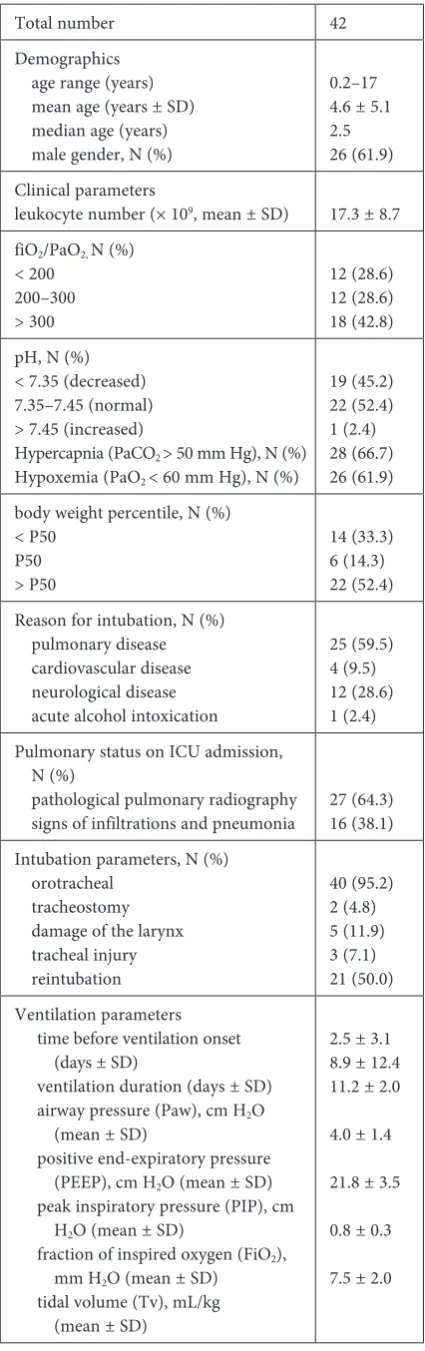
Forty-two patients (median age 2.5, 61.9% male) were ventilated for a total of 432 days. The median duration of ventilation was 8.9 ± 12.4 days. The clinical characteristics of the patients, includ-ing intubation and ventilation parameters, are giv-en in Table 1. In the majority of patigiv-ents (25 cases), the reason for intubation was pulmonary disease and in these patients, atelectasis and pneumothorax were common. Among these patients, there were 16 with pneumonia, 7 with acute respiratory dis-tress syndrome (ARDS) and 2 with bronchiolitis.
A total of 61 complications were observed in 42 patients, which equated to 97 complications per 1000 ventilation days. The following complica-tions were registered: cardiovascular insufficiency, gastric bleeding, ventilator-associated pneumonia, sepsis and multiple organ failure. The incidence of each complication is given in Table 2.
A statistically significant association of each complication with several clinical parameters was observed. The presence of respiratory disease at ICU admission was statistically significant for each of the complications. Also, cardiovascular insuffi-ciency was associated with low body weight per-centile, positive hemoculture, hypoxemia and hy-percapnia, while sepsis was associated with acidosis and hypoxemia.
The observed association of certain ventila-tion parameters with the occurrence of complica-tions was also statistically significant. The values of Paw, PEEP, PIP and FiO2 differed statistically sig-nificantly between the groups of patients with and without cardiovascular insufficiency, as well as be-tween those with and without sepsis, while the val-ues of PEEP and FiO2 were significantly different between the groups of patients with and without multiple organ failure.
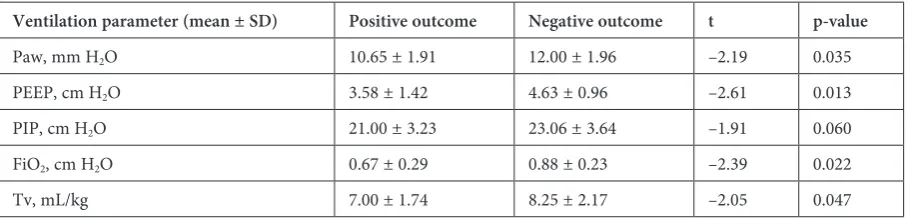
ventilated patients was significantly associated with the presence of respiratory disease at ICU admission, positive hemoculture and hypoxemia. The values of Paw, PEEP and Tv differed statisti-cally significantly between the groups of patients with positive and negative outcome. The results of the statistical analysis are given in Table 3. Low values of PIP (< 26 cm H2O), PEEP (< 6 cm H2O) and Tv (< 6 mL/kg) were associated with a posi-tive outcome.
Discussion
Mechanical ventilation is used as a first-line treatment in acute respiratory failure in adult pa-tients with different pathologies [14]. The results of controlled trials have proven the beneficial ef-fects of this technique and it has been associated with a significant reduction in endotracheal intu-bation and fatal complications [15]. It has proven effective in decreasing mortality rates and improv-ing overall survival [14, 15]. However, the experi-ence of mechanical ventilation in a pediatric set-ting is limited and the majority of evidence is based on case reports [16]. It has been well established as an acceptable form of ventilation in children with chronic respiratory failures due to neuromuscular disease or cystic fibrosis, but is underinvestigated in children with respiratory insufficiency [17].
This study, to our knowledge, represents the first report specifically detailing the incidence, pa-tient characteristics and outcome of mechanical ventilation in Serbian pediatric patients who expe-rienced respiratory insufficiency. A total of 61 ad-verse events were observed in 42 patients, equating to 97 complications per 1000 days of ventilation. In the majority of patients (59.5%), the reason for in-tubation was pulmonary disease. The incidence of
Table 1. Baseline clinical characteristics of the patients
Total number 42
Demographics age range (years) mean age (years ± SD) median age (years) male gender, N (%)
0.2–17 4.6 ± 5.1 2.5 26 (61.9) Clinical parameters
leukocyte number (× 109, mean ± SD) 17.3 ± 8.7
fiO2/PaO2, N (%)
< 200 200–300 > 300 12 (28.6) 12 (28.6) 18 (42.8) pH, N (%)
< 7.35 (decreased) 7.35–7.45 (normal) > 7.45 (increased)
Hypercapnia (PaCO2 > 50 mm Hg), N (%)
Hypoxemia (PaO2 < 60 mm Hg), N (%)
19 (45.2) 22 (52.4) 1 (2.4) 28 (66.7) 26 (61.9) body weight percentile, N (%)
< P50 P50 > P50 14 (33.3) 6 (14.3) 22 (52.4) Reason for intubation, N (%)
pulmonary disease cardiovascular disease neurological disease acute alcohol intoxication
25 (59.5) 4 (9.5) 12 (28.6) 1 (2.4) Pulmonary status on ICU admission,
N (%)
pathological pulmonary radiography
signs of infiltrations and pneumonia 27 (64.3)16 (38.1) Intubation parameters, N (%)
orotracheal tracheostomy damage of the larynx tracheal injury reintubation 40 (95.2) 2 (4.8) 5 (11.9) 3 (7.1) 21 (50.0) Ventilation parameters
time before ventilation onset (days ± SD)
ventilation duration (days ± SD) airway pressure (Paw), cm H2O
(mean ± SD)
positive end-expiratory pressure (PEEP), cm H2O (mean ± SD)
peak inspiratory pressure (PIP), cm H2O (mean ± SD)
fraction of inspired oxygen (FiO2),
mm H2O (mean ± SD)
tidal volume (Tv), mL/kg (mean ± SD)
2.5 ± 3.1 8.9 ± 12.4 11.2 ± 2.0
4.0 ± 1.4
21.8 ± 3.5
0.8 ± 0.3
7.5 ± 2.0
Table 2. Incidence of complications in mechanically ventilated patients
Complication Number
of patients (%)
Complications per 1000 venti-lation days
Cardiovascular
insufficiency 22 (52.4) 109 Gastric bleeding 11 (26.2) 92 Multiple organ
failure 15 (35.7) 71 Sepsis 6 (14.3) 56 Ventilator-associated
ventilation complications observed in Serbian pe-diatric patients corresponds to previous findings. The most commonly encountered complication, observed in 52.4% of cases, was cardiovascular in-sufficiency, a frequently encountered problem in patients with acute bronchospastic disease who re-quire mechanical ventilation [18]. Multiple organ failure, another common complication of mechan-ical ventilation, was observed with a frequency of 35.7% [19]. Gastrointestinal bleeding was observed with a frequency of 26.2%, similar to those report-ed by previous studies [20]. Sepsis and ventilator-associated pneumonia were detected with relative-ly low frequencies, 14.3% and 16.7%, respectiverelative-ly. The rate of ventilator-associated pneumonia ob-served in this study was 37.8 episodes per 1000 days of ventilation and this figure is higher than report-ed in previous preport-ediatric studies (5.6–12 episodes per 1000 days of ventilation) [21, 22].
Mortality in adult and pediatric patients with acute respiratory distress syndrome has been de-clining in the last two decades to 40–45% for the western part of the world, which has been
attributed to an overall improvement of intensive care treatment and the changes in ventilation strat-egies [23]. Clinical outcome was negative for 38% of the ventilated patients in this study and was sig-nificantly associated with the presence of respira-tory disease at ICU admission, positive hemocul-ture and hypoxemia. The values of Paw, PEEP, FiO2 and Tv differed statistically significantly be-tween the groups of patients with positive and neg-ative outcome. Application of mechanical ventila-tion using PIP < 26 cm H2O, PEEP < 6 cm H2O and Tv < 6 mL/kg was found to reduce the incidence of complications and to be associated with posi-tive clinical outcome in ventilated patients. This study supports previous findings, mostly for adult populations, that implementation of lung protec-tive strategies lowers the mortality rate [24–26]. Ventilation with lower tidal volumes has proven to decrease mortality and increase ventilation-free days [24, 27]. Complications of mechanical venti-lation in the pediatric popuventi-lation occur frequent-ly, but lower volumes/pressures of ventilation con-tribute to a decrease in incidence.
Table 3. Statistical parameters for association between ventilation parameter values and clinical outcome
Ventilation parameter (mean ± SD) Positive outcome Negative outcome t p-value
Paw, mm H2O 10.65 ± 1.91 12.00 ± 1.96 –2.19 0.035
PEEP, cm H2O 3.58 ± 1.42 4.63 ± 0.96 –2.61 0.013
PIP, cm H2O 21.00 ± 3.23 23.06 ± 3.64 –1.91 0.060
FiO2, cm H2O 0.67 ± 0.29 0.88 ± 0.23 –2.39 0.022
Tv, mL/kg 7.00 ± 1.74 8.25 ± 2.17 –2.05 0.047
References
[1] Principi T, Fraser DD, Morrison GC, et al.: Complications of mechanical ventilation in the pediatric population. Pediatr Pulmonol 2010, 46, 452–457.
[2] Benjamin PK, Thompson JE, O’Rourke PP: Complications of mechanical ventilation in a children’s hospital multidisciplinary intensive care unit. Respir Care 1990, 35, 873–878.
[3] Cox RG, Barker GA, Bohn DJ: Efficacy, results, and complications of mechanical ventilation in children with status asthmaticus. Pediatr Pulmonol 1991, 11, 120–126.
[4] Rivera R, Tibballs J: Complications of endotracheal intubation and mechanical ventilation in infants and children. Crit Care Med 1992, 20, 193–199.
[5] Kolatat T, Aunganon K, Yosthiem P: Airway complications in neonates who received mechanical ventilation. J Med Assoc Thai 2002, 85, Suppl 2, S455–S462.
[6] Elward AM, Warren DK, Fraser VJ: Ventilator-associated pneumonia in pediatric intensive care unit patients: risk factors and outcomes. Pediatrics 2002, 109, 758–764.
[7] Edmunds S, Weiss I, Harrison R: Extubation failure in a large pediatric ICU population. Chest 2001, 119, 897–900.
[8] Fontela PS, Piva JP, Garcia PC: Risk factors for extubation failure in mechanically ventilated pediatric patients. Pediatr Crit Care Med 2005, 6, 166–170.
[9] Kurachek SC, Newth CJ, Quasney MW: Extubation failure in pediatric intensive care: a multiple-center study of risk factors and outcomes. Crit Care Med 2003, 31, 2657–2664.
[10] Marraro GA: Innovative practices of ventilatory support with pediatric patients. Pediatr Crit Care Med 2003, 4, 8–20.
[12] Wilkinson JD, Pollack MM, Glass NL: Mortality associated with multiple organ system failure and sepsis in pedi-atric intensive care unit. J Pediatr 1987, 111, 324–328.
[13] Dellinger RP, Levy MM, Carlet JM: Surviving Sepsis Campaign: international guidelines for management of severe sepsis and septic shock: 2008. Crit Care Med 2008, 36, 296–327.
[14] Nava S, Carlucci A: Non-invasive pressure support ventilation in acute hypoxemic respiratory failure: common strategy for different pathologies? Intensive Care Med 2002, 28, 1205–1207.
[15] Keenan SP, Sinuff T, Cook DJ: Does noninvasive positive pressure ventilation improve outcome in acute hypox-emic respiratory failure? A systematic review. Crit Care Med 2004, 32, 2516–2523.
[16] Carvalho WB, Fonseca MC: Noninvasive ventilation in pediatrics: we still do not have a consistent base. Pediatr Crit Care Med 2004, 5, 408–409.
[17] Teague WG: Non-invasive positive pressure ventilation: current status in paediatric patients. Paediatr Respir Rev 2005, 6, 52–60.
[18] Pinsky MR: Cardiovascular issues in respiratory care. Chest 2005, 128, S592–S597.
[19] Del Sorbo L, Slutsky AS: Acute respiratory distress syndrome and multiple organ failure. Curr Opin Crit Care 2011, 17, 1–6.
[20] Mutlu GM, Mutlu EA, Factor P: GI complications in patients receiving mechanical ventilation. Chest 2011, 119, 1222–1241.
[21] Bigham MT, Amato R, Bondurrant P: Ventilator-associated pneumonia in the pediatric intensive care unit: char-acterizing the problem and implementing a sustainable solution. J Pediatr 2009, 154, 582–587.
[22] Elward AM: Pediatric ventilator-associated pneumonia. Pediatr Infect Dis J 2003, 22, 445–446.
[23] Zambon M, Vincent JL: Mortality rates for patients with acute lung injury/ARDS have decreased over time. Chest 2008, 133, 1120–1127.
[24] Albuali WH, Singh RN, Fraser DD: Have changes in ventilation practice improved outcome in children with acute lung injury? Pediatr Crit Care Med 2007, 8, 324–330.
[25] Amato MB, Barbas CS, Medeiros DM: Effect of a protective-ventilation strategy on mortality in the acute respira-tory distress syndrome. N Engl J Med 1998, 338, 347–354.
[26] Villar J, Kacmarek RM, Perez-Mendez L: A high positive end-expiratory pressure, low tidal volume ventilatory strategy improves outcome in persistent acute respiratory distress syndrome: a randomized, controlled trial. Crit Care Med 2006, 34, 1311–1318.
[27] Brower R, Thompson BT: ARDS Network Investigators. Tidal volumes in acute respiratory distress syndrome – one size does not fit all. Crit Care Med 2006, 34, 263–264.
Address for correspondence:
Aleksandra Nikolic
Institute of Molecular Genetics and Genetic Engineering Vojvode Stepe 444A
PO Box 23 11010 Belgrade Serbia
Tel.: + 381 11 397 66 58
E-mail: [email protected]
Conflict of interest: None declared