WEED SCIENCE
Tolerance of Transgenic Cotton to Topical Applications of Glyphosate
Michael A. Jones* and Charles E. Snipes
INTERPRETIVE SUMMARY
Transgenic cotton varieties expressing vegetative tolerance to over-the-top applications of glyphosate herbicide are now commercially available to producers. Weed management programs using glyphosate-tolerant cotton varieties allow growers a new option to control weeds in conventional tillage systems, as well as in reduced-tillage systems where cultivation is not used. However, limitations exist with glyphosate-tolerant cotton management systems with regard to the proper timing of over-the-top applications to cotton. Glyphosate is labeled only for over-the-top applications up to the four-leaf stage of development. This label restriction appears to be related to fruit shedding when over-the-top applications are made past the four-leaf stage of development.
Field studies were conducted to evaluate the effect of applying glyphosate over-the-top of glyphosate-tolerant cotton varieties. In these studies, all glyphosate-tolerant varieties appeared to respond similarly to delayed over-the-top applications of glyphosate. Plant mapping data revealed a sequential decrease in boll retention at early-season fruiting sites as glyphosate applications were delayed from the three-leaf to the six-leaf stage. The loss of these early-season fruiting structures did not reduce total lint yields. However, there appeared to be a delay in maturity as a result of the later over-the-top glyphosate applications. It appeared that considerable compensation for the loss of early-season fruit occurred after the topical applications of
glyphosate. The ability of glyphosate-tolerant cotton plants to recover from delayed over-the-top applications of glyphosate in most years will be, in many cases, directly related to environmental conditions that allow extended boll development later in the season.
ABSTRACT
Transgenic cotton (Gossypium hirsutum L.) cultivars tolerant to topical applications of glyphosate herbicide are now commercially available to producers. However, little information exists with regard to the tolerance of various cotton cultivars as affected by the timing of glyphosate applications. Therefore, the response of several glyphosate-tolerant transgenic cotton cultivars to various application timings of glyphosate was investigated. Two separate studies were conducted in 1995 and one in 1996 at the Delta Research and Extension Center located near Stoneville, MS. Treatments for both studies in 1995 consisted of seven glyphosate-tolerant cultivars (Coker 312-RR, Hartz 1215RR, Hartz 1220RR, Hartz 1244RR, Hartz 1330RR, Hartz 1380RR, and Hartz 1560RR) that were either unsprayed (that is, untreated control) or sprayed topically with 1.0 kg a.e. ha$$$$1 glyphosate plus a non-ionic surfactant at
0.5% v v$$$$1 at one of three different growth stages
(four-, five-, and six-leaf stage). A different strain of each glyphosate-tolerant cultivar was evaluated in the two studies in 1995. Treatments in 1996 consisted of four glyphosate-tolerant cultivars (Deltapine 9683RR, Deltapine 9685RR, Deltapine 9687RR, and Coker 312RR) that were either unsprayed (i.e., untreated control) or sprayed topically with glyphosate at 1.0 kg a.e. ha$$$$1 plus a non-ionic surfactant at 0.5% v v$$$$1) at
one of three different growth stages (three-, four-, and five-leaf stage) and two unsprayed conventional cultivars (Deltapine 5415 and 90). All transgenic cultivars responded similarly to glyphosate, and no differences in vegetative growth parameters or in total lint yield were found among any of the application timings in either year. However, mapping data revealed a sequential decrease in first position sympodia boll retention of the first three fruiting M.A. Jones, Pee Dee Research and Education Center, 2200
branches as topical applications of glyphosate were delayed. Retention values were 61, 44, 34, and 19% for the untreated, four-leaf stage, five-leaf stage, and six-leaf stage in one study in 1995 and 62, 55, 41, and 21%, respectively, for the same treatments in the second study. In 1996 retention values were 58, 45, 38, and 25% for the untreated, three-leaf stage, four-leaf stage, and five-four-leaf stage applications, respectively. The loss of early-season fruit caused by topical glyphosate applications resulted in a slight delay in maturity as measured by nodes above white flower counts. Although vegetative growth and total lint yield were unaffected in this study, it appeared that early-season fruit retention was negatively correlated and maturity was delayed as the timing of topical applications of glyphosate herbicide was delayed from the third true-leaf stage to the sixth true-leaf stage.
W
eed management programs incorporating cotton genetically engineered for tolerance to topical applications of specific nonselective herbicides provide producers more weed control options in conventional- and reduced-tillage systems. These programs may also provide greater flexibility in application timing, allow a broader spectrum of weeds to be controlled, and allow weeds to be controlled more economically and in a more environmentally sound manner. Since the mid-1980s, the Monsanto Company has been developing genes to confer crop tolerance to glyphosate [N-(phosphonomethyl)glycine] in many crops, including cotton, corn (Zea mays L.), and soybean (Glycinemax L. Merr.) (Johnson, 1996). Glyphosate is a
competitive inhibitor of the 5-enolpyruvylshikimate-3-phosphate synthase enzyme in the shikimic acid pathway, which is needed to synthesize the essential aromatic amino acids tryptophan, tyrosine, and phenylalanine (Comai and Stalker, 1986). Tolerance to glyphosate has been achieved by placing a cloned gene for 5-enolpyruvylshikimate-3-phosphate synthase from Agrobacterium spp. strain CP4 into transgenic plants under transcriptional control of a strong promoter (Johnson, 1996). This gene produces a 5-enolpyruvylshikimate-3-phosphate synthase enzyme with reduced sensitivity to glyphosate. Therefore, cotton plants containing this gene are tolerant to topical or post-directed applications of glyphosate.
Postemergence glyphosate applications in transgenic cotton will be a valuable tool for cotton
management because glyphosate offers the potential for postemergence control of a broader spectrum of weeds compared to other cotton herbicides (Snipes, 1995). Applying postemergence herbicides in cotton can be more economical than current standards (Snipes, 1995), and glyphosate is effective at controlling herbicide-resistant weed biotypes (Smeda et al., 1997). However, limitations appear to exist with regard to proper timing of topical glyphosate applications. Glyphosate is labeled for topical applications up to the four-leaf stage of developmentand thereafter post-directed applications are required (Roundup Ultra label, 1997, The Monsanto Co., 800 N. Lindbergh Blvd., St. Louis, MO 63167). These label restrictions appear to be related to the potential for fruit abortion following applications just prior to or during reproductive development. Since this technology is relatively new to researchers and producers, many questions exist regarding the optimum timing of topical applications of glyphosate to transgenic cotton and the subsequent effects of these applications on cotton growth, maturity, and yield. Recent complaints of high fruit abortion rates and the development of misshapen bolls in glyphosate-tolerant transgenic cotton cultivars by producers in the Mississippi Delta and surrounding states further reiterates the need for research evaluating transgenic cottons. Therefore, this study tested the hypothesis that delaying topical applications of glyphosate to glyphosate-tolerant cotton increases loss of early-season fruiting structures. Additional objectives were to determine the effects of these treatments on cotton maturity and yield.
MATERIALS AND METHODS
foam wetter/spreader adjuvant (alkyl aryl polyoxylkane ether free fatty acids), Helena Chem. Co., 6075 Poplar Ave., Suite 500, Memphis, TN 38119] at 0.5% v v$1 at one of three different growth
stages (four-, five-, and six-leaf stage).
A different strain of each glyphosate-tolerant cultivar was evaluated in the two studies in 1995. Treatments in 1996 included four glyphosate-tolerant cultivars (Deltapine 9683RR, Deltapine 9685RR, Deltapine 9687RR, and Coker 312RR) that were either unsprayed (i.e., untreated controls) or sprayed topically with 1.0 kg a.i. ha$1 glyphosate plus a
non-ionic surfactant at 0.5% v v$1 at one of three
different growth stages (three-, four-, and five-leaf stage) and two unsprayed conventional cultivars (Deltapine 5415 and 90).
Cotton was planted on 10 May 1995 and 3 May 1996 at a rate of approximately 14 seed m$1 of row
on a 1.0 m row spacing. Final plant population was 9 to 10 plants m$2. Plots were four rows wide by 9.1
m-long in 1995 and four rows wide by 12.2 m-long in 1996. Treatments were arranged in a randomized complete block design with four replications in 1995 and six replications in 1996.
Approximately 8 weeks before planting, 0.6 kg a.i. ha$1 trifluralin ((,(,(
-trifluoro-2,6-dinitro-N,N-dipropyl-p-toluidine) and 0.3 kg a.i. ha$1 norflurazon
[4-chloro-5-(methylamino)-2-((,(,( -trifluoro-m-tolyl)-3(2H)-pyridazinone] were applied and incorporated. At planting, 0.6 kg a.i. ha$1
fluometuron [1,1-dimethyl-3-((,(,( -trifluoro-m-tolyl) urea] and 0.3 kg a.i. ha$1 norflurazon
[4-chloro-5-(methylamino)-2-((,(,( -trifluoro-m-tolyl)-3(2H)-pyridazinone] were applied.
About 6 weeks after planting, 1.0 kg a.i. ha$1
cyanazine {2[[4-chloro-6-(ethlyamino)-s-triazin-2-yl]amino]-2-methylpropionitrile} and 2.2 kg a.i. ha$1
MSMA (monosodium acid methanearsonate) were postdirected in 1995 and 0.2 kg a.i. ha$1 lactofen
{1-(carboethoxy) ethyl 5-[2-chloro-4-(trifluoromethyl) phenoxyl-2-nitrobenzoate} was postdirected in 1996. About 2 weeks later in both years, a layby application of diuron [3-(3,4-dichlorophenyl)-1,1-dimethylurea] was applied.
Cultivation and hand-removal of weeds were used to ensure all plots were weed free. Other production practices and insect control measures were used in an attempt to optimize yields. Plots were furrow-irrigated (7.5 cm) on 26 July 1995 and
17 July 1996 to alleviate potential moisture stress. Nitrogen was applied at 134 kg ha$1 as a 32%
anhydrous urea-ammonium nitrate solution injected beside the row using fertilizer knives before planting on 23 March in both years.
Glyphosate was applied to the two middle rows of each four row plot on 5 June (four-leaf stage), 8 June (five-leaf stage), and 13 June (six-leaf stage) with a CO2-pressurized backpack sprayer (XR11003
spray tips) calibrated to deliver 190 L ha$1 at 26 kPa
in 1995. Glyphosate was applied to the two middle rows of each four row plot on 25 May (three-leaf stage), 31 May (four-leaf stage), and 3 June (five-leaf stage) with a CO2-pressurized backpack sprayer
(XR11002 spray tips) calibrated to deliver 80 L ha$1
at 21 kPa in 1996.
Prior to each application, the actual leaf stage at the time of glyphosate applications was determined for each plot by taking counts from 10 consecutive plants from the second row of each four row plot. Leaf counts were taken using the cotyledons as a reference point (node 0) and counting each node that had a leaf 2.5 cm in diameter or larger. These observations were averaged and recorded as actual leaf number for use in regression analysis. Plant height, node development, first fruiting branch, and nodes above white flower were determined by mapping five consecutive plants from the second row of each four row plot on 3 Aug. 1995 and on 14 June, 9 July, and 30 July in 1996.
Before harvest each year (3 Aug. 1995 and 19 Aug. 1996), percent boll retention at first position sympodial locations was determined for the first three sympodial branches by measuring five consecutive plants from the second row of each four row plot. Total boll retention for these three branches was determined by summing the boll retention for each individual branch and dividing by three. Seed cotton yield was determined by machine-harvesting the two middle rows of each plot with a spindle-picker modified for plot harvest on 5 Oct. 1995 and 10 Oct. 1996. A subsample consisting of 0.5 to 1.0 kg of seed cotton from each plot was used to determine gin turnout and percent lint. Lint yield was determined by multiplying gin turnout by seed cotton weight.
across cultivars when treatment by cultivar interactions were not significant. Since leaf stages for application timings differed in the 2 years, the data were analyzed separately for each year. In 1996, the two conventional cultivars (Deltapine 5415 and 90) were combined with the untreated control treatments for data analysis. Treatment means were separated using Fisher’s Protected LSD at P < 0.05. The actual measured leaf-stages for each plot at the time of glyphosate applications were regressed against total fruit retention or nodes above white flower counts.
RESULTS AND DISCUSSION
There were no differences in yield, boll retention, and most measured plant growth parameters among
cultivars in both years (data not shown). The glyphosate treatment by cultivar interaction was not significant in either year. Since the effects of topical applications of glyphosate were the same irrespective of cultivar in either year, means for measured parameters were averaged across cultivars by year. The timing of glyphosate applications did not affect lint yield or the location of the first fruiting branch, but did cause decreases in boll retention. In 1995, lint yields from the untreated control plots and from applications made to cotton at the four-, five-, and six-leaf stage averaged 1113,1093, 1101, and 1099 kg ha$1, respectively, when combined over both
studies (Tables 1 and 2). In 1996, lint yields for the untreated control plots averaged 1264 kg ha$1, while
lint yields for the three-, four-, and five-leaf treatments averaged 1248, 1260, and 1101 kg ha$1,
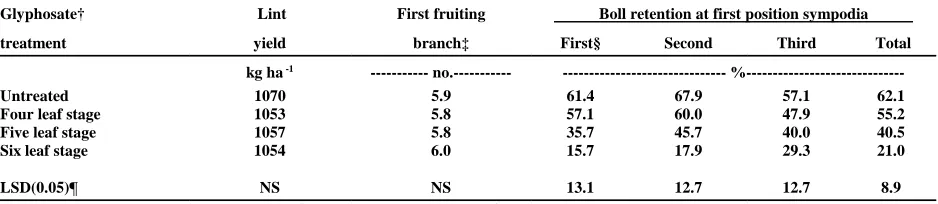
Table 2. Lint yield, first fruiting branch, and boll retention at first sympodial branch locations in response to glyphosate applied at various stages of cotton development in 1995 at Stoneville, MS. Values are averaged over seven cultivars (Strain 2).
Glyphosate† Lint First fruiting Boll retention at first position sympodia
treatment yield branch‡ First§ Second Third Total
kg ha -1
--- no.--- ---
%---Untreated 1070 5.9 61.4 67.9 57.1 62.1
Four leaf stage 1053 5.8 57.1 60.0 47.9 55.2
Five leaf stage 1057 5.8 35.7 45.7 40.0 40.5
Six leaf stage 1054 6.0 15.7 17.9 29.3 21.0
LSD(0.05)¶ NS NS 13.1 12.7 12.7 8.9
† Glyphosate applied at 1.0 kg a.e. ha-1
plus Induce at 0.5% v v-1
.
‡ First fruiting branch measured in ascending order with the cotyledonary node as 0.
§ First, second, and third refer to boll retention on the first, second, and third fruiting branches, respectively. Total is the mean boll retention averaged over the first three fruiting branches.
¶ Least significant difference at the 0.05 level of probability. NS = not significant at the 0.05 level of probability. Table 1. Lint yield, first fruiting branch, and boll retention at first sympodial branch locations in response to glyphosate
applied at various stages of cotton development in 1995 at Stoneville, MS. Values are averaged over seven cultivars (Strain one).
Glyphosate† Lint First fruiting Boll retention at first position sympodia
treatment yield branch‡ First§ Second Third Total
kg ha-1
--- no.--- ---
%---Untreated 1155 6.3 65.7 57.9 60.0 61.2
Four leaf stage 1133 6.2 45.7 42.9 43.6 44.3
Five leaf stage 1143 6.1 21.4 37.9 43.6 34.3
Six leaf stage 1143 6.1 12.9 16.4 27.9 19.1
LSD(0.05)¶ NS NS 11.3 12.1 12.0 8.3
† Glyphosate applied at 1.0 a.e. kg ha-1 plus Induce at 0.5% v v-1.
‡ First fruiting branch measured in ascending order with the cotyledonary node as 0.
§ First, second, and third refer to boll retention on the first, second, and third fruiting branches, respectively. Total is the mean boll retention averaged over the first three fruiting branches.
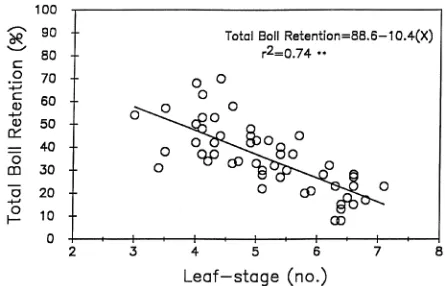
Fig. 1. Relationship of total boll retention on the first three fruiting branches at the first position sympodial locations to leaf-stage at the time of topical glyphosate applications. Each data point represents the actual measured leaf-stages at the time of glyphosate application for each sprayed plot for two studies (seven glyphosate-tolerant cultivars) in 1995 and one study (four glyphosate-tolerant cultivars) in 1996 averaged across replications. ** Indicates that the slope is significant at P = 0.01.
respectively (Table 3). The location of the first fruiting branch ranged between nodes 5.0 and 6.3 over the 2 years.
Delayed glyphosate applications decreased boll retention at first position sympodial fruiting sites (Tables 1, 2, and 3). Untreated plants retained 65.7, 61.4, and 54.2% of their first position bolls located on the first fruiting branch in the two 1995 studies and the 1996 study, respectively. Percent boll retention on the first fruiting branch declined incrementally as the timing of glyphosate application was delayed from the three-leaf to the six-leaf stage. The greatest decrease in boll retention occurred on plants treated topically with glyphosate at the six-leaf stage, with average boll retentions of 12.9 and 15.7% on the first fruiting branch in 1995 (six-leaf treatments were not evaluated in 1996).
Reductions in boll retention at first position sympodial locations similar to that observed on the first fruiting branch occurred on the second and third fruiting branches in both years (Tables 1, 2, and 3). Total boll retention for the first three fruiting branches for plants treated topically at the three-, four-, five-, and six-leaf stages was reduced by 25.5, 24.4, 45.1, and 67.8%, respectively, compared to the untreated control plants. Total boll retention for the first three fruiting branches displayed a negative linear relationship with the actual leaf-stage when glyphosate was topically-applied (r2 = $0.74),
regardless of cultivar or year (Fig. 1). Therefore, it appeared that the reproductive development of glyphosate-tolerant cotton was highly sensitive to delayed topical applications of glyphosate. Since fruit retention and boll numbers are highly correlated with lint yield (Jones et al., 1996a; Wells and
Meredith, 1984), caution should be exercised by producers when considering mid- and late-season (i.e., after the four-leaf stage to pre-harvest) over-the-top salvage applications of glyphosate, especially after reproductive development has initiated.
The potential of cotton to compensate for early-season boll loss may be important in deciding whether or not to use glyphosate over-the-top after square development has occurred. There were no differences in lint yield (Tables 1, 2, and 3) among treatments in this study despite reductions in early-season fruit retention, indicating that considerable compensation following early-season fruit loss occurred. Because of their indeterminate, perennial growth habit, cotton plants have several mechanisms
Table 3. Lint yield, first fruiting branch, and boll retention at first sympodial branch locations in response to glyphosate applied at various stages of cotton development in 1996 at Stoneville, MS. Values are averaged over six cultivars.
Glyphosate† Lint First fruiting Boll retention at first position sympodia
treatment yield branch‡ First§ Second Third Total
kg ha-1 --- no.--- ---
%---Untreated 1264 5.1 54.2 60.0 59.2 57.8
Three leaf stage 1248 5.2 36.7 46.7 51.7 45.0
Four leaf stage 1260 5.0 25.0 44.2 43.4 37.5
Five leaf stage 1101 5.0 18.3 23.4 32.5 24.7
LSD(0.05)¶ NS NS 12.8 10.4 12.8 10.2
† Glyphosate applied at 1.0 kg a.e. ha-1 plus Induce at 0.5% v v-1.
‡ First fruiting branch measured in ascending order with the cotyledonary node as 0.
§ First, second, and third refer to boll retention on the first, second, and third fruiting branches, respectively. Total is the mean boll retention averaged over the first three fruiting branches.
that promote compensatory late-season boll production. Early fruit removal studies have shown that cotton plants can compensate for early-season fruit loss with increased flowering (Ehlig and LeMert, 1973; Kletter and Wallach, 1982; Patterson et al., 1978; Ungar et al., 1987), flowering rates (Kennedy et al., 1986), fruit retention (Ehlig and LeMert, 1973; Kletter and Wallach, 1982; Patterson et al., 1978) and boll setting rates (Kennedy et al., 1986). Moreover, cotton plants exposed to early-season fruit removal shift their boll development locations to positions higher on the main stem and at more distal fruiting branch positions (Jones et al., 1996a).
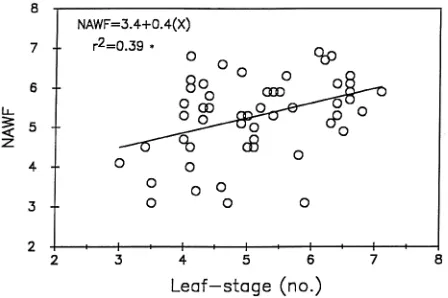
The loss of early-season fruit in these studies may have also delayed maturity as evidenced by a slight increase in nodes above white flower values as the timing of topical glyphosate applications was delayed from the third stage to the sixth leaf-stage (Fig. 2, Tables 4 and 5). Early maturity is often associated with low first fruiting branch nodal positions, rapid early node production, and greater fruit retention on these early fruiting sites (Kerby et al., 1990). Although it is possible for considerable
reproductive compensation to occur in cotton, the amount and duration of reproductive compensation after early-season fruit loss is highly dependent on a sufficiently long growing season with adequate environmental conditions to mature later-season fruit development.
There are numerous studies documenting yield losses when early-season square loss occurs (Brown, 1965; Kennedy et al., 1986; Pettigrew et al., 1992; Ungar et al., 1987). Therefore, some caution should be used when dealing with situations that may induce early-season square loss. Also, the slight delay in maturity associated with delayed applications in this study could increase production costs associated with prolonged insect and weed management, as well as reduce the effectiveness of harvest-aid materials and the harvesting process. In Mississippi, the number of days suitable for field work declines from 10.3 to 3.3 days for each 15 day period beginning 26 September and continuing until 9 December (Cooke et al., 1972). Delays in maturity jeopardize harvesting operations and contribute to late-season weather related yield and quality losses.
No differences in plant height, number of main
Table 4. Height (ht), number of nodes, first fruiting branch (FFB), and nodes above white flower (NAWF) at 85 days after planting in response to glyphosate applied at various stages of cotton development in 1995 at Stoneville, MS. Values are averaged over seven cultivars.
Glyphosate† Strain one Strain two
treatment Ht Nodes NAWF FFB‡ Ht Nodes NAWF FFB
cm --- no. --- cm no.
---Untreated 104 20.2 5.8 6.3 99 19.6 5.1 5.9
Four leaf stage 103 20.4 5.9 6.2 101 20.0 5.4 5.8
Five leaf stage 107 20.5 5.7 6.1 103 20.2 5.4 5.8
Six leaf stage 106 20.5 6.0 6.1 106 20.4 5.8 6.0
LSD(0.05)§ 3 NS 0.3 NS 4 NS 0.4 NS
† Glyphosate applied at 1.0 kg a.e. ha-1
plus Induce at 0.5% v v-1
.
‡ First fruiting branch measured in ascending order with the cotyledonary node as 0.
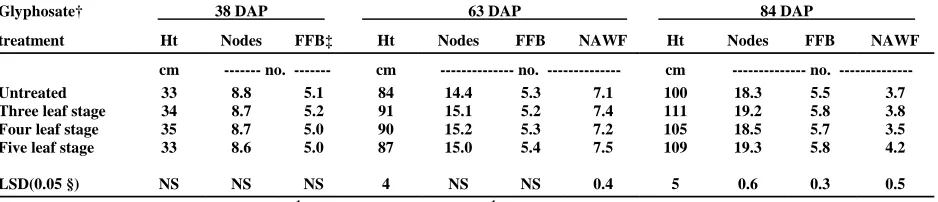
§ Least significant difference at the 0.05 level of probability. NS = not significant at the 0.05 level of probability. Table 5. Height, number of nodes, first fruiting branch, and nodes above white flower in response to glyphosate applied
at various stages of cotton development in 1996 at Stoneville, MS. Values are averaged over six cultivars.
Glyphosate† 38 DAP 63 DAP 84 DAP
treatment Ht Nodes FFB‡ Ht Nodes FFB NAWF Ht Nodes FFB NAWF
cm --- no. --- cm --- no. --- cm no.
---Untreated 33 8.8 5.1 84 14.4 5.3 7.1 100 18.3 5.5 3.7
Three leaf stage 34 8.7 5.2 91 15.1 5.2 7.4 111 19.2 5.8 3.8
Four leaf stage 35 8.7 5.0 90 15.2 5.3 7.2 105 18.5 5.7 3.5
Five leaf stage 33 8.6 5.0 87 15.0 5.4 7.5 109 19.3 5.8 4.2
LSD(0.05 §) NS NS NS 4 NS NS 0.4 5 0.6 0.3 0.5
† Glyphosate applied at 1.0 kg a.e. ha-1
plus Induce at 0.5% v v-1
.
‡ First fruiting branch measured in ascending order with the cotyledonary node as 0.
Fig. 2. Relationship of nodes above white flower counts to leaf-stage at the time of topical glyphosate applications. Each data point represents the actual measured leaf stages at the time of glyphosate application for each sprayed plot for two studies (seven glyphosate-tolerant cultivars) in 1995 and one study (four glyphosate-tolerant cultivars) in 1996 averaged across replications. *Indicates that the slope is significant at P = 0.05.
stem nodes, or location of the first fruiting branch were found among cultivars or application timings at 38 days after planting in 1996 (Table 5). Also, no differences in visual injury symptoms were observed among cultivars or application timings (data not shown). Glyphosate-tolerant cultivars appeared to be resistant to vegetative injury from topical applications of glyphosate. Plants that received topical glyphosate applications showed increased plant height at 85 days after planting in 1995 and at 63 and 84 days after planting in 1996 and showed increased node numbers at 84 days after planting in 1996 compared to the untreated plants (Tables 4 and 5). It appeared that the loss of early fruit caused by the topical glyphosate applications may have redirected assimilates within the plant toward vegetative development at the expense of reproductive structures. Similar increases in vegetative plant development after loss of early-season fruit were also reported by Jones et al. (1996b) after hand-removal of early-season flowers.
CONCLUSIONS
Topical applications of glyphosate herbicide to glyphosate-tolerant cotton cultivars decreased early-season boll retention at first position sympodia. Leaf-stage was negatively correlated with boll retention and positively correlated with nodes above
white flower values; however, topical applications of glyphosate to transgenic cotton did not significantly reduce total lint yield. The ability of cotton plants to compensate for the loss of early-season fruit after topical applications of glyphosate appeared to be extremely important in the ability of this new technology to work effectively in cotton production systems. The loss of early-season fruit can be tolerated in most years when the environment permits reproductive development to be extended later into the season. However, harvesting and weather related yield losses may be encountered as a result of delays in maturity.
REFERENCES
Brown, K.J. 1965. Response of three strains of cotton to flower removal. Cotton Grow. Rev. 42:279–286.
Comai, L., and D. Stalker. 1986. Mechanism of action of herbicides and their molecular manipulation. Oxford Surv. Plant Molec. Cell Biol. (3)166–195.
Cooke, F.T., J.M. Anderson, and A.M. Heagler. 1972. Crop budgets and planning data for major farm enterprises in the Yazoo-Mississippi Delta. Mississippi Agric. For. Exp. Stn. Bull. 794.
Ehlig, C.F., and R.D. LeMert. 1973. Effects of fruit load, temperature, and relative humidity on boll retention of cotton. Crop Sci. 13:168–171.
Johnson, E.M. 1996. Roundup Ready gene in cotton. p.51. In P. Dugger and D.A. Richter (ed.) Proc. Beltwide Cotton Conferences, Nashville, TN. 9–12 Jan. 1996. Natl. Cotton Council Am., Memphis, TN.
Jones, M.A., R. Wells, and D.S. Guthrie. 1996a. Cotton response to seasonal patterns of flower removal: I. Yield and fiber quality. Crop Sci. 36:633–638.
Jones, M.A., R. Wells, and D.S. Guthrie. 1996b. Cotton response to seasonal patterns of flower removal: II. Growth and dry matter allocation. Crop Sci. 36:639–645. Kennedy, C.W., W.C. Smith, Jr., and J.E. Jones. 1986. Effect of early season square removal on three leaf types of cotton. Crop Sci. 26:139–145.
Kerby, T.A., K.G. Cassman, and M. Keeley. 1990. Genotypes and plant densities of narrow-row cotton: I. Height, nodes, earliness, and location of yield. Crop Sci. 30:644–649. Kletter, E., and Wallach, D. 1982. Effects of fruiting form
Patterson, L.L., D.R. Buxton, and R.E. Briggs. 1978. Fruiting in cotton as affected by controlled boll set. Agron. J. 70:118–122.
Pettigrew, W.T., J.J. Heitholt, and W.R. Meredith, Jr. 1992. Early season floral bud removal and cotton growth, yield, and fiber quality. Agron. J. 84:209–214.
SAS Institute. 1987. SAS user’s guide: Statistics. SAS Inst., Cary, NC.
Smeda, R.J., C.E. Snipes, and W.L. Barrentine. 1997. Identification of graminicide-resistant johnsongrass (Sorghum halapense). Weed Sci. 45:132–137.
Snipes, C.E. 1995. The need for postemergence broadleaf weed control in cotton—Biotechnology’s impact. Proc. So. Weed Sci. Soc. 48:35–36.