Ames Laboratory Accepted Manuscripts
Ames Laboratory
7-31-2018
Giant microwave absorption in fine powders of
superconductors
G. Csősz
Budapest University of Technology and Economics and MTA-BME Lendület Spintronics Research Group (PROSPIN)
B. G. Márkus
Budapest University of Technology and Economics and MTA-BME Lendület Spintronics Research Group (PROSPIN)
A. Jánossy
Budapest University of Technology and Economics and MTA-BME Lendület Spintronics Research Group (PROSPIN)
N. M. Nemes
Universidad Complutense de Madrid
F. Murányi
Mettler-Toledo GmbH
See next page for additional authors
Follow this and additional works at:
https://lib.dr.iastate.edu/ameslab_manuscripts
Part of the
Atomic, Molecular and Optical Physics Commons
, and the
Condensed Matter
Physics Commons
This Article is brought to you for free and open access by the Ames Laboratory at Iowa State University Digital Repository. It has been accepted for inclusion in Ames Laboratory Accepted Manuscripts by an authorized administrator of Iowa State University Digital Repository. For more information, please [email protected].
Recommended Citation
Csősz, G.; Márkus, B. G.; Jánossy, A.; Nemes, N. M.; Murányi, F.; Klupp, G.; Kamarás, K.; Kogan, Vladimir G.; Bud’ko, Sergey L.; Canfield, Paul C.; and Simon, F., "Giant microwave absorption in fine powders of superconductors" (2018).Ames Laboratory Accepted Manuscripts. 213.
Giant microwave absorption in fine powders of superconductors
Abstract
Enhanced microwave absorption, larger than that in the normal state, is observed in fine grains of type-II
superconductors (MgB2 and K3C60) for magnetic fields as small as a few % of the upper critical field. The
effect is predicted by the theory of vortex motion in type-II superconductors, however its direct observation
has been elusive due to skin-depth limitations; conventional microwave absorption studies employ larger
samples where the microwave magnetic field exclusion significantly lowers the absorption. We show that the
enhancement is observable in grains smaller than the penetration depth. A quantitative analysis on K3C60 in
the framework of the Coffey–Clem (CC) theory explains well the temperature dependence of the microwave
absorption and also allows to determine the vortex pinning force constant.
Disciplines
Atomic, Molecular and Optical Physics | Condensed Matter Physics | Physics
Authors
G. Csősz, B. G. Márkus, A. Jánossy, N. M. Nemes, F. Murányi, G. Klupp, K. Kamarás, Vladimir G. Kogan,
Sergey L. Bud’ko, Paul C. Canfield, and F. Simon
www.nature.com/scientificreports
Giant microwave absorption in fine
powders of superconductors
G.
Csősz
1, B. G. Márkus
1, A. Jánossy
1, N. M. Nemes
2, F. Murányi
3, G. Klupp
4, K. Kamarás
4,
V. G. Kogan
5, S. L. Bud’ko
5, P. C.
Canfield
5& F. Simon
1Enhanced microwave absorption, larger than that in the normal state, is observed in fine grains of
type-II superconductors (MgB2 and K3C60) for magnetic fields as small as a few % of the upper critical field. The effect is predicted by the theory of vortex motion in type-II superconductors, however its
direct observation has been elusive due to skin-depth limitations; conventional microwave absorption
studies employ larger samples where the microwave magnetic field exclusion significantly lowers the
absorption. We show that the enhancement is observable in grains smaller than the penetration depth. A quantitative analysis on K3C60 in the framework of the Coffey–Clem (CC) theory explains well the temperature dependence of the microwave absorption and also allows to determine the vortex pinning
force constant.
Electrodynamics of superconductors remains an intensively studied field1 due to the wealth of attainable
fun-damental information, including the nature of pairing mechanism and the coupling strength, and also due to the technological importance of these materials. In addition, recent studies focus on novel topological phases including superconductors2. As an example, observation of the conductivity coherence peak in conventional
superconductors3 (Nb and Pb) and its absence in high-T
c materials4 pointed to a BCS mechanism in the former
and it was an early indication of non-BCS superconductivity in the latter compounds. Concerning applications, the DC electrodynamic properties in the mixed state of type-II superconductors determine the utility (e.g. loss, permanent field homogeneity, and stability) in superconducting solenoid coils that are widely used in supercon-ducting particle acceleration, solid state spectroscopy, or medical imaging. The AC electrodynamic properties are relevant for applications including e.g. power handling, sound and electromagnetic field detection5–7,
supercon-ducting microwave resonators8, and in microwave absorbers9.
The frequency dependent conductivity of superconductors, σ=σ1+iσ2, is well known for both BCS (i.e. weak-coupled s-wave pairing) and non-BCS superconductors (including strongly coupled s-wave and non s-wave superconductors) in the absence of magnetic field, B= 0. At zero temperature, T= 0, the real part, σ1(ω), is a delta
function at ω= 0 followed by σ1(ω) = 0 until the gap edge at ωg= 2Δ/ℏ (ref.10) (usually at 0.1–10 THz). According
to the Ferrell–Glover–Tinkham (FGT) sum rule11,12, the spectral weight of the delta function comes from states
which are gapped below ωg (the sum rule is discussed in depth in the Supplementary Material). The
technologi-cally important radio frequency range spans 9 orders of magnitude in superconductors (from 10 kHz up to 1 THz) with similar characteristic properties, thus measurements in the microwave range (1–100 GHz) are representative.
Conductivity in finite magnetic fields for the mixed state in type-II superconductors was first described by the Bardeen–Stephen (BS) model13 for the viscous motion of vortices. This was later improved by the Coffey–
Clem theory (CC) in a series of seminal papers14–19, which also includes the effect of pinning force on the
vor-tex motion. The most important prediction of the BS model is a finite σ1 conductivity at ω= 0. However, it is
less well-known that the FGT sum rule implies a non-zero σ1 that is larger than in the normal state for ω<ωg.
Observation of this effect has been elusive as most contributions study the surface impedance on polycrystalline3,
compacted powder pellet, or thin film samples20,21. Surface impedance studies have the advantage that sample
1Department of Physics, Budapest University of Technology and Economics and MTA-BME Lendület Spintronics
Research Group (PROSPIN), POBox 91, H-1521, Budapest, Hungary. 2GFMC, Unidad Asociada ICMM-CSIC
“Laboratorio de Heteroestructuras con Aplicacion en Espintronica”, Departamento de Fisica de Materiales Universidad Complutense de Madrid, 28040, Madrid, Spain. 3Mettler-Toledo GmbH, Heuwinkelstrasse 3., CH-8606,
Nänikon, Switzerland. 4Institute for Solid State Physics and Optics, Wigner Research Centre for Physics, Hungarian
Academy of Sciences, P.O. Box 49, H-1525, Budapest, Hungary. 5Ames Laboratory, U.S. Department of Energy
and Department of Physics and Astronomy, Iowa State University, Ames, Iowa, 50011, USA. Correspondence and requests for materials should be addressed to F.S. (email: [email protected])
Received: 26 April 2018 Accepted: 12 July 2018 Published: xx xx xxxx
www.nature.com/scientificreports/
2
SCIEnTIFICREPORtS | (2018) 8:11480 | DOI:10.1038/s41598-018-29750-7
geometry is well defined, however the effects of σ1 and σ2 are inevitably intermixed in this type of measurements.
Given that σ2 is orders of magnitude larger than σ1 in the superconducting state (due to the small value of the
penetration depth, λ, with respect to sample thickness), the surface impedance measurement is less sensitive to changes in σ1 (refs22–26).
The effects of σ1 and σ2 are decoupled for fine grains; for a sample placed in a microwave cavity, the loss is due
to σ1, whereas the resonance shift is due to σ2 (refs27–29). Therefore such samples provide a unique opportunity
to test the predictions of the CC theory on σ1,2(T, B). The enigmatic and yet unexplained increase of the electron
spin resonance signal in superconductors right below Tc (refs30,31) also highlights the need to study further the
electromagnetic absorption in superconductors.
This motivated us to revisit the microwave conductivity (at about 10 GHz) in the MgB2 and K3C60
super-conductors as a function of T and B. We observe an excess microwave loss (or microwave absorption) in small magnetic fields (as low as a few % of the upper critical field, Bc2) for a sample consisting of well-separated fine
grains (typical size is a few micrometers). The excess microwave absorption is not observable in a single crystal sample. A quantitative analysis is provided for K3C60, which is a one-gap, cubic superconductor with well known
magneto-transport properties32, whereas MgB
2 is a multi-band superconductor with strongly anisotropic Bc2
(refs33,34), thus application of the CC model is less straightforward.
Methods and Experimental
We studied fine powder MgB2 samples identical to batches in refs35 and30. Single crystal and powder K3C60
sam-ples were prepared by the conventional K intercalation method; the crystal sample was from the same batch as in ref.36. The starting fullerene powder material contains grains with a size of a few micrometers that is retained in
the K doped material according to literature studies37–39. The powder samples were further ground together with
non-conducting SnO2 powder to prevent conducting links between the grains. Samples were sealed in quartz
ampules under low pressure helium. Microwave properties were measured with the cavity perturbation method27,28 as a function of temperature, T, and in various static magnetic fields, B, inside a superconducting
solenoid, with zero-field cooling. Zero field measurements (besides the Earth’s magnetic field) were made in another cryostat without a magnet field solenoid to avoid trapped flux (which may amount to 10–20 mT). The unloaded copper cavity has a quality factor, Q0 ~ 10,000 and a resonance frequency, f0 ~ 11.2 GHz, whose
temper-ature dependence is taken into account. The samples were placed in the node of the microwave (or rf) electric field and maximum of the microwave magnetic field inside the TE011 cavity, which is the appropriate geometry to study minute changes in the conductivity29. The rf magnetic field is parallel to the DC field of the solenoid, which
yields the largest vortex motion induced absorption according to the CC theory16. Measurement40 of the quality
factor, Q, and the cavity resonance frequency, f yields the loss: Δ
( )
21Q = 21Q − 2Q10 and cavity shift: Δf/f0= (f−f0)/f0.
Results
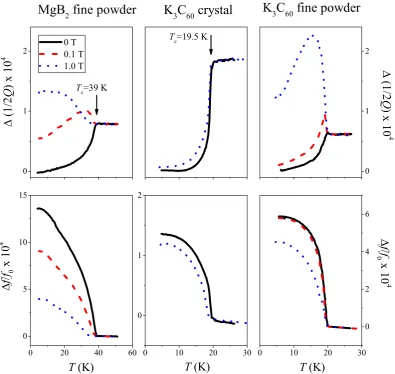
Figure 1 shows the microwave cavity loss and cavity shift for a fine powder of MgB2 and for two kinds of K3C60
samples: a single crystal and a fine powder as a function of temperature and for a few magnetic field values. The microwave loss decreases rapidly below Tc in zero magnetic field as expected for superconductors. The most
important observation is that the microwave loss becomes significant for a magnetic field as small as 0.1 T for the fine powder samples, whereas even 1 T has little effect on the microwave absorption for the single crystal K3C60
sample. In fact, we observe a giant, about a factor 3 times larger, microwave absorption below Tc than in the
nor-mal state. This striking difference between the crystal and fine grain samples is clearly demonstrated for K3C60
where measurements on both kinds of samples are shown. For MgB2, microwave measurements on compacted
samples (or surface impedance measurements) supports this observation as therein no enhanced microwave absorption was observed41–46. While the absorption becomes significant for the fine powder samples at B= 0.1 T,
the shift changes less, which means that the overall superconducting characteristics of the sample are maintained. We believe that the enhanced microwave absorption is an ubiquitous property of fine powders of type-II superconductors. However, we cannot quantitatively discuss this effect for MgB2 due to the multi-band
supercon-ductivity47,48 and the significant B
c2 anisotropy; Bc2 at 0 K is ~2 T and ~16 T for B c( ) and B a b( , ), respectively
(refs34,35,49). We therefore focus on K
3C60 in the following. The enhanced microwave loss appears progressively
with increasing magnetic field (additional data are shown in the Supplementary Material).
We also show the B= 0.1 T data for the powder sample (B≈ 0.002 ×Bc2) in Fig. 1; they show a peak in the
microwave loss right below Tc followed by a gradual decrease. The zero magnetic field data also shows a small
peak (invisible at the scale of Fig. 1) for the powder sample (shown in the Supplementary Material). This small peak is not due to magnetic field and is most probably a tiny conductivity coherence peak (the analogue of the Hebel–Slichter peak50) which is known to be strongly suppressed by strong-coupling effects in alkali fullerides51,52.
While the presence of a coherence peak itself is an interesting physical phenomenon3,53, it is not relevant for the
present discussion.
The fact that the enhanced microwave absorption occurs with the application of the magnetic field hints at a flux motion related phenomenon that is discussed in the framework of the CC theory. The microwave absorption peak occurs above the irreversibility line, i.e. it is related to the physical behavior of the vortex-fluid state; for K3C60Tirr(B= 0.1 T) ≈ 15 K and Tirr(B= 1 T) < 5 K (ref.54).
The strong dependence on the sample morphology is also discussed below. Superconducting fullerides are type-II (λξ) and have a short mean free path32 i.e. they can be described in the local electrodynamics limit as
www.nature.com/scientificreports/
Discussion
Conductivity in the superconducting state.
The phenomenological CC theory14–19 is based on atwo-fluid model and considers the motion of vortices due to the exciting electromagnetic field in the presence of a viscous background (described by the viscous drag coefficient, η) and a restoring force (described by an effective pinning force constant, κp).
The viscous drag was introduced in the Bardeen–Stephen theory13 and is determined by the superconducting
parameters10,55: η =
ρ Φ
T
( ) 0 c2B T( )T( )
n . The value of κp is unknown and only an upper limit can be estimated from ther-modynamic considerations55–57 for a “perfect pinning center”, i.e. a hollow cylinder with a diameter of about the
coherence length, d≈ξ. The condensation energy gain per unit length from placing a vortex in this cylinder is about d B2 /2μ
c2 0, where the square of the thermodynamic critical field is Bc2=B Bc1 c2/ ln
( )
λξ . This leads to:κ
μ = B .
2 (1)
p,max c
2
0
For a weaker pinning center, κp can be significantly lower and in the bulk of a perfect superconductor, it would
be zero.
The CC theory introduces the concept of the complex penetration depth, λ:
λ λ δ
λ δ
= +
−
(i/2)
1 2i / , (2)
2 2 vc2
2 nf2
Figure 1. Temperature dependent cavity loss, Δ
( )
2Q1 , and cavity shift, Δf/f0 for a fine powder of MgB2 and forthe single crystal and powder K3C60 samples. Two magnetic field data are shown for the crystal (0 and 1 T) and
[image:5.595.157.553.44.418.2]www.nature.com/scientificreports/
4
SCIEnTIFICREPORtS | (2018) 8:11480 | DOI:10.1038/s41598-018-29750-7
where δnf is the normal fluid skin depth, λ is the usual (real) penetration depth and δvc is the complex effective skin depth19. The latter quantity is zero for B= 0 and becomes finite in the mixed state when vortex motion is
present. λ is related to the complex conductivity by σ=i/μ ωλ0 2. Note that for B= 0 (i.e. when δ =vc2 0), we obtain
T
( 0)
2 2
λ = =λ and 2(T T) i /2 c n2
λ = = δ as expected. The CC theory yields the temperature and magnetic field dependent σ using explicit expressions for λ(T), δnf(T), Bc2(T). We have implemented the calculation (details are
given in the Supplementary Material) and validated our calculations by comparing the results to that published in ref.19.
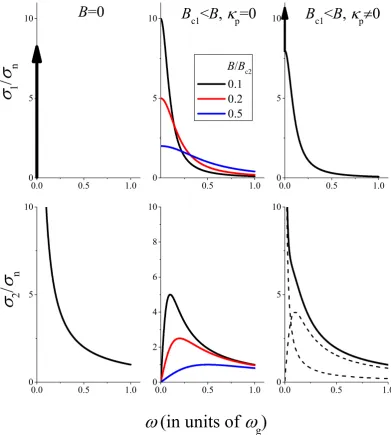
Here, we discuss qualitatively the predictions of the CC theory and some typical cases are shown in Fig. 2. In superconductors, at B= 0 the carrier spectral weight below ωg collapses into the σ1= 2μ λπ δ ω( )
02
function accord-ing to the Ferrell–Glover–Tinkham (FGT) sum rule11,12. The Kramers–Kronig relation dictates that σ
2= 1/μ0ωλ2.
Without vortex pinning, the Meissner state is destroyed for B>Bc1 and the Bardeen–Stephen theory gives
σ = +σ ω ω
B Bc21 in
c
. It is worth noting that this result is formally analogous to the AC Drude model as the underlying equation of motion (of electrons or vortices) is the same. Here, we introduced a cut-off frequency ω =
μ λ σ
B B c
02c2 n. Clearly, σ1 can be larger than σn for ω<ωc.
Figure 2. Illustration of σ ω( ) in superconductors for i) B= 0, ii) for finite fields (B>Bc1) with κp= 0 (the
Bardeen–Stephen case), and iii) for B≠ 0 and a finite κp (the case of the CC theory). Conductivity above the
superconducting gap, ωg, is not shown. The spectral weight in the delta function is preserved for B≠ 0. Note that
for κp≠ 0, the conductivity appears as if it were a sum of σ’s for the B= 0 and the BS flux-flow regimes (shown
[image:6.595.157.549.44.480.2]www.nature.com/scientificreports/
In the presence of vortex pinning, the CC theory predicts that σ is characterized by a mixture of the unper-turbed superconducting behavior and that of the Bardeen–Stephen theory with a shared spectral weight which depends on the pinning force constant. Pinning reduces the effect of the vortex flow on σ1. The enhanced σ1(ω)
AC conductivity (as compared to the normal state) is a direct consequence of the FGT sum rule for a finite mag-netic field. It allows to estimate the maximum possible value of the enhancement as σ1, max(ω) ≈σn×ωg/ω, that
would be realized at T= 0 in the absence of pinning. E.g. for K3C60 and ω/2π= 10 GHz we obtain σ1, max(ω) ≈ 140σn.
The CC theory allows to quantitatively analyze the conductivity in K3C60. The requirement of BBc1 is satis-fied for our magnetic fields of 0.1 … 1 T as Bc1 ~ 10 mT. The CC theory was developed for a superconductor which
occupies the total half space. We show in the Supplementary Material that it can be applied for a spherical sample which approximates well finite sized grains containing at least a few hundred/thousand vortices. In addition, the static and rf magnetic fields are parallel in our experiment, which is the standard case for the applicability of the CC theory. Albeit we cannot quantitatively consider the effect of the small particle size on the magnetic proper-ties, we believe that neither the surface barriers (also known as Bean-Livingstone barriers58) nor the so-called
geometrical barriers59 affect considerably the applicability of the CC theory. The argument is that both types of
barriers would affect the overall number of the vortices under the applied DC magnetic field (or the B value where vortices appear) but not the overall vortex dynamics under the application of the small AC magnetic field, which is the primary reason for the observed microwave absorption.
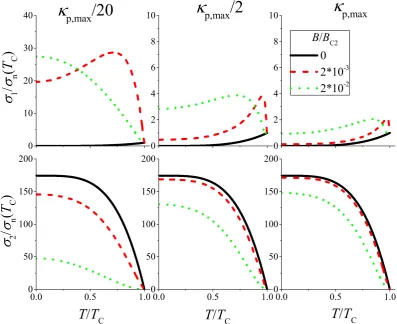
In Fig. 3, the calculated conductivity is plotted versus the reduced temperature for different force constants, κp,
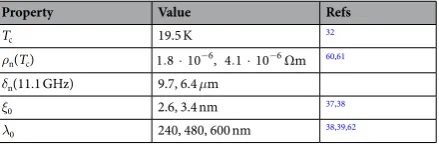
with the parameters ξ0= 3 nm (which corresponds to Bc2(0 K) = 37.5 T), λ0= 440 nm, and ρn(Tc) = 2.95 Ωm, the
mean values of the corresponding literature parameters for K3C60 (refs32,37–39,60–62), which are detailed in Table 1.
The pinning force constant is given in the figure with respect to κp,max = .3 84 10 N/m⋅ 4 2 according to Eq. (1). The figure indicates that κp strongly affects the magnetic field dependence of σ.
Analysis of the experimental data.
The sample morphology greatly affects the relation between the mate-rial conductivity, σ, and the microwave parameters, the loss and shift. Two limiting cases are known. 1) The sam-ple is large and the field penetrates into a limited distance from the surface. This approximates the measurement in the large K3C60 single crystal. 2) The sample is a small sphere with radius comparable to the penetration depth.Figure 3. Calculated real part and imaginary part of complex rf conductivity vs the reduced temperature for
different values of the pinning force constant, κp. The conductivity values are normalized by the normal state
conductivity at the critical temperature. The large value of σ2(T= 0)/σn(Tc) is due to a large (δn/λ)2. Note also the
[image:7.595.155.553.46.370.2]www.nature.com/scientificreports/
6
SCIEnTIFICREPORtS | (2018) 8:11480 | DOI:10.1038/s41598-018-29750-7
This approximates the K3C60 sample of well divided small grains. We discuss that the experimental observations
for the crystal and fine powder K3C60 are explained well by these two regimes.
In the first case, when the rf field penetrates in the skin depth only (known as the skin limit), the following equation holds between the microwave measurement parameters and the material quantities28:
νμ ω λ Δ − Δ
= − − f
f i Q
1
2 i , (3)
0 0
2
where the complex penetration depth, λ, is related to the conductivity as λ2=i(μ ωσ0 )−1. The dimensionless ν1 is the so-called resonator constant3 and it depends on the sample surface relative to that of the cavity.
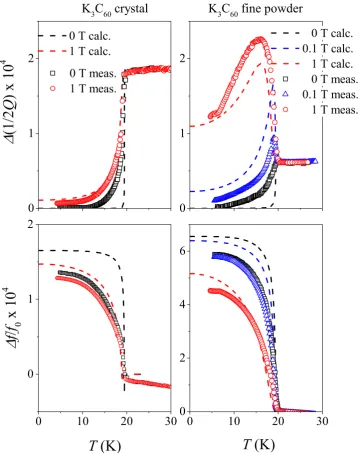
The left panels in Fig. 4. show the calculated and measured cavity loss and shift in 0 and 1 T magnetic fields for the single crystal sample. The calculation uses Eq. (3) with κp=κp,max/20. Although this low κp induces a large σ1,
there is no visible peak in the cavity loss in this case when excitation is limited to the surface. We discuss in detail in the Supplementary Material that the calculated cavity loss and shift are insensitive to the value of κp in this
limit. Clearly, the experimental data for the K3C60 crystal match well the calculations.
A suitable ν = . ⋅5 1 10−4 was chosen to match the calculation to the experiment. We find that for both the calculation and experiment, the cavity loss parameter drops rapidly below Tc, although σ1/σn is around unity due
to the vortex motion. This effect is due to the development of a significant σ2/σn ~ 100, which limits the
penetra-tion of microwaves into the sample and thus reduces the loss. This means that the microwave surface impedance measurement is not capable of providing information about σ1 in the presence of vortex motion. We note that the
experimental curves do not show such a rapid change as a function of temperature as the calculation. This may be related to the finite size and surface roughness of the single crystal sample.
Second, we discuss the opposite limit, when the microwave field penetrates into the sample (known as the penetration limit), the cavity measurables depend differently on the sample parameters. It was shown63 for a
sphere with radius, a:
γα Δ − Δ
= − f
f i Q
1
2 , (4)
0
α = − − +
a k ak ak
3 2 1
3 3 cot( ) ,
(5) 2 2
where k=nωc is the complex wavenumber, with n= i /σ ε ω 0 being the complex index of refraction. The dimen-sionless γ is a sample volume dependent constant.
The right panels in Fig. 4, show the measured cavity loss and shift data for the fine powder sample together with a fit according to Eq. (5). To obtain these fits, we fixed the transport and magnetic parameters (ρn, ξ0, λ0) of
K3C60 to the respective mean values as given in Table 1. We assumed that the sample consists of spheres with a
uniform diameter, a. The zero magnetic field data depends only on γ and a when the other parameters, δn and λ,
are fixed. A fit to the B= 0 data yields γ = .5 5(2) 10⋅ −4, and a= 6.2(2) μm. We then proceed to fit the magnetic field dependent data with κp as the only free parameter and we obtain κ = .p 1 0(1) 10⋅ 3 N/m2, which is about κp,max/20. As shown in Fig. 4, the calculation agrees well with the experimental data. The presence of a finite
microwave absorption at B= 1 T down to the lowest temperature appears to be surprising; its origin is therefore discussed qualitatively. Although the penetration depth due to superconductivity becomes smaller than the par-ticle size, it is accompanied by a large (σ1/σn≈ 30) conductivity due to the vortex motion. It means that a
substan-tial microwave absorption occurs on the surface of the sample. The important observation is that the loss remains proportional to σ1 in this case, although its effect is reduced. This is further elaborated in the last part of the
Supplementary Material.
Somewhat better fits could be obtained when letting λ, ρn, and Bc2 differ from the mean literature values. In
addition, Eq. (5) is valid for spheres only, it thus fixes the ratio between the real and imaginary parts (cavity loss and shift). A different particle shape or particle size distribution would allow for a different scaling factor for the loss and shift data which could also improve the fits. Although improved fits could be attained, we believe that the simplest model explains well the experimental observation of an enhanced microwave absorption. In addi-tion it allows to determine an effective pinning force constant, which is an important parameter to describe the
Property Value Refs
Tc 19.5 K 32
ρn(Tc) 1 8 10 , 4 1 10. ⋅ −6 . ⋅ −6 Ωm 60,61 δn(11.1 GHz) 9.7, 6.4 μm
ξ0 2.6, 3.4 nm 37,38
λ0 240, 480, 600 nm 38,39,62
Table 1. Transport and magnetic parameters of the K3C60 superconductor: the superconducting transition
temperature, Tc; the normal state resistivity at Tc, ρn; the normal state skin depth, δn; the coherence length at
T= 0, ξ0; and the magnetic field penetration depth at T= 0, λ0. The tabulated ξ0 values correspond to an upper
[image:8.595.158.378.46.119.2]www.nature.com/scientificreports/
electrodynamics of type-II superconductors. However, we note that κp determined herein may overestimate the
bulk pinning force constant; it is known that the presence of a substantial surface-volume ratio may give rise to additional vortex pinning58,59, with a strength that is difficult to estimate.
Summary
We demonstrated that moderate magnetic fields, which are small compared to the upper critical field, induces a large microwave absorption in fine powders of type II superconductors, like MgB2 and K3C60. The effect is absent
for samples containing larger grains or compacted powder pellets. The Bardeen–Stephen model of flux-flow pre-dicts that the real part of the AC conductivity can be enhanced in the microwave range, but this effect has not been observed. We analyze the conductivity using the Coffey–Clem theory which also accounts for vortex pin-ning effects. It is applied to calculate the microwave properties for two kinds of samples: when the electromag-netic field penetration is limited to the surface (skin limit) or when it fully penetrates into the fine grain samples (penetration limit). We show that microwave absorption in the skin limit is little affected by the vortex-motion enhanced σ1 but in the penetration limit, the effect is clearly observable. A quantitative analysis for K3C60 yields
the vortex pinning force constant that can be hardly determined by other means. Our observation allowed us to explain long-standing microwave anomalies in superconductors30,31 and it may lead to pertinent applications in
microwave communication techniques.
Figure 4. Comparison of measured and calculated cavity loss and shift parameters in the skin (left panels) and
[image:9.595.156.518.43.497.2]www.nature.com/scientificreports/
8
SCIEnTIFICREPORtS | (2018) 8:11480 | DOI:10.1038/s41598-018-29750-7
References
1. Dressel, M. Electrodynamics of Metallic Superconductors. Adv. Cond. Mat. Phys. (2013).
2. Villegas, K. H. A., Kovalev, V. M., Kusmartsev, F. V. & Savenko, I. G. Shedding light on topological superconductors.
arXiv:1805.03177.
3. Klein, O., Nicol, E. J., Holczer, K. & Grüner, G. Conductivity coherence factors in the conventional superconductors Nb and Pb.
Phys. Rev. B 50, 6307–6316 (1994).
4. Nuss, M., Mankiewich, P., Omalley, M., Westerwick, E. & Littlewood, P. Dynamic Conductivity and “Coherence Peak” in YBa2Cu3O7 Superconductors. Phys. Rev. Lett. 66, 3305–3308 (1991).
5. Semenov, A., Gol’tsman, G. & Korneev, A. Quantum detection by current carrying superconducting film. Physica C 351, 349–356 (2001).
6. Baek, B., Lita, A. E., Verma, V. & Nam, S. W. Superconducting a-WxSi1−x nanowire single-photon detector with saturated internal quantum efficiency from visible to 1850 nm. Applied Physics Letters 98 (2011).
7. Wei, J. et al. Ultrasensitive hot-electron nanobolometers for terahertz astrophysics. Nature Nanotechnology 3, 496–500 (2008). 8. Lancaster, M. J. Passive Microwave Device Applications of High-Temperature Superconductors. (Cambridge University Press,
Cambridge, UK, 2006).
9. Lin, T. S., Sobotka, L. G. & Froncisz, W. Superconductivity and microwave absorption. Nature 333, 21–22 (1988). 10. Tinkham, M. Introduction to superconductivity (Krieger Publishing Company, 1975).
11. Ferrell, R. A. & Glover, R. E. Conductivity of Superconducting Films: A Sum Rule. Phys. Rev. 109, 1398–1399 (1958).
12. Tinkham, M. & Ferrell, R. A. Determination of the Superconducting Skin Depth from the Energy Gap and Sum Rule. Phys. Rev. Lett.
2, 331–333 (1959).
13. Bardeen, J. & Stephen, M. J. Theory of the Motion of Vortices in Superconductors. Phys. Rev. 140, A1197–A1207 (1965).
14. Coffey, M. W. & Clem, J. R. Unified Theory of Effects of Vortex Pinning and Flux Creep upon the rf Surface Impedance of Type-II Superconductors. Phys. Rev. Lett. 67, 386–389 (1991).
15. Coffey, M. W. & Clem, J. R. Theory of rf magnetic permeability of isotropic type-II superconductors in parallel field. Phys. Rev. B 45, 9872–9881 (1992).
16. Coffey, M. W. & Clem, J. R. Theory of rf magnetic permeability of type-II superconductors in slab geometry with an oblique applie static magnetic field. Phys. Rev. B 45, 10527–10535 (1992).
17. Coffey, M. W. & Clem, J. R. Coupled nonlinear electrodynamics of type-II superconductors in the mixed state. Phys. Rev. B 46, 567–570 (1992).
18. Coffey, M. W. & Clem, J. R. Theory of high-frequency linear response of isotropic type-II superconductors in the mixed state. Phys. Rev. B 46, 11757–11764 (1992).
19. Coffey, M. W. & Clem, J. R. Theory of microwave transmission and reflection in type-II superconductors in the mixed state. Phys. Rev. B 48, 342–350 (1993).
20. Jin, B. B. et al. Anomalous Coherence Peak in the Microwave Conductivity of c-Axis Oriented MgB2 Thin Films. Phys. Rev. Lett. 91, 127006 (2003).
21. Janjušević, D. et al. Microwave response of thin niobium films under perpendicular static magnetic fields. Phys. Rev. B 74, 104501 (2006).
22. Henderson, W., Andrei, E. Y., Higgins, M. J. & Bhattacharya, S. ac Dynamics of a Pinned Flux-Line Lattice. Phys. Rev. Lett. 80, 381–384 (1998).
23. Revenaz, S., Oates, D. E., Labblé-Lavigne, D., Dresselhaus, G. & Dresselhaus, M. S. Frequency dependence of the surface impedance of YBA2Cu3O7−δ thin films in dc magnetic field: Investigation of vortex dynamics. Phys. Rev. B 50, 1178–1189 (1994).
24. Belk, N., Oates, D. E., Feld, D. A., Dresselhaus, G. & Dresselhaus, M. S. Frequency and temperature dependence of the microwave surface impedance of YBa2Cu3O2−δ thin films in dc magnetic field: Investigation of vortex dynamics. Phys. Rev. B 53, 1178–1189
(1996).
25. Parks, B. et al. Phase-Sensitive Measurments of Vortex Dynamics in the Terahertz Domain. Phys. Rev. Lett. 74, 3265–3268 (1995). 26. Pambianchi, M. S., Wu, D. H., Ganapathi, L. & Anlage, S. M. Dc magnetic field dependence of the surface impedance in
superconducting parallel plate transmission line resonators. IEEE Trans. Appl. Supercond. 3, 2774–2777 (1993). 27. Buravov, L. I. & Shchegolev, I. F. Instrum. Exp. Tech. 14, 528 (1971).
28. Klein, O., Donovan, S., Dressel, M. & Grüner, G. Microwave cavity perturbation technique: Part I: Principles. Int. J. Infr. Mill. Wav.
14, 2423–2457 (1993).
29. Kitano, H. et al. Evidence for Insulating Behavior in the Electric Conduction of NH3K3C60 Systems. Phys. Rev. Lett. 88, 096401 (2002).
30. Simon, F. et al. Magnetic-field-induced density of states in MgB2: Spin susceptibility measured by conduction-electron spin resonance. Phys. Rev. B 72, 012511 (2005).
31. Murányi, F., Urbanik, G., Kataev, V. & Büchner, B. Electron spin dynamics of the superconductor CaC6 probed by ESR. Phys. Rev. B 77, 024507 (2008).
32. Gunnarsson, O. Superconductivity in fullerides. Rev. Mod. Phys. 69, 575–606 (1997).
33. Nagamatsu, J., Nakagawa, N., Muranaka, T., Zenitani, Y. & Akimitsu, J. Superconductivity at 39 K in magnesium diboride. Nature
410, 63–64 (2001).
34. Buzea, C. & Yamashita, T. Review of the superconducting properties of MgB2. Super. Sci. Technol. 14, R115–R146 (2001). 35. Simon, F. et al. Anisotropy of superconducting MgB2 as seen in electron spin resonance and magnetization data. Phys. Rev. Lett. 87
(2001).
36. Nemes, N. M. et al. Conduction-electron spin resonance in the superconductor K3C60. Phys. Rev. B 61, 7118–7121 (2000). 37. Johnson, C. E. et al. Upper-critical-field-temperature phase diagram of alkali-metal-intercalated C60 superconductors. Phys. Rev. B
46, 5880–5882 (1992).
38. Holczer, K., Klein, O. & Grüner, G. Critical Magnetic Fields in the Superconducting State of K3C60. Phys. Rev. Lett. 67, 271–274 (1991).
39. Uemura, Y. J. et al. Magnetic-field penetration depth in K3C60 measured by muon spin relaxation. Nature 352, 605–607 (1991). 40. Nebendahl, B., Peligrad, D.-N., Pozek, M., Dulcic, A. & Mehring, M. An ac method for the precise measurement of Q-factor and
resonance frequency of a microwave cavity. Rev. Sci. Instrum. 72, 1876 (2001).
41. Zhukov, A. et al. Microwave surface resistance of MgB2. Appl. Phys. Lett. 80, 2347–2349 (2002). 42. Dulcic, A. et al. Magnetization and microwave study of superconducting MgB2. Phys. Rev. B 66 (2002).
43. Gallitto, A., Fricano, S., Vigni, M., Kolesnikov, N. & Kulakov, M. Magnetic field dependence of the microwave surface resistance in MgB2 superconductors. Int. J. Mod. Phys. B 16, 1571–1576 (2002).
44. Nefyodov, Y. et al. Characteristic features of the temperature dependence of the surface impedance in polycrystalline MgB2 samples.
Eur. Phys. Lett. 58, 422–428 (2002).
45. Hakim, N. et al. The superconducting gap of in situ MgB2 thin films by microwave surface impedance measurements. Appl. Phys.
Lett. 81, 3603–3605 (2002).
www.nature.com/scientificreports/
47. Liu, A., Mazin, I. & Kortus, J. Beyond Eliashberg superconductivity in MgB2: Anharmonicity, two-phonon scattering, and multiple gaps. Phys. Rev. Lett. 87 (2001).
48. Choi, H., Roundy, D., Sun, H., Cohen, M. & Louie, S. The origin of the anomalous superconducting properties of MgB2. Nature 418, 758–760 (2002).
49. Bud’ko, S. L., Kogan, V. G. & Canfield, P. C. Determination of superconducting anisotropy from magnetization data on random powders as applied to LuNi2B2C, YNi2B2C, and MgB2. Phys. Rev. B 64, 180506 (2001).
50. Hebel, L. C. & Slichter, C. P. Nuclear Spin Relaxation in Normal and Superconducting Aluminum. Phys. Rev. 113, 1504–1519 (1959). 51. MacFarlane, W. A. et al. Muon-spin-relaxation studies of the alkali-fulleride superconductors. Phys. Rev. B 58, 1004–1024 (1998). 52. Pennington, C. H. & Stenger, V. A. Nuclear magnetic resonance of C60 and fulleride superconductors. Rev. Mod. Phys. 68, 885 (1996). 53. Thiemann, M., Dressel, M. & Scheffler, M. arXiv:1803.02736.
54. Prassides, K. Physics and Chemistry of the Fullerenes. (Springer-Verlag, Berlin, Heidelberg, 2012). 55. Lévy, L.-P. Magnetism and Superconductivity. (Springer-Verlag, Berlin, Heidelberg, 2000). 56. Anderson, P. Theory of flux creep in hard superconductors. Phys. Rev. Lett. 9, 309–311 (1962).
57. Wu, D.-H. & Sridhar, S. Pinning forces and lower critical fields in YBa2Cu3Oy crystals: Temperature dependence and anisotropy. Phys. Rev. Lett. 65, 2074–2077 (1990).
58. Bean, C. P. & Livingston, J. D. Surface Barrier in Type-II Superconductors. Phys. Rev. Lett. 12, 14–16 (1964). 59. Zeldov, E. et al. Geometrical Barriers in High-Temperature Superconductors. Phys. Rev. Lett. 73, 1428–1431 (1994). 60. Dra, B. & Simon, F. Electron-Spin Dynamics in Strongly Correlated Metals. Phys. Rev. Lett. (2009).
61. Klein, O. & Grüner, G. Elecrical resistivity of K3C60. Phys. Rev. B (1992).
62. Tycko, R. et al. Electronic Properties of Normal Superconducting Alkali Fullerides Probed by 13C Nuclear Magnetic Resonance.
Phys. Rev. Lett. 68, 1912–1915 (1992).
63. Landau, L. D. & Lifschitz, E. M. Electrodynamics of Continuous Media, Course of Theoretical Physics 8 (Pergamon Press, Oxford, UK, 1984).
Acknowledgements
Stimulating discussions with Károly Holczer are appreciated. Support by the National Research, Development and Innovation Office of Hungary (NKFIH) Grant Nrs. K119442, SNN118012 and 2017-1.2.1-NKP-2017-00001, and by the Spanish MINECO Grant Nr: MAT2017-84496-R are acknowledged. This work (P.C.C., S.L.B., and V.G.K.) was supported by the U.S. Department of Energy, Office of Basic Energy Science, Division of Materials Sciences and Engineering. The research was performed at the Ames Laboratory which is operated for the U.S. Department of Energy by Iowa State University under Contract No. DE-AC02-07CH11358.
Author Contributions
G.C. implemented the CC calculations, which were verified by B.G.M. under the supervision of F.S., A.J. and F.M. contributed to the microwave impedance measurements. N.M.N. prepared and characterized the single crystal K3C60. G.K. and K.K. prepared and characterized the fine powder K3C60 samples. S.L.B. and P.C.C. prepared and
characterized the MgB2 sample. V.G.K. helped the theoretical discussion in the paper. All authors contributed to
writing of the manuscript.
Additional Information
Supplementary information accompanies this paper at https://doi.org/10.1038/s41598-018-29750-7.
Competing Interests: The authors declare no competing interests.
Publisher's note: Springer Nature remains neutral with regard to jurisdictional claims in published maps and
institutional affiliations.
Open Access This article is licensed under a Creative Commons Attribution 4.0 International
License, which permits use, sharing, adaptation, distribution and reproduction in any medium or format, as long as you give appropriate credit to the original author(s) and the source, provide a link to the Cre-ative Commons license, and indicate if changes were made. The images or other third party material in this article are included in the article’s Creative Commons license, unless indicated otherwise in a credit line to the material. If material is not included in the article’s Creative Commons license and your intended use is not per-mitted by statutory regulation or exceeds the perper-mitted use, you will need to obtain permission directly from the copyright holder. To view a copy of this license, visit http://creativecommons.org/licenses/by/4.0/.