InTrans Project Reports Institute for Transportation
8-2016
Draft Project Management Update to the Iowa
DOT Project Development Manual
Jennifer S. Shane
Iowa State University, [email protected]
Follow this and additional works at:http://lib.dr.iastate.edu/intrans_reports Part of theCivil Engineering Commons
This Report is brought to you for free and open access by the Institute for Transportation at Iowa State University Digital Repository. It has been accepted for inclusion in InTrans Project Reports by an authorized administrator of Iowa State University Digital Repository. For more information, please [email protected].
Recommended Citation
Draft Project Management Update to the Iowa DOT Project
Development Manual
Abstract
This work supported drafting project management guidance for the Iowa Department of Transportation (DOT). The goal is to incorporate a greater focus on project management in their project development process. A technical advisory committee (TAC) was assembled to accomplish this effort. The TAC took into consideration the current status of project management with the Iowa DOT, their experience during the demonstration workshop held in Iowa as part of the implementation assistance they received, the project management peer exchange hosted by the Iowa DOT, and additional examples of project management that were presented. With this basis, the TAC participated in a number of discussions to develop draft guidance for the foundation of a Project Management Office (PMO) within the Iowa DOT. The final report describes the process that was used in establishing this guidance. The report details the decisions and decision process that the TAC employed in this endeavor and provides additional thoughts and insight into the draft guidance. Appendix A includes the draft guidance in the form of PMO function details and detailed lists of project management roles and responsibilities. Appendix B includes a starter list of project management resources for the PMO.
Keywords
Construction projects, Guidelines, Infrastructure, Manuals, Project management, Education and training
Disciplines
Civil Engineering
Comments
For this and other projects, see the InTrans project page athttp://www.intrans.iastate.edu/research/projects/ detail/?projectID=-475742275
Draft Project Management
Update to the Iowa DOT
Project Development Manual
Final Report
August 2016
Sponsored by
About CMAT
The mission of the Construction Management and Technology (CMAT) program is to improve the efficiency and cost-effectiveness of planning, designing, constructing, and operating transportation facilities through innovative construction processes and technologies.
About InTrans
The mission of the Institute for Transportation (InTrans) at Iowa State University is to develop and implement innovative methods, materials, and technologies for improving transportation efficiency, safety, reliability, and sustainability while improving the learning environment of students, faculty, and staff in transportation-related fields.
Disclaimer Notice
The contents of this report reflect the views of the authors, who are responsible for the facts and the accuracy of the information presented herein. The opinions, findings and conclusions expressed in this publication are those of the authors and not necessarily those of the sponsors.
The sponsors assume no liability for the contents or use of the information contained in this docu-ment. This report does not constitute a standard, specification, or regulation.
The sponsors do not endorse products or manufacturers. Trademarks or manufacturers’ names ap-pear in this report only because they are considered essential to the objective of the document.
Non-Discrimination Statement
Iowa State University does not discriminate on the basis of race, color, age, ethnicity, religion, national origin, pregnancy, sexual orientation, gender identity, genetic information, sex, marital status, disability, or status as a U.S. veteran. Inquiries regarding non-discrimination policies may be directed to Office of Equal Opportunity, Title IX/ADA Coordinator, and Affirmative Action Officer, 3350 Beardshear Hall, Ames, Iowa 50011, 515-294-7612, email [email protected].
Iowa Department of Transportation Statements
Federal and state laws prohibit employment and/or public accommodation discrimination on the basis of age, color, creed, disability, gender identity, national origin, pregnancy, race, religion, sex, sexual orientation or veteran’s status. If you believe you have been discriminated against, please contact the Iowa Civil Rights Commission at 800-457-4416 or Iowa Department of Transportation’s affirmative action officer. If you need accommodations because of a disability to access the Iowa Department of Transportation’s services, contact the agency’s affirmative action officer at 800-262-0003.
The preparation of this report was financed in part through funds provided by the Iowa Department of Transportation through its “Second Revised Agreement for the Management of Research Conducted by Iowa State University for the Iowa Department of Transportation” and its amendments.
Technical Report Documentation Page
1. Report No. 2. Government Accession No. 3. Recipient’s Catalog No.
InTrans Project 16-582
4. Title and Subtitle 5. Report Date
Draft Project Management Update to the Iowa DOT Project Development Manual
August 2016
6. Performing Organization Code
7. Author(s) 8. Performing Organization Report No.
Jennifer S. Shane (orcid.org/0000-0002-2612-4269) InTrans Project 16-582
9. Performing Organization Name and Address 10. Work Unit No. (TRAIS)
Construction Management and Technology Institute for Transportation
Iowa State University
2711 South Loop Drive, Suite 4700 Ames, IA 50010-8664
11. Contract or Grant No.
12. Sponsoring Organization Name and Address 13. Type of Report and Period Covered
Iowa Department of Transportation 800 Lincoln Way
Ames, IA 50010
Federal Highway Administration U.S. Department of Transportation 1200 New Jersey Avenue SE Washington, DC 20590
Final Report
14. Sponsoring Agency Code
15. Supplementary Notes
Visit www.intrans.iastate.edu for color pdfs of this and other research reports.
16. Abstract
This work supported drafting project management guidance for the Iowa Department of Transportation (DOT). The goal is to incorporate a greater focus on project management in their project development process.
A technical advisory committee (TAC) was assembled to accomplish this effort. The TAC took into consideration the current status of project management with the Iowa DOT, their experience during the demonstration workshop held in Iowa as part of the implementation assistance they received, the project management peer exchange hosted by the Iowa DOT, and additional examples of project management that were presented. With this basis, the TAC participated in a number of discussions to develop draft guidance for the foundation of a Project Management Office (PMO) within the Iowa DOT.
This report describes the process that was used in establishing this guidance. The report details the decisions and decision process that the TAC employed in this endeavor and provides additional thoughts and insight into the draft guidance. Appendix A includes the draft guidance in the form of PMO function details and detailed lists of project management roles and responsibilities. Appendix B includes a starter list of project management resources for the PMO.
17. Key Words 18. Distribution Statement
5DPM—DOT project management—Iowa DOT No restrictions.
19. Security Classification (of this report)
20. Security Classification (of this page)
21. No. of Pages 22. Price
Unclassified. Unclassified. 24 NA
D
RAFT
P
ROJECT
M
ANAGEMENT
U
PDATE TO
THE
I
OWA
DOT
P
ROJECT
D
EVELOPMENT
M
ANUAL
Final Report August 2016
Principal Investigator
Jennifer S. Shane, Director
Construction Management and Technology Institute for Transportation
Iowa State University
Authors
Jennifer S. Shane
Sponsored by
the Federal Highway Administration and the Iowa Department of Transportation
(InTrans Project 16-582)
Preparation of this report was financed in part
through funds provided by the Iowa Department of Transportation through its Research Management Agreement with the
Institute for Transportation
A report from
Construction Management and Technology Institute for Transportation
Iowa State University
2711 South Loop Drive, Suite 4700 Ames, IA 50010-8664
v
TABLE OF CONTENTS
ACKNOWLEDGMENTS ... vii
EXECUTIVE SUMMARY ... ix
INTRODUCTION ...1
OVERVIEW OF SHRP 2 R10 ...2
5DPM Implementation...3
Council Bluffs Interstate System Segment 4 Demonstration Workshop ...3
DEVELOPMENT PLAN...5
Task 1: Assemble Technical Advisory Committee ...5
Task 2: Review of the Current Project Development Process Manual and Identification of Possible Updates ...5
Task 3: Draft Guidance ...8
REFERENCES ...9
APPENDIX A: DRAFT PROJECT MANAGEMENT OFFICE GUIDANCE ...10
Project Management Office ...10
APPENDIX B: PROJECT MANAGEMENT RESOURCES ...14
Project Management ...14
Project Scope ...14
Project Scheduling ...14
vi
LIST OF FIGURES
Figure 1. Five-dimensional project management (5DPM) ...2
APPENDIX A: DRAFT PROJECT MANAGEMENT OFFICE GUIDANCE
Figure 1. Centralized Project Management Office functions ...10
LIST OF TABLES
APPENDIX A: DRAFT PROJECT MANAGEMENT OFFICE GUIDANCE
vii
ACKNOWLEDGMENTS
This project was sponsored by the Iowa Department of Transportation (DOT) with User
ix
EXECUTIVE SUMMARY
This project involves consideration and development of guidance to incorporate a greater focus on project management in the Iowa Department of Transportation (DOT) Project Development Process Manual. This report is required for the U.S. DOT Federal Highway Administration (FHWA) User Incentive implementation assistance that was utilized from the Second Strategic Highway Research Program (SHRP 2) R10 project, Project Management Strategies for Complex Projects.
A technical advisory committee (TAC) was assembled to accomplish this effort. The TAC took into consideration the current status of project management with the Iowa DOT, their experience during the demonstration workshop held in Iowa as part of the implementation assistance in the spring of 2015, the project management peer exchange hosted by the Iowa DOT in May 2016, and additional examples of project management that were presented at the peer exchange. With this basis, the TAC participated in a number of discussions to develop draft guidance for the foundation of a Project Management Office (PMO) within the Iowa DOT.
The PMO is founded on four functions:
1. A governance role on all infrastructure projects
2. A source of information on project management methodology and standards
3. A project management coach
4. A project manager where appropriate
These four functions with detailed lists of roles and responsibilities are included in Appendix A of this report.
1
INTRODUCTION
The Iowa Department of Transportation (DOT) was selected to receive User Incentive funding from the U.S. DOT Federal Highway Administration (FHWA) for the Second Strategic Highway Research Program (SHRP 2) Implementation Assistance Program. Through the program, the Iowa DOT plans to utilize the results from the SHRP 2 R10 project, Project Management Strategies for Complex Projects, on the reconstruction of Segment 4 of the Council Bluffs Interstate System (CBIS).
In May 2016, the Iowa DOT hosted a peer exchange with agencies that have implemented or are actively implementing R10 outcomes as well as other agencies that are reviewing their project management policies. Additionally, as part of the assistance for the User Incentive funding, the Iowa DOT is interested in developing a statewide policy for managing projects based on the outline of R10 as well as the lessons learned from implementing R10 on the CBIS project.
The objective of this report is to outline the work done by the Iowa DOT to develop a draft project management update for the Iowa DOT Project Development Process Manual.
This report begins with an overview of the SHRP 2 R10 project and the concepts underlying five-dimensional project management (5DPM), followed by a description of the process used to update the Iowa DOT Project Development Process Manual, specifically as it relates to project management practices. Appendix A includes the draft guiding principles for the project
2
OVERVIEW OF SHRP 2 R10
The shift in US transportation infrastructure needs has largely been from building new infrastructure to replacing, expanding, or renewing existing infrastructure. The project
management issues involved with infrastructure renewal are markedly different than the issues for new construction, furthering the need for a change in project management approaches for renewing the nation’s infrastructure.
Not only are infrastructure renewal projects more complicated by their nature, but the situation has also been exacerbated by years of under-funded maintenance and replacement. In other words, what would have been a complex process under ideal circumstances has been made even more challenging because of the need for rapid renewal to avert infrastructure failures. Adding to the challenge is the fact that complexity can evolve from the interaction of many factors, not all of which manifest themselves on each project.
Rapid-renewal projects cover a wide spectrum of project types, varying in engineering
complexity, size, modality, jurisdictional control, financing approach, contract type, and delivery method. Each project calls for a distinct project management style with teams comprised of different resident skill sets to successfully complete the project.
The objective of the SHRP 2 R10 research project was to determine the specific requirements for successfully managing complex rapid-renewal projects. The ultimate goal of the work was to develop a comprehensive training and development program to enable project partners to work more cooperatively on such projects.
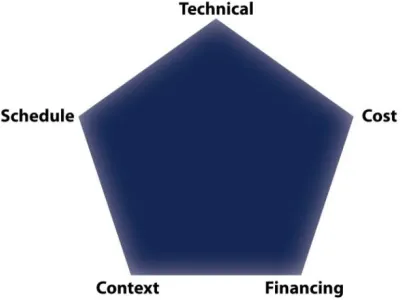
[image:16.612.202.405.541.691.2]Traditional project management theory is based on optimizing the trade-off between cost, schedule, and technical requirements. The R10 researchers found an increased effect of project context and financing on design (or technical requirements), cost, and schedule. The result is the need to manage all these factors as separate dimensions, which results in five-dimensional project management (5DPM). As shown in Figure 1, 5DPM extends traditional three-dimensional (3D) project management by adding the dimensions of context and financing.
3
5DPM Implementation
5DPM is detailed in the guidebook developed through the SHRP 2 R10 project (Shane et al. 2015). The management plan presented in the guidebook has three sequential, but overlapping phases: project analysis, project planning, and project implementation.
The project analysis phase entails examining the project, identifying and prioritizing complexity factors, mapping project complexity, and defining critical success factors for the project. The project planning phase includes the interrelated and iterative methods of assembling a project team, selecting project arrangements, and preparing an early cost model and finance plan. Finally, during the project implementation phase, the primary functions are to develop project action plans to address the resource issues identified in the previous phase, and to identify and utilize project execution tools as appropriate.
5DPM project management tools:
Incentivize critical project outcomes Develop dispute resolution plans Perform comprehensive risk analysis Identify critical permit issues
Evaluate applications of off-site fabrication
Determine involvement in right of way and utilities
Determine work packages and sequencing
Design to budget
Colocate team
Establish flexible design criteria Evaluate flexible financing
Develop finance expenditure model
Establish public involvement plans
The authors suggest implementation of 5DPM should start early in the project development process to gain the most benefit. Key aspects of 5DPM include early communication about the project among the project team and early awareness of the issues that have an impact on the success of the project. These aspects were reiterated as 5DPM benefits during the peer exchange hosted by the Iowa DOT in May 2016 (Shane 2016).
Council Bluffs Interstate System Segment 4 Demonstration Workshop
4
Through the exercises, the Iowa DOT rated the schedule dimension as the most complex,
followed by cost, context, technical, and finance, in respective order. The team then proceeded to identify critical success factors for each dimension.
5
DEVELOPMENT PLAN
The objective of this report is to outline the work done by the Iowa DOT to develop a draft project management update for the Iowa DOT Project Development Process Manual, and
specifically the areas involving project management. Three tasks were completed to develop this project management update .
Task 1: Assemble Technical Advisory Committee
One of the keys to development of the draft update was the technical advisory committee (TAC). The TAC consisted of a group of Iowa DOT personnel familiar with the R10 project
management concept, the Iowa DOT Project Development Process Manual, and the Iowa DOT project development process.
The TAC members were passionate about the development of a project management process for the Iowa DOT. TAC members represented as much as possible the various offices and levels involved in project development at the Iowa DOT—from planning through maintenance and operation. This spectrum represented the participants typically requested to participate in project meetings using the 5DPM process developed as part of the R10 project.
Once the TAC was identified, the group met frequently for targeted, facilitated sessions, which were documented, during the next several weeks.
Task 2: Review of the Current Project Development Process Manual and Identification of Possible Updates
At the first TAC meeting, June 28, 2016, Jennifer Shane, who is the director of the Construction Management and Technology Program at Iowa State University’s Institute for Transportation, presented several options to the members for how to proceed with developing the draft revisions to the Project Development Process Manual. Prior to this meeting, Jennifer reviewed the Project Development Process Manual and began identifying points where concepts from 5DPM could be inserted. These were the three options that Jennifer presented to the TAC at that meeting:
1. Review the tasks, in order, that are identified in the Project Development Process Manual and make recommendations regarding where specific concepts from 5DPM could be included.
This option allows for the 5DPM concepts to either be used on all projects or only on specifically identified projects, such as complex projects.
This option works within the current set up of the Project Development Process Manual. The Project Development Process Manual already includes detailed descriptions of the tasks that are completed for projects, including actions, inputs, outputs, affected parties, and
6
2. Develop a draft chapter for the Project Development Process Manual that only applies to complex projects and relies heavily on the 5DPM guidebook (Shane et al. 2015) and lessons learned from Iowa’s implementation on the CBIS.
This option would limit the use of the 5DPM concepts to primarily complex projects. The concepts could be used on other projects, but this would be on a case-by-case basis and not consistent across the organization. Under this option, the 5DPM guidelines would be in a standalone chapter of the Project Development Process Manual.
3. Develop a combination of options 1 and 2 to establish a standalone set of guiding principles that will be used to guide revisions of the Project Development Process Manual as the agency evolves over time.
After some discussion, the TAC selected option 3. The consensus was that there are a number of decisions that need to be made within the Iowa DOT and that the TAC may be premature in identifying exactly what actions should be taken at what point. The TAC also felt that there were some guiding principles that they would like to develop in greater detail and that would add value to the project development process.
Several TAC members also mentioned that a draft Policy and Procedure document and a project management position description had already been developed.
Based on this discussion, the TAC members were asked to provide one key take-away from the peer exchange that they attended in May 2016, as well 1 to 3 guiding principles.
Jennifer compiled a master list, which she distributed at the next TAC meeting, July 5, 2016, along with the draft Policy and Procedure document and the project management position description that were mentioned at the first TAC meeting.
The master list of key take-aways and guiding principles was intended to facilitate discussion on how to proceed.
The key take-aways from the peer exchange were as follows:
Facilitated communication from project team members
Clarify roles and responsibilities and develop frameworks for communication The DOT can be significantly more effective in management of projects
Implementation of project management needs to come from top management
Difficult for senior/experienced staff to change the way they do business
7 1a. Clear definition of roles and responsibilities 1b. Dedicated project management resources 2a. Standard scope of work process
2b. Project schedules should be developed and managed for all projects
3. Estimates of effort for all project tasks to aid in decision-making and resource distribution 4. Project risks should be identified and managed
The TAC then started to discuss guiding principles 1a and 1b in greater depth.
At the next TAC meeting, July 15, 2016, Jennifer provided several sample documents, including information from other DOTs regarding their development process as it related to each of the guiding principles. The TAC reviewed these examples and discussed portions of these documents that they found favorable, as well as those that created some concerns.
Through this discussion, a foundation for the Iowa DOT to build upon was developed to support the identified guiding principles. The foundation is that an effective project management system needs to embrace the following:
1. Provide a governance role on all projects, regardless of size, and aid in assessing scope, allocating resources, and verifying time, budget, risk, and impact assumptions prior to programing the project.
2. Serve as a source of information on project methodology and standards.
3. Serve as a management coach, assist in the development of project management skills, and aid in sharing practices and communication across functional areas. The best practices will be documented and shared as project performance will be actively monitored.
4. Provide project management for specifically identified projects.
To implement this foundation, the Iowa DOT plans to establish a Project Management Office (PMO). The primary goal of the PMO is to establish benefits from standardized processes and promote the adoption of project management policies, processes, and methods throughout the Iowa DOT. The PMO will facilitate the execution of the foundation, as well as the guiding principles identified by the TAC.
During the next meeting, July 19, 2016, the TAC was provided a draft of the PMO charter, which described the foundation and began to develop roles. During this meeting the charter was discussed and modified.
8
some of the functions of the PMO do not require an engineering license or education. It is expected that the PMO staff will bring a wide variety of skills to the department.
Task 3: Draft Guidance
In developing the draft guidance, as presented in Appendix A, the TAC was mindful of the lessons and guidance provided from 5DPM and other project management resources. While on the surface, the guidance does not explicitly represent 5DPM, in many cases, it does embrace the concepts from the five dimensions, the 5DPM methods, and the project management tools as represented in the published guidebook (Shane et al. 2015) and training. Several examples of this relationship include the following:
1. The responsibilities for a project manager explicitly state that in addition to managing the three dimensions of the iron triangle (project scope, cost, and schedule), project managers must also manage financing (i.e., cash flow, efficient use of capital, project prioritization, and asset management) and context.
2. The responsibilities of the PMO include training Iowa DOT staff and consultant partners on 5DPM concepts and tools as applicable to Iowa DOT project delivery processes.
3. The PMO will participate in selecting the project manager and in-house resources and in identifying and working with consultants, which is a function of assembling the project team and selecting team arrangements.
4. The PMO will provide governance on standard processes including the guiding principles, which include several of the 5DPM tools, including performing a comprehensive risk analysis.
9
REFERENCES
Gransberg, D. D. 2015. SHRP2 R10 Demonstration Workshop - Managing Complex Projects -
for the Iowa Department of Transportation: Summary Report. Applied Research Associates, Inc., Champaign, IL.
Shane, J. S. 2016. Iowa DOT Project Management Peer Exchange, Construction Management and Technology Program, Institute for Transportation, Iowa State University, Ames, IA. Shane, J. S., K. Strong, D. Gransberg, and D. Jeong. 2015. Guide to Project Management
10
APPENDIX A: DRAFT PROJECT MANAGEMENT OFFICE GUIDANCE
Project Management Office
The primary goal of the Project Management Office (PMO) is to encourage a culture of
collaboration and teamwork between different functional groups and stakeholders. The PMO will strive to achieve this goal by standardizing and following project management policies,
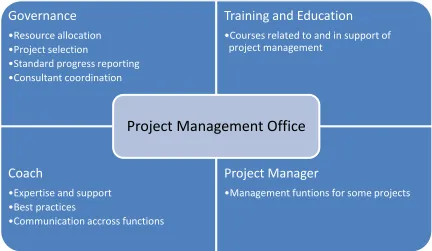
processes, and methods. The PMO will serve four primary functions:
1. The PMO will assume a governance role on all infrastructure projects, regardless of size, and aid in assessing scope, allocating resources, and verifying time, budget, risk, and impact assumptions prior to the project being included in the 5-yr program. The PMO will also collaborate in the project identification and programming process based on asset management and other standards.
2. The PMO will serve as a source of information on project management methodology and standards.
3. The PMO will serve as a project management coach and will aid in sharing practices and communication across functional areas. The best practices will be documented and shared as project performance will be actively monitored.
[image:24.612.89.521.374.625.2]4. The PMO will recommend project managers for projects deemed critical by DOT management. The project manager will report directly to the PMO for these projects.
Figure 1. Centralized Project Management Office functions
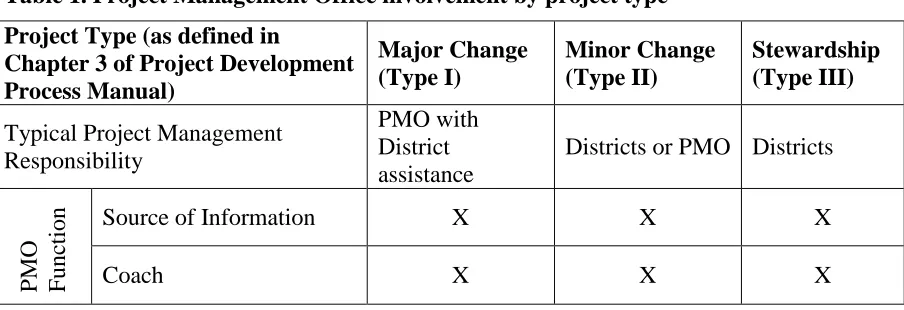
The Iowa Department of Transportation has developed and implemented a process in their Project Development Process Manual. Typical project management responsibilities and PMO
Governance
•Resource allocation •Project selection
•Standard progress reporting •Consultant coordination
Training and Education
•Courses related to and in support of project management
Coach
•Expertise and support •Best practices
•Communication accross functions
Project Manager
•Management funtions for some projects
11
[image:25.612.70.522.123.278.2]involvement will be based on the process outlined in this manual and will vary depending on the project type, as outlined in Table 1.
Table 1. Project Management Office involvement by project type
Project Type (as defined in
Chapter 3 of Project Development Process Manual) Major Change (Type I) Minor Change (Type II) Stewardship (Type III)
Typical Project Management Responsibility
PMO with District assistance
Districts or PMO Districts
P
MO
F
unc
ti
on Source of Information X X X
Coach X X X
The PMO will coordinate with the Office of Construction and Materials to oversee the evolution of project management skills at the district level (e.g. potential migration of RCE role from inspection to construction project management over time).
The PMO will develop a long term plan for ensuring primary project management skills (scheduling, estimating, scoping, planning) are resident in an identifiable group within each division and each district.
Roles and Responsibilities
The following are the roles and responsibilities of various parties as they pertain to project management. These roles should be conducted in accordance with the Iowa DOT Project Development Process Manual.
Iowa DOT Executive Responsibilities
Executive team members shall…
1. Plan for, support, and provide appropriate resources for the PMO to actively support project management functions
2. Be able to call on the PMO for current information related to the management of DOT projects and outside services.
Project Management Office Responsibilities
Project Management Office team members shall…
1. Engage Executive, District, Project Managers, and functional staff as appropriate for successful project management functions
2. Encourage communication among disciplines
3. Provide reporting mechanisms
12 4. Develop project management staffing
a. Depending on nature of the project as defined in Table 2, the PMO will
recommend a PM for a project. The PM will then establish a Project Management Team (PMT). The PMT membership will include representatives from across functional areas as described in the Project Development Process Manual Chapter 1 (the list should include either the District Construction Engineer or Resident Construction Engineer and consultant team members as needed in addition to others listed)
b. Additionally, for complex or critical projects with significant operations impacts, the PMT will also include a PM as designated by the District. It is expected that this person, in addition to serving the District’s representative on the PMT will provide constructability and operations related input and serve as the PM post letting. This will also encourage and aid in developing staff with PM background at each District should a decentralized PMO be considered in future iterations. 5. Provide training and mentoring
a. Including PMBOK, 5DPM, and other standards
6. Provide management standards, including
a. Schedule development during the scoping process or when the PMT is assembled
b. Scoping documents
c. Project charters
d. Approval of scopes of work e. Risk register
f. Risk checklist
g. Project change request form
h. The scope change/creep approval process
i. Financial planning and management
j. Construction management
7. Provide cost estimating, scheduling expertise, resources, and support a. Ensure that the schedule is available to everyone
b. Resource loaded schedules based on estimates of effort for all project tasks (deliverables)
c. Develop and maintain estimates for complex projects; provide assistance and quality control for estimates prepared by others on smaller projects.
d. Prepare or coordinate the preparation of financial plans for complex projects. 8. Foster a team environment
9. Help with resource leveling between districts 10.Help develop role and responsibility guidance
11.Incorporate consultant coordination function and duties within its organizational framework to benefit from a more cohesive, consistent and efficient use of outside services as needed for successful project delivery.
12.Maintain a resource pool of properly trained project management practitioners a. This includes in-house resources as well as consultants
13.Maintain the Iowa DOT Project Development Process Manual
13 District/Functional Staff Responsibilities
District/Functional staff shall…
1. Ensure each project has a project manager and resources assigned
2. Ensure project managers and project teams receive the appropriate staff support and resources to develop and deliver transportation projects in accordance with the Project Development Process Manual
3. Proactively address priorities, conflicts, and any resource issues with projects and project teams
4. Monitor and report development and delivery issues, and collaborate with the project management team to take corrective action as needed
Project Managers Responsibilities
For projects assigned to them, project managers shall… 1. Manage the progress of each project
2. Lead the project development and delivery process in a manner consistent with the Project Development Process Manual
3. Perform responsibilities outlined in the policy and procedures for the defined project category type
4. Identify project resource requirements and work with District/Functional staff to form the project team
5. Implement the tools provided as part of 5DPM as standardized for Iowa DOT project delivery process.
6. Manage scope, schedule, budget, funding, and context
a. Scope changes shall be documented and approved prior to implementation b. Schedule progress and key phase dates and milestones shall be kept up-to-date c. Project estimates shall be kept up-to-date
7. Develop and manage risk registers for types I and II projects
8. Develop and manage communication plans between project sponsors, project team, other agencies and stakeholders.
Project Team Members Responsibilities
Project team members shall…
1. Provide project managers a schedule and budget (either cost or labor-hours) estimate of work effort for the tasks assigned
2. Perform roles and responsibilities as defined in the project plan
14
APPENDIX B: PROJECT MANAGEMENT RESOURCES
This appendix includes a list of possible resources for project management. This is intended to be a living list that is updated and maintained by the PMO staff and is not considered to be an all-inclusive list.
Project Management
1. Shane, J. S., K. Strong, D. Gransberg, and D. Jeong. (2015). Guide to Project Management Strategies for Complex Projects. SHRP 2 S2-R10-RW-2.
onlinepubs.trb.org/onlinepubs/shrp2/SHRP2_S2-R10-RW-2.pdf.
2. Project Management Institute. (2013). PMBOK Guide. ISBN-10: 1935589679.
3. Project Management Institute. (2007). Project Manager Competency Development Framework. ISBN-10: 1933890347.
Project Scope
1. Minnesota Department of Transportation. (2016). Project Management, Scope Guidance. www.dot.state.mn.us/pm/scope.html.
Project Scheduling
1. Project Management Institute. (2011). Practice Standard for Scheduling. ISBN-10: 1935589245.
2. Minnesota Department of Transportation. (2016). Project Management, Primavera P6. www.dot.state.mn.us/pm/p6.html.
Project Risk
1. Golder Associates Inc., K. Molenaar, M. Loulakis, and T. Ferragut. (2014). Guide for the Process of Managing Risk on Rapid Renewal Projects. SHRP 2 S2-R09-RW-2.
www.trb.org/Main/Blurbs/168369.aspx.
2. Project Management Institute. (2009). Practice Standard for Project Risk Management. ISBN-10: 193389038X.