ISSN 0975-928X
Research Article
Combining ability analysis for yield and its component traits in groundnut
(
Arachis hypogaea
L.)
R. Prabhu1*, N. Manivannan1, A. Mothilal2 and S.M. Ibrahim3
1
Department of Oilseeds, Centre for Plant Breeding and Genetics, TNAU, Coimbatore, Tamil Nadu, India.
2
Regional Research Station, TNAU, Vridhachalam, Tamil Nadu, India.
3
Agricultural College and Research Institute, TNAU, Madurai, Tamil Nadu, India. *Email: [email protected]
(Received: 10 Mar 2014; Accepted: 14 Mar 2014)
Abstract
Line × tester analysis was carried out involving six lines and three testers in groundnut for assessing the combining ability for yield and its component characters. Hybrids recorded significant variance for all characters studied. Variance due to parents showed significance for all characters except for shell weight, pod yield per plant, kernel yield per plant and oil yield per plant. The variance due to hybrids vs parents had significance for all characters except for plant height, shelling percentage, oil content and rust disease scores. In case of combining ability ANOVA, lines showed significant variance for all characters except for sound mature kernel. Significant differences were present among the testers for characters viz., plant height and number of pods per plant. The variance due to line x tester had significance for all characters except for 100-kernel weight, oil content, late leaf spot and rust disease scores. The SCA variances were higher than GCA variances indicating the predominance of non-additive gene action for all the characters studied. The parent ICGV 03128 proved to be a good general combiner for oil yield and other economic traits and hence need to be included in the oil yield improvement programmes. The hybrid combinations viz., ICGV 00350 × VRI Gn 6, CO 7 × GPBD 4, ICGV 03128 × GPBD 4, ICGV 03128 × COG 0437 and ICGV 03128 × VRI Gn 6 recorded superior per se for oil yield per plant. Among these crosses ICGV 03128 × GPBD 4 and ICGV 03128 × VRI Gn 6 exhibited additive type gene action with one good general combining ability parent for oil yield per plant, oil content, kernel yield per plant and other characters. Hence, selection can be made in these crosses in early generation itself. The disease scores viz., late leaf spot and rust also recorded non significant sca
values indicating that these traits are controlled by additive gene action.
Keywords: Groundnut, combining ability, gene action, oil yield, foliar diseases.
Introduction:
Groundnut (Arachis hypogaea L.) is one of the leading oilseed crops of India and is a rich source of edible oil and protein for human diet. In general, the per se performance of parents is not always a true indicator of its potential in hybrid combinations. Combining ability is the relative ability of a genotype to transmit its desirable performance to its crosses. Combining ability analysis is not only the quickest method of understanding the genetic nature of quantitatively inherited characters, but also gives essential information about the selection of parents which in turn throws better segregants. The knowledge of the type of gene action involved in the expression of yield and yield components is essential to choose an appropriate breeding strategy to isolate desirable segregants in the later generations. An investigation was taken up in groundnut to study the general and specific combining ability and the gene action determining the yield and yield components using line x tester design.
Material and Methods
The material for the study consisted of six released/advanced breeding lines viz., ICGV 00350, CO 7, ICGV 03128, TMV 2, TMV Gn 13 and VRI 2 and three testers viz., GPBD 4, COG 0437 and VRI Gn 6. The lines are susceptible to foliar fungal diseases namely late leaf spot and
rust. However, testers are resistant/moderately resistant to these diseases. Crosses were made between theses lines and testers in order to develop foliar disease resistant genotypes with high yield. The parents were crossed in line x tester mating fashion to synthesize 18 F1 hybrids at the Regional
Research Station, Vridhachalam, during Rabi 2012-13. Individual cross combinations along with their parents were raised in Randomized Block Design with two replications, in four meter row with spacing of 30 x 10 cm, at Oilseeds farm, Tamil Nadu Agricultural University, Coimbatore, during Kharif 2013. The package of practices recommended for the groundnut cultivation in Tamil Nadu was followed throughout the crop growing period.
ISSN 0975-928X Results and Discussion
Analysis of variance indicated presence of significant differences among genotypes for all the characters studied (Table 1). Significant variances were observed among hybrids for all the characters. Whereas, the variance due to parents showed significance for all characters except for shell weight, pod yield per plant, kernel yield per plant and oil yield per plant. The variances due to hybrids vs parents had significance for all characters except for plant height, shelling percentage, oil content and rust disease scores, indicating the existence of high level of heterosis for these characters.
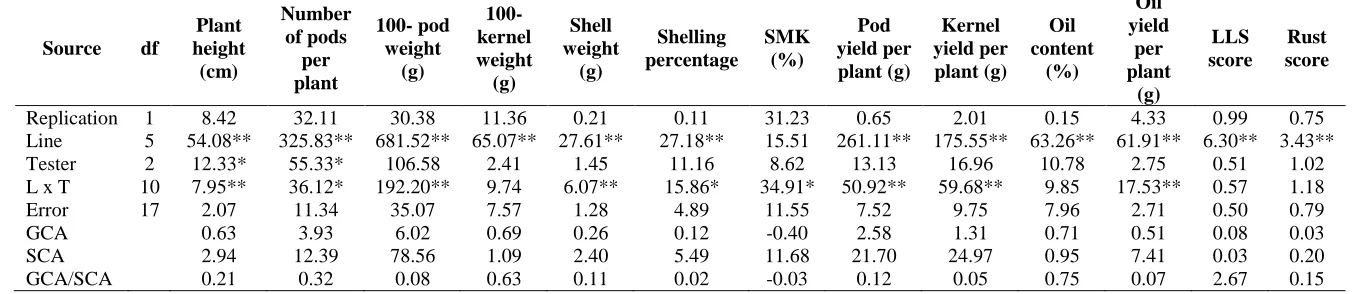
Analysis of variance for combining ability analysis (Table 2) indicated the presence of significant differences among the lines for all the characters studied except for sound mature kernel. While, significant differences were present among the testers for the characters like plant height and number of pods per plant. The significant variance of line × tester interaction indicated the importance of specific combining ability. The mean squares due to lines were of a larger magnitude than those of testers and line × tester for all the characters indicating greater diversity among the lines for combining ability. The magnitude of specific combining ability variances was much greater than those of general combining ability variances for all the characters, which indicated the preponderance of non-additive gene action for all the characters. Hence improvement of these yield related characters could be accomplished by selection at later filial generations. The role of non-additive gene action for these characters have been reported by Vindhiyavarman (2000), Rudraswamy et al. (2001), Jayalakshmi et al. (2002), Dasaradha Rami Reddy et al. (2004), Vasanthi et al. (2004), Yadav et al. (2006), Manivannan et al. (2008), Rekha et al. (2009), Ganesan et al. (2010), Mothilal and Ezhil (2010), Savithramma et al. (2010), John et al. (2011) and Pavithradevi (2013).
Choice of parents: The success of any breeding programme largely depends on the choice of the parent used in the hybridization. In addition to it, high mean was also considered as the main criterion for the selection of superior parents for breeding programme. Further, the parents having high general combining ability (gca) effects could be useful as, the gca effect is due to additive gene action and is fixable.
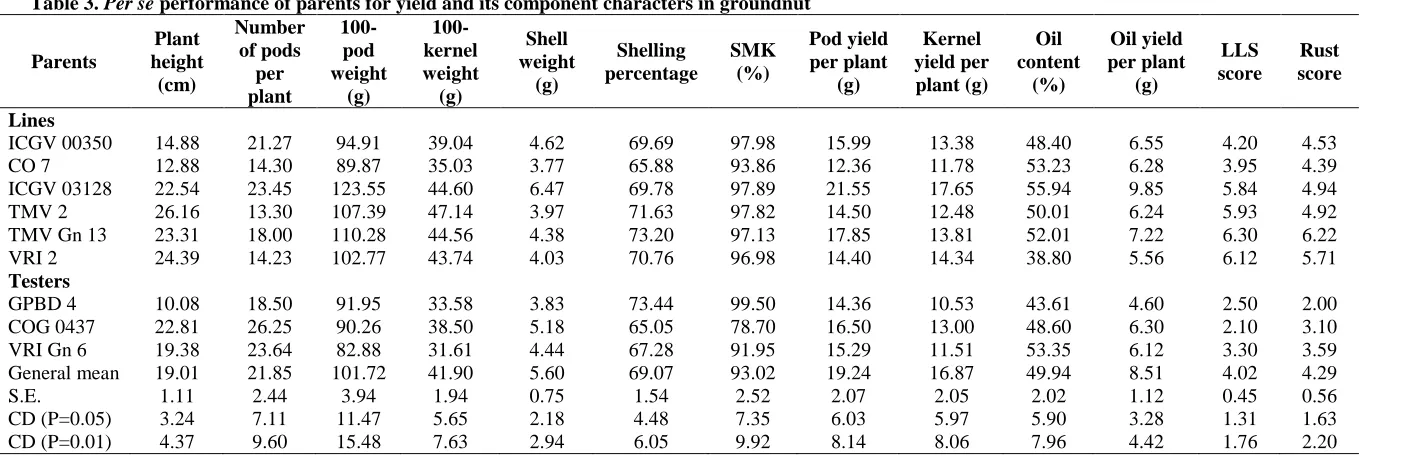
The per se performance of parents for yield and its component characters are presented in Table 3 and compared with general mean. Based on per se, parent ICGV 03128 recorded higher mean for 100-pod weight, shell weight, 100-pod yield per plant, kernel yield per plant, oil content and oil yield per plant. TMV 2 registered higher mean for plant height and 100-kernel weight whereas, TMV Gn
13 recorded higher mean for late leaf spot and rust disease scores. The tester parent GPBD 4 recorded higher mean for shelling percentage and sound mature kernel and for the character number of pods per plant by COG 0437. Hence these parents were considered as more superior than other parents. The estimates of gca effect (Table 4) showed that among the lines, ICGV 03128 was found to be superior as it showed significant and positive gca effect for number of pods per plant, 100-pod weight, 100-kernel weight, shell weight, pod yield per plant, kernel yield per plant, oil content oil yield per plant and late leaf spot score. The line parent TMV 2 was a good general combiner for plant height, 100-pod weight and 100-kernel weight, while CO 7 was a good combiner for number of pods per plant and oil content. Good general combiner for shell weight and shelling percentage were ICGV 00350 and TMV Gn 13, respectively. The parent ICGV 00350 was a good combiner for both diseases while CO 7 had good combining ability for late leaf spot score and moderate combining ability for rust disease score. Among the tester parents, VRI Gn 6 recorded significant positive gca effect for number of pods per plant. Since, high gca effect is attributed to additive gene actions, these parents could be used in breeding programme for yield improvement through pedigree breeding.
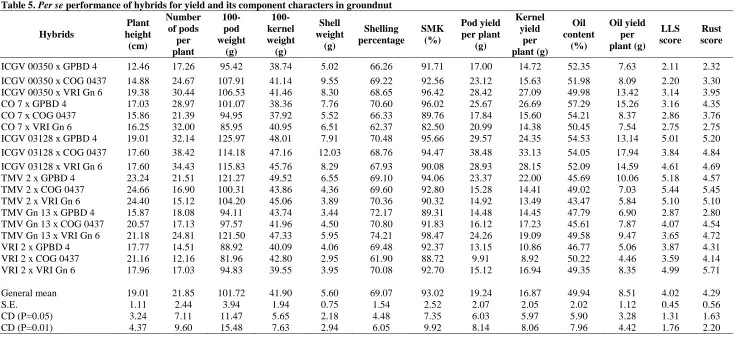
Choice of crosses:The specific combining ability is the deviation from the performance predicted on the basis of general combining ability. The specific combining ability (sca) effect alone may not be the appropriate choice for exploitation of heterosis because the hybrid with low mean value may also possess high sca effect. Hence, the cross combinations were identified based on two criteria viz., per se performance and the gene action involved in the crosses for further exploitation. The per se performance of hybrids for yield and its component characters are presented in Table 5. The crosses ICGV 00350 × VRI Gn 6, CO 7 × GPBD 4, ICGV 03128 × GPBD 4, ICGV 03128 × COG 0437 and ICGV 03128 × VRI Gn 6 manifested higher per se performance for pod yield per plant, kernel yield per plant, oil content and oil yield per plant. Hence based on oil yield per plant and component characters, the crosses ICGV 00350 × VRI Gn 6, CO 7 × GPBD 4, ICGV 03128 × GPBD 4, ICGV 03128 × COG 0437 and ICGV 03128 × VRI Gn 6 were considered as desirable crosses.
ISSN 0975-928X
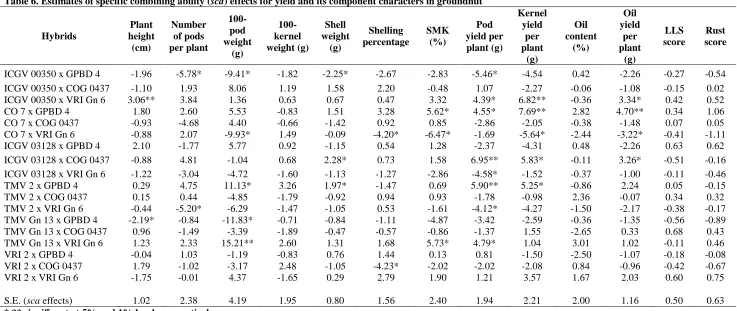
simultaneously for all the characters. In case of other two high oil yielding crosses viz., ICGV 03128 × GPBD 4 and ICGV 03128 × VRI Gn 6, non significant sca was observed for kernel yield per plant, oil content, oil yield per plant and other component characters. It indicated the presence of additive gene action and hence selection can be effective in these crosses in early generation itself. The disease scores viz., late leaf spot and rust scores also recorded non significant sca values indicating that above crosses can be best utilized for resistance breeding due to additive gene action. Among the high oil yielding crosses ICGV 00350 × VRI Gn 6, CO 7 × GPBD 4 and ICGV 03128 × COG 0437 recorded significant sca effects for pod yield per plant and kernel yield per plant and non significant sca effect for other characters. One of the parents involved in this cross ICGV 03128 was a good general combiner for these characters, indicating the presence of additive type of epistasis for pod yield per plant, kernel yield per plant, oil content, oil yield per plant and late leaf spot score. Due to the presence of additive type epistasis, selection needs to be postponed to later generations.
From the foregoing discussion, it might be concluded that the parent ICGV 03128 was considered as good combining parent for oil yield per plant and component characters and could be utilized in breeding programme. Most of the high oil yielding crosses exhibiting desirable sca effects involved parents with high and low gca effects, indicating the influence of non-additive gene interactions in these crosses. Among the hybrids , ICGV 03128 × GPBD 4 and ICGV 03128 × VRI Gn 6 exhibited superior per se performance and one of the parent with good general combining ability and additive type of gene action. Hence, selection can be made in early generation itself, in these crosses. These crosses could be exploited by pedigree method to yield transgressive segregants integrated with late leaf spot and rust disease resistance.analysed. The crosses ICGV 00350 × VRI Gn 6, CO 7 × GPBD 4 and ICGV 03128 × COG 0437 recorded superior per se performance and non additive type of gene action, indicating that the progenies should be advanced to later filial generations.
Acknowledgement: We are thankful to Department of Biotechnology (DBT), New Delhi, for the financial assistance provided for this study under the GOI scheme of “Integrated MAS to develop groundnut varieties for resistance to foliar fungal diseases Rust and Late Leaf Spot”.
References
Dasaradha Rami Reddy, C. and Suneetha, K. 2004. Combining ability and heterosis in groundnut (Arachis hypogaea L.). Paper presented in the national symposium on
Enhancing Productivity of Groundnut for Sustaining Food and Nutritional Security held at NRCG, Junagadh, between 11th to 13th October 2004. pp. 28-30.
Ganesan, K.N., Paneerselvam., R. and Manivannan, N. 2010. Identification of crosses and good combiners for developing new genotypes in groundnut (Arachis hypogaea L.) Electron. J. Plant Breed., 1(2): 167-172.
Jayalakshmi, V., Raja Reddy, C., Reddy, P.V. and Lakshmikantha Reddy, G. 2002. Combining ability analysis of morphological and physiological attributes in groundnut (Arachis hypogaea L.). Indian J. Agric. Res., 36(3): 177-181. John, K., Raghava Reddy, P., Hariprasad Reddy,
P., Sudhakar, P. and Eswar Reddy, N.P. 2011. General and specific combining ability estimates of physiological traits for moisture stress tolerance in groundnut (Arachis hypogaea L.). Int. J. Appl. Biol. Pharm. Technol., 2(4): 470-481.
Kempthorne, O. 1957. An Introduction to Genetic Statistics. John Wiley and Sons Inc., New York, pp. 545.
Manivannan, N., Muralidharan, V. and Mothilal, A. 2008. Combining ability analysis in groundnut (Arachis hypogaea L.). Madras Agric. J., 95(1-6): 14-17.
Mothilal, A. and Ezhil, A. 2010. Combining ability analysis for yield and its components in groundnut (Arachis hypogaea L.). Electron. J. Plant Breed., 1(2): 162-166. Pavithradevi, S. 2013. Identification of
Quantitative Trait Loci (QTLs) for yield and yield component traits under drought stress in Spanish bunch groundnut (Arachis hypogaea L.). Ph.D. (Ag.) Thesis, submitted to Tamil Nadu Agricultural University, Coimbatore. Rekha, D., Savithramma, D.L., Shankar, A.G. and
Marappa, N. 2009. Combining ability studies for growth and yield traits in groundnut (Arachis hypogaea L.). Environ. Ecol., 27(1): 117-120.
Rudraswamy, P., Nehru, S.D. and Kulkarni, R.S. 2001. Combining ability studies on groundnut. Mysore J. Agric. Sci., 35(3): 193-202.
Savithramma, D.L., Rekha, D. and Sowmya, H.C. 2010. Combining ability studies for growth and yield related traits in groundnut (Arachis hypogaea L.). Electron. J. Plant Breed., 1(4): 1010-1015.
ISSN 0975-928X
Groundnut for Sustaining Food and Nutritional Security held at NRCG, Junagadh, between 11th to 13th October 2004. pp. 77-79.
Vindhiyavarman, P. 2000. Combining ability estimates in groundnut (Arachis hypogaea L.). Madras Agric. J., 87(7-9): 462-466. Yadav, K.N.S., Gowda, M.B., Savithramma, D.L.
ISSN 0975-928X
Table 1. Analysis of variance for parents and hybrids for yield and its component characters in groundnut
Source df
Plant height
(cm)
Number of pods
per plant
100- pod weight
(g)
100- kernel weight (g)
Shell weight
(g)
Shelling percentage
SMK (%)
Pod yield per plant (g)
Kernel yield per plant (g)
Oil content
(%)
Oil yield per plant (g)
LLS score
Rust score
Replications 1 6.47 8.32 9.36 12.80 2.24 5.64 7.13 3.36 3.97 4.56 3.74 1.28 1.06
Hybrids 17 22.03** 123.59** 326.05** 25.16** 11.86** 18.64** 26.11* 108.29** 88.74** 25.67** 28.84** 2.25** 1.82** Parents 8 64.22** 44.30** 324.93** 61.45** 1.46 18.28** 82.27** 13.90 8.51 56.93** 4.13 5.31** 3.43** Hybrids vs
Parents 1 9.52 187.07** 155.26* 123.78** 31.51** 8.48 71.23* 306.97** 371.63** 10.12 106.23** 5.37** 0.19
Error 26 2.48 11.92 31.00 7.53 1.12 4.73 12.73 8.58 8.40 8.19 2.53 0.40 0.63
*,** significant at 5% and 1% levels, respectively
Table 2. Analysis of variance for combining ability analysis for yield and its component characters in groundnut
Source df
Plant height
(cm)
Number of pods
per plant
100- pod weight
(g)
100- kernel weight (g)
Shell weight
(g)
Shelling percentage
SMK (%)
Pod yield per plant (g)
Kernel yield per plant (g)
Oil content
(%)
Oil yield
per plant
(g)
LLS score
Rust score
Replication 1 8.42 32.11 30.38 11.36 0.21 0.11 31.23 0.65 2.01 0.15 4.33 0.99 0.75
Line 5 54.08** 325.83** 681.52** 65.07** 27.61** 27.18** 15.51 261.11** 175.55** 63.26** 61.91** 6.30** 3.43**
Tester 2 12.33* 55.33* 106.58 2.41 1.45 11.16 8.62 13.13 16.96 10.78 2.75 0.51 1.02
L x T 10 7.95** 36.12* 192.20** 9.74 6.07** 15.86* 34.91* 50.92** 59.68** 9.85 17.53** 0.57 1.18
Error 17 2.07 11.34 35.07 7.57 1.28 4.89 11.55 7.52 9.75 7.96 2.71 0.50 0.79
GCA 0.63 3.93 6.02 0.69 0.26 0.12 -0.40 2.58 1.31 0.71 0.51 0.08 0.03
SCA 2.94 12.39 78.56 1.09 2.40 5.49 11.68 21.70 24.97 0.95 7.41 0.03 0.20
GCA/SCA 0.21 0.32 0.08 0.63 0.11 0.02 -0.03 0.12 0.05 0.75 0.07 2.67 0.15
ISSN 0975-928X
Table 3. Per se performance of parents for yield and its component characters in groundnut
Parents
Plant height
(cm)
Number of pods
per plant
100- pod weight
(g)
100- kernel weight (g)
Shell weight
(g)
Shelling percentage
SMK (%)
Pod yield per plant
(g)
Kernel yield per plant (g)
Oil content
(%)
Oil yield per plant
(g)
LLS score
Rust score
Lines
ICGV 00350 14.88 21.27 94.91 39.04 4.62 69.69 97.98 15.99 13.38 48.40 6.55 4.20 4.53
CO 7 12.88 14.30 89.87 35.03 3.77 65.88 93.86 12.36 11.78 53.23 6.28 3.95 4.39
ICGV 03128 22.54 23.45 123.55 44.60 6.47 69.78 97.89 21.55 17.65 55.94 9.85 5.84 4.94
TMV 2 26.16 13.30 107.39 47.14 3.97 71.63 97.82 14.50 12.48 50.01 6.24 5.93 4.92
TMV Gn 13 23.31 18.00 110.28 44.56 4.38 73.20 97.13 17.85 13.81 52.01 7.22 6.30 6.22
VRI 2 24.39 14.23 102.77 43.74 4.03 70.76 96.98 14.40 14.34 38.80 5.56 6.12 5.71
Testers
GPBD 4 10.08 18.50 91.95 33.58 3.83 73.44 99.50 14.36 10.53 43.61 4.60 2.50 2.00
COG 0437 22.81 26.25 90.26 38.50 5.18 65.05 78.70 16.50 13.00 48.60 6.30 2.10 3.10
VRI Gn 6 19.38 23.64 82.88 31.61 4.44 67.28 91.95 15.29 11.51 53.35 6.12 3.30 3.59
General mean 19.01 21.85 101.72 41.90 5.60 69.07 93.02 19.24 16.87 49.94 8.51 4.02 4.29
S.E. 1.11 2.44 3.94 1.94 0.75 1.54 2.52 2.07 2.05 2.02 1.12 0.45 0.56
CD (P=0.05) 3.24 7.11 11.47 5.65 2.18 4.48 7.35 6.03 5.97 5.90 3.28 1.31 1.63
CD (P=0.01) 4.37 9.60 15.48 7.63 2.94 6.05 9.92 8.14 8.06 7.96 4.42 1.76 2.20
Table 4. Estimates of general combining ability (gca) effects for yield and its component characters in groundnut
Parents
Plant height
(cm)
Number of pods
per plant
100- pod weight
(g)
100- kernel weight (g)
Shell weight
(g)
Shelling percentage
SMK (%)
Pod yield
per plant (g)
Kernel yield per plant (g)
Oil content
(%)
Oil yield per plant (g)
LLS score
Rust score
Lines
ICGV 00350 -3.14** 0.96 0.37 -2.52* 1.48** -0.75 1.36 1.92 0.42 1.19 0.21 -1.32** -1.06**
CO 7 -2.33** 4.29** -8.93** -3.89** 0.45 -2.36* -2.78 0.58 0.16 3.74** 0.89 -0.88** -0.63
ICGV 03128 -0.65 11.83** 15.74** 4.01** 3.27** 0.26 1.19 11.40** 9.81** 3.31* 5.72** 0.68* 0.66
TMV 2 5.39** -5.32** 5.68* 3.18* -1.21* 0.89 0.18 -3.07* -2.09 -4.19** -1.86* 1.44** 0.79*
TMV Gn 13 0.49 -3.16* 1.48 1.38 -1.51** 3.60** 0.99 -2.64* -1.81 -2.59* -1.42* -0.27 -0.23
VRI 2 0.25 -8.60** -14.35** -2.15 -2.49** -1.64 -0.95 -8.20** -6.49** -1.46 -3.54** 0.35 0.47 Testers
GPBD 4 -1.15* -1.09 1.54 0.11 -0.35 0.89 0.98 -0.38 0.11 0.49 0.17 -0.10 -0.33
COG 0437 0.41 -1.39 -3.44 -0.49 0.34 -1.03 -0.52 -0.80 -1.24 0.60 -0.54 -0.14 0.09
VRI Gn 6 0.75 2.47* 1.89 0.38 0.01 0.14 -0.46 1.18 1.13 -1.09 0.37 0.24 0.24
S.E. (Lines) 0.59 1.37 2.42 1.12 0.46 0.90 1.39 1.12 1.27 1.15 0.67 0.29 0.36
S.E. (Testers) 0.42 0.97 1.71 0.79 0.33 0.64 0.98 0.79 0.90 0.81 0.48 0.20 0.26
ISSN 0975-928X
Table 5. Per se performance of hybrids for yield and its component characters in groundnut
Hybrids
Plant height
(cm)
Number of pods
per plant
100- pod weight
(g)
100- kernel weight (g)
Shell weight
(g)
Shelling percentage
SMK (%)
Pod yield per plant
(g)
Kernel yield
per plant (g)
Oil content
(%)
Oil yield per plant (g)
LLS score
Rust score
ICGV 00350 x GPBD 4 12.46 17.26 95.42 38.74 5.02 66.26 91.71 17.00 14.72 52.35 7.63 2.11 2.32
ICGV 00350 x COG 0437 14.88 24.67 107.91 41.14 9.55 69.22 92.56 23.12 15.63 51.98 8.09 2.20 3.30
ICGV 00350 x VRI Gn 6 19.38 30.44 106.53 41.46 8.30 68.65 96.42 28.42 27.09 49.98 13.42 3.14 3.95
CO 7 x GPBD 4 17.03 28.97 101.07 38.36 7.76 70.60 96.02 25.67 26.69 57.29 15.26 3.16 4.35
CO 7 x COG 0437 15.86 21.39 94.95 37.92 5.52 66.33 89.76 17.84 15.60 54.21 8.37 2.86 3.76
CO 7 x VRI Gn 6 16.25 32.00 85.95 40.95 6.51 62.37 82.50 20.99 14.38 50.45 7.54 2.75 2.75
ICGV 03128 x GPBD 4 19.01 32.14 125.97 48.01 7.91 70.48 95.66 29.57 24.35 54.53 13.14 5.01 5.20
ICGV 03128 x COG 0437 17.60 38.42 114.18 47.16 12.03 68.76 94.47 38.48 33.13 54.05 17.94 3.84 4.84 ICGV 03128 x VRI Gn 6 17.60 34.43 115.83 45.76 8.29 67.93 90.08 28.93 28.15 52.09 14.59 4.61 4.69
TMV 2 x GPBD 4 23.24 21.51 121.27 49.52 6.55 69.10 94.06 23.37 22.00 45.69 10.06 5.18 4.57
TMV 2 x COG 0437 24.66 16.90 100.31 43.86 4.36 69.60 92.80 15.28 14.41 49.02 7.03 5.44 5.45
TMV 2 x VRI Gn 6 24.40 15.12 104.20 45.06 3.89 70.36 90.32 14.92 13.49 43.47 5.84 5.10 5.10
TMV Gn 13 x GPBD 4 15.87 18.08 94.11 43.74 3.44 72.17 89.31 14.48 14.45 47.79 6.90 2.87 2.80
TMV Gn 13 x COG 0437 20.57 17.13 97.57 41.96 4.50 70.80 91.83 16.12 17.23 45.61 7.87 4.07 4.54
TMV Gn 13 x VRI Gn 6 21.18 24.81 121.50 47.33 5.95 74.21 98.47 24.26 19.09 49.58 9.47 3.65 4.72
VRI 2 x GPBD 4 17.77 14.51 88.92 40.09 4.06 69.48 92.37 13.15 10.86 46.77 5.06 3.87 4.31
VRI 2 x COG 0437 21.16 12.16 81.96 42.80 2.95 61.90 88.72 9.91 8.92 50.22 4.46 3.59 4.14
VRI 2 x VRI Gn 6 17.96 17.03 94.83 39.55 3.95 70.08 92.70 15.12 16.94 49.35 8.35 4.99 5.71
..
General mean 19.01 21.85 101.72 41.90 5.60 69.07 93.02 19.24 16.87 49.94 8.51 4.02 4.29
S.E. 1.11 2.44 3.94 1.94 0.75 1.54 2.52 2.07 2.05 2.02 1.12 0.45 0.56
CD (P=0.05) 3.24 7.11 11.47 5.65 2.18 4.48 7.35 6.03 5.97 5.90 3.28 1.31 1.63
ISSN 0975-928X
Table 6. Estimates of specific combining ability (sca) effects for yield and its component characters in groundnut
Hybrids
Plant height
(cm)
Number of pods per plant
100- pod weight
(g)
100- kernel weight (g)
Shell weight
(g)
Shelling percentage
SMK (%)
Pod yield per plant (g)
Kernel yield
per plant
(g)
Oil content
(%)
Oil yield
per plant
(g)
LLS score
Rust score
ICGV 00350 x GPBD 4 -1.96 -5.78* -9.41* -1.82 -2.25* -2.67 -2.83 -5.46* -4.54 0.42 -2.26 -0.27 -0.54
ICGV 00350 x COG 0437 -1.10 1.93 8.06 1.19 1.58 2.20 -0.48 1.07 -2.27 -0.06 -1.08 -0.15 0.02
ICGV 00350 x VRI Gn 6 3.06** 3.84 1.36 0.63 0.67 0.47 3.32 4.39* 6.82** -0.36 3.34* 0.42 0.52
CO 7 x GPBD 4 1.80 2.60 5.53 -0.83 1.51 3.28 5.62* 4.55* 7.69** 2.82 4.70** 0.34 1.06
CO 7 x COG 0437 -0.93 -4.68 4.40 -0.66 -1.42 0.92 0.85 -2.86 -2.05 -0.38 -1.48 0.07 0.05
CO 7 x VRI Gn 6 -0.88 2.07 -9.93* 1.49 -0.09 -4.20* -6.47* -1.69 -5.64* -2.44 -3.22* -0.41 -1.11
ICGV 03128 x GPBD 4 2.10 -1.77 5.77 0.92 -1.15 0.54 1.28 -2.37 -4.31 0.48 -2.26 0.63 0.62
ICGV 03128 x COG 0437 -0.88 4.81 -1.04 0.68 2.28* 0.73 1.58 6.95** 5.83* -0.11 3.26* -0.51 -0.16
ICGV 03128 x VRI Gn 6 -1.22 -3.04 -4.72 -1.60 -1.13 -1.27 -2.86 -4.58* -1.52 -0.37 -1.00 -0.11 -0.46
TMV 2 x GPBD 4 0.29 4.75 11.13* 3.26 1.97* -1.47 0.69 5.90** 5.25* -0.86 2.24 0.05 -0.15
TMV 2 x COG 0437 0.15 0.44 -4.85 -1.79 -0.92 0.94 0.93 -1.78 -0.98 2.36 -0.07 0.34 0.32
TMV 2 x VRI Gn 6 -0.44 -5.20* -6.29 -1.47 -1.05 0.53 -1.61 -4.12* -4.27 -1.50 -2.17 -0.38 -0.17
TMV Gn 13 x GPBD 4 -2.19* -0.84 -11.83* -0.71 -0.84 -1.11 -4.87 -3.42 -2.59 -0.36 -1.35 -0.56 -0.89
TMV Gn 13 x COG 0437 0.96 -1.49 -3.39 -1.89 -0.47 -0.57 -0.86 -1.37 1.55 -2.65 0.33 0.68 0.43
TMV Gn 13 x VRI Gn 6 1.23 2.33 15.21** 2.60 1.31 1.68 5.73* 4.79* 1.04 3.01 1.02 -0.11 0.46
VRI 2 x GPBD 4 -0.04 1.03 -1.19 -0.83 0.76 1.44 0.13 0.81 -1.50 -2.50 -1.07 -0.18 -0.08
VRI 2 x COG 0437 1.79 -1.02 -3.17 2.48 -1.05 -4.23* -2.02 -2.02 -2.08 0.84 -0.96 -0.42 -0.67
VRI 2 x VRI Gn 6 -1.75 -0.01 4.37 -1.65 0.29 2.79 1.90 1.21 3.57 1.67 2.03 0.60 0.75
.
S.E. (sca effects) 1.02 2.38 4.19 1.95 0.80 1.56 2.40 1.94 2.21 2.00 1.16 0.50 0.63