A STUDY OF STRESS MANAGEMENT WITH SPECIAL REFERENCE TO INSTRUCTORS & TRAINEES ASSOCIATES WITH TECHNICAL
EDUCATIONAL INSTITUTES IN DELHI
AUSHVIR KAUR*
*Researcher Scholar, Singhania University
SHIV SHAKTI
International Journal in Multidisciplinary and Academic Research (SSIJMAR)
Vol. 1, No. 4, November-December (ISSN 2278 – 5973)
This Study was designed to analysis stress among the Instructors working in a technical institute and students or trainees studying in a technical institute. And to find out the comparison of stress level among the students and teacher who are associated with Technical Field. Second purpose was to detect the primary sources of perceived stress among technical students/trainees and instructor. Third purpose was to find out the activities trainees and Instructors routinely participate in to reduce stress, relax, unwind or cope with individual
pressures and how often they participate in these types of activities. The fourth purpose to find out a suitable stress management technique which can be beneficial to reduce stress. The fifth purpose was to find out how effectively these preferred relaxing, stress managing, coping activities reduce perceived stress. A final
purpose was to find out if any differences exist among selected variables (gender, marital status, contractual staff, and year in institute, race, and age) for perceived stress levels, sources of stress, and methods for managing stress. Methods: In this study lots of variables first have been identified on the basis of existing literature review and exploratory study. For final findings a survey has been conducted in the ITI of Delhi. For this, permission was taken from the principal and also staffs have been selected on the convenience basis. The trainees of different trades were contacted to fill the stress questionnaire prepared for the trainees. Conclusion: It is found that stress is present in every person who is associated with technical organization but the reason for that varies. Whether it‟s a Instructor or trainee, male or female, permanent or contractual, married or unmarried, young or old all of them tries different stress management method to reduce their stress but in case of some young trainees it is found that they are not able to find out properly that which sources are disturbing them to concentrate on their training as well as on their personal life. They are also not aware of which stress management technique should be adopted to reduce their stress and for that one small session is also organized.
In today fast going modern world, rapidly increasing population, rapidly changing advance technology where there is no end of obsolete machinery/equipment and swiftly increasing competition in the market resulted into unemployment and increasing population below poverty line all has resulted causing stress everywhere.
Poverty in India is widespread, with nation estimated to have a third of the world's poor. In 2011, World Bank stated, 32.7% of the total Indian people falls below the International poverty line of US$ 1.25 per day (PPP) while 68.7% live on less than US$ 2 per day.
Figure: 1
And when we talk about population it is increasing day by day which is not only affecting our economy but also creating stress among our young generation to earn for their livelihood.
"Richer are becoming more Rich and Poor are becoming Poorer".
Our current population in India is 1,220,200,000 (1.22 Billion) among which male population in India is 628,800,000(628.8 Million), female population is 591,400,000(591.4 Million) and sex ratio is 940 females per 1,000 males. 0 to 25 years of age includes 50% and over 65% below the age of 35 years. The
INCREASING POPULATION INCREASING ILLITERACY RATE
TECHNOLOGY ADVANCEMENT LACK OF PROPER TRAINING INCREASING HARD COMPETITION IN
MARKET
ECONOMIC CRISES RECESSION UNEMPLOYABILITY
POVERTY
figure represents 17.31% of the world's population. And little part of this population is associated with our Industrial Training Institute.
Figure: 2
There are about 700 trainees, 20 Administrative staff, 55(approx) qualified faculty members which includes permanent as well as working on a contractual basis in Jija Bai ITI For Women, Sirifort, New Delhi. Each and every individual whether it is trainee or working staff is suffering from a stress whether a general stress, acute, episodic or chronic stress.
"Stress is ruling like a king on us and we are like a helpless slave of it".
They say tough time doesn‟t last for long! But how can we forget that in these testing tough situations our strengths have the tendency to become our weakness. Under Stress, a natural and healthy tendency can turn compulsive.
Industrial Training Institute which provide training in technical field and constituted under Directorate General of Employment & Training (DGET), Ministry of Labour& Employment, Union Government of India.
Industrial Training Institute (ITI's) is government run training organizations. They provide post school technical training as well as to the students who are just 8th pass. The main objective of opening of ITI is to provide technical manpower to the industries and as well as making the trainees that much trained so that they can move towards self employment-self dependent and to earn their livelihood freely. These trainees are trained in basic skills required to do job as operator or a craftsman.
action or reaction and even a most of the staff working here is found to be under stress but reason for their stress was not found similar and same in regard with students also.
Stress may be considered as any physical, chemical, or emotional factor that causes bodily or mentally unrest and that may be a factor in disease causation. Physical and chemical factors that can cause stress include trauma, infections, toxins, illnesses, and injuries of any sort. Emotional causes of stress and tension are numerous and varied. While many people associate the term "stress" with psychological stress, scientists and physicians use this term to denote any force that impairs the stability and balance of bodily functions. The aim of present study is to find out the causes and effects of stress in Technical faculty members and trainees studying in technical institutes. However, the broad objectives of the study would include to find out the causes of stress to the faculty, to find out the various symptoms of stress experienced by instructors working in the field of study, to explain it to how the stress affect the ability of the employees to perform at the workplace and how stress affects trainees in their learning and to understand the various effects of stress on the performance and behavior of the employees and trainees in the technical institutes.
Types of Stress
There are some terms related to stress but these terms when listen by a common man creates a confusion to understand what stress is? What the stress is all about? In daily life, we often use the term "stress" to describe negative situations. This leads many people to believe that all stress is bad for you, which is not true. There are some kinds of stress which gives positive feeling too but are confusing terms. Terms like
Eustress and Distress
Bad Stress and Good Stress
Figure: 3
All of the above terms are interrelated and linked with different kind of stress from which most of the individual suffers and faced by mainly every individual in their day-to-day life‟s.
Eustress or Positive Stress: It is a positive, good and pleasant stress which is experience by any individual before exerting his/her physical force to the new things which excite them and give strength for creativity and to perform actively and best. For example getting an admission in institute after getting success in entrance exam , starting of a new session and experience under new atmosphere at initial stage, thinking for a bright career in future, reading new books related to trade, meeting new friends, meeting new teachers, participating in a curricular competition, giving a speech etc. Some stress are
Eustress
Positive
Stress
Good
Stress
Distress
Negative
Stress
Bad
Stress
Acute
Stress
Chronic
Stress
Hyper
Stress
not avoidable often can‟t be avoided by an individual as this kind of stress give positive feeling.
Characteristics
Give strength and Motivates
Is short-term in nature
Is supposed to be in our capacity
Feeling of excitement
Improves performance
Active participation
Creative thinking
It helps to change our daily routine
Productive and Effective
Eustress or Positive or Good stressors include:
Getting an admission in college/institute for higher studies
Giving educational tuitions
Getting new books
Using new machinery or equipments
Receiving a promotion
Increment in salary
Starting a new job
Marriage
Buying a home
Having a child
Having new born brother/sister
Moving
Taking a vacation
Holiday seasons
Retiring etc.
Getting engaged
Winning the lottery
P
E
R
FOR
MAN
C
E
POSITIVE STRESS Vs NEGATIVE STRESS
GOOD MAXIMUM PERFORMANCE
GOOD
EUSTRESS DISTRESS
POSITIVE NEGATIVE
GOOD BAD
POOR
POOR
POOR PERFORMANCE
LOW OPTIMUM HIGH
Figure: 4
Eustress Vs Distress
Distress or Negative Stress: It is a kind of bad or negative stress which creates unpleasant feelings or emotions. It is not an unusual thing for a person to feel depressed, upset, confused or frustrated at various intervals of time in their routine or daily lives. When this kind of feelings occurs, then this sign are indicating towards person suffering from any problem or are
STRESS
HE
AL
T
experiencing some kind of unexpected distressing situation. The situation like not getting an admission, demotion, unexpected transfer to a long distance place, assaulted by senior, death of spouse or a child, no increment in salary from a long time etc. are the situation which causes distress. When this kind of stress occur the mind and body undergoes some changes which can also lead to mental or physical disturbing, damage of some sensitive part of the body or can result into bodily disease.
Characteristics
Causes anxiety or nervousness Can be short- or long-term
Is supposed to be out of our capacity Unpleasant feelings
Decreases performance Can lead to mental problems Physical Discomfort
Feeling of overworked Sense of helplessness Apathy
Hopeless/ Powerless Afraid/ Panic
Discouraged
Denting, Tearing or Scratching of any products.
Distress or Negative Stress stressors include: Not getting an admission in any institute.
Not getting an admission in desire trade or field Poor performance
Uncomfortable dressing/uniform Job Insecurity
Non-approval of leave Lack of training
Unproductive and time consuming meetings workload (overload and under load)
Unexpected termination Unexpected Transfer No Motivation No Incentive
Being abused or neglected Assaulted by senior
False Propaganda Conflict with colleagues Shift work / hours of work
Physical environment (noise, air quality, etc)
Isolation at the workplace (emotional or working alone) Financial Problem
Death of spouse/ Child Death of Parents
Parents Fight or parents conflict Family Criticism
Divorce
Hospitalization of any member Accident
Long travelling hours
Acute Stress: Acute stress is also known as”Fight or Flight Response”. It is not like a normal stress that we all experience in our life as a result of work pressure, family and other life obligations. It is a psychological reaction to the serious trauma, such as witnessing a death, suffering severe injury or being cruelly attack, job interview, any blunder mistake done during a working which can‟t be rectify, stolen of answer sheet by the student after completing exam, unexpected transfer to the long distance place or out of the city, child serious disease, misbehavior of instructor with the trainee, hard punishment, fire from job workplace, recession, termination of the student from an institute etc. The people who are suffering from this kind of stress are at the highest risk of long-term psychological problems. It is a kind of stress in which your body reacts immediately to the threats (Can be real or imagined), challenges, competition, and scare.
compulsion of job, stress of poverty, chronic illnesses, relationship conflicts, political problems, and dysfunctional families.
DEFINITION
Stress is difficult to define precisely. The concept of stress was first introduced in the life sciences by Selye Hans in 1936. It was derived from the Latin word „stringere‟; it meant the experience of physical hardship, starvation, torture and pain. Selye Hans, 1936 defined stress as “the non-specific response of the body to any demand placed upon it”. Further, stress was defined as “any external event or internal drive which threatens to upset the organismic equilibrium” (Selye Hans, 1956). Another definition given by Stephen Robbins (1999) stress has been stated as “a dynamic condition in which an individual is confronted with an opportunity, constraint or demand related to what he / she desires and for which the outcome is perceived to be both uncertain and important.”
McGrath (1970) defined stress as a perceived imbalance between demand and response capacity under conditions where failure to meet demand has important consequences.
Ryhal and Singh (1996) stated that stress is the state of an organism it perceived that its well-being is endangered and that it must direct all its energies to its protection.
Spielberg (1979) defined stress in two different ways. According to him, it is a dangerous potentiality, harmful/unpleasant external situation/conditions (stressors) that produce stress reaction; and secondly to the internal thought, judgment, emotional state and physiological process that are evoked by stressful stimuli.
We can say that stress is that dynamic condition or unrealistic condition in which individual meets with an opportunity, hurdles, struggle, failure or success towards an objective and which is not visible but can be feel through the individual behavior whether negative or positive reaction towards willing or unwilling circumstances or situation. It is a state of mind in which individual has no control on certain point.
Figure 5
The main causes of stress vary greatly from one person to another. As our life becomes more and more hectic, the stresses can take their toll on us.
Job Insecurity among instructor working on the basis of contract/ad-hoc or temporary.
Sudden Change of Technology or Trade changes/de-affiliation causes stress among contractual which can fire them from an institute.
Excessively high workloads, with unrealistic deadlines making people feel rushed, under pressure and overwhelmed.
Insufficient workloads, making people feel that their skills are being underused.
A lack of control over work activities.
A lack of interpersonal support or poor working relationships leading to a sense of isolation.
People being asked to do a job for which they have insufficient experience or training.
Unexpected transfer at any time to long distance in other ITI''s
Difficulty settling into a new promotion, both in terms of meeting the new role's requirements and adapting to possible changes in relationships with colleagues.
Concerns about job security which are employed on contractual basis in government sector, lack of career opportunities, or level of pay.
Bullying or harassment.
Weak or ineffective management which leaves staff feeling they don't have a sense of direction, or over-management, which can leave instructor feeling undervalued and affect their self-esteem.
Multiple reporting lines for staff, with each Group Instructor or principal asking for their work to be prioritized.
Failure to keep staff informed about significant changes to the organization, causing them uncertainty about their future.
A poor physical working environment, eg excessive heat, cold or noise, inadequate lighting, uncomfortable seating, malfunctioning equipment, etc. Conflict at work can also be a common area of stress.
Fear of being laid off
Conflict with colleagues
More overtime due to staff cutbacks/ shortage of staff.
Pressure to perform to meet rising expectations but with no increase in job satisfaction.
Unproductive and time consuming meetings.
Pressure to work at optimum levels – all the time including other official work!
Fear of unexpected termination among the contractual staff at any time and without authentic reason.
In urgency, non approval of leave by concern/higher authority.
Out of way behavior or unpleasant behavior by the immediate officer.
False propaganda i.e., rumor & gossip regarding any staff member without knowing the truth.
Assaulted or disrespect by senior staff.
No incentive & no increment in salary from a long period of time in this inflation period also cause stress.
Poor Time Management. When time is not managed properly, tasks do not get completed properly therefore a person becomes stressed due to having to rush to get assignments completed when do.
Pressure to involve in other activities beside their own prescribed syllabus.
Misbehavior of students.
Fighting among students.
Poor performance of the students.
Short duration of course and vast syllabus.
Improper working of machinery/ equipments.
Unhygienic Condition of washrooms
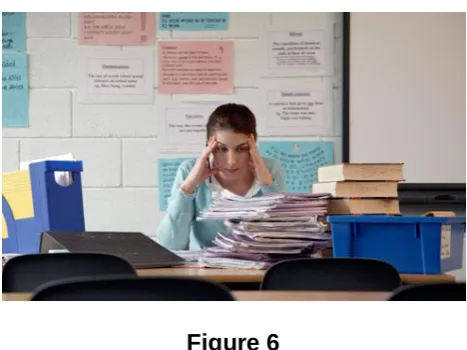
Figure 6
STRESS PLANNING PROCESS
Stress can have serious effects on our health. It is not good for a person's body or mind to be under constant stress. We need to have an outlet for our anxiety or it can literally kill us. Using stress management techniques to help keep our stress level down can make a huge difference in the way we feel. Stress has many side effects such as body pains,headaches,flu like symptoms and so many more. If our job causes us to feel stressed often try some of the following stress management techniques which can help us to feel better.
Stress management techniques can help us to unwind and relax. Too much stress is never good for anyone. If we feel we are overworked it is best to request sometime off to keep your mind and body healthy.
Stress planning process can help us to identify the major causes of stress in our life and how we can get free from that causes.
“Every Moment You Connect Is A Gift, Spend It On The Things That Matter
Figure7
The first important thing to reduce stress in your life is to identify the sources which are causing stress in you.
Start making a small notes or point on stress in your diary. Look at how you currently try to handle or manage your stress.
Unhealthy ways of managing with stress can cause any dangerous disease and this can be of long run so avoid unhealthy way try to adopt healthier one
Following strategies may temporarily help to reduce stress, but in actual they can cause more damage and also harm the body in long run:
o Smoking
o Drinking too much
o Alcoholic
o Overeating or under eating
o Zoning out for hours in front of theTV or computer
o Withdrawing from friends, family, and activities
o Crying Loudly
o Sitting alone in dark room for a long period of time
CREATE YOUR STRESS MANAGEMENT PLAN
IDENTIFY APPROPRIATE STRESS MANAGEMENT TECHNIQUES
LIST AND PRIORITIZE THE SOURCES OF STRESS
o Sleeping too much
o Procrastinating
o Filling up every minute of the day to avoid facing problems
o Taking out your stress on others (lashing out, angry outbursts, physical violence
Learning healthier ways to manage stress
Learn how to say “no”.
Avoid people who stress you out. Take control of your environment.
Express your feelings instead of bottling them up. Be willing to compromise.
Be more assertive. Manage your time better. Focus on the positive.
Don‟t try to control the uncontrollable. Learn to forgive.
Maintain healthy relationships
Healthy Relationships
We all want to have healthy relationships, be they with our families, roommates, professors, teachers, staff, students or friends. Having a healthy relationship becomes especially important when the person is close to us; someone we are considering dating, or our significant other. So what makes a relationship healthy? Here are some points to consider:
Both people must show respect to each other and must have respect equally in their heart towards each other also.
Both people must share open and honest communication.
They must respect privacy and keep each other confidential matters secret instead of disclosing to others.
They both must take Decisions together or they must share and discussed anything truthfully.
They should not use any kind of threats or coercion to get the other person to agree with you.
Independence and personal responsibility should be encouraged.
Both people are encouraged to maintain healthy relationships with friends and family.
Individual belief and value systems must be respected and encouraged.
Stress management strategy- Make time for fun and relaxation o Go for a walk.
o Deep breathing o Spend time in nature. o Call a good friend.
o Sweat out tension with a good workout. o Write in your journal.
o Take a long bath. o Light scented candles.
o Savor a warm cup of coffee or tea. o Play with a pet.
o Work in your garden. o Get a massage.
o Curl up with a good book. o Listen to music.
o Take a break and stare out the window at the birds,clouds and trees try to clear your mind and relax.Open your windows. Getting some sun will help boost your attitude.
o Watch a comedy.
o Don‟t slouch. Sitting up straight will help increase blood circulation. o Send yourself flowers not only will they brighten up the room the scent
will help boost endorphins in your brain which signal happiness.
o Staying organized and keeping your workplace clean will help reduce stress.
o Take a little walk around the office. Exercise is a great way to relieve stress.
o Balance personal, work, and family needs and obligations.
o Social support is a major factor in how we experience stress. Social support is the positive support you receive from family, friends, and the community. It is the knowledge that you are cared for, loved, esteemed, and valued. More and more research indicates a strong relationship between social support and better mental and physical health.
o Don‟t get so caught up in the hustle and bustle of life. o Set aside relaxation time.
Reference
1.Carry L. cooper: Theories of Organizational Stress, Amazon.com.
2.Fed Luthans: Organizational Behaviour, 8th edition, Irvin/McGraw Hill.
3.Anna Maravelas: How to Reduce Workplace Conflict and Stress.
4.W. Doyle Gentry, PhD: Anger Management for Dummies
5.Martha Davis, Elizabeth Robbins Eshelman, Matthew McKay and Patrick Fanning: The Relaxation & Stress Reduction Workbook
6.Dr. Serge Doublet THE STRESS MYTH Published in the US by Science & Humanities Press
7.Udai Pareek(Oxford & IBH,1982),Managing Conflict and Collaboration
8.Kothari, C.R. Research Methodology----Methods and Techniques.
9. R. Panneerselvam: Research Methodology
10.I sadore Newman, Carolyn R. Benz: Qualitative-quantitative research methodology
11.Article on Stress Management Website: About.com, Buzzle.com, stress symptoms.org. Turn-stress-into-bliss.com
12.Wiley Online Library.com
13.Cooke, D. K., Sims, R. L., & Peyrefitte, J. (1995).
The relationship between graduate student attitudes and attrition. Journal of Psychology, 129, 677.
14.about.com Guide