TAM framework: A structural analysis approach. AACE Journal, 15(3), 279-287.
Evaluating Effectiveness of E-Blackboard System
Using TAM Framework: A Structural Analysis Approach
**Invited as a paper from E-Learn 2005**
IBRAHIM ABDALLA United Arab Emirates University
Abu-Dhabi, UAE [email protected]
Recently, the educational settings have witnessed a growing use ofweb-based ICT applications and courseware develop-ment tools to suppledevelop-ment traditional teaching. Limited studies have evaluated effectiveness of such new technolo-gies. In this article, a survey was conducted to evaluate the effectiveness of e-Blackboard instructional platform system in terms of students’ perceptions based on the students’ interactive behaviour with the ICT-rich learning environ-ment. The classical Technology Acceptance Model (TAM) framework was utilized. Results suggest that the ease of use as well as the usefulness of technology positively influences student’s attitudes towards the system, which in turn deter-mines technology’s effectiveness. Perception of usefulness also significantly influences technology effectiveness.
which offer almost the same basic features of instructional platform. The CMS e-Blackboard was introduced to the UAE University (UAEU) in 2002 as part of the strategic plan to integrate ICT into the curricula. The UAEU investment in educational software and multimedia was coupled with great efforts to shift to computer-aided classrooms. This shift was materialised by the implementation of the Laptop Project in 2002.
The primary objectives of the Laptop Project were to achieve an instruction-al and learning paradigm shift as well as develop improvements in: (a) curriculum integration and offerings, (b) shifting from lecture-based to student-based environment, (c) furnishing life long learning skills, (d) asynchronous and synchronous communication skills, (e) student-centred learning skills, and (f) team building and cooperation skills. Furthermore, the investment included an expansion of network and wireless connections throughout the UAEU campuses and dorms, together with providing free Internet access to all UAEU community. Training in e-Blackboard and related e-learning multimedia applications was conducted for both students and faculty.
Implementation of the web-based delivery mechanisms into the traditional presentation of academic information is largely based on two approaches emphasizing: (a) synchronous teaching methods through mini lectures, class discussions, and in class student teamwork, and (b) asynchronous teaching methods, which are independent of student’s locations and provide 24/7 access to e-course contents. Both approaches use such communication tools in e-Blackboard as e-mail, bulletin boards, and chat rooms for providing interaction among students and faculty. Various e-Blackboard tools are also used by the instructors to manage the e-course and tracking students’ grades and interaction as well as create and post course content and learning aids such as quizzes and external links.
EVOLVING PHASES OF E-LEARNING
E-learning itself has as many meanings as there are a wide array of compo-nents involved in designing different e-learning processes and environments. It varies from one that has a small electronic component to that sophisticated one, which conducts everything through pervasive use of w-ICTs. Such varied meanings would of course yield several models; each of them answers the needs of an e-learning process. Therefore, different e-learning models have different combinations of various blended components (Taha, 2004). Hoppe and Breitner (2003) traced the evolution of asynchronous learning, which took place through three appreciable dominant systems: z Stand-alone (1950-90)
z Internet-based (1993-2004) z Mobile e-learning (2005- )
METHODOLOGY
The study incorporated questionnaire survey designed on theoretical references of previous relevant works (e.g., Rainbow & Sadler-Smith, 2003; Poon, Low, & Yong, 2004). Likert’s five-scale of extremity was employed to indicate the degree of acceptance as 1 indicates strongly disagree unto 5 for strongly agree.
Research Participants
Research Instruments and Data Collection
The questionnaire was distributed by hand to students while they were sitting for the final Fall-semester (January 5, 2005) examination. The participants were requested to stay for a longer time, after finishing their exam, to complete the questionnaire on their perception of the effectiveness of e-Blackboard. In addition to the demographic information part, the participating students were asked to indicate their perception and level of agreement with a number of measures that have been acknowledged by previous research studies as having an influence on the effectiveness of web-based learning.
The measures that were considered in this study included student’s percep-tion regarding (a) e-Blackboard ease of use, (b) usefulness, (c) attitude, and (d) cognitive behaviour. A multistage sampling approach was used to sample students at random. Three colleges were selected. Seven, nine, and eight sections were selected randomly from COE, CIT, and CBE, respec-tively.
DATA ANALYSIS
Sample Demographics
Genderwise, 65% of the respondent population was female students and 35% male students. Respondents’ years of age ranged from 17 to 28 with an average of 20.7 years. Eighty-nine percent (89%) of the student respondents were UAE students, whereas 11% were international students.
Course Websites Experience
the respondents had good experiences in using a laptop and surfing the Web. Ninety percent (90%) of the respondents do access the Internet at home and/or the university campus. Eighty percent (80%) used compatible modems to the UAEU wireless network for reaching e-resources or scholarly use of the Web.
STRUCTURAL MODEL AND RESEARCH HYPOTHESES
Perceived ease of use (PEOU) and perceived usefulness (PU) of technology are the primary constructs of the model for understanding IT use and acceptance (TAM) that was developed by Davis, Bagozzi, & Warshaw (1989). The TAM framework was used to assess the effectiveness of e-Blackboard courseware as a web-based learning technology, as well as understanding the interaction between the learners’ behaviour such as involvement, participation, cognitive engagement, motivation, and so forth within an ICT-rich learning environment.
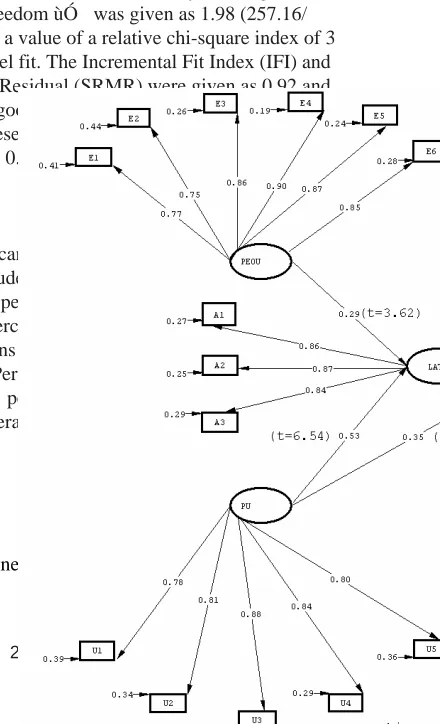
Based on previous research, TAM and extended TAM models (e.g., Stoel & Lee, 2003; Selim, 2003) the following TEM was proposed to examine student’s perception of technology effectiveness. The PEOU and PU hypothesized to determine learner’s attitude (LATT) towards the course management system (CMS) technology. These hypotheses were key to tackling the interactions between user behaviour and e-Blackboard environ-ment to determine the effectiveness of the technology (EOT):
H1: PEOU positively influences LATT H2: PU positively influences LATT H3: PU positively influences EOT H4: LATT positively influences EOT
RESULTS
LISREL programme was used to estimate the structural parameters of the proposed technology effectiveness model (TEM), based on confirmatory factor analysis (CFA). Figure 1 displays the model fit, parameters, and corresponding t-statistics. Chi-square for the model was given as 257.16 with 130 degrees of freedom; however, due to large sample size effect (n >200), this test was discounted (Sharma, 1996; Tanaka, 1993).
Figure 1. Technology Effectiveness Model (TEM)
Alternatively, a relative square fit index, calculated by dividing the chi-square value by the degrees of freedom ùÓ was given as 1.98 (257.16/ 130). According to Kline (1998), a value of a relative chi-square index of 3 or less suggests an adequate model fit. The Incremental Fit Index (IFI) and Standardized Root Mean Square Residual (SRMR) were given as 0.92 and 0.045, respectively, to suggest a good fit to the data. Other fit indices were also within acceptable limits. These include AGFI, RMSEA, NFI, CFI, and NNFI, which were given as 0.81, 0.043, 0.90, 0.92, and 0.91, respectively.
Alternatively, a relative square fit index, calculated by dividing the chi-square value by the degrees of freedom was given as 1.98 (257.16/130). According to Kline (1998), a value of a relative chi-square index of 3 or less suggests adequate model fit. The Incremental Fit Index (IFI) and Standard-ized Root Mean Square Residual (SRMR) were given as 0.92 and 0.045, respectively, to suggest a good fit to the data. Other fit indices were also within acceptable limits. These include AGFI, RMSEA, NFI, CFI, and NNFI, which were given as 0.81, 0.043, 0.90, 0.92, and 0.91, respectively. All path coefficients were significant (p <0.05). Both PEOU and PU positively affected students’ attitude towards e-Blackboard. The t-statistics were 3.62 and 5.13 (p <0.05), respectively. Moreover, the students’ attitude positively influenced students’ perception regarding effectiveness of e-Blackboard in terms of interactions between students’ behavior and within ICT-rich learning environment. Perception of e-Blackboard usefulness also influences positively on students’ perception regarding effectiveness of e-Blackboard. Therefore, all generated hypotheses (H1, H2, H3, and H4) were supported.
CONCLUSIONS
Empirical analysis, based on perceptions of undergraduate students from the UAE University employing TAM framework, confirmed that the previous evidence regarding the primary relevance of PU and PEOU of a technology largely attributed to a person’s attitude towards the technology. According to the proposed TEM, the interaction between the e-Blackboard learning environment and student’s behaviour measured, for example, by students’ motivation and cognitive engagement during e-Blackboard sessions, is indicative of effective technology implementation.
References
Davis, F.D., Bagozzi, R.P., & Warshaw, P.R. (1989). User acceptance of com-puter technology: A comparison of two theoretical models. Manage-ment Science, 35, 982-1003.
Hoppe, D.G., & Breitner, M.H. (2003). Business models for elearning. Retrieved De-cember 25, 2005, from http://www.wiwi.uni-hannover.de/Forschung/Diskus-sionspapiere/dp-287.pdf
Kline, R.B. (1998). Principles and practice of structural equation model-ling. New York: Guilford Press.
Poon, W.C., Low, K.L., & Yong, D.G. (2004). A study of web-based learn-ing (WBL) environment in Malaysia. International Journal of Educa-tional Management, 18(6), 374-385.
Rainbow, S.W., & Sadler-Smith, E. (2003). Attitudes to computer-assisted learning amongst business and management students. British Journal of Ed-ucational Technology, 34(5), 615-624.
Selim, M. H. (2003). An empirical investigation of students’ acceptance of course websites. Computers and Education, 40(4), 343-360.
Sharma, S. (1996). Applied multivariate techniques. New York: John Wiley & Sons.
Stoel, L., & Lee, K.H. (2003). Modelling the effect of experience on stu-dent acceptance of web-based courseware. Internet Research: Electronic Networking Applications and Policy, 13(5), 364-374.
Taha, A. (2004, July). Networked e-information for support course website process at UAE University. Proceedings of IADIS e-Society Conference, Avila, Spain.
Tanaka, J.S. (1993). Multifaceted conceptions of fit in structural equations models. In K.A. Bollen & J.S. Long (Eds.), Testing structural equation models. Newbury Park, CA: Sage.
Acknowledgements
APPENDIX
SURVEY INDICATORS USED TO BUILD STRUCTURAL MODEL CONSTRUCTS
PEOU
E1: It is easy to remember how to perform tasks using E-Blackboard E2: It is easy to get E-Blackboard to do what I wanted it to do E3: Interaction with E-Blackboard was clear and understandable E4: Getting the information from E-Blackboard was easy E5: Learning to use E-Blackboard was easy
E6: Becoming skilful at using E-Blackboard was easy
PU
U1: Using E-Blackboard gave me greater control over my studies U2: Using E-Blackboard improved the quality of the assignments I did U3: Using E-Blackboard improved my learning productivity
U4: Using E-Blackboard enhanced the effectiveness of my study activities
U5: Using E-Blackboard made it easier to study / learn
LATT
A1: I like using E-Blackboard A2: E-Blackboard is fun to use
A3: E-Blackboard provides an attractive learning environment
EOT
T1: Active participation during E-Blackboard class activities stimulat-ed my learning interest
T2: I exert more mental effort in learning and I concentrate better during Blackboard sessions
T3: Using E-Blackboard enabled me to build higher level of self-confidence