O R I G I N A L R E S E A R C H
Open Access
Secure Hash Algorithm-2 formed on
DNA
Dieaa I. Nassr
Correspondence: [email protected]; [email protected] Computer Science Division, Department of Mathematics, Faculty of Science, Ain Shams University, Cairo, Egypt
Abstract
We present a new version of the Secure Hash Algorithm-2 (SHA-2) formed on artificial sequences of deoxyribonucleic acid (DNA). This article is the first attempt to present the implementation of SHA-2 using DNA data processing. We called the new version DNSHA-2. We present new operations on an artificial DNA sequence, such as (1)R¯k(α) andL¯k(α)to mimic the right and left shift bykbits, respectively; (2)S¯k(α)to mimic the right rotation bykbits; and (3) DNA-nucleotide addition(mod 264)to mimic word-wise addition(mod 264). We also show, in particular, how to carry out the different steps of SHA-512 on an artificial DNA sequence. At the same time, the proposed nucleotide operations can be used to mimic any hash algorithm of its bitwise operations similar to bitwise operations specified in SHA-2. The proposed hash has the following features: (1) it can be applied to all data, such as text, video, and image; (2) it has the same security level of SHA-2; and (3) it can be performed in a biological environment or on DNA computers.
Keywords: Secure hash function, SHA-2, DNA
Mathematics Subject Classification (2000): 68P25, 94A60, 92D20
Introduction
A hash function is a function that maps a binary data of arbitrary size to a fixed-size string. For input data (often called message), the output of the hash function is called the hash value or digest of the message. Several applications use hash functions in hash tables to reduce the time cost for finding a data record given its search key. Typically, the domain size of a hash function is greater than its range. Therefore, there must be different massages (inputs) producing the same digest (output), and this is called a collision case. A hash function adapted to cryptographic applications has certain properties, including its resistance to collision, pre-image and second pre-image attacks [1–4], and to be a one-way function (infeasible to reverse). In this case, the hash function is called a secure hash function and it is used for providing message authentication, data integrity, password verification, and many other information security applications [5].
Secure Hash Algorithm-2 (SHA-2) is a set of secure hash functions standardized by NIST as part of the Secure Hash Standard in FIPS 180-4 [6]. Although there is a new version of the standard called 3 [7], NIST does not currently intend to remove SHA-2 from the revised Secure Hash Standard as no significant attack on SHA-SHA-2 has been demonstrated. Rather, SHA-3 can be used in the information security applications that need to improve the robustness of NIST’s overall hash algorithm toolkit. There are six
hash functions belonging to SHA-2, and these hash functions have names corresponding to their digest length: 224, 256, 384, 512, 512/224, and SHA-512/256.
These hash functions have very similar structures unlike only in the number of rounds, additive constants, shift amounts, and digest size.
The aim of this paper is to introduce a new version of SHA-2 in DNA model consider-ing the security properties of SHA-2. To the best of our knowledge, there is no article that discusses the implementation of SHA-2 using DNA data processing. We are therefore interested in studying how to implement SHA-2 on the DNA environment. Since the hash functions belonging to SHA-2 have almost the same basic processes, we focus on the con-struction of SHA-512 to be processed in a DNA environment (DNSHA-512) and the other hash functions are similar. The construction of DNSHA-512 contains new imitation of the operations:
1. Right (and left) shift byk bits 2. Right rotation byk bits 3. Addition modulo264
In Table1, we give the list of abbreviations used in this paper.
The paper is organized as follows. In the “DNA” section, we present some basic back-ground of DNA required in this paper. A brief explanation of SHA-512 is given in the SHA-512” section. In the “DNSHA-2” section, we give the nucleotide operations that mimic the bitwise operations used in SHA-2 and the algorithm of DNSHA-512 of the pro-posed implementation of SHA-512 on an artificial DNA sequence. The “Implementation” section contains the implementation of DNSHA-512. In the “Conclusion” section, we include the conclusion.
Table 1List of abbreviations
SHA-2 Secure Hash Algorithm-2
DNA Deoxyribonucleic acid
A The nitrogenous base (adenine)
C The nitrogenous base (cytosine)
G The nitrogenous base (guanine)
T The nitrogenous base (thymine)
(en−1. . .e1e0)2 A binary string
⊕ Bitwise XOR
¬ Bitwise negation
∧ Bitwise AND
∨ Bitwise OR
+ Addition(mod 264)
Rk Right shift bykbits
Sk Right rotation bykbits
¯¬ The nucleotide operation to imitate the bitwise NOT
¯∧ The nucleotide operation to imitate the bitwise AND
¯∨ The nucleotide operation to imitate the bitwise OR
¯⊕ The nucleotide operation to imitate the bitwise XOR
¯
Rk The nucleotide operation to imitate the right shift bykbits
¯
DNA
Deoxyribonucleic acid (DNA) is a huge molecule; most of them exist in the nucleus of the cells of the organism and in many viruses and contain a genetic code used during the reproduction and the evolution of these organisms. Most of the DNA molecules consist of two chains of biological polymers wrapped around a double strand. Each strand of DNA is made up of a long sequence of nucleotides. These nucleotides are for storing genetic information. They get the information needed to build proteins, DNA, or RNA. There are four types of nucleotides: adenineA, cytosine
C, guanineG, or thymineT. Their names are usually abbreviated with the first letter only. A long chain (sequence) of nucleotides is written as a sequence of lettersA,C,
G, andT. This sequence (of nucleotides) forms the genetic code of cells. A sequence of nucleotides is connected together using a vertebra composed of phosphate and
a sugar (deoxyribose). Nucleotides are sometimes called bases. Some results [8, 9]
pointed out that it is possible to build and generate a chain of artificial nucleotides (DNA sequences) and create complex molecular machines. Because of the progress
in the discovery of many properties of DNA [10, 11], there is a new data storage
technique that depends on the DNA molecule. Several methods have been given in [12–19] for storing data in DNA sequences in which 1 g of DNA can be used to store about 106TB of data; thus, a small number of grams of DNA is enough to store all the data of our world for hundreds of years. Many results [20–24] have developed a new data processing in DNA environment known as DNA computing. Adelman [20] has shown that by biochemical DNA operations, molecules could be used to carry out the computation. This author exploited the biochemical operations of DNA to obtain a solution for the Hamiltonian path problem. Computations are carried out in efficient parallel operations. Additionally, Lipton [24] has offered an encoding schema, exploiting operations of DNA molecules, to obtain a solution for the satisfiability problem with a small number of variables. A generalization of Lipton’s schema has been given in [22]. Boneh et. al. [25] has shown that the data encryption standard (DES) could be broken by using the concept of DNA computation. He has presented a molecular program to break DES. Now, the study of the features of DNA has several objectives not only in the gene sequences but also in carrying out computations and in the field of data protection, where a private data can be written in a secret location in a DNA molecule to protect this data for a long time from unauthorized persons [26–30].
In the literatures [12–17], encoding data in DNA sequence has been classified by two ways [18,19]:
1. The binary data is transformed to a DNA sequence. For example [31–33], the binary digits “00,” “01,” “10,” and “11” are transformed into the nucleotidesA,C,G, andT, respectively.
2. Each specified number of bits, e.g., byte, is converted into a fixed number of nucleotides using a given encoding table, see [34].
SHA-512
This section gives a brief description of the hash algorithm SHA-512 [6]. It is an iterated
hash function that pads and parses the input message into n1024-bit message blocks
computed, using a compression functionf :
H(0)=IV, IV is an initial hash value (512-bit block)
H(j)=f(H(j−1),M(j))for 1≤j≤n. The final 512-bit blockHnis the hash value.
The hash function SHA-512 is described in Algorithm 1. We use the notation in Table1, where all operators perform on 64-bit words.
The initial hash valueH(0) is given in Table2. We parseH(0) into eight 64-bit blocks
H1(0),H2(0),. . .H8(0). The first 64 bits ofH(0)are denotedH1(0), the next 64 bits areH2(0), and so on up toH8(0).
Suppose that the input message is ofmbits. The input message is prepared as follows:
1. The input messageM is padded in the usual method: add the bit “1” to the end of M, and after that add k zero bits, where k is the minimal solution (non-negative) to the equationm+1+k≡896(mod 1024). Next, to this addition, append 128-bit block that represents the numberm written in binary. For example, the binary data of the message “BOB” are “01000010 01001111 01000010.” This data has 24 bits. By joining the bit “1” to the end of this message, we get “01000010 01001111 01000010 1.” Solving the equation24+1+k≡896(mod 1024), we havek=871.
Therefore, preparing the message, we get:
010000100100111101000010 1 00 . . .0 871 zeros
000. . .11000
24 is written in binary (128-bit) .
2. The number of bits of the padded message becomes a multiple of 1024. Therefore, the padded message is parsed inton 1024-bit blocks’M(1),M(2),. . .,M(n).The blocki is parsed into 16 words, where each word has 64 bits. The words of block i are given byM(0i),M1(i),. . .M(15i).Note that the first 64 bits of blocki is stored in the wordM0(i),where the leftmost bit is stored in the most significant bit position. By the same way, the wordM1(i)is the second 64 bits, and so on up toM(15i).For example, the message “BOB” after padding is one 1024-bit block, and the words
M(j1),j=0, 1,. . ., 15are given as:
Table 2The initial hashH(0)
H(10) 6a09e667f3bcc908
H(20) bb67ae8584caa73b
H(30) 3c6ef372fe94f82b
H(40) a54ff53a5f1d36f1
H(50) 510e527fade682d1
H(60) 9b05688c2b3e6c1f
H(70) 1f83d9abfb41bd6b
Algorithm 1 SHA-512
Input:n1024-bit blocks’M=M(1),M(2),. . .,M(n).
Output:H=H1(n),H2(n),. . .,H8(n)is the hash ofM.
Begin
1: for i=1 to ndo n= number of 1024-bit blocks in the padded message
2: r1=H1(i−1) 3: r2=H2(i−1) 4: r3=H3(i−1) 5: r4=H4(i−1) 6: r5=H5(i−1) 7: r6=H6(i−1) 8: r7=H7(i−1) 9: r8=H8(i−1)
10: for j=0 to 79do the SHA-512 compression function
11: C=CH(r5,r6,r7) Eq.1
12: U=MAJ(r1,r2,r3) Eq.2
13: S0=0(r1) Eq.3
14: S1=1(r5) Eq.4
15: use Algorithm2to computeWj
16: T1=h+S1+C+Kj+Wj
K0,K1,. . .,K79are constant
words used in SHA-512 [6].
17: T2=S0+U
18: r8=r7
19: r7=r6
20: r6=r5
21: r5=r4+T1
22: r4=r3
23: r3=r2
24: r2=r1
25: r1=T1+T2
26: end for
Compute theithintermediate hash value 27: H1(i)=r1+H1(i−1)
28: H2(i)=r2+H2(i−1) 29: H3(i)=r3+H3(i−1) 30: H4(i)=r4+H4(i−1) 31: H5(i)=r5+H5(i−1) 32: H6(i)=r6+H6(i−1) 33: H7(i)=r7+H7(i−1) 34: H8(i)=r8+H8(i−1) 35: end for
36: H=H1(n),H2(n),. . .,H8(n)is the hash ofM
The algorithm of SHA-512 is given in Algorithm 1. Now, we define the logical function used in Algorithm 1:
CH(r1,r2,r3)=(r1∧r2)⊕(¬r1∧r3) (1)
MAJ(r1,r2,r3)=(r1∧r2)⊕(r1∧r3)⊕(r2∧r3) (2)
0(r1)=S28(r1)⊕S34(r1)⊕S39(r1) (3)
0(r1)=S14(r1)⊕S18(r1)⊕S41(r1) (4)
The following algorithm, is to computeWj.
Algorithm 2 ComputeWj
Input:one 1024-bit blockM(i).
Output:Wj64-bit block.
Begin
1: if0≤j≤15then
2: Wj=M(ji) 3: else
4: σ0=S1(Wj−15)⊕S8(Wj−15)⊕R7(Wj−15) 5: σ1=S19(Wj−2)⊕S61(Wj−2)⊕R6(Wj−2). 6: Wj=σ1+Wj−7+σ0+Wj−16
7: end if
End
DNSHA-2
In this section, we propose modern operations on nucleotides that mimic the bitwise operations used in 2 and can therefore be used to mimic all members of SHA-2, i.e., to give a new version of SHA-2 called DNSHA-2. This section contains seven subsections. In the “DNA coding” section, we give how to represent data in artifi-cial DNA sequences. In the “Basic DNA-nucleotide operations” section, we present the nucleotide operations that mimic the bitwise operations (NOT, AND, OR, XOR). In the “DNA right and left shift” and “DNA right rotation” sections, we show how to imple-ment the nucleotide operationsR¯k,L¯k, andS¯kwhich mimic the bitwise operations (shown in Table1),Rk,Lk, andSk, respectively. The nucleotide operation that mimic the word-wise addition (mod 264) is given in the “DNA-nucleotide addition (mod 264)” section. In the “DNA initialization and preprocessing” section, we show how initialization and preprocessing operations, especially in SHA-512, are imitated in DNA computing. In the following, sometimes, we refer to any choice of the nucleotide bases (A,C,G, orT) by the symbolsxi,yi, andzi(orxi,yi, orzi).
DNA coding
digits “00,” “01,” “10,” and “11” are transformed into the nucleotidesA,C,G, andT, respec-tively. For example, the binary string “01001110” is transformed into the nucleotides “CATG.”
We conclude this by defining the transformationλ:
λ(ei+1ei)= ⎧ ⎪ ⎪ ⎪ ⎨ ⎪ ⎪ ⎪ ⎩
A, ifei+1ei=00;
C, ifei+1ei=01;
G, ifei+1ei=10;
T, ifei+1ei=11.
Algorithm 3 describes the representation of a data in an artificial DNA sequence. Since the byte (8-bit) is the commonly used data storage unit, we suppose in Algorithm 3 (also, in this article) that the binary data is of an even number of bits.
Algorithm 3 DNA-encoding
Input:e=(em−1em−2. . .e0)2is a binary data, wheremis an even number Output:α=xm/2−1xm/2−2. . .x0is an artificial DNA sequence.
Begin
1: for i=0 to m/2-1do
2: xi=λ(e2i+1e2i) 3: end for
4: α=xm/2−1xm/2−2. . .x0 End.
We give the following example to illustrate steps of Algorithm 3.
Example 1Let e = (100111)2be a binary data. The DNA nucleotides of e gives the
artificial DNA sequenceα=GCT since:
1. Ati=0,x0=λ(11)=T, 2. Ati=1,x1=λ(01)=C, 3. Ati=2,x2=λ(10)=G.
Algorithm 4 shows how to decode binary data from an artificial DNA sequence. Note that in the following algorithm we useλ−1to give the inverse transformation ofλ.
Algorithm 4 DNA-decoding
Input:α=xm−1xm−2. . .x0is an artificial DNA sequence.
Output:e=(e2m−1e2m−2. . .e0)2a binary data that corresponds toα Begin
1: for i=0 to m-1do
2: e2i+1e2i =λ−1(xi) 3: end for
4: e=(e2m−1e2m−2. . .e0)2 End
Example 2Letα = GCT be an artificial DNA sequence. The binary data ofα gives e=(100111)2since:
1. Ati=0,e1e0=λ−1(T)=11, 2. Ati=1,e3e2=λ−1(C)=01, 3. Ati=2,e5e4=λ−1(G)=10.
Basic DNA-nucleotide operations
In literatures [12–17], the nucleotide operations that imitate bitwise operations (NOT, AND, OR, XOR) are defined. The symbols(¬,∧,∨,⊕) are commonly used to express the bitwise operations (NOT, AND, OR, XOR), respectively. Throughout this paper, the symbols(¯¬,¯∧,¯∨, ¯⊕) are used to give the nucleotide operations that imitate the bitwise operations (NOT, AND, OR, XOR), respectively. Note that we are putting a bar sign over most of the DNA operations or above the DNA terms to differ from bitwise operations.
The nucleotide operation ¯¬is defined as:
¯¬A=T
¯¬C=G
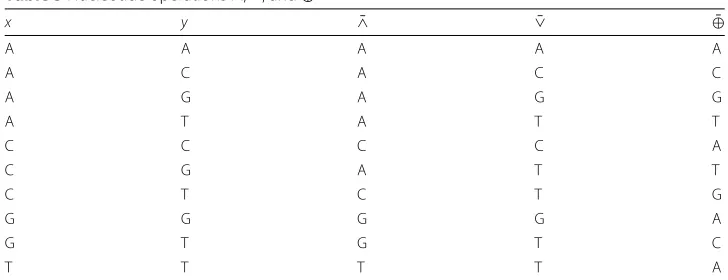
In literatures [12–17], the nucleotide operations between two nucleotides xandyare defined as in Table3
DNA right and left shift
In this subsection, we propose two new operations on DNA sequence that used to mimic the right and left shift bykbits. Letα = xm−1xm−2. . .x0be a DNA sequence ande =
(e2m−1e2m−2. . .e0)2be the binary data encoded inα. We have to mimic the operation
Rk(e) (right shift byk < 2mbits) in SHA-2 to beR¯k(α)in DNSHA-2. In this regard, we take into consideration whetherkis an even number or odd. In case ofkis an even number, the operationRk(e)can be imitated inαby deletingk/2 nucleotides from right and then appendingk/2 nucleotidesAfrom left. Therefore,
¯
Rk(α)= AA . . .A
k
2nucleotides
xm−1. . .xk/2
For example, ifα=TAGC,e=(11001001)2, andk=4, then
R4(e)=00001100 (5)
¯
R4(α)=AATA (6)
Table 3Nucleotide operations¯∧,¯∨, and ¯⊕
x y ¯∧ ¯∨ ¯⊕
A A A A A
A C A C C
A G A G G
A T A T T
C C C C A
C G A T T
C T C T G
G G G G A
G T G T C
In case ofkis an odd number, the operationR¯k(α)can be computed in two steps. The first step is calculatingR¯k−1(α)sincek−1 is even. The second step is calculating the right shift by one bit in DNA sequence where we denote to this operation asRSOB(α)and define it in Algorithm 5.
Letα = xm−1xm−2. . .x0be an artificial DNA sequence andλ−1(xi)= e2i+1e2i. Then,
RSOB(α)is ym−1ym−2. . .y0, where λ−1(yi) = e2i+2e2i+1 for i = 0, 1,. . .,m−2 and
λ−1(y
m−1)=0e2m−1. To illustrate how to perform this step, we give the following notes: 1. Ifβis a DNA sequence ofm nucleotidesG,thenα¯∧βyields nucleotides
zm−1zm−2. . .z0,whereλ−1(zi)=e2i+10fori=0, 1,. . .m−1,i.e.,ziis either nucleotideA orG.
2. Ifα=Axm−1xm−2. . .x1andβis a DNA sequence ofm nucleotidesC,then
α¯∧βyields nucleotidesAz
m−1. . .z1,whereλ−1
zi=0e2ifori=1, 2,. . .m−1, i.e.,ziis either nucleotideA orC.
3. Therefore, we need to define the new nucleotide operation¯ as follows: Ifλ−1(zi)=e2i+10andλ−1(zi+1)=0e2i+2,thenλ−1
zi¯zi+1
=e2i+2e2i+1.We define this nucleotide operation in Table4.
Algorithm 5 RSOB operation
Input:α=xm−1xm−2. . .x0is an artificial DNA sequence. Output:RSOB(α)
Begin
1: defineβ1to be a DNA sequence ofmnucleotidesC. i.e.,β1=CC. . .C 2: defineβ2to be a DNA sequence ofmnucleotidesG. i.e.,β2=GG. . .G 3: β3=Axm−1xm−2. . .x1
4: β4=β1¯∧β3 β4contains only two types of nucleotidesAandC
5: β5=α¯∧β2 β5contains only two types of nucleotidesAandG
6: returnβ4¯β5 End
The following example illustrates steps of Algorithm 5.
Example 3We use the same symbols in the algorithm. Letα = TAC be an artificial DNA sequence encoding the binary data e=(110001)2. We haveβ1=CCC,β2=GGG,
andβ3=ATA.Then,β4=β1¯∧β3=ACA andβ5=α¯∧β2=GAA.The result is given by
β4¯β5=CGA encoding the binary data(011000)2.
We give the operationR¯k(α)in Algorithm 6. Similarly, we have to mimic the operation
Lk(e)(left shift byk < 2mbits) in SHA-2 to beL¯k(α)in DNSHA-2. In case ofkis even,
Table 4The nucleotide operation¯
x y ¯
A A A
A C G
A G C
Algorithm 6 The operationR¯k(α)
Input:α=xm−1xm−2. . .x0is an artificial DNA sequence. Output:R¯k(α)
Begin
1: ifkis eventhen
2: return AA . . .A
k
2nucleptides
xm−1. . .xk/2
3: else
4: α= AA . . .A
k−1
2 nucleptides
xm−1. . .x(k−1)/2 α= ¯Rk−1(α)
5: returnRSOB(α) Algorithm 5
6: end if
End
the operationLk(e)can be imitated inα by deletingk/2 nucleotides from left and then appendingk/2 nucleotidesAfrom right. Therefore,
¯
Lk(α)=xk/2−1. . .x0 AA . . .A k
2nucleptides
For example, ifα=TAGC,e=(11001001)2, andk=4, then
L4(e)=10010000 (7)
¯
L4(α)=GCAA (8)
In case of k is odd,L¯k(α)can be computed in two steps. The first step is calculating
¯
Lk−1(α)sincek−1 is even. The second step is calculating the left shift by one bit in DNA sequence where we denote this operation asLSOB(α)and define it in Algorithm 7.
Let α = xm−1xm−2. . .x0 be an artificial DNA sequence and λ−1(xi) = e2i+1e2i.
Then,LSOB(α)isym−1ym−2. . .y0, whereλ−1(yi) = e2ie2i−1fori= 1, 2,. . .,m−1 and
λ−1(y
0)=e00.
Algorithm 7 LSOB operation
Input:α=xm−1xm−2. . .x0is an artificial DNA sequence. Output:LSOB(α)
Begin
1: defineβ1to be a DNA sequence ofmnucleotidesC. i.e.,β1=CC. . .C 2: defineβ2to be a DNA sequence ofmnucleotidesG. i.e.,β2=GG. . .G 3: β3=xm−2. . .x0A
4: β4=β2¯∧β3 β4contains only two types of nucleotidesAandG
5: β5=α¯∧β1 β5contains only two types of nucleotidesAandC
6: returnβ4¯β5 End
Example 4We use the same symbols in the algorithm. Letα = GTC be an artificial DNA sequence encoding the binary data e=(101101)2. We haveβ1=CCC,β2=GGG,
andβ3=TCA.Then,β4=β2¯∧β3=GAA andβ5=α¯∧β1=ACC.The result is given by
β4¯β5=CGG encoding the binary data(011010)2.
We give the operationL¯k(α)in Algorithm 8.
Algorithm 8 The operationL¯k(α)
Input:α=xm−1xm−2. . .x0is an artificial DNA sequence. Output:L¯k(α)
Begin
1: ifkis eventhen
2: returnxk/2−1. . .x0 AA . . .A k
2nucleptides
3: else
4: α=x(k−1)/2−1. . .x0 AA . . .A
k−1
2 nucleptides
α= ¯Lk−1(α)
5: returnLSOB(α) Algorithm 7
6: end if
End
DNA right rotation
In this subsection, we introduce a new operation on DNA sequence that used to mimic the right rotation bykbits. In Algorithm 9, we give the operationS¯k(α)on DNA sequence
α to imitate the operation Sk(e) (right rotation byk bits), where e is the binary data encoded inα.
Letα=xm−1xm−2. . .x0be a DNA sequence ande=(e2m−1e2m−2. . .e0)2be the binary
data encoded inα. To computeS¯k(α), we first compute R¯k(α)using Algorithm 6 and then computeL¯2m−k(α)using Algorithm 8. Therefore,S¯k(α) = ¯Rk(α)¯∨¯L2m−k(α). The
Algorithm 9 The operationS¯k(α)
Input:α=xm−1xm−2. . .x0is an artificial DNA sequence and a positive integerk<2m. Output:S¯k(α)
Begin
1: β1= ¯Rk(α) 2: β2= ¯L2m−k(α) 3: returnβ1¯∨β2 End
following example illustrates steps of Algorithm 9.
AAA,andβ2 = ¯L2(α)=GTA.The result is given byβ1¯∨β2 =GTA encoding the binary
data(101100)2.
DNA-nucleotide addition (mod 264)
In this subsection, we mimic word-wise additionmod 264. We use the symbol to
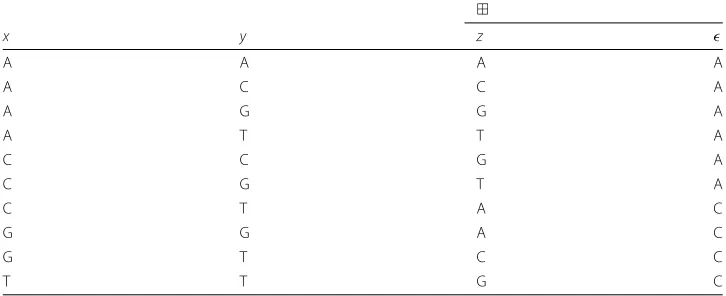
express nucleotide addition. In Table5, the addition of two nucleotidesxandytakes the form:
(z,)=xy
wherezis the addition of two nucleotidesxandy, andis called the carry nucleotide.
In Algorithm 10, we mimic the binary addition (mod 264). Note that the binary
sequence of 64 bits can be encoded in a DNA sequence of 32 nucleotides. Therefore, in Algorithm 10, we have the inputs which are two DNA sequences each of 32 nucleotides.
We use the symbolbetween two DNA sequences each of 32 nucleotides to express
the nucleotide additionmod 264given in Algorithm 10.
Algorithm 10 Nucleotides Addition (mod 264)
Input: two artificial DNA sequences x31x30. . .x0 encoding binary data b1 and
y31y30. . .y0encoding binary datab2.
Output: DNA sequence z31z30. . .z0 encoding binary data b3 , whereb3 = b1 +b2
(mod 264). Begin
1: (z0,)=x0y0 2: for i=1 to 31do
3: (x,x)=xi 4: (zi,y)=xyi
5: (,A)=xy
6: end for
7: returnz31z30. . .z0 End
Table 5Nucleotide operations
x y z
A A A A
A C C A
A G G A
A T T A
C C G A
C G T A
C T A C
G G A C
G T C C
Let
α1=TCTTTTCAGTACAATTTGCATAACGTGTGGAA,
α2=TGATAGCTATTCGATTTACTAAGCATATGTGA
be inputs for Algorithm 10. The following example illustrates how to computeα1α2.,
i.e., steps of Algorithm 10.
Example 6We use the same symbols in the algorithm. We have x0=A,y0=A,z0=A,
and=A.Also, we have the following:
1. Ati=1,x1=A,x=A,x=A,y1=G,z1=G,y=A,=A. 2. Ati=2,x2=G,x=G,x=A,y2=T,z2=C,y=C, =C. 3. Ati=3,x3=G,x=T,x=A,y3=G,z3=C,y=C, =C. 4. Ati=4,x4=T,x=A,x=C,y4=T,z4=T,y=A,=C. 5. Ati=5,x5=G,x=T,x=A,y5=A,z5=T,y=A, =A. 6. Ati=6,x6=T,x=T,x=A,y5=T,z5=G,y=C,=C. 7. Ati=7,x7=G,x=T,x=A,y7=A,z7=T,y=A, =A. 8. Ati=8,x8=C,x=C,x=A,y8=C,z8=G,y=A, =A. 9. Ati=9,x9=A,x=A,x=A,y9=G,z9=G,y=A,=A. 10. Ati=10,x10=A,x=A,x=A,y10=A,z10=A,y=A,=A. 11. Ati=11,x11=T,x=T,x=A,y11=A,z11=T,y=A, =A. 12. Ati=12,x12=A,x=A,x=A,y12=T,z12=T,y=A,=A. 13. Ati=13,x13=C,x=C,x=A,y13=C,z13=G,y=A, =A. 14. Ati=14,x14=G,x=G,x=A,y14=A,z14=G,y=A, =A. 15. Ati=15,x15=T,x=T,x=A,y15=T,z15=G,y=C,=C. 16. Ati=16,x16=T,x=A,x=C,y16=T,z16=T,y=A,=C. 17. Ati=17,x17=T,x=A,x=C,y17=T,z17=T,y=A,=C. 18. Ati=18,x18=A,x=C,x=A,y18=A,z18=C,y=A,=A. 19. Ati=19,x19=A,x=A,x=A,y19=G,z19=G,y=A,=A. 20. Ati=20,x20=C,x=C,x=A,y20=C,z20=G,y=A, =A. 21. Ati=21,x21=A,x=A,x=A,y21=T,z21=T,y=A,=A. 22. Ati=22,x22=T,x=T,x=A,y22=T,z22=G,y=C,=C. 23. Ati=23,x23=G,x=T,x=A,y23=A,z23=T,y=A, =A. 24. Ati=24,x24=A,x=A,x=A,y24=T,z24=T,y=A,=A. 25. Ati=25,x25=C,x=C,x=A,y25=C,z25=G,y=A, =A. 26. Ati=26,x26=T,x=T,x=A,y26=G,z26=C,y=C, =C. 27. Ati=27,x27=T,x=A,x=C,y27=A,z27=A,y=A, =C. 28. Ati=28,x28=T,x=A,x=C,y28=T,z28=T,y=A,=C. 29. Ati=29,x29=T,x=A,x=C,y29=A,z29=A,y=A, =C. 30. Ati=30,x30=C,x=G,x =A,y30=G,z30=A,y=C,=C. 31. Ati=31,x31=T,x=A,x=C,y31=T,z30=T,y=A,=C.
Thus, the result is the DNA sequence:
DNA initialization and preprocessing
Since the initialization and preprocessing operations in the hash functions belonging to SHA-2 are almost similar, but differ only in initial values, we will focus on these operations for SHA-512 to be imitated in DNA computing. We give DNSHA-512 as the member of DNSHA-2 that mimics SHA-512 formed on an artificial DNA sequence.
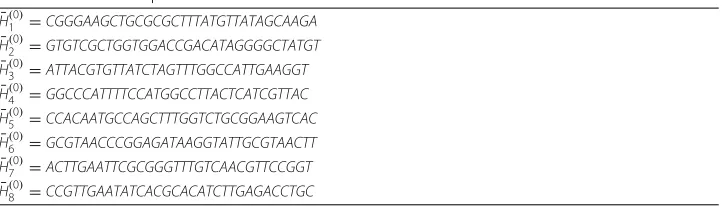
The initial hash valueH(0)is encoded in the DNA sequenceH¯(0)as in Table6.
In this paper, we suppose that a binary data encoded in a DNA sequence is of an even number of bits. This is because, in the usual way, binary data are stored in some number of bytes (8-bit unit). In the following, we need to mimic the beginning computation in SHA-512 to be done similarly in DNSHA-512:
1. Pad the DNA sequence (supposed to be hashed) as follows: Suppose the length of the DNA sequence ism nucleotides. We append the nucleotide G to the end of the sequence, and after thatk nucleotides of type A, where k is the minimal solution (non-negative) to the relationm+2+k≡448 (mod 512). Next, to this append, we add a DNA sequence of 64 nucleotides encoded the binary data of the value of
2m.We have the length of the padded DNA sequence which is a multiple of 512 nucleotides.
2. We parse the DNA sequence inton 512-nucleotide blocks’M¯(1),M¯(2),. . .,M¯(n).
The first 32 nucleotides of nucleotide blocki are denotedM¯(0i), the next 32 nucleotides areM¯(1i), and so on up toM¯15(i). The nucleotide blockiM¯(i)(of 512 nucleotides) in DNSHA-512 has to imitate the 1024-bit blockM(i)in SHA-512. Therefore, the 32 nucleotides ofM¯(ji)have to be the DNA sequence that encodes
M(ji).
To show how to prepare the DNA sequence to be hashed, we give Example7.
Example 7The binary data of the message “BOB” are “01000010 01001111 01000010.” This binary data is encoded in the DNA sequence “CAAGCATTCAAG” with m = 12. By appending the nucleotide G to the end of this sequence, we get “CAAGCATTCAAG G.” Solving the equation12+2+k≡448 (mod 512),we have k=434.Therefore, preparing the DNA sequence, we get:
CAAGCATTCAAG G AA . . .A
434 nucleotides
AAAAAAAAAAAAAAAAAAAAAAAAAAAAACGA
64 nucleotides encode the binary of 24
The 32 nucleotides ofM¯j(1),j=0, 1,. . ., 15are given as:
Table 6The DNA sequenceH¯(0) ¯
H(10)=CGGGAAGCTGCGCGCTTTATGTTATAGCAAGA
¯
H(20)=GTGTCGCTGGTGGACCGACATAGGGGCTATGT
¯
H(30)=ATTACGTGTTATCTAGTTTGGCCATTGAAGGT
¯
H(40)=GGCCCATTTTCCATGGCCTTACTCATCGTTAC
¯
H(50)=CCACAATGCCAGCTTTGGTCTGCGGAAGTCAC
¯
H(60)=GCGTAACCCGGAGATAAGGTATTGCGTAACTT
¯
H(70)=ACTTGAATTCGCGGGTTTGTCAACGTTCCGGT
¯
DNSHA-512
We give Algorithm 11 for DNSHA-512 that mimics Algorithm 1. Now, we define functions used in Algorithm 11 (DNA functions):
DNACH(r1,r2,r3)=(r1¯∧r2)¯⊕(¯¬r1¯∧r3) (9)
DNAMAJ(r1,r2,r3)=(r1¯∧r2)¯⊕(r1¯∧r3)¯⊕(r2¯∧r3) (10)
¯
0(α)= ¯S28(α)¯⊕¯S34(α)¯⊕¯S39(α) (11)
¯
1(α)= ¯S14(α)¯⊕¯S18(α)¯⊕¯S41(α) (12)
Now, we give the algorithm needed to computeW¯j. Implementation
This section, presents an implementation of DN512. Typically, all members of SHA-2 can similarly be implemented on an artificial DNA sequence. In Table7, we consider some metrics to evaluate DNSHA-512 compared to SHA-512.
We made a computer program that simulates each step of DNSHA-512. Then, we apply the program to hash two types of data: text and image.
The text used for the hash is “BOB.” As previously stated in Example7, the binary data for this message is encoded in the DNA sequence “CAAGCATTCAAG.” After padding the DNA sequence, we get:
CAAGCATTCAAG G AA . . .A
434 nucleotides
AAAAAAAAAAAAAAAAAAAAAAAAAAAAACGA
64 nucleotides encode the binary of 24
The hash of this message using DNSHA-512 is given by the 32 nucleotides of
¯
H1(1),H¯2(1),. . .,H¯8(1)as follows:
Table 7Evaluation metrics for DNSHA-512 and SHA-512
Metrics SHA-512 DNSHA-512
Storage unit Bit DNA nucleotide
The input size in every iteration 1024 bits 512 nucleotides The output size in every iteration 512 bits 256 nucleotides
Algorithm 11 DNSHA-512
Input:n512-nucleotide blocks’M¯ = ¯M(1),M¯(2),. . .,M¯(n).
Output:H¯ = ¯H1(n),H¯2(n),. . .,H¯8(n)is the hash ofM¯.
Begin
1: for i=1 to ndon= number of 512-nucleotide blocks’ in the padded DNA sequence 2: r1= ¯H1(i−1)
3: r2= ¯H2(i−1) 4: r3= ¯H3(i−1) 5: r4= ¯H4(i−1) 6: r5= ¯H5(i−1) 7: r6= ¯H6(i−1) 8: r7= ¯H7(i−1) 9: r8= ¯H8(i−1)
10: for j=0 to 79do Mimic the SHA-512 compression function
11: C=DNACH(r5,r6,r7) Eq.9
12: U=DNAMAJ(r1,r2,r3) Eq.10
13: S0= ¯0(r1) Eq.11
14: S1= ¯1(r5) Eq.12
15: use Algorithm1to computeW¯j
16: T1=r8S1CKjW¯j
K0,K1,. . .,K79are constant words used in SHA-512 [6]
These constant words considered here to be encoded in
constant DNA sequences
17: T2=S0U
18: r8=r7
19: r7=r6
20: r6=r5
21: r5=r4T1
22: r4=r3
23: r3=r2
24: r2=r1
25: r1=T1T2
26: end for
Compute theithintermediate hash value 27: H¯1(i)=r1H¯1(i−1)
28: H¯2(i)=r2H¯2(i−1) 29: H¯3(i)=r3H¯3(i−1) 30: H¯4(i)=r4H¯4(i−1) 31: H¯5(i)=r5H¯5(i−1) 32: H¯6(i)=r6H¯6(i−1) 33: H¯7(i)=r7H¯7(i−1) 34: H¯8(i)=r8H¯8(i−1) 35: end for
36: H¯ = ¯H1(n),H¯2(n),. . .,H¯8(n)is the hash ofM¯
Algorithm 12 ComputeW¯j
Input:one 512-nucleotide blockM¯(i).
Output:W¯jDNA sequence of 32 nucleotides.
Begin
1: if0≤j≤15then 2: W¯j= ¯M(ji) 3: else
4: σ0= ¯S1(W¯j−15)¯⊕¯S8(W¯j−15)¯⊕¯R7(W¯j−15) 5: σ1= ¯S19(W¯j−2)¯⊕¯S61(W¯j−2)¯⊕¯R6(W¯j−2) 6: W¯j=σ1W¯j−7σ0W¯j−16
7: end if
End
31 30 29 28 27 26 25 24 23 22 21 20 19 18 17 16 15 14 13 12 11 10 9 8 7 6 5 4 3 2 1 0
¯
H(11) T T T C A G G A A T A C C A A A A C A C G C G A C G G T T C C A
¯
H(21) G A T G G T T C G T C T C A A A C C C A G A C T G C C C C C A G
¯
H(31) G C T A G T T C A T C T G G A C A G T C C G C T C T C T C A G G
¯
H(41) G G T G G C C A C G G T C C C G A C C C A T A G A T G A C A G G
¯
H(51) G C T A C A T T A C C G T C A T C T C G G T T C C G T T T C C A
¯
H(61) A C G A C C A G A G T T G A A G G T A T C A T T T A C T C C T C
¯
H(71) T T G A C G C T C C T A G A T G A C T T T G A C T G C A C G C T
¯
H(81) A C T T T A G A A A A G T C T A T T G A A G A C T C G T A T G C
The corresponding hash of this message using SHA-512 is given by 64-bit words of
H1(1),H2(1),. . .,H8(1)as follows:
H1(1) fd28314011986bd4
H2(1) 8ebdb74054879552
H2(1) 9cbd37a12d67774a
H4(1) ae946b561532384a
H5(1) 9c4f16d376bd6fd4
H6(1) 18522f82b34fc75d
H7(1) f8675c8e1fe1e467
H8(1) 1fc802dcf821db39
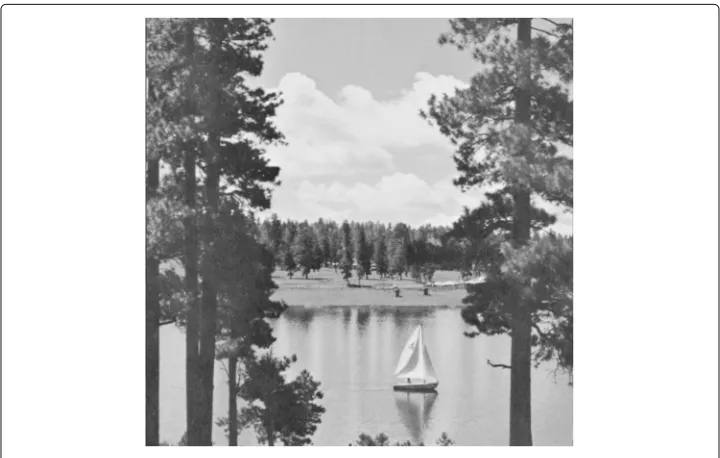
The image used for the hash is the lake image declared in Fig.1.
31 30 29 28 27 26 25 24 23 22 21 20 19 18 17 16 15 14 13 12 11 10 9 8 7 6 5 4 3 2 1 0
¯
H(14103)A A G G T G T C C G C C C T T C T G C G G C T T T C G A T G C G
¯
H(24103)T C T A G T T C G T C A C C C C G G T T T A T G C C A C T G C T
¯
H(34103)G G T C T A A C G C T T G C A C G G A G G G C G A A T C A C C T
¯
H(44103)G G T T G A A T C G C T G C G C T C C G A T G T C A C C A G G A
¯
H(54103)A C C A T C A A T T A T A G A T G T T C C A C T C C G A G G A G
¯
H(64103)C A T A C A T T C A T G T C A T C A T C T G C G G C T C A T G C
¯
H(74103)A A G G T T G C T T A G C T G A G A A C A A G T T G G G A C G C
¯
H(84103)A T C T C G A A A A G T A G T T G C G G T T A A C G A T G A G T
The corresponding hash of this image using SHA-512 is given by 64-bit words of
H1(4103),H2(4103),. . .,H8(4103)as follows:
H1(4103) 0aed657de69fd8e6
H2(4103) dcbdb455afce51e7
H2(4103) adc19f91a2a60d17
H4(4103) af836799d63b4528
H5(4103) 14d0f323bd4758a2
H6(4103) 4c4f4ed34de69d39
H7(4103) 0af9f278810bea19
H8(4103) 37600b2f9af0638b
Conclusion
We have presented the implementation of SHA-2 using DNA data processing. To the best of our knowledge, this result is the first attempt to model a standard hash function using DNA data processing. We have shown how to encode binary data into a DNA sequence,
and we have given nucleotide operations that mimic the bitwise operations used in SHA-2. In particular, we have presented the DNA operationsR¯k(α),L¯k(α), andS¯k(α)that used to mimic the bitwise operationsRk(e),Lk(e), andSk(e), wheree(binary data) is encoded in the the DNA sequenceα. Therefore, this work can be used to mimic any hash algorithm of its bitwise operations limited to bitwise operations specified in SHA-2. Similarly, the nucleotide operations proposed in this result can be exploited to lead to a preliminary result to perform SHA-3 on DNA sequences.
Acknowledgements
We are grateful to Hatem M. Bahig for his support, valuable comments, and remarks. Furthermore, we are thankful to the referees for their precious comments, which lead to the improvement of the paper.
Authors’ contributions
DIN is the only author of this article, and he has performed all the analysis, verifications, and completions of the results included in this article. The author read and approved the final manuscript.
Funding Not applicable
Availability of data and materials Not applicable.
Competing interests
The author declares that he has no competing interests.
Received: 20 March 2019 Accepted: 23 August 2019
References
1. Aoki, K., Guo, J., Matusiewicz, K., Sasaki, Y., Wang, L.: Preimages for stepreduced SHA2. In: Advances in Cryptology -ASIACRYPT 2009, 15th International Conference on the Theory and Application of Cryptology and Information Security, Tokyo, Japan, December 6-10, 2009. Proceedings, Vol. 5912 of Lecture Notes in Computer Science, pp. 578–597. Springer, (2009).https://doi.org/10.1007/978-3-642-10366-7_34
2. Indesteege, S., Mendel, F., Preneel, B., Rechberger, C.: Collisions and other non-random properties for step-reduced SHA-256. In: Selected Areas in Cryptography, pp. 276–293. Springer, (2009). https://doi.org/10.1007/978-3-642-04159-4_18
3. Kelsey, J., Kohno, T.: Herding hash functions and the nostradamus attack. In: Advances in Cryptology - EUROCRYPT 2006, pp. 183–200. Springer, (2006).https://doi.org/10.1007/11761679_12
4. Sanadhya, S., Sarkar, P.: New collision attacks against up to 24-step SHA-2. In: Progress in Cryptology-INDOCRYPT 2008, pp. 91–103. Springer, (2008).https://doi.org/10.1007/978-3-540-89754-5_8
5. Menezes, A. J., van Oorschot, P. C., Vanstone, S. A.: Handbook of Applied Cryptography, CRC Press, Inc., USA (1996 ) 6. N.I. of Standards, Technology, FIPS PUB 180-4: Secure Hash Standard, pub-NIST (2012).http://csrc.nist.gov/
publications/fips/fips180-4/fips-180-4.pdf
7. N.I. of Standards, Technology,SHA-3 Standard: Permutation-Based Hash and Extendable-Output Functions: FiPS PUB 202, pub-NIST (2015).https://books.google.com.eg/books?id=hCwatAEACAAJ
8. Friedman, M., Rogers, Y., Boyce-Jacino, M.: Gene pen devices for array printing, WO Patent App, No. 6235473 (2000). http://www.freepatentsonline.com/6235473.html
9. Kimoto, M., Matsunaga, K., Hirao, I. I.: DNA aptamer generation by genetic alphabet expansion SELEX (ExSELEX) using an unnatural base pair system. Springer, New York (2016)
10. Calladine, C., Drew, H., Luisi, B., Travers, A.: Understanding DNA: The Molecule and How itWorks. 3rd ed. Academic Press, Cambridge (2004)
11. Watson, J.: Molecular biology of the gene, Benjamin/Cummings (1987).https://books.google.com.eg/books?id= cM0fAQAAIAAJ
12. Atito, A., Khalifa, A., Rida, S. Z., Khalifa, A.: DNA-based data encryption and hiding using playfair and insertion techniques. J. Commun. Comput. Eng.2, 44–49 (2012)
13. Guo, C., Chang, C., Wang, Z.: A new data hiding scheme based on DNA sequence. Int. Innov. J. Comput. Inf. Control. 8, 1–11 (2012)
14. Khalifa, A.: Lsbase: a key encapsulation scheme to improve hybrid crypto-systems using DNA steganography. In: 2013 8th International Conference on Computer Engineering & Systems (ICCES), pp. 105–110, (2013).https://doi. org/10.1109/icces.2013.6707182
15. Khalifa, A, Atito, A: High-capacity DNA-based steganography. In: 8th International Conference on Informatics and Systems. IEEE, (2012). BIO–76–BIO–80
16. Skariya, M., Varghese, M.: Enhanced double layer security using RSA over DNA based data encryption system. Int J Comput Sci Eng Technol.4, 746–750 (2013)
17. Taur, J., Lin, H., Lee, H., Tao, C.: Data hiding in DNA sequences based on table lookup substitution. Int J Innov Comput Inf Control.8, 6585–6598 (2012)
19. UbaidurRahmana, N. H., Balamuruganb, C., Mariappanab, R.: A novel string matrix data structure for DNA encoding algorithm. Procedia Comput. Sci.46, 820–832 (2015)
20. Adleman, L.: Molecular computation of solutions to combinatorial problems. Science.266(11), 1021–1024 (1994) 21. Bahig, H. M., Nassr, D. I.:DNA-based AES with silent mutations. Arab. J. Sci. Eng.44, 1–15 (2018).https://doi.org/10.
1007/s13369-018-3520-8
22. Boneh, D., Dunworth, C., Lipton, R., Sgall, J: On the computational power of DNA. Discret. Appl. Math.71(1-3), 79–94 (1996)
23. Kari, L., Seki, S., Sosík, P.: DNA Computing—Foundations and Implications. Springer, Berlin (2012) 24. Lipton, R.: Using DNA to solve np-complete problems. Science.268, 542–545 (1995)
25. Boneh, D., Dunworth, C., Lipton, R.: Breaking DES using a molecular computer. In: DNA Based Computers, Proceedings of a DIMACS Workshop, Princeton, New Jersey, USA, April 4, 1995, pp. 37–66, (1995).https://doi.org/10. 1090/dimacs/027/04
26. Abbasy, M., Manaf, A., Shahidan, M.: Data Hiding Method Based on DNA Basic Characteristics. Springer (2011). https://doi.org/https://doi.org/10.1007/978-3-642-22603-8_5
27. Abbasy, M., Nikfard, P., Ordi, A., Torkaman, M. DNA base data hiding algorithm.1, 183–193 (2012) 28. Gehani, A., LaBean, T., Reif, J.: DNA-based Cryptography. Springer, Berlin (2004)
29. Hamed, G., Marey, M., El-Sayed, S. S., Tolba, F.: DNA Based Steganography: Survey and Analysis for Parameters Optimization. Springer, Cham (2016).https://doi.org/10.1007/978-3-319-21212-8_3
30. Tang, Q., Ma, G., Zhang, W., Yu, N.: Reversible data hiding for DNA sequences and its applications. Int. Digit. J. Crime For.6(4), 1–13 (2014)
31. Cui, G., Qin, L., Wang, Y., Zhang, X.: An encryption scheme using DNA technology. In: Third International Conference on Bio-Inspired Computing: Theories and Applications, pp. 37–42, (2008).https://doi.org/10.1109/bicta.2008. 4656701
32. Sabry, M., Hashem, M., Nazmy, T., Khalifa, M. E.: Design of DNA-based advanced encryption standard (AES). In: 2015 IEEE Seventh International Conference on Intelligent Computing and Information Systems (ICICIS), pp. 390–397, (2015).https://doi.org/10.1109/intelcis.2015.7397250
33. Xin-she, L., Lei, Z., Yu-pu, H.: A novel generation key scheme based on DNA. In: International Conference on Computational Intelligence and Security, pp. 264–266, (2008).https://doi.org/10.1109/cis.2008.113 34. Wang, X., Zhang, Q.: DNA computing-based cryptography. In: 2009 Fourth International on Conference on
Bio-Inspired Computing, pp. 1–3, (2009).https://doi.org/10.1109/bicta.2009.5338153
Publisher’s Note