The Thirty-Third AAAI Conference on Artificial Intelligence (AAAI-19)
On the Time Complexity of Algorithm
Selection Hyper-Heuristics for Multimodal Optimisation
Andrei Lissovoi, Pietro S. Oliveto, John Alasdair Warwicker
Rigorous Research, Department of Computer ScienceThe University of Sheffield, Sheffield S1 4DP, United Kingdom {a.lissovoi,p.oliveto,j.warwicker}@sheffield.ac.uk
Abstract
Selection hyper-heuristics are automated algorithm selec-tion methodologies that choose between different heuristics during the optimisation process. Recently selection hyper-heuristics choosing between a collection of elitist randomised local search heuristics with different neighbourhood sizes have been shown to optimise a standard unimodal benchmark function from evolutionary computation in the optimal ex-pected runtime achievable with the available low-level heuris-tics. In this paper we extend our understanding to the domain of multimodal optimisation by considering a hyper-heuristic from the literature that can switch between elitist and non-elitist heuristics during the run. We first identify the range of parameters that allow the hyper-heuristic to hillclimb ef-ficiently and prove that it can optimise a standard hillclimb-ing benchmark function in the best expected asymptotic time achievable by unbiased mutation-based randomised search heuristics. Afterwards, we use standard multimodal bench-mark functions to highlight function characteristics where the hyper-heuristic is efficient by swiftly escaping local op-tima and ones where it is not. For a function class called CLIFFd where a new gradient of increasing fitness can be
identified after escaping local optima, the hyper-heuristic is extremely efficient while a wide range of established elitist and non-elitist algorithms are not, including the well-studied Metropolis algorithm. We complete the picture with an anal-ysis of another standard benchmark function called JUMPd
as an example to highlight problem characteristics where the hyper-heuristic is inefficient. Yet, it still outperforms the well-established non-elitist Metropolis algorithm.
1
Introduction
Selection hyper-heuristics are automated algorithm selec-tion methodologies designed to choose which of a set of low-level heuristics to apply in the next steps of the opti-misation process (Cowling, Kendall, and Soubeiga 2001). Rather than deciding in advance which heuristics to apply for a problem, the aim is to automate the process at run-time. Originally shown to effectively optimise scheduling problems, such as the scheduling of a sales summit and uni-versity timetabling (Cowling, Kendall, and Soubeiga 2001; 2002), they have since been successfully applied to a variety
Copyright c2019, Association for the Advancement of Artificial Intelligence (www.aaai.org). All rights reserved.
of hard combinatorial optimisation problems (see (Burke et al. 2010; 2013) for surveys of results).
Despite their numerous successes, very limited rigor-ous theoretical understanding of their behaviour and per-formance is available (Lehre and ¨Ozcan 2013; Alanazi and Lehre 2014). Recently, it has been proved that a simple se-lection hyper-heuristic called Random Descent (Cowling, Kendall, and Soubeiga 2001; 2002), choosing between eli-tist randomised local search (RLS) heuristics with differ-ent neighbourhood sizes, optimises a standard unimodal benchmark function from evolutionary computation called LEADINGONES in the best possible runtime (up to lower order terms) achievable with the available low-level heuris-tics (Lissovoi, Oliveto, and Warwicker 2018). For this to oc-cur, it is necessary to run the selected low-level heuristics for a sufficient amount of time, called thelearning period, to allow the hyper-heuristic to accurately determine how use-ful the chosen operator is at the current stage of the opti-misation process. If the learning period is not sufficiently long, the hyper-heuristic fails to identify whether the chosen low-level heuristics are actually useful, leading to random choices of which heuristics to apply and a degradation of the overall performance. Since the optimal duration of the learning period may change during the optimisation, (Doerr et al. 2018) have recently introduced a self-adjusting mecha-nism and rigorously proved that it allows the hyper-heuristic to track the optimal learning period throughout the optimi-sation process for LEADINGONES.
Kork-maz 2006). In the mentioned works, the acceptance operator remains fixed throughout the run, with the hyper-heuristic only switching between different mutation operators. How-ever, it would be more desirable that hyperheuristics are al-lowed to decide to use elitist selection for hillclimbing in exploitation phases of the search and non-elitism for explo-ration, for instance to escape from local optima.
(Qian, Tang, and Zhou 2016) analysed selection hyper-heuristics in the context of multi-objective optimisation. They considered a hyper-heuristic selecting between elitist (IE) and strict elitist (OI) acceptance operators and pre-sented a function where it is necessary to mix the two ac-ceptance operators. Lehre and ¨Ozcan presented a hyper-heuristic which chooses between two different low level heuristics that use the above described OI (elitist) and AM (non-elitist) acceptance operators (Lehre and ¨Ozcan 2013). The considered Simple Random hyper-heuristic uses 1-bit flips as mutation operator and selects the AM acceptance operator with probabilitypand the OI acceptance operator with probability1−p. Essentially the algorithm is a Ran-dom Local Search algorithm that switches between strict elitism, by only accepting improvements, and extreme non-elitism by accepting any new found solution. For the stan-dard ROYALROADk benchmark function from evolutionary computation, which consists of several blocks ofkbits each that have to be set correctly to observe a fitness improve-ment, andk≥2they theoretically proved that it is necessary to mix the acceptance operators for the hyper-heuristic to be efficient, because by only accepting improvements (i.e.,
p= 0) the runtime is infinite due to the hyper-heuristic not being able to cross the plateaus of equal fitness while by al-ways accepting any move (i.e.,p= 1), the algorithm simply performs a random search. By choosing the value of the pa-rameterpappropriately they provide an upper bound on the expected runtime of the hyper-heuristic ofO(n3·k2k−3) ver-sus theO(nlog(n)·(2k/k))expected time required by
evo-lutionary algorithms with standard bit mutation (i.e., each bit is flipped with probability 1/n) and with the standard selection operator that accepts new solutions if their fitness is as good as that of their parent (Doerr, Sudholt, and Witt 2013). In particular, just using the IE acceptance operator throughout the run leads to a better performance. Hence, the advantages of switching between selection operators rather than just using one all the time were not evident.
In this paper we present a systematic analysis of the same hyper-heuristic considered in (Lehre and ¨Ozcan 2013) for multimodal optimisation problems where the considerable advantages of changing the selection operator during the run may be highlighted. In particular, we will increase our understanding of the behaviour and performance of hyper-heuristics by providing examples of instance classes where the hyper-heuristic is efficient at escaping local optima and examples where it is not. We first perform an analysis of the standard unimodal ONEMAXbenchmark function from evolutionary computation to identify the range of parameter values forpthat allow the hyper-heuristic to hillclimb, hence to locate local optima efficiently. In particular, we prove that for any p = (1+)n1 , for any constant > 0, the hyper-heuristic is asymptotically as efficient as the best
mutation-Algorithm 1 Move Acceptance Hyper-Heuristic (MAHHOI) (Lehre and ¨Ozcan 2013)
1: Choosex∈ {0,1}nuniformly at random 2: whiletermination criteria not satisfieddo 3: x0←FLIPRANDOMBIT(x)
4: ACC←
ALLMOVES with probability p ONLYIMPROVING otherwise
5: ifACC(x, x0)thenx←x0
based unbiased randomised search heuristic (Lehre and Witt 2012) even though it does not rely on elitism. Afterwards we highlight the power of the hyper-heuristic by analysing its performance for standard benchmark function classes cho-sen because they allow us to isolate important properties of multimodal optimisation landscapes.
Firstly, we consider the CLIFFdclass of functions, consist-ing of a local optimum that, once escaped, allows the iden-tification of a new slope of increasing fitness. For this class of functions we rigorously prove that the hyper-heuristic ef-ficiently escapes the local optima and even achieves the best known expected runtime ofO(nlogn)(for general purpose randomised search heuristics) on the hardest instances of the function class (Corus, Oliveto, and Yazdani 2017). Thus, we prove that it considerably outperforms established eli-tist and non-elieli-tist evolutionary algorithms and the popular METROPOLISalgorithm. We complete the picture by con-sidering the standard JUMPk multimodal instance class of functions to provide an example of problem characteristics where the hyper-heuristic is not efficient. This class is cho-sen to isolate problems where escaping local optima is very hard because it is difficult to identify a new slope of increas-ing gradient. Nevertheless, the hyper-heuristic is efficient for instances of moderate jump size (i.e., constant) where it still considerably outperforms METROPOLIS.
Due to space constraints in this extended abstract, we omit some proofs.
2
Preliminaries
In this section, we will formally introduce the hyper-heuristic algorithms and the problem classes we will analyse in this paper, and briefly state some widely-known mathe-matical tools for the runtime analysis of randomised search heuristics that we will use throughout the paper.
Algorithms
We will analyse the Move Acceptance hyper-heuristic pre-viously considered in (Lehre and ¨Ozcan 2013). In each it-eration, one bit chosen uniformly at random will flip and, with probabilitypthe ALLMOVES(AM) acceptance opera-tor is used, while with probability1−pthe ONLYIMPROV
-ING(OI) acceptance operator is used. Algorithm 1 shows its pseudocode.
used with probabilityp, and the IE acceptance operator is used with probability1−p.
The problem classes we consider are all functions of uni-tation, where changing the number of 1-bits in the bit-string by 1 (as is done by the FLIPRANDOMBIT mutation oper-ator of Algorithm 1) will always change the fitness value, i.e., there are no plateaus of constant fitness. Under these conditions, we point out that all the statements made in the paper for the MAHHOIhyper-heuristic will also hold for the MAHHIE hyper-heuristic. In the rest of this paper, we will focus the analysis on the MAHHOIhyper-heuristic.
Benchmark Function Classes
We will present a runtime analysis of the MAHHOI hyper-heuristic on three benchmark problem classes defined over
n-bit strings – ONEMAX, CLIFFd, JUMPm – commonly used in the theory of randomised search heuristics to evalu-ate their performance. These problem classes are artificially constructed with the purpose of reflecting and isolating com-mon difficulty profiles that are known to appear in classical combinatorial optimisation problems and are expected to ap-pear in real-world optimisation.
The ONEMAXproblem class is a class of unimodal func-tions which provide a consistent fitness gradient leading to the global optimum. The class displays the typical function optimisation feature that improving solutions are harder to identify as the optimum is approached. It is generally used to evaluate and validate the hillclimbing performance of ran-domised search heuristics. The function is defined as fol-lows:
ONEMAX(x) := n X
i=1 xi.
In the above definition the global optimum is placed in the
1n bit-string for convenience of the analysis i.e., fitness
in-creases with the number of 1-bits. The results we derive will hold for any instance in the function class, i.e., the opti-mum may be any bit string and the fitness function returns the Hamming distance to the global optimum. This class of functions is known to be the easiest among all functions with a unique global optimum for unary unbiased black box algo-rithms (mutation-based EAs) (Lehre and Witt 2012).
We also consider two similar multi-modal problem classes, where the optimisation algorithm will need to es-cape from a local optimum in order to reach the global opti-mum. The two classes differ in whether the fitness function guides the search toward or away from the global optimum once the search process does escape the local optimum.
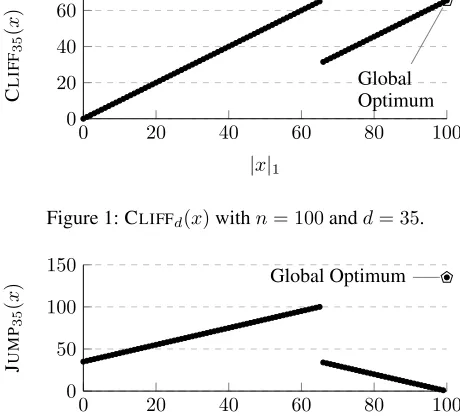
The CLIFFdclass of functions was originally proposed as an example where non-elitist evolutionary algorithms out-perform elitist ones (J¨agersk¨upper and Storch 2007). Func-tions within the class generally lead the optimisation pro-cess to a local optimum, from which a fitness-decreasing mutation can be taken to find another fitness-improving slope leading to the global optimum. An example instance is shown in Figure 1. We define the CLIFFd class of
func-tions (for1< d < n/2) as follows:
0 20 40 60 80 100
0 20 40 60
Global Optimum
|x|1
C
L
IFF
35
(
x
)
Figure 1: CLIFFd(x)withn= 100andd= 35.
0 20 40 60 80 100
0 50 100 150
Global Optimum
|x|1
J
U
M
P35
(
x
)
Figure 2: JUMPm(x)withn= 100andm= 35.
CLIFFd(x) :=
ONEMAX(x) if|x|1≤n−d, ONEMAX(x)−d+ 1/2 otherwise.
As for ONEMAX, the global optimum is placed at the1nbit
string to simplify notation. The parameterd controls both the fitness decrease from the local optimum to the lowest point on the slope leading to the global optimum and the length of this second slope. This class of problems captures real-world problems where local optima have narrow basins of attraction: if it is able to escape from the local optimum, a search heuristic has good chances of identifying a new basin of attraction.
The JUMPm class of functions is similar to CLIFFd, but
has both fitness gradients leading toward the local optima: thus, to find the global optimum, the search algorithm should not only take a fitness-decreasing mutation to escape the lo-cal optimum, but also disregard the fitness gradient in fur-ther iterations. An example instance is shown in Figure 2. We define the JUMPmclass of functions (for1< m < n/2) as follows:
JUMPm(x) :=
n+m if|x|1=n, m+ONEMAX(x) if|x|1≤n−m, n−ONEMAX(x) otherwise.
As for ONEMAX, the global optimum is placed at the1nbit
string to simplify notation. Compared to CLIFFd, this class of functions features a local optimum with a much broader basin of attraction, making it more difficult for the search heuristics to escape the basin and locate the global optimum.
Mathematical Analysis Tools
search heuristic by considering its drift (i.e., its expected de-crease in distance from the optimum in each step). We will apply these theorems throughout the paper for our analyses using the Hamming distance as a measure of distance to the optimum (or another set of target solutions), and write∆(i)
to refer to the drift conditioned on the parent solution con-tainingi1-bits.
The following Additive Drift Theorem provides upper and lower bounds on the expected runtime given, respectively, lower and upper bounds on the drift which hold throughout the process.
Theorem 1(Additive Drift Theorem (He and Yao 2001)). Let{Xt}t≥0be a sequence of random variables over a finite set of statesS ⊆R+0 and letT be the random variable that denotes the first point in time for whichXt= 0. If there exist δu≥δl>0such that for allt≥0, we have
δu≥E(Xt−Xt+1|Xt)≥δl, then the expected optimisation timeE(T)satisfies
X0/δu≤E(T |X0)≤X0/δl, and E(X0)/δu≤E(T)≤E(X0)/δl.
If the drift changes considerably throughout the process, then the following Variable Drift Theorem provides sharper upper bounds on the runtime.
Theorem 2 (Variable Drift Theorem (Johannsen 2010)). Let(Xt)t≥0 be a stochastic process over some state space S⊆ {0} ∪[xmin, xmax], wherexmin>0. Leth(x)be an in-tegrable, monotone increasing function on[xmin, xmax]such thatE(Xt−Xt+1 | Xt ≥ xmin) ≥h(Xt). Then it holds for the first hitting timeT := min{t|Xt= 0}that
E(T|X0)≤ xmin h(xmin)
+
Z X0
xmin
1
h(x)dx.
The Negative Drift Theorem allows to derive exponen-tial lower bounds on the runtime when the drift is negative in large enough areas of the search space (Oliveto and Witt 2011; 2012). The Simplified Drift Theorem with Scaling is a generalised version of the Negative Drift Theorem that al-lows the negative driftεto be sub-constant in magnitude.
Theorem 3(Simplified Drift Theorem with Scaling (Oliveto and Witt 2015)). LetXt,t≥0be real-valued random vari-ables describing a stochastic process over some state space. Suppose that there exist an interval[a, b]⊆Rand, possibly depending on` := b−a, a drift boundε := ε(`)> 0, as well as a scaling factorr:=r(`)such that for allt≥0the following conditions hold:
1. E(Xt+1−Xt|X0, . . . , Xt;a < Xt< b)≥ε,
2. P(|Xt+1−Xt| ≥jr |X0, . . . , Xt;a < Xt) ≤e−jfor allj ∈N0,
3. 1≤r2≤ε`/(132 log(r/ε)).
Then for the first hitting time T∗ := min{t≥0 :
Xt≤a | X0> b} it holds that P(T∗ ≤ eε`/(132r
2)
) =
O(e−ε`/(132r2)).
3
Unimodal Functions
We begin the study of MAHHOI by analysing its perfor-mance on unimodal functions. Since in this setting accept-ing worsenaccept-ing moves is never required, the hyper-heuristic cannot outperform the elitist algorithms. Nevertheless, The-orem 6 shows that MAHHOIcan still be very efficient when optimising ONEMAX, even withp > 0. We first introduce Theorem 4 and Theorem 5, which show that the parameterp
should not be too large.
Theorem 4. The runtime of MAHHOI on ONEMAX(x),
withp≥(√nlog2n)/n, is at leastnΩ(logn)with probabil-ity at least1−n−Ω(logn).
For ONEMAX, the larger the value ofp, the greater the probability of accepting a move away from the global op-timum and the greater the expected runtime of the hyper-heuristic. Applying the standard Negative Drift Theorem (Oliveto and Witt 2011; 2012) for MAHHOIwith any con-stant value ofpgives the following result.
Theorem 5. The runtime of MAHHOIonONEMAX, with p = Θ(1), is at least 2Ω(n) with probability at least 1−
2−Ω(n).
We now provide an upper bound onpfor which the hyper-heuristic is efficient.
Theorem 6. The expected runtime of MAHHOIon ONE -MAX, withp <1/(n−1), is at most
E(Tp)≤ n
1−p(n−1)+
n
1 +p·ln
n
1−p(n−1)
.
If p = 0, we have the well-studied Randomised Local Search (RLS) algorithm, and Theorem 6 gives an expected runtime ofE(T0)≤n+nlnn=O(nlogn). Forp= 1/n,
combining Theorem 6 with a separate argument regarding the time needed to reach a fitness ofnfrom a fitness ofn−
1 (using e.g. Lemma 8) yields aO(nlogn) bound on the expected runtime. Forp= 1
(1+)n with any constant >0,
applying Theorem 6 directly shows that any ONEMAXstyle hillclimbs can be completed in expected timeO(nlogn).
Corollary 7. The expected runtime of MAHHOIonONE -MAX, with p = (1+)n1 , for any constant > 0, is O(nlogn).
For the remainder of the paper, we consider MAHHOI with p = 1
(1+)n. We will show how with this
param-eter value, as well as hill-climbing efficiently, the hyper-heuristics can escape from difficult local optima effectively.
4
When the Hyper-Heuristic is Efficient
We now analyse the CLIFFd(1< d < n/2) class of bench-mark functions. Recall that CLIFFdfeatures a local optimum that the hyper-heuristic must escape before climbing a fit-ness gradient toward the global optimum. We refer to the lo-cal optimum ati=n−das the ‘cliff’, two ONEMAXstyle hillclimbs as the ‘first slope’ and ‘second slope’ respectively (see Figure 1), and usedto denote the ‘length of the cliff’.To find the global optimum of the CLIFFd function, it is
down from the cliff and accepting a worse candidate solu-tion and then climbing up the second slope, or making a pro-hibitive jump to the global optimum on the other side of the cliff (this is possible with standard bit mutation, by requiring expected exponential time in the length of the cliff, but not with local mutations).
We now consider the performance of MAHHOI on CLIFFd. Clearly, withp = 1, MAHHOI reduces to a ran-dom walk across the fitness landscape. Similarly, ifp= 0, with probability at least1/2, the bit-string is initialised with at mostn/21-bits, and will hillclimb to the top of the cliff. There is no improving step from this position and the global optimum cannot be reached. By the law of total expectation, the expected runtime will be infinite. We will show that us-ing MAHHOIwithp = (1+)n1 , which has been shown to hillclimb efficiently (Corollary 7), will still allow worsen-ing moves with sufficiently high probability to be able to move down from the cliff and reach the global optimum in expected polynomial time.
Theorem 9 bounds the expected runtime of MAHHOIon CLIFFd from above. We begin, however, by introducing a helper Lemma, which was proved in (Droste, Jansen, and Wegener 2001), for trajectory based algorithms which can only change the number of 1-bits in the bit-string by 1. The lemma was subsequently used to analyse the perfor-mance of the (1+1) EA for noisyOneMax for small noise strength (Droste 2004). Unlike in noisy optimisation, where the noise represents uncertainty with the respect to the true fitness of solutions, in hyper-heuristics the AM operator is intended to be helpful to the optimisation process by allow-ing the algorithm to escape from local optima.
Lemma 8. (Droste, Jansen, and Wegener 2001, Lemma 3)
LetE(Ti+)be the expected time to reach a state withi+ 1
1-bits, given a state with i 1-bits, and p+i and p−i be the transition probabilities to reach a state with, respectively, i+ 1andi−11-bits. Then:
E(Ti+) = 1
p+i + p−i p+i ·E(T
+ i−1).
Within the context of non-elitist local search algorithms, such as MAHHOI, the transition probabilityp+i (p−i ) refers to the probability of making a local mutation which in-creases (respectively dein-creases) the number of 1-bits in the offspring solution and accepting that solution.
Theorem 9. The expected runtime of MAHHOI on
CLIFFd, with p = (1+)n1 for any constant > 0, is Onlogn+nd23
.
Proof. Letidenote the number of 1-bits in the bit-string at any timet > 0. We wish to bound the expected runtime from above by separately bounding four ‘stages’ of the op-timisation process, each starting once all earlier stages have ended, and ending once a solution with at least certain num-ber of 1-bits has been constructed for the first time during the optimisation process (i.e., the HH may go backwards after-wards yet will remain in the same stage): the first stage ends wheni≥n−dis reached, the second wheni≥n−d+ 1,
the third wheni ≥n−d+ 2, and the fourth wheni=n, i.e., the optimum has been constructed. We useT1, . . . , T4to
denote the number of iterations the algorithm spends in each of these stages, and note that by definition of these stages, the number of iterationsT before the optimum is reached is
T =T1+T2+T3+T4, and by linearity of expectation,
E(T) =E(T1) +E(T2) +E(T3) +E(T4). (1)
In the first stage, while i < n−d, CLIFFd resembles the ONEMAXfunction, and we can use the upper bound for the expected runtime of MAHHOIon ONEMAX withp=
1
(1+)n from Theorem 6. Hence,E(T1) =O(nlogn).
The second stage begins withi ≥n−d, and ends once
i≥n−d+1. Wheni=n−d, there are no improving moves. If the OI operator is selected, there will be no change in the candidate solution. Hence, any move must come from use of the AM operator, which is selected with probability (1+)n1 . A mutation step may either increase the number of 1-bits in the bit-string with probabilityd/n, or decrease the number of 1-bits with probability(n−d)/n. We use Lemma 8 to boundE(T2), the expected time to jump down from the cliff,
E(T2) =E(Tn+−d) =
n2(1 +)
d +
n−d d ·E(T
+ n−d−1).
(2)
We now must boundE(Tn+−d−1). Ati =n−d−1, the drift is as follows:
∆(n−d−1) = d+ 1
n −
1 (1 +)n·
n−d−1
n
= n(d+(d+ 1)) +d+ 1
n2(1 +) ,
as flipping any one of the(d+ 1)remaining 0-bits increases the fitness by 1 and is accepted by either operator, and flip-ping any one of the(n−d−1)1-bits decreases the fitness by 1 and is only accepted if the ALLMOVESoperator is chosen, which occurs with probabilityp= 1/((1 +)n).
Clearly, for all0 ≤ i ≤n−d−1, the drift is bounded from above by the drift ati=n−d−1, while the distance to the required point fromi=n−d−1is 1. By the Additive Drift Theorem (Theorem 1), we have
E(Tn+−d−1)≤1/∆(n−d−1)
= n
2(1 +)
n(d+(d+ 1)) +d+ 1 =O
n
d
.
We can now return to boundingE(T2)in Equation 2:
E(T2) =
n2(1 +)
d +
n−d d ·E(T
+ n−d−1)
= n
2(1 +)
d +
n−d d ·O
n
d
=O n2
d
. (3)
(d−1)/n, the accepted move decreases the number of 1-bits toi=n−di.e., the hyper-heuristic returns to the local optimum. With probability(n−d+1)/n, the accepted move instead increases the number of 1-bits toi=n−d+ 2. We again use Lemma 8 to boundE(T3), the expected time to
take one step up the second slope. Noting thatE(Tn+−d) =
O(n2/d)by Equation 3, we get
E(T3) =E(Tn+−d+1) = n d−1 +
n−d+ 1
d−1 ·E(T
+ n−d)
= n
d−1 +
n−d+ 1
d−1 ·O
n2 d =O n3 d2 .
Ifd = 2, the CLIFFd function will have been optimised at this point. However, for d ≥ 3, it is necessary to climb further up the second slope. If d = 3, we point out that
E(T4) =E(Tn+−d+2), and by applying Lemma 8 bound
E(Tn+−d+2) = n
d−2+ 1 (1 +)n·
n−d+ 2
d−2 ·E(T
+
n−d+1)
= n
d−2+ 1 (1 +)n·
n−d+ 2
d−2 ·O
n3 d2
=n/(d−2) +O n3/d3 .
Ford >3, we know thati=n−d+ 2andi=n−d+ 3
are points on the second slope, and by applying Lemma 8 bound
E(Tn+−d+3) = n
d−3+ 1 (1 +)n·
n−d+ 3
d−3 ·E(T
+
n−d+2)
= n
d−3+ 1 (1 +)n·
n−d+ 3
d−3 ·O
n3 d3
=n/(d−3) +O n3/d4 .
Ford >4this trend will continue as MAHHOIprogresses closer towards the global optimum; in particular, fork < d, we will haveE(Tn+−d+k) = d−nk+Ondk3
.
Hence, E(T4) = P d−1 k=2E(T
+
n−d+k). The terms in
the summation will be asymptotically dominated by the
O(n3/d3) term in E(T+
n−d+2) if d is sub-linear,
giv-ing E(T4|d=o(n))≤d·O(n3/d3) =O(n3/d2).
How-ever, ifdis linear in the problem size, the first terms will dominate, and we will have:
E(T4|d= Θ(n)) =O(1) +
d−1 X
i=2 n
d−i ≤O(1) +
d−1 X
i=0 n d−i
=O(1) +n·
d
X
j=1
1
j =O(nlogn).
Combining the bounds for the sub-linear and lineard, we conclude thatE(T4) =O
nlogn+nd23
.
We now return to our overall runtime bound from Equa-tion 1 and complete the proof:
E(T) =E(T1) +E(T2) +E(T3) +E(T4)
=O
nlogn+n
2
d + n3
d2 +nlogn+ n3 d2
=O nlogn+n3/d2 .
Algorithm 2 METROPOLIS Algorithm (Metropolis et al. 1953)
1: Choosex∈ {0,1}nuniformly at random, setα(n)≥1 2: whiletermination criteria not satisfieddo
3: x0←FLIPRANDOMBIT(x)
4: ∆f ←f(x0)−f(x)
5: if∆f ≥0thenx←x0
6: elseChooser∈[0,1]uniformly at random
7: ifr≤α(n)∆f thenx←x0
Theorem 9 gives an expected runtime bound of MAHHOI on CLIFFd of O nlogn+n3/d2
. This bound is small-est whendis large, suggesting that the algorithm is fastest when the cliff is hardest for elitist algorithms, i.e., a lin-ear cliff length, d = Θ(n), gives an expected runtime of
O(nlogn). This runtime asymptotically matches the best case expected performance of an artificial immune system, which escapes the local optimum with an ageing operator (alsoO(nlogn)in expectation (Corus, Oliveto, and Yazdani 2017)), which is the best runtime known for hard CLIFFd
functions (for problem-independent search heuristics). We suspect MAHHOI is faster in practice (i.e., by decreasing the leading constants in the runtime), but leave this proof for future work. Mutation based EAs have a runtime ofΘ(nd)
for d ≤ n/2 (Paix˜ao et al. 2017); ford = Θ(n), this will give at least exponential runtime in the length of the cliff. Steady-State Genetic Algorithms which use crossover have recently been proven to be faster by at least a linear factor (Dang et al. 2018), but would still require exponential ex-pected runtimes for large cliff lengths.
The worst-case scenario for MAHHOIis a constant cliff length, giving a runtime ofO(n3). This means that the (1+1)
EA will outperform MAHHOIifd < 3, but will be slower for any3< d≤n/2, with a performance gap that increases exponentially with the length of the cliff. For CLIFFd, only an upper bound on the expected runtime of the non-elitist (1,λ) EA is available in the literature:O(n25)ifλis neither
too large nor too small (J¨agersk¨upper and Storch 2007). We can also compare the performance of MAHHOI on CLIFFd with a well-studied non-elitist algorithm. The METROPOLIS algorithm (Algorithm 2) accepts worsening moves with probabilityα(n)f(y)−f(x), for someα(n)≥1,
and accepts all improvements (Metropolis et al. 1953). The-orem 10 shows that MAHHOIwill considerably outperform METROPOLISon CLIFFdfor alld >3.
Theorem 10. The expected runtime of METROPOLIS on
CLIFFdis at leastmin
1 2 ·
n−d+1 d−1 ·
n logn
d−3/2 , nω(1)
.
We have proven that while METROPOLIScannot optimise hard CLIFFd variants in polynomial time, MAHHOIis ex-tremely efficient for hard cliffs, and has an expected runtime ofO(n3)in the worst case.
5
When the Hyper-Heuristic is Inefficient
We now consider the JUMPmfunction class (1< m < n/2)has a harder time escaping the local optimum. Unlike CLIFFd, the fitness decreases on the second slope, making it harder to traverse.
In order to optimise the JUMPmfunction (Figure 2), it is first necessary to reach the local optimum at the top of the slope. Then, either a jump to the global optimum is made, which requires exponential expected time in the length of the jump for unbiased mutation operators, or a jump is made down to the slope of decreasing fitness, which must be tra-versed before the global optimum is found.
Theorem 11. The runtime of MAHHOI on JUMPm, with p=(1+)n1 , is at leastΩ(nlogn+ 2cm), for some constant c > 0 and any constant > 0, with probability at least
1−2−Ω(m).
The following theorem provides an upper bound on the expected runtime by considering the expected time for the MAHHOIto acceptmconsecutive worsening moves from the local to the global optimum.
Theorem 12. The expected runtime of MAHHOI on
JUMPm, with p = (1+)n1 , for any constant > 0, is O nlogn+n2m−1/m
.
Using global mutations to jump can achieve faster ex-pected runtimes. The exex-pected runtime of the (1+1) EA on JUMPm isΘ(nm)(Droste, Jansen, and Wegener 2002),
and a bound on Steady State (µ+1) Genetic Algorithms of
O(nm−1)has recently been proved (Dang et al. 2018), both
outperforming our upper bound for MAHHOI. Recent work has shown that exponential speedups are achieved by an Ar-tificial Immune System and an Evolutionary Algorithm and Genetic Algorithm (GA) with heavy-tailed mutation oper-ators (Corus, Oliveto, and Yazdani 2018; Friedrich, Quin-zan, and Wagner 2018; Doerr et al. 2017) (however, the ex-pected runtime is still exponential inm). A compact GA has polynomial speedups over these algorithms for super-constant jump lengths whenm=o(n)(Hasen¨ohrl and Sut-ton 2018). In particular for logarithmic jump lengths the al-gorithm optimises JUMPmin expected polynomial time. We point out that steady state GAs with diversity mechanisms that enhance the power of crossover can optimise JUMPmin expected timeO(mnlogn+ 4m)for jumps up tom=n/8)
(Dang et al. 2016) and in Θ(nlogn+ 4m) with an unre-alistically small crossover probability ofO(n/m)(K¨otzing, Sudholt, and Theile 2011).
Concerning algorithms that use non-elitism to escape from local optima, we will now show that METROPOLIShas worse performance than MAHHOIon JUMPm. The large fit-ness difference between the two points ati = n−mand
i=n−m+ 1makes METROPOLISunlikely to accept the
i=n−m+ 1point whenα(n)is set high enough to enable efficient hill-climbing of the first slope.
Theorem 13. The runtime of METROPOLISonJUMPm(x) is2Ω(n), with probability at least1−2−Ω(n).
Unlike METROPOLIS, MAHHOI does not consider the magnitude of the fitness difference between two solutions in its acceptance operators. This allows it to optimise JUMPm
with smaller jump sizes, such as m = Θ(1), in expected
polynomial time, while METROPOLISrequires exponential time in expectation in all cases.
6
Conclusions
We have rigorously analysed the performance of the Move Acceptance Hyper-Heuristic (MAHHOI) for multimodal optimisation problems. We have shown that setting the pa-rameter value to p ≤ 1/((1 +)n), for any constant >
0, allows to hillclimb the ONEMAX function in expected
O(nlogn)runtime as desired. On the other hand, for too large parameter values we have shown how the runtime be-comes exponential.
We have also shown that MAHHOIperforms well on mul-timodal landscapes where the candidate solution identifies a gradient of increasing fitness after leaving a local optimum. The CLIFFdfunction class was analysed to provide such an example where MAHHOIexhibits very good performance, matching the best runtime known for problem-independent search heuristics, for instances that are prohibitive for elitist Evolutionary Algorithms and METROPOLIS.
On multimodal functions with long slopes of decreasing fitness that have to be traversed, MAHHOI does not per-form as well. In particular, we analysed the JUMPmfunction class to provide such an example, proving that MAHHOI has a runtime that is exponential in the size of the ‘jump’, with overwhelming probability. However, also the estab-lished non-elitist METROPOLISalgorithm was shown to be inefficient on this benchmark function, with an even worse runtime (i.e., at least exponential in the problem size, with overwhelming probability). The difference is particularly dramatic for small jumps (i.e.,m= Θ(1)), where MAHHOI is able to find the global optimum in expected polynomial time, because unlike METROPOLIS, its acceptance operators do not consider the magnitude of the fitness difference be-tween the parent and offspring solutions.
All the statements given in the paper for MAHHOIalso hold for MAHHIE, a variant of MAHHOI which chooses the IMPROVINGANDEQUALacceptance operator with prob-ability1−p, and the ALLMOVESacceptance operator with probabilityp.
Various avenues can be explored in future work. Firstly, analysing more sophisticated move acceptance operators would give more insight into the behaviour and performance of hyper-heuristics commonly used in literature, such as
Monte Carlo approaches (Ayob and Kendall 2003). Also, implementing learning mechanisms within the MAHHOI, such that it could ‘learn’ to prefer a certain operator in certain parts of the fitness landscape similarly to the hyper-heuristic introduced in (Doerr et al. 2018) for muta-tion operator selecmuta-tion, should be considered. Furthermore, MAHHOI should be analysed on classical problems from combinatorial optimisation with real-world applications. Fi-nally, more comprehensive hyper-heuristics that choose be-tween multiple parameter sets, including the population size, should be analysed.
References
Alanazi, F., and Lehre, P. K. 2014. Runtime analysis of se-lection hyper-heuristics with classical learning mechanisms. InProc. of CEC ‘14, 2515–2523. IEEE.
Ayob, M., and Kendall, G. 2003. A monte carlo hyper-heuristic to optimise component placement sequencing for multi head placement machine. InProc. of InTech ‘03, 132– 141.
Bilgin, B.; ¨Ozcan, E.; and Korkmaz, E. E. 2007. An exper-imental study on hyper-heuristics and exam timetabling. In
Proc. of PATAT ‘07, 394–412. Springer.
Burke, E. K.; Hyde, M.; Kendall, G.; Ochoa, G.; ¨Ozcan, E.; and Woodward, J. R. 2010. A classification of hyper-heuristic approaches. InHandbook of Metaheuristics. Springer. 449–468.
Burke, E. K.; Gendreau, M.; Hyde, M.; Kendall, G.; Ochoa, G.; ¨Ozcan, E.; and Qu, R. 2013. Hyper-heuristics: A survey of the state of the art.J. Op. Res. Soc.1695–1724.
Corus, D.; Oliveto, P. S.; and Yazdani, D. 2017. On the runtime analysis of the opt-IA artificial immune system. In
Proc. of GECCO ’17, 83–90. ACM.
Corus, D.; Oliveto, P. S.; and Yazdani, D. 2018. Fast ar-tificial immune systems. In Proc. of PPSN ‘18, 67–78. Springer.
Cowling, P.; Kendall, G.; and Soubeiga, E. 2001. A hyper-heuristic approach to scheduling a sales summit. InProc. of PATAT ‘01, 176–190. Springer.
Cowling, P.; Kendall, G.; and Soubeiga, E. 2002. Hyper-heuristics: A tool for rapid prototyping in scheduling and optimisation. InProc. of EvoWorkshops ‘02, 1–10. Springer. Dang, D.-C.; Friedrich, T.; K¨otzing, T.; Krejca, M. S.; Lehre, P. K.; Oliveto, P. S.; Sudholt, D.; and Sutton, A. M. 2016. Escaping local optima with diversity mechanisms and crossover. InProc. of GECCO ’16, 645–652. ACM. Dang, D.; Friedrich, T.; K¨otzing, T.; Krejca, M. S.; Lehre, P. K.; Oliveto, P. S.; Sudholt, D.; and Sutton, A. M. 2018. Escaping local optima using crossover with emergent diver-sity. IEEE Trans. Evol. Comp.22(3):484–497.
Doerr, B.; Le, H. P.; Makhmara, R.; and Nguyen, T. D. 2017. Fast genetic algorithms. InProc. of GECCO ’17, 777–784. ACM.
Doerr, B.; Lissovoi, A.; Oliveto, P. S.; and Warwicker, J. A. 2018. On the runtime analysis of selection hyper-heuristics with adaptive learning periods. In Proc. of GECCO ’18, 1015–1022. ACM.
Doerr, B.; Sudholt, D.; and Witt, C. 2013. When do evolu-tionary algorithms optimize separable functions in parallel? InProc. of FOGA ’13, 51–64. ACM.
Droste, S.; Jansen, T.; and Wegener, I. 2001. Dynamic pa-rameter control in simple evolutionary algorithms. InProc. of FOGA ‘01. ACM. 275 – 294.
Droste, S.; Jansen, T.; and Wegener, I. 2002. On the analysis of the (1+1) evolutionary algorithm.Th. Comp. Sci.51–81. Droste, S. 2004. Analysis of the (1+1) EA for a noisy one-max. InProc. of GECCO ’04, 1088–1099. Springer.
Friedrich, T.; Quinzan, F.; and Wagner, M. 2018. Escaping large deceptive basins of attraction with heavy-tailed muta-tion operators. InProc. of GECCO ’18, 293–300. ACM. Hasen¨ohrl, V., and Sutton, A. M. 2018. On the runtime dy-namics of the compact genetic algorithm on jump functions. InProc. of GECCO ’18, 967–974. ACM.
He, J., and Yao, X. 2001. Drift analysis and average time complexity of evolutionary algorithms. Artif. Intel.
127(1):57–85.
J¨agersk¨upper, J., and Storch, T. 2007. When the plus strategy outperforms the comma strategy and when not. InProc. of FOCI ’07, 25–32. IEEE.
Johannsen, D. 2010. Random combinatorial structures and randomized search heuristics. Ph.D. Dissertation, Univer-sit˝at des Saarlandes, Saarbr˝ucken.
K¨otzing, T.; Sudholt, D.; and Theile, M. 2011. How crossover helps in pseudo-boolean optimization. In Proc. of GECCO ’11, 989–996. ACM.
Lehre, P. K., and ¨Ozcan, E. 2013. A runtime analysis of simple hyper-heuristics: To mix or not to mix operators. In
Proc. of FOGA ’13, 97–104. ACM.
Lehre, P. K., and Witt, C. 2012. Black-box search by unbi-ased variation.Algorithmica623–642.
Lissovoi, A.; Oliveto, P. S.; and Warwicker, J. A. 2018. Simple Hyper-heuristics Optimise LeadingOnes in the Best Runtime Achievable Using Randomised Local Search Low-Level Heuristics . ArXiv e-prints.
Metropolis, N.; Rosenbluth, A. W.; Rosenbluth, M. N.; Teller, A. H.; and Teller, E. 1953. Equation of state cal-culations by fast computing machines. J. of Chem. Phys.
1087–1092.
Oliveto, P. S., and Witt, C. 2011. Simplified drift analy-sis for proving lower bounds in evolutionary computation.
Algorithmica369–386.
Oliveto, P. S., and Witt, C. 2012. Erratum: Simplified drift analysis for proving lower bounds in evolutionary computa-tion. CoRRabs/1211.7184.
Oliveto, P. S., and Witt, C. 2015. Improved time complexity analysis of the simple genetic algorithm. Th. Comp. Sci.
605:21–41. ¨
Ozcan, E.; Bilgin, B.; and Korkmaz, E. E. 2006. Hill climbers and mutational heuristics in hyperheuristics. In
Proc. of PPSN ‘06, 202–211. Springer.
Paix˜ao, T.; P´erez Heredia, J.; Sudholt, D.; and Trubenov´a, B. 2017. Towards a runtime comparison of natural and artificial evolution.Algorithmica681–713.