DISCUSSION
Considerations of temperature in the
context of the persistence classification
in the EU
Michael Matthies
1*and Sabine Beulke
2Abstract
Simulation degradation studies for industrial chemicals, biocidal products and plant protection products are required in the EU to estimate half-lives in soil, water and sediment for the comparison to persistence criteria for hazard (P/vP) assessment, and for use in exposure assessments. There is a discrepancy between European regulatory approaches regarding the temperature at which degradation half-lives should be (1) measured in simulation degradation testing of environmental compartments, and (2) compared to the P/vP criteria. In this paper, an opinion is provided on the options for the experimental temperature and extrapolation to other conditions. A review of the historical develop-ment of persistence criteria did not give conclusive evidence of the temperature at which the half-lives that underpin the P-criteria were measured, but room temperature is likely. Half-lives measured at 20 °C are in line with the inten-tions of some international agreements, but in the EU there is a continued political debate regarding the relevant temperature for comparison with persistence criteria. Measuring degradation at 20 °C has the advantage that metab-olites/transformation products can be identified with greater accuracy, and that kinetic fits to determine half-lives for parent compounds and metabolites carry less uncertainty. Extrapolation of half-lives to lower temperatures is possible for assessing environmental exposure, but the uncertainty of the persistence classification is smaller when measured half-lives are used for direct comparison with P/vP criteria, without extrapolation. Model simulations demonstrate the pattern of concentrations that can be expected for realistic worst case climate scenarios in the EU based on the half-life of 120 days in soil at 20 °C and of 40 days in water at 20 °C, and their temporal and spatial variability.
Keywords: PBT assessment, Exposure assessment, Environmental temperature, Hazard, Degradation simulation testing, Persistence criteria, Arrhenius equation, Temperature normalisation
© The Author(s) 2017. This article is distributed under the terms of the Creative Commons Attribution 4.0 International License (http://creativecommons.org/licenses/by/4.0/), which permits unrestricted use, distribution, and reproduction in any medium, provided you give appropriate credit to the original author(s) and the source, provide a link to the Creative Commons license, and indicate if changes were made.
Background
Classification of a chemical as being persistent (P), bio-accumulative (B) and toxic (T) or very persistent (vP) and very bioaccumulative (vB) is an integral part of the chemical legislation in the European Union (EU). PBT/ vPvB substances can give rise to specific concerns due to their potential to accumulate in parts of the environ-ment, which is in practice difficult to reverse and the effects of such accumulation are unpredictable in the long-term [15]. Criteria for PBT/vPvB hazard assessment
are laid down in the European regulation for industrial chemicals registered under REACH [23], biocidal prod-ucts [25], plant protection products (PPP) [24], and vet-erinary medicines [21]. These criteria are identical across European regulatory frameworks but the consequences are quite different [36]. Guidance for PBT/vPvB assess-ment of industrial chemicals and biocidal products has been provided since 2003 in Technical Guidance Docu-ments and their revisions [12, 13, 15, 17, 26]. Although chlorinated PPPs have been amongst the first acknowl-edged POPs (persistent organic pollutants), PBT/vPvB assessment of PPP was only introduced in 2009 with the new regulation EC 1107/2009 [24], but no guidance was provided on how to conduct a PBT/vPvB assessment [46]. A working document was issued by DG [10] which
Open Access
*Correspondence: [email protected]
1 Institute of Environmental Systems Research (USF), University of Osnabrück, 49069 Osnabrück, Germany
laid down the evidence needed to identify POP, PBT and vPvB properties for PPPs.
For persistence classification in the EU, degradation half-life criteria have been defined for fresh, estuarine and marine waters and sediments and for soil (Table 1). How-ever, it is not clear what the relevant conditions are for the half-lives to be compared with persistence criteria. In par-ticular, temperature has a great influence on the degrada-tion half-lives in water, sediment and soil since (bio) chemical reactions are temperature dependent. For PPP, a reference temperature of 20 °C is recommended and degra-dation half-lives1 should be normalised to this temperature
if the study has been undertaken at a different temperature [10]. On the other hand, a temperature of 12 °C as a stand-ard environmental characteristic and 9 °C for abiotic marine degradation has been proposed for industrial chemicals and biocidal products [15, 16, 26]. Moreover, the temperature at which chemicals should be tested in labora-tory simulation studies is still a matter of discussion and is related to the method of extrapolation to other tempera-tures. Thus, there is a discrepancy between the various European regulatory approaches regarding the temperature at which degradation half-lives should be [1] tested in sim-ulating degradation testing of environmental compart-ments, and [2] compared to the P/vP criteria of Table 1.
The objectives of the paper are to provide an opinion on the following:
• The temperature at which the half-life should be measured for P/vP assessment.
• How the half-life should be derived (measure at 20 °C or measure at 12 °C and then extrapolate to 20 °C).
• How the extrapolation should be undertaken and under which conditions it is valid.
Environmental exposure and hazard (PBT/vPvB) assessment in the EU
Exposure assessment
Degradation half-lives in water, sediment and soil are not only required as hazard properties in PBT/vPvB assessment, but also as input data for environmental and indirect human exposure and risk assessment. For this purpose, specific exposure scenarios and environmental transport and fate models have been developed and used for the calculation of predicted environmental concen-trations (PECs) in air, water, soil and sediment. The envi-ronmental risk is characterised by dividing these PECs by appropriate PNECs (predicted no-effect concentrations)
1 The time for 50% decline in the initial mass by degradation and/or other loss mechanisms is referred to in the literature as DT50, DegT50, half-life or t½. Throughout this article, half-life is used and this is abbreviated as t½.
or by calculating Toxicity Exposure Ratios. For indus-trial chemicals and biocides, the Guidance on Informa-tion Requirements and Chemical Safety Chapter R.16 [14] details the methodology of environmental exposure estimation and the role of degradation half-lives. It is obvious that PECs should be calculated at the relevant temperature for the exposure models employed. A refer-ence temperature of 12 °C is defined as average outdoor temperature in Europe and 9 °C as average temperature of marine waters.
However, degradation has only a limited impact on cal-culated PECs of industrial chemical and biocidal prod-ucts. Degradation rate constants are input parameters for the calculation of PECregional and PEClocal for soil, but not for sediment and surface water, which is the receiving compartment for almost all industrial chemicals and bio-cides. Moreover, half-lives for biodegradation in surface water based on results of screening tests on biodegrada-bility or (Q)SAR calculations do not need to be corrected for different environmental temperatures. Thus, tempera-ture correction of degradation half-lives has only a minor influence on exposure and risk assessment for industrial chemicals and biocides.
For active substances of PPP, approved versions of FOCUS simulation models and FOCUS scenarios are used to calculate the concentrations in groundwater [27] and surface water [29] in the EU review process [24]. Degradation half-lives for soil, surface water and sedi-ment are used as input parameters and these are adjusted to half-lives at the actual temperature on each day of the simulation period for the various European scenarios. Annual average temperatures range from 8 °C in north-ern to 18 °C in southnorth-ern countries [27, 29]. Thus, the variability across the European climate zones is explicitly taken into account in the environmental exposure assess-ment, which makes an average European outdoor tem-perature obsolete for PPP. Regional distribution models are not part of exposure assessment of PPP.
Hazard assessment
In chemical hazard assessment, intrinsic substance properties are directly compared to pre-defined criteria without any of the processing that is done in exposure
Table 1 Criteria for the classification as P or vP [23]
Criteria for persistence (P) Criteria for very persistent (vP)
Marine water: t½ > 60 days Fresh and estuarine water: t½ > 40 days
Marine sediment: t½ > 180 days
Fresh and estuarine sediment: t½ > 120 days Soil: t½ > 120 days
Water: t½ > 60 days Sediment:
models. These criteria are regarded as independent of the intended use, emission volume and mode of entry into the environment. Thus, there is a fundamental dif-ference in environmental exposure and PBT/vPvB hazard assessment: (1) in environmental exposure assessment, concentrations are predicted by taking account of simul-taneous processes of transport, distribution and deg-radation in and between representative environmental compartments at conditions relevant for the EU [15]; (2) in PBT/vPvB assessment, hazardous substance prop-erties are compared to numerical and narrative crite-ria, which are based upon available data for reference chemicals, derived under laboratory conditions, and consensus-based policy discussions [1]. Thus, the scien-tific background as well as the political intentions and assumptions under which the criteria have been derived are of utmost significance.
Reference temperature for persistence criteria in P/ vP assessment
A brief summary of the historical development of persis-tence criteria is provided with particular consideration of temperature.
Non‑EU regulations and international agreements
Development of criteria for classification of persistent toxic substances goes back to the 70s of the last century. They evolved over the last decades due to the diversifica-tion of the protecdiversifica-tion aims under various nadiversifica-tional regu-latory frameworks and international agreements [34]. Japan was the first nation regulating PCBs and other chloro-organic compounds by assessing their P, B, and T properties [35]. However, they did not define criteria for a formal assessment process. Canada and the USA recognised the need for elimination of persistent toxic substances from the Great Lakes and introduced the con-cept of half-life of a substance in water as a measure (cri-terion) for persistence [31, 50]: “Half-life means the time required for the concentration of a substance to diminish to one-half of its original value in a lake or water body”. They also defined a numerical value for the persistence criterion: “Persistent toxic substance means any toxic substance with a half-life in water of greater than eight weeks” [31, 50]. With the beginning of the 90s, various international commissions and North-American national institutions developed further the concept of environ-mental half-lives as persistence criteria and extended it to other environmental compartments (air, soil, sedi-ment, ground water). An ad hoc science group of Envi-ronment Canada [22] reviewed degradation half-lives of a set of critical substances, mainly hydrophobic neutral organic compounds, such as PCBs, PAHs, PCDD/Fs. Sci-entific judgement was used to assign numerical values
(half-lives) of 6 months in water and soil and 1 year in sediment, respectively, which became legally bind-ing with the Canadian Environmental Protection Act [8]. The different half-lives reflect the persistence data available for the set of neutral hydrophobic reference chemicals, against which a chemical is to be compared. The group stated that “…under Canadian climate condi-tions 6 months is a reasonable window of time in which soil temperature and moisture favour biodegradation of many substances”.
With the evidence of long-range transboundary trans-port (LRT) of chemicals, broader international activities were launched for regulating persistent organic pollut-ants (POPs) [47, 49]. The specified half-life in water of 60 days was not based on new scientific findings or dif-ferent environmental temperatures to be considered but was a compromise with a simultaneous decision for a bioconcentration factor (BCF) of 5000. The UNEP Crite-ria Expert group on POPs [48] stressed the need for the development and improvement of relevant test meth-ods and recommended that the International Standards Organization (ISO) and the Organisation for Economic Cooperation and Development (OECD) undertook efforts to ensure that such needs concerning new and improved test methods were better met. Up to this point, temperature has not been explicitly considered for screening of chemicals based on their persistence accord-ing to the criteria in Annex D of the Stockholm Conven-tion [49].
USEPA [51, 53] reviewed persistence criteria defined in various international agreements and national regula-tions and specified a lower boundary of 60 days for mod-erate action and an upper boundary of 180 days for high action without consideration of specific environmental compartments and conditions. A half-life of 60 days was chosen because the initial concentration of a released chemical drops to approximately 1% within 1 year, i.e. six half-lives. Soil biodegradation is tested at 22 ± 2 °C [52].
An international expert group at the SETAC Pellston workshop “Science-Based Guidance and Framework for the Evaluation and Identification of PBTs and POPs” stated that “It is reasonable to assume that persistence criteria, defined according to the reference chemi-cal approach, are related to available half-life data for known POPs. Because these half-lives are likely to have been derived under laboratory conditions, these are the conditions for which the comparison should take place. According to the reference chemical approach, tempera-ture correction, therefore, does not seem justified” [7].
EU regulations
the environment [40, 41]. A half-life of 50 days in marine waters was defined as the only persistence criterion with-out further specification of the test methods and condi-tions, e.g. temperature. Around the year 2000, several papers and statements dealt with the temperature rel-evant for European climate conditions. The Swedish Committee on New Guidelines on Chemicals Policy [9] proposed that “a substance is regarded as unacceptably persistent if its half-life is longer than 8 weeks in a simu-lation test at 20 °C”. This life corresponds to a half-life of 1 year in the northern European climate (average annual temperature of 5 °C) and takes into account unfa-vourable degradation conditions. Sinkkonnen and Paas-sivirta [45] suggested degradation half-times for POPs as input parameters to the Baltic Sea model assuming an annual average temperature of 7 °C. Beyer et al. [5] could demonstrate that the LRT potential can monotonically increase or decrease with increasing temperature, or it can have a maximum in the temperature range between 5 and 30 °C.
The Technical Guidance Document (TGD) on Risk Assessment [26] added a new chapter on marine risk assessment, which also contains a subchapter on PBT assessment. Consequently, only criteria for water systems (fresh and marine waters and sediments) were defined (Table 1) in 2003, but not for soil. The numerical values for marine water (60 days) and sediment (180 days) as well as those for vP assessment are identical with those of international agreements, but for those fresh water (40 days) and fresh water sediment (120 days) are smaller. European outdoor temperature was not taken into con-sideration when defining the criteria.
PBT/vPvB assessment became legally binding with the release of REACH [23], which laid down the persis-tence criteria from the TGD [26] plus a half-life in soil of 120 days, which is shorter than in the international agreements. Again, the relevant temperature (and other environmental conditions) for testing persistence was not defined in the regulation. In the first version of the Guidance in Information and Chemical Safety Assess-ment Chapter R.11 [12], nothing is said on the relevant temperature for persistence testing. In version 2.0 of the Guidance Chapter R.11 [15], one sentence relates to temperature: “Please note that since its 32nd meeting the Member State Committee has started to require new simulation degradation studies to be carried out around neutral pH values and at 12 °C, which is understood as the mean temperature of European surface waters”. The draft version 4.0 of the Guidance Chapter R.7b Endpoint specific guidance [16] states that “New simulation stud-ies should be conducted at environmentally relevant tem-peratures namely at 12 °C as this is seen as the average surface water temperature for the European Union (9 °C
for sea water). If information on degradation half-life is already available from existing simulation degradation tests performed at a higher temperature, they should be normalised to a half-life corresponding to 12 °C by using the Arrhenius equation”. A generic activation energy of 65.4 kJ mol−1 is proposed which has been derived by EFSA [19] (see below). The draft version 3.0 of the Guid-ance Chapter R.11 PBT/vPvB assessment [17] refers to this statement. Simulation degradation studies should be performed according to the OECD guidelines no. 307 for aerobic degradation in soil [37], no. 308 for anaerobic and aerobic transformation in water and sediment [38] and no. 309 for aerobic mineralisation in surface water [39]. However, Honti and Fenner [30] concluded that available OECD 308 data are insufficient to derive persistence indi-cators that had both acceptable robustness and uncer-tainty. Rauert et al. [42] proposed “…normalising DegT50 values to 12 °C because this temperature is established or suggested under the majority of frameworks (i.e. Bioc-ides Regulation, REACH and medicinal products Direc-tives)”. However, the guidance for PBT/vPvB assessment is the same for the three mentioned frameworks. For PPP, DG [10] stated in its Working Document on “Evidence needed to identify POP, PBT and vPvB Properties for Pesticides”: “Laboratory studies: DT50 values should be normalised to a temperature of 20 °C, as this is the cur-rent practice in recent assessments of soil degradation rates of active substances”. This Working Document has been applied for the initial establishment of the list of candidates for substitution [11] as required in Article 80 [7] of Regulation (EC) No 1107/2009 [24], i.e. half-lives at 20 °C have been considered when the list was compiled.
QSAR approaches
selected “training set” chemicals and evaluated the out-come of this calibration with environmental aerobic bio-degradation data of a set of 115 chemicals. Although it is not explicitly stated at which temperature biodegradation half-lives were determined, room temperature for labo-ratory and summer temperature for field measurements can be assumed. Regression analysis was undertaken to identify statistical relationships between biodegradability and basic properties. As the QSAR models were trained using data on biodegradation half-lives at room tempera-ture, any predictions will also refer to this temperature. Temperature correction of the results of biodegradabil-ity testing and BIOWIN calculations is not required for screening information [15].
Overall persistence
Persistence criteria are based on the hazardous proper-ties of hydrophobic neutral reference chemicals. Under this approach, it is assumed that the objective of the P assessment is to avoid chemicals similar to known PBTs such as PCBs. These known PBTs have different half-lives in different media. Degradation in water is assumed to be faster than in soil and sediment. An alternative approach, called management approach [7, 43] is to attempt to limit the overall residence time of a chemical in the environ-ment as the goal of the assessenviron-ment scheme. The overall residence time or the reciprocal overall persistence, Pov, can be calculated by a multimedia model, which takes into account environmental degradation as well as distri-bution [33, 44]. The objective is to control the presence of chemicals in the environment and not to compare half-lives against a pre-defined set of media-specific criteria. Thus, average environmental temperature could be con-sidered in multimedia modelling as it is done for calcula-tion of PECregional [15].
Accumulation in the environment
The main concern underlying the persistence assessment is resistance to degradation processes and accumulation in soil, water or sediment causing unexpected long-term effects on living organisms. The regulatory P-criteria must ensure that this concern does not materialise, with a sufficient margin of safety.
This was explored for a reference temperature of 20 °C assuming realistic worst case soil/climate/crop scenarios in the EU developed by EFSA [18]. The aver-age annual air temperature for the scenarios relevant to total soil in the Northern, Central and Southern European Zone is 4.7, 8.0 and 11.0 °C, respectively. A PPP with a half-life of 120 days at 20 °C was assumed to be applied at each location to a winter cereal crop every year for 20 years, or every 3 years for 45 years. Triennial application is common for PPP as these are
often specific to certain agricultural crops, and these crops are grown in a rotation with other crops which are treated with different products. Concentrations of the PPP in soil were calculated using the FOCUS model PELMO [32], an exposure model that is well accepted in the regulatory framework [27] and which consid-ers extrapolation of the degradation rate constants to the respective temperature values in the soil on a daily basis. The scenario parameterisation for this model is provided by EFSA [20]. The climate conditions reflect actual conditions over multiple years at the scenario sites and change throughout the simulation period in order to account for the natural variability between dif-ferent years at the same location. Figure 1 shows that the rate of decline in concentrations after application differs between the various years, and even within a single year as a result of the temporal variation in the climate. The calculations were continued for a number of years after the last application.
Figure 1 (upper panel) shows that the maximum and minimum simulated total concentration in soil reached just after an application initially increases year-on-year, because there is some residual chemical left from the previous application the year before. It is a mathemati-cal consequence of first-order degradation that the mini-mum and maximini-mum concentrations stabilise at a certain level over time, if the frequency and magnitude of the emission remain constant. The levels, and the time at which stabilisation occurs, depend on the half-life and the actual environmental conditions. Figure 1 (upper panel) shows the pattern of concentrations that can be expected for realistic worst case soil/climate/crop scenarios in the EU based on the half-life of 120 days in soil at 20 °C, con-sidering the temporal and spatial variability. The build-up of concentrations in soil stabilises after 6, 8 and 10 years in the Southern, Central and Northern zone, respectively. Thus, there is a range of 8 ± 2 years, i.e. the variability in the time after which the plateau is reached in the three zones is 25% (coefficient of variation, CV). The simulated minimum residues before the next application stabilise at around 6 mg/kg soil in the Southern climate zone, 10 mg/ kg soil in the Central zone and 16 mg/kg in the North-ern zone, this corresponds to a CV of 47%. The CV of the simulated maximum concentrations (approximately 13, 20 and 27 mg/kg soil in the three climate zones) is 35%. These CVs reflect the spatial variability between the three zones.
after the last release; the concentrations in soil decline steadily to negligible levels within a few years.
Additional calculations were undertaken for a hypo-thetical compound discharged to EU surface waters (Fig. 2). The chemical has a half-life for fresh water of 40 days and for sediment of 120 days at 20 °C. The
FOCUS surface water model TOXSWA was used to cal-culate the mass of the chemical in water and sediment of a pond and a ditch for two of the FOCUS locations with annual average temperatures of 12.1 and 16.7 °C [29]. The model adjusts the half-life to the actual daily temperature of the scenario. The chemical was discharged into the
Fig. 1 Concentration of a PPP with a half-life of 120 days at 20 °C in soil calculated for the EFSA soil scenarios in the Northern, Central and Southern Regulatory Zones [18, 20] for annual (top panel) and triennial application (bottom panel)
water once a year for 10 years with variable climate con-ditions. Figure 2 shows that even in a static pond there is no long-term increase of the annual maximum mass in the water, very limited increase in the sediment over the 10 years and the chemical disappears within a few years of the last emission.
Experimental temperature to determine degradation half‑lives
The purpose of simulation degradation testing in the con-text of the P-classification is to determine a half-life for comparison with the persistence criteria defined by the EU regulations. In principle, tests could be undertaken at any temperature within the ranges given in the test guidelines and the resulting half-lives could be adjusted to other temperatures using correction procedures. How-ever, this extrapolation carries some uncertainties. It is therefore advantageous to undertake the test at the actual temperature of interest (20 °C is appropriate for the P-criterion) and avoid the need for extrapolation. There are additional advantages of a test temperature of 20 °C and these are discussed below.
Practical considerations and comparability with existing data
Historically, degradation tests for PPP regulatory pur-poses have been undertaken at 20 °C, with few stud-ies at 10 °C. This is partly for practical reasons. There is a much wider availability of laboratory test facilities to study degradation at 20 °C than at lower temperatures, less risk of study temperatures to deviate from the target, and the costs are reduced. There is now a large database of experimental half-lives at 20 °C (e.g. The University of Hertfordshire Pesticide Properties Database, http:// sitem.herts.ac.uk/aeru/ppdb/en/index.htm). This allows benchmarking of results for new chemicals against the existing data.
Uncertainties in the half‑lives
Half-lives are derived by fitting kinetic models to chemi-cal residues plotted against time. The FOCUS work group on degradation kinetics [28] gives guidance on how to undertake the model fitting. The group stressed that the data set must be of sufficient quality to clearly establish the dissipation pattern. It is difficult to obtain robust kinetic fits to data that decline slowly over time. In these cases, the confidence intervals of the estimated degrada-tion rate constants are often large, indicating parameter uncertainty. This is because there is not enough infor-mation inherent in the data to obtain a reliable estimate of degradation. At low temperatures, the study period is simply too short to give a sufficient decline in the
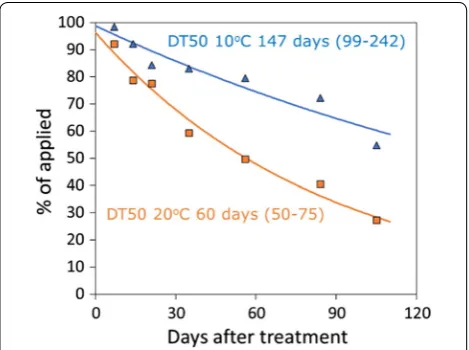
residues beyond the half-life. A test temperature of 20 °C causes a faster decline of the residues and allows a more reliable kinetic analysis. This is illustrated in Fig. 3 using hypothetical data. The graph shows an example fit of first-order kinetics to the mass of a chemical measured at 10 and 20 °C. The 95% confidence interval of the half-life at 10 °C is 99–242 days, this is much wider than the con-fidence interval at 20 °C of 50–75 days.
For a robust assessment of the degradation rate con-stant, the residues should ideally decline to 10% by the end of the study, but at least reach the half-life (i.e. 50% of initial mass or less). The typical study period of 120 days is long enough to reach the half-life in soil of non-per-sistent substances at a test temperature of 20 °C. If 12 °C or even 9 °C was used as the reference temperature for the P-criterion, then the P-criterion for soil would have to be much longer. The experimental period could be extended, but this might lead to an undesirable loss of biological activity and additional costs. It is thus much more straightforward to discriminate between persis-tent and non-persispersis-tent substances at a test temperature of 20 °C. Uncertainties in the optimisation could lead to an under-estimation of the half-life and this could result in an incorrect classification of a substance as non-per-sistent when it is in fact pernon-per-sistent, or vice versa. Where a geometric mean or other form of average is calculated from several half-lives of the same substance, it is impor-tant that the individual estimates are accurate because the uncertainty of each estimate is propagated into a greater uncertainty of the average. As it is easier to obtain robust half-lives at 20 °C, this is the preferred experimen-tal temperature.
Identification and quantification of metabolites
At higher temperatures, metabolites are formed at larger quantities and earlier in the study period. Breakdown products that are classified as major metabolites at 20 °C may not be detected at all at 10 °C. Deriving robust half-lives for metabolites at 10 °C will often be impossible. Performing the test at 20 °C will avoid having to carry out two experiments, one to derive the half-life of the parent compound and one to detect and identify metabolites. This will not only save experimental effort, but also time for kinetic analysis and reporting, regulatory evaluation and decision making.
Extrapolation to other temperatures
The relationship between the degradation rate constant and temperature is often described by the Arrhenius or similar equations [19]. The Arrhenius equation assumes that the first-order rate constant of degradation depends on the activation energy Ea of the reaction and the
tem-perature at which the reaction occurs.
k = degradation rate constant [d−1]. A = factor equal to the rate coefficient at infinite temperature [d−1]. E
a = activation energy [kJ mol−1]. R = gas
con-stant = 0.008314 [kJ mol−1 K−1] and T = absolute tem-perature [K].
The degradation half-life is related to the degradation rate constant by ln (2)/k. The experimental half-life can be extrapolated to the temperature of interest using this relationship:
t ½ (T) = half-life at experimental temperature T [days] and t ½ (Tref) = half-life at temperature of interest Tref
[days].
The equations could in principle be used to adjust a half-life measured at 20 °C in a degradation simulation test to a half-life at any other temperature, for example 12 °C. ECHA [15, 16] guidance recommends a simplified version of the equation shown here to correct from the experimental temperature to 12 °C:
The validity of the Arrhenius equation has been dis-cussed extensively. It is based on the concept that a certain amount of energy (i.e. the activation energy) is needed for a chemical reaction to occur. In surface waters, sediment and soils, chemical breakdown is mediated by a number of different reactions, including
k=A exp−
Ea RT
.
t1/2(Tref)=t1/2(T)exp
Ea R
1 Tref−T1
t1/2
12◦C
=t1/2
T ◦C
exp(0.08[T◦C−12◦C]).
cleavage of molecules by enzymes released by micro-organisms, photolytic and hydrolytic reactions. These reactions will not all have the same activation energy. Microbial transformations further depend on the abun-dance and activity of micro-organisms and the stability of enzymes which are also related to temperature. The tem-perature at which micro-organism is most active can vary from species to species.
The composition of the microbial population is not the same in all surface waters, sediments and soils. The potential for microbial degradation of chemicals will, therefore, also vary between biological systems. The interesting question is: even if the various systems have a different absolute level of microbial activity, is the relative change of this activity as a result of changing temperature the same in all systems? This question can be split into two aspects: (i) is the shape of the temperature response (linear, exponential, etc.) the same in all systems, i.e. can the same type of equation be used to describe this response, and (ii) are the parameters of the response curve the same in all systems? In the context of this opin-ion paper, this translates to the following: (i) is the Arrhe-nius equation valid in all systems, and (ii) is the activation energy the same?
For PPP, there is a wealth of experience with the use of the Arrhenius equation from the research and regu-latory context. There is a large body of evidence that degradation in the field can be well predicted based on the Arrhenius equation if the difference in tempera-ture between field and laboratory is taken into account. EFSA [19] collated a large number of degradation stud-ies for PPP in soil conducted at different temperatures and fitted the Arrhenius equation to the half-lives. They concluded that the Arrhenius equation is valid over the temperature range from 0 to 30 °C. This was based on an analysis of 56 datasets. The frequency distribution of activation energies from 99 datasets had a median of 65.4 kJ mol−1. This activation energy was recommended by EFSA as a generic value for the temperature extrap-olation within the exposure assessment for PPP. How-ever, it was acknowledged that the activation energy for the temperature response of PPP degradation can vary from compound to compound. Variations in tempera-ture response parameters have also been found by Bagi [4] for hydrocarbon biodegradation in marine environ-ments. Alidina et al. [2] observed that the temperature response of chemical attenuation of trace organic chemi-cals in managed aquifer recharge systems depended on the compound.
Where extrapolation is necessary, the option which introduces the least uncertainty into the decision mak-ing is preferred. For industrial chemicals and biocides, we have two options regarding the regulatory assess-ment: (i) measure the half-life at 20 °C and use this for comparison with the P-criterion, extrapolate to 12 °C for the risk assessment, or (ii) measure at 12 °C and use this half-life in the risk assessment, extrapolate to 20 °C for comparison with the P-criterion. Option (i) would lead to a more accurate half-life for the persistence assessment. There would be some uncertainty in the risk assessment for industrial chemicals and biocidal products, but this uncertainty is overruled by the many other uncertainties inherently contained in exposure modelling. Moreover, the impact of degradation half-lives on exposure mod-elling outcome, i.e. PECs, is less relevant than for the P-assessment (see above). Option (ii) on the other hand places the uncertainty into the half-life used for compari-son with the P-criterion. This has a much greater impact on the decision making particularly for PPP where the exceedance of the P-criteria could mean that there is no further assessment and the product cannot be registered. Therefore, on balance, it is preferred to measure at 20 °C and extrapolate to 12 °C if necessary. In the exposure assessment for PPP, an extrapolation is undertaken from the temperature at which the simulation tests are under-taken to the actual daily temperature in multi-year mod-elling scenarios for various European locations. Here, the uncertainty will be greater if the half-life is extrapolated to temperatures far above or below the reference temper-ature. A measurement temperature of 20 °C appears to be a good compromise.
To our opinion, undertaking biodegradation tests at 20 °C and extrapolating to different environmental tem-peratures where necessary seems to be the best option, as long as the limitations of this approach are kept into con-sideration. Temperature should be systematically varied in laboratory incubation studies to better understand its impact on the biotransformations of chemicals.
Conclusions
There is a contentious issue in EU regulatory frameworks at which experimental temperature degradation simula-tion tests should be undertaken, and which temperature is relevant for comparison with persistence criteria. Two main alternatives are being considered: 20 °C and a lower temperature (i.e. 9 °C for marine water and 12 °C for all other systems). There is a lot of experience gained from soil and water/sediment simulation tests conducted at 20 °C (or room temperature), in particular for PPP, but only few data from testing at lower temperatures. This opinion comes to the conclusion that measuring deg-radation at 20 °C has several advantages over lower
temperatures in the light of accuracy and uncertainty as well as the regulatory purpose:
(1) Concentrations of metabolites/transformation products are higher and thus are identified with higher accuracy.
(2) Robust kinetic fits of dissipation processes are bet-ter achieved for higher temperature with less uncer-tainty.
(3) Comparison of degradation half-lives with P/vP-criteria at 20 °C is in line with the intentions of some international agreements on PBT chemicals and POPs. Scenario calculations for PPP with half-lives of 120 days at 20 °C in soil and sediment, and of 40 days in water, adjusted to various European climate zones, demonstrate the expected concen-tration patterns. But the relevant temperature for comparison with persistence criteria is a regula-tory question that needs a broad evaluation of the possible solutions and their relative advantages and disadvantages, based on scientific background and political intentions of the regulatory frameworks. (4) Uncertainty of persistence classification is smallest
when measured degradation half-lives are used for direct comparison with P/vP assessment criteria. (5) Extrapolation of half-lives to lower temperatures
using the Arrhenius equation is justified for assess-ing exposure to industrial chemicals and biocidal products in a standard European environment as well as for comparing degradation of PPP in differ-ent European climate zones as long as the limita-tions of this approach are kept into consideration. (6) Additional systematic laboratory studies focusing
on the temperature range below 20 °C in soils, and water–sediment systems for a range of contaminant classes would enhance our understanding of the impact of environmental temperature variation on the biotransformations of chemicals.
Abbreviations
B: bioaccumulative; BCF: bioconcentration factor; CV: coefficient of variation; DT50: time for 50% dissipation or disappearance; FOCUS: Forum for Interna-tional Co-ordination of pesticide fate models and their Use; ISO: InternaInterna-tional Standards Organization; LRT: long-range transport; OECD: Organisation for Economic Cooperation and Development; OSPAR: Oslo Paris Convention; PEC: predicted environmental concentration; P: persistent; PNEC: predicted no-effect concentration; PBT: persistent, bioaccumulative, and toxic; POP: persistent organic pollutant; POV: overall persistence in all compartments; PPP: plant protection product; (Q)SAR: (quantitative) structure–activity-relationship; REACH: Registration, Evaluation, Authorization and Restriction of Chemicals; T: toxic; t½: half-life; TGD: Technical Guidance Document; UNEP: United Nations Environment Program; vB: very bioaccumulative; vP: very persistent.
Authors’ contributions
Author details
1 Institute of Environmental Systems Research (USF), University of Osnabrück, 49069 Osnabrück, Germany. 2 Enviresearch Ltd, 34 Grainger Park Road, New-castle upon Tyne NE4 8RY, UK.
Acknowledgements Not applicable.
Competing interests
Funding for this assessment was provided by BASF (Germany). The opinions expressed in this paper are those of the authors alone and the authors declare no competing financial or non-financial interests.
Received: 26 April 2016 Accepted: 14 March 2017
References
1. Abelkop ADK, Graham JD, Royer TV (2015) Persistent, bioaccumulative, and toxic (PBT) chemicals: technical aspects, policies, and practices. CRC Press, Boca Raton
2. Alidina M, Shewchuk J, Drewes JE (2015) Effect of temperaure on the removal of trace organic chemicals in managed aquifer recharge systems. Chemosphere 122:23–31
3. Arnot J, Gouin T, Mackay D (2005) Development and application of models of chemical fate in Canada: practical methods for estimating environmental biodegradation rates. CEMN Report No. 200503, Canadian Environmental Modelling Network, Trent University, Peterborough, Canada, http://www.trentu.ca/academic/aminss/envmodel/CEMNRe-port200503.pdf
4. Bagi A (2013) Effect of low temperature on hydrocarbon biodegradation in marine environments. Ph.D. thesis no. 199, University of Stavanger, Norway, ISBN: 978-82-7644-539-8, ISSN: 1890–1387
5. Beyer A, Wania F, Gouin T, Mackay D, Matthies M (2003) Temperature dependence of the characteristic travel distance. Environ Sci Technol 37:766–771
6. Boethling RS, Howard PH, Meyian W, Stiteler W, Beauman J, Tiradot M (1994) Group contribution method for predicting probability and rate of aerobic biodegradation. Environ Sci Technol 28:459–465
7. Boethling R, Fenner K, Howard P, Klecka G, Madsen T, Snape JR, Whelan MJ (2009) Environmental persistence of organic pollutants: guidance for development and review of POP risk profiles. Integr Environ Assess Manag. 5:539–556
8. CEPA (1999) Canadian Environmental Protection Act, 255
9. CNG (2000) Non-hazardous products–proposals for implementation of new guidelines on chemicals policy, technical report SOU 2000:53. Swed-ish Committee on New Guidelines on Chemical Policy, Stockholm 10. DG SANCO (2012) Working Document on “Evidence needed to identify
POP, PBT and vPvB Properties for Pesticides”, Brussels, 25 Sept 2012—rev. 3, European Commission, Health and Consumers Directorate-General, Safety of the Food chain, Chemicals, contaminants, pesticides. http:// ec.europa.eu/food/plant/pesticides/approval_active_substances/docs/ wd_evidence_needed_to_identify_pop_pbt_vpvb_properties_rev3_ en.pdf. Accessed 18 March 2016
11. DG SANCO (2013) Ad hoc study to support the initial establishment of the list of candidates for substitution as required in Article 80(7) of Regulation (EC) No 1107/2009. Final Report. Brussels, 09 July 2013. European Commission Directorate General for Health and Consumers. http://ec.europa.eu/food/plant/docs/pesticides_ppp_app-proc_cfs_ report-201307.pdf. Accessed 05 Oct 2016
12. ECHA (2008) Guidance on information requirements and chemical safety assessment. Chapter R.11: PBT Assessment, May 2008, European Chemicals Agency, Helsinki. http://www.reach-info.de/dokumente/infor-mation_requirements_r11.pdf
13. ECHA (2012) Guidance on information requirements and chemical safety assessment. Chapter R11: PBT/vPvB Assessment. Version 1.2, Technical Report ECHA-12-G-07-EN. European Chemicals Agency, Helsinki 14. ECHA (2012) Guidance on Information Requirements and Chemical
Safety Assessment. Chapter R.16: Environmental Exposure Assessment.
Version 2, Technical Report ECHA-10-G-06-EN. European Chemicals Agency, Helsinki
15. ECHA (2014) Guidance on Information Requirements and Chemical Safety Assessment. Chapter R.11: PBT/vPvB Assessment. Version 2, Techni-cal Report ECHA-14-G-07-EN. European ChemiTechni-cals Agency, Helsinki 16. ECHA (2016) Guidance for Information Requirements and Chemical
Safety Assessment. Chapter R.7b: Endpoint specific guidance. Draft ver-sion 4.0 (Public). European Chemicals Agency, Helsinki
17. ECHA (2016) Guidance on Information Requirements and Chemical Safety Assessment. Chapter R.11: PBT/vPvB Assessment. Draft version 4.0 (Public). European Chemicals Agency, Helsinki
18. EFSA (2010) Selection of scenarios for exposure of soil organisms to plant protection products. EFSA J 8(6):1642
19. EFSA (2007) Scientific opinion of the panel on plant protection products and their residues on a request from EFSA related to the default Q10 value used to describe the temperature effect on transformation rates of pesticides in soil. EFSA J 622:1–32
20. EFSA (2012) Tier-1 and Tier-2A scenario parameterisation and example calculations. EFSA J 10(1):2433
21 EMA (2014) Guidance on the assessment of persistent, bioaccumula-tive and toxic (PBT) or very persistent and very bioaccumulabioaccumula-tive (vPvB) substances in veterinary medicine. European Medicines Agency, London. Rapport nr. EMA/CVMP/ERA/52740/2012; 2012. http://www.ema.europa. eu/docs/en_GB/document_library/Scientific_guideline/2012/07/ WC500130368.pdf
22 Environment Canada (1995) Toxic substances management policy-persistence and bioaccumulation criteria final report of the ad hoc sci-ence Group on criteria Technical Report En40-499/1-1995, Environment Canada, Ottawa
23 EP&C (2006) Regulation (EC) No 1907/2006 of the European Parliament and of the Council of 18 December 2006 concerning the registra-tion, evaluaregistra-tion, authorisation and restriction of chemicals (REACH), establishing a European chemicals agency, amending directive 1999/45/ EC and repealing Council Regulation (EEC) No 793/93 and Commission Regulation (EC) No 1488/94 as well as Council Directive 76/769/EEC and Commission Directives 91/155/EEC, 93/67/EEC, 93/105/EC and 2000/21/ EC. Off J Eur Commun, L 396/1
24 EP&C (2009) Regulation (EC) No 1107/2009 of the European Parliament and of the Council of 21 October 2009 concerning the placing of plant protection products on the market and repealing council directives 79/117/EEC and 91/414/EEC (91/414/EEC). Off J Europ Commun. 52:1–50 25 EP&C (2012) Regulation (EU) No 528/2012 of the European Parliament
and of the Council of 22 May 2012 concerning the making available on the market and use of biocidal products. Off J Eur Commun 1–123 26 European Commission (2003) Technical Guidance Document on Risk
Assessment in Support of Commission Directive 93/67/EEC on risk assessment for new notified substances part II. Commission Regulation (EC) No 1488/94 on risk assessment for existing substances and of direc-tive 98/8/EC of the European Parliament and of the Council concerning the placing of biocidal products on the market, Technical Report EUR 20418 EN/2 Luxembourg
27 European Commission (2014) Assessing potential for movement of active substances and their metabolites to ground water in the EU. Report of the FOCUS ground water work Group, EC Document Reference Sanco/13144/2010 version 3
28 FOCUS (2014) Forum for international co-ordination of pesticide fate models and their use. Generic guidance for estimating persistence and degradation kinetics from environmental fate studies on pesticides in EU registration. Version 1.1. http://esdac.jrc.ec.europa.eu/projects/degrada-tion-kinetics. Accessed April 2016
29 FOCUS (2015) Forum for International Co-ordination of pesticide fate models and their use. Generic guidance for surface water scenarios (ver-sion 1.4) http://esdac.jrc.ec.europa.eu/projects/surface-water. Accessed April 2016
30 Honti M, Fenner K (2015) Deriving persistence indicators from regulatory water-sediment studies—opportunities and limitation in OECD 308 data. Environ Sci Technol 49:5879–5886
32 Klein M (1995) PELMO Pesticide leaching model, user manual version 2.01. Fraunhofer Institute for Molecular Biology and Applied Ecology IME, Schmallenberg
33 Matthies M, Klasmeier J, Beyer A, Ehling C (2009) Assessing persistence and long-range transport potential of current-use pesticides. Environ Sci Technol 43:9223–9229
34 Matthies M, Solomon K, Vighi M, Gilman A, Tarazona J (2016) The origin and evolution of assessment criteria for persistent, bioaccumulative and toxic (PBT) chemicals and persistent organic pollutants (POPs). Environ Sci Process Impacts. 18:1114–1128
35 METI (2017) Chemical Substances Control Law, Ministry of Economy, Trade and Industry, Government of Japan. http://www.meti.go.jp/eng-lish/information/data/chemical_substances01.html. Accessed March 2017
36 Moermond C, Janssen M, de Knecht J, Montforts M, Peijnenburg W, Zweers P, Sijm D (2011) PBT assessment using the revised Annex XIII of REACH—a comparison with other regulatory frameworks. Integr Environ Assess Manag. 8:359–371
37 OECD (2002a) Aerobic and Anaerobic Transformation in Soil. OECD Guidelines for the Testing of Chemicals Nr. 307. Paris; 2002. http://www. oecd-ilibrary.org/environment/test-no-307-aerobic-and-anaerobic-trans-formation-in-soil9789264070509-en. Accessed 08 April 2014
38 OECD (2002b) Test No. 308: Aerobic and anaerobic transformation in aquatic sediment systems–simulation biodegradation test, guidelines for the testing of chemicals, Section 3. Paris, France: OECD. Report 308. http://www.oecd-ilibrary.org/content/book/9789264070523-en. Accessed 24 April 2002
39 OECD (2004) Test No. 309: Aerobic mineralisation in surface water– simulation biodegradation test, Guidelines for the testing of chemicals, Section 3. Paris, OECD. Report 307. http://www.oecd-ilibrary.org/content/ book/9789264070547-en. Accessed 24 April 2002
40 OSPAR (2001) Oslo Paris convention for the protection of the marine envi-ronment of the North-East Atlantic. Guidance on how to apply the safety net procedure for the inclusion of substances in the list of substances of possible concern, Technical. OSPAR Commission, London
41 OSPAR (2003) Oslo Paris convention for the protection of the marine environment of the North-East Atlantic. Hazardous substances strategy, technical. OSPAR Commission, London
42 Rauert C, Friesen A, Hermann G, Jöhncke U, Kehrer A, Neumann M, Prutz I, Schönfeld J, Wiemann A, Willhaus K, Wöltjen J, Duquesne S (2014) Proposal for a harmonised PBT identification across different regulatory frameworks. Environ Sci Eur 26:9
43 Scheringer M, MacLeod M, Matthies M, Klasmeier J, Witt J (2006) Persis-tence criteria in the REACH legislation: critical evaluation and recommen-dations. German Environmental Agency, Dessau. http://www.reach-info. de/dokumente/gutachten_gesamtpersistenz.pdf
44 Scheringer M, Jones KC, Matthies M, Simonich S, van de Meent D (2009) Multimedia partitioning, overall persistence, and long-range transport potential in the context of POPs and PBT chemical assessments. Integr Environ Assess Manag 5:557–576
45 Sinkkonen S, Paasivirta J (2000) Degradation half-life times of PCDDs, PCDFs and PCBs for environmental fate modeling. Chemosphere 40:943–949
46 Solomon KR, Matthies M, Vighi M (2013) Assessment of PBTs in the EU: a critical assessment of the proposed evaluation scheme with reference to plant protection products. Environ Sci Eur 25:1–25
47 UNECE (1998) Protocol to the 1979 convention on long-range trans-boundary air pollution on persistent organic pollutants. Technical United Nations Economic Commission for Europe, Geneva
48 UNEP (1999) Meeting documents related to the negotiations of the Stockholm Convention. 2nd meeting of the POPs Criteria Expert Group, Vienna, Austria, 14–18 June 1999. http://chm.pops.int/TheConvention/ Overview/History/Documents/tabid/62/Default.aspx
49 UNEP (2001) Stockholm convention on persistent organic pollutants. Technical, Secretariat of the Stockholm Convention, Geneva
50 USEPA (1978) Great Lakes water quality agreement. Annex 12. Persistent toxic substances., United States Environmental Protection Agency. http:// www.epa.gov/grtlakes/glwqa/1978/annex.html#ANNEX%2012. Accessed 22 Jan 2015
51 USEPA (1998) Proposed category for persistent, bioaccumulative, and toxic chemical substances. Fed Reg 63:53417–53423
52 USEPA (1998b) Fate, transport and transformation test guidelines: OPPTS 835.3300 soil biodegradation. United States Environmen-tal Protection Agency. Prevention, Pesticides and Toxic Substances (7101). EPA712–C–98–088, January 1998. http://www.regulations. gov/#!documentDetail;D=EPA-HQ-OPPT-2009-0152-0025
53 USEPA (1999) Category for persistent, bioaccumulative, and toxic new chemical substances. Fed Reg 64:20194–60204
![Table 1 Criteria for the classification as P or vP [23]](https://thumb-us.123doks.com/thumbv2/123dok_us/9599401.1942324/2.595.305.539.102.190/table-criteria-classification-p-vp.webp)