Structural Chaos
Conor Mayo-Wilson
May 22, 2015
Abstract
A dynamical system is called “chaotic” if small changes to its initial conditions can create large changes in its behavior. By analogy, call a dynamical system “structurally chaotic” if small changes to the equa-tions describing the evolution of the system produce large changes in its behavior. Although there are many definitions of “chaos”, there are few mathematically precise candidate definitions of “structural chaos.” I propose a definition, and I explain two new theorems that show that a set of models is structurally chaotic if contains a chaotic function. I conclude by discussing the relationship between structural chaos and structural stability.
Suppose a scientist wishes to predict the behavior of a dynamical system, such as the evolution of an ecosystem, the motion of a pendulum, or the spread of an epidemic. To do so, the scientist might estimate the current state of the system (e.g., the number of predators in an ecosystem), develop a mathematical model of how the system evolves (e.g., equations describing how the number of predators changes over time), and use her model to predict the future given the estimated current state. Thus, there are at least two potential sources of predictive inaccuracy. First, predictions may be inaccurate because the scientist mismeasures or misestimates the system’s initial conditions. Call this initial conditions error (ice). Alternatively, error may arise from an inaccurate model of how the system changes over time. Call thisstructural model error(sme).1
Frigg et al. [2014] argue that the distinction between sme and ice is crucial for both scientific practice and policy-making. They claim that, al-though there are methods that generate accurate predictions in the presence of bothiceand chaos, there are no known methods for doing the same with
1
respect tosmeand a phenomenon akin to chaos, which they call the “hawk-moth effect.”2 For this reason, Frigg et al. [2014] argue that the hawk-moth effect andsmeare neglected but important topics for philosophers of science. The hawk-moth effect is intended to be the analog of Lorenz’s famous “butterfly effect”, which occurs when small changes to a system’s initial conditions (e.g. a butterfly flapping its wings) can create large changes in the system’s behavior (e.g., storm patterns). Analogously, a hawk-moth effect occurs when small changes to the structural equations describing the evolution of a dynamical system produce large changes in its behavior. Frigg et al. [2014] produce ample argument and computer simulations to think the hawk-moth effect is both widespread and important, but they do not provide a precise a mathematical definition of the phenomenon. This is important because although there are many formal definitions of the butterfly effect and “chaos” [Batterman, 1993, Werndl, 2009], there are far fewer mathematically precise definitions that might be used to formalize Frigg et al. [2014]’s hawk-moth effect, or what I will call “structural chaos.”
Frigg et al. [2014]’s argument, therefore, raises at least three important questions for philosophers of science, applied mathematicians, and working scientists. First, for each definition of “chaos”, what is the analogous concept of structural chaos? Second, what are the relationships among the various notions of chaos (simpliciter) and the analogous notions of structural chaos? Finally, what are the implications of structural chaos for prediction, control, and explanation?
This paper takes a preliminary step with respect to the first two ques-tions. Section one discusses definitions of “chaos.” I focus on topologically mixing systems, which are an important class of chaotic ones.3 In section two, I define an analogous notion of “structural mixing” that might be used to characterize structural chaos. I then prove that a collection of models is structurally mixing if it contains a topologically mixing model.
Section three explores the relationship between my results and other po-tential characterizations of structural chaos. There, I argue that definitions of “structural instability” are not clearly analogous to notions of chaos. The final section discusses the philosophical importance of my results.
2
Similar arguments appear in [Parker, 2011].
3According to Devaney et al. [1989]’s widely-cited definition, chaotic systems satisfy
1
Chaos
To study chaos, it is necessary to define precisely what a “dynamical system” is. I will consider only discrete-time dynamical systems, which are triples hX, d, ϕi where (i) hX, di is a metric space called the state space, and (ii) ϕ : X → X is a time-evolution function. For the remainder of the paper, I use the phrases “model”, “dynamical function” and “time-evolution function” interchangeably, though of course I recognize not all models in science are time-evolution functions.
For example, a dynamical system might describe the number of rabbits in an ecosystem over time. In this case, X is the set of natural numbers, which represent different numbers of rabbits; dmeasures the difference be-tween two population sizes, and ϕ describes how the number of rabbits changes over time. OrX might be the set of vectors specifying the temper-ature, pressure, and wind velocities at different places in the atmosphere;
d would represent how similar two descriptions of the earth’s climate are, and ϕ would represent how the climate changes over time. I consider only deterministic dynamical systems, in which future states are determined entirely by initial conditions and the system’s time evolution functionϕ. If the system’s initial condition is x, then ϕn(x) represents the state of the system after nstages, so thatϕ(x), ϕ2(x), ϕ3(x), etc. represent the state of the system after one unit of time, two units, three units, and so on.
When is a dynamical system sensitive to initial conditions? Let ∆ be a number representing a large distance between states. What counts as “large” can depend upon the state space and one’s interests. Say a dy-namical system’s behavior issensitive to initial conditions to degree ∆ if for every state x ∈ X and every arbitrarily small distance > 0, there exists a state y within distance of x and a natural number N such that
d(ϕN(x), ϕN(y)) > ∆. Informally, a system exhibits sensitivity to initial conditions if no matter the true initial state x, there is an arbitrarily close statey such that, ify had been the initial state, the future would have been radically different.
becomes arbitrarily large asn grows. Sof is sensitive to initial conditions, butf does not exhibit “chaotic” behavior in the least.
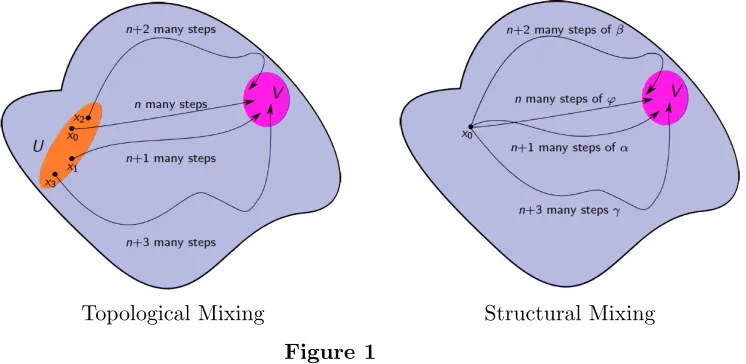
What other conditions might one add to characterize “chaos”? There is no wide agreement, and several different definitions of chaos are common.4 Because my aim is to show how three types of questions might be answered, I will not defend a particular analysis of chaos. Rather, I will show how to answer the three questions with respect to the concept of “topologically mixing”, which plays an important in characterizing chaos (see footnote 3). A time-evolution function ϕ is called topologically mixing if for any pair of non-empty open sets U and V, there exists a number N > 1 such that ϕn(U)∩V =6 ∅ for all n≥ N. To reduce technical jargon, I say ϕ is chaoticif it is topologically mixing.
For the reader unfamiliar with topology, ignore the phrase “open set.” Just think ofU and V as representing sections of state space. If the system begins in some state inU, then the expressionϕn(U) represents all possible future states afternmany steps of time. For example, suppose the dynamical system describes the movement of a gas molecule in a room. Further, assume thatU represents the upper-left quarter of the room and that V represents the lower-right hand corner. Thenϕn(U) represents the possible positions of the gas molecule afternunits of time if the gas particle starts in the upper-left quarter of the room. The above equation says that there is some time in the future such that, from that point onward, there is always a position in the upper-left corner of the room (U) such that, if the gas particle starts in that position, then it will end up in the lower-right quarter of the room (V). A model is chaotic if this holds for any regions of state space, so that a gas particle that starts in one area of the room can end up in any other area after a sufficiently long time.
2
Structural Chaos
A dynamical system is chaotic if, when model is held fixed, similar initial conditions can have any future. Analogously, a set of models should be called “structural chaotic” if, when the initial conditions are held fixed, similar models can produce any future. See Figure 1. To rigorously define
4
“structural chaos”, therefore, one needs a metric to quantify how “close” two models are.
Let XX represent all time-evolution functions for a system with state
space X. Depending upon one’s interests, different metrics will be appro-priate. However, there is clearly some relationship between (1) the distance between two models and (2) the distances between their predicted future states after one unit of time. If two models entail that a system, starting in the same initial position, will be in radically different places in a short amount of time, then the models are substantially different.
One demanding notion of closeness requires that two models are close only if their values are close everywhere in state space. That is, the dis-tance between two models is the maximum/supremum disdis-tance between the models after one unit of time, where the maximum is taken over all possible starting states. In symbols, define:
D(ϕ, ψ) = sup
x∈X
d(ϕ(x), ψ(x)).
Henceforth, I assume that D quantifies the distance between two models, but my results hold for a variety of metrics.
“Structural mixing” should capture the idea that similar models can produce very different trajectories through the state space given the same initial conditions. To make this idea rigorous, I introduce some notation. Suppose Φ⊆XX is a set of models which a scientist considers to be plausible for a given dynamical system. For any >0, letBΦ(ϕ) denote all models in Φ that are within distanceofϕ. The setBΦ(ϕ) represents all models that are “sufficiently similar” toϕ. Next, for any natural numbern∈Nand any
pointx∈X, define a mapfx,n :P(XX)→ P(X) as follows: fx,n(Ψ) ={ϕn(x) :ϕ∈Ψ}
whereP(S) is the power set of S, i.e., the set of all subsets of S. In other words,fx,n maps a set of time-evolution functions to the set of points they
reach after nstages if they are initialized to start atx.
Say that the set of models Φ is structurally mixing at ϕ if for all states x∈ X, all >0 and all non-empty open sets V ⊆X, there is some timeN ∈Nsuch that
fx,n(BΦ(ϕ))∩V 6=∅
Topological Mixing Structural Mixing
Figure 1
What is the relationship between chaos and structural chaos so defined? To answer that question, one last definition is necessary. Say the state space
Xhasno isolated pointsif every state contains points arbitrarily close to it. For example, ifX is the set of real numbers (e.g., representing a location in space, or speed, or temperature), then there are no isolated points. Why? For every real number x and every arbitrarily small distance , there are numbers within distance of x. Many dynamical systems have no isolated points, and so the assumption is not particularly strong. Nonetheless, under this very weak assumption, a set of time-evolution functions is structurally chaotic if it contains a chaotic model.5
Theorem 1 Suppose ϕ is continuous and topologically mixing. Then XX
is structurally mixing atϕ if X has no isolated points,
One might object that this theorem is very weak. According to the theo-rem, one should worry about structurally chaos ifevery time-evolution func-tion were a plausible descripfunc-tion of the dynamics of the system. However, in practice, the set of plausible models Φ is much narrower given available data, domain-specific knowledge, and so on. For example, if it is 40◦C in Demascus today, then it would be bizarre if it snowed tomorrow. However, one possible time-evolution function for Demascus’ weather entails that 40 degree days are followed by snowy ones. Thus, one might object that if the
5
class of models is restricted to realistic ones, then structural chaos will be rarer.
However, the proof of the above theorem shows something much stronger. It shows that, if the true model is chaotic and the set of “plausible” models contains those that are empirically indistinguishable from the true one, then structural chaos will arise. To explain why, I introduce some definitions.
Data sets are always finite. So let F by a finite set of states, which represents the observed history of the system so far. Let > 0 be a small number representing the precision of one’s measurement devices. Say two models are F-indistinguishable if (1) the values of the two models are equal for all but finitely many states outsideF and (2) the two models are no more than apart according toD.
Two models areF-indistinguishable if they are, in a very strong sense, indistinguishable given all available data. Why? The first clause entails that the two models are equal on all observed data points, and so there is no way that past data alone can distinguish between them. If two models differanywhere, however, then there are logically possible experiments that can distinguish them. Namely, if controlled experiments are financially, pragmatically and ethically feasible (which they often are not), one can initialize the system to one of the states at which the two models differ and observe the results.
This is where the second clause kicks in. Suppose scientists’ measur-ing instruments and statistical techniques cannot guarantee estimates of the observed states with accuracy better than > 0. If two models are F -indistiguishable, then second clause guarantees that no information about the current or next state of the system is sufficient to distinguish the mod-els. One might object that small measurement errors are detectable in the long run, especially if chaos is present. However, if the true dynamics are continuous andis sufficiently small, then the second clause entails that no experiment of a feasible length (i.e. time) will distinguish between it and an
F-indistinguishable model.
The previous discussion motivates the following definition. LetF denote the finite set of observed states. Say a set Φ of models is closed under empirical indistinguishability if there exists some > 0 such that if
ϕ∈ Φ and ψ is F-indistinguishable from ϕ, then ψ ∈Φ. If scientists are strict empiricists, then the set of models that they consider possible ought to be closed under empirical indistinguishability. Theorem 1 is a special case of the following stronger result.
containing ϕ. If X has no isolated points and Φ is closed under empirical indistinguishability, then Φis structurally chaotic at ϕ.
3
Structural Stability: Conclusions and Future
Re-search
Readers familiar with chaos theory may find the previous theorem surpris-ing. On one hand, my definition of “structural chaos” seems to formalize the idea that small errors in identifying the model can lead to divergent future behavior. On the other hand, many of “structurally chaotic” models (ac-cording to my definition) arestructurally stable in several senses discussed by chaos theorists.6 This is counter-intuitive because structural stability is intended to formalize the idea that small changes to the model do not result in large differences in the model’s trajectory.
One possible reason for the tension is that definitions of structural sta-bility almost always assume that the set of models under investigation are well-behaved, in the sense that models are differentiable (perhaps several times) and hence, continuous. In contrast, in order to demonstrate the ex-istence of “structural chaos” in computer simulations, Frigg et al. [2014] simulate discretized functions that are, by necessity, discontinuous. More-over, if a set of models is closed under empirical indistinguishability in my sense, it will contain discontinuous functions and other “poorly behaved” models.
I will not defend the thesis that physical laws might be discontinuous or non-differentiable. Rather, I discuss the relation between structural chaos (in my sense) and various notions of structural stability in order to illustrate a broader point. Mathematicians, scientists, and philosophers have yet to in-vestigate whether plausible structural analogs of “chaos” are in tension with definitions of structural stability. My results show that there may be no direct logical inconsistency, and that inconsistency may only arise when ad-ditional, substantive assumptions (e.g. continuity or differentiability) about the dynamics of the system are introduced.
There are two further reasons to question whether standard definitions of “structural instability” are really the appropriate dynamical analogs of
6Supposef :A→Aandg:B →B are functions on topological spaces. Thenf and gare said to betopologically conjugate if there is a homeomorphismh:A→Bsuch that
g◦h=h◦f. A functionf :A→AisCr structurally stable if there is some >0 such
that every function within distanceoff in theCr metric is topologically conjugate to
chaos. It is not necessary to review all existing definitions of structural sta-bility. Rather, it suffices to describe their common logical form [Pugh and Peixoto, 2008]. Given some equivalence relationR (e.g., topological conju-gacy) over models, one says a function f is structurally stable if all “close” models (under some metric) are R-equivalent to f. Why are definitions of this form not analogous to definitions of chaos?
First, the concepts employed to define structural stability are disjoint from those used to define chaos. For example, definitions of structural stabil-ity typically discuss homeomorphisms and diffeomorphisms, whereas defini-tions of chaos employ nodefini-tions like sensitivity to initial condidefini-tions, topological transitivity, density, etc. Of course, some difference in definitions is unavoid-able, as structural stability is about small changes in models, whereas chaos is about small changes in states.
Nonetheless, if Werndl [2009] and Berkovitz et al. [2006] are correct, then probability is a key concept in characterizing chaos. In contrast, none of the definitions of structural stability employ probability at all. This is surprising, given that probability is perhaps the most widely-employed tool used to characterize uncertainty, noise, and (expected) error. The fact that probability is not used in definitions of structural stability, therefore, raises serious questions about the importance of such definitions for discussions of prediction, control, and explanation.7
Second, time plays different roles in definitions of chaos and structural stability respectively. Definitions of chaos – like the definition of topological mixing – typically place constraints on the distant future of the system. For example, in many chaotic systems, nearby initial conditions may have similar trajectories for a long period of time, but their trajectories may diverge radi-cally in the distant future. The potential for such sudden divergence is what renders long-term predictions problematic. In contrast, to my knowledge, all but one of the equivalence relations used to define structural stability constrain only one time step in the evolution of a dynamical system, and the exception is applicable only to dynamical systems that are described by differential equations.
These two reasons do not provide conclusive evidence that the math-ematically rich research on structural stability is, at the end of the day, unimportant for empirical science. Rather, they suggest two more questions to add to the list at the outset of the paper: what are the relationships
7
among various definitions of chaos and structural stability? And what is the importance of the various notions of structural stability for prediction, control, and explanation?
4
Philosophical Upshots
Section one described three questions for philosophers and scientists who study chaos theory. Section two provided an example of how one might go about answering two of the three questions. There, I defined a notion of “structural mixing” that is analogous to the standard notion of “topological mixing”, and I proved a theorem relating the two concepts. I conclude by discussing the philosophical significance of this research program.
Roughly, the main result asserts that, if the dynamics of a system might be chaotic, then there are many “similar” regularities that (i) produce widely different future behavior and (ii) are compatible with the observed past. The consequent of that conditional is just an instance of the problem of induction. So an investigation of structural chaos amounts to a mathematically precise investigation of a central philosophical problem.
It is now easy to see why the three questions above are philosophically important. Question one asks, “For each definition of ‘chaos’, what is the analogous concept of structural chaos?” Because there are different “de-grees” of chaos [Berkovitz et al., 2006], an answer to that question would characterize differing “degrees” of problem of induction.8 That is, an answer to the first question would allow one to characterize inductive problems in terms of their difficulty.
Question two asks, “what is the relationship between chaos and struc-tural chaos?” The classic problem of induction shows that past observations are insufficient to identify a dynamical system’s time-evolution function, and hence, there are many regularities that (a) are compatible with past obser-vations and (b) predict radically different futures. The existence of chaos entails that predicting or manipulating a dynamical system’s behavior might be impossibleeven if the exact dynamics of the system are known. Hence, an answer to question two connects research on the classical problem of induc-tion and new research in chaos theory, which respectively identify different sources of difficulty for prediction and manipulation.
8Kelly [1996] contains a sophisticated hierarchy of “problems” of induction. I am
Finally, question three asks, “what are the implications of structural chaos for prediction, control, and explanation?” The importance of this question is self-explanatory: prediction, control, and explanation are three central goals of science, and so an answer to question three amounts to an answer to the question, “Why is structural chaos important?”
5
Acknowledgments
Thanks to Seamus Bradley, Roman Frigg, and Charlotte Werndl for exten-sive comments on earlier drafts of this paper. I am also indebted to con-ference participants at “Mathematizing Science” (at the University of East Anglia), the British Society for Philosophy of Science, and the Philosophy of Science Association for suggestions about how to improve this paper.
A
Proofs
Lemma 1 Let X be any metric space, U ⊆ X an open set and F ⊆ X
be finite. Then U \F is open. If X be has no isolated points, U \F is non-empty.
Theorem 2 Suppose ϕ is continuous and topologically mixing. Suppose thatϕ∈Φand that Φ is closed underF-indistinguishability for some finite
F ⊆X. If X has no isolated points, then Φis structurally mixing at ϕ.
Proof: Letx0∈X. It must be shown that for all >0 and all non-empty
open setsV ⊆X, there is someN ∈N such that
fx0,n(BΦ(ϕ))∩V 6=∅for all n≥N
Call this condition†(, V, N). Let >0 and V ⊆X be an open set.
Define xj = ϕj(x0) for all natural numbers j, and let M = |F|+ 1.
Because Φ is closed under F-indistiguishability, there is β > 0 such that if (a) ϕ and ψ agree everywhere on all but finitely many elements of X\F
and (b) D(ϕ, ψ) < β, then ψ ∈ Φ. As ϕ is continuous and F is finite, it follows that for all k≤M there isδk>0 such that
Bδk(xk)∩F =
{xk} ifxk ∈F
∅ otherwise. and
Here I am usingBγ(z) to refer to the γ-ball around z∈X with respect to
the metricd.
Let δ = min{δk : k≤ M}. Because ϕ is topologically mixing, for each k≤M there isNk∈Nsuch that for alln≥Nk:
ϕn(Bδ(xk))∩V 6=∅
LetN∗=M+ max{Nk :k≤M}. I claim that †(, V, N∗). Let n≥N∗.
It is necessary to find someψ∈BΦ(ϕ) such thatψn(x0)∈V. Ifϕn(x0)∈V,
then we’re done. Otherwise, because M > |F|, there is k ≤ M such that
xk6∈F. Notice
n−k≥N∗−M ≥max{Nj :j≤M} ≥Nk.
Hence, by choices ofδ and N∗, there is y ∈Bδ(xk) such that ϕn−k(y)∈V.
Notey6=xk becauseϕn−k(xk) =ϕn(x0)6∈V. I claim thatymay be chosen
so thatϕj(y)6=x
k for all j≤n−k.
Why? Suppose for the sake of contradiction that for all y ∈ Bδ(xk),
there is some j ≤ (n−k) such that ϕj(y) = xk. In particular, there is j0 ≤ (n−k) such that ϕj0(xk) = xk. Thus, for all m ≥ (n−k) and all y∈Bδ(xk):
ϕm(y)∈ {xk, ϕ(xk), . . . , ϕj0−1(xk)}.
LetT =X\ {xk, ϕ(xk), . . . , ϕj0−1(xk)}. Then T is non-empty and open by
the lemma. However,ϕm(Bδ(xk))∩T =∅ for all m ≥(n−k). Soϕis not
topologically mixing, contradicting assumption.
It has been shown that y ∈ Bδ(xk) may be chosen so that ϕj(y) 6= xk
for allj ≤(n−k). Define ψ:X→X as follows:
ψ(z) =
ϕ(y) if z=xk ϕ(z) otherwise.
NoteD(ϕ, ψ) =d(ϕ(xk), ϕ(y)). By continuity ofϕ, it follows thatd(ϕ(xk), ϕ(y))≤
min{β, }. Hence, ψ ∈ B(ϕ). Because ψ is equal to ϕ everywhere except xk 6∈ F, it follows that ψ is βF-indistinguishable from ϕ. As Φ is closed
underβF-indistinguishability, ψ∈Φ.
Finally, ψn(x) =ϕn−k(y)∈V becauseϕj(y)6=xk for all 0≤j≤n−k.
References
Robert W. Batterman. Defining chaos.Philosophy of Science, 60(1):43—66, March 1993.
Joseph Berkovitz, Roman Frigg, and Fred Kronz. The ergodic hierarchy, randomness and hamiltonian chaos. Studies in History and Philosophy of Science Part B: Studies in History and Philosophy of Modern Physics, 37 (4):661–691, 2006.
Seamus Bradley. Scientific uncertainty: A user’s guide. Grantham Institute on Climate Change, Discussion Paper 56, 2012. URL http://philpapers.org/rec/BRASUA.
Robert L. Devaney, Luke Devaney, and Luke Devaney. An introduction to chaotic dynamical systems, volume 6. Addison-Wesley Reading, 1989.
Roman Frigg, Seamus Bradley, Hailiang Du, and Leonard A. Smith. Laplaces demon and the adventures of his apprentices. Philosophy of Science, 81(1):31—59, 2014.
Kevin T Kelly. The logic of reliable inquiry. Oxford University Press, New York, 1996.
Wendy S. Parker. When climate models agree: The significance of robust model predictions. Philosophy of Science, 78(4):579–600, 2011.
Charles Pugh and Mauricio Peixoto. Structural stability. Scholarpedia, 3(9), 2008. ISSN 1941-6016. doi: 10.4249/scholarpedia.4008. URL http://www.scholarpedia.org/article/Structural stability.