Algorithmic Aspects of Topology Control Problems
for Ad hoc Networks
∗Errol L. Lloyd
† Dept. Comp. and Info. Sci.University of Delaware Newark, DE 19716
Rui Liu
Dept. Comp. and Info. Sci. University of Delaware
Newark, DE 19716
Madhav V. Marathe
‡ Los Alamos National Lab MS M997, P. O. Box 1663 Los Alamos, NM 87545Ram Ramanathan
Internetwork Design Dept. BBN (A Verizon Company) Cambridge, MA 02138S. S. Ravi
§ Dept. Comp. Sci.SUNY Albany Albany, NY 12222
ABSTRACT
Topology control problems are concerned with the assign-ment of power values to the nodes of an ad hoc network so that the power assignment leads to a graph topology satis-fying some specified properties. This paper considers such problems under several optimization objectives, including minimizing the maximum power and minimizing the total power. A general approach leading to a polynomial algo-rithm is presented for minimizing maximum power for a class of graph properties calledmonotoneproperties. The diffi-culty of generalizing the approach to properties that are not monotone is discussed. Problems involving the minimiza-tion of total power are known to beNP-complete even for simple graph properties. A general approach that leads to an approximation algorithm for minimizing the total power for some monotone properties is presented. Using this ap-proach, a new approximation algorithm for the problem of minimizing the total power for obtaining a 2-node-connected
∗This research was started when some of the authors were
visiting the Basic and Applied Simulation Sciences Group (D-2) of the Los Alamos National Laboratory.
†Prepared through collaborative participation in the
Com-munications and Networks Consortium sponsored by the U. S. Army Research Laboratory under the Collaborative Tech-nology Alliance Program, Cooperative Agreement DAAD19-01-2-0011.
‡Research supported by the Department of Energy under
Contract W-7405-ENG-36.
§Supported by NSF Grant CCR-97-34936.
Permission to make digital or hard copies of all or part of this work for personal or classroom use is granted without fee provided that copies are not made or distributed for pro£t or commercial advantage and that copies bear this notice and the full citation on the £rst page. To copy otherwise, to republish, to post on servers or to redistribute to lists, requires prior speci£c permission and/or a fee.
MOBIHOC’02, June 9-11, 2002, EPFL Lausanne, Switzerland.
Copyright 2002 ACM 1-58113-501-7/02/0006 ...$5.00.
graph is obtained. It is shown that this algorithm provides a constant performance guarantee. Experimental results from an implementation of the approximation algorithm are also presented.
Categories and Subject Descriptors
F.2 [Theory of Computation]: ANALYSIS OF ALGO-RITHMS AND PROBLEM COMPLEXITY
; C.2.1 [COMPUTER-COMMUNICATION NET-WORKS]: Network Architecture and Design
General Terms
Algorithms, Design, Experimentation
Keywords
Topology control, ad hoc network, power conservation, graph model, graph property, approximation algorithm
1.
INTRODUCTION
1.1
Motivation
An ad hoc network consists of a collection of transceivers. All communication among these transceivers is based on ra-dio propagation. For each ordered pair (u, v) of transceivers, there is a transmission power threshold, denoted by
p(u, v), with the following significance: A signal transmit-ted by the transceiver u can be received by v only when the transmission power of uis at least p(u, v). The trans-mission power threshold for a pair of transceivers depends on a number of factors including the distance between the transceivers, the direction of the antenna at the sender, in-terference, noise, etc. [15].
of this directed graph are in one-to-one correspondence with the transceivers. A directed edge (u, v) is in this graph if and only if the transmission power ofuis at least the trans-mission power thresholdp(u, v).
The main goal oftopology controlis to assign transmis-sion powers to the transceivers so that the resulting directed graph satisfies some specified properties. Since the battery power of each transceiver is an expensive resource, it is im-portant to achieve the goal while minimizing a given func-tion of the transmission powers assigned to the transceivers. Examples of desirable graph properties are small diameter, connectivity, etc. Examples of minimization objectives con-sidered in the literature are the maximum power assigned to a transceiver and the total power of all transceivers (the lat-ter objective is equivalent to minimizing the average power assigned to a transceiver).
As stated above, the primary motivation for studying topol-ogy control problems is to make efficient use of the available power at each node. In addition, using a minimum amount of power at each node to achieve a given task is also likely to decrease the MAC layer interference between adjacent radios. We refer the reader to [12, 14, 15, 18, 20, 22] for a thorough discussion of the power control issues for ad hoc networks.
1.2
Formulation of Topology Control
Prob-lems
Topology control problems have been studied under two graph models. The discussion in Section 1.1 corresponds to thedirected graph modelstudied in [15]. The undi-rectedgraph modelproposed in [10] represents the ad hoc network as an undirected graph in the following manner. First, the directed graph model for the network is constructed. Then, for any pair of nodesuandv, whenever both the di-rected edges (u, v) and (v, u) are present, this pair of directed edges is replaced by a single undirected edge{u, v}. All of the remaining directed edges are deleted. Under this model, the goal of a topology control problem is to assign trans-mission powers to nodes such that the resulting undirected graph has a specified property and a given function of the powers assigned to nodes is minimized. Note that the di-rected graph model allows two-way communication between some pairs of nodes and one-way communication between other pairs of nodes. In contrast, every edge in the undi-rected graph model corresponds to a two-way communica-tion.
In general, a topology control problem can be specified by a triple of the formM, P, O. In such a specification,M ∈ {Dir, Undir}represents the graph model,Prepresents the
desired graph property andO represents the minimization
objective. For the problems considered in this paper O ∈ {MaxP, TotalP}(abbreviations of Max Power and Total
Power). For example, consider theDir, Strongly
Con-nected, MaxP problem. Here, powers must be assigned
to transceivers so that the resulting directed graph is strongly connected and the maximum power assigned to a transceiver is minimized. Similarly, theUndir, 2-NC, TotalP
prob-lem seeks to assign powers to the transceivers so that the resulting undirected graph has a node connectivity (see be-low for definition) of (at least) 2 and the sum of the powers assigned to all transceivers is minimized.
2.
ADDITIONAL DEFINITIONS
This section collects together the definitions of some graph theoretic and algorithmic terms used throughout this paper. Given an undirected graphG(V, E), anedge subgraph
G(V, E) ofGhas all of the nodes ofGand the edge setE
is a subset of E. Further, if Gis an edge weighted graph, the weight of each edge inG is the same as it is inG.
The node connectivity of an undirected graph is the smallest number of nodes that must be deleted from the graph so that the resulting graph is disconnected. Theedge connectivityof an undirected graph is the smallest num-ber of edges that must be deleted from the graph so that the resulting graph is disconnected. For example, a tree has node and edge connectivities equal to 1 while a simple cy-cle has node and edge connectivities equal to 2. When the node (edge) connectivity of a graph is greater than or equal to k, the graph is said to be k-node connected (k-edge connected). Given an undirected graph, polynomial algo-rithms are known for finding its node and edge connectivities [21].
The main results of this paper use the following definition.
Definition 2.1. A property Pof the (directed or
undi-rected) graph associated with an ad hoc network is mono-toneif the property continues to hold even when the powers assigned to some nodes are increased while the powers as-signed to the other nodes remain unchanged.
Example: For any k ≥ 1, the property k-Node Con-nected(abbreviated ask-NC) for undirected graphs is
mono-tone since increasing the powers of some nodes while keeping the powers of other nodes unchanged may only add edges to the graph. However, properties such asAcyclicor Bipar-titeare not monotone.
Some of the topology control problems considered in this paper are NP-complete. For such problems, we study ap-proximation algorithms. In this context, an apap-proximation algorithm provides aperformance guarantee of ρ if for every instance of the problem, the solution produced by the approximation algorithm is within the multiplicative factor ofρof the optimal solution. Apolynomial time approx-imation scheme (PTAS) is an approximation algorithm that, given a problem instance and an accuracy requirement
3.
PREVIOUS WORK AND SUMMARY OF
RESULTS
3.1
Previous Work
The form of topology control problems considered in this paper was proposed by Ramanathan and Rosales-Hain [15]. They presented efficient algorithms for two topology control problems, namelyUndir, 1-NC, MaxPandUndir, 2-NC, MaxP. After determining the minimum value for the
objective, their algorithms also reduce the power assigned to each transceiver such that each power level is minimal while maintaining the desired graph property. In addition, they presented efficient distributed heuristics for these problems. Several groups of researchers have studied theUndir, 1-NC, TotalP problem [1, 2, 3, 10]. Reference [1] proves
that the problem is NP-hard and presents an approxima-tion algorithm with a performance guarantee of 2. The other references consider a geometric version of the prob-lem along with a symmetry assumption concerning trans-mission power thresholds. More precisely, these references assume the following: (a) Each transceiver is located at some point ofd-dimensional Euclidean space. (b) For any pair of transceivers u and v, p(u, v) = p(v, u) = the Eu-clidean distance between the locations of u and v. For a justification of this model, see Kirousis et al [10]. They show that theUndir, 1-NC, TotalP problem isNP
-hard when transceivers are located in 3-dimensional space. They also present an approximation algorithm with a per-formance guarantee of 2 for the problem in any metric space. In addition, they provide some results for the 1-dimensional version of the Undir, 1-NC, TotalP problem where
there is an additional constraint on the diameter of the re-sulting undirected graph. Clementi et al [2] show that the 2-dimensional version of the Undir, 1-NC, TotalP
problem remains NP-hard. They also show that the 2-dimensional version with a diameter constraint can be ef-ficiently approximated to within some constant factor and that the 3-dimensional version does not have a polynomial time approximation scheme.
Researchers have also addressed other versions of topology control problems. Hu [7] proposed a distributed algorithm based on Delaunay triangulation to maintain connectivity. However, that paper does not address the issue of assign-ing transmission powers to nodes. Radoplu and Meng [14] present a distributed protocol for maintaining strong con-nectivity in a network with mobile nodes. The networks generated by their protocol include minimum-energy paths (i.e., paths that allow messages to be transmitted using a minimum amount of energy) from each node to a designated master node. Wattenhofer et al [22] discuss a cone-based distributed algorithm for topology control; their algorithm generates a power assignment which ensures that the size of the node set that remains connected under this power
assignment is the same as the one in which every node is assigned the full power. Li and Halpern [11] improve upon the protocol of [14] by proposing another protocol; given a networkG, the new protocol creates a subnetworkG such that whenever there is a path between a pair of nodes inG, there is a minimum-energy path between them inG. Li et al [12] provide a more detailed analysis of the protocol of [22] and establish a precise bound on the angle of the cone that ensures connectivity. They also establish several properties of the protocol in [22].
3.2
Summary of Main Results
The main results of this paper are the following.
1. We show that for any monotone graph property P
that can be tested in polynomial time for undirected (directed) graphs, the problem Undir, P, MaxP
(Dir, P, MaxP) can be solved in polynomial time.
This generalizes some of the results in [15] where ef-ficient algorithms were presented for two monotone properties, namely1-Node Connectedand2-Node Connected.
2. We established that there are non-monotone and effi-ciently testable properties (e.g. Graph is a tree) for
which the problem of minimizing the maximum power is NP-complete. This result shows that, in general, if the monotonicity condition is eliminated, then ob-taining an efficient algorithm for minimizing maximum power may not be possible.
3. As mentioned above, for any monotone and efficiently testable propertyP, a solution that minimizes the
max-imum power can be obtained in polynomial time. How-ever, if we introduce the additional requirement that the number of nodes that use the maximum power must also be minimized, we show that there are mono-tone properties for which the resulting problem isNP -complete.
4. We present a general approach for developing approxi-mation algorithms forNP-hard topology control prob-lems under theTotal Powerminimization objective
when the power threshold values are symmetric. The approximation results of [1, 10] are special cases of this general approach. As an illustration of our gen-eral approach, we present a constant factor approxi-mation algorithm for the Undir, 2-NC, TotalP
5. Finally, we present experimental results obtained from an implementation of the above approximation algo-rithm and compare its performance with an algoalgo-rithm discussed in [15].
4.
RESULTS FOR MINIMIZING MAXIMUM
POWER
In this section, we present our results for theMax Power
objective. We begin with a general algorithm for the topol-ogy control problem where the graph property is both mono-tone and polynomial time testable. Next, we give an exam-ple of a non-monotone property for which the problem of minimizing the maximum power is NP-complete. Finally, we show that the additional requirement of minimizing the number of nodes that use the maximum power also renders the problemNP-complete even for certain monotone prop-erties.
4.1
An Algorithm for Monotone and Ef£ciently
Testable Properties
We begin with a simple lemma that points out the useful-ness of monotonicity.
Lemma 4.1. For any instance of Undir, P, MaxP
andDir, P, MaxPwhere the graph property Pis
mono-tone, there is an optimal solution in which all of the nodes are assigned the same power value.
Proof: Consider an optimal solution to the given instance where the nodes don’t necessarily have the same power val-ues. Let Q denote the maximum power assigned to any node. Since the graph property is monotone, for any node whose power value is less thanQ, we can increase it toQ
without destroying the property.
Theorem 4.1. For any graph property P that is
mono-tone and that can be tested in polynomial time, the problems
Undir, P, MaxP and Dir, P, MaxP can be solved
in polynomial time.
Proof: We will present the proof for Dir, P, MaxP.
(The proof forUndir, P, MaxPis virtually identical.)
Consider an instance ofDir, P, MaxP. By Lemma 4.1,
there is an optimal solution in which every transceiver is as-signed the same power value. We can estimate the number of candidate optimal power values as follows. LetT denote the set of all transceivers in the system and let|T|=n. Con-sider any transceiveru∈T. The number of different power values that need to be considered foruis at mostn−1, since at most one new power value is needed for each transceiver inT− {u}. Therefore, for all of then transceivers, the to-tal number of candidate power values to be considered is
n(n−1) =O(n2).
For each candidate power value, the corresponding di-rected graph can be constructed inO(n2) time. LetFP(n)
denote the time needed to test whether property Pholds
for a directed graph withn nodes. Thus, the time needed to test whether property Pholds for each candidate
solu-tion value is O(n2 +FP(n)). An optimal solution can be
obtained by sorting the O(n2) candidate solution values and using binary search to determine the smallest value for which propertyPholds. Since the number of candidate
so-lution values is O(n2), the time taken by the sorting step is O(n2logn). The binary search would try O(logn) can-didate solution values and the time spent for testing each candidate is O(n2+FP(n)). Thus, the total running time
of this algorithm is O((n2+FP(n)) logn). SinceFP(n) is a
polynomial, the algorithm runs in polynomial time. As an illustration of the above theorem, letPdenote the
property2-Node Connectedfor undirected graphs. It is
known that this property can be tested in O(n2) time for a graph with n nodes [21]. For this property, the general algorithm outlined in the proof of Theorem 4.1 yields an al-gorithm with a running time of O(n2logn). This running time matches the time of the algorithm given in [15]. How-ever, it should be noted that the algorithm in [15] not only finds an optimal solution but also reduces the power of each transceiver so that the power levels are minimal. There is no increase in their asymptotic running time.
Instead of requiring the entire graph to be connected, one may require connectivity only for a specified subset of the nodes. Such a requirement arises in the context of multicast-ing (see for example [19]). Connectedness of a specified sub-set of nodes can be seen to be a monotone property. Thus, the general approach presented above leads to a polynomial time algorithm for this property as well.
4.2
Dif£culty of Generalizing to Non-monotone
Properties
We now show that there is a natural non-monotone graph property for which the problem of minimizing the maximum power is NP-complete. As mentioned earlier, this result points out that if the monotonicity requirement is omitted, then an efficient algorithm for minimizing maximum power may not be possible.
The property that we use for this purpose is “Gisa Tree”.
Surprisingly, we show that this property makes the topology control problem NP-complete even without any minimiza-tion objective. The proof of Lemma 4.2 utilizes a reduc-tion from the following problem, which is known to beNP -complete [6].
Exact Cover by 3-Sets(X3C)
Instance: A setS ={x1, x2, . . . , xn}of elements, wheren= 3rfor some integerr; a collectionC={C1, C2, . . . , Cm}of
subsets ofS such that|Cj|= 3, 1≤j≤m.
We note that whenever there is a solution to an instance of X3C, the number of sets in the solution is exactlyr(i.e.
n/3).
Lemma 4.2. To find a power assignment such that the resulting undirected graphGis a tree isNP-complete.
By abuse of terminology, we use Undir, Tree, * to
denote this problem.
Proof: In theUndir, Tree, * problem, we are given
a collection of nodes, and a (symmetric) power threshold
p(u, v) for each pair of nodes. The question is whether there exists a power assignment such that the graph induced by the power assignment is a tree.
It is easy to see that Undir, Tree, * is inNPsince
one can guess a power assignment and verify in polynomial time that the resulting graph is a tree. We prove theNP -hardness of the problem by a reduction from X3C (defined above).
Given an instance I of X3C consisting of a set S withn
elements and a collection C ofm subsets, we construct an instanceI of the Undir, Tree, * problem as follows.
The node setV ofI contains a total of n+m+ 1 nodes: There is one node (called anelement node)ui correspond-ing to each elementxiofS(thus, there are totally 3relement nodes), one node (called a set node) vj corresponding to
each setCj ofC(thus, there are totally mset nodes), and a special node (called theroot node) denoted byR. The power thresholds are chosen as follows. (The reader should bear in mind that the power thresholds are symmetric; that is, for any pair of nodesuandv,p(u, v) =p(v, u).)
p(R, vj) = 1 (1≤j≤m).
p(ui, vj) = 2 ifxi∈Cj, 1≤i≤n, 1≤j≤m.
For all other pairs of nodes, the power thresholds are set to 3. This completes the construction of the instanceI of
Undir, Tree, *. It is easy to verify that the construction
can be carried out in polynomial time. We now argue that there is a solution to theUndir, Tree, *instance if and
only if there is a solution to the X3C instance.
If: Suppose the X3C instance has a solutionC. We choose the following power assignment: p(R) = 1, p(ui) = 2 (1 ≤
i≤n), p(vj) = 2 ifCj is inC and p(vj) = 1 otherwise
(1≤j≤m). It can be seen that the graphGresulting from this power assignment contains only the following edges:
(a) The edge {R, vj}, for eachj, 1≤j≤m.
(b) For each node vj whose corresponding setCjis in C,
there are edges fromvjto the three nodes correspond-ing to the elements inCj.
By choosing R as the root and using the fact that C is an exact cover, it can be verified that G is a tree: The root nodeRis adjacent to each of the set nodes; and, each
element node appears as one of the three children of a set node corresponding to a subset in the collectionC.
Only if: Now, suppose theUndir, Tree, *instance has
a solution. Letp(x) denote the power assigned to nodexand letGdenote the graph induced by the power assignment.
We first observe that p(R) ≥ 1; otherwise, R would be an isolated node and thus G cannot be a tree. Similarly,
p(vj) ≥ 1 for every set node vj and p(ui) ≥ 2 for every element node ui. As a consequence, the root node R is adjacent to each of the set nodes v1, v2, . . ., vm, and the
maximum power assigned is at least 2. Therefore, there are two cases to consider:
Case 1.The maximum power assigned is 2.
LetX={vjk : p(vjk) = 2}. We claim that the collection
C={Cjk : vjk∈X}is an exact cover forS. We prove this
by first showing that each elementxiappears in some subset
of C. To see this, we note that the graphGis connected (since it is a tree). Thus, there is at least one edge from the element nodeui(corresponding to elementxi) to some other node ofG. Since the maximum power assigned to any node is 2 and the power threshold for the element nodeui
to have an edge toRor an edge to any other element node is 3,uimust be adjacent to a set nodevj. Further, because
the threshold values are symmetric,p(vj) = 2. Thus,vj ∈
X and the corresponding subset Cj is in C. Hence, each
element appears in some subset in the collectionC. We now show that the subsets in the collection C are pairwise disjoint. Suppose some pair of subsetsCa andCb
in C have a common elementxi. By our choice ofC, the power values assigned to the corresponding set nodesvaand
vbare both 2. Further, the power assigned to nodeuiis also
2. Thus, in the graphG,ui is adjacent to bothva and vb.
As observed earlier, the root nodeRis adjacent to bothva
and vb. Now, the four edges{R, va},{va, ui}, {ui, vb}and
{vb, R}create a cycle inG. This contradicts the assumption
thatGis a tree. So, the subsets inC are pairwise disjoint, andC is indeed an exact cover forS.
Case 2.The maximum power assigned is 3.
First, note that at most two nodes can have power 3, since if three nodes have power 3, then they are mutually adjacent, and thusGis not a tree.
Second, if the power assignment is as in the following cases, we argue that there is an equivalent assignment in which the maximum power is 2. These cases are: only one node has power 3;Rand one set nodevihave power 3; and, one element nodeuiand one set nodevjhave power 3 where
xi∈Cj. In any of these cases, the resulting graphGhas no
Following the argument in Case 1, a solution to X3C can be constructed.
Finally, we claim that there are no such valid power as-signments in the remaining cases (i.e. Randuihave power
3;vi and vj have power 3; ui and uj have power 3; or, ui
andvj have power 3 where xi∈/ Cj). The reasons are the following:
1. If two set nodesviandvjhave power 3, then the edges
{R, vi},{R, vj}and{vi, vj}form a cycle.
2. If the root nodeRand one element nodeuihave power
3, the edge{R, ui}is inG. Therefore, edge{ui, vj}, 1≤j≤ m, is not inG, otherwiseR,ui, andvjform a cycle. Recall thatp(ui)≥2 for every element nodeui, therefore eachvj
with power 2 is linked with exactly 3 element nodes. No two set nodes can linked with the same element node, otherwise those three nodes and R form a cycle. Hence, totally 3k
(wherek is the number of set nodes with power 2) element nodes are linked to some set node. Further, no element nodes can link with each other since the power thresholds between such nodes are 3. This implies that there are 3k+ 1 element nodes. There is a contradiction because we know in this instance ofUndir, Tree, *, the number of element
nodes is a multiple of 3.
3. If two element nodesuiandujhave power 3, the edge
{ui, uj}is inG. Recall that all set nodes have to be linked
withR, so one and only one of ui and uj is linked with a
set node. Suppose it isui. We know from above that 3k
element nodes are linked with some set node. So, together withuj, there are 3k+ 1 element nodes - a contradiction.
4. If one element nodeuiand one set nodevjhave power 3, wherexi∈/Cj, thenuiis linked withvj. Therefore, there
are 4 nodes linked withvj, which areui and three element nodes whose corresponding elements are in setCj. Hence, there are totally 3k+1 element nodes - a contradiction.
This completes the proof of the case 2 as well as that of Lemma 4.2.
Theorem 4.2. There is a non-monotone property Pfor
whichUndir, P, MaxPisNP-complete.
Proof: Let Pdenote the property “G isa Tree”. It is
clear thatUndir, P, MaxP is inNP because given a
power assignment the required conditions can be verified in polynomial time. Further, the NP-hardness follows from Lemma 4.2.
4.3
Dif£culty of Minimizing the Number of
Nodes of Maximum Power
An extension ofUndir, P, MaxPfor monotone graph
properties is explored in this section. While such problems can be solved efficiently, our algorithm in Section 4.1 assigns the maximum power value to all of the nodes. From a prac-tical point of view, it is important to reduce the number of nodes with maximum power without affecting the required
property. In this section, we show that this additional re-quirement renders the problem NP-complete even for cer-tain monotone graph properties. A formal statement of the problem is as follows.
Minimizing Max-power Users
Instance: A positive integerM; a positive numberP (max-power); a node setV; a power threshold functionp associ-ated withV (∀u, v∈V,p(u, v) is the power threshold); and a graph propertyP.
Question: Does there exist a power assignment where the power assigned to each node is at most P and the number of the nodes that are assigned powerP is at mostM, such that the resulting undirected graphGsatisfiesP?
Theorem 4.3. There is a monotone and polynomial time testable propertyPfor which the problemMinimizing Max-power UsersisNP-complete.
Proof sketch: LetPbe the property “the diameter of
G islessthan or equal to 6”. This property implies
that inG, each node is at most 6 hops away from any other node. Obviously,Pis monotone, and can be tested inO(N
3)
time by using the Floyd-Warshall algorithm, whereNis the number of nodes in the graph G [4]. We now show that for
P,Minimizing Max-power UsersisNP-complete using
a reduction fromSet-covering, a well-knownNP-complete problem [6].
Set-covering
Instance: A positive integerK; a setA={a1, a2, . . . , an}; a setF ={f1, f2, . . . , fm}, wherefi, 1≤i≤mis a subset of
Aand∀ai∈A,∃fj∈F, such thatai∈fj. Without loss of generality, suppose allfi, 1≤i≤mare non-empty. Question: Does there exist a setS⊆F, with|S| ≤K, where
∀ai∈A,∃s∈S, such thatai∈s?
It is obvious thatMinimizing Max-power Usersis in
NP since P can be tested in polynomial time. We now
outline a reduction from Set-covering to prove the NP -hardness of the problem.
Given an instanceI of Set-covering, map each element
ai of A to a node ui and map each fi of F to a node
vi. Further, our instanceI of Minimizing Max-power Usersalso contains four special nodes: w,s1,s2,s3. The power threshold function pis defined as follows (note that the power thresholds are symmetric):
p(ui, vj) = 1 ifai∈fj
p(w, vj) =P (1≤j≤m)
p(w, s1) =p(s1, s2) =p(s2, s3) = 1.
The proof that there is a solution to theMinimizing Max-power Usersinstance if and only if there is a solution to
Set-coveringis omitted.
5.
A GENERAL APPROACH FOR
MINIMIZ-ING TOTAL POWER
5.1
Approximating Minimum Total Power
Topology control problems in which the minimization ob-jective is the total power tend to be computationally in-tractable. For example, the problem is NP-hard even for the (simple) property 1-Node-Connected [10]. A
com-mon way of coping with such problems is to develop poly-nomial time approximation algorithms for them. In this section, we present a general outline for such an approxi-mation algorithm for topology control problems of the form
Undir, P, TotalP. We observe that this general outline
encompasses the approximation algorithm forUndir, 1-NC, TotalPpresented in [10]. Based on the general
out-line, we also develop an approximation algorithm with a con-stant performance guarantee forUndir, 2-NC, TotalP.
A slight modification of this algorithm yields an approx-imation algorithm for the problem of obtaining a 2-edge-connected graph while minimizing total power.
In presenting our general scheme, we assume (as done in Section 4.1) that the propertyPto be satisfied by the graph
is monotone and that the property can be tested in polyno-mial time. We also assumesymmetricpower thresholds as in [2, 3, 10]; that is, for any pair of transceiversuandv, the power thresholdsp(u, v) andp(v, u) are equal.
An outline for our general approximation algorithm (called HeuristicGen-Total-Power) is shown in Figure 1. Note
that Steps 1 and 3 of the outline can be implemented in polynomial time. The time complexity of Step 2 depends crucially on the propertyP. For some properties such as
1-Node Connected, Step 2 can be done in polynomial time.
For other properties such as 2-Node Connected, Step 2
cannot be done in polynomial time unlessP =NP[6]. In such cases, an efficient algorithm that produces an approxi-mately minimum solution can be used in Step 2. The follow-ing theorem proves the correctness of the general approach and establishes its performance guarantee as a function of some parameters that depend on property P and the
ap-proximation algorithm used in Step 2 of the general outline.
Theorem 5.1. For monotone propertyP, letI be an
in-stance ofUndir, P, TotalP. LetOP T(I)andGT P(I)
denote respectively the total power assigned to the nodes in an optimal solution and in a solution produced by Heuristic
Gen-Total-Powerfor the instanceI.
(i) The graphGresulting from the power assignment pro-duced by the heuristic (i.e. step 3) satisfies P.
Input: An instance I ofUndir, P, TotalPwhere the
propertyPis monotone and polynomial time testable. Output: A power value π(u) for each transceiveru such that the graph induced by the power assignment satisfies property Pand the total power assigned to all nodes is as
small as possible.
Steps:
1. From the given problem instance, construct the following undirected complete edge weighted graph
Gc(V, Ec). The node setV is in one-to-one correspon-dence with the set of transceivers. The weight of every edge{u, v}inEcis equal to the power threshold value
p(u, v) (which is also equal top(v, u) by the symmetry assumption).
2. Construct an edge subgraphG(V, E) ofGcsuch that
Gsatisfies propertyPand the total weight of the edges
in E is minimum among all edge subgraphs of Gc
satisfying propertyP.
3. For each node (transceiver) u, assign a power value
π(u) equal to the weight of the largest edge incident onu.
Figure 1: Outline of Heuristic Gen-Total-Power for Approximating Total Power
(ii) Consider the complete graphGc(V, Ec) constructed in
Step 1 of the heuristic. LetH(V, EH)be an edge sub-graph ofGc with minimum total edge weight satisfying propertyPand let W(H)denote the total edge weight
ofH. Let Step 2 of the heuristic produce an edge sub-graph G(V, E) of G with total edge weight W(G). Suppose there are quantities α > 0 and β > 0 such that
(a)W(H)≤α OP T(I)and
(b)W(G) ≤β W(H),
thenGT P(I)≤2αβ OP T(I). In other words,
Heuris-tic Gen-Total-Powerprovides a performance guar-antee of2αβ.
Before proceeding to the proof of this result, we illustrate its use by discussing how the 2-approximation algorithm pre-sented in [10] for theUndir, 1-NC, TotalP problem
can be derived from the above general outline. In Step 2 they use an efficient algorithm for constructing a minimum spanning tree of Gc. They also show that the total power assigned by any optimal solution is at least the weight of a minimum spanning tree of Gc. Thus, using the notation of Theorem 5.1, α = β = 1 for their approximation algo-rithm. Since1-Node-Connectedis a monotone property,
Proof of Theorem 5.1:
Part (i): The edge subgraph G(V, E) constructed in Step 2 of the heuristic satisfies propertyP. We show that
every edge inE is also in the subgraphGinduced by the power assignment produced in Step 3. Then, even if G
has other edges, the monotonicity ofPallows us to conclude
thatGsatisfiesP.
Consider an edge {u, v} with weight p(u, v) in E. Re-call that p(u, v) is the minimum power threshold for the existence of edge{u, v} and that the power thresholds are symmetric. Since Step 3 assigns to each node the maxi-mum of the weights of edges incident on that node, we have
π(u) ≥ p(u, v) and π(v) ≥ p(u, v). Therefore, the graph
Ginduced by the power assignment also contains the edge
{u, v}and this completes the proof of Part (i).
Part (ii): By conditions (a) and (b) in the statement of the theorem, we haveW(G) ≤ α β OP T(I). We observe thatGT P(I)≤2W(G). This is because in Step 3 of the heuristic, the weight of any edge is assigned to at most two nodes (namely, the endpoints of the edge). Combining the two inequalities, we getGT P(I) ≤2αβ OP T(I), and this completes the proof of Theorem 5.1.
5.2
A New Approximation Algorithm
This section presents an approximation algorithm for the
Undir, 2-NC, TotalP problem. This algorithm is
de-rived from the general approach outlined in Figure 1. We note that the property 2-Node-Connected is monotone.
The following notation is used throughout this section. I
denotes the given instance of Undir, 2-NC, TotalP
withn transceivers. For each transceiveru,π∗(u) denotes the power assigned to u in an optimal solution. Further,
OP T(I) denotes the sum of the powers assigned to the nodes in an optimal solution.
We obtain an approximation algorithm for theUndir, 2-NC, TotalPproblem from the outline of Figure 1 by
us-ing an approximation algorithm from [8] for the minimum weight2-Node-Connectedsubgraph problem in Step 2 of
the outline. This approximation algorithm provides a per-formance guarantee of (2 + 1/n). Using the notation of The-orem 5.1, we haveβ≤(2 + 1/n).
We also show (see Lemma 5.1 below) that for the complete edge weighted graphGc(V, Ec) constructed fromIin Step 1 of the outline, there is an edge subgraphG1(V, E1) such that
G1 is2-Node-Connected and the total weightW(G1) of
the edges inG1 is at most (2−2/n)OP T(I). Again, us-ing the notation of Theorem 5.1, this result implies that
α≤(2−2/n). Thus, once we establish Lemma 5.1, it would follow from Theorem 5.1 that the performance guarantee of the resulting approximation algorithm for theUndir, 2-NC, TotalPproblem is 2 (2−2/n) (2 + 1/n), which
ap-proaches 8 asymptotically from below. The remainder of
this section is devoted to the formal statement and proof of Lemma 5.1.
Lemma 5.1. LetIdenote an instance of theUndir, 2-NC, TotalP problem with n transceivers. LetOP T(I) denote the total power assigned to the transceivers in an op-timal solution toI. LetGc(V, Ec)denote the complete graph constructed in Step 1 of Heuristic Gen- Total- Power. There is an edge subgraph G1(V, E1) of Gc such that G1
is 2-Node-Connectedand the total weightW(G1) of the edges inG1 is at most(2−2/n)OP T(I).
Our proof of Lemma 5.1 begins with an optimal power assignment to instanceIand constructs the graphG1 satis-fying the properties mentioned in the above statement. This construction relies on several definitions and known results from graph theory. We begin with the necessary definitions.
❢
❢ ❢
❢ ❢
❢ ❅
❅ ❅
❅ ❅
❅ ❅
❅ ❅
❅
v
1v
2v
3v
4v
5v
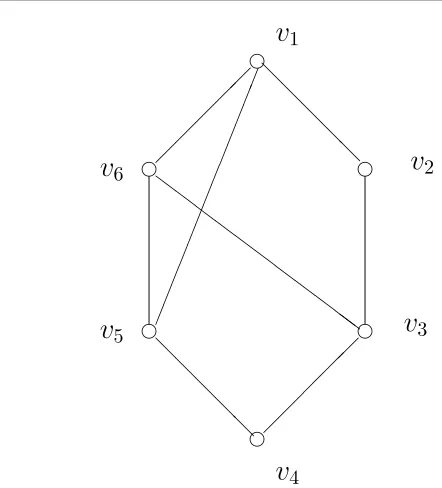
6Figure 2: A simple cycle v1, v2, v3, v4, v5, v6, v1 with two chords {v1, v5}and {v3, v6}.
Definition 5.1. LetG(V, E)be an undirected graph. Sup-pose the node sequencev1,v2,v3,. . .,vk,v1forms a sim-ple cycleCof length at least 4 inG. Any edge{vi, vj}ofG
(1≤i=j≤k) which is not inCis achord.
Figure 2 shows a simple cycle of length 6 with two chords.
Definition 5.2. An undirected graph G(V, E) is
criti-cally 2-Node-Connectedif it satisfies both of the follow-ing conditions.
(ii) For every edge e ∈ E, the subgraph ofG obtained by deleting the edge eis not2-Node-Connected.
For example, a simple cycle on three or more nodes is critically2-Node-Connected. This is because such a cycle
is2-Node-Connected, and deleting any edge of the cycle
yields a simple path which is not2-Node-Connected.
A number of properties of critically2-Node-Connected
graphs have been established in the literature (see for exam-ple, [5, 13, 23]). We use the following property in proving Lemma 5.1.
Theorem 5.2. If a graphGis critically2 - Node -Conn-ectedthen no cycle ofGhas a chord.
For a proof of the above1theorem, see [5, 13].
We also use some terminology associated with Depth-First-Search(DFS) [4]. When DFS is carried out on a con-nected undirected graphG(V, E), a spanning treeT(V, ET) is produced. Each edge in T is called a tree edge. Each tree edge joins a child to its parent. Anancestorof a node
uin T is a node which is not the parent ofubut which is encountered in the path fromuto the root ofT. Each edge in E−ET is called aback edge. Each back edge joins a nodeuto an ancestor ofuinT. The following lemma estab-lishes a simple property of back edges that arise when DFS is carried out on a critically2-Node-Connectedgraph.
Lemma 5.2. LetG(V, E)be a critically 2 - Node - Con-nected graph and let T(V, ET) be a spanning tree for G produced using DFS. For any nodeu, there is at most one back edge fromuto an ancestor ofuinT.
Proof:The proof is by contradiction. Suppose a nodeuhas two or more back edges. Letvandwbe two ancestors ofu
inT such that both{u, v}and{u, w}are back edges. Note that these two edges are in G. Without loss of generality, letwbe encountered beforevin the path inTfrom the root to u in T. The path from w to uin T together with the edge {u, w} forms a cycle in G. By our choice of w, this cycle also includes the nodev. Therefore, the edge{u, v}is a chord in the cycle. This contradicts the assumption that
Gis critically 2-Node-Connected since by Theorem 5.2,
no cycle inGcan have a chord. The lemma follows. We now prove several additional lemmas that are used in our proof of Lemma 5.1. Consider the given instance I of theUndir, 2-NC, TotalPproblem and letV denote the
set of transceivers. Fix an optimal solution to the instance
Iand letp∗denote the maximum power value assigned to a node in this optimal solution. Let the chosen optimal power assignment induce the graph G∗(V, E∗). Note that G∗ is
2-Node-Connected. LetG∗1(V, E1∗) be an edge subgraph
1It should be noted that the graph theoretic terminology
used in [5, 13] is different from ours. The statement of The-orem 5.2 given above is from [23].
ofG∗such thatG∗1is critically2-Node-Connected. (Such
a subgraph can be obtained by starting withG∗and repeat-edly removing edges until no further edge deletion is possible without violating the 2-Node-Connectedproperty.) For
each edge{u, v}of G∗1, we assign a weightw1(u, v) as fol-lows.
1. Let r be a node such that π∗(r) = p∗. Using r as the root, perform a DFS ofG∗1. LetT(V, ET) be the resulting spanning tree. Thus, each edge ofG∗1is either
a tree edge or a back edge.
2. For each tree edge {u, v}where v is the parent ofu, letw1(u, v) =π∗(u).
3. For each back edge{u, v}wherevis an ancestor ofu, letw1(u, v) =π∗(u).
The following lemma bounds the total weightW1(G∗1) of all
the edges inG∗1 under the edge weight functionw1 chosen above.
Lemma 5.3. W1(G∗1) ≤ (2−2/n)OP T(I).
Proof: As mentioned above, each edge ofG∗1is either a tree
edge or a back edge. Consider the tree edges first. For each tree edge{u, v}, wherevis the parent ofu,w1(u, v) =π∗(u). Thus, the weightπ∗(u) is assigned to at most one tree edge (namely, the edge that joins uto the parent of uif any in
T). The power value of the root rin the optimal solution, namely p∗, is not assigned to any tree edge (since the root has no parent). Thus, the total weight of all of the tree edges under the weight functionw1 is bounded byOP T(I)−p∗.
Now consider the back edges. For each back edge{u, v}, where vis an ancestor of u,w1(u, v) =π∗(u). SinceG∗1 is
critically 2-Node-Connected, by Lemma 5.2, each node
has at most one back edge to an ancestor. Thus, the weight
π∗(u) is assigned to at most one back edge. Again, the power value p∗of the rootr in the optimal solution is not assigned to any back edge. Thus, the total weight of all of the back edges under the weight functionw1is also bounded byOP T(I)−p∗.
Therefore, the total weightW1(G∗1) of all of the edges in
G∗1under the edge weight functionw1is at most 2OP T(I)−
2p∗. Sincep∗is the largest power value assigned to a node in the optimal solution, p∗ is at least OP T(I)/n. Hence,
W1(G∗1) is bounded by (2−2/n)OP T(I) as required.
The following lemma relates the weightw1(u, v) of an edge
{u, v}to the power thresholdp(u, v) needed for the existence of the edge. The proof of this lemma is omitted.
Lemma 5.4. For any edge{u, v}inG∗1,p(u, v)≤w1(u, v).
We are now ready to complete the proof of Lemma 5.1.
described above. Since the graphGcconstructed in Step 1 of
the heuristic (Figure 1) is a complete graph, every edge inG∗1
is also inGc. Consider the edge subgraphG1(V, E1) ofGc
whereE1=E1∗. SinceG∗1is2-Node-Connected, so isG1.
By Lemma 5.4, for each edge{u, v}inE1,p(u, v)≤w1(u, v). Therefore, the total weight W(G1) of all of the edges in
G1 under the edge weight function p is at most W1(G∗1).
By Lemma 5.3, W1(G∗1) is bounded by (2−2/n)OP T(I).
Therefore, W(G1) is also bounded by (2−2/n)OP T(I). In other words, the edge subgraph G1(V, E1) is 2-Node-connectedand the total weight of all its edges is at most
(2−2/n)OP T(I). This completes the proof of Lemma 5.1. The following is a direct consequence of the above discus-sion.
Theorem 5.3. There is a polynomial time approximation algorithm with a performance guarantee of2 (2−2/n) (2 + 1/n)(which approaches8asymptotically from below) for the
Undir, 2-NC, TotalP problem.
Finally, we complete this section with an analogous result for twoedgeconnectivity:
Theorem 5.4. There is a polynomial time approximation algorithm with a performance guarantee of8(1−1/n)(which approaches8asymptotically from below) for theUndir, 2-EC, TotalPproblem.
The proof (omitted here) is similar to that for Theorem 5.3 and utilizes a 2-approximation algorithm of [9] for the min-imum cost2-Edge-connected subgraphproblem.
5.3
Experimental Results
5.3.1
Overview
In the preceding sections, we established that our algo-rithm forUndir, 2-NC, TotalP has an approximation
ratio of 8. In this section, we report on the experimen-tal performance of this algorithm through computer simula-tions. Since there are no existing approximation algorithms specifically for Undir, 2-NC, TotalP, in the
experi-ments described here we compare the performance of our algorithm with Ramanathan and Rosales-Hain’s algorithm in [15]. Recall that the algorithm finds an optimum solution for theUndir, 2-NC, MaxPin which the power level of
each node is minimal.
5.3.2
Experimental Environment
Our experiments were conducted using a customized im-plementation with an experimental setup similar to the one described in [15]. In these experiments, the radio wave prop-agation model used is theLog-distance Path Loss Model:
P L(d) = −10 log10
GtGrλ2
(4π)2d20
+ 10ηlog10
d d0
whereη is the path loss exponent, d0 is the close-in ref-erence distance,λis the radio wavelength,Gt is the trans-mitter antenna gain,Gris the receiver antenna gain, andd
is the separation distance between transmitter and receiver (see [16] for detailed descriptions of these parameters). All of the parameters are chosen to emulate a 2.4 GHz wireless radio, and ifdis less than a certain threshold, the transmis-sion power is set to the minimum transmistransmis-sion power of 1 dBm.
The experiments are conducted by varying the density of the network and the geographical distribution of the nodes. In total, there were 22 sets of experiments, and 10 trials were run on each set. Each of the results we cite is the average over the 10 trials.
The node density varies from 0.625 node/sq mile to 4.06 nodes/sq mile in a 4 mile by 4 mile area. The experiments are conducted using two node distributions: one uniform and one skewed. Specifically, in the uniformly distributed networks, all nodes are placed using a random uniform dis-tribution. In the networks with a skewed distribution, the network area is equally divided into a 2 by 2 grid, with 80% of the nodes uniformly distributed in two diagonal squares, and the other 20% of the nodes uniformly distributed in the other two diagonal squares.
In each experiment, after generating a placement of the nodes, both our Min Total algorithm and the Min Max al-gorithm of [15] are run on the network consisting of those nodes. Each algorithm assigns power to each node such that the resulting network is2-Node Connected. For each
al-gorithm we measure both the maximum and average power assigned, as well as the maximum and average degrees of nodes in the resulting network.
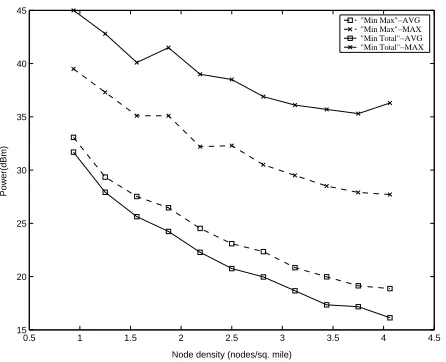
The experimental results are shown in Figures 3, 4, 5, and 6. In Figures 3 and 5, “Min Max”-AVG (“Min Max”-MAX) and “Min Total”-AVG (“Min Total”-MAX) are the aver-age (maximum) power using the Min Max and the Min To-tal algorithms respectively; likewise “Min Max”-AVG (“Min Max”-MAX) and “Min Total”-AVG (“Min Total”-MAX) in Figures 4 and 6, are the average (maximum) degrees using the Min Max and the Min Total algorithms respectively.
5.3.3
Observations
maxi-0.5 1 1.5 2 2.5 3 3.5 4 4.5 15
20 25 30 35 40 45
Node density (nodes/sq. mile)
Power(dBm)
"Min Max"−AVG "Min Max"−MAX "Min Total"−AVG "Min Total"−MAX
Figure 3: Power in uniformly distributed network
0.5 1 1.5 2 2.5 3 3.5 4 4.5 2.5
3 3.5 4 4.5 5 5.5 6 6.5 7 7.5
Node density (nodes/sq mile)
Degree
"Min Max"−MAX "Min Max"−AVG "Min Total"−MAX "Min Total"−AVG
Figure 4: Degree in uniformly distributed network
mum power using the Min Max algorithm, and about 44% -70% using our algorithm. Those numbers decrease as the density of the network increases, which implies that the av-erage power decreases faster than the maximum power, and a smaller percentage of nodes have the maximum power as the network density increases.
In the skewed placements of nodes, our Min Total algo-rithm outperforms the Min Max algoalgo-rithm with respect to average power by 6% -19%. We observe that the difference between average power and maximum power is larger than in uniform placements. The average power is about 50% -76% of the maximum power using Min Max algorithm of [15], and about 35% -64% using our algorithm. In other words, for a given average node density, the maximum power in a skewed network is higher than that in a uniformly distributed net-work, while the average power in skewed is lower. The reason is that in a skewed network the node density varies signifi-cantly from region to region. With a larger number of nodes in a smaller area, the average distance between two nodes
0.5 1 1.5 2 2.5 3 3.5 4 4.5 10
15 20 25 30 35 40 45 50
Node density (nodes/sq. mile)
Power (dBm)
"Min Max"−MAX "Min Max"−AVG "Min Total"−MAX "Min Total"−AVG
Figure 5: Power in skewednetwork
0.5 1 1.5 2 2.5 3 3.5 4 4.5 2
3 4 5 6 7 8 9 10
Node density (nodes/sq. mile)
Degree
"Min Max"−MAX "Min Max"−AVG "Min Total"−MAX "Min Total"−AVG
Figure 6: Degree in skewednetwork
is less, hence the required power levels are, on the average, smaller.
As a general rule, smaller is better in regard to node de-grees in the network induced by the power assignments. In that context, in the case where nodes are uniformly dis-tributed, the average (maximum) degree of the network with power assigned by our Min Total algorithm is consistently smaller than the average (maximum) degree of the network with power assigned by the Min Max algorithm in [15]. When using either of the algorithms, the average degree does not vary much as the network density changes. Specifically, the average degree is around 2.75 using our algorithm, which is very close to the smallest degree possible since in a 2-node-connected graph, the degree of each node must be at least 2.
6.
CURRENT WORK
We are currently working on extending these results to other graph properties such as bounded node degree, bounded diameter, etc. We are also considering properties that in-volve more than one graph parameter (e.g. 2-Node-connected and bounded maximum degree). In the case of problems in-volving Max Power, we are working on the development
of efficient algorithms for minimizing the power assigned to each transceiver after a solution that minimizes the maxi-mum power has been obtained.
7.
REFERENCES
[1] W. Chen and N. Huang. “The Strongly Connecting Problem on Multihop Packet Radio Networks”,IEEE Trans. Communication, Vol. 37, No. 3, Mar. 1989. [2] A. E. F. Clementi, P. Penna and R. Silvestri.
“Hardness Results for the Power Range Assignment Problem in Packet Radio Networks”,Proc. Third International Workshop on Randomization and Approximation in Computer Science(APPROX 1999), Lecture Notes in Computer Science Vol. 1671,
Springer-Verlag, July 1999, pp. 195–208.
[3] A. E. F. Clementi, P. Penna and R. Silvestri. “The Power Range Assignment Problem in Packet Radio Networks in the Plane”,Proc. 17th Annual Symposium on Theoretical Aspects of Computer Science(STACS 2000), Feb. 2000.
[4] T. Cormen, C. Leiserson, R. Rivest and C. Stein.
Introduction to Algorithms(second edition), MIT Press and McGraw-Hill, Cambridge, MA, 2001. [5] G. A. Dirac. “Minimally 2-Connected Graphs”,J. f¨ur
Reine und Angewandte Mathematik, Vol. 228, 1967, pp. 204–216.
[6] M. R. Garey and D. S. Johnson.Computers and Intractability: A Guide to the Theory of
NP-completeness, W. H. Freeman and Co., San Francisco, CA, 1979.
[7] L. Hu. “Topology Control for Multi-hop Packet Radio Networks”,IEEE. Trans. Communications, 41(10), 1993, pp. 1474-1481.
[8] S. Khuller and B. Raghavachari. “Improved
Approximation Algorithms for Uniform Connectivity Problems”,J. Algorithms, Vol. 21, 1996, pp. 434–450. [9] S. Khuller and U. Vishkin, “Biconnectivity
Approximations and Graph Carvings”,J. ACM, Vol. 41, 1994, pp. 214–235.
[10] L. M. Kirousis, E. Kranakis, D. Krizanc and A. Pelc. “Power Consumption in Packet Radio Networks”,
Proc. 14th Annual Symposium on Theoretical Aspects of Computer Science(STACS 97), Lecture Notes in Computer Science Vol. 1200, Springer-Verlag, Feb. 1997, pp. 363–374.
[11] L. Li and J. Y. Halpern, “Minimum Energy Mobile
Wireless Networks Revisited”,Proc. IEEE Conference on Communications (ICC’01), June 2001,
pp. 278–283.
[12] L. Li, J. Y. Halpern, P. Bahl, Y. Wang and
R. Wattenhofer, “Analysis of Cone-Based Distributed Topology Control Algorithm for Wireless Multi-hop Networks”,Proc. ACM Principles of Distributed Computing Conference (PODC’01), Aug. 2001. [13] M. D. Plummer. “On Minimal Blocks”,Trans. AMS,
Vol. 134, Oct.-Dec. 1968, pp. 85–94.
[14] V. Radoplu and T. H. Meng. “Minimum Energy Mobile Wireless Networks”,IEEE J. Selected Areas in Communications, 17(8), Aug. 1999, pp. 1333-1344. [15] R. Ramanathan and R. Rosales-Hain. “Topology
Control of Multihop Wireless Networks Using Transmit Power Adjustment”,Proc. IEEE INFOCOM 2000, Tel Aviv, Israel, March 2000, pp. 404–413.
[16] T. S. Rappaport.Wireless Communications: Principles and Practice, Prentice-Hall, Inc., Englewood Cliffs, NJ, 1996.
[17] R. Ravi and D. P. Williamson, “An Approximation Algorithm for Minimum-Cost Vertex-Connectivity Problems”,Algorithmica, 18: 21-43, 1997.
[18] E. M. Royer, P. Melliar-Smith and L. Moser, “An Analysis of the Optimum Node Density for Ad hoc Mobile Networks”,Proc. IEEE Intl. Conf. on Communication (ICC’01), Helsinki, Finland, June 2001.
[19] E. M. Royer and C. Perkins, “Transmission Range Effects on AODV Multicast Communication”, To appear in ACM Mobile Networks and Applications
(special issue on Multipoint Communication in Wireless Networks).
[20] H. Takagi, and L. Kleinrock. “Optimal Transmission Ranges for Randomly Distributed Packet Radio Terminals”, IEEE Transactions on Communications,
Vol. COM-32, No. 3, pp. 246-257, March 1984. Also appears inMultiple Access Communications, Foundations for Emerging Technologies,Norman Abramson (Ed.), IEEE Press, pp.342-353, 1992. [21] J. van Leeuwen. “Graph Algorithms”, Chapter 10 in
Handbook of Theoretical Computer Science, Vol. A, Edited by J. van Leeuwen, MIT Press and Elsevier, Cambridge, MA, 1990.
[22] R. Wattenhofer, L. Li, P. Bahl and Y. Wang. “Distributed Topology Control for Power Efficient Operation in Multihop Wireless Ad Hoc Networks”,
Proc. IEEE INFOCOM 2001, Anchorage, Alaska, April 2001, pp. 1388–1397.