The transition zone: an essential functional
compartment of cilia
Szymanska and Johnson
R E V I E W
Open Access
The transition zone: an essential functional
compartment of cilia
Katarzyna Szymanska and Colin A Johnson
*Abstract
Recent studies of the primary cilium have begun to provide further insights into ciliary ultrastructure, with an emerging picture of complex compartmentalization and molecular components that combine in functional modules. Many proteins that are mutated in ciliopathies are localized to the transition zone, a compartment of the proximal region of the cilium. The loss of these components can disrupt ciliary functions such as the control of protein entry and exit from the cilium, the possible trafficking of essential ciliary components, and the regulation of signaling cascades and control of the cell cycle. The discovery of functional modules within the primary cilium may help in understanding the variable phenotypes and pleiotropy in ciliopathies.
Keywords:Cilia, Transition zone, IFT, Ciliopathies
Review
Cilia are microtubule-based, hair-like organelles that occur on the apical surface of most mammalian cells in
G0/G1of the cell cycle [1], with the exception of bone
marrow-derived cells [2]. Defects in cilia structure or function are the cause of a suite of congenital conditions known as ciliopathies, which now include polycystic kid-ney disease, nephronophthisis, Senior-Løken syndrome, Bardet-Biedl syndrome (BBS), Joubert syndrome (JBTS) and Meckel-Gruber syndrome (MKS). Most of these conditions vary in the severity of the clinical phenotype, and display extensive allelism [3] and pleiotropy [3-7].
Ultrastructure of the cilium
There are three general types of cilia, differentiated on the basis of their microtubule structure (Figure 1). Cilia
with the canonical “9 + 2”microtubule pattern are
mo-tile: Motile cilia occur on epithelial cells in the lungs, in the olfactory bulb, in the inner ear as a kinocilium, and in the reproductive tracts of both sexes. Motile cilia in
the respiratory tract perform“whip”-like movements to
mediate fluid flow [8], although olfactory cilia, despite their 9 + 2 microtubule pattern, are thought to be im-motile [9] and kinocilia are moved by deflection [10]. During embryonic development nodal cilia play a
crucial role in left-right patterning. They are located at
the embryonic node, and although they have a “9 + 0”
microtubule pattern they mediate a leftward flow at the
node in a “whirlpool”-like manner due to the retention
of dynein arms between microtubules. The leftward flow is thought to transport morphogens that are essen-tial for the first step of symmetry breaking in the devel-opmental of the mammalian body plan [2]. The third
type of cilia is an immotile (“9 + 0”) primary cilium,
which is now known to participate in diverse roles in cell signaling, chemosensation, mechanosensation and thermosensation [11].
In quiescent cells, cilia are derived from a mother cen-triole that migrates to the apical surface of the cell and matures into the basal body. The mother centriole con-sists of a barrel-shaped structure of nine triplets of microtubules, each triplet built from A-, B- and C-tubules (Figure 1). The basal body consists of both mother and daughter centrioles, but only the former acts as a matrix for the subsequent nucleation of microtu-bules during the formation of a cilium. The mother cen-triole can also be distinguished from the daughter by the presence of fibrous distal and subdistal appendages [12]. During ciliogenesis, the doublets containing A- and B-tubules are extended to form the ciliary axoneme by a process of intraflagellar transport (IFT) [13] and the cen-triolar appendages mature into transition fibers [14]. Once the basal body is docked, the axoneme begins to
* Correspondence:[email protected]
Section of Ophthalmology and Neurosciences, Leeds Institute of Molecular Medicine, St. James’s University Hospital, Leeds, UK
be assembled. The microtubules mediate anterograde transport towards the tip of cilia by kinesin motors car-rying IFT-complex B proteins and other cargo proteins. In turn, cytoplasmic dyneins mediate retrograde move-ment of IFT-complex A towards the proximal regions of the cilium. IFT transport plays a crucial role in cilia as-sembly and disasas-sembly as well as in transporting signal-ing components. Dyneins are also components of more general motor protein complexes responsible for minus-end, microtubule-based motile processes. IFT mediates both assembly and resorbtion of the cilium, and proces-sing of key intermediates of signaling cascades [15].
The transition zone
The most proximal region of a cilium is called the
“ciliary gate” and can be divided into two structurally
distinct sub-regions: the transition fibers and the transi-tion zone (Figure 1) [16]. For many years, the ciliary gate was observed in TEM (transmission electron micros-copy) cross-sections [16-19] but its function remained unknown. These early observations suggest that the ciliary gate forms at the very early stages of ciliogenesis that precede IFT. The basal body terminates with the
end of the C-tubule and the beginning of the transition fibers. More distally, the axoneme of the cilium is then established. In motile cilia, the boundary between the axoneme and the transition zone is known as the basal plate and is thought to take part in the nucleation of the central microtubules (Figure 1) [20]. The appearance of the transition zone varies between species and cell-type [21], but the basic structural components appear to be
conserved. For example, the so-called “connecting
cilium” in photoreceptor cells of mammals is a ciliary
transition zone that extends between the outer and inner segment of photoreceptors [22], and its extended struc-ture was a factor in enabling the biochemical purifica-tion of outer segments and the identificapurifica-tion of the photoreceptor sensory cilium proteome [23].
Transition fibers (Figure 1) emerge from the B-tubules of the basal body triplet microtubules just before the end
of the C-tubule and form a “pinwheel-like” structure on
TEM cross-sections. The tips of transition fibers are thought to anchor microtubules to the plasma membrane, although the composition of transition fibers is still largely unknown. In some species and in motile cilia the terminal plate (often visualized as an electron-dense aggregate on
basal body transi on fibres
zone ciliary necklace
with parallel strands Y - shaped links
transition fibres axoneme
basal plate in motile cilia
γ-tubulin Acα-tubulin
Tmem216 1μm
cilium cilium
mother centriole
daughter centriole
fibrous appendages basal plate in motile cilia Y - shaped links ciliary necklace
terminal
plate terminal plate
Figure 1This figure shows schematic representation of cilia ultrastructure with cross-sections at the level of the basal body, transition fibers, transition zone and axoneme in motile and non-motile cilia.On the left hand side, is an enlarged immunofluorescence micrograph of a single primary cilium on an IMCD3 epithelial cell immunostained for the cilia marker acetylated ?-tubulin (blue), the basal body markerγ -tubulin (red), and transmembrane protein (TMEM) 216 (green) which localizes to the transition zone. Scale bar = 1μm.
Szymanska and JohnsonCilia2012,1:10 Page 2 of 8
TEM) is observed in this area. No function has been
ascribed for the terminal plate, although in Tetrahymena
it was shown to be enriched in centrin [24]. Transition fibers are observed on the mature mother centriole and they may play a role in anchoring to the plasma mem-brane through CEP164 [25] and ODF2 (outer dense fibre
2)/cenexin [26]. InChlamydomonas, IFT52 was observed
on transition fibers as well [27], suggesting that they have a role in docking the IFT and motor proteins required for ciliogenesis. Although the complete protein composition of those fibers is still unknown, it is thought that they take part in creating a pore complex, similar to nuclear pores, which is required for transporting proteins in and out of cilia [28].
Moving up toward the ciliary tip and on the other side
of the ciliary gate, the so-called “Y-shaped” linkers and
the ciliary necklace are observed (Figure 1), the latter a characteristic structure of the transition zone. Y-shaped linkers are structures connecting the outer doublets of microtubules to the plasma membrane and the ciliary necklace [29]. Their detailed protein structure is as yet uncharacterized and their shape and name is species specific [20,29-34]. The ciliary necklace is a specialized structure that consists of several parallel strands of intra-membrane particles and their number is species and cell-specific. The identity of these strands is unknown, but they encircle the ciliary membrane spacing from the plasma/ciliary membrane boundary to the basal plate [20]. Y-shaped linkers and the ciliary necklace are espe-cially visible in the elongated transition zone structure of connecting cilia in photoreceptors [35], and the latter
has been shown to contain CEP290 in Chlamydomonas
[36] and RPGRIP1L inC.elegans[19]. In motile cilia, the
ciliary necklace coincides with the minus ends of the central pair of microtubules at the basal plate [20]. This
region is enriched inγ-tubulin [37], which suggests that
this is the location for nucleation and stabilisation of the central pair of microtubules. Similar to the transition fibers, the transition zone has been proposed to
regu-late ciliary protein composition in Chlamydomonas, C.
elegans and mammalian cells [19,36,38] by regulating intracellular trafficking to and from the cilium. However, the molecular details of protein sorting at the transition zone remain to be discovered.
Trafficking to cilia
It is difficult to define a simple model for the mechan-isms of protein targeting to cilia, with several competing models described below and reviewed elsewhere [39-41]. Although the identity of ciliary cargo proteins is becom-ing clearer, the mechanisms of their intracellular trans-port are still mysterious. One model assumes the existence of characteristic protein recognition sequences that mediate correct targeting. A focus of research has
been the ciliary transport of transmembrane proteins, which has required the identification of specific protein sequences necessary for targeting and the identification of modules that recognize these sequences [42-44]. These include, for example, the N-terminal RVxP se-quence for the PKD2 protein [44], and the C- terminal VxPx sequence for rhodopsin [43].
A second model involves vesicle trafficking and exo-cytosis, although the direct vesicle transport of mem-brane proteins through the ciliary gate is unlikely because the vesicle size exceeds 60 nm. Instead, proteins are thought to be transported in vesicles from the Golgi apparatus to a specific docking site at the periciliary base. The exocyst complex is then thought to tether the vesicles, presumably directing the fusion of vesicles with
the ciliary membrane mediated by SNAREs (soluble N
-ethylmaleimide sensitive factor receptors) and the Rab family of small GTPases [45]. SNAREs are present at the surface of the exocyst complex to allow proteins to pass the ciliary diffusion barrier and to cross to the ciliary membrane [45], implying an active transport process [41]. This model of trafficking would therefore be analo-gous to that proposed for nuclear pores where importins and exportins are utilized. IFT proteins may mediate this transport machinery since they are enriched at the level of transition fibers [27]. Once trafficked through the ciliary gate, proteins may then be incorporated as cargo proteins in the IFT complexes and transported along the ciliary axoneme. The third model suggests that IFT pro-teins create clusters in the trans-Golgi network that coat vesicles and ensure targeted trafficking to the cilium [46]. The clusters would later become IFT complexes still attached to cargo proteins.
fusion since it localizes to the photoreceptor connecting cilium/transition zone, and appears to facilitate protein transport through Rab8-dependent processes [56].
Another possible mechanism of protein targeting to cilia is through the BBSome complex. This is proposed to medi-ate trafficking of transmembrane proteins to the ciliary membrane and consists of seven highly conserved proteins, one novel protein and a coat-like structure [50]. The BBSome directly recognizes cilia targeting sequences and is the major effector of Arl6/BBS3 (an Arf-like GTPase). Rabin8, the GEF that activates Rab8, has also been shown to interact with the BBSome [50]. The BBSome is not dir-ectly required for cilia formation in most tissues [57] but its failure to deliver important receptors and transmembrane proteins to the cilium is thought to result in cell signaling failure and organ-specific pathological abnormalities. Pro-teins, after fulfilling their function in the cilium, have to be removed from it. This function is suggested to be also
mediated by the BBSome. In Chlamydomonas it was
observed that the BBSome and IFT particles co-localize, and the BBSome may play a docking function for the retro-grade IFT complex A [58]. Proteins targeted to be removed from cilia may also be ubiquitinated, then accumulated at the base of cilia for targeted degradation by the endocytic pathway [59].
Recent advances in characterizing the transition zone
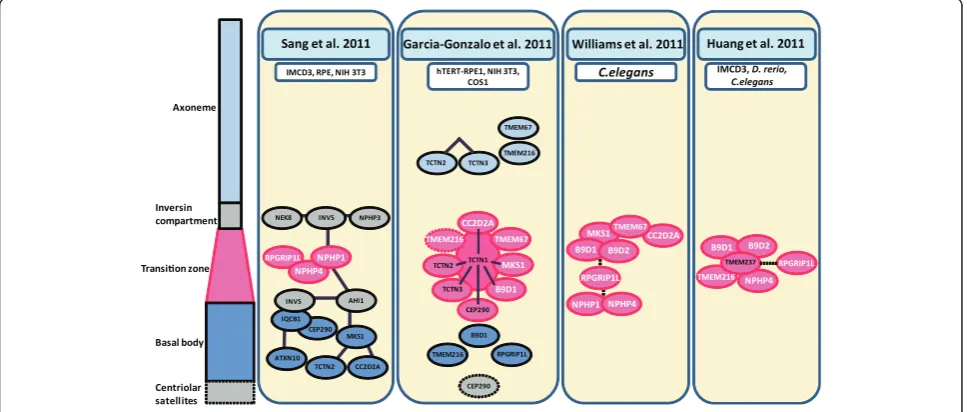
In five recent papers, the composition of protein complexes at the ciliary gate and transition zone was investigated. In
two of the studies [54,60], the authors used the G-LAP tandem-affinity method, a stringent proteomic strategy for the identification of interacting proteins. It allowed the authors not only to identify three interconnected functional modules, but to also identify three new ciliopathy genes:
Sang et al. 2011 identified ATXN10 and TCTN2, and
Garcia-Gonzalo et al. 2011 identified TCTN1. The first
module, the “nephronophthisis NPHP module” identified
in Sang et al. 2011, was composed of NPHP1/nephrocys-tin-1, which was previously suggested to take part in the regulation of cargo and IFT ciliary entry [61]. NPHP4 and RPGRIP1L (also components of the NPHP module) were also localized to the transition zone and cell-cell boundar-ies.In vitrostudies showed that this module was not essen-tial for ciliogenesis, but it may play an important part in epithelial morphogenesis and the establishment of tissue architecture. On the other hand, a second module (the
“JBTS module”) that contains IQCB1 and CEP290 is
essen-tial for cilia formation. Proteins in the third module (the
“MKS module” containing MKS1, CC2D2A and TCTN2)
are involved in neural tube development and Sonic Hedgehog signaling. The authors proposed the existence of an additional ciliary segment located distal to the transition zone in the proximal part of cilia, which they called the
“inversin compartment” (Figure 2). The function of this
section of the cilium remains to be understood, but several proteins were found to be localized in it, notably NEK8, INVS/inversin and NPHP3 [62]. INVS and AHI1/jouberin were found to play a bridging role between these three modules. There were no interactions observed between the
Figure 2Localization of the indicated proteins (coloured ovals) to sub-ciliary compartments (pale blue, axoneme; grey, inversin compartment; pink, transition zone; dark blue, basal body; grey with dashed square , centriolar satellites) are represented based on biochemical and genetic interaction data from four recent studies of the composition of the transition zone (Sanget al.2011, Garcia-Gonzaloet al.2011, Williamset al.2011 and Huanget al.2011; each indicated at the top of each section).White text indicates common components identified by different studies; dark lines indicate an interaction identified by MS/MS; a dashed line indicates a genetic interaction; overlapping ellipses indicated a direct interaction. The model system(s) used to generate these data are also indicated for each study.
Szymanska and JohnsonCilia2012,1:10 Page 4 of 8
NPHP-JBTS-MKS modules and the BBS proteins, and no overlap with IFT complex proteins [60].
In Garcia-Gonzalo et al. 2011, the authors identified
mutations in TCTN1 as a cause of Joubert syndrome.
They showed that TCTN1/tectonic-1 interacts with TCTN2, TCTN3, MKS1, B9D1 and CC2D2A and, under some circumstances, with CEP290, TMEM67/meckelin and TMEM216. They showed that TCTN1 localizes to the transition zone and that it is required for transition zone localization of MKS1 and TMEM67. During detailed studies they observed other proteins at the transition zone: TCTN2, TCTN3 and TMEM67 (all three of which also localized elsewhere in the cilium); MKS1 and CEP290 (also localized to centriolar appendages); CC2D2A and B9D1 (also localized to the basal body) and NPHP4. RPGRIP1L was localized to the basal body like TMEM216, which was also observed at distal regions of the cilium and occasionally at the transition zone (Figure 1). The authors stated that the Tectonic module (containing TCTN1, TCTN2 and TCTN3) and MKS proteins localize to the transition zone where they regulate ciliogenesis and ciliary membrane composition in a tissue-specific manner, and dysfunction of the transition zone is a basic defect causing human ciliopathies [54].
Williams and colleagues, 2011 conducted their research on C. elegans which has ciliated sensory neurons in amphid sensory cells. They grouped the investigated pro-teins into two modules: MKS/MKSR (containing MKS1, B9D1, B9D2, TMEM67, CC2D2A) and NPHP (containing NPHP1 and NPHP4) (Figure 2) that despite seemingly un-related components share a common biological function. Both modules are linked through RPGRIP1L, which is re-sponsible for endogenous localization to the transition zone for all of the other investigated proteins. Collectively, both modules are required for the early steps of
ciliogen-esis, namely the basal body– transition zone membrane
docking and formation of the transition zone [19]. It is notable that CC2D2A has been implicated in Rab8-dependent vesicle trafficking and fusion [56], although the role of the MKS/MKSR module in mediating these pro-cesses remains unclear.
Li et al. 2011 [63] investigated TCTEX1/DYNLT, a dynein light chain subunit involved in cargo binding but that can also be recruited for functions independent of the dynein complex [64]. Active phosphorylated TCTEX1 was found to be recruited to the ciliary transition zone prior to cilia disassembly and entry into S phase of the cell cycle [63]. Furthermore, active TCTEX1 was recruited to the transition zone of neuronal progenitor cells, where it had a key role in cell cycle regulation and the probable deter-mination of cell fate between proliferation of progenitors and differentiation into post-mitotic neurons.
In Huanget al.2011, the authors identified mutations in
TMEM237/JBTS14as a cause of Joubert syndrome-related
disorders [65]. They used three model systems (C. elegans,
zebrafish and IMCD3 cells) to investigate biochemical and genetic interactions between TMEM237 and other ciliary proteins. TMEM237 localized to the ciliary transition zone and, largely in agreement with previous studies [54,60], interacted genetically with NPHP4, TMEM216, B9D1 and B9D2. The authors also noted that TMEM237 required RPGRIP1L for localization to the transition zone in both
the IMCD3 cell andC. elegansmodels, which suggests that
RPGRIP1L has a structural role in mediating the scaffold-ing or bridgscaffold-ing between interactscaffold-ing ciliary proteins [65].
Figure 2 summarizes the localization of ciliary proteins
based on the results of Sang et al.2011, Garcia-Gonzalo
et al.2011, Williamset al.2011 and Huanget al.2011. There are some obvious inconsistencies among the stud-ies, which could be explained by possible differences in cilia structure between tissues and the dynamic nature of ciliogenesis and protein transport within cilia. Sang
et al. 2011 proposed interaction modules that will be very useful in further analysis of protein-protein interac-tions, signaling pathways and the molecular structure of
cilia. Garcia-Gonzaloel al. 2011 added another module
containing Tectonic proteins (TCTN1, TCTN2 and TCTN3) crucial for cilia formation and the patterning of
the developing embryo. Williamset al. 2011 described a
further functional module (the “MKS/MKSR module”
including MKS1, TMEM67, CC2D2A, B9D1 and B9D2). This observation confirmed the existence of a general
“NPHP1-NPHP4-RPGRIP1L module” with RPGRIP1L
functioning as a bridging protein. Huang et al. 2011
described a fourth ciliopathy geneTMEM237 using a
next-generation sequencing strategy, and confirmed the transition zone localization of RPGRIP1L, NPHP4, B9D1 and B9D2. The dynamic nature of ciliogenesis regulation by transition zone proteins has been highlighted by a fourth recent study [63].
Conclusion
RPGRIP1L [3,66]. A fifth study [63] has highlighted the complex, dynamic nature of the transition zone and a
pos-sible role of this region of the cilium in G1/S checkpoint
control. Linking the cilium, cell cycle control and extracel-lular cues of signaling pathways will be a further field of intensive future work, and will no doubt bring further sur-prises in our understanding of the complex ultrastructure of the primary cilium.
Abbreviations
BBS: Bardet-Biedl syndrome; IFT: Intraflagellar transport; JBTS: Joubert syndrome; LCA: Leber congenital amaurosis; MKS: Meckel-Gruber syndrome; NPHP: Nephronophthisis; TEM: Transmission electron microscopy;
TMEM: Transmembrane protein; SLS: Senior-Løken syndrome; SNARE: Soluble N- ethylmaleimide sensitive factor receptor; GEF: Guanine nucleotide exchange factor.
Competing interests
The authors declare no competing financial interests.
Authors' contributions
KS and CAJ contributed equally to the preparation of the manuscript. Both authors read and approved the final manuscript.
Acknowledgments
The authors would like to acknowledge funding from the European Community's Seventh Framework Programme FP7/2009 under grant agreement no: 241955, SYSCILIA. http://syscilia.org/
Figure 3Five ciliopathies with extensive genetic heterogeneity and pleiotropy (BBS, Bardet-Biedl syndrome; JBTS, Joubert syndrome; MKS, Meckel-Gruber syndrome; NPHP,
nephronophthisis; SLS, Senior-Løken syndrome) are indicated by ovals of different colour, with the ciliary proteins mutated as a known cause of each disorder indicated by the coloured lines.
Table 1 List of proteins localized to the transition zone involved in ciliopathies
Gene Localization Publication Ciliopathy
MKS1 TZ Garcia-Gonzalo et al, 2011; Williams et al, 2011 MKS
BB Sang et al, 2011 MKS
TMEM216 AX Garcia-Gonzalo et al, 2011 MKS, JBTS
TZ Garcia-Gonzalo et al, 2011; Huang et al, 2011 MKS, JBTS
BB Garcia-Gonzalo et al, 2011 MKS, JBTS
TMEM67 AX Garcia-Gonzalo et al, 2011 MKS, JBTS, NPHP
TZ Garcia-Gonzalo et al, 2011; Williams et al, 2011 MKS, JBTS, NPHP
CEP290 TZ Garcia-Gonzalo et al, 2011 MKS, JBTS, NPHP, BBS, LCA, SLS
BB Sang et al, 2011 MKS, JBTS, NPHP, BBS, LCA, SLS
CS Garcia-Gonzalo et al, 2011 MKS, JBTS, NPHP, BBS, LCA, SLS
RPGRIP1L TZ Sang et al, 2011; Williams et al, 2011; Huang et al, 2011 MKS, JBTS, NPHP, LCA
BB Garcia-Gonzalo et al, 2011 MKS, JBTS, NPHP, LCA
CC2D2A TZ Williams et al, 2011 MKS, JBTS
BB Sang et al, 2011 MKS, JBTS
TCTN2 AX Garcia-Gonzalo et al, 2011 MKS
TZ Garcia-Gonzalo et al, 2011 MKS
BB Sang et al, 2011 MKS
NPHP1 TZ Sang et al, 2011; Williams et al, 2011 JBTS, NPHP, SLS
NPHP4 TZ Sang et al, 2011; Garcia-Gonzalo et al, 2011; Williams et al, 2011; Huang et al, 2011 NPHP, SLS
B9D1 TZ Garcia-Gonzalo et al, 2011; Williams et al, 2011; Huang et al, 2011 MKS
BB Garcia-Gonzalo et al, 2011 MKS
The proteins are described to localize to the transition zone and other ciliary compartments in recent publications. Abbreviations:AX, Axoneme;BB, Basal body; BBS, Bardet-Biedl syndrome;CS, Centriolar satellites;JBTS, Joubert syndrome;LCA, Leber congenital amaurosis;MKS, Meckel-Gruber syndrome;NPHP,
nephronophthisis;SLS, Senior-Løken syndrome;TZ, transition zone.
Szymanska and JohnsonCilia2012,1:10 Page 6 of 8
Received: 15 December 2011 Accepted: 2 March 2012 Published: 2 July 2012
References
1. Pan J, Snell W:The Primary Cilium: Keeper of the Key to Cell Division. Cell2007,129:1255–1257.
2. Praetorius HA, Spring KR:A physiological view of the primary cilium.Annu Rev Physiol2005,67:515–529.
3. Davis EE, Zhang Q, Liu Q, Diplas BH, Davey LM, Hartley J, Stoetzel C, Szymanska K, Ramaswami G, Logan CV, Muzny DM, Young AC, Wheeler DA, Cruz P, Morgan M, Lewis LR, Cherukuri P, Maskeri B, Hansen NF, Mullikin JC, Blakesley RW, Bouffard GG, Comparative Sequencing Program NISC, Gyapay G, Rieger S, Tönshoff B, Kern I, Soliman NA, Neuhaus TJ, Swoboda KJ, Kayserili H:TTC21B contributes both causal and modifying alleles across the ciliopathy spectrum.Nat Genet2011,43:189–196.
4. Baala L, Romano S, Khaddour R, Saunier S, Smith UM, Audollent S, Ozilou C, Faivre L, Laurent N, Foliguet B, Munnich A, Lyonnet S, Salomon R, Encha-Razavi F, Gubler MC, Boddaert N, de Lonlay P, Johnson CA, Vekemans M, Antignac C, Attie-Bitach T:The Meckel-Gruber syndrome gene, MKS3, is mutated in Joubert syndrome.Am J Hum Genet2007,80:186–194. 5. Bergmann C, Fliegauf M, Bruchle NO, Frank V, Olbrich H, Kirschner J,
Schermer B, Schmedding I, Kispert A, Kranzlin B, Nürnberg G, Becker C, Grimm T, Girschick G, Lynch SA, Kelehan P, Senderek J, Neuhaus TJ, Stallmach T, Zentgraf H, Nürnberg P, Gretz N, Lo C, Lienkamp S, Schäfer T, Walz G, Benzing T, Zerres K, Omran H:Loss of nephrocystin-3 function can cause embryonic lethality, meckel-gruber-like syndrome, situs inversus, and renal-hepatic-pancreatic dysplasia.Am J Hum Genet2008, 82:959–970.
6. Devuyst O, Arnould VJ:Mutations in RPGRIP1L: extending the clinical spectrum of ciliopathies.Nephrol Dial Transplant2008,23:1500–1503. 7. Mougou-Zerelli S, Thomas S, Szenker E, Audollent S, Elkhartoufi N, Babarit C,
Romano S, Salomon R, Amiel J, Esculpavit C, Gonzales M, Escudier E, Leheup B, Loget P, Odent S, Roume J, Gérard M, Delezoide AL, Khung S, Patrier S, Cordier MP, Bouvier R, Martinovic J, Gubler MC, Boddaert N, Munnich A, Encha-Razavi F, Valente EM, Saad A, Saunier S,et al:CC2D2A Mutations in Meckel and Joubert Syndromes Indicate a Genotype-Phenotype Correlation.Hum Mutat2009,30:1574–1582.
8. Kotov N, Bates D, Gizatullina A, Gilaziev B, Khairullin R, Chen M, Drozdov I, Umezawa Y, Hundhausen C, Aleksandrov A, Yan XG, Spurgeon SK, Smales CM, Valeyev NV:Computational modelling elucidates the mechanism of ciliary regulation in health and disease.BMC Systems Biology2011,5:143. 9. Menini A (Ed:The Neurobiology of Olfaction. Boca Raton, FL: CRC Press; 2010 10. Fontilla MF, Peterson EH:Kinocilia heights on utricular hair cells.Hear Res
2000,145:8–16.
11. Fliegauf M, Benzing T, Omran H:When cilia go bad: cilia defects and ciliopathies.Nat Rev Mol Cell Biol2007,8:880–893.
12. Paintrand M, Moudjou M, Delacroix H, Bornens M:Centrosome organization and centriole architecture: Their sensitivity to divalent cations.J Struct Biol1992,108:107–128.
13. Satir P:Studies on cilia.J Cell Biol1968,39:77–94.
14. Sorokin SP:Reconstructions of Centriole Formation and Ciliogenesis in Mammalian Lungs.J Cell Sci1968,3:207–230.
15. Pedersen LB, Veland IR, Schroder JM, Christensen ST:Assembly of primary cilia.Dev Dyn2008,237:1993–2006.
16. Omran H:NPHP proteins: gatekeepers of the ciliary compartment.J Cell Biol2010,190:715–717.
17. Gibbons IR, Grimstone AV:On Flagellar Structure in Certain Flagellates. J Biophys Biochem Cytol1960,7:697–716.
18. Ringo DL:Flagellar motion and fine structure of the flagellar apparatus in Chlamydomonas.J Cell Biol1967,33:543–571.
19. Williams CL, Li C, Kida K, Inglis PN, Mohan S, Semenec L, Bialas NJ, Stupay RM, Chen N, Blacque OE, Yoder BK, Leroux MR:MKS and NPHP modules cooperate to establish basal body/transition zone membrane associations and ciliary gate function during ciliogenesis.The Journal of Cell Biology2011,192:1023–1041.
20. Gilula NB, Satir P:The ciliary necklace.J Cell Biol1972,53:494–509. 21. Fisch C, Dupuis-Williams P:Ultrastructure of cilia and flagella–back to
the future!Biol Cell2011,103:249–270.
22. Quinlan RJ, Tobin JL, Beales PL:Modeling ciliopathies: primary cilia in development and disease.Curr Top Dev Biol2008,84:249–310.
23. Liu Q, Tan G, Levenkova N, Li T, Pugh EN, Rux JJ, Speicher DW, Pierce EA: The Proteome of the Mouse Photoreceptor Sensory Cilium Complex.Mol Cell Proteomics2007,6:1299–1317.
24. Kilburn CL, Pearson CG, Romijn EP, Meehl JB, Giddings TH, Culver BP, Yates JR, Winey M:New Tetrahymena basal body protein components identify basal body domain structure.J Cell Biol2007,178:905–912.
25. Graser S, Stierhof Y-D, Lavoie SB, Gassner OS, Lamla S, Le Clech M, Nigg EA: Cep164, a novel centriole appendage protein required for primary cilium formation.J Cell Biol2007,179:321–330.
26. Ishikawa H, Kubo A, Tsukita S, Tsukita S:Odf2-deficient mother centrioles lack distal/subdistal appendages and the ability to generate primary cilia.Nat Cell Biol2005,7:517–524.
27. Deane JA, Cole DG, Seeley ES, Diener DR, Rosenbaum JL:Localization of intraflagellar transport protein IFT52 identifies basal body transitional fibers as the docking site for IFT particles.Curr Biol2001,11:1586–1590. 28. Rosenbaum JL, Witman GB:Intraflagellar transport.Nat Rev Mol Cell Biol
2002,3:813–825.
29. O'Toole ET, Giddings TH Jr, Dutcher SK:Understanding Microtubule Organizing Centers by Comparing Mutant and Wild-Type Structures with Electron Tomography. InMethods in Cell Biology, Volume 79. Edited by McIntosh JR. Waltham, MS: Academic Press; 2007:125–143.
30. Reese TS:Olfactory cilia in the frog.J Cell Biol1965,25:209–230. 31. Anderson RGW:Isolation of ciliated or inciliated basal bodies from the
rabbit oviduct.J Cell Biol1974,60:393–404.
32. Cavalier-Smith T:Basal Body and Flagellar Development During the Vegetative Cell Cycle and the Sexual Cycle of Chlamydomonas Reinhardii.J Cell Sci1974,16:529–556.
33. Dute R, Kung C:Ultrastructure of the proximal region of somatic cilia in Paramecium tetraurelia.J Cell Biol1978,78:451–464.
34. Geimer S, Melkonian M:Centrin Scaffold in Chlamydomonas reinhardtii Revealed by Immunoelectron Microscopy.Eukaryot Cell2005,4:1253–1263. 35. Horst CJ, Forestner DM, Besharse JC:Cytoskeletal-membrane interactions: a stable interaction between cell surface glycoconjugates and doublet microtubules of the photoreceptor connecting cilium.J Cell Biol1987, 105:2973–2987.
36. Craige B, Tsao C-C, Diener DR, Hou Y, Lechtreck K-F, Rosenbaum JL, Witman GB:CEP290 tethers flagellar transition zone microtubules to the membrane and regulates flagellar protein content.J Cell Biol2010, 190:927–940.
37. Silflow CD, Liu B, LaVoie M, Richardson EA, Palevitz BA:γ-tubulin in Chlamydomonas: Characterization of the gene and localization of the gene product in cells.Cell Motil Cytoskeleton1999,42:285–297. 38. Hu Q, Milenkovic L, Jin H, Scott MP, Nachury MV, Spiliotis ET, Nelson WJ:
A Septin Diffusion Barrier at the Base of the Primary Cilium Maintains Ciliary Membrane Protein Distribution.Science2010,329:436–439. 39. Ishikawa H, Marshall WF:Ciliogenesis: building the cell's antenna.Nat Rev
Mol Cell Biol2011,12:222–234.
40. Hu Q, Nelson WJ:Ciliary diffusion barrier: The gatekeeper for the primary cilium compartment.Cytoskeleton2011,68:313–324.
41. Nachury MV, Seeley ES, Jin H:Trafficking to the Ciliary Membrane: How to Get Across the Periciliary Diffusion Barrier?Annu Rev Cell Dev Biol2010, 26:59–87.
42. Deretic D, Williams AH, Ransom N, Morel V, Hargrave PA, Arendt A: Rhodopsin C terminus, the site of mutations causing retinal disease, regulates trafficking by binding to ADP-ribosylation factor 4 (ARF4).Proc Natl Acad Sci U S A2005,102:3301–3306.
43. Mazelova J, Astuto-Gribble L, Inoue H, Tam BM, Schonteich E, Prekeris R, Moritz OL, Randazzo PA, Deretic D:Ciliary targeting motif VxPx directs assembly of a trafficking module through Arf4.EMBO J2009,28:183–192. 44. Geng L, Okuhara D, Yu Z, Tian X, Cai Y, Shibazaki S, Somlo S:Polycystin-2
traffics to cilia independently of polycystin-1 by using an N-terminal RVxP motif.J Cell Sci2006,119:1383–1395.
45. Jahn R, Scheller RH:SNAREs—engines for membrane fusion.Nat Rev Mol Cell Biol2006,7:631–643.
46. Follit JA, Tuft RA, Fogarty KE, Pazour GJ:The Intraflagellar Transport Protein IFT20 Is Associated with the Golgi Complex and Is Required for Cilia Assembly.Mol Biol Cell2006,17:3781–3792.
48. Hsiao Y-C, Tong ZJ, Westfall JE, Ault JG, Page-McCaw PS, Ferland RJ:Ahi1, whose human ortholog is mutated in Joubert syndrome, is required for Rab8a localization, ciliogenesis and vesicle trafficking.Hum Mol Genet
2009,18:3926–3941.
49. Yoshimura S-i, Egerer J, Fuchs E, Haas AK, Barr FA:Functional dissection of Rab GTPases involved in primary cilium formation.J Cell Biol2007, 178:363–369.
50. Nachury MV, Loktev AV, Zhang Q, Westlake CJ, Peränen J, Merdes A, Slusarski DC, Scheller RH, Bazan JF, Sheffield VC, Jackson PK:A Core Complex of BBS Proteins Cooperates with the GTPase Rab8 to Promote Ciliary Membrane Biogenesis.Cell2007,129:1201–1213.
51. Follit JA, Li L, Vucica Y, Pazour GJ:The cytoplasmic tail of fibrocystin contains a ciliary targeting sequence.J Cell Biol2010,188:21–28. 52. Knödler A, Feng S, Zhang J, Zhang X, Das A, Peränen J, Guo W:
Coordination of Rab8 and Rab11 in primary ciliogenesis.Proc Natl Acad Sci2010,107:6346–6351.
53. Kim J, Krishnaswami SR, Gleeson JG:CEP290 interacts with the centriolar satellite component PCM-1 and is required for Rab8 localization to the primary cilium.Hum Mol Genet2008,17:3796–3805.
54. Garcia-Gonzalo FR, Corbit KC, Sirerol-Piquer MS, Ramaswami G, Otto EA, Noriega TR, Seol AD, Robinson JF, Bennett CL, Josifova DJ, García-Verdugo JM, Katsanis N, Hildebrandt F, Reiter JF:A transition zone complex regulates mammalian ciliogenesis and ciliary membrane composition. Nat Genet2011,43:776–784.
55. Nalefski EA, Falke JJ:The C2 domain calcium-binding motif: Structural and functional diversity.Protein Sci1996,5:2375–2390.
56. Bachmann-Gagescu R, Phelps IG, Stearns G, Link BA, Brockerhoff SE, Moens CB, Doherty D:The ciliopathy gene cc2d2a controls zebrafish photoreceptor outer segment development through a role in Rab8-dependent vesicle trafficking.Hum Mol Genet2011, 20:4041–4055.
57. Jin H, White SR, Shida T, Schulz S, Aguiar M, Gygi SP, Bazan JF, Nachury MV: The Conserved Bardet-Biedl Syndrome Proteins Assemble a Coat that Traffics Membrane Proteins to Cilia.Cell2010,141:1208–1219. 58. Lechtreck K-F, Johnson EC, Sakai T, Cochran D, Ballif BA, Rush J, Pazour GJ,
Ikebe M, Witman GB:The Chlamydomonas reinhardtii BBSome is an IFT cargo required for export of specific signaling proteins from flagella. J Cell Biol2009,187:1117–1132.
59. Huang K, Diener DR, Rosenbaum JL:The ubiquitin conjugation system is involved in the disassembly of cilia and flagella.J Cell Biol2009, 186:601–613.
60. Sang L, Miller Julie J, Corbit Kevin C, Giles Rachel H, Brauer Matthew J, Otto Edgar A, Baye Lisa M, Wen X, Scales Suzie J, Kwong M, Huntzicker EG, Sfakianos MK, Sandoval W, Bazan JF, Kulkarni P, Garcia-Gonzalo FR, Seol AD, O'Toole JF, Held S, Reutter HM, Lane WS, Rafiq MA, Noor A, Ansar M, Devi AR, Sheffield VC, Slusarski DC, Vincent JB, Doherty DA, Hildebrandt F: Mapping the NPHP-JBTS-MKS Protein Network Reveals Ciliopathy Disease Genes and Pathways.Cell2011,145:513–528.
61. Jiang S-T, Chiou Y-Y, Wang E, Chien Y-L, Ho H-H, Tsai F-J, Lin C-Y, Tsai S-P, Li H:Essential role of nephrocystin in photoreceptor intraflagellar transport in mouse.Hum Mol Genet2009,18:1566–1577.
62. Shiba D, Manning DK, Koga H, Beier DR, Yokoyama T:Inv acts as a molecular anchor for Nphp3 and Nek8 in the proximal segment of primary cilia.Cytoskeleton2010,67:112–119.
63. Li A, Saito M, Chuang J-Z, Tseng Y-Y, Dedesma C, Tomizawa K, Kaitsuka T, Sung C-H:Ciliary transition zone activation of phosphorylated Tctex-1 controls ciliary resorption, S-phase entry and fate of neural progenitors. Nat Cell Biol2011,13:402–411.
64. Chuang J-Z, Yeh T-Y, Bollati F, Conde C, Canavosio F, Caceres A, Sung C-H:The Dynein Light Chain Tctex-1 Has a Dynein-Independent Role in Actin Remodeling during Neurite Outgrowth.Dev Cell2005, 9:75–86.
65. Huang L, Szymanska K, Jensen VL, Janecke AR, Innes AM, Davis EE, Frosk P, Li C, Willer JR, Chodirker BN, Greenberg CR, McLeod DR, Bernier FP, Chudley AE, Müller T, Shboul M, Logan CV, Loucks CM, Beaulieu CL, Bowie RV, Bell SM, Adkins J, Zuniga FI, Ross KD, Wang J, Ban MR, Beck C, Nürnberg P, Douglas S, Craft CM, Akimenko M-A,et al:TMEM237 is mutated in individuals with a Joubert syndrome related disorder and expands the role of the TMEM family at the ciliary transition zone.Am J Hum Genet
2011,89:713–730.
66. Khanna H, Davis EE, Murga-Zamalloa CA, Estrada-Cuzcano A, Lopez I, den Hollander AI, Zonneveld MN, Othman MI, Waseem N, Chakarova CF, Maubaret C, Diaz-Font A, MacDonald I, Muzny DM, Wheeler DA, Morgan M, Lewis LR, Logan CV, Tan PL, Beer MA, Inglehearn CF, Lewis RA, Jacobson SG, Bergmann C, Beales PL, Attié-Bitach T, Johnson CA, Otto EA, Bhattacharya SS, Hildebrandt F,et al:A common allele in RPGRIP1L is a modifier of retinal degeneration in ciliopathies.Nat Genet2009,41:739–745.
doi:10.1186/2046-2530-1-10
Cite this article as:Szymanska and Johnson:The transition zone: an essential functional compartment of cilia.Cilia20121:10.
Submit your next manuscript to BioMed Central and take full advantage of:
• Convenient online submission
• Thorough peer review
• No space constraints or color figure charges
• Immediate publication on acceptance
• Inclusion in PubMed, CAS, Scopus and Google Scholar
• Research which is freely available for redistribution
Submit your manuscript at www.biomedcentral.com/submit
Szymanska and JohnsonCilia2012,1:10 Page 8 of 8