Utility-Based Node Cooperation Mechanism in Wireless
Sensor Networks
Xiaohui Lin*, Junling Zhang, Can Hu, Yide Huang, Bin Chen, Ning Xie, Hui Wang
Shenzhen Key Lab of Advanced Communications and Information Processing, Faculty of Information Engineering, Shenzhen University, Shenzhen, China
Email: *[email protected]
Received March 14, 2013; revised April 12, 2013; accepted May 6,2013
Copyright © 2013 Xiaohui Lin et al. This is an open access article distributed under the Creative Commons Attribution License, which permits unrestricted use, distribution, and reproduction in any medium, provided the original work is properly cited.
ABSTRACT
In wireless sensor networks, due to the energy and resource constraints, nodes may be unwilling to forward packets for their neighbors. This can render severe deteriorations in the network performance and malfunctions of the system. To tackle such selfish behaviors and enhance the cooperation among sensors, based on reputation and energy consumption of each node, we present a utility function to punish the malicious nodes and encourage cooperation among nodes. Spe- cifically, we firstly give a mixed strategy Nash equilibrium solution for the two nodes. Then we extend the model to multi-nodes scenario. With the unity function, each sensor’s reputation is evaluated according to its degree of coopera- tion. The extensive simulation results have shown the effectiveness of the mechanism, in that the cooperative behaviors are encouraged, which can ensure the normal functioning of the network system.
Keywords: Wireless Sensor Networks; Selfish Node; Game Theory; Reputation; Energy
1. Introduction
Wireless sensor networks (WSNs) have recently pene- trated deeply into our society and drawn considerable attentions from the academia and industry. WSNs are composed of a large number of cheap and tiny senor nodes deployed in monitored areas. Compared with tra- ditional networks, wireless sensor networks have dy- namic topology and are characterized by their non-cen- tralized structure, self-organized and multi-hop features. As a novel technology in acquiring and processing in- formation, WSN has been widely applied in many fields, such as military affairs, industry, agriculture, health care, and environmental monitoring, etc. [1].
However, in the deployment of WSN, one of the key concerns is the limited energy constraint, which has re- stricted the capabilities of sensor nodes in data commu- nication, computing, and information processing.
Specifically, to conserve limited energy, some selfish nodes may be unwilling to forward data for their neighbor- ing nodes, which can cause the decrease in network throughput and the severe deterioration in system per- formance. Therefore, to guarantee network performance, cooperation among sensors should be definitely encour- aged, and reasonable incentive mechanisms [2-4] should
also be designed to fulfill this target.
2. Related Work
Thus far, many different methods have been proposed to tackle the selfish issues of nodes. Generally, they can be classified into three categories.
2.1. Reputation Based Mechanism
In this mechanism [5,6], if a node successfully forwards data packets for its neighbors, the reputation of this node will be increased; otherwise if it drops packets, the repu- tation will be decreased. When the reputation value drops below a threshold, the node is either punished or isolated. In [7], Marti uses a watchdog algorithm to identify mis- behaving nodes. In addition, they also design a path rater to enhance the routing quality by deleting these selfish nodes from the path. Similarly, by using the idea of Watchdog, authors in [8] propose CONFIDANT (Coop- eration of Nodes Fairness in Dynamic Ad-hoc Networks) protocol, which aims at detecting and isolating misbe-having nodes.
2.2. Credit-Payment Mechanism
This mechanism is similar to reputation-based one. The
difference is that the mechanism introduces a concept of virtual currency or credits as payment to a cooperating neighbor from which a node has received service. A sending node will pay its neighbor who has successfully forwarded packets for it. On the other hand, if a non- cooperative neighbor refuses to provide service, it will forfeit its virtual currency or credits as a punishment. If the virtual currency is used up, it cannot send its own packets anymore [9].
In [10], Buttyaan et al. propose Packet Purse Model
(PPM), in which, a type of virtual currency called “nuglets” is used. In PPM, each packet is loaded with nuglets by the source. Each forwarding node can take some amount of nuglets as reward for the forwarding services, thus stimulating the cooperative behaviors of the neighbors.
2.3. Game Theory Mechanism
Game theory provides analytical tools to predict the out-come of complex interactions among rational entities. A game consists of a set of players, a set of strategies avail- able to players, and a specification of payoffs for each combination of strategy [11,12]. The cooperation among sensors can also be model as a game. By properly de-signing the utility function in the game, the high through- put can be guaranteed and energy consumption can also be balanced [13,14]. In [15], a repeated game model for WSN is proposed, and punishment mechanism is also employed to encourage the cooperation of sensor nodes.
3. Model and Assumptions
In this paper, we will design a utility function based on reputation and energy consumption of nodes to encour- age cooperation among nodes. We will also propose a mechanism to monitor the malicious nodes and selfish nodes. Firstly, we give the system model and basic con- cepts and assumptions.
3.1. Node Entity
A node has the following attributes: 1) ID-Every node has its unique ID.
2) Type. The nodes are categorized into three types— normal nodes, malicious nodes and selfish nodes. Normal nodes always cooperate. Malicious nodes always drop packets from neighbors. Selfish nodes occasionally par- ticipate in forwarding packets (with some probability). We assume that, at the beginning, selfish nodes drop pac- kets more often. When their reputation values fall below a certain threshold, they begin to behave like normal nodes and forward more packets for others.
Transmission Range. Nodes can only communicate with their neighbors which are within their transmission range. The distance between two nodes can be written as
2
22 1 2 1
d x x y y
where,
x y1, 1
, x y2, 2
dare coordinates of two nodes.
If the value of is less than or equal to the
transmis-sion range (in this paper, we t d to 10), the two
nodes can be considered as neigh se bors.
1) Reputation. We assume the initial reputation of
every node is R010. Nodes participating in packets
forwarding can gain some reputation as a reward (this
increment of reputation is defined as inc), while those
who act selfishly will lose some reputation as a punish-
ment (this decrement of reputation is defined as ).
R
dec 2) Energy. The initial energy level of all nodes at the
beginning in the network is 0. When sending/forward-
ing and receiving packets, node will consume some amount of energy. A node will die when its energy is depleted.
R
E
3.2. Network Setup
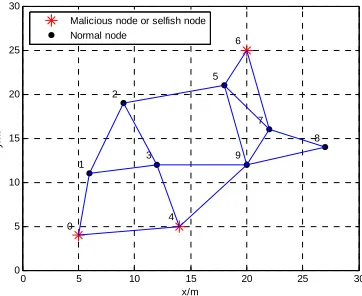
[image:2.595.334.515.569.717.2]In this paper, the simulated network is demonstrated in
Figure 1. The area is 30 30 m with 10 nodes, which are numbered from 0 to 9. Neighbors are connected by straight line. One malicious node (node 6) and two self- ish nodes (node 0 and 4) are included into the network.
3.3. Cooperation Modeling
We assume each node will send packets to each other in the network. Each packet is included the following in- formation-sequence number, source node, and destina- tion node.
We design a utility function, which takes node reputa-tion and energy consumpreputa-tion into considerareputa-tion. The uti- lity function can be expressed as
1
i i i i i i i
U t S t f t B t C t f t P t (1)
where S ti
is a Boolean variable, which indicateswhether node i can participate in packet forwarding
based on its residual energyE ti
.0 5 10 15 20 25 30 0
5 10 15 20 25 30
0 1
2
3
4 5
6
7 8 9
x/m
y/m
Malicious node or selfish node Normal node
1,
0, otherwise i i
E t Eth
S t
Only when the residual energy level of node is
higher than the minimum energy threshold , can it
participate in the packet forwarding. Otherwise, it will be excluded from the network if its energy falls below the threshold level.
i Eth
i
f t is the forward probability, which
has to be decided by the game strategy. We set the
aver-age value of total utility mean as the threshold (will be
illustrated later, see Equation (7)), and when the utility of a neighboring node is less than this threshold, node will drop packets from this neighbor.
U
i
B ti ,Ci t and
denote the benefit, cost and punishment in a node’s packet forwarding respectively. Specifically, bene-fit and punishment refer to the increment and decrement of reputation, respectively, while cost refers to the energy consumed by node in packet forwarding.
i
P t
We average the reputation values that all neighbors as-sign to a node at the end of each round and get reputation
of that node. In Table 1 we list the definitions of the
[image:3.595.56.286.391.732.2]pa-rameters to be used in the paper. According to the above definitions, we have:
Table 1. Parameters and descriptions.
Parameters Descriptions
Ri(t) the current reputation of node i
Rik(t) reputation assigned to node in period t i by its neighboring node k
f ik
n t the number of packets forwarded by node i for node k
in period t
d ik
n t the number of packets from node k but dropped by
node i in period t
Ki the number of neighbors of node i
Ei(t) the current energy of node i
t ik
E t transmitting energy consumption for packets from
node i to its neighbor node k in period t
r ik
E t energy consumption by node i to receive packets from
node k in period t
t ik
n t the number of packets transmitted by node i for node k
in period t
r ik
n t the number of packets received by node i from node k
in period t
s ik
n t the number of packets sent by node i to node k in
period t
Et transmitting energy consumption for one packet
Er receiving energy consumption for one packet
Fi(t) the total number of forwarding packets by node i in period t
Di(t) the total number of packets dropped by node i in period t
α, β normalized weight factors, , 0,1
1 ,
, ,
,
1
,
,
1
.
t r
i i ik ik
k
t t r r
ik ik ik ik
t f s
ik ik ik
f
i ik inc
k
t r
i ik ik
k
d
i ik dec
k
E t E t E t E t
E t n t Et E t n t Er
n t n t n t
B t n t R
k
C t E t E t
P t n t R
k
In the paper, we only consider alive nodes, thus we let 1
i
S . Therefore, Equation (1) can be written as
1
i
f
ik inc
f r
k
i ik
k i
d
ik dec
k i
i
U t
n t R
ik
f t n t Et n t Er
K
n t R f t
K
(2)
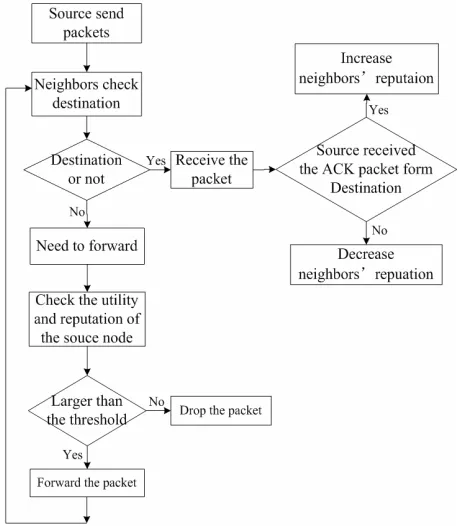
[image:3.595.308.537.455.718.2]We consider the packet forwarding at the relay nodes. The packet forwarding decision making at a node is il-lustrated in Figure 2. In the proposed utility function, if a node is always forwarding packets for its neighbors, then we have n tikr
n tikf
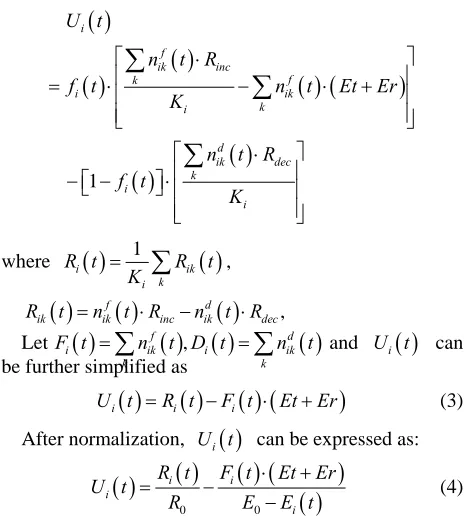
. Therefore, the above equation can be rewritten as
1 i f ik inc f k i ik k i d ik dec k i i U tn t R
f t n t
K
n t R f t K
Et Er where i
1 i
k i
R t R t
K
k ,
f
d
,ik ik inc ik dec
R t n t R n t R
f d
Let i ik
k
, i ik
k
F t
n t D t
n t and U ti
can be further simplified as
i i i
U t R t F t Et Er (3)
After normalization, U ti
can be expressed as:
0 0
i i
i
i
R t F t Et Er
U t
R E E t
(4)
Note that, the above utility function consists of two parts. The first part is the ratio of the current global reputation value of the node to the initial reputation value, and the second part is the ratio of the forwarding energy consumption of the node to the total energy consumption. To reflect the effects of reputation and energy on the
utility, we add two adjustable weight factors—α and β,
and have the newly defined utility function given by:
0 0
i i
i
i
R t F t Et Er
U t
R E E t
(5)
The total utility of the n nodes in the network is given
by
total 1 n i iU t U t
. (6)The average utility of total utility is
total
meanU t
U t
n
. (7)
4. Game Model
4.1. Two Nodes Game Model
In this model, we let nodes i and j be two forwarding
nodes. According to above analysis, the behaviors of two nodes can be described as the classic “prisoner dilemma
problem”. The payoff matrix of nodes i and j can be ex-
pressed as listed in Table 2 [12].
We consider packets forwarding between the two
neighboring nodes, and let . So
the energy consumption can be written as
0.02 J, 0.05 J
[image:4.595.56.288.83.343.2]Er Et
Table 2. Payoff matrix of two nodes.
Node j
Node i Cooperate Non-Cooperate
Cooperate
, i
inc ij j inc ji
R t E t R t E t
, i dec ij j dec
R t E t R t
Non-Cooperate , i
dec j dec ji
R t R t E t
, i dec j dec R t R t
0.05 0.02 0.07 J
ij ji
E E Et Er . Let Rdec 1,
now we need to find the proper inc.
The behaviors of different nodes can be complicated- normal nodes always cooperate, and malicious nodes never cooperate, and selfish nodes only participate in packet forwarding with a certain probability. Let the
forwarding probability of nodeiand be i
R
j f and fj
respectively, then the mixed strategies for the two nodes are i
fi,1fi
and j
fj,1fj
i
respectively.
Thus the expected payoff of node is given by:
, 1 1 1 1i i j
i i
i j inc ij j dec ij
i i
i j dec j dec
i i i
i j inc j dec dec ij i dec
i i i
i j inc j dec ij dec
v
f f R E f R E
f f R f R
i
f f R f R R E f R
f f R f R E R
(8)
We differentiate this payoff with respect to fi, and let
the differentiation value equal to zero:
0
i i
i
j inc j dec ij
i
v
f R f R E
f
(9)
Then we have:
ij
j i i
inc dec
E f
R R
(10)
Similarly, for the other node, we have:
ji
i j j
inc dec
E f
R R
(11)
With Equations (10) and (11), the best-responses of
the two nodes are shown in Figure 3. We get three Nash
Equilibrium points-mixed strategy NE (Nash equilib-rium), and two pure strategies NE (both nodes cooperate, and neither nodes cooperates). From the results, we can see that the strategy-(cooperate, cooperate) has the high-est payoff for the two nodes, with which we can achieve Pareto Optimality [16]. Therefore, cooperation is the best strategy for a node.
4.2. Multi-Node Game
Figure 3. The best responses of two neighbor nodes.
nario. Without loss of generality, we consider the utility of node . To encourage cooperation among nodes, the utility of cooperation should be larger than that of non- cooperation, i.e.,
i
0 0
i inc i i dec
i i i 0
F t R F t Et Er D t R
K R E E t K R
which can be further simplified as:
0 0
i inc i dec i
i i
F t R D t R F t Et Er
K R E E t
(12)
5. Performance Analysis and Simulation
Results
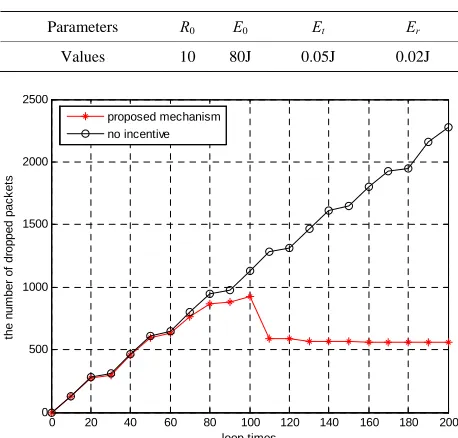
[image:5.595.58.285.83.267.2]We calculate the NE of the proposed game model with C++ and MATLAB, and set the node’s strategy accord- ing to these NEs. We use DSDV as the routing protocol.
Table 3 shows the parameter setting.
We firstly compare the proposed mechanism with the scenario that without incentive. The simulated results are
shown in Figure 4. We can observe that, if there is no
incentive, nodes will be unwilling to forward packets, which will lead to high drop packet rate. While the self-ish behavior of nodes is effectively restricted by the pro-posed mechanism, which can remarkably lower the pac- ket loss rate as shown in the figure.
It is observed that the proposed mechanism can restrict the behaviors of selfish nodes. Specifically, a selfish node should avoid being isolated by increasing the for-warding probability (with more cooperation behaviors). Note that a malicious node never cooperates. We set a utility threshold Uth
t to differentiate the selfish nodes from malicious nodes (if the utility is lower than the threshold, the node will be treated as malicious node and excluded from the network). Hence the selfish nodes can increase the forwarding probability when its utility isTable 3. Parameters setting in the experiment.
Parameters R0 E0 Et Er
Values 10 80J 0.05J 0.02J
0 20 40 60 80 100 120 140 160 180 200
0 500 1000 1500 2000 2500
loop times
th
e
num
b
er of
d
ro
pp
ed
pa
c
k
e
ts
[image:5.595.308.537.96.315.2]proposed mechanism no incentive
Figure 4. Number of packets dropped with time.
lower than the threshold (we set Uth
t Umean
t ). Insome papers [e.g. 4,5], the utility function is simply based on reputation, and selfish nodes will be excluded from the network once identified. The isolation of these malicious nodes can lead to the decrease in the number
of packet drop as shown in Figure 5.
In Figure 5, compared with the proposed mechanism, the reputation-based mechanism can reduce the packet loss rate to zero when the malicious nodes are identified and isolated (after round time 100). This, however, can lead to unbalance in energy consumption among nodes, which can further incur early energy depletion for the nodes in the reputation-based mechanism as illustrated in
Figure 6. Instead, in the proposed game approach, as the selfish nodes are rational, each node adaptively adjusts its forwarding probability to maximize its own utility and avoid being isolated, thus more nodes will survive and packet relay is more evenly distributed among the net-work. This can definitely extend the network lifetime.
Another problem need to solve is setting of dec and
inc. We let
R
R 0.5, and substitute these values
into Equation (12), then we have
010
i inc i i
i i
F t R D t F t Et Er
K E E t
which can be further Simplified as:
010 i
inc
i i
i
K Et Er D t
R
E E t F t
(13)
We determine the range of through extensive ex-
periments and find that inc , is the proper
parameter set that can ensure the cooperation of nodes. inc
R 0.4
0 20 40 60 80 100 120 140 160 180 200 0
200 400 600 800 1000 1200
loop times
the
num
ber of
droppe
d pa
c
k
et
s
[image:6.595.59.285.85.259.2]utility-based mechanism reputation-based mechanism
Figure 5. Number of packets dropped.
0 20 40 60 80 100 120 140 160 180 200 0
1 2 3 4 5 6 7 8 9 10
loop times
the
nu
m
b
er of
al
iv
e node
s
[image:6.595.59.285.285.472.2]utility-based mechanism reputation-based mechanism
Figure 6. Number of nodes alive versus time.
5.1. The Effect of Reward and Punishment
We let 0.5
R
, and simulate four scenarios using different values of Reward and Punishment. Obviously,
the smaller the inc, the smaller the reward achieved,
and relatively the harsher the punishment. The reward and punishment parameters are set as the follows:
1) Scenario 1: Rinc 0.1,Rdec 1
0.2, 1
R R
2) Scenario 2: inc dec
0.3, 1
R R
3) Scenario 3: inc dec
0.4, 1
R R
4) Scenario 4: inc dec
0.5, 1
R R
5) Scenario 5: inc dec
It can be seen from Figure 7, the packet loss rate is
high in either scenario 1 (small reward value) or scenario 5 (large reward value). This phenomenon is reasonable since when the reward for packet forwarding is small, selfish nodes can only get low incentive in packet for-warding (utility is low), thus its strategy is to decrease the forwarding probability and save energy. On the other hand, a large reward value can lead to longer time in
identifying the selfish nodes, which can lead to more packet drop by the selfish nodes. Scenario 4 shows the
best performance. In the 100th round, the packet loss rate
[image:6.595.309.536.332.506.2]dropped rapidly because the malicious node is identified and excluded from the network. Also, with the incentive mechanism, the selfish nodes can gradually adjust its probability and cooperate more in packet forwarding.
Figure 8 is the number of nodes alive with time. In the
100th round, the malicious node is identified and ex-
cluded from the network. Nodes in scenario 1 have the longest lifetime, and hence, with regard to lifetime, pa- rameter setting in scenario 1 is optimal. However, it also shows bad performance in packet loss rate. Thus, de- pending on different criteria and preference, the parame- ter setting should be flexible and adjustable.
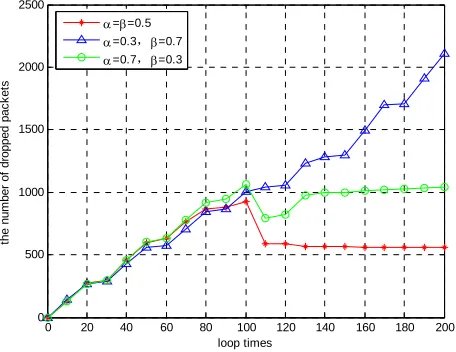
5.2. Eight Effects
We set Rinc 0.4,Rdec 1 and simulate three scenarios
with different values of α and β.
0 20 40 60 80 100 120 140 160 180 200
0 200 400 600 800 1000 1200
loop times
the num
ber
of
dr
op
ped pac
k
et
s
Rinc=0.1,Rdec=1
Rinc=0.2,Rdec=1
Rinc=0.3,Rdec=1
Rinc=0.4,Rdec=1
[image:6.595.308.535.339.676.2]Rinc=0.5,Rdec=1
Figure 7. Number of packets dropped.
0 20 40 60 80 100 120 140 160 180 200 5
5.5 6 6.5 7 7.5 8 8.5 9 9.5 10
loop times
the
n
um
be
r of
al
iv
e nod
es
Rinc=0.1,Rdec=1 R
inc=0.2,Rdec=1
Rinc=0.3,Rdec=1 Rinc=0.4,Rdec=1 R
inc=0.5,Rdec=1
[image:6.595.310.535.530.716.2]1) Scenario 1: 0.5
2) Scenario 2: 0.3, 0.7
3) Scenario 3: 0.7, 0.3
[image:7.595.59.287.337.513.2] [image:7.595.58.286.340.715.2]Figure 9 is the number of packets dropped with time. It is observed that parameters in scenario 1 show the best performance. The packet loss rate in scenario 2 is much higher than the other two. That’s because the utility func- tion assigns large weight to the energy part while small weight to reputation part, which causes selfish nodes to care more about energy saving instead of the reputation, leading to a high packet loss rate. By assigning equal weights to both parts, scenario 1 can strike a balance in between. We can also observe that, before the first 100 rounds, the packet loss rate increased steadily because the malicious node has not been identified. Afterwards malicious node is identified and isolated, and also due to the effect of incentive mechanism, the network perform-ance can be maintained at a steady level.
Figure 10 is the number of node alive with time. It is shown that scenario 2 has the best performance. As ana-
0 20 40 60 80 100 120 140 160 180 200
0 500 1000 1500 2000 2500
loop times
th
e num
be
r of
dropp
ed pa
c
k
e
ts
==0.5
=0.3,=0.7
[image:7.595.62.287.533.718.2]=0.7,=0.3
Figure 9. Number of packets dropped.
0 20 40 60 80 100 120 140 160 180 200 5
5.5 6 6.5 7 7.5 8 8.5 9 9.5 10
loop times
the
num
b
er
of
al
iv
e no
des
==0.5
=0.3,=0.7
=0.7,=0.3
Figure 10. Number of nodes alive versus time.
lyzed above, in scenario 2, nodes care more about energy saving. Therefore, there is a tradeoff between energy consumption and performance, and we should find a
balance point in between (e.g. 0.5).
6. Conclusion
In this paper, we propose a utility-based game mecha-nism to enhance the cooperation among sensor nodes. In the mechanism, reputation and energy of the nodes are taken into consideration. We have also derived the Nash equilibrium solution to the game and extended it to a multiple-node scenario. With the mechanism, by prop- erly tuning the related parameters, malicious node can be identified and isolated, and at the same time, selfish be- haviors can also be restricted. Additionally, simulation results show that the network performance of our mecha- nism is better than that of conventional punishment mechanism, in which selfish nodes will be directly re- moved from the network once identified. Instead, in the proposed method, selfish node is not excluded, and with the incentive mechanism, the selfish node can adjust its behavior, thus balancing the energy consumption and enhance the network lifetime. Finally, we have also illus- trated the effects of different parameters on the network, which can provide a guideline for the optimization of the mechanism.
7. Acknowledgements
The research was jointly supported by research grant from Natural Science Foundation of China under project numbers NSFC60602066, NSFC60773203, NSFC60902 016, NSFC61001182 and NSFC61171071, 973 Program under the project number 2013CB336700, and grants from Foundation of Shenzhen City under project num-bers JC201005250035A, JC201005250047A, JC201005 280404A JC201005280556A, JCYJ20120613115037732, and ZDSY20120612094614154.
REFERENCES
[1] I. F. Akyildiz, S. Weilian, Y. Sankarasubramaniam, et al., “A Survey on Sensor Networks,” IEEE Communications Magazine, Vol. 40, No. 8, 2002, pp. 102-114.
doi:10.1109/MCOM.2002.1024422
[2] S. Vikram, N. Pavan, C. F. Chiasserini, et al., “Coopera- tion in Wireless Ad Hoc Networks,” Proceedings of the INFOCOM 2003 Twenty-Second Annual Joint Confer- ence of the IEEE Computer and Communications, San Franciso, 30 March-3 April 2003.
[3] E. Altman, A. A. Kherani, P. Michiardi and R. Molva. “Non-Cooperative Forwarding in Ad-hoc Networks,” Te- chnical Report INRIA Report No. RR-5116, 2004..
Transactions on Networking, Vol. 13, No. 6, 2005, pp. 1325-1338. doi:10.1109/TNET.2005.860109
[5] P. Michiardi and R. Molva, “Core: A Collaborative Re- putation Mechanism to Enforce Node Cooperation in Mobile Ad Hoc Networks,” Proceedings of the IFIP TC6/ TC11 6th Joint Working Conference on Communications and Multimedia Security, Deventer, 3-5 September 2002, pp. 107-121.
[6] S. Bansal and M. Baker, “Observation-Based Cooperation Enforcement in Ad Hoc Networks,” Technical Paper, 2003.
[7] S. G. Marti, T. J. Giuli and K. Lai, “Mitigating Routing Misbehavior in Mobile Ad Hoc Networks,” MOBICOM, Boston, 2000, pp. 255-265.
[8] S. Buchegger and J. L. Boudec, “Performance Analysis of the CONFIDANT Protocol Cooperation of Nodes-Fair- ness in Dynamic Ad-Hoc Networks,” ACM International Symposium on Mobile Ad Hoc Networking and Comput- ing, Lausanne, 9-11 June 2002, pp. 226-236.
doi:10.1145/513800.513828
[9] S. Zhong, J. Chen and Y. R. Yang, “Sprite: A Simple, Cheat-Proof, Credit-Based System for Mobile Ad-Hoc Networks,” Proceedings of the INFOCOM 2003 Twenty- Second Annual Joint Conference of the IEEE Computer and Communications, San Franciso, 30 March-3 April 2003.
[10] L. Buttyaan and J. P. Hubaux, “Nuglets: A Virtual Cur- rency to Stimulate Cooperation in Self-Organized Mobile Ad Hoc Networks,” Technical Report No. DSC/2001/001, Swiss Federal Institute of Technology (EPFL), Lausanne, 2001.
[11] R. Gibbons, “Game Theory for Applied Economists,” Pricenton University Press, Princeton, 1992.
[12] M. J. Osborne and A. Rubinste, “A Course in Game The-ory,” The MIT Press, Cambridge, 1994.
[13] D. Levin, “Punishment in Selfish Wireless Networks: A Game Theoretic Analysis,” Proceedings of the ACM Work- shop on the Economics of Networked Systems (NetEcon 2006), Ann Arbor, 11 June 2006.
[14] H. Zhu, J. Zhu and K. J. R. Liu, “A Cartel Maintenance Framework to Enforce Cooperation in Wireless Networks with Selfish Users,” IEEE Transactions on Wireless Com- munications, Vol. 7, No. 5, 2008, pp. 1889-1899. doi:10.1109/TWC.2008.061014
[15] Y. Lu, J. Shi and L. Xie, “Repeated-Game Modeling of Cooperation Enforcement in Wireless Ad Hoc Network,” Journal of Software, Vol. 19, 2008, pp. 755-756.
doi:10.3724/SP.J.1001.2008.00755