PhD Dissertation
International Doctorate School in Information and Communication Technologies
DISI - University of Trento
Universidad Cat´olica
“Nuestra Se˜nora de la Asunci´on”
D
ISTRIBUTEDI
DENTITYM
ANAGEMENTJuan Ignacio Pane Fern´andez
Advisor:
Prof. Fausto Giunchiglia University of Trento
Co-Advisor:
Prof. Luca Cernuzzi
Universidad Cat´olica “Nuestra Se˜nora de la Asunci´on”
Abstract
Semantics is a local and a global problem at the same time. Local because is in the mind of the people who have personal interpretations, and global because we need to reach a common understanding by sharing and aligning these personal interpretations.
As opposed to current state-of-the-art approaches based on a two layer archi-tecture (local and global), we deal with this problem by designing a general three layer architecture rooted on the personal, social, and universal levels. The new in-termediate social level acts as a global level for the personal level, where semantics is managed around communities focusing on specific domains, and as local for the universal level as it only deals with one part of universal knowledge.
For any of these layers there are three main components of knowledge that helps us encode the semantics at the right granularity. These are: i) Concrete knowledge, which allows us to achieve semantic compatibility at the level of en-tities, the things we want to talk about; ii)Schematic knowledge, which defines the structure and methods of the entities; andiii) Background knowledge, which enables compatibility at the language level used to describe and structure entities.
To my wife Gloria, my son Giorgio, and my parents Jorge and Estela, whose constant love and support helped me achieve this goal and
Acknowledgment
I would like to thank Prof. Luca Cernuzzi for believing in me and opening the door to the opportunity of doing the PhD at Trento.
This PhD would also have not been possible without the guidance and constant support of my advisor, Prof. Fausto Giunchiglia, from whom I have learned so much and I hope to continue learning.
I would also like to thank Ilya Zahirayeu, Pavel Shvaiko and Pierre Andrews, who dedicated so much of their time to teach me how to do research when I needed it the most. With help of each of them I was able to develop a part of this thesis, and for that, I will be eternally grateful.
Also, I would like to thank all the members of the Knowdive group, with whom I have had, and continue to have many fruitful conversations and feedback on a daily basis. There are many other people that have helped come this far, to all of you, thank you very much!
The work presented in Chapter 5: “Semantic Matching” and Chapter 10: “Eval-uation of Structure Preserving Semantic Matching” was carried out with the contri-bution of Mikalai Yatskevich, Pavel Shvaiko, Lorenzo Vaccari, Paolo Besana and Fiona Mc’Neill and is partially published in [GMY+08], [MBPG09], [VSP+12] and [GAP12] in the scope of the EU funded project OpenKnowledge http: //www.openk.org(FP6-027253) .
The work presented in Chapter 3: “Knowledge Components”, Chapter 6: “Back-ground Knowledge Evolution” and Chapter 11: “Evaluation of Back“Back-ground Knowl-edge Evolution” was carried out with the contribution of Ilya Zaihrayeu and Pierre Andrews and is partially published in [APZ11a], [AZP12] and [APZ11b] in the scope of the EU funded project Insemtives http://www.insemtives.eu
(FP7-231181).
Juan Pane: List of publications
[AKPZ11] Pierre Andrews, Sergey Kanshin, Juan Pane, and Ilya Zaihrayeu,
Semantic Annotation of Images on Flickr, Proceedings of ESWC 2011 (Grigoris Antoniou, Marko Grobelnik, and Elena Simperl, eds.), LNCS, vol. 6644, Springer, June 2011, pp. 476–480.
[APZ11a] Pierre Andrews, Juan Pane, and Ilya Zaihrayeu, Semantic disam-biguation in folksonomy: A case study, Advanced Language Tech-nologies for Digital Libraries (Raffaella Bernardi, Sally Chambers, Bjrn Gottfried, Frdrique Segond, and Ilya Zaihrayeu, eds.), Lecture Notes in Computer Science, vol. 6699, Springer Berlin / Heidelberg, 2011, pp. 114–134.
[APZ11b] Pierre Andrews, Juan Pane, and Ilya Zaihrayeu, Sense induction in folksonomies, Workshop on Discovering Meaning On the Go in Large Heterogeneous Data 2011 (Fiona McNeill, Harry Halpin, and Michael Chan, eds.), International Joint Conference on Artificial Intelligence, 2011.
[APZA11] Pierre Andrews, Juan Pane, Ilya Zaihrayeu, and Aliaksandr Autayeu,
Supporting semantic annotations in flickr, Intelligent Computer Com-munication and Processing (ICCP), 2011 IEEE International Confer-ence on, aug. 2011, pp. 187 –194.
[AZP12] Pierre Andrews, Ilya Zaihrayeu, and Juan Pane, A classification of semantic annotation systems, Semantic Web Journal (2012), no. In-teroperability, Usability, Applicability, to appear.
[EFH+09] J´erˆome Euzenat, Alfio Ferrara, Laura Hollink, Antoine Isaac, Cliff Joslyn, V´eronique Malais´e, Christian Meilicke, Andriy Nikolov, Juan Pane, Marta Sabou, Franc¸ois Scharffe, Pavel Shvaiko, Vas-silis Spiliopoulos, Heiner Stuckenschmidt, Ondrej Sv´ab-Zamazal, Vo-jtech Sv´atek, C´assia Trojahn dos Santos, George A. Vouros, and Shenghui Wang,Results of the ontology alignment evaluation initia-tive 2009, Proceedings of the 4th International Workshop on Ontology Matching (OM-2009) collocated with the 8th International Seman-tic Web Conference (ISWC-2009) (Pavel Shvaiko, J´erˆome Euzenat, Fausto Giunchiglia, Heiner Stuckenschmidt, Natalya Fridman Noy, and Arnon Rosenthal, eds.), CEUR Workshop Proceedings, vol. 551, CEUR-WS.org, 2009.
[EFM+10] J´erˆome Euzenat, Alfio Ferrara, Christian Meilicke, Juan Pane, Franc¸ois Scharffe, Pavel Shvaiko, Heiner Stuckenschmidt, Ondrej Sv´ab-Zamazal, Vojtech Sv´atek, and C´assia Trojahn dos Santos, Re-sults of the ontology alignment evaluation initiative 2010, Proceed-ings of the 5th International Workshop on Ontology Matching (OM-2010) (Pavel Shvaiko, J´erˆome Euzenat, Fausto Giunchiglia, Heiner Stuckenschmidt, Ming Mao, and Isabel F. Cruz, eds.), CEUR Work-shop Proceedings, vol. 689, CEUR-WS.org, 2010.
[GAP12] Fausto Giunchiglia, Aliaksandr Autayeu, and Juan Pane,S-Match: an open source framework for matching lightweight ontologies, Semantic Web Journal (2012), no. Semantic Web Tools and Systems, to appear. [GMY+08] Fausto Giunchiglia, Fiona McNeill, Mikalai Yatskevich, Juan Pane, Paolo Besana, and Pavel Shvaiko,Approximate structure-preserving semantic matching, Proceedings of the OTM 2008 Confederated International Conferences. ODBASE 2008 (Moterrey, Mexico), Springer-Verlag, 2008, pp. 1217–1234.
[MBPG09] Fiona McNeill, Paolo Besana, Juan Pane, and Fausto Giunchiglia,
Service integration through structure preserving semantic matching, Cases on Semantic Interoperability for Information Systems Integra-tion:Practices and Applications11(2009), no. Semantic Interoperabil-ity, 26–45.
[MSVP08] Maurizio Marchese, Pavel Shvaiko, Lorenzino Vaccari, and Juan Pane,An application of approximate ontology matching in eResponse, 5th International ISCRAM conference (Washington. USA), 2008. [VSP+12] Lorenzino Vaccari, Pavel Shvaiko, Juan Pane, Paolo Besana, and
Contents
I General notions 1
1 Introduction 3
1.1 Thesis organization . . . 5
2 Problem statement 9 II Global architecture for managing local semantics 11 3 Knowledge Components 13 3.1 Introduction . . . 13
3.2 Background knowledge . . . 15
3.2.1 The linguistic part . . . 16
3.2.2 The conceptual part . . . 18
3.3 Schematic knowledge . . . 19
3.4 Concrete knowledge . . . 21
3.4.1 Real world entities . . . 21
3.4.2 Mental entities . . . 22
3.4.3 Digital entities . . . 24
3.5 Related work . . . 28
3.6 Summary . . . 30
4 The semantic layers 33 4.1 Introduction . . . 33
4.2 Universal (global) layer . . . 34
4.3 Community (glocal) layer . . . 36
4.4 Personal (local) layer . . . 38
4.5 Summary . . . 39
5.2 The basic algorithm . . . 45
5.2.1 From natural language to lightweight ontologies . . . 45
5.2.2 Node and tree matching . . . 47
5.3 Structure Preserving Semantic Matching (SPSM) . . . 47
5.4 The S-Match open source framework . . . 49
5.5 Related work . . . 51
5.6 Summary . . . 52
6 Background Knowledge Evolution 55 6.1 Introduction . . . 55
6.2 Motivating example: Folksonomies . . . 57
6.2.1 Syntactic Folksonomy . . . 57
6.2.2 Semantic Folksonomy . . . 58
6.2.3 Semantifying Delicious . . . 59
6.3 Related work . . . 59
6.4 Sense Induction . . . 61
6.4.1 Preprocessing Tags . . . 62
6.4.2 Algorithms . . . 62
6.5 Distance measures . . . 67
6.6 Summary . . . 68
7 Knowledge propagation 71 7.1 Introduction . . . 71
7.2 Problem definition . . . 72
7.3 Motivating Example . . . 73
7.4 Related Word . . . 75
7.5 Background Knowledge . . . 76
7.5.1 Explaining new concepts . . . 77
7.5.2 Basic learning operations . . . 78
7.6 Schematic knowledge . . . 79
7.6.1 New attribute definitions . . . 79
7.6.2 New entity types . . . 79
7.7 Concrete knowledge . . . 80
7.7.1 New Attribute values . . . 80
7.8 Summary . . . 81
IV Entity compatibility 83 8 Entity Compatibility 85 8.1 Introduction . . . 85
8.2 Principle of compatibility . . . 86
8.2.1 Compatibility on identifiers . . . 86
8.3 Related Work . . . 94
8.4 Summary . . . 95
9 Identity Management 97 9.1 Introduction . . . 97
9.2 Digital identifiers . . . 98
9.2.1 Local and Global identifiers . . . 98
9.2.2 Identifiers: definition . . . 100
9.3 Dynamics in Entities . . . 102
9.3.1 Original entity . . . 102
9.3.2 Copied entity . . . 105
9.3.3 Shared entity . . . 107
9.4 Entity alignment . . . 112
9.4.1 Aligning metadata . . . 112
9.4.2 Unifying identifiers . . . 113
9.5 Related work . . . 116
9.6 Summary . . . 119
V Evaluation 121 10 Evaluation of Structure Preserving Semantic Matching 123 10.1 Introduction . . . 123
10.2 Methodology . . . 124
10.2.1 Tree creation . . . 124
10.2.2 Tree alteration . . . 124
10.2.3 Expected Similarity . . . 126
10.3 Results . . . 127
10.3.1 Syntactic Alterations . . . 127
10.3.2 Semantic Alterations . . . 128
10.3.3 Combined Alteration . . . 128
10.4 Summary . . . 131
11 Evaluation of Background Knowledge Evolution 133 11.1 Introduction . . . 133
11.2 A semantic annotation dataset . . . 134
11.2.1 A tool for Creating Golden Standards of Semantic Anno-tation Systems . . . 135
11.2.2 Semantifying a Delicious Dataset . . . 138
11.3 Sense induction evaluation . . . 146
11.3.1 Methodology . . . 146
11.3.2 Preliminary results . . . 151
VI Concluding Remarks 157
12 Conclusion 159
List of Figures
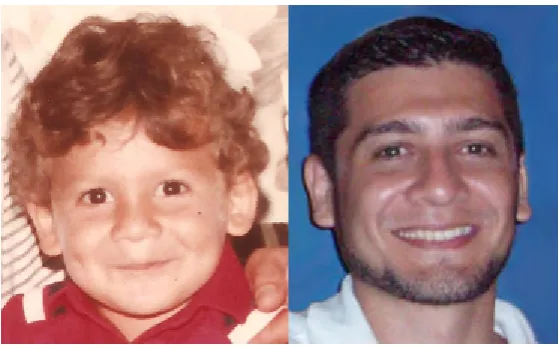
3.1 A depiction of the same object (a person) at different points in time showing how the time dimension is a source for heterogeneity
when describing entities. . . 14
3.2 Example definitions of synsets. . . 17
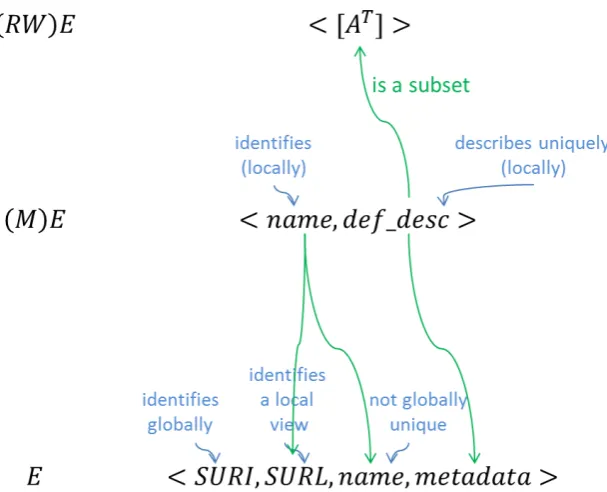
3.3 The relation between the elements of real world, mental, and digital entities. . . 26
3.4 Kinds of ontologies from [UG04]. . . 29
4.1 Extract from the Library of Congress Classification for Medicine. 35 4.2 The connection between the three layers: Universal, Community and Personal . . . 38
5.1 Two subsets of movies related Web directories from Google and Yahoo and an example matching solution . . . 44
5.2 Result of Structure Preserving Semantic Matching (SPSM). . . 48
5.3 S-Match architecture . . . 50
6.1 Sense-User-Bookmark Tripartite graph . . . 65
6.2 Decisions to Extend the Concept Taxonomy . . . 66
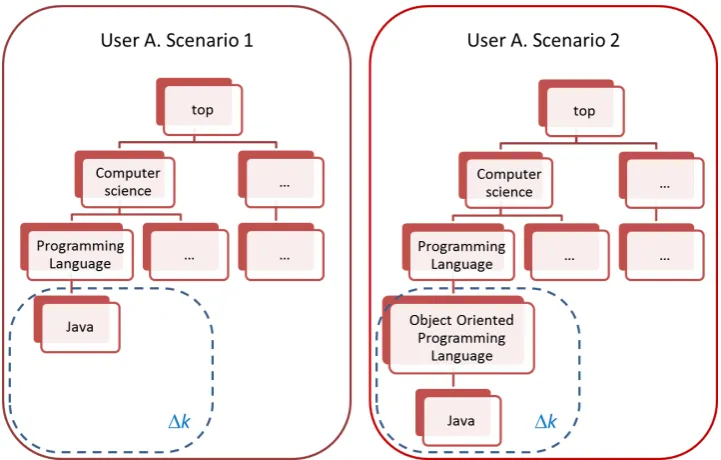
7.1 A simplified example of the knowledge of two users, A and B . . 74
7.2 User A’s (Alice) knowledge after the interaction with User B (Bob) in two different scenarios. . . 75
9.1 Entity creation: a) Entity with enough identifying attributes has a SU RIasID; b) Entity with not enough identifying attributes has aSU RLasID. . . 103
9.2 Updating an entity withSU RLasIDwhen creating the first iden-tifying set gives aSU RIto the entity. . . 104
9.3 Updating an existing identifying set of an entity withSU RI. . . . 104
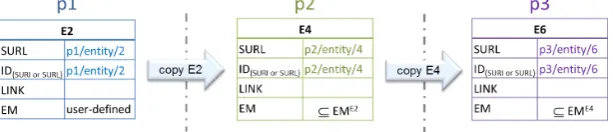
9.4 Copying an entity that has aSU RIfrom p1 to p2, and from p2 to p3105 9.5 Copying an entity that has asIDaSU RLfrom p1 to p2, and from p2 to p3 . . . 106
9.6 Sharing an entity that has aSU RIfrom p1 to p2 . . . 108
9.8 Sharing an entity that has aSU RIfrom p1 to p2, and from p2 to p3 109 9.9 Sharing an entity that has aSU RLasIDfrom p1 to p2, and from
p2 to p3 . . . 109
9.10 Sharing an entity that has aSU RIfrom p1 to p2, and later copying the shared entity from p2 to p3. . . 110
9.11 Sharing an entity that has asIDaSU RLfrom p1 to p2, and later copying the shared entity from p2 to p3 . . . 110
9.12 Updating a shared entity for which the original entity has aSU RI. The update operation in the example did not change theID, for example, more non-identifying attributes were added. . . 111
9.13 Updating a shared entity for which the original entity as aSU RL asID. The update operation in the example did not change the ID, for example, a value was changed. . . 111
9.14 Unifying two entities that haveSU RLs as IDs. In this example E14becomes the original entity andE2shares fromE14. . . 113
9.15 Unifying entities with 2 SU RLs, one of which as been shared. Before: the entities with differentSU RLs; After: all the entities with the sameSU RLs asID . . . 114
9.16 Unifying an entity with aSU RIwith another withSU RLasID that is shared. . . 115
9.17 Merging an entity with aSU RI with another withSU RLasID that is shared. . . 116
10.1 Evaluation results for syntactic changes. . . 129
10.2 Evaluation results for semantic changes. . . 130
10.3 Evaluation results for combined changes. . . 132
11.1 Semantic Folksonomy Dataset Creation Process. . . 135
11.2 Annotation Page for the Manual Tag Disambiguation . . . 137
11.3 RDF Mapping for the Semantified Delicious dataset . . . 140
11.4 Accuracy of the Preprocessing algorithm by the number of possible splits proposed to the validator. . . 142
11.5 Accuracy of the WSD algorithm by the level of polysemy. . . 142
11.6 Distribution of validated tokens by type of validated dataset. . . . 145
11.7 Number of times a tag is reused by the same User on all the Book-marks . . . 146
11.8 Example of taxonomy, an unknown relevant concept uj, its cor-rect generalisations gj and the generalisations proposed by three hypothetical algorithmshik, adapted from [AM02b] . . . 147
11.10Precision/Recall Evolution of Step One with the Tag Collocation Distances; the cross marks the point with the maximum F measure: max(F1) = 61.8%, P = 55%, R= 80.3% . . . 153 11.11Precision/Recall Evolution of Step One with the User Collocation
Distances; the cross marks the point with the maximum F measure: max(F1) = 61.4%,P = 58.8%,R= 70.9% . . . 153 11.12Precision/Recall Evolution of Step One with the Resource
List of Tables
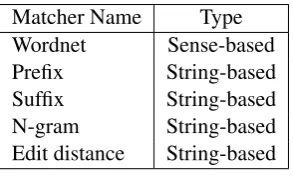
5.1 Element level matchers . . . 47 10.1 Parameters used for generating and modifying the trees . . . 127 11.1 Statistics of the tags2con-delicious gold standard dataset . . . 141 11.2 Resulting gold standards GSk for the evaluation of the sense
in-duction algorithm . . . 150 11.3 Mean precision/recall results for the collocation measures on both
Part I
Chapter 1
Introduction
In the Web 2.0 era knowledge made available in digital format is growing at a fast pace. Individuals, communities and organizations usually have their own local models and standards to represent their knowledge, which evolves over time, cre-ating semantically heterogeneous knowledge bases, even if dealing with the same domain. Given the proliferation of information systems, and the growing special-ization in key areas (e.g., bioinformatics, e-government, e-health), there is a need to collaborate in order to build shared innovative solutions, which would benefit from the knowledge that can be obtained by combining information from differ-ent sources. This is especially true in domains facing iddiffer-entification problems, for example, in governmental agencies that need to gather information from different sources for fighting tax evasion, or for health researches that need to combine pa-tient data to measure, for example, the effect of a treatment. This collaborative process poses the need of bridging the interoperability issues coming from hetero-geneous knowledge representations.
The aim of this thesis is to propose a framework for dealing with the semantic heterogeneity issue in distributed scenarios in order to maximize interoperability. We organize our knowledge framework around entities, i.e., things we want to rep-resent, describe and manage. There are several sources of semantic heterogeneity such as the natural language used to describe the entities and their schemas and the set of attributes chosen to describe the entities. These need to be resolved in order to achieve interoperability and to enable collaboration between the participants of the distributed scenario.
that deals with the heterogeneity at schema level, allowing us to define different entity types based on the formal language of the background knowledge; andiii)
theconcrete knowledgethat contains the model of the entities, based on the entity types defined in the schematic knowledge and where the values for the attributes of the entities can be expressed as references to other entities, as concepts from the formal language, besides the classical set of basic data types such as integer, float, date, etc.
Capturing the semantics of the entities in this distributed scenario is local and a global problem at the same time. Local because the entities are to be provided by people who have personal interpretations and that would want to provide descrip-tions about their entities using their personal (local) knowledge (terms, concepts, structure of the entities); and global because in order to profit from the distributed scenario, where people benefit from the knowledge created by others, we need to reach a common understanding by sharing and aligning these personal (local) interpretations.
We propose to achieve interoperability by capturing the real world semantics of knowledge systems created at three different layers: local (personal), social (com-munities) and global (across com(com-munities). Where in the first layer people create and maintain locally their own vision of the world, then they share this knowledge with other people and interact in several bounded social contexts (their communi-ties), but where in order to achieve successful multi-context interaction there is a need of an upper layer that formalizes what is commonly known across communi-ties. We believe that in such scenario entities will be created mostly in a bottom-up fashion, and that interoperability will be achieve by reusing the background (lan-guage and concepts) and schematic (entity types) knowledge mainly in a top-down fashion.
In this distributed scenario we need to also deal with the dynamic nature of knowledge, this is, while we can enable interoperability by reusing a predefined set of words and concepts in a top-down fashion, we also need to provided the ca-pabilities for extending such set of words and concepts based on their usage by the participants of the distributed scenario. This is needed because relying on a fixed vocabulary can hinder the capability of the system to extract machine processable semantics from natural language labels. As we will see, this is a real problem in highly dynamic scenarios such as Computer Science. Once the system is capable of creation new terms and concepts, either automatically by relying on the process described before, or manually by the user, we also need to define the procedure by which new knowledge is propagated among the participants of the distributed system.
identify three types of entities:i)real world entities, i.e., those that actually exits;ii)
mental entities, i.e., those that people from in their mind from their own perspective referring to real world entities based on their experience and the interaction with the world; andiii)digital entities, i.e., those that are encoded in the system as provided by people (based on their mental entities) referring to real wold entities. Under such condition, the digital entity should be able to distinguish between the identity of the actual real world entity, and the identity of the local perspective encoded in the system. This difference will prove to be key in the design of the system, and will allows us to propose a solution capable of achieving the goal of capturing the real world semantics of the real world entities, given partial views about them.
The contribution of this thesis is threefold:
1. the definition of a general architecture for managing and enabling interoper-ability of entities in a distributed setting, rooted in the notion of the identifi-cation of entities;
2. the development of components of the system based on the defined architec-ture, these are:
• S-Match, an open source framework for semantic matching (http: //www.s-match.org).
• the Tags2Con “Delicious” dataset is, to the best of our knowledge, the first publicly available dataset included in the Linked Open Data initiative that contains manually created links from Delicious tags to Wornet synsets for disambiguating the meaning of the tags (http: //disi.unitn.it/˜knowdive/dataset/delicious/).
• the development of a generic sense induction algorithm that can be extended with new distance metrics.
3. the evaluation of the above mentioned components.
1.1
Thesis organization
The structure of the thesis is as follows:
In part I: General notions introduces the problem statement that is to be ad-dressed in this thesis.
Part II:Global architecture for managing local semanticsis composed by the following chapters:
type definitions and theconcrete knowledgecontains the entities of the sys-tem;
• Chapter 4: “The semantic layers” outlines the three layers of knowledge: Universal, Community and Personal that will allow people to communicate with each other in a fully distributed manner, but also in bounded contexts, while enabling interoperability;
Part III:Background and Schema compatibilitydeals with the issue of how to achieve interoperability at the level of language and schema and is composed by the following chapters:
• Chapter 5: “Semantic Matching” presents an algorithm that allows the sys-tem to extract formal semantics from natural language labels and to use this to compare tree-like such as schemas or entity types;
• Chapter 6: “Background Knowledge Evolution” presents a sense induction algorithm for the computation of new concepts based on the usage of terms in a distributed setting, and the addition of these new concepts to the linguistic and conceptual part of the background knowledge;
• Chapter 7: “Knowledge propagation” presents a pragmatic approach for the propagation of knowledge from the different components of the knowledge presented in Chapter 3 between all the layers presented in Chapter 4;
Part IV:Entity compatibilitystudies how to achieve interoperability at the level of entities and is composed by the following chapters:
• Chapter 8: “Entity Compatibility” defines the conditions under which, given the incomplete and inconsistent perspectives about entities, it can be estab-lished whether two perspectives refer to the same real world entity or not;
• Chapter 9: “Identity Management” defines how to manage the identity of the real world entity being referred by different perspectives by different people, even using different terminologies. The core contribution of this thesis is described in this Chapter gluing all the previous notions presented in the previous chapters;
Part V: Evaluation presents the evaluation of two components: “Semantic Matching” and “Background Knowledge Evolution” and is composed of the fol-lowing chapters.
• Chapter 11: “Evaluation of Background Knowledge Evolution” presents the evaluation methodology and initial evaluation of the sense induction algo-rithms defined in Chapter 6. The contribution of the chapter is also a public gold standard dataset based on Delicious containing links to Wordnet. The dataset is used for the evaluation of the sense induction algorithm and can also be used to evaluate Natural Language Processing (NLP) and Word Sense Disambiguation (WSD) algorithms.
Chapter 2
Problem statement
The goal of the thesis is to define a distributed system that allows people to manages their knowledge locally. People would normally want to manage things they are interested in according to their personal point of views but being able to effectively collaborate with each other. Thesethings people care about need to be properly modeled to achieve interoperability between people’s systems; we will model these
thingsas entities.
The problem, in such distributed scenario,is how to capture the real world semantics of entities in order to be able to manage their identity to achieve inter-operability.
This problem, is composed by several subproblems, namely:
1. In a distributed setting, there are several sources of heterogeneity, the lan-guage, the schema, the ways entities are described, the different perspectives from which they are described, and the identifiers used.
2. Semantics is a local and a global problem at the same time. Local because the entities are created locally by people, and global because there is a need of shared understanding if we are to allow people to effectively collaborate. 3. People use natural language in order to communicate with each other.
How-ever, natural language is inherently ambiguous and the computer does not have the same capability humans have to understand this language and ex-ploit its semantics. We need to formalize the natural language so that its semantics can also be exploited by the computer system.
4. If we are to capture the real world semantics of entities in a distributed sce-nario, the solution cannot operate under a closed world assumption, i.e., knowledge is inherently dynamic in nature, and the solution cannot be a static knowledge system but a system that supports the constant evolution of knowledge.
6. Finally, entities are created and maintained by people from different perspec-tives, which means that we need to deal with incomplete and inconsistent perspectives for the same entity being referred.
In this thesis we deal with each of these problems, namely:
• in Chapter 3: “Knowledge Components” we present the structure of the knowledge for dealing with different semantic heterogeneity sources;
• in Chapter 4: “The semantic layers” we outlined three layers of knowledge: Universal, Community and Personal that will allow people to communicate with each other in a fully distributed manner, but also in bounded contexts, while enabling interoperability;
• in Chapter 5: “Semantic Matching” we outline a state-of-the-art algorithm that allows the system to extract formal semantics from natural language labels;
• in Chapter 6: “Background Knowledge Evolution” we present a sense induc-tion algorithm that can compute new concepts based on the usage of terms in a distributed setting;
• in Chapter 7: “Knowledge propagation” we present a pragmatic approach that enables the systems to propagate knowledge from the different compo-nents of the knowledge presented in Chapter 3 between all the layers pre-sented in Chapter 4;
• in Chapter 8: “Entity Compatibility” we defined the conditions under which, given the incomplete and inconsistent perspectives about entities, we can establish whether two perspectives refer to the same real world entity or not;
• in Chapter 9: “Identity Management” we finalize the research by establishing how to manage the identity of the real world entity being referred by different perspectives by different people, and even using different terminology. The core contribution of this thesis is described in this Chapter gluing all the previous notions presented in the previous chapters;
Part II
Chapter 3
Knowledge Components
3.1
Introduction
When knowledge and structured information is developed and maintained in dis-tributed scenarios by independent, unrelated organizations, it will most likely have different structures, even when dealing with the same domain. This difference in knowledge organization is known asthe semantic heterogeneity problem. The dif-ficulties faced when trying to integrate these heterogeneous sources of information is known as the interoperability problem [Hal05]. However, there is a need to collaborate in order to build shared information systems, which benefit from the knowledge that can be obtained by combining information from different sources. This collaborative process poses the need of working with heterogeneous knowl-edge [HM93].
The heterogeneity problem can be dealt with at different levels. The authors in [PH00] identify three main sources of semantic heterogeneity: structural, do-main and data. We argue that structural and dodo-main can be merged, and distinguish a more basic level that the authors recognized as a problem at all their levels, the natural language. Therefore, our new approach recognizes the following levels:
1. Language: when naming attributes and values there are several issues such as the language used (e.g., “English” vs. “Italian”), the domain terminol-ogy used to refer to the same object or concept, even in the same language (e.g., “dog” vs “Canis lupus familiaris”), the level of specificity used (e.g., “dog” vs “animal”), besides the well known issues such as case sensitivity, synonyms, acronyms, homonyms, and word variations.
2. Schema: refers to the structure given to the data to be managed in the appli-cation domain. Even in the same domain there are issues such as the name of the properties, the ordering, the exact choice of properties used, aggregation of properties (e.g.,{price+taxes}or{price,taxes}) [PH00].
Figure 3.1: A depiction of the same object (a person) at different points in time showing how the time dimension is a source for heterogeneity when describing entities.
formats in the values. The time validity is another important source of het-erogeneity and possible conflicts. The same object can be described differ-ently according to when the description was created. Figure 3.1 shows an example of how a description of the same person (in this case a picture) can greatly vary according to the time dimension.
We adopt an a-priory approach to dealing with semantic heterogeneity. This is, instead of the classical post-hoc approach, where for each of the sources of het-erogeneity there is already a well established community researching how to inte-grate existing heterogeneous sources (schema matching, data integration, ontology alignment) we want to tackle the heterogeneity problem by defining a Knowledge Organization System (KOS) that deals with the above mentioned heterogeneity problems by design.
We propose a KOS model centered in the data, which we call entities, how the entities can be structured, i.e., the schema, and how the entities can be described, i.e., the language used. Considering this, we define three main components, each dealing with a specific heterogeneity issue:
1. background knowledge: containing the natural language dictionary in sev-eral languages, but given the ambiguity of the natural language, we convert all the natural language into a formal language, i.e., a set of concepts with relations between them. This component already deals with the difference in values due to synonymy, homonymy, variations of words, different language, etc.
knowledge. This means that when naming an attribute, there is no issue of ambiguous names, where the order of the attributes is not important, because they are all formalized and easily comparable, even when different schemas are used for the same entity type for different application domains.
3. concrete knowledge: the entities (data) we want to manage in the system. We center our attention in capturing the semantics of the real world entities as provided by people, therefore dealing by construction with different points of view. We therefore recognize the difference between the identification of the real world entity and the identification of the, possible different, (partial) views provided by people.
In the remainder of the thesis, a system that follows the above-mentioned ar-chitecture will be referred to as a knowledge base.
The rest of the Chapter is organized as follows. In Section 3.2 we present the basic building block of our framework, the linguistic and conceptual parts, explain-ing why the lexplain-inguistic part is not enough and how by havexplain-ing the conceptual part, we can already solve much of the semantic heterogeneity issues. In Section 3.3 we present the model for defining entity types and in Section 3.4 we define what we mean by entities, and the difference between real world entities, mental entities (those provided by people about the real world entities) and digital entities (those encoded in the system that captures the semantics of the real world entity as pro-vided by people). In Section 3.5 we compare our approach to the related work. Finally, Section 3.6 summarized the Chapter.
3.2
Background knowledge
1Human (and machines) need a common language in order to communicate with each other. Natural language is the means by which humans understand each other; however, as noted by [SRT05, GH06], natural language, is inherently ambiguous semantically, but also syntactically. A number of issues with natural language, also reported in [APZ11a] are:
Base form variation This problem is related to natural language input issues where a description is based on different forms of the same word (e.g., plurals vs. singular forms, conjugations, misspellings) [GH06].
Homography Elements of the language may have ambiguous interpretation. For example, the term “atm” may mean, in the physics domain: a standard unit of pressure, “the atmosphere”; or in the banking domain: a “cash machine”;
Synonymy Syntactically different words may have the same meaning. For exam-ple, the words “image” and “picture” may be used interchangeably by people
1Parts of this section were published in [APZ11a] in collaboration with Pierre Andrews and Ilya
but will be treated by the system as two different elements of the language because of their different spelling;
Specificity gap This problem comes from a difference in the specificity of words used when describing things. For example, a user might describe a picture with the term “dog”, while another can describe the same picture with the term “Labrador”, which is more specific than dog, and the system can treat both terms as not related due to the syntactic difference.
The above mentioned issues make natural language unsuitable for the commu-nication between machines, which do no poses (to the best of our knowledge) the skills we as humans use to overcome them. Therefore, a more formal language is needed for machines to be able to successfully interact. Sheth [SRT05] calls this formal semantics a representation model such that there is a definite semantic in-terpretation, making them machine processable. An example of a formalism with formal semantics can be found in ontologies.
This work follows the approach outlined in [GMFD10], thus identifying two main components of the background knowledge: i) the linguistic part, contain-ing the natural language elements that make as bridge between what is provided by humans (in natural language) and ii) and conceptual part formalizing what is processable by the machines.
3.2.1 The linguistic part
The linguistic part follows the model introduced by Wordnet [Fel98], a freely and publicly available large lexical database. The main components are words, synsets, senses, and relations. Words from different parts of the speech (nouns, verbs, ad-jectives and adverbs) are grouped into sets of cognitive synonyms, called synsets, each representing a different concept. Given the homonyms existing in natural language, a word can be present in more than one synset, therefore, in order to unequivocally identify the synset that the word is referring to, there is the notion of word sense. Considering the “atm” example mentioned earlier, the word “atm” has twosenses, “atmosphere” and “cash machine”. Synsets are interlinked by means of conceptual-semantic and lexical relations.
We adopt the model presented in [GMFD10], where there are different in-stances of the linguistic component, one for each language (e.g., English and Span-ish) that is to be supported by the system.
The more rigorous definition of the components of the linguistic part are:
Model Object 2(Synonymous set (synset)) A Synonymous set orsynset=
hSW, pt, ciis a tuple whereSW is a set of synonymouswords (SW ⊆W) that denote the concept, represented byc, and whereptis called the preferred term of the synset (pt∈SW)
synset#1 = <
SW={atm, atmosphere, standard atmosphere, standard preasure}, pt=atmosphere, c#1
>
synset#2 = <
SW={atm, cash machine, cash dispenser, automatic teller machine}, pt=cash machine, c#2
>
synset#3 = <SW={machine}, pt=machine, c#3>
Figure 3.2: Example definitions of synsets.
Figure 3.2 shows example definitions of three synsets, wherec#1,c#2and c#3 can be read as concept number one, two and three respectively, i.e., making the concepts language independent and where the interpretation in natural language is given by the synonymous wordsSW in the synset. A more formal definition of concept will be given in Model Object 6 in page 19 in the conceptual part section. As can be seen in this example, the word atmis polysemous, as it belongs to more than onesynset, i.e., it has more than one sense. Note also that multi-word forms or expressions are also considered as atomic, when they represent an atomic sense or concept.
Model Object 3(Natural Language Dictionary (N LD)) A natural language dictionary N LD is a tuple N LD = hnlid, LW, SY Ni, where nlid is a unique identifier of the dictionary language; LW is a set of words of this language (LW ∈W); and SYN is a set of synsets, such that the set of words SW of any synset in SYN is a subset of the set of words of the language, i.e., SW ⊆LW .
Model Object 4(Word sensew s) A word sensew s=hword, ciis a pair, where the word is defined in Model Object 1 and c is a the sense of the word. We say that the word correspond to the Natural language part of the word sense, while the conceptccorrespond to the formal part, given thatcis unambiguous.
For example,hatm, c#2i. Note that the word sense does not suffer from the polysemy issues, as the sense is already disambiguated.
in the set represents a disjoint lemmatized token fromstring representing words recognized in the linguistic part with its disambiguated concept2. The aim of the semantic string is to unequivocally encode the intended mean-ing of the strmean-ing, thus eliminatmean-ing possible ambiguities introduced by the nat-ural language such as, homonyms and synonyms. This is normally achieved using Natural Language Processing (NLP) techniques, the definition of which is out of the scope of the current thesis. The interested reader is referred to [ZSG+07] for details of NLP.
3.2.2 The conceptual part
Despite the numerous research areas and researchers devoted to the definition of a concept, there is no widespread agreement of a satisfactory and complete definition of what a concept is [ML11]. The classical theory of concepts [ML11] states that
a lexical concept “c” has a definitional structure in that it is composed of simpler concepts that express necessary and sufficient conditions for failing underc, i.e., a concept element is defined by its relation to other concepts and its relation to the world. The prototype theory extends this intuition by adding a probabilistic element to it, i.e., a concepthas a probabilistic structure in that something falls under c just in case it satisfies a sufficient number of properties encoded byc’s constituents.
This work adopts the concept definition outlined in [APZ11a], the one defined by Description Logics (DL) [BCM+03], which we believe is a more pragmatic definition of the classical and prototype theories of concept. In DL, the semantics (or, the extension) of a concept is defined as a set of elements (or, instances). For example, the extension of the concept Person is the set of people existing in some model (e.g., in the model of the world). Because they are defined under a set-theoretic semantics, operators from the set theory can be applied on concepts, e.g., one could state that concept Organism subsumes (or, is more general than) the conceptPersonbecause the extension of the former concept is a superset for the extension of the latter concept. Among other things, the subsumption relation can be used for building taxonomies of concepts. These properties lead to a number of useful reasoning capabilities such as computing the instances of concepts through the concept subsumption, computing more specific or general concepts. A more complete account to DL is out of the scope of this chapter; interested readers are referred to [BCM+03] for details.
Pragmatically, the conceptual part is composed by concepts and semantic re-lations between them (e.g., is-a and part-of) as defined by [GMFD10]. Concepts are independent of natural language, where the later is considered just a mean for conveying thought [ML11], that in our model acts as a bridge between the con-ceptual part and humans. As humans communicate in different parts of the world
2For more details on tokenization, lemmatization and disambiguation the reader is referred to
using different natural languages, different synsets representing the same concept in different languages (i.e., belonging to different Natural Language Dictionaries as defined in Model Object 3), are linked to the same concept.
In our example from Section 3.2.1, there are two synsets in English forh{atm, atmosphere. . .}, c#1iandh{atm, cash machine. . .}, c#2i(using a simplified rep-resentation). If we define the same synsets using words in Spanish, we would get something similar toh{atm, atm´osfera. . .}, c#1iandh{cajero autom´atico. . .}, c#2i
respectively. In the conceptual part, as we can note, there are only two concepts for representing both ideas, independently of the language. Note however, that due to the well known problem of gaps in languages (i.e., given a word in one language, it is not always possible to identify an equivalent word in another language) not all concepts have a corresponding synset in all languages.
The more rigorous definition of the components of the conceptual part are:
Model Object 6(Conceptc) A conceptcis a cognitive unit that represents the intension, i.e., the set of properties that differentiates this concept from others, and defines its extension, i.e., the set of objects that represent such property [GM10].
Model Object 7(Conceptual relation (concept relation)) A conceptual re-lation is a tripleconcept relation=hcsource, ctarget, crelationiwherecsource is the source of the relation,ctarget is the target of the relation, andcrelation is the type of relation.
For example, hc#2, c#3, c#4i could be understood as a relation between “cash machine” and “machine”, defined by the concept c#4, which can be defined, for instance, as theis arelation.
3.3
Schematic knowledge
Once we have the background knowledge constructs (the language and the con-cepts) that enable systems to interoperate, we need to defined the schema of the objects that will be dealt with in the system. The “objects” that are the subject of our framework will be called entities (see Section 3.4). In order to be able to rep-resent these entities, we need to define the format of how these entities will look like, i.e., the types of entities that we will be able to represent in the system.
The exact definition of the entity types that are to be supported by a Knowl-edge Organization System (KOS) is highly domain dependent. For example, in the health domain we would need to deal with types of entities such as Persons that can act as Patients or Doctors, Diseases, Treatments and Medicines, which are not the same of types of entities that are dealt with by the music domain. However, we need to define the basic building blocks that will allows us to define entity types uniformly across different system.
Model Object 8(Entity Type (etype)) An Entity Type (etype) is a tuple ET =hc,{AD}i, wherecis the concept of the etype, andAD={AD}is a non-empty set of attribute definitions.
We envision specifying a set of mandatory attribute definitions that have to be present with their corresponding values when an entity of the particular etypeis instantiated, . This however, is highly etype dependent, and fur-thermore, domain dependent, e.g., while in a medical application the gender of a person might be mandatory, in a phone application most likely it is not strictly mandatory. In general, theetypedefinition is the entry point for the creation of an entity, and the set of attribute definitions should normally be shown to the user creating the entity3.
Model Object 9(Attribute definition (AD)) An Attribute Definition is a tupleAD=hc, D, isSeti, wherecis the concept that represents the attribute name,Dis the domain of the data type that restricts the possible values for the attribute definition (i.e., date, string, integer, real, relations, concept. . .), andisSetis a boolean value which indicates whether AD can be instantiated to a set of values (in the caseisSet=true) or to a single value (in the case isSet = f alse). We choose to store the concept in the definition and not the natural language name in order to avoid the ambiguity of the natural language is its related problems [APZ11a].
Considering D, we can distinguish betweem three types of domain data types:
normal (semantic-less) data types such as string, date, integer, float. . .. These are normal basic types that are not linked to a concept in the conceptual part.
•
• conceptual values including semantic strings and word senses, i.e., those which have a formal part with a link to a concept in the con-ceptual part. Selecting a specific concept as the domain allows us to restrict the possible values even further, for example, when defining a color attribute, we can set the domain to the concept of color. By doing so, all and only those concepts which are colors (defined by theis a re-lation between the concept of color and the colors such as black, white, red. . .) will be allowed as values of the specifiedAD.
• relational attribute values, which means that the value of the attribute is a reference to an entity, for which the entity type is defined in when specifying the relation, e.g., when defining a friend attribute, we can say that the type of the entity has to be a Person.
As stated before, the exact entity types to be modeled are domain dependent. However, there are some common entity types that are usually shared across
sev-3How to show the set of attributes to be filled in by the user is an Human Computer Interaction
eral application domains. These entity types could be defined a-priory fostering reusability, thus avoiding heterogeneous definitions for the same type. Some com-mon entity types are, for example, Person, Location, Organization, Event and those more specific than Mind products such as Music, Paintings, Pictures, etc. We de-velop a root entity type called “Thing” which can be used as default entity type for any entity, in the case the domain application wants to leave the entities untyped (e.g., OKKAM [BSG07])
A recent joint effort by several Internet search engines have made available at schema.org4 the definition of these entity types, and other commonly used types of content for the web, allowing webmasters to markup their pages in order to structure the data, that can later be reused by others and be recognized by these search engines in order to improve their search results.
3.4
Concrete knowledge
The purpose of our framework is to manage the knowledge of the users and com-munities. While the language and concepts are important in order to share knowl-edge, they are not the aim, per-se, of most common Knowledge Organization Sys-tems; they are just means by which we are able to exchange of knowledge and ideas. When people engage in conversations, they talk about things, and these things, are what we will denominateentitiesin our framework. The types of enti-ties, or their schema, is defined a priori, and the general model for defining these entity types is presented in Section 3.3.
Anentityis any object that is important enough for a person to talk about it and give it a name (e.g., a Location, a Person, an Event. . .). We make the distinction betweenreal world entities (those that exist), mental entities (those that people form in their minds about real world entities) and digital entities (those that we model in the system trying to capture the semantics of the previous two).
Given that diversity is an unavoidable and intrinsic property of the world and as such cannot be avoided [GMD12], the ultimate purpose of the semantic framework is to interoperate at the level of entities, considering people’s own diverse views of the world, by being able to manage the identities of thereal world entities.
3.4.1 Real world entities
A (real world) entity is something that has a distinct, separate existence, although it need not be a material (physical) existence5that belongs to a certain type [YYSL08]. Each real world entity has a set of properties that evolve over time in the course if its existence, as it interacts with other entities and the world. For example, people (Person entities) might move from locations to locations, their physical appearance
4
http://schema.org/
change over time (see Figure 3.1), they might acquire or loose titles (such as engi-neer or baron) and play different roles at different times such as actor or governor. This evolution though, might not always be perceived by everyone aware of their existence at all times.
(RW)E =h{AT}i (3.1)
Equation 3.1 shows a model of a real world entity(RW)E containing a set of attributes{AT}where theT = [t1, t2]stands for the time interval when the values of the attributes are valid, i.e., as the entity evolves, the same attribute might have different values, for example thehair colorattribute might change from “red” to “dark brown” as can be seen in Figure 3.1, and new attributes might appear and disappear.
From the point of view of the existing real world entity, its uniqueness is given by its existence and expressed to the world by its attributes and its actions.
3.4.2 Mental entities
A mental entity is a personal (local) model created and maintained by a person6that
referencesanddescribesa real world entity7. According to Searle [Sea58], the ref-erenceis achieved by a proper name and thedescriptionis achieved by definite de-scriptions. A definite description [Rus05] is a characterization that entails the exis-tence, uniqueness and universality of the entity (or object) being referred [Lud11], i.e., it is a set of uniquely referring descriptive statements.
(M)E=hname, def desci (3.2) Equation 3.2 shows the tuple conforming the mental entity(M)Ethat is com-posed by aname(to be further discussed in Section 3.4.2.1) and a definite descrip-tiondef desc(to be further discussed in Section 3.4.2.2).
3.4.2.1 Mental identifiers: names
Names are (local) symbols created by people to refer to specific (real world) enti-ties. Each (real world) entity being identified by a name has a (local) set of char-acteristics that distinguishes them (locally) from the other real world entities of the same type (called a definite description in Philosophy). The pragmatics of a proper name lies in the fact that it enables us to refer publicly to real world entities with-out being forced to ana-prioriagreement on the descriptives characteristics exactly identifying the real world entity being referred [Sea58]. Thus, what differentiates
6
This applies to agents in general such as people and organizations, but for the sake of brevity and clarity, we will us the term person instead of agent throughout the document.
7
(real world) entities from one another8 is encoded in the definite description, and the name is a reference to this description [Sea58],an identifiercreated by people to avoid having to exchange the whole definite description when interacting with each other.
Names used in mental entities have the following characteristics:
• A name is a (local) identifier for a definite description [Sea58];
• Both the name and the definite description in one mental entity have the same referent (the same real world entity) [Sea58];
• Names are locally created and maintained by people, which entails that:
– there can be different names (created by different people) for the same real world entity (synonames, simmilarly to synonyms).
– the same name can be given to different real world entities (homonymy).
• There can be different (local) names, for the same (local) definite description. Note that thenameelement is by definition a reference to the real world entity being mentioned or thought about. Most commonly, proper names play the role of thenameelement, and whenever this is true, we can directly recognize the refer-ent. However, we also normally use “indexicals” to refer to real world entities, i.e., context-sensitive expressions whose meaning vary from context to context [Bra10]. Example indexicals are “my mother” or “my home town”, each having a different referent according to who is uttering the expression. Nicknames are other types of names that are typically used. There are also cases when arbitrary “labels” are used as names. A person might use one or more of these kinds of names to refer to the same real world entity. Whenever we use the elementnamein this document, we refer to all these classes of names, and possibly others, that serve as references forreal world entitiesin the mind of the people.
3.4.2.2 Descriptions
A (definite) description is a (local) set of characteristics, a mental model created by a person, that (locally) distinguishes real world entities from one another.
Multiple mental entities (created by multiple people) can refer to the samereal world entityfrom different perspectives (according how the person has interacted with thereal world entity) encoding different (overlapping or disjoint) descriptions. For example, multiple people might have different points of view of a particular person (there is only one person in the real world being referred), perhaps because they know the person from different social contexts, e.g., Arnold Swarchenegger as an actor, as a politician, as a friend, or as a father.
Mental entities and their corresponding definite descriptions have the following characteristics:
8
1. A mental entities is a local model of a real world entity (it encodes one point of view);
2. Different mental entities from different people with different perspectives, can refer to the same real world entity;
3. Mental entities areincomplete, as the person creating the mental model does not know all the details about the real world entity9;
4. Mental entities can haveinconsistent10descriptions, mainly due to:
(a) temporal dependency, i.e., a description that is not true anymore, but which was true in some past, e.g., “the person with black hair”. This is due to the evolution of the entity and the fact that descriptions act as static “photos” of real world entities at one point in time11;
(b) subjectivity, e.g., nice person, horrible place;
(c) false descriptions, those that were never true about the real world en-tity, but is believed to be true by the person holding the description, e.g., Schwarzenegger was the president of USA (only true in a fictional movie)12.
5. The uniqueness of reference of the definite description in a mental model is considered with respect to all the other entities the bearer of the mental model has, not with respect to all the other possible real world entities of the same type [Sea58];
6. The definite description of a mental entity might be formed via a direct inter-action with the real world entity it refers to, or learned from someone else.
7. The mental description is created using the local knowledge13, therefore dif-ferent descriptions for the same characteristic might be difdif-ferent. E.g., one might think that someone’s eye is blue, but another person might say that is marine blue (just because s/he has a more detailed knowledge about colors);
3.4.3 Digital entities
The purpose of this work is to develop a model that captures the semantics of the real world entities. Given that real world entities can only be captured and modeled
9Unless the mental entity is about him/herself, but not all entities are self-conscious. 10
with respect to the real world entity
11
This is why the time validity T is important in equation 3.1.
12
Note that given the local knowledge and context of the person with this description, this might be true, but nevertheless, it is universally false, i.e., not true about the real world entity.
13
by people14, we also need to encode and understand the local semantics of the men-tal entities that are provided by people, which can differ from one another, being referred and described in diverse ways and even in different languages [GMD12]. Digital entities are the way we capture real semantics by allowing the computer to bridge between the mental entities people provide about the real entities15. In the following models we will make clear how we capture each of the important elements of the different kinds of entities. In the rest of this document we will use the term entity to refer todigital entity, and whenever we refer to one of the other two (real world or mental entities) we will make an explicit distinction.
In order to capture the real world semantics of real world entities, as provided by the mental entities, we need to address the following issues present in mental entities:
1. The name as identifier is locally unique, but not globally unique (homonyms, indexicals).
2. The same real world entity can be given different names (synonames). 3. A mental entity encodes only a partial view of the real world entity (this is
known as thepartial knowledge problem).
4. Neither names nor definite descriptions are persistent in the real world entity (they evolve over time as the real world entity evolves).
5. Definite descriptions are only locally identifying (at the mental level). This can create two types of problems when people refer to real world entities:
• People believe they talk about the same real world entity, while they are actually referring to different real world entities (false positiveF P);
• People believe they talk about different real world entities, while they actually refer to the same real world entity (false negativeF N). The above mentioned issues uncovers the need of being able to unequivocally encode the identifier of real world entities, given the diverse views over them, also being able to encode and maintain these different views. This means that we need two identifiers for the digital entities:i)a real world identifier, which captures the real world semantics of the real world entity, referred to as SURI (from semantic URI), and ii)a mental identifier, which allows the identification and subsequent retrieval of a particular point of view, referred to as SURL (from semantic URL).
Figure 3.3 shows the relation between the elements of equations 3.1, 3.2 and how these elements are mapped into the main components of a digital entity. As we can see in Figure 3.3, a digital entity(E)contains a SURI16, which represents
14
Sensors can also give automatic information about entities, but still they will be programed by people and thus use the mental model of the person programming the sensors.
15
A digital entity can be thought as if it was the mental entity of the computer.
16
Figure 3.3: The relation between the elements of real world, mental, and digital entities.
the identifier at the real world level, and a SURL17, which represents an identifier at a local (mental) level. Given different local views, defined by the metadata and identified by the SURL, the system should be able to distinguish that these local views (with different SURLs) actually refer to the same real world entity (as identified by the common SURI).
In what follows we present the model used for representing the digital entities, which incorporates the desired characteristics presented in the previous sections. We use a recursive style for defining the digital entity, where each new element in a Model Object will be defined in a subsequent Model Object. Model Object 10 introduces the model for the digital entity, that is to be used as the basis of our framework.
Model Object 10(Entity) An entity eis a tuple e = hID, SURL, etype, name,EM,[link],[copy]i, where:
IDis a universally unique identifier of thereal world entitymodeled by e(which globally encodes the uniqueness and existence of real world entity). Only when the global uniqueness condition over EMis met (see Section 8.2.2) theID = SU RI(in Chapter 9 we will expand on the definition ofIDwith Model Object 14);
17
•
• SU RLis the local (dereferenceable) URL identifying the entity(which corresponds to local identifier in the mental entity without the homon-imy problem, see Section 9.2.1.1);
• etypeis the entity type (e.g., Person, Organization, Event);
• EMis the Entity Metadata encoding the local mental model ofe(which corresponds to the (local) definite description created by a person us-ing his/her knowledge, i.e., language and concepts, and is it a subset of the evolving attributes<{AT}>of the (RW)E in equation 3.1)taken at a certain point in time;
• linkis an optional property that refers to a remote entity if the person creating the entity decides to share the metadata definitionEMof an-other person, i.e., to fully rely on the remote entity being referred for its metadata definitionEM, (which corresponds to the case when people decide to fully trust other’s mental entity definition);
• and copy is also an optional property that specifies from where this entity has been copied. (which encodes the way we interact with the real world entity, remembering if we have had learned about this entity from someone else or not).
The last two elements of the model,linkandcopyallows us to solve the real world phenomena of knowledge propagation between people in two different ways:i)in real time by sharing (see Section 9.3.3), andii)by learning from other sources of information by copying (see Section 9.3.2).
By being able toshare entities we can significantly reduce the number of local entities with different metadata (EM) andIDs to maintain, align and match. Well known entities could be maintained by trusted people, organi-zations or communities and other people can reuse these trusted definitions. For example, entities of type Location (e.g., countries and cities) and famous people (e.g., politicians, actors, scientists) could by maintained by dedicated communities. By allowing tocopy entities, and therefore fully import the whole entity definition encoded in EM, we allow people to quickly learn from one another, and consequently improve uponEM.
Model Object 11(Entity Metadata (EM)) The Entity Metadata (EM) is a set of instantiated attributesEM =< {Attr} >where each Attr defines a characteristic of the entity ewith its value(s). Thetype definition in the entity contains the list of attribute definitionsADthat should be suggested to the user, some of which might be mandatory depending on the application domain.
(according to isSet from AD) from the domain D of possible values as defined inAD, and T is a time interval during which the assignment ofAV toAD is valid, if applicable. The possible AD to be used in a particular entity is recommended by the set of attribute definitions{AD}available in theetype(see Model Object 8) of the entity for which the current instantiated attributeAttris being created.
3.5
Related Work
18In this chapter we presented a model for managing knowledge that addresses sev-eral sources of semantic heterogeneity by construction. Therefore, instead of fo-cusing on post-hoc solutions to the semantic heterogeneity issues and therefore interoperability, we focus more on how to deal with heterogeneity by design in the knowledge model. The post-hoc approach for dealing with heterogeneity is spread among several well established research areas such as schema matching, ontology alignment, database interoperability, all of which, are out of the scope of the current chapter. In this section we will analyze other models of Knowledge Organization System (KOS) and how these compare to our solution.
There are several KOS models currently in use by people and organizations. These KOSs can take the form of an authority file, a glossary, a classification scheme, a taxonomy, a thesaurus, a lexical database (such as WordNet), or an ontology, among others (see [Hod00] for an in-depth discussion on the different types of KOSs). Figure 3.4 shows different kinds of ontologies with different levels of expressivity and formality which can vary from a list of terms, through Database schemas to rigorously formalized logical theories using Description Log-ics [UG04]. In what follows we will compare and contrast some of these Knowl-edge Representation Systems to the one presented in this chapter.
Relational Databases are one of the most commonly used KOS. They are based on relational algebra and use tables, columns, primary and foreign keys and con-straints to implement the knowledge model of the domain. There is a close rela-tion between the schematic knowledge presented in Secrela-tion 3.3 and the database schema (tables and columns). The concrete knowledge (see Section 3.4) is compa-rable to the rows of the tables (the data itself), which are the instances of the given schema. Despite these similarities, current relational database systems have no sufficient support for the Background Knowledge model presented in Section 3.2. There is no notion of language independent concepts that can be used to model the schema, nor to be used as values. The semantics of the schema usually does not become part of the database definition and is lost after design-time. This is one of the mayor reasons contributing to the heterogeneity problem [PH00], which hiders the interoperability between different database systems, even when dealing with
18Parts of this section were published in [AZP12] in collaboration with Pierre Andrews and Ilya
Figure 3.4: Kinds of ontologies from [UG04].
the same domain. This is the main problem that the Schema Integration field has been dealing with for many years [BLN86].
The knowledge model proposed in previous sections has a direct formaliza-tion in Descripformaliza-tion Logics (DL) [BCM+03]. DL classes correspond to concepts, instances to entities, relations and attributes to roles [GDMF11]. The Conceptual part (Section 3.2.2) and the Schematic Knowledge (Section 3.3) provide the TBox, while the Concrete knowledge (Section 3.4), i.e., entities, provides the ABox for the application domain. However the linguistic part (Section 3.2.1) cannot be prop-erly represented in DL. DL identifiers are only symbols used to denote an element of the domain of interpretation. As such, it does not allow the definition of multiple synsets in different languages for a particular concept, although a name predicate could be attached to each identifier, this has not the same power of expressiveness as multilingual synsets.
An Ontology, as defined by Gruber et al., “is an explicit specification of a (shared) conceptualization” of the application domain [Gru93]. In practice, on-tologies are usually modeled with (a subset of) the following elements: concepts (e.g., CAR, PERSON), relations between concepts (e.g., PERSON is-a BEING), instances of these concepts (e.g., bmw-2333 of CAR, Mary is-instance-of Person), properties is-instance-of concepts and instances (e.g., PERSON has-father), re-strictions on these properties (e.g., MAX(PERSON has-father) = 120 ), relations between instances (e.g., Marry has-father John), etc [Gro04]. These elements have a direct relation with the Model Objects presented in Sections 3.2, 3.3 and 3.4. However, depending on the specific implementation, the duality between the lin-guistic and conceptual part presented in Section 3.2 is captured or not.
sup-ported by WorldWide Web Consortium (W3C)19 with participation from a large number of researchers and industrial partners. Examples are the Resource De-scription Framework (RDF) [LS99] and the OWL Web Ontology Language family of languages [MvH04].
While the model presented in the previous sections has a direct relation with the elements of OWL, and thus can be implemented with it, there are some issues when comparing it to RDF. In RDF there is no explicit distinction between concepts and individuals, therefore we cannot neatly distinguish between classes and their instances (concepts (see Model Object 6) and entities (see Model Object 10) as de-fined in our model). Furthermore, in RDF there are no cardinality constraints when assigning predicates to instances. Considering our previous example, nothing pre-vents us from creating two predicates such as “Mary has-father John” and “Mary has-father James” which cannot be the case considering real world semantics, i.e., assuming that the semantics of has-father is biological father, that Marry refers to the same real world person, and that James and John are different real world people. The previous example also shows another drawback of defining the pred-icates (attribute definition in our terms) with natural language labels, i.e., it is not uncommon to find subtle differences in meaning between any two ontologies even if they represent the same domain and are encoded in the same formalism [SK08]. For example, thepriceelement in one ontology could include taxes, and in another could mean without taxes. Finally, given that the assignment of URIs to instances (entities) is optional within RDF, metadata for entities can be created without a link to a real world entity [HHD07].
3.6
Summary
In this chapter we propose a Knowledge Organization System (KOS) centered on the management of entities, that by construction deals with several sources of se-mantic heterogeneity. The background knowledge deals with the issues of the ambiguity of natural language converting words into formal concepts. Based on the background knowledge, the schematic knowledge defines the model for entity types that can be instantiated and reused according to the application domain.
The main contribution of this chapter is the modeling of the digital entities, in the concrete knowledge, that captures the real world semantics of the real world entities (those that actually exist) as provided partially by people from different per-spectives using diverse terms and languages. The digital entity solves the problems with names and descript