CURRICULUM AND EDUCATION ARTICLE
Assessing
“
The Framework
”
for Kindergarten Through Fifth
Grade Biological Evolution
Ron Wagler
Published online: 14 April 2012
#Springer Science+Business Media, LLC 2012
The Framework
The National Science Education Standards (National Research Council 1996) was one of the most influential documents in the history of United States (U.S.) science education and guided science educators for well over a decade (Carin et al.2005). In early 2010, experts in educa-tion and science came together to develop a new document that identified “the key scientific practices, concepts and ideas that all students should learn by the time they complete high school”(National Academies 2011). In July of 2011, this document entitled, “A Framework for K-12 Science Education: Practices, Crosscutting Concepts, and Core Ideas”1 (National Research Council 2011), was released (National Academies2011).
“A key purpose for the framework is to serve as the basis for new science education standards”(National Academies 2011). The framework is also meant to be utilized by science education curriculum and assessment developers, preservice teacher programs, and those that construct professional de-velopment materials—district and state science supervisors and those that work in informal science education settings (National Academies 2011). “The framework lays out broadly the core ideas and practices that students should learn, and the standards will build upon that foundation,
explaining in detail what students should learn at various grade levels” (National Academies 2011). Now that the framework has been completed, the development of the new standards (i.e., Next Generation Science Standards [Achieve Inc.2011]) will be led by a group of states coor-dinated by Achieve Inc. (2011), a nonprofit education orga-nization (National Academies 2011). “The release of the Next Generation Science Standards is expected in Fall 2012, with public drafts available in winter 2011/12 and summer of 2012”(Achieve Inc.2011). When the standards are complete, states will voluntarily adopt the standards to “guide science education in their public schools”(National Academies2011).
Kindergarten Through Fifth Grade Biological Evolution Content in the Framework
The framework presents science content in physical scien-ces, life scienscien-ces, Earth and space scienscien-ces, and engineering and technology. Under each major scientific area (e.g., life sciences) the content is divided into grade categories. These categories are“By the end of grade 2”(average age, 8 years old);“By the end of grade 5”(average age, 11 years old); “By the end of grade 8”(average age, 14 years old); and“By the end of grade 12” (average age, 18 years old). The categories denote the science content students should learn by the end of a given grade (National Research Council 2011).
The vast majority of the biological evolution content is presented in the life science area (National Research Council 2011, p. 6–15 to 6–21) with a minimal amount occurring in the Earth science area (National Research Council2011, p. 7–6 and 7–14). Biological evolution and/ or mechanisms of biological evolution (e.g., natural 1Henceforth referred to as the framework. Note that“A Framework for
K-12 Science Education: Practices, Crosscutting Concepts, and Core Ideas”can be download for free athttp://www.nap.edu/catalog.php? record_id013165.
R. Wagler (*)
Department of Teacher Education, The University of Texas at El Paso,
500 West University Avenue, Education Building, Room 601, El Paso, TX 79968-0574, USA
selection) are presented in both the“By the end of grade 8” and“By the end of grade 12”categories in the life science area. Foundational concepts that can be built upon to un-derstand specific biological evolution concepts are pre-sented in the“By the end of grade 2”and the“By the end of grade 5”categories, but there are noreferences to bio-logical evolution or any mechanisms of biobio-logical evolution ineitherof these elementary categories (National Research Council2011, p. 6–15 to 6–21).
For example, in the “LS4.A: Evidence of Common Ancestry and Diversity”section (National Research Council 2011, p. 6–16) in the“By the end of grade 2”category it is stated that“Some kinds of plants and animals that once lived on Earth (e.g., dinosaurs) are no longer found anywhere, although others now living (e.g., lizards) resemble them in some ways”and in the“By the end of grade 5”category it is stated that“Fossils can be compared with one another and to living organisms according to their similarities and differen-ces.”These are examples of foundational concepts thatcanbe built upon to understand specific biological evolution con-cepts (e.g., common ancestry) but these are not biological evolution concepts. This same trend is observed in the other three life science sections (i.e., LS4.B: Natural Selection; LS4.C: Adaptation; LS4.D: Biodiversity and Humans [National Research Council2011, p. 6–17 to 6–19]) and the two Earth science sections (i.e., ESS1.C: The History of Planet Earth [National Research Council 2011, p. 7–6]; ESS2.E: Biogeology [National Research Council2011, p. 7–14]) that address biological evolution. In conclusion, when assessing the framework as a whole, nobiological evolution content exists at the kindergarten through fifth grade level.
Other Biological Evolution Issues of Concern in the Framework
Three other biological evolution issues of concern are also present in the framework that are worthy of mention. First, under the “LS4.A: Evidence of Common Ancestry and Diversity”section in the“By the end of grade 2”category it is stated“Some kinds of plants and animals that once lived on Earth (e.g., dinosaurs) are no longer found anywhere, although others now living (e.g., lizards) resemble them in some ways” (National Research Council 2011, p. 6–16). This statement is incorrect. Birds are avian dinosaurs and they are extant. Second, there is no mention of genetic drift anywhere in the framework even though genetic drift is one of the basic mechanisms of biological evolution. High school students (i.e., in the“By the end of grade 12” cate-gory) should have the opportunity to learn about genetic drift to fully understand biological evolution. Third, there is
no mention anywhere in the framework of human biological evolution.Homo sapiensare a product of biological evolu-tion. Students should learn, in their kindergarten through twelfth grade educational experience, about how our species arose and the mechanisms that have produced humans.
As a side note, it should also be pointed out that in the “LS4.D: Biodiversity and Humans”section (National Research Council 2011, p. 6–19) in the “By the end of grade 12” category the current anthropogenic impacts of human activity (e.g., Millennium Ecosystem Assessment2005; Tripati et al. 2009; World Wide Fund for Nature2010) is mentioned and the current great mass extinction (e.g., Jackson2008; Wake and Vredenburg2008; Zalasiewicz et al.2010) is hinted at.
The framework states“But human activity is also having adverse impacts on biodiversity through overpopulation, overexploitation, habitat destruction, pollution, introduction of invasive species, and climate change. These problems have the potential to cause a major wave of biological extinctions—as many species or populations of a given species, unable to survive in changed environments, die out—and the effects may be harmful to humans and other living things”(National Research Council2011, p. 6–19).
This addition is applauded but, considering the gravity of the global environmental situation, students should be ex-posed to this content at all grade levels to become active participants in reducing our current level of degradation of the biosphere (Wagler2011a) and to understand how human activity is impacting biological evolution (Wagler2011b).
Why Should Elementary Students Learn about Biological Evolution?
elemen-tary students do notlearnabout biological evolution along with other biology content they miss thecompletepicture of all past and present life because biological evolution produced this life. This lack of exposure to evolution in the elementary grades impacts students’ educational success when they are intro-duced, in middle school and high school, to the complex interactions of organisms and environments since biological evolution is an indivisible component of these interactions. As a result, the students’overall long-term biological development (i.e., knowledge and application of that knowledge) is impacted by the lack of biological evolution knowledge that was not presented in their elementary classroom.
The Cognitive Readiness of Young Children to Learn Biological Evolution
Past beliefs doubting young children’s ability to think ab-stractly, sometimes used as an argument for not teaching biological evolution to children, have been shown to be unfounded (e.g., Carey 1985; Gelman and Baillargeon 1983; Gelman and Kalish 2005; Keil et al. 1998; Metz
1995; Nadelson et al. 20092; National Research Council 2007; Toyama2000).“Contrary to conceptions of develop-ment held 30 or 40 years ago, young children can think both concretely and abstractly” (National Research Council 2007, p. 3). Young children“are able to reason in ways that provide a foundation for scientific thinking, including po-tential precursors of modeling, designing experiments, and reasoning about theory and evidence” (National Research Council2007, p. 81). This is the case, whether that theory is the theory of gravity or the theory of biological evolution. Furthermore, recent research has shown that when third graders are taught the biological evolutionary origins and biological evolution of nonhuman and human animals, they begin to incorporate this knowledge into their responses about speciation (Berti et al.2010).
2
For further research related to the cognitive readiness of elementary children and their ability to participate in classroom activities [i.e., biological evolution] that may require abstract thought see Nadelson et al. (2009).
K-4 Biological Evolution Content Standards
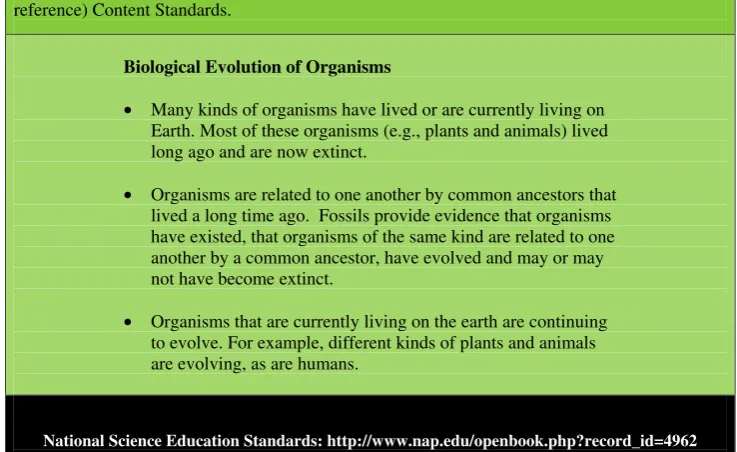
Directions: The K-4 Biological Evolution Content Standards should be added to the National Science Education Standards (NSES) K-4 Life Science Content Standards (p. 129) and used in conjunction with the NSES K-4 Life Science (p. 129) and Earth Science (p. 134, See fossil reference) Content Standards.
Biological Evolution of Organisms
• Many kinds of organisms have lived or are currently living on Earth. Most of these organisms (e.g., plants and animals) lived long ago and are now extinct.
• Organisms are related to one another by common ancestors that lived a long time ago. Fossils provide evidence that organisms have existed, that organisms of the same kind are related to one another by a common ancestor, have evolved and may or may not have become extinct.
• Organisms that are currently living on the earth are continuing to evolve. For example, different kinds of plants and animals are evolving, as are humans.
National Science Education Standards: http://www.nap.edu/openbook.php?record_id=4962
Teaching Biological Evolution in Elementary School
Recently, supporting materials have emerged from both science educators and science education researchers encour-aging the teaching of biological evolution at the elementary level in U.S. schools. These materials include (but are not limited to) elementary biological evolution education re-search (e.g., Au et al.2008; Nadelson et al. 2009; Prinou et al. 2011; Solomon and Johnson 2000; Venville and Donovan2007), research-based position papers calling for the teaching of evolution in elementary schools (Hermann 2011), elementary biological evolution education resources (e.g., Understanding Evolution 2011), and elementary biological evolution education curricula (e.g., Chanet and Lusignan 2009; Eldredge and Eldredge 2009; Understanding Evolution 2011).
Furthermore, because the National Science Education Standards (NRC1996) did not provide national biological evolution content standards for kindergarten through fourth grade, biological evolution content standards were devel-oped that could be used in conjunction with the National Science Education Standards K-4 life science and K-4 earth science content standards (NRC 1996) (see Fig. 1). For a full review of the K-4 biological evolution content standards including examples of integration activities using the K-4 biological evolution content standards and supplemental teacher information for the K-4 biological evolution content standards, see Wagler2010.
A Respectful Request
Considering the future influence the Next Generation Science Standards will have on local schools, school dis-tricts, state departments of education, national curriculum groups, and many other entities, the author respectfully requests that the developers of the Next Generation Science Standards:
1. Assess the complete body of indirect and direct research associated with the cognitive readiness of young chil-dren to learn biological evolution and
2. Based on this assessment, utilize the presented ele-mentary biological evolution supporting materials (and others) to develop kindergarten through fifth grade biological evolution content standards for the Next Generation Science Standards.
Conclusion
Young children possess the cognitive abilities necessary to learn biological evolution while in elementary school (e.g.,
Berti et al. 2010; Carey 1985; Gelman and Baillargeon 1983; Gelman and Kalish 2005; Keil et al. 1998; Metz 1995; Nadelson et al. 2009; National Research Council 2007; Toyama2000). Many elementary biological evolution education supporting materials exist that can assist the developers of the Next Generation Science Standards in developing kindergarten through fifth grade biological evo-lution content standards for the Next Generation Science Standards (e.g., Au et al.2008; Chanet and Lusignan2009; Eldredge and Eldredge 2009; Hermann 2011; Nadelson et al. 2009; Prinou et al. 2011; Solomon and Johnson2000; Understanding Evolution 2011; Venville and Donovan 2007; Wagler2010). The recommendation from the frame-work, as the basis for the Next Generation Science Standards, is to not teach biological evolution to kindergar-ten through fifth grade students in the U.S. Instead, the framework recommends that the first time U.S. students learn biological evolution content is in sixth grade. Let us hope that the developers of the Next Generation Science Standards will consider the author’s respectful request. If kindergarten through fifth grade biological evolution con-tent standards are not included in the Next Generation Science Standards, U.S. elementary children may very well experience firsthand Theodosius Dobzhansky’s claim that “nothing in biology makes sense except in the light of evolution”(Dobzhansky1973, p. 125).
References
Achieve Inc. Next generation science standards. 2011. http://www. achieve.org/next-generation-science-standards. Accessed 27 Sept 2011.
Au TKF, Chan CKK, Chan TK, Cheung MWL, Ho JYS, Ip GWM. Folkbiology meets microbiology: a study of conceptual and be-havioral change. Cogn Psychol. 2008;57(1):1–19.
Berti AE, Toneatti L, Rosati V. Children’s conceptions about the origin of species: a study of Italian children’s conceptions with and without instruction. J Learn Sci. 2010;19:506–38.
Carey S. Conceptual change in childhood. Cambridge, MA: MIT Press; 1985.
Carin AA, Bass JE, Contant TL. Teaching science as inquiry. Upper Saddle River, NJ: Pearson Merrill Prentice Hall; 2005.
Chanet B, Lusignan F. Teaching evolution in primary schools: an example in French classrooms. Evol Educ Outreach. 2009;2:136–40.
Dobzhansky T. Nothing in biology makes sense except in the light of evolution. Am Biol Teach. 1973;35:125–9.
Eldredge N, Eldredge G. Lessons from EEO: Toward a universal evolutionary curriculum. Evol Educ Outreach. 2009;2:643–54. doi:10.1007/s12052-009-0185-5.
Gelman R, Baillargeon R. A review of some piagetian concepts. In: Flavell JH, Markman EM, editors. Handbook of child psycholo-gy, vol. 3. Hoboken, NJ: Wiley; 1983. p. 167–230.
Gould SJ. Dorothy, it’s really oz. A pro-creationist decision in Kansas is more than a blow against Darwin. Time Mag. 1999;154:59. Hermann RS. Breaking the cycle of continued evolution education
controversy: On the need to strengthen elementary level teaching of evolution. Evol Educ Outreach. 2011;4:267–74. doi:10.1007/ s12052-011-0325-6.
Jackson JBC. Ecological extinction and evolution in the brave new ocean. Proc Natl Acad Sci. 2008;105:11458–65.
Keil FC, Smith CS, Simons D, Levin D. Two dogmas of conceptual empiricism. Cognition. 1998;65:103–35.
Metz KE. Reassessment of developmental constraints on children’s science instruction. Rev Educ Res. 1995;65:93–127.
Millennium Ecosystem Assessment. Millennium ecosystem assessment: ecosystems and human well-being (synthesis report). 2005.
http://www.maweb.org/en/index.aspx. Accessed 27 Sept 2011. Nadelson L, Culp R, Bunn S, Burkhart R, Shetlar R, Nixon K, Waldron
J. Teaching evolution concepts to early elementary school stu-dents. Evol Educ Outreach. 2009;2:458–73.
National Academies. Conceptual framework for national science edu-cation standards. 2011.http://www7.nationalacademies.org/bose/ Standards_Framework_Homepage.html. Accessed 27 Sept 2011. National Research Council. National science education standards.
Washington: National Academy; 1996.
National Research Council. Taking science to school: learning and teaching science in grades k-8. Washington: National Academies; 2007.
National Research Council. A framework for k-12 science education: practices, crosscutting concepts, and core ideas. Washington: National Academy; 2011.
Prinou L, Halkia L, Skordoulis C. The inability of primary school to introduce children to the theory of biological evolution. Evol Educ Outreach. 2011;4:275–85. doi:10.1007/s12052-011-0323-8.
Solomon GEA, Johnson SC. Conceptual change in the classroom: teaching young children to understand biological inheritance. Br J Dev Psychol. 2000;18:81–96.
Toyama N. What are food and air like inside our bodies? Children’s thinking about digestion and respiration. Int J Behav Dev. 2000;24(2):222–30.
Tripati AK, Roberts CD, Eagle RA. Coupling of CO2 and ice sheet stability over major climate transitions of the last 20 million years. Science. 2009;326:1394–7.
Understanding Evolution. Understanding evolution. 2011. http:// evolution.berkeley.eduAccessed 27 Sept 2011.
Venville G, Donovan J. Developing year 2 students’theory of biology with concepts of the gene and DNA. Int J Sci Educ. 2007;29 (9):1111–31.
Wagler R. A missing link: K-4 biological evolution content standards. Evol Educ Outreach. 2010;3(3):443–50. doi: 10.1007/s12052-010-0240-2.
Wagler R. The anthropocene mass extinction: an emerging curriculum theme for science educators. Am Biol Teach. 2011a;73(2):78–83. doi:10.1525/abt.2011.73.2.5.
Wagler R. The impact of human activities on biological evolution: a topic of consideration for evolution educators. Evol Educ Outreach. 2011b;4(2):343–7. doi:10.1525/abt.2011.73.2.5. Wake DB, Vredenburg VT. Are we in the midst of the sixth mass
extinction? a view from the world of amphibians. Proc Natl Acad Sci. 2008;105:11466–73.
World Wide Fund for Nature. Living planet report 2010. 2010.http:// wwf.panda.org/about_our_earth/all_publications/living_planet_ report/. Accessed 27 Sept 2011.