http://www.arjournals.org/index.php/ijpm/index
Original Research Article
Antimicrobial Activity of Lemongrass and Oregano essential oil against standard antibiotic
resistant
Staphylococcus aureus
and field isolates from chronic mastitis cow
Jae-Young Choi
1, Dereje Damte
1, Seung-Jin Lee
1, Jong-Choon Kim
2, Seung-Chun Park
1**Corresponding author:
Seung-Chun Park
1College of Veterinary Medicine,
Kyungpook National University, Daegu 702-701, South Korea
2 College of Veterinary Medicine,
Chonnam National University, Gwangju 500-757, South Korea
A b s t r a c t
The study was carried out to investigate the antibacterial activity of lemongrass and Oregano essential oil against standard antibiotic resistant Staphylococcus aureus strains and field isolates from a chronic mastitic cow. Disc diffusion and minimum inhibitory concentration (MIC) assay were used to investigate antibacterial activity of lemongrass and Oregano essential oil while their combined effect with antibiotic were assessed using a microbroth chequerboard technique. For identification of the essential oil component Gas Chromatography Coupled Mass Spectroscopy (GC/MS) analysis was performed. Disc diffusion assay revealed dose-dependent inhibition zone with lemongrass oil showing consistently larger inhibition zone than oregano oil. Lemongrass essential oils were further evaluated for its antibacterial activity in combination with antibiotic which resulted both synergistic and additive interaction. Lemongrass oil-amoxicillin combination showed synergistic interactions against all tested organism while the combination for lemongrass oil-norfloxacin showed synergistic effect for two field isolates and an additive for the remaining strains. The current study indicated that both lemongrass and oregano essential oils exhibit antibacterial activity, and lemongrass oil in combination with antibiotics could be a potential agent for antibacterial treatments against antibiotic resistant bacterial infections.
Key Words: Lemongrass; Oregano essential oil, Resistant, S. aureus, antibiotics.
Introduction
Plant-derived essential oils have long been used as flavoring agents in food and beverages. Due to the presence of antimicrobial ingredients, they have potential use as natural agents for food preservation [1] and as antibiotic in various ways [2]. With the misuse and overuse of antibiotics to treat diseases, antibacterial resistance to the drugs has begun to appear and has become more serious because of selective pressure [3]. Staphylococcus aureus, one of the etiologic agents of bovine mastitis, has been reported several times as resistant pathogen against various antibiotics [4, 5, 6]. Antibiotic resistance of the methicillin-Resistant Staphylococcus aureus (MRSA) isolated from livestock against several antibiotics has been confirmed [5]. MRSA separated in many countries has wide-range of resistant against chloramphenicol, clindamycin, norfloxacin, ciprofloxacin, erythromycin, gentamicin, linezolid, oxacillin, penicillin, rifampin, trimethoprim/sulfamethoxazole, and tetracycline [7, 8].
Among the different options to tackle antimicrobial resistance, use of essential oil has been an alterative approach and an area of research concern. Many essential oils have been traditionally used by people for various purposes of which cinnamon, clove and rosemary oils had shown antibacterial and antifungal activity [9]. Lemongrass essential oil has been reported for its flavoring, antiseptic and deodorant properties [10] while oregano essential oil
exhibit antifungal, antibacterial, and antimicrobial activity, respectively [11].
In the current study, lemongrass and oregano essential oil antibacterial activity against standard antibiotic resistant S. aureus type strains and field isolates S. aureus from chronic bovine mastitis were investigated. Furthermore, the effects of lemongrass essential oil in combination with antibiotics were also evaluated in order to seek effective combinations to treat infections caused by resistant S. aureus strains.
Materials and methods
Standard test microorganism
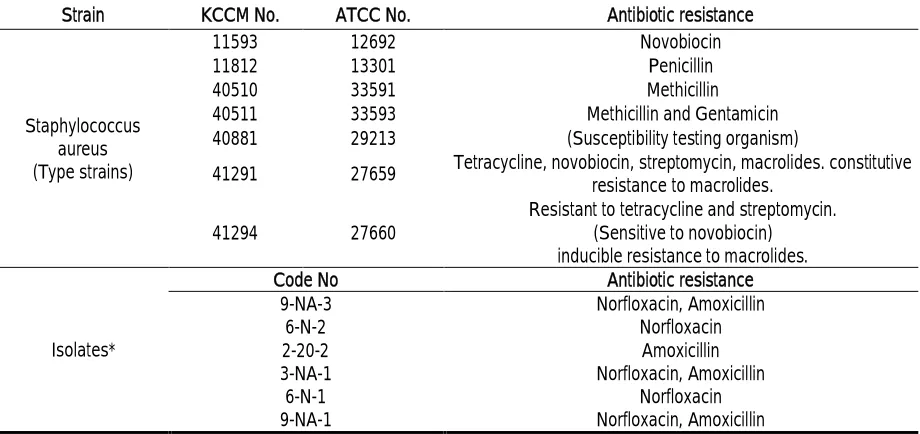
Standard antibiotic resistant strains of S. aureus (KCCM 11593, KCCM 11812, KCCM 40510, KCCM 40511, KCCM 40881, KCCM 41291, and KCCM 41294) were obtained from Korean Culture Center of Microorganisms (KCCM, http://www.kccm.or.kr). The selected test organisms characteristics are summarized in Table 1. These organisms were pre-incubated overnight with tryptic soy broth (DIFCO, USA) in shaking incubator at 37℃.
ISSN: 0975-0185
PAGE | 135 |
Sampling and field Isolates microorganisms
Mastitis milk samples were collected from chronic mastitic cows in Kyungsangpook-Do province and immediately transported to the laboratory in ice-cooled containers. Mastitic milk samples of 500 μL were inoculated into 5 mL of Trypticase soy broth (Difco) with NaCl and incubated at 37°C for 20 h with shaking. The inoculums were spread onto agar plates and incubated at 37°C for 24 h. The colonies were tested for S. aureus levels using conventional methods that included Gram staining, colonial morphology, and coagulase assays. Phenotypic methicillin-Resistant of S. aureus
was determined by an agar screen test performed according to the recommendations of the National Committee for Clinical Laboratory Standards (NCCLS) (20, 34) with Mueller-Hinton agar (Difco) containing 4% NaCl and 2, 4, or 8 μg/mL of oxacillin (Sigma, St. Louis, Mo.). Isolated methicillin-Resistant colonies are listed in Table 1. The isolates were stored at -70°C in freezer vials till further analysis.
Table 1. Antibiotic resistance Staphylococcus aureus type strains and field isolates.
Strain KCCM No. ATCC No. Antibiotic resistance
Staphylococcus aureus (Type strains)
11593 12692 Novobiocin
11812 13301 Penicillin
40510 33591 Methicillin
40511 33593 Methicillin and Gentamicin
40881 29213 (Susceptibility testing organism)
41291 27659 Tetracycline, novobiocin, streptomycin, macrolides. constitutive
resistance to macrolides.
41294 27660
Resistant to tetracycline and streptomycin. (Sensitive to novobiocin) inducible resistance to macrolides.
Isolates*
Code No Antibiotic resistance
9-NA-3 Norfloxacin, Amoxicillin
6-N-2 Norfloxacin
2-20-2 Amoxicillin
3-NA-1 Norfloxacin, Amoxicillin
6-N-1 Norfloxacin
9-NA-1 Norfloxacin, Amoxicillin
* : Isolates are from bovine mastitis milk samples of Kyungsanpook-Do province. Samples were collected and diagnosted by the inspector, Eun-young Kim of Kyungsangpook-Do Veterinary Service Laboratory.
Essential oils and antibiotics
Lemongrass essential oil, oregano essential oil and solvents (Polysorbate 80 and Polysorbate 20) were supplied from Biomist, Co. Ltd. Korea. The oils were stored in an amber bottle at 4°C until use. Norfloxacin, and amoxicillin were purchased from Becton (Becton Dickinson, Heidelberg, Germany).
Gas Chromatography Coupled Mass Spectroscopy
analysis
Gas Chromatography Coupled Mass Spectroscopy (GC/MS) analysis was performed by Kyungpook National University Center for Scientific Instruments. GC/MS was carried out using a HP (Hewlett-Packard) 6890 Plus GC gas chromatograph with (MSD) – HP 5973 MSD mass selective detector. Samples were diluted with HPLC-grade methanol to 1:1000(v/v). Sample portions (1μL) were injected into the HP-5 column. GC oven program was set at 50 °C for 4 min and then raised to 280 °C at a rate of 4 °C/min and held at
the final temperature for 2 min. The velocity of Helium carrier gas (99.99%) was 0.7 mL/min. Quantitative analysis is performed with area normalization method.
Disk diffusion assay
To test antimicrobial activity against selected standard antibiotic resistant S. aureus type strains and field isolates from chronic mastitis cow, disk diffusion susceptibility test was performed according to the guideline of NCCLS. Antibiotic resistance S. aureus type strains and field isolates were seeded in 5 mL of Muller-Hinton broth (MHB) (DIFCO, USA) and incubated in 37℃ shaking incubator overnight. Incubated S. aureus (105CFU/mL)
PAGE | 136 |
Minimal Inhibitory Concentration (MIC)
The MICs were determined by a broth microdilution method in Muller-Hinton broth [4]. A series of two fold dilution of antibiotics (Amoxicillin, AM and norfloxacin, NF) and essential oil (lemongrass and oregano ranging from 0.2 to 2.6 mg/ml) were inoculated with an overnight culture at a final inoculum of ~5x10⁵ CFU/mL. The
plates were incubated at 37˚C overnight and MIC was determined. The MIC was defined as the lowest concentration of the antibiotic that prevented visible growth. Inhibition of bacterial growth in the plates containing test oil was judged by comparison with growth in blank controls.
Combination effect of lemongrass and antibiotics
S. aureus (KCCM 11812, KCCM 40511) and isolates (3-NA-1, 6-N-1, 9-NA-1) were selected as antibiotic resistant model. The effects of lemongrass oil, amoxicillin and norfloxacin in combination were assessed by using a microbroth chequerboard technique [3]. Each well containing the mixture of antibiotic and citral was inoculated with a 4-6 h broth culture diluted to give a final concentration of ~5x10⁵ CFU/mL and incubated at 37˚C for 18-20 h. Fractional
inhibitory concentration (FIC) was calculated by dividing the MIC of the combination of antibacterial and essential oil by the MIC of antibacterial or essential oil alone. The FIC index, obtained by adding both FICs, was interpreted as synergistic when it was ≤ 0.5, as additive (indifferent) when it was > 0.5 and ≤ 2.0, and as antagonistic when it was >2.0. The combination value was derived from the highest dilution of antibiotic combination permitting no visible growth.
Result and discussion
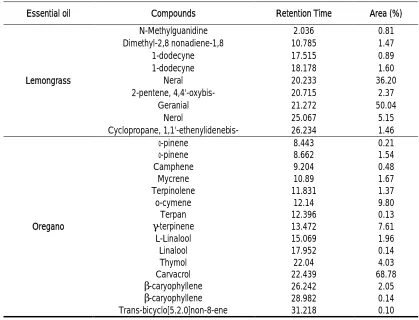
In the GC/MS analysis of lemongrass essential oil, geranial (50.04%) and neral (36.20%) were mainly identified. These are the isomeric citral (the trans-isomer, geranial, and the cis-isomer, neral), making 86.24% of lemongrass essential oil consisted of citral. The retention times of the two resulting peaks were 20.2 min and 21.2 min. The remaining trace compounds identified are summarized in Table 2. For case of oregano essential oil, the major components identified was carvacrol (68.78%). All the compounds identified oregano essential oil is also summarized in Table 2.
As Table 3 shows, gradient-dependent inhibition zone were revealed by disk diffusion assays. In almost every test group, lemongrass oil showed larger inhibition zone than oregano oil. Inhibition zone of 5% lemongrass oil was two times larger than that of 5% oregano oil. In case of oregano oil, the diameter of 1% and 5% showed great differences but 5% and 10% shows little differences except S. aureus KCCM 40881.
The result for the MIC value of lemongrass oil, oregano oil, amoxicillin, & norfloxacin against standard antibiotic resistant
bacterial strains and field isolates are summarized in Table 4. MIC for lemongrass oil ranged from 100 to 1000 µg/mL and for oregano oil from 100 to 4000 µg/mL. For both standard antibiotic resistant bacterial strains and field isolates, lemongrass oil has shown equal or higher MIC levels than oregano essential oil. The antibiotics amoxicillin and norfloxacin had also shown MIC values ranging from 0.5 to 128 µg/mL and 1 to 64µg/mL, respectively. Norfloxacin had shown more stable antibacterial activity with smaller range than amoxicillin. Lemongrass oil showing consistent higher antibacterial activity in both disc diffusion and MIC tests, hence it was further tested for its antibacterial effect in combination with antibiotics.
The results of combination studies are shown in Table 4. The effect of lemongrass oil-antibiotics combination against both selected standard antibiotic resistant bacterial strain and field isolates represented both synergistic and additive interaction. Lemongrass oil-amoxicillin combination showed synergistic interactions against all tested organism while the combination for lemongrass oil-norfloxacin showed synergistic effect for two field isolates and an additive for the remaining strains.
In improving the quality of healthcare which could be obtained from essential oil, it is necessary to investigate the plant extracts scientifically for their optimum usage. In the current study, the potential use of essential oils antibacterial activity against standard and field isolates antibiotic resistant strain was reported.
PAGE | 137 |
Table 2. GC/MS analysis of lemongrass and oregano essential oil.Essential oil Compounds Retention Time Area (%)
Lemongrass
N-Methylguanidine 2.036 0.81
Dimethyl-2,8 nonadiene-1,8 10.785 1.47
1-dodecyne 17.515 0.89
1-dodecyne 18.178 1.60
Neral 20.233 36.20
2-pentene, 4,4'-oxybis- 20.715 2.37
Geranial 21.272 50.04
Nerol 25.067 5.15
Cyclopropane, 1,1'-ethenylidenebis- 26.234 1.46
Oregano
α-pinene 8.443 0.21
α-pinene 8.662 1.54
Camphene 9.204 0.48
Mycrene 10.89 1.67
Terpinolene 11.831 1.37
o-cymene 12.14 9.80
Terpan 12.396 0.13
γ-terpinene 13.472 7.61
L-Linalool 15.069 1.96
Linalool 17.952 0.14
Thymol 22.04 4.03
Carvacrol 22.439 68.78
β-caryophyllene 26.242 2.05
β-caryophyllene 28.982 0.14
Trans-bicyclo[5.2.0]non-8-ene 31.218 0.10
Table 3. Antimicrobial activity assay with disc diffusion method
Compound Concentration KCCM (Diameter, mm) Isolates(Diameter, mm)
40881 41291 41294 11593 40510 9-NA-3 6-N-2 2-20-2 3-NA-1 6-N-1 9-NA-1
Lemongrass
10% 28±2 26±6 25±2 25±6 34.5±2.5 26.5±2 29±1 17±3.4 24±1.5 25.5±1.3 21±1.25
5% 19±1 18±0.5 19.5±0.5 18±2.5 28±1.5 13±1.5 12.5±1 8±2 14±0.5 11.5±1 10±1
1% 8.5±0.5 6.5±2.5 6±0.1 8.5±0.5 11±1 5.5±1 6±2.5 1.4±1 6±2.5 8.5±1 7±2
Oregano
10% 14±0 5.5±1.5 5±0.5 6±0 10±1 9.5±1 11±2 8±1.5 6±2 7.5±1 5.5±1
5% 9±2 5.5±0.5 5±0.2 4±0.2 9.5±1.5 5.5±1 5.5±2 3.5±1 3±2 4±1.5 2.5±0.5
1% 3.5±0.5 1.5±0.5 3.5±0.5 1.5±0.5 1±1 2±1 1±0.5 1.5±0.5 1±1 1.5±0.5 2±1.5
Control 8 8 8 8 8 8 8 8 8 8 8
PAGE | 138 |
Table 4. Comparison of MIC of oregano oil, lemongrass oil, amoxicillin, and norfloxacin and combination effect ofLemongrass essential oil and antibiotics.
Antibiotic resistant strains
MIC (µg/mL) MIC (μg/mL)
C.-Thymol Citral Amoxicillin Norfloxacin
KCCM 11593 500 500 0.5 1
KCCM 11812 100 500 32 4
KCCM 40510 100 500 32 4
KCCM 40511 100 100 64 1
KCCM 40881 100 500 2 2
KCCM 41291 100 100 4 1
KCCM 41294 500 100 8 2
9-NA-3 1000 500 128 64
6-N-2 4000 1000 128 64
2-20-2 2000 1000 128 64
3-NA-1 4000 1000 64 32
6-N-1 4000 500 128 8
9-NA-1 1000 500 128 8
LEO+ NF LEO+AM
MIC FIC Interpretation MIC FIC Interpretation
KCCM 11812 200, 1 0.065 Additive 50, 2 0.1625 Synergism
9-NA-3 200, 8 0.525 Additive 25, 8 0.1125 Synergism
6-N-2 50, 8 0.175 Synergism 25, 8 0.0875 Synergism
2-20-2 25, 8 0.15 Synergism 25, 4 0.0563 Synergism
LEO: Lemongrass essential oil,
Conclusion
The current study indicated that both lemongrass and oregano essential oils exhibit antibacterial activity, and lemongrass oil in combination with antibiotics could be a potential source for antibacterial treatments against antibiotic resistant bacterial infections. Further in vivo studies and clinical trials are recommended to justify and further evaluate for the potential use in clinical and preventive applications.
Authors Contribution
Jae-Young Choi,
Experimental designing and doing experiment Dereje Damte
Experimental design, result interpretation and writing manuscript Seung-Jin Lee
Result interpretation and data analysis Jong-Choon Kim
Result interpretation and data analysis editing manuscript Seung-Chun Park
Supervisor role, Experimental design, reviewing manuscript
Acknowledgement
This research was financially supported in part by Basic Science Research Program through the National Research Foundation of Korea (NRF) funded by the Ministry of Education, Science and Technology (No. 2011-0021670) and was supported in part by the Ministry of Knowledge Economy (MKE), Korea Institute for Advancement of Technology (KIAT) through the Inter-ER Cooperation Projects.
References
[1]. Helander IK, Alakomi HL, Latva-Kala K, Mattila-Sandholm T, Pol I, Smid EJ, von Wright A. Characterization of the action of selected essential oil components on Gram negative
bacteria. J Agric Chem.
1998;46:3590–3595.
[2]. Chorianopoulos N, Kalpoutzakis E, Aligiannis N, Mitaku S, Nychas GJ, Haroutounian SA. Essential oils of Satureja, Origanum, and Thymus
species: chemical composition and antibacterial activities against foodborne pathogens. J Agric Food Chem. 2004;52:8261-7.
PAGE | 139 |
essential oil alone and in combinationwith antibiotics against
extended-spectrum b-lactamase-producing
Escherichia coli. FEMS Immunol Med Microbiol. 2008;53:190-4.
[4]. Melter O, Aires de Sousa M, Urbaskova P, Jakubu V, Zemlickova H, de Lencastre H. Update on the major clonal types of methicillin-resistant Staphylococcus aureus in the Czech Republic. J Clin Microbiol. 2003;41:4998-5005.
[5]. Lee JH. Methicillin (Oxacillin)-resistant
Staphylococcus aureus strains
isolated from major food animals and their potential transmission to humans. Appl Environ Microbiol. 2003;69:6489-94.
[6]. Kobayashi H. National hospital infection surveillance on methicillin-resistant Staphylococcus aureus. J Hosp Infect. 2005;60:172-5.
[7]. Tenover FC, Biddle JW, Lancaster
MV. Increasing resistance to
vancomycin and other glycopeptides in Staphylococcus aureus. Emerg Infect dis. 2001;7:327–32.
[8]. Barnard FM, Maxwell A. Interaction between DNA gyrase and quinolones: effects of alanine mutations at GyrA subunit residues Ser(83) and Asp(87).
Antimicrob Agents Chemother.
2001;45(7):1994-2000.
[9]. Ouattara B, Simard RE, Holley RA, Piette GJ, Bégin A. Antibacterial activity of selected fatty acids and essential oils against six meat spoilage organisms. Int J Food Microbiol. 1997;37:155-62.
[10]. Prabuseenivasan S, Jayakumar M, Ignacimuthu S. In vitro antibacterial activity of some plant essential oils. BMC Complement Altern Med. 2006;6:39.
[11]. V´agi E, Sim´andi B, Suhajda A, H´ethelyi E. Essential oil composition and antimicrobial activity of Origanum majorana L. extracts obtained with ethyl alcohol and supercritical carbon dioxide. Food Res Int. 2005;38:51–57. [12]. Tohidpour A, Sattari M, Omidbaigi R, Yadegar A, Nazemi J. Antibacterial effect of essential oils from two medicinal plants against
Methicillin-resistant Staphylococcus aureus
(MRSA). Phytomedicine.
2010;17:142-5.
[13]. Jayaraman P, Sakharkar MK, Lim CS, Tang TH, Sakharkar KR. Activity and
interactions of antibiotic and
phytochemical combinations against Pseudomonas aeruginosa in vitro. Int J Biol Sci. 2010;6:556-68.