Calculation and Simulation of Transmission Reliability in
Wireless Sensor Network Based on Network Coding
https://doi.org/10.3991/ijoe.v13i12.7883
Zhifu Luan
Weifang University of Science and Technology, Weifang, China
Abstract—The wireless sensor network (WSN) has penetrated into every corner in our lives, ranging from national defense, biological medicine, envi-ronmental monitoring, to traffic management. It is of great significance to study the reliability of data transmission, a key determinant of the results of monitor-ing events. The network reliability lies in fault tolerance: when some nodes or links in the network fail, the data can be recovered at the sink node by selecting the appropriate finite domain space. In this paper, network coding is used to improve the reliability of WSN. Firstly, the author calculated the data transmis-sion reliability and average energy consumption of network coding in single-path and multi-single-path scenarios. Then, the average energy consumption of net-work coding was compared with that of the traditional method. Finally, the reli-abilities of the two different methods were simulated on MATLAB at different channel loss rates. The experimental results show that the reliability of the net-work coding technique is better than the traditional one at the expense of a small amount of energy.
Keywords—Wireless Sensor Network (WSN), Network Coding, Reliability
1
Introduction
The wireless sensor network (WSN) has penetrated into every corner in our lives, ranging from national defence, biological medicine, environmental monitoring, to traffic management. The network is formed through self-organization of sensors de-ployed in multiple sensing areas. In the WSN, the sensors can work cooperatively to sense, collect and process specific information in the monitoring area, laying the basis for real-time acquisition, processing and transmission of information [1]. It is of great significance to study the reliability of data transmission, a key determinant of the results of monitoring events.
Refer-ence [3] gives the definition of the ability to deliver material, information and energy under the specified conditions and within a desired time frame. Reference [4] defines WSN reliability as the success rate of source-to-destination data transmission in the network. Over the years, various models have been constructed to study the WSN reliability. For example, Reference [5] constructs a Markov chain-based reliability model in light of the state transition in both software and hardware. The model is further improved in Reference [6] with a quantitative analysis method. References [7, 8] introduce a reliability modelling method based on Architecture Analysis & Design Language (AADL), which quantifies the reliability following the idea of the General-ized Stochastic Petri Nets (GSPN) model.
The WSN reliability is mainly reflected by such three parameters as data acquisi-tion, data transmission and network coverage [9]. Among them, the data transmission plays the most fundamental role [10, 11]. Traditionally, the reliability of data trans-mission in the WSN are improved by Automatic Repeat Request (ARQ), Forward Error Correction (FEC) and multi-path transmission. The reliability of data acquisi-tion is often modelled as an overlay problem [12], while the network coverage is a reflector of the monitoring quality and the reliability of the acquired data. By defini-tion, network coverage refers to the ability to monitor each location in an area of in-terest. The greater the network coverage, the greater the monitoring ability. The pa-rameter is often measured by the K-coverage [13, 14], that is, the location or area of interest is covered by at least K nodes. To meet different data reliability requirements in the area of interest, the K value can be set according to the unused Quality of Ser-vice (QoS).
Data acquisition is one of the many functions of the WSN. The successful opera-tion of the WSN also relies on the reliable transmission of the acquired data to the observer. However, the reliability of data transmission is traditionally explored based on the reliable routing mechanism, and rarely from the perspective of network topolo-gy. The one-sided focus on reliable routing mechanism is attributable to the fixed topology of traditional networks. As sensor nodes grow denser in distribution and greater in quantity, the network topology has become increasingly flexible, making it possible to study data transmission reliability based on network topology [15-17].
2
Composition and Characteristics of the WSN
2.1 Composition of the WSN
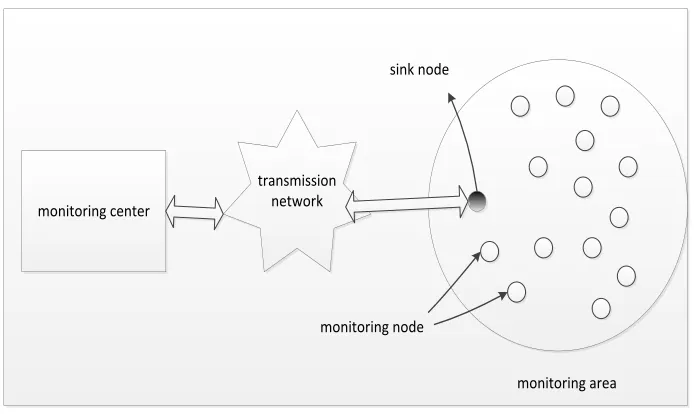
The WSN is a task-oriented wireless ad hoc network [18], that integrates sensor technology, embedded technology, wireless communication technology with distrib-uted information processing technology. The network monitors the target in real time with various micro sensors, processes the monitoring data in an embedded module, and transmits the data to the remote monitoring centre via wireless or physical net-work. The WSN consists of four parts: wireless sensor nodes, sink node, transmission network, and remote monitoring centre. Its structure is shown in Figure 1.
!"#$%"&$#'()*#%*&
%&+#,!$,,$"#( #*%-"&.
,$#.(#"/*
!"#$%"&$#'(+&*+ !"#$%"&$#'(#"/*
Fig. 1. The structure of WSN
2.2 Characteristics of the WSN
The WSN, as the combination of various emerging technologies, carries many characteristics that are not available in general networks [19].
1.Self-organization: the WSN is an ad hoc network formed with sensor nodes based on the distributed network protocol. Without relying on any fixed infrastructure, the network automatically adjusts the entry, exit and migration of nodes. In this way, a plurality of active nodes can quickly form an independent network.
3.Dynamic topology: In the case of battery exhaustion or failure, the WSN nodes may exit the network following the pre-set procedures. Owing to the mobility of sensor nodes, external wireless sensor nodes can be admitted to the network at any time.
4.Multi-hop routing: The internodal communication distance is relatively short in the WSN. The nodes can only communicate directly with neighbouring nodes. Distant communication requires an intermediate node for data transmission. The multi-hop routing in the WSN is accomplished by common nodes, each of which both re-ceives and forwards information. The data is transmitted from each sensor node to the sink node via multi-hop relay.
5.Redundant height: For the sake of system reliability and fault tolerance, the same monitoring point is covered by the monitoring ranges of multiple sensor nodes. 6.Limited hardware resources: Under the constraints of price, volume and power
consumption, the nodes have much smaller computing power, program space and memory space than ordinary computers. This excludes complex protocol hierarchy from the design of node operating system.
7.Limited power supply: The sensor nodes are powered by battery, which cannot be charged or replaced in many applications. When the battery runs out, the nodes will lose their functions. Thus, energy-saving must be considered in the design of the WSN.
8.Fault tolerance: The WSN boasts strong fault tolerance and robustness in that the nodes can join or exit the network at any time, and that the network operation is immune from the fault of any node.
9.Broadcast communication: the broadcast communication mode is adopted instead of the point-to-point mode in traditional network.
10.Data processing: The traditional emphasis on connectivity is replaced by the focus on data. The WSN nodes are required to possess such functions as data aggrega-tion, fusion, capturing and compression.
2.3 Energy consumption of sensor nodes
The highlighting of energy-saving differentiates the WSN from traditional wireless networks. The energy saving is no big deal in traditional wireless networks due to continuous energy supplementation. By contrast, the WSN faces serious energy con-straint because of the large number of widely distributed sensor nodes. Therefore, it is the primary goal of WSN design to make efficient use of node energy and prolong the life of the network.
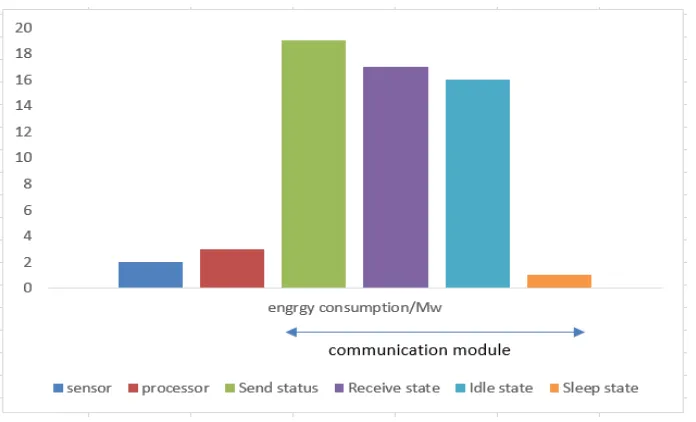
progress of integrated circuit has further lowered the energy consumption of proces-sors and sensor nodes, making the wireless communication module the largest con-sumer (Figure 2).
The wireless communication module has four states, including sending, receiving, idle and sleeping. In the idle state, the module always monitors the use of wireless channel and checks if data have been sent to itself. In the sleeping state, the commu-nication module is shut down. The sending state marks the greatest energy consump-tion of the module, followed closely by the idle and receiving states. By contrast, the module has the minimal energy consumption in the sleeping state. Hence, the network communication can be made more energy-efficient by reducing unnecessary forward-ing and receivforward-ing, and speedforward-ing up the activation of the sleepforward-ing state. The efficient use of energy may help to maximize the lifetime of the WSN.
Fig. 2. The energy consumption module of sensor nodes
3
Transmission Reliability of Network Coding
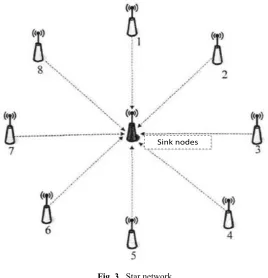
Fig. 3. Star network
If network coding technique is used alone, it is impossible to avoid the channel loss effect. After all, the effect is the same whether the sink node loses one packet only or all packets at once. Thus, the network coding technique should be
combined with the redundant technology to improve data transmission reliability. The popular ways to increase redundancy include multi-path transmission, retrans-mission coding of data packets, and increasing redundant packets.
The FEC is encoded only at the source node and decoded at the destination node. In network coding, however, the intermediate nodes can be recoded. Compared with FEC, the network coding features better flexibility and fault tolerance. For example, assume that 3 raw data packets are transmitted such that the last-hop node of the sink node receives the encoded data packets x1, x2, x3 and x4, where x1 is linearly corre-lated with the encoding vector of x2, and other data packets are linearly independent. If the FEC is adopted, the node will forward the packets directly. Suppose the packet x3 is lost after transmission, the sink node will not be able to decode the data packets x1, x2 and x4 because the encoding coefficient matrix is not full rank. If the network encoding is employed, the node will receive the 4 new encodings by encoding the data packets, and the coefficient matrix of any three of these packets is full rank. Even if a packet is lost, the sink node can decode it smoothly.
To disclose the advantage of network coding, the reliability of data transmission and energy consumption of network coding were simulated with different paths. The
reliability of data transmission is denoted as R and defined as the probability that the sink node will receive the original data packet successfully after one transmission.
Definition 1: The average energy consumption E refers to the average energy con-sumed by a successfully transmitted packet. It can be expressed as:
(1)
Definition 2: The ratio of the average energy consumption in network coding to that in the traditional mode can be expressed as:
(2)
3.1 Single-path transmission
In a multi-hop WSN, the packets are transmitted by sensor nodes via multi-hop routing, the internodal communication quality is susceptible to channel effects, and link failures are independent of each other. In the case of link failure, the sensor nodes will not fail. Let us denote the channel loss rate as e, and the energy consumed by a node to send a packet as!. Through an n time hopping, the probability for a packet to reach p nodes is:
(3)
Assuming that the source node sends packets, the probability for the sink node to successfully receive packets is:
(4)
where the probability P is equivalent to the reliability R defined in the preceding section.
The energy consumed to send a packet to the sink node via an n time hopping is calculated as follows. Since the packet is lost after a certain hop, the total energy consumed to send packets can be obtained by induction.
(5)
The number of packets received by the sink node is expected to be Kp, whereby the average energy consumption is:
(6) average =Number of packets receivedTotal energy consumed
E
c average
average !=Et
E
(1 )
= ! n
p e
K K
(1 )
= ! nK
P e
K
1
1
(1 ) (1 )
! ! "
=
= " n+
#
n " i ti
E Kn e iK e e
1 1
average
(1 ) (1 ) (1 )
! ! "
= " + "
= =
"
#
nn i
t t i
n
Kn e iK e e
E E
Kp K e 1 (1 ) 1
! ! " " =
= +
#
n " i ni
The average energy consumption ratio is:
(7)
By Formula (7), it is learned that ">1. In this research, random linear coding is used for the simple computation of nodes.
3.2 Multi-path transmission
Suppose there exist L non-intersecting paths which are of equal length n, and the source node sends K packets simultaneously through multiple paths to the sink node. Then, the probability for any packet to successfully reach the sink node after one transmission is:
(8)
Thus, the probability for the sink node to successfully receive K packets is Kp, that is, the reliability R is,
(9)
If packets are sent along the L paths, the total energy consumption is:
(10) The average energy consumed to send the packets along the paths is:
(11)
When the network coding is employed in multi-path transmission, the intermediate nodes only encode without increasing redundant packets. In this case, the total energy consumed to send packets is:
(12)
The number of packets received by the sink node is expected to be:
(13) Therefore, the average energy consumption is:
(14)
average
1 average
1
( 1) 1
[ (1 ) ]( )(1- ) µ
!
" " # #
= + = = + +
$
# + c t ni n n
i
E n
E n i e e K m e
1 [1 (1 ) ]
= ! ! ! n L
p e
{1 [1 (1 ) ] }
= K = ! ! ! n L K
k
P p e
K
't = t
E LE K L ' ' (1 ) (1 ) = = = ! !
t t t t
average n average
E E
E E
LK e n LK e
K
1
1
' [ !(1 ) ! (1 )" ] [( 1) 2]
=
= " +
#
" + " + nn i
c
i
E L Kn e iK e e n L
(1! )n
The average energy consumption ratio is:
(15)
4
Simulation Experiment and Result Analysis
The model given in the previous section was simulated in the environment of MATLAB 7.0.
4.1 Single-path transmission
Suppose that the path length is 5, and the source node sends 3 packets to the sink node such that the sink node receives 5 encoded data packets. Then, the reliabilities of the network coding and the traditional method were simulated at different channel loss rates.
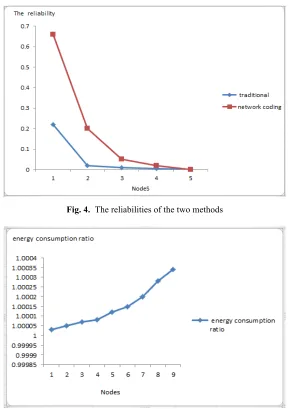
As shown in Figure 4, the network coding has achieved better reliability than the traditional method. This paper only considers the redundant coded packets at the source node. The reliabilities of the two methods still decreased with the loss of chan-nel. In a single-path, the network coding improved the reliability to a greater extent than the traditional method at high channel loss rate of redudant data and with few network encoding packets; however, the results were still not desirable. To fruther improve the data transmission reliability of network coding, appropriate redundant data packets should be added to the nodes.
Figure 5 presents the average energy consumption ratio of the two different trans-mission methods. It can be seen that " increased with e. However, regardless of the size of the e, the energy consumed by the single-path transmission combined with network coding always exceeded the energy consumed by that combined with the traditional method. This means network coding can improve the reliability of data transmission in the network at the expense of a small amount of energy.
4.2 Multi-path transmission
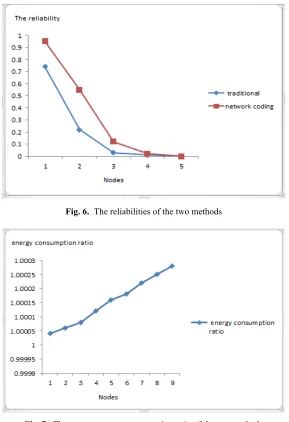
Similarly, assume that 5 packets are sent from the source node along 3 paths, each of which is 5 in length. Then, the reliabilities of the network coding and the traditional method were simulated at different channel loss rates.
As can be seen from Figure 6, the network coding method outperformed the tradi-tional method at the same redundancy. With the increase of the channel loss rate, both method transmitted fewer redundant data, indicating that the transmission improve-ment failed to offset link failure and results in longer paths.
Figure 7 illustrates the average energy consumption ratio between the two different methods. It shows that network coding can improve the reliability of data transmis-sion in the WSN at the expense of a small amount of energy.
!
verage
verage
' ' '
' '
!
= =c
a c
t
t a
E E
E
E 1
[( 1) 2] 1
3000 [1 (1 )+ ( 1)(1 ) ]
! + = +
+ ! n + ! ! ! n
n L e
5
Conclusions
This paper calculates and analyses the transmission reliability and average energy consumption of network coding in single-path and multi-path scenarios. The simula-tion on MATLAB 7.0 indicates that the technique is more reliable than the tradisimula-tional method at the expense of a small amount of energy. In addition, the author also simu-lated the reliabilities and the average energy consumption ratio of the network coding and the traditional method. The experimental results verify that the network coding technique is superior to traditional transmission.
Fig. 4. The reliabilities of the two methods
Fig. 6. The reliabilities of the two methods
Fig. 7. The average energy consumption ratio of the two methods
6
References
[1]Sun L.M., Li J.Z. (2005). Wireless Sensor Networks, Beijing: Tsinghua Press.
[2]Meng H.J. (2010). Research on Optimization of network reliability and its application, Shanghai: East China University of Science and Technology.
[4]Yousefi H., Mizanian K., Jahangir A.H. (2010). Modeling and Evaluating the Reliability of Cluster-Based Wireless Sensor Networks, Proceedings of 24th IEEE International Con-ference on Advanced Information Networking and Applications. https://doi.org/10.1109/ AINA.2010.72
[5]Tang F., Luo H.W., Xu Y.W. (2005). The application of Mobile Ad Hoc network in the US, Engineer equipment research, 24(5), pp. 61-64.
[6]Rolader G., Rogers J.C., Batteh J. (2004). Self-healing minefield, Pro-ceedings of the So-ciety of Photo-Optical Instrumentation Engineers. Bellingham, USA, pp. 13-24.
[7]Huang C.F., Tseng Y.C. (2005). A survey of solutions to the coverage problems in wire-less sensor networks, Journal of Internet Technology, 6(1), pp. 1-8.
[8]Liu J.J. (2011). Research on network coverage based on Voronoi graph in wireless sensor networks, Wuhan: Wuhan University of Technology.
[9]Li S.S. (2007). Research on key technologies for reliable data transmission in wireless sen-sor networks, Hunan: National University of defense technology.
[10]Kosanovic M., Stojcev M. (2008). Reliable transport of data in wireless sensor network, Proceedings of 26th International Conference on Microelectronics, pp. 455 - 458.
https://doi.org/10.1109/ICMEL.2008.4559320
[11]Willig A., Karl H. (2005). Data transport reliability in wireless sensor networks - asurvey of issues and solutions, Praxis Der Informationsverarbeitung Und Kommunikation, 28, pp. 86 - 92. https://doi.org/10.1515/PIKO.2005.86
[12]Liudong X., Akhilesh S. (2006). Qos Reliability of Hierarchical Clustered Wireless Sensor Networks, Performance, Computing and Communications Conference 25th IEEE Interna-tional, pp. 641-646.
[13]Zhou Z.H., Das S., Gupta H. (2004). Connected K-Coverage Problem in Sensor Networks Computer Communications and Networks, ICCCN, pp. 373-378.
[14]Ren Y., Zhang S.D., Zhang H.K. (2006). Coverage control theory and algorithm in wire-less sensor networks, Journal of software engineering, pp. 422-433.
[15]Wang X., Xing G., Zhang Y. (2003). Integrated coverage andconnectivity configuration in wireless sensor networks, In: Akyildiz IF, Proc. of the ACM Int'l Conf. on Embedded Networked Sensor Systems (Sen Sys), pp. 28-39.
[16]Sen A., Shen B.H., Zhou L., Hao B. (2006). Fault-Tolerance in Sensor Networks: A New Evaluation Metric, Infocom IEEE International Conference on Computer Communica-tions, 47, pp. 1-12. https://doi.org/10.1109/INFOCOM.2006.270
[17]Kashyap A., Khuller S., Shayman M. (2006). Relay Placement for Higher Order Connec-tivity in Wireless Sensor Networks, Infocom IEEE International Conference on Computer Communications, 15(1), pp. 1-12.
[18]Zhang S.J. (2010). Wireless sensor network technology and its application, Beijing: China Electric Power Press, pp. 210-213.
[19]Brunda S., Chaitra H.K. (2004). Survey of wireless sensor networks, Journal of communi-cations, 25(4), pp. 114-124.
7
Author
Zhifu Luan is the lecturer of Weifang University of Science and Technology, Shandong, China. His research interest field is computer application technology. He has computer teaching experience of 20 years. He has presided over a scientific re-search project and participated in a few scientific rere-search projects.