http://www.arjournals.org/ijop.html
Research article
ISSN: 0975-0185
Anthelmintic activity of Ethanolic extract of whole plant of Eupatorium Odoratum. L
Jitendra Patel1*, G.S. Kumar 1, Md. Shamim Qureshi2, P.K. Jena3.
*Corresponding author:
Jitendra Patel 1. Department of Pharmacognosy, Bharat Institute of Technology-School of Pharmacy,
Mangalpally, Ibrahimpatnam, RR Dist- 501510, AP, India. Mobile No. : 09392481888, E mail-
2. Department of
Pharmacognosy, 3Department of Pharmaceutical Chemistry, Jeypore College of Pharmacy Rondapalli, (K) Orissa-764002 India
Abstract
Successive extracts from the Whole plant of Eupatorium Odoratum. L (Asteraceae) were investigated for their anthelmintic activity against Pheretima posthuma and three concentrations (10, 50 and 100 mg/ml) of each extracts were studied in activity, which involved the determination of time of paralysis and time of death of the worm. Ethanolic extract exhibited significant anthelmintic activity at highest concentration of 100 mg/ml. Piperazine citrate in 10 mg/ml concentration as that of extract was included as standard reference and 1% Gum acacia in normal saline as control. The anthelmintic activity of ethanloic extract was significant followed by hydroalcoholic extract of Eupatorium Odoratum.
Keywords: Anthelmintic activity, Eupatorium Odoratum, Pheretima
posithuma, Piperazine citrate.
Introduction
Helminth infections are among the most common infections in man, affecting a large proportion of population all over the world. In developing countries they pose a large threat to public health and contribute to the prevalence of malnutrition, anaemia, eosinophilia and pneumonia. Although the majority of infections due to worms are generally limited to tropical regions [1].
Parasitoses have been of concern to the medical field for centuries and the helminths still cause considerable problems for human beings and animals. During the past few decades, despite numerous advances made in understanding the mode of transmission and the treatment of these
parasites, there are still no efficient products to control certain helminths and the indiscriminate use of some drugs has generated several cases of resistance[2-4]. Furthermore, it has been recognized recently that anthelmintic substances having considerable toxicity to human beings are present in foods derived from livestock, posing a serious threat to human health [5,6]. Consequently, the discovery and development of new chemical substances for helminth control is greatly needed and has promoted studies of traditionally used anthelmintic plants, which are generally considered to be very important sources of bioactive substances [7].
doi:10.5138/ijpm.2010.0975.0185.02020
128 Since the time immemorial, our traditional system of medicine and folklore claiming that medicinal plants as a whole or their parts are being used in all types of diseases successfully including antibacterial and anthelmintic, anti-inflammatory etc. As we know very well, now a days the medicinal preparation available in the market from which most of them either not effective up to the mark or has to develop resistance resulting in reoccurrence again. Plant derived drug serve as a prototype to develop more effective and less toxic medicines.
Eupatorium Odoratum commonly known as Pogosongha (Hindi) is widely distributed in forest of India. It also known as bitter bush, Siam weed, baby tea, and Santa Maria. It is an erect surb of about 3 m high. The leaves are alternate and the fruits are one-seeded. It may reach 1 m or more as a free standing shrub and 4 m or more when climbing into trees or shrubs. Stems reach 2 cm in diameter [8]. Traditionally Eupatorium has many more presumed beneficial uses, including treatment of dengue fever, arthritis, certain infectious diseases, migraine, intestinal worms, malaria, and diarrhea [9]. The whole plant extract possess diuretic activity [10]. The leaves of Eupatorium shown anti-inflammatory [11], wound healing [12] and insect repellant properties [13]. Flavonoids from the flowers of Eupatorium odoratum have shown antimycobacterial activity and cytotoxicity [14]. Phytochemical analysis of extract of Eupatorium Odoratum showed the presence of steroids, triterpenes alkaloids, flavonoids, tannins, diterpenes, glycosides, lactones and saponins [15]. The present study was carried out to investigate the whole plant extract for anthelmintic activity.
Material and Methods
Plant MaterialWhole plant material of Eupatorium odoratum was collected from local area of Koraput (Orissa) India. It was identified and authenticated by Mr. Kartik Charan Lenka, Scientist (Taxonomy, Biodiversity & Ethno botany of Eastern ghat)
Jeypore, at Bijju Patnaik Plant Garden & Research Center M. S. Swaminathan Research Foundation Jeypor, Orissa. A voucher specimen in deposited in Department of Pharmacognosy. Preparation of Extracts
The whole plant material was collected in the month of October 2008, shade dried and powdered. 250gm of powder was subjected to successive soxhlet extraction by various solvent such as petroleum ether, chloroform, ethanol and hydroalcohol (40%). The solvent was then removed under reduced pressure the yield obtained was petroleum ether (3.8%), chloroform (3.5%), ethanol (5.2%) and hydroalcohol (4.1%) w/w with respect to dried powder. which were used for anthelmintic activity.
Phytochemical screening[16]
The Successive extract was subjected to preliminary phytochemical testing for the detection of major chemical groups. The details of the tests are as follows:
1. For phenols: The extract was spotted on a filter paper. A drop of phoshomolybdic acid reagent was added to the spot and was exposed to ammonia Vapours (Blue coloration of the spot indicates the presence of phenols).
2. Braemer’s test for tannins: To a 2–3 ml of extract, 10% alcoholic ferric chloride solution was added. (Dark blue or greenish grey coloration of the solution indicate the presence of tannins in the drug).
3. Liebermann-Burchardt test for steroids and terpenoids: To 1 ml of extract of drug, 1 ml of chloroform, 2–3 ml of acetic anhydride and 1 to 2 drops of concentrated sulfuric acid were added. (Dark green coloration of the solution indicates the presence of Steroids and dark pink or red coloration of the solution indicate the presence of terpenoids).
4. Alkaloids: To 2–3 ml of extract was spotted on a small piece of precoated TLC plate and the plate was sprayed with modified Dragendorff’s reagent. (Orange coloration of the spot indicates the presence of alkaloids).
hydrochloric acid. The extract was cooled, filtered and the filtrate was shaken with diethyl ether. The ether extract was further extracted with strong ammonia. (Pink or deep red coloration of aqueous layer indicate the presence of anthraquinones).
6. Shinoda test for flavonoids: To 2–3 ml of extract, a piece of magnesium ribbon and 1 ml of concentrated hydrochloric acid were added. (Pink red or red coloration of the solution indicate the presence of flavonoids in the drug).
Anthelmintic Bioassay
Healthy adult Indian earthworms,Pheretima postuma, (Annelida, Megescolecidae) due to its anatomical and physiological resemblance with the intestinal roundworm parasites of human beings [17,18], were used in the present study. All earthworms were of approximately equal size. They were collected from local place, washed and kept in water.
Assessment of Anthelmintic Activity
Anthelmintic activity was assessed using earthworms by the reported methods with slight modification[19]. Samples for anthelmintic activity were prepared by dissolving 2.5 gm dried crude extracts in 25 mL 1% gum acacia solution prepared in normal saline (vehicle). To obtain a stock solution, different working solutions were prepared to get a concentration range of 10, 50 and 100 mg/mL. The anthelmintic activity was evaluated on adult Indian earthworm, Pheretima posthuma due to its anatomical and physiological resemblance with the intestinal round worm parasites of human being [20]. The anthelmintic activity of successive extract whole plant material of Eupatorium odoratum was determined by using the method of Mathew et al [21]. Six groups of approximately equal size Indian earthworms consisting of six earthworms in each group were used for the study. Each group was treated with one of the following.
Group-I - Vehicle (1% Gum acacia in normal saline)
Group-II - Piperazine citrate (15 mg/ml)
Group-III- Petroelum ether extract (10,50,100 mg/ml.)
Group- IV- Chloroform extract (10, 50,100 mg/ml.)
Group- V- Ethanolic extract (10, 50,100 mg/ml.) Group- VI- Hydroalcoholic extract (10, 50,100 mg/ml.)
Observations were made for the time taken to paralyze and / or death of individual worms. Paralysis was said to occur when the worms do not review even in normal saline. Death was concluded when the worms lost their motility followed with fading away of their body colour [22,23].
Statistical analysis
The data on biological studies were reported as mean ± Standard deviation (n = 6). For determining the statistical significance, standard error mean and analysis of variance (ANOVA) at 5 % level significance was employed. P < 0.05 were considered significant.
Results and Discusion
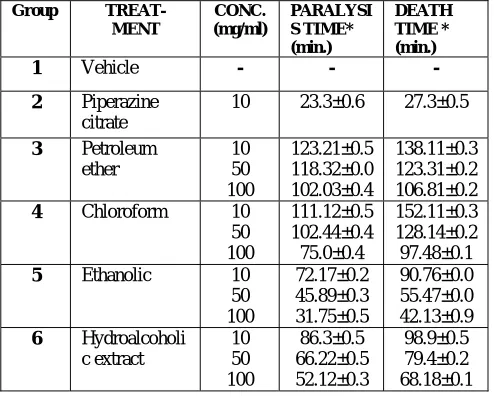
Successive extract of Whole plant material of Eupatorium odoratum showed significant anthelmintic activity on selected worms. Ethanolic extract found to be more active as compared to remaining extracts. The Ethanolic extract demonstrated paralysis as well as death of worms in a less time as compared to piperazine citrate especially at higher concentration of 10 mg/ml in case of Pheretima posthuma. The results are shown in Table -1. Phytochemical analysis of the sucessive extracts Whole plant material of Eupatorium odoratum revealed presence of saponin, steroids, alkaloids, tannins, polyphenols, terpenoids and flavonoids as are the chemical constituents. Results are shown in Table.-2. Tannins are polyphenolic compounds [24]. Some synthetic phenolic anthelmintics, e.g. niclosamide, oxyclozanide, bithionol, nitroxynil, etc, are shown to interfere with energy generation in helminth parasites by uncoupling oxidative phosphorylation [25]. It is possible that tannins contained in the extract of Eupatorium odoratum produced similar effects. In another study, polyphenols from bryophytes were shown to have anthelmintic activity against Nippostrongylus brasiliensis [26]. Another possible anthelmintic
effect of tannins is that they can bind to free proteins in the gastrointestinal tract of host animal [27] or glycoprotein on the cuticle of the parasite [28] and cause death. Several authors have reported that an increase in the supply of digestible protein does improve the resilience and resistance of sheep to gastrointestinal nematodes [29-31]. Tannin containing plants increase the supply and absorption of digestible protein by animals [32]. This is achieved by formation of protein complexes in the rumen by tannins, which later dissociate at low pH in the abomasum to release more protein for metabolism in the small intestines of ruminant animals [33]. In addition, tannins or their metabolites have a direct effect on the viability of the preparasitic stages of helminths. Other phytochemicals reported to have an anthelmintic effect include essential oils [34], flavonoids and terpenoids [35].
Table 1: Anthelmintic activity of whole plantof Eupatorium
odoratum Group TREAT-MENT CONC. (mg/ml) PARALYSI S TIME* (min.) DEATH TIME * (min.)
1 Vehicle - - -
2 Piperazine
citrate
10 23.3±0.6 27.3±0.5
3 Petroleum
ether 10 50 100 123.21±0.5 118.32±0.0 102.03±0.4 138.11±0.3 123.31±0.2 106.81±0.2
4 Chloroform 10
50 100 111.12±0.5 102.44±0.4 75.0±0.4 152.11±0.3 128.14±0.2 97.48±0.1
5 Ethanolic 10
50 100 72.17±0.2 45.89±0.3 31.75±0.5 90.76±0.0 55.47±0.0 42.13±0.9
6 Hydroalcoholi
c extract 10 50 100 86.3±0.5 66.22±0.5 52.12±0.3 98.9±0.5 79.4±0.2 68.18±0.1
Table 2: Phytochemical screening of Eupatorium odoratum
Sl. No
Tested group Petroleum ether Chloro-form Etha-nolic Hydro-alcoholic extract
1 Steroids +++ +++ --- ---
2 Terpenoids +++ +++ --- ---
3 Alkaloids --- +++ --- ---
4 Glycosides --- --- +++ +++
5 Phenols --- --- +++ +++
6 Tannins --- --- +++ +++
7 Flavonoids --- --- +++ +++
+++ positive --- Negative
Conclusion
From the above results, it is concluded that Ethanolic extracts of whole plant material of Eupatorium odoratum showed significant anthelmintic activity. Eupatorium odoratum was used by tribals traditionally to treat intestinal worm infections. The experimental evidence obtained in the laboratory model could provide a rationale for the traditional use of this plant as anthelmintic. The plant may be further explored for isolation of the active constituent accountable for anthelmintic activity.
References
1. Bundy DA: Immunoepidemiology of intestinal helmintihc infection, The global burden of intestinal nematode disease.
Trans. Royal. Soc. Trop. Med. Hyg. 1994,8:259-61.
2. Coles GC:. Anthelmintic resistance and the control of worms. J Med. Microb 1999,48:323-325.
3. Geerts S, Gryseels B: Drug resistance in human helminths: current situation and lessons from the livestock. Clin. Microbiol.
Rev.(2000),13(2):207-222.
4. Sangster NC: Anthelmintic resistance: past, present and future. Intl. J. Parasitology.1999,29:115-124.
5. Padilha T: Resíduos de Anti-helmínticos na Carne e Leite. In: Controle dos Nematóides Gastrintestinais em Ruminantes. Padilha, T., Ed., General Pacheco, Embrapa-CNPGL.1996,258.
6. Turnipseed SB, Roybal JE, Rupp HS, Gonzalez SA, Pfenning AP, Hurlbut JA: Confirmation of avermectin residues in food matrices with negative-ion atmospheric pressure chemical ionization liquid chromatography / mass spectrometry. Rapid. Comm. Mass. Spec.1999,13:493-499.
7. Hamond JA, Fielding D, Bishop SC: Prospects for plant anthelmintics in tropical veterinary medicine. Vet. Res. Comm.1997,21:213-228.
8. Schmidt GJ, Schilling EE: Phylogeny and Biogeography of Eupatorium (Asteraceae: Eupatorieae) Based on Nuclear ITS Sequence. Amer. J. Bot.2000, 87(5):716-726.
9. Sasaki Yohei, Matsumoto Atsushi, Takido Michio, Yoshimura Mamoru, Nagumo Seiji: "Study on Eupatorium Plants Called "Fujibakama". Jap. J. Pharmacog.2006,60(1):15-20.
10. Rejitha Gopinath:
Diuretic activity of Eupatorium odoratum L inn. J. Pharm. Res, 2009;2(5):844-846. 11. Victor B Owoyele, Joseph O Adedij,
Ayodele O Soladoy: Anti-inflammatory activity of aqueous leaf extract of Chromolaena odorata. Inflammopharmacology. 2005,13(5- 6):479-484.
12. Biswal PR, Sardar KK, Parija SC, Mishra PR, Mishra SN: Wound healing effect of eupatorium odoratum linn, and himax in rabbits. Indi. J. of Indige. Medi.. 1997,19(1):71-4
13. Lakshman Lal: Studies on natural repellents against potato tuber moth (Phthorimaea operculella Zeller) in country stores. Potato Research. 1987,30( 2): 329-334.
14. Apichart Suksamrarn, Apinya Chotipong, Tananit Suavansri, Somnuk Boongird, Puntip Timsuksai, aovaluk Vimuttipong and Aporn Chuaynugul: Antimycobacterial activity and cytotoxicity of flavonoids from
the flowers of Chromolaena odorata. Arch. of Pharmaco. Res.2004,27(5):507-511.
15. Prasad S, Narayana K, Jayakumar K: Phytochemical analysis of toxic plant Chromolaena odorata (Eupatorium odoratum). J. of Indi. Soci. of Toxic. 2005,1(1):
16. Kumar GS, Jayaveera KN, Kumar CK Ashok, Umachigi P Sanjay,Vrushabendra Swamy BM, Kumar DV Kishore: Antimicrobial effects of Indian medicinal plants against acne-inducing bacteria. Tropi. J. of Ph. Res. June .2007,6 (2):717-723.
17. Vidyarthi RD: A Textbook of Zoology. 14th ed. New Delhi: Chand and Co. Press.1977,329-31.
18. Thorn GW, Adams RD, Brunwald E, Isselbacher KJ, Petersdorf RG: Harrison’s Principles of Internal Medicine. New York;
Mc Grew Hill.1977,1088-90.
19. Vigar Z: Atlas of Medical Parasitology. 2nd ed. Singapore:Publishing House; 1984,216-18.
20. Ghosh T, Maity Tk, Bose A and Dash GK: Anthelmintic activity of Bacopa monierri, Indi. J.Nat Pro.2005,21:16-19.
21. Mathew AS, Patel KN, Shah BK: Indi. J. Nat.Prod.1995,14 (1):11.
22. Vagdevi HM, Latha KP, Vaidya VP, Vijayakumar M, Pai KS: Synthesis and Pharmacological screening of some novel naphtha (2, 1-b) Furo-pyrazolines, isoxazoles and isoxazolines, Indi. J. harma. Sci.2001, 63: 286-291.
23. Bolton S: In Pharmaceutical Statistics-Practical and Clinical Applications. New York: Marcel Dekker. 1997,69-78.
24. Bate-Smith EC: The phenolic constituents of plants and their taxonomic significance 1. Dicotyledons. J. Linn. Soc. Bot. 1962,58:95-173.
25. Martin RJ: Mode of action of Anthelmintic drugs. Vet. J.1997, 154:11-34.
26. Gamenara DE, Pandolfi, Saldana J, Dominguez L, Martinez MM, Seoane G: Nematocidal activity of natural polyphenols from bryophytes and their derivatives. Arzneimittelforschung.2001,51:506-510. 27. Athnasiadou S, Kyriazakis I, Jackson F,
Coop RL: Direct anthelmintic effects of condensed tannins towards different gastrointestinal nematodes of sheep: In vitro and in vivo studies. Vet. Parasitol.2001,99:205-219.
28. Thompson DP, Geary TG: The structure and function of helminth surfaces. In: Biochemistry and Molecular Biology of Parasites (J. J. Marr, Ed.), 1st ed. Academic Press, New York.1995,203-232.
29. Coop RL, Holmes PH: Nutrition and parasite interaction. Int. J. Parasitol.
1996,26:951-962.
30. Van houtert MFJ, Sykes AR: Implications of nutrition for the ability of ruminants to withstand gastrointestinal nematode infections. Int. J. Parasitol. 1996,26:1151-1167.
31. Donaldson J, Van houtert MFJ, Sykes AR: The effect of protein supply on the peripaturient parasite status of the mature ewe. Proc. New Zealand Soc. An. Prod.1997,186-189.
32. Waller PJ, Bernes G, Thomsborg SM, Sukur A, Richter SH, Ingebrigtsen K, Hoglund J: Plants as de-worming agents of livestock in Nordic countries: historical perspective,popular beliefs and prospects for the future. Acta Vet.Scand.2001,42:31- 44.
33. Wang Y, Waghorn GC, Douglas GB, Barry TN, Wilson GF: The effect of condensed tannins in Lotus corniculatus upon nutrient metabolism and upon body and wool growth in grazing sheep. Proc. New Zealand Soc. of An. Prod. 1994,54:219-222. Received.
34. Pessoa LM, Morais SM, Bevilaqua CM, Luciano JH: Anthelmintic activity of Essential oil of Ocimum gratissimum Linn. and eugenol against Haemonchus contortus. Vet. Parasitol.2002,109:59-63.
35. Lahlou M: Potential of Origanum compactum as a cercaricide in Morocco. Ann. Trop. Med. Parasitol.2002,96:587-593.