Design and Verification of a
Blood Cell Separation Microfluidic Device
https://doi.org/10.3991/ijoe.v13i06.7081Amjad Gawanmeh
Khalifa University, Abu Dhabi, UAE.
[email protected] Anas Alazzam
Khalifa University, Abu Dhabi, UAE.
Bobby Mathew
UAE University, Al-Ain, UAE
Abstract—Blood cell separation microdevices are designed in biomedical engineering for the separation of particular cells from blood, such as cancer cells. The movement of blood microentities, especially abnormal ones, in a con-tinuous flow microfluidic device is controlled by several forces. Therefore, un-derstanding and guiding the movement of these microentities is a challenging problem. These cells are subject to different types of forces that result from nat-ural or external effects. These forces include that due to gravity, virtual mass, buoyancy, dielectrophoresis, and inertia. Therefore, these are to be accounted for in any design or implementation of a system. In this paper we use formal analysis of a separation microdevice to model and verify the microenetit’s movement and behavior at high level of abstraction while considering different types of forces. The dynamic behavior of the microentity can be modeled as a Markovian decision process to predict the trajectory of the same. This model can provide probabilistic analysis for the microentity movement in the micro-device under the effect of different types of forces.
Keywords—Cell separation, microentities, formal analysis, microdevice
1
Introduction
There are several microparticles separation method proposed in the literature. Most of these are usually tested using a theoretical model as well as experimental data. Simulation, on the other hand, cannot provide full coverage for complex systems, since huge number of test cases are needed. Therefore, other complementary testing and verification techniques such as formal method are often used. Formal methods, particularly model checking, uses mathematical reasoning to model and verify differ-ent types of complex systems [3]. The objective is to make sure that design specifica-tions are valid with regards to certain design requirements. Model checking [4] is an automatic formal verification technique that verifies whether a model of a system meets a given specification. Probabilistic model checking [5], on the other hand, is a variant of traditional model checking, where the probabilistic behavior of the given system is described using a Markovian model. This model can then be used to verify probabilistic properties. In this paper, we use PRISM probabilistic model checker which provides cutting-edge formal verification methods based on optimized tech-niques and has been used in several industrial contexts.
This paper presents a design and verification method for blood cell separation mi-crodevice. The system is designed and implemented in the laboratory, and then formal performance analysis is conducted using probabilistic model checking. Probabilistic model checking will be used for the formal analysis of the movement of microentities in microdevices that are intended for cell separation. The proposed method can help improve the design by analyzing the effect of the position of the electrodes, and the deployed DEP force on the efficacy of the separation process. Experimental results show that certain position and forces can degrade the probability of successful separa-tion of certain microentities.
2
Related Work and Background
Huang et al. [6] first proposed a model that can predict the trajectory of cells in microfluidic devices. The proposed method can determine the levitation height of cells subjected to external forces. Another work by Kralj et al. [7] modeled the trajec-tory of microparticles in a continuous flow microdevice, where separation is achieved based on the size of microparticles. Neculae et al. [8] did an analysis to predict micro-entity trajectory by considering all the forces associated with the particle. Lam et al. [9] developed a mathematical model to calculate the trajectory of microentities in a microfluidic device.
prob-lem of computationally handling the verification of system with a large state-space. A possible solution to this problem is to use a less complex model by using abstractions.
Probabilistic model checking [5] is a formal analysis method where the behavior of the system is described using a Markovian model and probabilistic properties can be defined and verified for this model. There are several probabilistic model checkers in the literature, such as PRISM [10]. We have used the PRISM model checker in this work as it supports a wide range of modeling options, such as Continuous Time Mar-kov Chains (CTMCs), Discrete Time MarMar-kov Chains (DTMCs) and MarMar-kov Decision Processes (MDPs). The system to be verified in PRISM is modeled using the PRISM modeling and specification language. PRISM also supports a wide range of property specification languages, such as PCTL, CSL, LTL and PCTL. Once the given system is modeled with Continuous Time Markov Chain (CTMC) and is implemented in PRISM, the reliability properties are defined according to the needs and are verified to find the results. Another main reason for using the PRISM model checker in this work is to find failure and success probabilities about abnormal cells separation using microdevices.
The work in [1, 2] proposed a microfluidic device for the separation of abnormal cells from blood. The microdevice is designed by interdigitating electrodes on the bottom surface of the microchannel. The method was formally validated in [11] using model checking. The work in [12] presented validated dynamic model for predicting the path of microparticles subjected to a dielectrophoretic field, on a microfluidic device. In addition, the authors in [13] used switching of a focused stream of micro-sized particles in order to guide cells to desired locations inside a continuous flow microfluidic device. This paper extends pervious work by providing probabilistic analysis of the cell separation process in the microdevice. Despite the existence of several methods for testing and analysis of medical systems [14], to the best of our knowledge, this is the first attempt to apply probabilistic analysis on such system.
3
Design of a Blood Cell Separation Microdevice
Fig. 1 illustrates the different types of forces that are considered in the microchan-nel adopted in this work. The design is based on a repeating unit of the microchanmicrochan-nel represented under steady state conditions, the electric field and electric potential in-side this repeating unit are provided by Khoshmanesh et al. [15] and Zhang et al.[16]. The system specifications assume that there are no electric charges inside the microchannel. The force due to DEP depends on the gradient of the electric field and thus the need for non-uniform electric field. The force due to DEP also depends on the radius and electrical properties of the microentities, the electrical properties of the medium, and the applied frequency. The forces in Fig. 1 are defined as drag !!!"#$!!,
DEP force !!!"#! , and virtual mass force, !!!"! [1]. This model is based on similar
Fig. 1. Schematic of a section of the forces in blood cell separation microdevice [1].
According to Fig. 1, a microentity flows in the microchannel is affected by eight different forces. Some of these forces are imposed by the fluid flow, such as !!". The main force that will be used to guide the microentities into the separation path is en-forced through!!!"#. In our formal analysis, we assume that !!"# is controlled by the separation device, and the rest are controlled by other factors, such as field flow and location of the microentity. In the next section, we provide formal modeling and anal-ysis for the separation system.
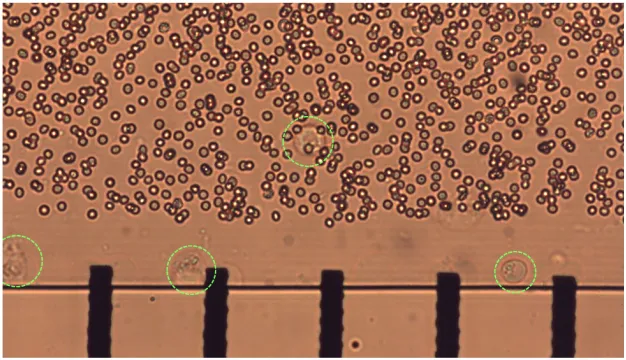
Fig. 2 below shows a view of separated abnormal cells from blood cells. We ob-served that some abnormal cells could not be captured in the separation process. Therefore, in the next step, we intend to conduct performance analysis on the design, which will help provide statistical information about the ability of the microdevice to capture abnormal cells. This can help in improving the performance of the microde-vice by changing certain design parameters such as electric field strength, frequency or electrode position and dimensions.
4
Formal Probabilistic Analysis of Separation Microdevice
Formal methods have proved to provide a complete coverage, and are becoming fundamental for the certification of different types of systems. Model checking [4] is a method that can be used for the modeling and design of state based systems. The system is first modeled, and then, this model verified exhaustively and automatically against certain specifications.
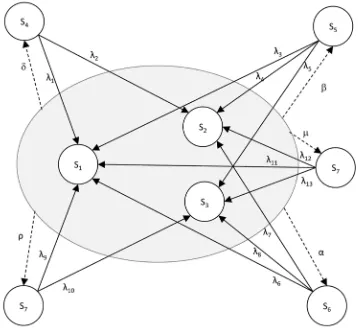
Fig. 3. The behavior of the separation device modeled with MDP.
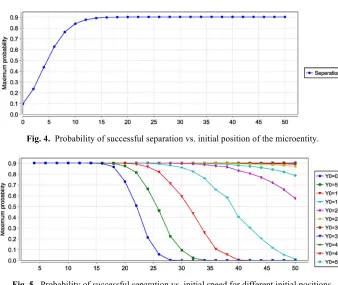
PRISM model checker is used in this work to develop and verify a model for the microdevice. It supports probabilistic verification and has been used in several indus-trial contexts. Therefore, we will use it in order to model and verify the separation microdevice. First, a decision process is used to model the behavior of the microfluid-ic devmicrofluid-ice, as illustrated in Fig. 3. Next, probabilistmicrofluid-ic analysis is conducted on the model for the state transaction probabilities as specified in Table 1. Fig. 4 shows the probability of successful separation vs. initial microentity position. In addition, Fig. 5 shows the probability of successful separation vs. initial microentity speed for differ-ent values of initial position. Results show that the system is affected by these param-eters.
Table 1. State Transitional Probabilities for the MDP of the separation microdevice State Transitions Probability State Transitions Probability
!0 1 !7 0.08
!1 0.02 !8 1 - !6 - !7
!2 1 - !1 !9 0.05
!3 0.15 !10 1-!9
!4 0.05 !11 0.60
!5 1 - !3 - !4 !12 0.20
Fig. 4. Probability of successful separation vs. initial position of the microentity.
Fig. 5. Probability of successful separation vs. initial speed for different initial positions.
5
Conclusion and Discussion
the first novel work that combines formal probabilistic analysis and microdevices in the literature.
6
Acknowledgment
This work is financially supported by seed-grant funding from UAE University, Al Ain, Abu Dhabi (grant # 31N264) and the seed funding program from Al Jalila Foun-dation, Dubai, UAE, (grant # AJF201618).
7
References
[1]B. Mathew, A. Alazzam, M. Abutayeh, A. Gawanmeh, and S. Khashan, "Modeling the tra-jectory of microparticles subjected to dielectrophoresis in a microfluidic device for field flow fractionation," Chemical Engineering Science, vol. 138, pp. 266-280, 2015.
https://doi.org/10.1016/j.ces.2015.07.014
[2]B. Mathew, A. Alazzam, S. Khashan, and M. Abutayeh, "Lab-on-chip for liquid biopsy (LoC-LB) based on dielectrophoresis," Talanta, vol. 164, pp. 608-611, 2017.
https://doi.org/10.1016/j.talanta.2016.11.008
[3]P. Boca, J. P. Bowen, and J. I. Siddiqi, Formal methods: state of the art and new directions
vol. 1: Springer, 2010. https://doi.org/10.1007/978-1-84882-736-3
[4]C. Baier, J.-P. Katoen, and K. G. Larsen, Principles of model checking: MIT press, 2008. [5]M. Kwiatkowska, G. Norman, and D. Parker, "PRISM: probabilistic model checking for
performance and reliability analysis," ACM SIGMETRICS Performance Evaluation Re-view, vol. 36, pp. 40-45, 2009. https://doi.org/10.1145/1530873.1530882
[6]Y. Huang, X.-B. Wang, F. F. Becker, and P. Gascoyne, "Introducing dielectrophoresis as a new force field for field-flow fractionation," Biophysical journal, vol. 73, pp. 1118-1129, 1997. https://doi.org/10.1016/S0006-3495(97)78144-X
[7]J. G. Kralj, M. T. Lis, M. A. Schmidt, and K. F. Jensen, "Continuous dielectrophoretic size-based particle sorting," Analytical chemistry, vol. 78, pp. 5019-5025, 2006.
https://doi.org/10.1021/ac0601314
[8]A. Neculae, C. G. Biris, M. Bunoiu, and M. Lungu, "Numerical analysis of nanoparticle behavior in a microfluidic channel under dielectrophoresis," Journal of Nanoparticle Re-search, vol. 14, p. 1154, 2012. https://doi.org/10.1007/s11051-012-1154-4
[9]Y. C. Lam, S. H. Ling, W. Y. Chan, and K. S. Chian, "Dielectrophoretic cell motion model over periodic microelectrodes with unit-cell approach," Microfluidics and Nanofluidics,
vol. 18, pp. 873-885, 2015. https://doi.org/10.1007/s10404-014-1478-8
[10]M. Kwiatkowska, G. Norman, and D. Parker, "PRISM 4.0: Verification of probabilistic re-al-time systems," in International Conference on Computer Aided Verification, 2011, pp. 585-591. https://doi.org/10.1007/978-3-642-22110-1_47
[11]A. Gawanmeh, A. Alazzam, and B. Mathew, "Formal Verification of a Microfluidic De-vice for Blood Cell Separation," Scalable Computing: Practice and Experience, vol. 17, pp. 227-236, 2016.
[12]B. Mathew, A. Alazzam, S. Khashan, and B. El-Khasawneh, "Path of microparticles in a microfluidic device employing dielectrophoresis for hyperlayer field-flow fractionation,"
[13]B. Mathew, A. Alazzam, G. Destgeer, and H. J. Sung, "Dielectrophoresis based cell switching in continuous flow microfluidic devices," Journal of Electrostatics, vol. 84, pp. 63-72, 2016. https://doi.org/10.1016/j.elstat.2016.09.003
[14]A. Gawanmeh, H. Al-Hamadi, M. Al-Qutayri, S.-K. Chin, and K. Saleem, "Reliability analysis of healthcare information systems: State of the art and future directions," in E-health Networking, Application & Services (HealthCom), 2015 17th International Confer-ence on, 2015, pp. 68-74.
[15]K. Khoshmanesh, S. Nahavandi, S. Baratchi, A. Mitchell, and K. Kalantar-zadeh, "Dielec-trophoretic platforms for bio-microfluidic systems," Biosensors and Bioelectronics, vol. 26, pp. 1800-1814, 2011. https://doi.org/10.1016/j.bios.2010.09.022
[16]C. Zhang, K. Khoshmanesh, A. Mitchell, and K. Kalantar-Zadeh, "Dielectrophoresis for manipulation of micro/nano particles in microfluidic systems," Analytical and bioanalyti-cal chemistry, vol. 396, pp. 401-420, 2010. https://doi.org/10.1007/s00216-009-2922-6
[17]E. Loth, "Numerical approaches for motion of dispersed particles, droplets and bubbles,"
Progress in Energy and Combustion Science, vol. 26, pp. 161-223, 2000.
https://doi.org/10.1016/S0360-1285(99)00013-1
8
Authors
Amjad Gawanmeh is member of IEEE. He is an assistant professor at Khalifa University, Department of Electrical and Computer Engineering, Abu Dhabi, UAE.
Anas Alazzam is an assistant professor at Khalifa University, Department of Elec-trical and Computer Engineering, Abu Dhabi, UAE.
Bobby Mathew is an assistant professor at UAE University, Department of Elec-trical and Computer Engineering, P O Box 15551, Al-Ain, UAE.