.
Research Article
© 2019 Cordelia Onyinyech Omodero. This is an open access article licensed under the Creative Commons Attribution-NonCommercial-NoDerivs License (http://creativecommons.org/licenses/by-nc-nd/3.0/).
Government General Spending and Human
Development: A Case Study of Nigeria
Cordelia Onyinyechi Omodero, PhD, ACA
Department of Accounting, College of Management Sciences, Michael Okpara University of Agriculture, Umudike, Umuahia, Abia State, NigeriaDoi: 10.2478/ajis-2019-0005
Abstract
The study assesses the impact of government general spending on human development in Nigeria from 2003 to 2017. The purpose is to determine the response of human development index (HDI) to recurrent and capital government expenditure. In order to achieve this objective, the multiple linear regression model linking the study variables was applied while Ordinary Lease Squares method was used to analyze the model. The results indicate that government’s capital expenditure and inflation have insignificant negative influence on HDI, corruption does not have any impact on HDI but government recurrent expenditure has strong and significant positive impact on HDI. The study concludes that resources on recurrent expenses should be reduced while more money should be invested in capital projects for human capital development in Nigeria.
Keywords: human development index, government, capital and recurrent expenditure, corruption, inflation
1. Introduction
Human development is a strategy to improve human skills, create avenues for people to make better choices that boost a healthier, longer and fulfilled lives. The predominant aim of every government’s spending is to guarantee a long and healthy life for the citizens, ensure they are knowledgeable and enjoy a decent standard of living. Government expenditure on human development avails a country the opportunity of having a suitable, competent, healthy and educated labor force to contribute meaningfully to national development. This is because the quality of human capital in a nation determines its economic development and sustainability.
The measurement of a nation’s economic development based on gross domestic product (GDP) or gross national income (GNI) per capita is only restricted to income alone but human development comprises components that best paint a picture of how developed a nation is especially as parameters such health, education, physical environment and freedom are the benchmark. Although the United Nations notes that Human Development Index (HDI) used as measurement for a nation’s economic development does not take into cognizance some important human problems such as poverty, empowerment, inequalities, security and safety. However, the yardstick and elements of HDI remain the vital aspects of a country’s economy that can lead to growth if duly incorporated into national budgets and implemented accordingly.
Haq, a Pakistan economist with the support from Gustav Ranis of Yale University and Lord Meghnad Desai of the London School of Economics, later the United Nations Development Program accepted it in their Human Development Report Office as the basis for measuring nations’ economic performance (UNDP, 2018).
HDI stresses that a country has to implement policies that encourage usage of a nation’s economic wealth for the betterment of its citizens. By implication, a nation’s resources should be channeled to human development projects for proper national development. Based on this premise, this study is motivated to investigate the effect of government general spending on human development in Nigeria. Several domestic and foreign studies on government expenditure have been on economic growth (Chandran Govindaraju, Rao & Anwar, 2011; Al-Bataineh, 2012; Gangal & Gupta, 2013; Hasnul, 2015; Al-Shatti, 2014;Lahirushan & Gunsekara, 2015; Torki, 2016; Jelilov & Musa, 2016; Muguro, 2017) among others. Kairo, Mang, Okeke and Aondo (2017) did a similar study in Nigeria, but failed to classify government expenditure into development and non-development in order to determine their specific effect on HDI.
HDI measurement for Nigeria started in 2003 and was estimated at 0.443 and rose to 0.532 in 2017. Nigeria’s ranking in 2003 being the base year was 220 and in 2017, Nigeria ranked 157 among 189 countries included in the UNDP report. Though, the study focuses on government general expenditure, but the rise of corruption in the public sector in Nigeria and the inherent effect of inflation on all facets of the economy are concerns the study aims to examine the extent to which they affect human development.
1.1 Objective of the study
The major objective of this study is to investigate the impact of government general spending on human development in Nigeria.
The study also seeks to achieve the following specific objectives:
1. To ascertain the impact of government capital expenditure on human development index (HDI) used as proxy for human development in Nigeria.
2. To determine the effect of government recurrent expenditure on HDI in Nigeria. 3. To examine the influence of corruption on HDI in Nigeria.
4. To evaluate the effect of inflation on HDI in Nigeria.
1.2 Hypotheses
To pursue the above study objectives, the following null hypotheses have been formulated:
- Ho1: Government capital expenditure does not have significant impact on HDI in Nigeria.
- Ho2: There is no significant relationship between government recurrent expenditure and
HDI in Nigeria.
- Ho3: Corruption does not have any significant influence on HDI in Nigeria.
- Ho4: Inflation does not significantly affect HDI in Nigeria.
2. Literature Review
2.1 Conceptual review
Figure 1*: Conceptual Framework showing the impact of Government General Spending on Human Development.
2.1.1 Conceptual framework
Figure 1* above depicts the study dependent variable represented by Human Development Index and the independent variables which include: capital expenditure, recurrent expenditure, corruption perception index and inflation rate in Nigeria.
2.1.2 Human capital development
Human capital refers to the capabilities and skills of human resources of a country, which comprise level of education, expertise and abilities of the labor force, while human capital development is the process of obtaining and increasing the number of persons who possess the competence, knowledge and know-how that are required for economic growth and development of a nation (Okojie, 2005). Human capital is an inherent and attained aptitudes obtained by a workforce through education as the major source (Ilegbunosa, 2013). In other words, human proficiencies to work depends on the level of education acquired over time. Harbison (1973) submitted that human capital development is the deliberate and uninterrupted process of gaining necessary knowledge, skills and experiences that are utilized to produce economic value for driving sustainable national development. However, human beings are the only factor of production among others, which can learn, create, adjust to changes and embrace new technologies (Lyakurwa, 2007; Ejere, 2011). Following the definitions of other scholars, human capital can be defined as the genetic product of learning which translates into special talents, capacities and technical know-how found in a nation’s labor force for national economic expansion. Human capital development is the method of adding values to human beings in a nation in order to have a qualified, knowledgeable and healthy workforce that can give solution to national economic challenges on a constant basis.
2.1.3 Human development index (HDI)
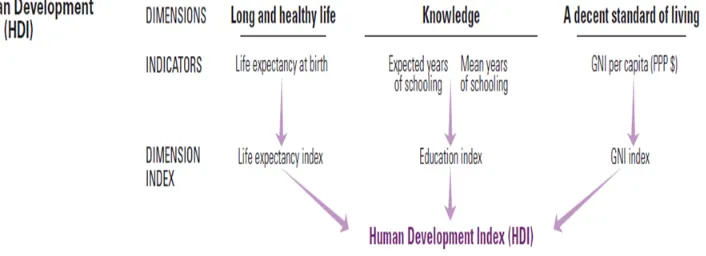
The human development index is a statistical tool employed to generally assess a nation’s social and economic attainment in all ramifications. The social and economic dimensions of a country are centered on the health of people, their educational accomplishments and standard of living (The Economic Times, 2018). HDI is one of the best tools to keep track of the level of development of a country, as it combines all major social and economic indicators that are accountable for economic development of a nation (TET, 2018).
Figure 2**: Human development index
Source: United Nations Development Programme (UNDP).
2.1.4 Government expenditure
Government expenditure refers to all expenses made by a nation’s government on collective needs of a country (Muguro, 2017). These expenses are classified under recurrent and development (capital) expenditures. Recurrent expenditures are government regular spending on a routine basis for workers’ wages and salaries, goods and services and other administrative expenses. They are different from capital expenditures which are usually in form of investment into developmental projects such as construction of road and bridges, railways, building of schools and hospitals among others. Wanjiru (2013) puts it that government spending on education and health sectors leads to development and buildup of human capital that will be more resourceful and adequately creative to enhance economic growth.
2.2 Theoretical framework
The theory underpinning this study is the Endogenous Growth Theory pioneered by Romer (1994). The theory encourages government expenditure on human capital development and technological advancement as the major drivers of economic growth. Endogenous growth theory holds that economic growth depends on investment in human capital, innovation and knowledge management (Romer, 1994). The theory also focuses on positive externalities and spillover effects of a knowledge based economy which leads to economic development. Policy effects emanating from this model are connected to the potential for externalities spillovers coming from the wealth of knowledge and perhaps labor force skills. Economies, which have abundance in those factors, can grow faster than the ones limited by their unavailability. By examining policy, the most essential ways to foster growth is to enhance the educational levels of the labor force. Thus, based on this model, education, as a positive spillover, is crucial to growth. Since many developing countries have constraints regarding education and related issues, it is key for governments in those countries trying to prioritize improvements on education and provide subsidies for research and development (Augusto, Raimundo, & Fontenele, 2012).
Government spending on education (research and development), healthcare, job provisions and capacity building helps to access a common pool of knowledge emanating from global technological spillovers and these are very essential for economic development of a nation.
2.2.1 Selected foreign and domestic studies on government spending and economic growth.
Chandran Govindaraju et al. (2011) carried a study on the effect of government expenditure on the effect of government expenditure on economic growth in Malaysia. The research covered a period from 1970-2006 but considered two scenarios where the impact of aggregate government expenditure on RGDP was examined and on the other hand, where the public spending on education alone was used to assess the impact of government expenditure on RGDP. The study found support for Wagner’s law by establishing that aggregate government expenditure had significant positive relationship with RGDP while the use of single predictor variable (education) had a result that agreed with Keynesian hypothesis. Hasnul (2015) used Ordinary Least Squares (OLS) method to elongate the study on the effect of government expenditure on economic growth in Malaysia from 1970-2014. The study found negative relationship between government expenditure and economic growth in Malaysia. The findings further revealed that education, defense, healthcare and other operating expenditures had insignificant impact on economic growth.
operating public spending had positive impacts on economic growth.
Gangal and Gupta (2013) examined the influence of government spending on economic growth of India using time series data from 1998 to 2012. The study employed co-integration and granger causality tests method for evaluation. The result indicated a stable long run relationship between public expenditure and economic growth while establishing that public spending influenced economic growth positively and significantly.
Lahirushan and Gunsekara (2015) employed panel data of Asian countries spanning from 1970-2013 to investigate the impact of government expenditure on economic growth. The countries include: Bhutan, China, India, Japan, Malaysia, Singapore, Sri Lanka, South Korea and Thailand. The random effects panel OLS model was applied and the result indicated a long run relationship and a significant positive impact of government expenditure on economic growth in Asian region.
Kwendo and Muturi (2015) used panel data from 1995 to 2010 and Hausman test to examine the effect of public spending on economic growth in Burundi, Kenya, Rwanda, Tanzania and Uganda. The study target was to establish the effect of government spending components of agriculture, consumption, defense and health on economic growth. The findings revealed that agriculture and defense exerted a negative influence on growth while consumption and health had positive effect on economic growth.
Jelilov and Musa (2016) employed OLS technique to examine the impact of government expenditure on economic growth in Nigeria from 1981-2012. The study established evidence that government expenditure influences economic growth significantly and positively. Omodero (2018) elongated the study in Nigeria from 1999 to 2016 but concentrated on the effect of selected non-development government expenses (which include: education, healthcare, defense & security, agriculture and public debt servicing) on GDP. The findings revealed among others that government spending on public debt servicing, defense and security had significant positive influence on GDP while the other predictor variables had negative impacts on GDP. Based on the outcome, the study suggested a redirection of government resources to agriculture, education and healthcare which can really help to boost economic growth of the country if applied.
Farooq (2016) studied public expenditures and economic growth in Pakistan using three-staged least squares method. The study covered a period from 1971 to 2014 and the findings revealed that both developed and non-developed government expenditures had a strong positive impact on economic activity measured by GDP.
Kyissima, Pacific and Ramadha (2017) assessed the long and short run impact of government expenditure in Tanzania using time series data covering a period from 1996-2014. The findings revealed that in the long-run, government expenditure had significant positive correlation with economic growth, but in the short run, there was no significant relationship established. The study suggested improvement in distribution of resources and private sector involvement to boost economic growth in Tanzania.
Muguro (2017) investigated the impact of public expenditure on economic growth in Kenya for a period covering 1963 to 2015. The two types of government spending which are capital and recurrent government expenditure were used as the predictor variables while economic growth was measured by real GDP. The regression results among others revealed that all components of government spending had no significant impact on economic growth in Kenya.
2.2.2 Research gap
3. Methodology
The research is an ex-post facto and quantitative research involving secondary form of data. The dependent variable is the Human Development Index (HDI) used as proxy for human development in Nigeria. The data on HDI were collected from the United Nations Development Programme (UNDP) reports. The independent variables include: government recurrent (REX) and capital (CEX) expenditures, corruption perception index (CPI) and inflation (INF). The data on recurrent and capital expenditures were extracted from Central Bank of Nigeria (CBN), Statistical Bulletin, 2017 edition, data on inflation were obtained from World Bank website while Corruption Perception Index data were sourced from Transparency International annual reports. In order to achieve uniformity of the data sets, all the data were logged except the HDI which were already expressed in a logged form. The data were analyzed with Statistical Package for Social Sciences (SPSS) version 20. The decision rule is that at p-value above 5%, Ho is accepted and rejected if otherwise.
The multiple regression model adopted is:
HDI = ∝ + β1(LOGCEX) + β2(LOGREX) + β3(LOGCPI) + β4(LOGINF) + ε
Where,
HDI = Human Development Index
CEX = Capital Expenditure
REX = Recurrent Expenditure
CPI = Corruption Perception Index
INF = Inflation rate
ἀ = Constant
β1-β4 = Coefficients of the regression
ε = error term
The A Priori expectation of the research is that CEX and REX should have significant positive impact on HDI while CPI and INF which are assumed to be under control by the relevant government authorities should not exert any significant influence on HDI, all things being equal.
4. Data Analysis and Interpretations
4.1 Model Summary of Results
Table 1*: Model summary of results
Model R R Square Adjusted R Square Std. Error of the Estimate Durbin-Watson
1 .959 .920 .888 .009329869 1.202
a. Predictors: (Constant), LOGCPI, LOGINF, LOGREX, LOGCEX b. Dependent Variable: HDI
Source: Author’s computation, 2019.
Table 2**: Analysis of variance (Anova)
Model Sum of Squares Df Mean Square F Sig.
1
Regression .010 4 .003 28.859 .000
Residual .001 10 .000
Total .011 14
a. Dependent Variable: HDI
b. Predictors: (Constant), LOGCPI, LOGINF, LOGREX, LOGCEX
Source: Author’s Computation, 2019.
The value of F-statistics on Table 2** above is 28.859 with a p-value of 0.000 < 0.05 level of significance. This shows that the model is a good fit and statistically significant. The result is a further proof that the independent variables collectively impact on HDI significantly. However, the appropriateness of the model is questioned when F-statistics p-value is greater than 5%, but in this result on Table 2**, the p-value is less than 5% level of significant.
4.2 Test of hypotheses
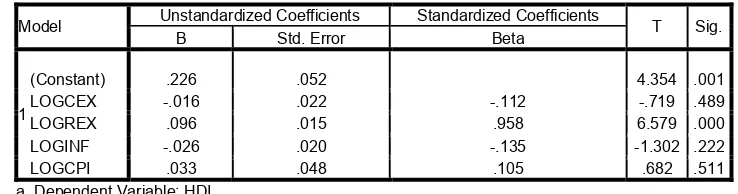
Table 3***: Coefficients
Model Unstandardized Coefficients Standardized Coefficients T Sig.
B Std. Error Beta
1
(Constant) .226 .052 4.354 .001
LOGCEX -.016 .022 -.112 -.719 .489
LOGREX .096 .015 .958 6.579 .000
LOGINF -.026 .020 -.135 -1.302 .222
LOGCPI .033 .048 .105 .682 .511
a. Dependent Variable: HDI
Source: Author’s Computation, 2019.
The regression result on Table 3*** above is a follows:
HDI = 0.226 – 0.016CEX + 0.096REX – 0.026INF + 0.033CPI.
The null hypotheses (Ho1-Ho4) will be tested based on the t-statistics results on table 3***
above. Where the p-values of the individual predictor variable exceeds 5%, the Ho will be accepted and will be rejected where the result proves otherwise.
4.2.1 Hypothesis I
Ho1: Government capital expenditure does not have significant impact on HDI in Nigeria.
The Ho1 states that CEX does not have significant impact on HDI. The result on table 3***
above reveals that t-statistic for CEX is -0.719 with the p-value of 0.489 > 0.05. This result implies
that CEX has insignificant negative impact on HDI, thus the Ho1 is accepted and the alternative
country. Therefore, this result is consistent with the findings of (Al-Shatti, 2014; Hasnul, 2015; Muguro, 2017) but conflicts with the studies of (Al-Bataineh, 2012; Gangal & Gupta, 2013; Lahirushan & Gunsekara, 2015; Farooq, 2016; Jelilov & Musa, 2016; Torki, 2016).
4.2.2 Hypothesis II
Ho2: There is no significant relationship between government recurrent expenditure and HDI in
Nigeria.
The result on Table 3*** above indicates that t-statistics on REX is 6.579 with the p-value of 0.000 < 0.05. The result shows that REX has a robust and significant positive influence on HDI.
Thus Ho2 is declined and the alternative suggestion accepted. This result implies that the
government spends so much money on HDI related administrative costs such as salaries and wages of academic workers and health workers while ignoring major investments on human development that would yield returns that have better implication on the country’s economic growth and expansion. Building of schools, hospitals, skill acquisition centers, information technology training center, research and development centers are some of the capital expenditures that have external spill overs to drive the economy. However, this result meets the a priori economic expectation of the research and agrees with the outcomes of the studies of (Al-Bataineh, 2012; Gangal & Gupta, 2013; Lahirushan & Gunsekara, 2015; Farooq, 2016; Jelilov & Musa, 2016; Torki, 2016), while having discrepancy with the findings of (Al-Shatti, 2014; Hasnul, 2015; Muguro, 2017).
4.2.3 Hypothesis III
Ho3: Corruption does not have any significant influence on HDI in Nigeria.
The study earlier hypothesized that corruption does not have any significant influence on HDI in Nigeria. The result on Table 3*** above shows that corruption has insignificant positive impact on
HDI, therefore the Ho3 is accepted and the alternative suggestion rejected. The a priori expectation
is met because CPI is not expected to affect HDI. By implication, investments on HDI should not be compromised by any government with a development culture in mind.
4.2.4 Hypothesis IV
Ho4: Inflation does not significantly affect HDI in Nigeria.
The result on Table 3*** above provides evidence that inflation has insignificant negative
influence on HDI. Thus, Ho4 is accepted and the alternative hypothesis declined. Again, a priori
expectation is met owing to the fact that relevant authorities in the country do everything possible to put this ugly economic scenario under control for economic activities to thrive. The outcome of inflation if allowed is usually adverse, but in this case, though negative but it not significant, so the influence is not felt on HDI.
5. Conclusion and Recommendations
Based on the findings of this study, the conclusion drawn is that human development issues have not been sufficiently captured in the national budget for capital projects, hence the adverse effect of CEX on HDI of the country. Therefore, the study suggests the following:
• The government should increase its capital expenditure on human capacity building, this is
in line with endogenous growth theory which states that investment in human capital has external spillovers that lead to economic growth. These investments are in form research and development (R&D) which are capital intensive projects, building of skill acquisition centers, more schools to absorb school dropouts. Amnesty programs in the Nigerian Universities to rehabilitate school dropouts in the country should be encouraged and well financed in all the 36 states in the country.
• The resources on recurrent expenditures for HDI should be minimized and more money
• The government should endeavor to maintain anti-graft fight especially in the public sector for effective and efficient use of resources to develop human capital of the nation.
• The relevant authorities such as monetary policy authority should be given maximum
support to keep inflation under control, hence its eruption can render government’s budgets for human capital development in the country ineffective.
This study made use of federal government recurrent and capital expenditures. Therefore, future researchers may wish to investigate the impact of government expenditure on specific HDI components in local government areas in the country.
References
Al-Bataineh, I.M. (2012). Impact of government expenditures on economic growth in Jordan. Interdisciplinary
Journal of Contemporary Research in Business, 4(6), 1320-1338.
Al-Shatti, A.S. (2014). The impact of public expenditures on economic growth in Jordan. International Journal of
Economics and Finance, 6(10), 157-167. Doi:10.5539/ijef.v6n10p157.
Augusto, M.C., Raimundo, S. E., & Fontenele, S. (2012). The new endogenous growth theory. An Investigation
on growth policy for developing countries. www.sober.org.br/palestra/12/070079.pdf. Retrieved: August 8, 2017.
Chandran Govindaraju, V.G.R., Rao, R. & Anwar, S. (2011). Economic growth and government Spending in
Malaysia: A re-examination of Wagner and Keynesian views. Econ Changer Restrict, 44, 203-219. Doi:
10.1007/s10644-010-9099-z.
Ejere, S.I. (2011). Human Capital formation as catalyst for national development: Nigeria in Perspective.
International Business and Management, 2(2), 98-104.
Farooq, N. (2016). Public expenditures and economic growth: A case study of Pakistan. American Journal of
Social and Management Sciences, 7(2), 33-41. Doi:10.5251/ajsms.2016.7.2.33.41.
Gangal, V.L.N. & Gupta, H. (2013). Public expenditure and economic growth: A case study of India. Global
Journal of Management and Business Studies, 3(2), 191-196.
Harbison, F.H. (1973). Human resources as the Wealth of Nations. New York: Oxford University Press.
Jelilov, G. & Musa, M. (2016). The impact of government expenditure on economic growth in Nigeria. Sacha
Journal of Policy and Strategic Studies, 5(1), 15-23.
Kairo, C.I., Mang, N.J., Okeke, A. & Aondo, D.C. (2017). Government expenditure and human Capital
development in Nigeria: an Auto-Regressive Distributed Lagged Model Approach (ARDL). International
Journal of Advanced Studies in Economics and Public Sector Management, 5(1), 143-158.
Kwendo, C.M. & Muturi, W. (2015). The effect of public expenditure on economic growth in the East African
Community. Journal of Business Management and Economics, 3(10.151), 9-13. Doi:
http://dx.doi.org/10.15520/jbme.2015.vol3.iss10.151.pp09-13.
Kyissima, K.H., Pacific, Y.K.T. & Ramadhan, A.A. (2017). Government expenditure and Economic growth in
Tanzania: A time series analysis. International Journal of Development and Economic Sustainability, 5(1),
11-22.
Lahirushan, K.P.K.S. & Gunasekara, W.G.V. (2015). The impact of government expenditure on Economic
growth: A study of Asian Countries. International Journal of Social, Behavioural, Educational, Economic,
Business and Industrial Engineering, 9(9), 3152-3160.
Lyakurwa, W.M. (2007). Human Capital and technology for development. Lesson for Africa, AFDB.
Muguro, J.W. (2017). Effect of public expenditure on economic growth in Kenya: 1963-2015. M.sc Degree
Thesis submitted to the School of Business and Public Management, KCA University.
Okojie, C.E.E. (2005). Human capital formation for productivity growth in Nigeria. Nigerian Economic and
Financial Review: 44-5.
Omodero, C.O. (2018). Public sector recurrent expenditure and national development in Nigeria. A paper
presented at The National Conference organized by Faculty of Management Sciences (FMS), University of Port Harcourt, Nigeria with the theme: Institutional Restructuring and Reforms for National Development on 28-29 August, 2018. Proceedings of the FMS National Conference, pages 71-83.
Romer, P. M. (1994). The origins of Endogenous Growth. The Journal of Economic Perspectives, 8(1), 3-22.
JSTOR
Torki, M.A. (2016). The impact of government expenditures on economic growth in Jordan 1980-2013).
International Business Research, 9(1), 99-105.
UNDP (2018). Human development index trends, 1990-2017. Human Development Report Office (HDRO),
United Nations Development Programme. Retrieved from http://hdr.undp.org/ on January 10, 2019.
Wanjiru, M.R. (2013). Does the composition of public expenditure affect economic growth? Evidence from