COTTON LEAF DISEASE IDENTIFICATION USING
PATTERN RECOGNITION TECHNIQUES
1
Patil Tushar,
1Palambe Shubham,
1Tawale Gauri ,
1Patil Rajashree
2Sanchika Bajpai
1
Student,Dept of Computer, BSIOTR, Maharashtra, India
2Professor, Dept of Computer, BSIOTR, Maharashtra, India
Abstract: The large number of people depends on cotton crop. The recognition of cotton leaf disease are of the Major important as they have a cogent and momentous impact on quality and production of cotton. Cotton disease identification is an art and science.Now a day’s image processing technique is becoming a key technique for diagnosing the various features of the crop. The diseases can affect any part or area of the crop. This paper mainly focuses detection of various cotton crop diseases and to classify them.
There are so many classification techniques such as k-Nearest Neighor classifier , k-means Classifier, Probabilistic Neural Network, Genetic Algorithm, Support Vector Machine, and Principal Component Analysis, Artificial neural network, Fuzzy logic. Selecting a classification method is always a difficult task because the quality of result can vary for different input data.
A smart phone empowers farmer to keep updated with the on going conditions of his agricultural land using IOT at any time and any part of the world. IOT technology can reduce the cost and enhance the productivity of traditional farming.
Keywords: - Image segmentation, Cotton leaf, diseases, Feature extraction
1.
INTRODUCTION
India accounts for approximately 25 percent of world’s cotton area and 16 percent of total cotton production. Maharashtra is the important cotton growing state in India with 31.33 lacks hectors area and production of 62.00 lack bales (2008-09), the 2nd largest producer of cotton in the world.
These are the diseases which affect the cotton crop in large amount. To reduce the loss of cotton crop due to these diseases, it is important to detect the disease in early stage. Thus, the major objectives of the proposed disease detecting system are to study different types of diseases and its detection techniques for developing simple, robust and less computational time algorithm. The system should be automatic with more accurate disease detection.
Journal homepage: www.mjret.in
With cost-effectiveness improvements in computational technology and large-scale networks, sharing data with others becomes correspondingly more convenient. Additionally, digital resources are more easily obtained via cloud computing and storage. Since cloud data sharing requires off-premises infrastructure that some organizations jointly held, remote storage are somehow threatening privacy of data owners. Therefore, enforcing the protection of personal.
Nowadays image processing techniques and neural networks are used for implementation of automatic system that can detect the different plant diseases. Such system is useful in monitoring large. The diseases can be easily identified with the help of the infected area of the crop. Generally through the naked eyes the observations taken by the Experts ancient time for the detection and identification of crop diseases. But for this the continuous monitoring is required by the Experts and it is too expensive in large fields. So in many under developed countries in agricultural area, farmer needs to take lots of efforts crop fields as well as for early detection of diseases.
1.1 SOFTWARE REQUIREMENT
I. Operating system : Windows 10 (32-Bit)
II. GUI creation : HTML, JavaScript
III. Database : MySQL
1.2 HARDWARE REQUIREMENT
i. Processor : PentiumIV 2.6 ghz
ii. RAM : 512 mbdd ram
iii. Monitor : 15” color
iv. Hard Disk : 20 GB
v. Key Board : Standard Windows Keyboard
1.3 PROBLEM STATEMENT
2. LITERATURE SURVEY
BalajiBanu [1] designed a wireless sensor networks to observe the conditions of the farming and increasing the crop yield and quality. Sensors are used to monitor different conditions of environment like water level, humidity, temperature etc., the processors ATMEGA8535 and ICS8817 BS, analog to digital conversion and wireless sensor nodes with wireless transceiver module based on Zig bee protocol are used in the designing the system. Database and web application is used to retrieve and store data. In this experiment the sensor node failure and energy efficiency are managed.
Liu Dan [2], Joseph Haule, Kisangiri Michael [3] and Wang Weihong, Cao Shuntian [38] carried out experiments on intelligent agriculture greenhouse monitoring system based on ZigBee technology. The system performs data acquisition, processing, transmission and reception functions. The aim of their experiments is to realize greenhouse environment system, where the of system efficiency to manage the environment area and reduce the money and farming cost and also save energy. IOT technology here is based on the B-S structure and cc2530 used like processing chip to work for wireless sensor node and coordinator. The gateway has Linux operating system and cortex A8 processor act as core. Overall the design realizes remote intelligent monitoring and control of greenhouse and also replaces the traditional wired technology to wireless, also reduces manpower cost.
Joseph haule [3], DragoşMihaiOfrim, BogdanAlexandruOfrim and DragoşIoanSăcăleanu [18] have proposed an experiment that explains the use of wsn used in automating irrigation. Irrigation control and rescheduling based on wsn are powerful solutions for optimum water management through automatic communication to know the soil moisture conditions of irrigation design. The process used here is todetermine the proper frequency and time of watering are important to ensure the efficient use of water, high quality of crop detection delay throughput and load.
scheduling based on wireless sensor networks are used. WSN uses low power and a low data rate and hence energy efficient technology. All the devices and machines controlled with the help of inputs received via sensors which are mixed with soil. Farmers can analyze whether the system performs in normally or some actions are need to be performed. Vijay Kumar [4], Lin Zhang, Min yuan, Deyi Tai, Xia Oweixu, Xiang Zhan, Yuanyuan Zhang [13] studied the work of rural farming community that replaces some of the traditional techniques. The sensor nodes have several external sensors namely leaf wetness, soil moisture sensor, soil pH, atmospheric pressure sensors attached to it. Based on the soil moisture sensor the mote triggers the water sprinkling during the period of water scarcity and switches off after adequate water is sprinkled. This results in water conservation and soil pH is sent to the base station and in turn base station intimates the farmer about soil pH via SMS using GSM model. This information helps the farmers to reduce quantity of fertilizers used. A development of rice crop monitoring using WSN is proposed to provide a helping hand to farmers in real time monitoring and increasing the rice production. The automated control of water sprinkling and ultimate supply of information is implemented using wireless sensor networkes a time as the Cotton farmers manually check the disease since the Cotton field is
3. SYSTEM ARCHITECTURE
Fig.2.1 System Architecture
Fig.2.1 shows the proposed architecture of experiment which is performed on netbeans. In this fig there are steps that we are going to use for cotton leaves disease detection. Firstly, image acquisition than image processing, image segmentation, feature extraction, and then finally detection and classification of plant disease.
• Image Acquisition: The images of the plant leaf are gathering from CICR Nagpur.
This image is in RGB form. Color transformation structure for the RGB leaf image is created, and then, a device-in dependent color space transformation for the color transformation structure is applied.
• Image Pre-processing: To remove noise in image or other object removal, different
pre-processing techniques is consider. Image clipping i.e. cropping of leaf image to get the interested image region. Image smoothing is done using the smoothing filter . Image enhancement is carried out for increasing the contrast.
• Image Segmentation: Segmentation means partitioning of image into various parts
of same features or having some similarity. The segmentation can be done using various methods like Otsu’ method, k-means clustering, converting RGB image into HIS model.
• Feature Extraction: Feature extraction plays an important role for identification of an
• Classification: Using ANN: after feature extraction is done, the learning database images are classified by using neuralnetwork. The feature vectors are considered as neural network in ANN . The output of the neural is function of weighted sum of the inputs. The back propagation algorithm modified SOM; Multiclass Support vector machines can used.
4. ALGORITHM
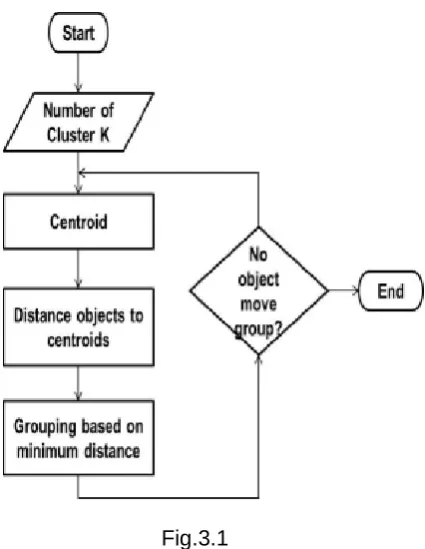
K-means Clustering Steps K-means is an unsupervised clustering method which classifies the input image into various clusters referring to their distance from each other [8]. Following fig. 2 shows the flow chart of k-means algorithm which is relatively efficient and applicable only when mean is defined.
Fig.3.1
Flow chart for clustering of cotton leaves
The items are divided around cancroids µi ∀ i . . . k which are calculated by minimizing the
following objective [8]: Equation (1)
Here k is number of clusters i.e and is centroid of all the points
Equation (2)
Compute new centroid for each cluster [8].
Equation (3)
Where k is the number of clusters, i repeat over all the intensity values, j repeats over all
the centroids and are the centroid intensities.
5. WATERFALL MODEL
Fig.4.1 Waterfall Model
6. CONCLUSIONS
Internet of Things has enables the agriculture crop monitoring easy and efficient to enhance the productivity of the crop and hence profits for the farmer. Wireless sensor network and sensors of different types are used to collect the information of crop conditions and environmental changes and these information is transmitted through network to the farmer/devices that initiates corrective actions. Farmers are connected and aware of the conditions of the agricultural field at anytime and anywhere in the world. Some disadvantages in communication must be overcome by advancing the technology to consume less energy and also by making user interface ease of use.
REFERENCES
[1] BalajiBhanu, Raghava Rao, J.V.N. Ramesh and Mohammed Ali hussain, “Agriculture Field Monitoring and Analysis using Wireless Sensor Networks for improving Crop Production”, 2014 Eleventh International Conference on Wireless and Optical Communications Networks (WOCN)
[2] LIU Dan, Cao Xin, Huang Chongwei, JI Liang Liang, “Intelligent agent greenhouse environment monitoring system based on IOT technology”, 2015 International Conference on Intelligent Transportation, Big Data & Smart City
[3] JosephHaule, Kisangiri Michael, “Deployment of wireless sensor networks (WSN) in automated irrigation management and scheduling systems: a review”, Science, Computing and Telecommunications (PACT), 2014, Pan African Conference
[4] S. Vijayakumar, J. Nelson Rosario, “Preliminary Design for Crop Monitoring Involving Water and Fertilizer Conservation Using Wireless Sensor Networks”, Communication Software and Networks (ICCSN), 2011 IEEE 3rd International Conference.
[5] G. Nisha, J.Megala, “Wireless Sensor Network Based Automated Irrigation and Crop Field Monitoring System”, 2014 Sixth International Conference on Advanced Computing (IcoAC).
[6] MengJi-hua, Wu Bing-fang, Li Qiang-zi, “A Global Crop Growth Monitoring System Based on Remote Sensing”, 2006 IEEE International Symposium on Geoscience and Remote Sensing.
[7] Alan Mainwaring, Joseph Polastre, Robert Szewczyk, David Culler, John Anderson, “Wireless Sensor Networks for Habitat Monitoring”, International Conference
.
[8] Lei Xiao, LejiangGuo, “The Realization of Precision Agriculture Monitoring System Based on Wireless Sensor Network”, 2010 International Conference on Computer and Communication Technologies in Agriculture Engineering.
[9] Ling-ling LI, Shi-feng YANG, Li-yan WANG, Xiang-ming GAO, “The Greenhouse Environment Monitoring System Based on Wireless Sensor Network Technology”, Proceedings of the 2011 IEEE International Conference on Cyber Technology in Automation, Control, and Intelligent Systems, March 20-23, 2011, Kunming, China.