SECURE STORAGE OF VIDEO BY ENCRYPTION
USING 4 OUT OF 8 CODES AND SCANNING
TECHNIQUES
Pratik Vishnu Sawant
First Year M.Tech, Software Engineering
Veermata Jijabai Technological Institute,
Mumbai, India
Abstract: Hiding data is essential for everyone whether it is an organization or an individual
by considering the data theft and privacy violation incidences. Data can be in any form i.e.
textual data or visual data. Visual data mainly consists of images and video files. Video files
may contain some important or confidential records which can create huge amount of loss if
leaked or made available publically. Hence, securing video files for storage is very much
important. The paper presents technique for efficient encryption and decryption of video files.
For encryption, paper uses combination of previously defined Four out of Eight codes and
Scanning Techniques presented in the paper. Paper also presents decryption methodology
which uses authentication and authorization to ensure that the videos which are encrypted
by the system are been accessed by the legitimate user after decryption.
Keywords: Encryption, Decryption, authentication, authorization, data theft, data hiding, security,
video files, four out of eight, scanning techniques
1. INTRODUCTION
In modern days, we are using lots of media files especially video files. There is possibility
that video files may contain some sensitive data which is not intended except trusted user.
These video files may be the recordings of some organizations internal structure, some
patented process or recording of some secret conferences or may be proof of some criminal
case.
Journal homepage: www.mjret.in
If such sensitive information is leaked, it may cause harm to related organization. Hence, this
project focuses on the file system, especially video files to hide them from the unauthorized
users by encryptingthem to secured level.
The project follows traditional approach of key, but the actual encryption is done by internally
generated key which is derived from the actual key and unknown to the external world.
The project is focusing on encryption processing, but it will also decrypt the stored video file
by authenticating the legitimate user on the basis of key produced. Hence, Decryption is also
the part of project along with Encryption as primary focus. And authentication module have
also been introduced without which decryption is not possible. Hence, the basic idea will
revolve around four out of eight [1] method and scanning techniques [2] for encryption and decryption of video.
2. LITERATURE REVIEW
Video Encryption[9] is basically divided into four categories[3]: 2.1 Completely Layered Encryption
Video encrypted in this type of encryption uses traditional algorithms like RSA, DES and
AES. This type of encryption leads to heavy computations and hence has heavy resource
utilization.
2.2 Encryption Using Permutation
This encryption style contains scrambling of video content using permutation algorithm.
2.3 Selective Encryption
Only particular video contents will be encrypted here. Hence, it is low on computational time
and resource utilization. Proposed system is example of selective encryption technique.
1.4 Perceptual Encryption
It is weak style of encrypting video since videos are perceptible. We have to continuously
monitor audio and video quality.
Further, we can have different cryptography models based on what type of keys is used for
encryption and decryption.
1) Symmetric key encryption models[4][5] 2) Asymmetric key encryption models
3) Hash functions (Mathematical) models
The proposed encryption technique uses Symmetric Key encryption model. Symmetric key,
symmetric key encryption algorithms can be DES[4][5][7] and AES[4][5][6]. This model uses either stream cipher or block cipher for the encryption. Stream cipher ensures encryption of
element one by one whereas block cipher refers to encryption of block of data at a time.
3. FOUR OUT OF EIGHT CODES
Serial Number Binary Hexadecimal Decimal Alpha Numeric
1 00110011 33 51 A, a
2 00110101 35 53 B, b
3 00110110 36 54 C, c
4 00111001 39 57 D, d
5 00111010 3A 58 E, e
6 00111100 3C 60 F, f
7 01010011 53 83 G, g
8 01010101 55 85 H, h
9 01010110 56 86 I, i
10 01011001 59 89 J, j
11 01011010 5A 90 K, k
12 01011100 5C 92 L, l
13 01100011 63 999 M, m
14 01100101 65 101 N, n
15 01100110 66 102 O, o
16 01101001 69 105 P, p
17 01101010 6A 106 Q, q
18 01101100 6C 108 R, r
19 10010011 93 147 S, s
20 10010101 95 149 T, t
21 10010110 96 150 U, u
22 10011001 99 153 V, v
23 10011010 9A 154 W, w
24 10011100 9C 156 X, x
25 10100011 A3 163 Y, y
26 10100101 A5 165 Z, z
27 10100110 A6 166 0
28 10101001 A9 169 1
29 10101010 AA 170 2
30 10101100 AC 172 3
31 11000011 C3 195 4
32 11000101 C5 197 5
33 11000110 C6 198 6
34 11001001 C9 201 7
35 11001010 CA 202 8
36 11001100 CC 204 9
Table 1: Four Out of Eight Codes [1]
Four out of Eight codes are basically binary 8 bit binary numbers having four 1’s and four 0’s i.e. first 4 bits have two 1’s and two 0’s and similarly in next 4 bits. This table will be useful in
4. SCANNING TECHNIQUES
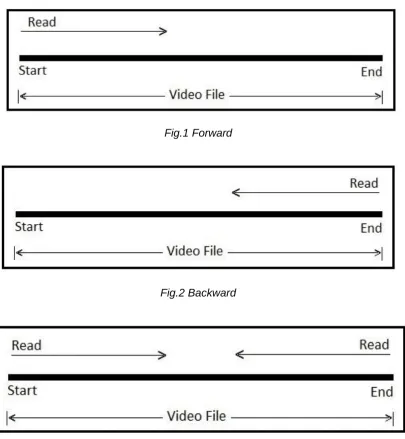
Every Scanning Technique is a basic flow of how we are going to read a source video file
and how it will be written after encryption. Writing of the encrypted file is kept untouched and
concentration is shifted only on reading patterns. Some of the reading patterns are as shown
in the following figures.
Fig.1 Forward
Fig.2 Backward
Fig.4 Concurrent toward Ends
These are some example patterns. Here it is possible to skip some data from getting
encrypted to increase speed of execution.
5. ENCRYPTION
As shown in fig. encryption process, user key gets converted into encryption key by
processing in the 4 out of 8 method which is based on 4 out of 8 table mentioned above.
This encryption key, pattern and source video is combined at encryption process to process
out desired encrypted video.
Fig.5 Encryption Process
Encryption Algorithm:
1. Fetch Encryption Key from 4 out of 8 modules. 2. Generate name for new encrypted file.
3. Create new file with generated name.
4. Write some elements of key at predefined positions. 5. Fetch video file byte by byte from address specified. 6. Fetch Read Pattern.
7. Decide interval of encryption ‘n’.
8. For each byte do 8th and 9th step till end of file.
9. EXOR every nth element of file.
6. DECRYPTION
As shown in fig. decryption process, user key gets converted into decryption key by
processing in the 4 out of 8 method which is based on 4 out of 8 table mentioned above.
This decryption key, pattern and source video is combined at decryption process to process
out desired decrypted video. But, authentication has important role here, hence
authentication module is used before start of the decryption process.
Authenticator and Pattern Decider will read the control information embedded by the encryption process and will verify it with the current user key provided. The encrypted file will
hold the part of encryption key but not the whole key hence, it will be difficult to decrypt the
fetched encrypted file even if part of key remains present in it. And only authenticator may
verify it.
Fig.6 Decryption Process
Decryption Algorithm:
1. Get user key
2. Generate decryption key.
3. Verify user key with partial key embedded in encrypted file. 4. Only if match found, perform step 4. Else terminate.
5. Fetch name for decrypted file.
6. Create new file to store decrypted data. 7. Fetch pattern.
8. Fetch interval of encryption ‘n’.
9. Start decryption by repeating steps 10 and 11 till end of file.
10. EXOR every nth element of encrypted file.
11. Write every byte.
7. RESULTS
video is encrypted or not and simultaneously will be checking for the user is authorized or
not to view this file. The legitimate requests will be accepted and file will be decrypted, else
system will show an error since it is unable to process the request. It might be possible, that
for closely correct keys i.e. part of user key written inside encrypted file is correct and other
part is incorrect then system may fail by executing decryption module, but unauthorized user
will never able to get actual video file since, decryption is fully dependent on decryption key
which is function of user key.
According to performance parameters of video encryption,
1. Security level
Security level will be high in the proposed system since the data is changed at byte
level, hence, the video will be in completely disturbed format which cannot be opened
with any video player unlike other algorithms working on frames of video. Hence, it is
better than perceptual encryption system.
2. Speed
Speed of encryption will be based on actual size of video file on disk and not on the
frames and density of frames in the video. Time complexity of the algorithm, which is
combined feature of read pattern and encryption interval can be defined in worst
case as O(n) where n is number of bytes. This is better than other video encryption
algorithms working on frames of video.
3. Video Size
Size of video remains unchanged with this algorithm. Which leads to no data loss
and quality of video retains even after number of encryption and decryption cycles.
4. Encryption Ratio
Encryption ration is function of encryption interval which changes dynamically for
every video encryption. Ideally the encryption ratio should be from 20% to 50% for
faster performance needs and from 50% to 100% where security is more important
than resource and time utilization.
8. CONCLUSION & FUTURE SCOPE
The system proposed here is an efficient technique for encryption and decryption of video
files. It gives full customization and freedom for improvements as all parameters for
encryption can hold different values at different time and at different application projects. The
system is reliable since it will not decrypt the file properly without correct user key which
As system is fast, it can be implemented in video players which wants to save video
player dependent videos and decrypt the video in real time i.e. at the time of rendering.
REFERENCES
[1]. Panduranga H.T, Naveen Kumar S.K, “Hybrid approach for Image Encryption Using SCAN Patterns and Carrier Images”
[2]. Chao Shen Chen and Rong Jian Chen, “Image encryption and decryption using SCAN methodology,” Proc. PDCAT, 2006.
[3]. Ajay Kulkarni, Saurabh Kulkarni, Ketki Haridas and Aniket More ”Proposed Video Encryption Algorithm v/s Other Existing Algorithms: A Comparative Study”
[4]. Milind Mathur.and Ayush Kesarwani “Comparison Between DES , 3DES ,RC2 , RC6, BLOWFISH And AES”, Proceedings of National Conference on New Horizons, university of Oklahoma, , ISBN 978-93-82338-79-6,2013.
[5]. Jawahar Thakur and Nagesh Kumar, “DES, AES and Blowfish: Symmetric Key Cryptography Algorithms Simulation Based Performance Analysis”, International Journal of Emerging Technology and Advanced Engineering, ISSN 2250-2459, Volume 1, Issue 2, December 2011.
[6]. Douglas Selent, “Advanced Encryption Standard”, InSight : RIVIER ACADEMIC JOURNAL, VOLUME 6, NUMBER 2, FALL 2010
[7]. Dr. Prerna Mahajan & Abhishek Sachdeva, “A Study of Encryption Algorithms AES, DES and RSA for Security”, Global Journal of Computer Science and Technology Network, Web & Security Volume 13 Issue 15 Version 1.0 Year 2013