Estimation of Compensation Current Reference using
Fuzzy Logic Controller for Three-Phase Hybrid Active
Power Filter
Zubair Ahmed Memon
Department of Electrical Engineering Mehran University of Engineering & Technology,
Jamshoro, Pakistan.
Muhammad Aslam Uqaili
Department of Electrical Engineering Mehran University of Engineering & Technology,
Jamshoro, Pakistan.
Mukhtiar Ali Unar
Department of Computer Systems Engineering
Mehran University of Engineering & Technology,
Jamshoro, Pakistan.
ABSTRACT
This research deals with design of three-phase hybrid active power filter to reduce the current distortions caused by non-linear loads. The Instantaneous Active and Reactive Power Method (p-q) is used to perform the identification of disturbing currents. The p-q algorithm generates the reference compensation current signal, while this generated reference compensation current signal is exactly followed by the output current of the voltage source converter. Fuzzy logic controller for three-phase hybrid active power filter is used to generate the switching signals in order to control the output currents of voltage source converter. Simulation results showed that the hybrid active power filter can compensate the harmonic currents effectively and improve power quality.
Keywords
Hybrid Active Filter, p-q theorem, Total Harmonic Distortion, Fuzzy Logic Controller.
1.
INTRODUCTION
Nowadays industries prefer to use power electronics based devices due to their effectiveness. Though these power electronics based devices are advantageous to the electronics and electrical industry, these devices generate and inject the harmonics in the power industry. These harmonic are known as electrical disturbance which is the main cause of the power quality associated harms. The industrial process is affected by the power quality problems. Therefore for improving the quality of the power supply this harmonic distortion should be decreased with the help of the filters. In the literature, various topologies of active power filters (APFs) have been presented for mitigation of harmonics [1-3]. The APF topologies are not cost-effective for the application of high power because of their high rating and very high switching frequency of pulse width modulator (PWM) converter. Thus LC passive filters (PFs) are used for harmonic filtration of such large nonlinear loads. Low cost and high reliability is the main advantage of PFs. However, PFs suffer from some shortcomings for example, the performance of these filters is affected due to the varying impedance of the system and with the utility system the series and parallel resonances may be created, which cause current harmonics increase in the supply [4-5]. As discussed above both APFs and PFs suffer from a number of disadvantages. Therefore another solution of harmonic mitigation, called hybrid active power filter (HAPF), has been introduced. Hybrid active power filters (HAPF) provide the combined advantages of APF and PPF and eliminate their disadvantages. These topologies are cost
magnitude but opposite in the phase direction of the harmonic current [6].
In the literature a number of methods have been emphasized for identification of reference current [7-12]. For identification of disturbing current the instantaneous reactive power method has been used in this paper. For controlling the output currents of the converter, to follow the reference currents, hysteresis current controller have been used in [13-15].The implementation of hysteresis current controller is simple and its performance is also excellent. However, this controller suffers from drawbacks. Its main drawback is to generate the variable switching frequency. Therefore reliability and efficiency of hybrid active power filter is affected [16]. To avoid these drawbacks, this paper present the fuzzy logic based current controller to control the output currents of the voltage source converter. Although to control the output current of converter based on fuzzy based is not new [17-18], this approach with 15 rules has not yet being applied to proposed filter.
2.
HYBRID
ACTIVE
POWER
FILTER
STRUCTURE
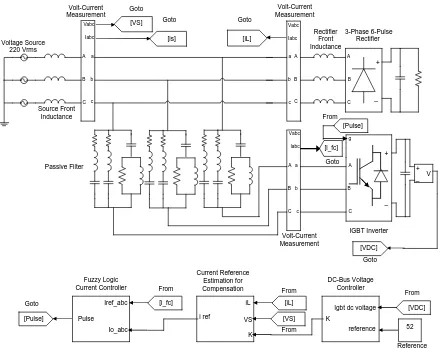
The simulink model of hybrid active power filter (HAPF) control is shown by Figure 1.
It is based on:
A three-phase three-wire power circuit; Non-linear load based on uncontrolled rectifier; Reference current estimator block based on p-q theory; Pulse generation block, based on fuzzy based current
control technique;
The (HAPF) consists of a voltage source converter (VSC) and capacitor
DC bus voltage controller block.
3.
GENERATION
OF
COMPENSATION
CURRENT
REFERENCE
The reference currentfor the control of (HAPF) can be determined by calculation of instantaneous power components of the p-q theory in a stationary 𝛼𝛽frame [19-20].
eα
eβ = H
er
ey
eb
(1)
Where,
𝐻 = 2
3
1 −1
2 −
1 2
0 3
2 −
3 2
The above equations show that and coordinates are orthogonal to each other. They also indicate that eα and iα are on the -axis while eβ and iβ are on the -axis. In three-phase circuit the
equation of instantaneous real power can be computed as:
p = erir+ eyiy+ ebib = eαiβ+ eβiβ (3)
The instantaneous reactive power can be computed as:
q = eαiβ+ 𝑒𝛽iα (4)
From (3) and (4) equations, the instantaneous powers are recomputed as in equation (5)
p
q = K iiαβ (5)
Where,
𝐾 = −eeα eβ
β eα
Based on above equations, the thee-phase voltage vr, vy and vb and
currents of the non-linear load can be transformed in to 𝛼𝛽 frame as:
eα
eβ = H
vr
vy
vb
(6)
And
iLα
iLβ = H
iLr
iLy
iLb
(7)
The instantaneous powers (𝑝𝐿 𝑎𝑛𝑑 𝑞𝐿) of the load can be computed as:
pL
qL = K
iLα
iLβ (8)
Equation (8) is rearranged as:
iLα
iLβ = K
−1 pL
qL (9)
The pL is divided in to average power(p L) and oscillating power
(p L) . Similarly qL is divided in to average power (q L) and oscillating power (q L) as in equation (10).
pL= p L+ p L and qL= q L+ q L (10)
From equation (9) the -phase load current iLα can be computed
as follows:
iLα=
eα
eα2+ eβ2
p L+
−eβ
eα2+ eβ2
q L+
eα
eα2+ eβ2
p L+
−eβ
eα2+ eβ2
q L (11)
From equation(11), it can be observed that in order to cancel out harmonic distortion in power system line, the second, third and fourth term of equation (11) must be compensated by the HAPF. The reference compensating currents can be expressed as follows:
i∗ r
i∗ y
i∗ b
= 2
3
1 0
−1 2 3 2
−1 2 − 3 2
K−1 p∗ + pave
p∗ (12)
Where p∗ and q∗ are given by,
p∗= −p
+
_ V
A
B
C g
a
b
c A
C B A
B
C a
b
c
a
b
c A
B
C
A
B
C
+
_ 3-Phase 6-Pulse
Rectifier Rectifier
Front Inductance
Vabc Iabc
Vabc Iabc
Vabc Iabc
IGBT Inverter Passive Filter
Voltage Source 220 Vrms
Source Front
Inductance Volt-Current Measurement
Volt-Current Measurement
Volt-Current Measurement
+
_ [VS]
[is] [iL]
[image:3.595.75.515.107.461.2] [image:3.595.300.574.541.638.2][i_fc] [Pulse]
[VDC] Goto
Goto Goto
Goto From
Goto
[Pulse] Goto
From From
From
From
52
Reference [VDC] [iL]
[VS] [i_fc]
Pulse Iref_abc
Io_abc
i ref
iL
VS
K
K
reference Igbt dc voltage Fuzzy Logic
Current Controller
Current Reference Estimation for Compensation
DC-Bus Voltage Controller
Fig 1: General structure of hybrid active power filter and its control
4. DC BUS VOLTAGE CONTROLLER
The DC Bus voltage controller is used to control the power supply to the insulated gate bipolar transistor converter. To avoid using external power such as DC power supply, Batteries, and many more, the charging and discharging phenomenon of capacitor element is manipulated. The charging and discharging phenomenon of capacitor is controlled by the DC bus voltage controller for maintaining the DC voltage level at constant and the transient response reached the stability. There are different control techniques that can be implemented for the DC bus voltage controller such as using the PI controller and fuzzy controller but in this paper, the approach used is based on [21]. Figure 2 shows the voltage controller of DC bus. Voltage controller of DC-bus regulates the voltage of the capacitor on DC side of the converter and compensates losses of the converter. The voltage of the capacitor is measured and then it is compared to constant value. The resultant difference is then fed into gain. In this way, hybrid active power filter controls and builds up the DC voltage of capacitor without using external supply.
Fig 2: Voltage controller of DC bus
1
Z
[VDC]
52 +
_ Reference
From
Unit delay
Gain
5. FUZZY CURRENT CONTROL
TECHNIQUE
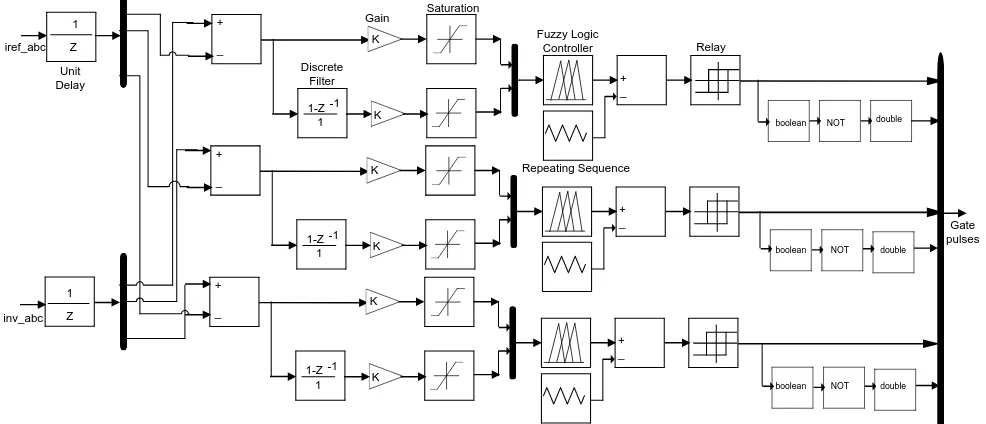
The fuzzy logic controller is used to generate switching signals for voltage source converter to follow the reference current. For the control purpose of (HAPF) the fuzzy controller uses two inputs and one output known as error (e) error rate (∆e) and control signal (u) respectively.
The error can be defined as difference between the output currents of the (VSC) and reference currents of the individual phase. The current control method is related to fuzzy controller based PWM current controller has been used in this paper. By comparing carrier signal with fuzzy controller output the switching signals are generated for three-phase VSC as shown in Figure 3.
+ _ +
_ K
K 1-Z -1
1
+ _ +
_
K
K 1-Z -1
1
+ _ +
_ K
K 1-Z -1
1
Gate pulses 1
Z
1
Z iref_abc
inv_abc Unit Delay
Discrete Filter
Gain Saturation
Fuzzy Logic
Controller Relay
Repeating Sequence
boolean boolean boolean
NOT NOT NOT
[image:4.595.50.543.163.375.2]double double double
Fig 3: Three-phase fuzzy logic current controller for three-phase HAPF
[image:4.595.320.556.419.525.2]In this controller, we have used five fuzzy sets (Very Small, Small, Zero, Big, Very Big) for the error and by three fuzzy sets (Low, Zero, High) for the error rate. The output is characterized by five fuzzy sets (Very Decrement, Decrement, Constant, Increment, Very Increment). Their member functions are shown in Figures 4, 5 and 6.
Fig 4: The degree of membership for the error (e)
Fig 5: The degree of membership for the rate change of error
(∆e)
Fig 6: The degree of membership for the output signal (u)
The linguistic rules for the fuzzy logic controller are given in table 1:
Table 1. Fuzzy control rules
∆e e
Low Zero High
V.Small V.Inc V.Inc V.Inc
Small V.Inc Inc Inc
Zero Inc Cons Dec
Big Dec Dec V.Dec
[image:4.595.60.283.475.691.2]6. SIMULATION RESULTS
The circuit parameters used in simulation are presented in table2:
Table 2. Simulation parameters [22].
Supply voltage Vs = 220Vrms
Supply/ line inductance Ls = 0.0016 Henery
Rectifier front-end inductance LL = 0.023 Henery
Capacitance of the load CL= 50 micro Farad
Resistance of the load RL=78 Ohm
Capacitance of inverter dc-bus Cdc = 4500 micro farad
Simulations were performed to show the usefulness of the HAPF which actually compensates the harmonic currents of the source current effectively.
A nonlinear load, consisting of a three-phase uncontrolled rectifier and adjustable speed drives, is fed by sinusoidal and symmetrical mains phase voltages (220 Vrms, 50 Hz).
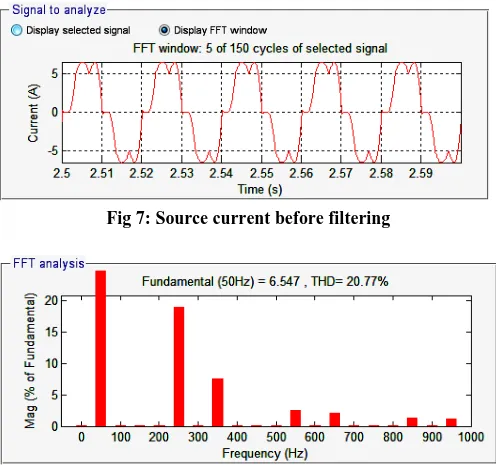
[image:5.595.47.295.320.553.2]Figures 7 and 8 show the source current before filtering (only one phase current has been shown for the clearness) and its harmonic spectrum respectively.
Fig 7: Source current before filtering
Fig 8: Frequency spectrum of source current before filtering
It is clearly shown that the THD of the source current is 20.77% for the proposed system. After filtering simulation results have been shown in next figures. Thus, Fig. 9 shows that the distortion of the source current is reduced and it becomes sinusoidal and now it is in phase with the source voltage, thus power factor of the system is improved. The THD of the source current is reduced from 20.77% to 2.01% as depicted in Figure 10. In Figure 11, the output current of the HAPF tracks the reference current closely.
Fig 9: After filtering source voltage and current are in phase
[image:5.595.313.536.388.555.2]Fig 10: Frequency spectrum of source current after filtering
Fig 11: Hybrid active power filter output current and reference current
7. CONCLUSION
In this paper we have presented the three-phase hybrid active power filter with 15-rules base fuzzy logic controller for compensation of harmonic currents generated by the non-linear load. The fuzzy logic control based HAPF for three-phase system is modeled and simulated in MATLAB/SIMULINK environment. The main objective of this research work has been accomplished. The total harmonic distortion of the supply current has been decreased at a high level of expectation from 20.77% to 2.01% in the simulation. Which is a achievement to meet the IEEE 519 recommended harmonic standard.
providing moral support and necessary facilities to complete this research work
9.
REFERENCES
[1] Nitin Gupta, Dubey S.P, and Singh S.P, “Neural
network-based shunt active filter with direct current control for power quality conditioning,” International Journal of Power Electronics, vol. 3, no. 6, pp. 597-620, 2011.
[2] Akagi H. “New Trends in active filters for power
conditioning,” IEEE Transactions on Industrial
Applications, vol. 32, no. 6, pp.1312-1322, 1996.
[3] Tao Zhou, and Francois B, “Energy management and power control of a hybrid active wind generator for distributed power generation and grid integration,” IEEE Transactions on Industrial Electronics, vol. 58, no.1, pp. 95-104, 2011.
[4] Subhashish Bhattacharya, Po-Tai Cheng, and Deepak M. Divan, “Hybrid solutions for improving passive filter performance in high power applications,” IEEE Transactions on Industry Applications, vol. 33, no. 3, pp.732-747, 1997.
[5] Peng F.Z, Akagi H, and Nabae A, “New approach to harmonic compensation in power systems – A combined system of shunt passive and series active filters”, IEEE Transactions on Industrial Applications, vol.6, no .3, pp. 983-990, 1990.
[6] Vedat M, Karslı, Mehmet Tümay and Berrin Süslüoğlu,
“An evaluation of time domain techniques for compensating currents of shunt active power filters,” International Conference on Electrical and Electronics Engineering Bursa, Turkey, Dec. 2003.
[7] Chen C.I, Chang G.W, Hong R.C, and Li H.M,
“Extend real model of kalman filter for time-varying harmonics estimation,” IEEE Transactions on Power Delivery, vol. 25, no.1, pp.17-26, 2010.
[8] Akagi H, Kanazawa Y, and Nabae A, “Instantaneous reactive power compensators comprising of switching devices without energy storage components,” IEEE Transaction on Industry Applications, vol. 20, no. 3, pp. 625-630, 1984.
[9] Zeng Jiang, Liu Yan, Ouyang Sen, and Zhen Zaitian, “Novel hysteresis current controller for active power filter,” International Conference on Electrical and Control Engineering, Guangzhou, China, pp.1378-1384, 2010.
[10] Wu T.F, Shen C.L, Chang C. H, and Chiu J.Y, “A 1-Φ
3W grid-connection pv power inverter with partial active power filter,” IEEE Transaction on Aerospace and Electronic Systems, vol. 39, no. 2, pp. 635-646, 2003.
[11] El-Habrouk M, and Darwish M. K, “Design and
implementation of a modified fourier analysis harmonic current computation technique for 132 power active
filters using DSPs,” IEE Proceedings of Electric Power Applications, vol. 148, no. 1, pp. 21-28, 2002.
[12] Norman M, Ahsanul A, Senan M, and Hashim H,
“Review of control strategies for power quality conditioners,” Proceedings of the IEEE National Conference on Power and Energy Conference (PECON), Kuala Lumpur, Malaysia, pp. 109-115, 2004.
[13] Khositkasame S, and Sangwongwanich S, “Design of harmonic current detector and stability analysis of a hybrid parallel active filter,” Proceedings of the Power Conversion Conference, Nagaoka, Japan, 1997, pp. 181-186.
[14] Komatsu Y, and Kawabata T, “Characteristics of three phase active power filter using extension p-q theory,” Proceedings of the IEEE International Symposium on Industrial Electronics, Guimaraes, Portugal, 1997, pp. 302-307.
[15] Dobrucky B, Kim H, Racek V, Roch M, and Pokorny
M, “Single-phase power active filter and compensator
using instantaneous reactive power method,”
Proceedings of the Power Conversion Conference, Osaka, Japan, 2002, pp. 167-171.
[16] El-Habrouk M, and Darwish M. K, “Design and
implementation of a modified fourier analysis harmonic current computation technique for power active filters using DSPs,” Proc. IEE Electric Power Applications, vol. 148, no. 1, pp. 21-28, 2001. [17] Lamchich M.T, and Raoufi M, “A fuzzy logic based
controller for shunt power active filter,” Journal of Electrical Engineering, vol. 8, no. 2, pp.1-6, 2008.
[18] Chennai S, and Benchouia M. T, “Intelligent
controllers for shunt active filter to compensate current harmonics based on SRF and SCR control strategies,” International Journal on Electrical Engineering and Informatics,‐ vol. 3, no. 3, 2011.
[19] Akagi H, “Instantaneous reactive power compensation
comprising switching devices without energy storage
elements,” IEEE Transactions on Industry
Applications, vol. 2, no. 3, pp 625–630, 1984.
[20] Bayındır Ç.K, and Ermiş M, “Understanding the
modelling and analysis of a shunt active power filter using MATLAB/Simulink,” International Journal of Electrical Engineering Education, vol. 43, no. 3, pp.185-205, 2006.
[21] Bartosz K, Tomasz K, Wojciech W, Lucian A, and Claus L.B, “Hybrid power filter with reduced inverter power rating,” International conference on harmonics and Power Quality, Cascais, Portugal, 2006.
[22] Dan S.G, Benjamin D.D, Magureanu, R, Asminoaei L, Teodorescu R, and Blaabjerg F, “Control strategies
of active filters in the context of power
conditioning,” European Conference on Power