Correlations of Biomechanical Characteristics with Ball Speed in Penalty Corner Push-In
Dimensioning and Calibration of a mathematical model : Case of the Convection model,
Constant coefficient diffusion and Dissipation and source term (Republic of Congo)
NGOUBOU Roch Corneille, DINGA Jean Bienvenu et NGANGA Dominique
1Laboratory of Physico-chemical analysis of the Institute for Research in Exact and Natural Sciences, Scientific Research (IRSEN). 2Faculty of Science and Technology, Doctoral Training in Environmental Geosciences (Marien NGOUABI University).
Received 25th September 2019, Accepted 1st October 2019
Abstract
This study focuses on the analysis of solutions of differential equations modeling a physical or chemical phenomenon ; This analysis is fundamentally based on a single solution, that of the resolution of the equation Convection, Diffusion and Dissipation at constant coefficient and source term by the method of decomposition of Adomian (Joseph BONAZEBI YINDOULA,2014). This analytical work has shown that the resolution of a differential equation or a differential equation system does not guarantee the reliability of the solution obtained, the latter will have to be validated in terms of :
Dimensioning ;
Correlation with an experimental approach ;
Validation of related data by statistical indices.
The simulation by ground data of the solution of the equation of Convection, Diffusion and Dissipation at constant coefficient and source term resulting from the decomposition of Adomian has highlighted inadequacies of this solution : The existence of negative values on the variable (mass concentration) after digital application of ground data (GPS data) ; The solution resulting from Adomian's decomposition does not have the dimension of mass concentration and gives dimensional values : Dimensioning problem ; The solution resulting from the decomposition of Adomian has no parameters that characterize the pollutant that can be tracked : Calibration problem. This work is a significant contribution to improving the solution of the Convection, Diffusion and Dissipation equation at constant coefficient and source term derived from the decomposition of Adomian and thus proposes an algorithm of Dimensionand and Calibration of Adomian's solution.
Keywords: Mathematical Model, Equation to Dimensions, Transcendent Functions.
© Copy Right, IJRRAS, 2019. All Rights Reserved.
Introduction
This work aims to build an appropriate method of monitoring water pollutant by proceeding upstream by an analytical approach of some algorithms of transport of pollutant in water. The literature review identified the Constant and Term Coefficient Convection, Diffusion, and Dissipation equation as one of the pollutant transport equations in water; The analysis of the solution resulting from the Adomian decomposition method of this equation (Joseph BONAZEBI YINDOULA, 2014) has presented some insufficiencies which remove it from the experimentation: • the size of the solution; • The negativity of the values estimated by this solution; • No parameter in the expression of this solution characterizes the pollutant to follow; • The reliability of this solution. Our work consisted specifically in bringing a dimensioning and calibration to the ADM algorithm by
Correspondence
NGOUBOU Roch Corneille [email protected]
the construction of two coefficients A and B having the dimension of a mass concentration in order to obtain an estimated approach of the measurements which is in phase with the experimentation.
Presentation of the equation of Convection, Diffusion and Dissipation at constant coefficient and term.
Model of Convection, Diffusion and Dissipation with constant coefficient and term. This model is formalized by: 𝛛𝐂(𝐱,𝐭) 𝛛𝐭 + 𝛛𝐂(𝐱,𝐭) 𝛛𝐱 − 𝛛𝟐𝐂 𝐱,𝐭
𝛛𝐱𝟐 + 𝐂 𝐱, 𝐭 = 𝐅(𝐱, 𝐭) (1)
𝐀𝐯𝐞𝐜 𝐅 𝐱, 𝐭 = −𝐀𝐒𝐢𝐧 𝐱 + 𝐭 +B and A, B are real
numbers depending on pollutant concentration and position. Also, we consider that the transport of the pollutant in the water is done along the longitudinal axis.
Solution resulting from the Adomian Decomposition.
A solution of the model (1) by the
International
Journal of Recent Research and Applied Studies
ADM has for analytical expression:
𝐂 𝐱, 𝐭 = 𝐂𝐨𝐬 𝐱 ∗ 𝐂𝐨𝐬(𝐭) (2).
With 𝐱, 𝐭 ∈ 𝟎; 𝟏𝟎 𝐱[𝟎; 𝟏𝟎]
Analysis of the Solution resulting from the Adomian Decomposition.
Land data
Location of Sampling points
The study is conducted on the Djiri River and two sampling points were selected based on their accessibility for sampling on the Djiri River (Table 5.1). The upstream (S1) and downstream (S2) points have geographic coordinates:
Table 1
Geographic Coordinates of Points
S1: Old Djiri Bridge 1st exit (Station) S2: Former Djiri Bridge 2nd Exit
The upstream point (S1) is located 1km and the electric steel mill. All samples were taken over 12 months between May 2016 December 2017 in two points (upstream and downstream) chosen because of their accessibility and proximity to the target industrial site.
Materials
The material requirements and tools for collecting analytical samples, collecting input data and developing expected results are summarized in the table below:
Table 2
Materials and Tools
Results and Discussions Results
Simulation of the ADM solution.
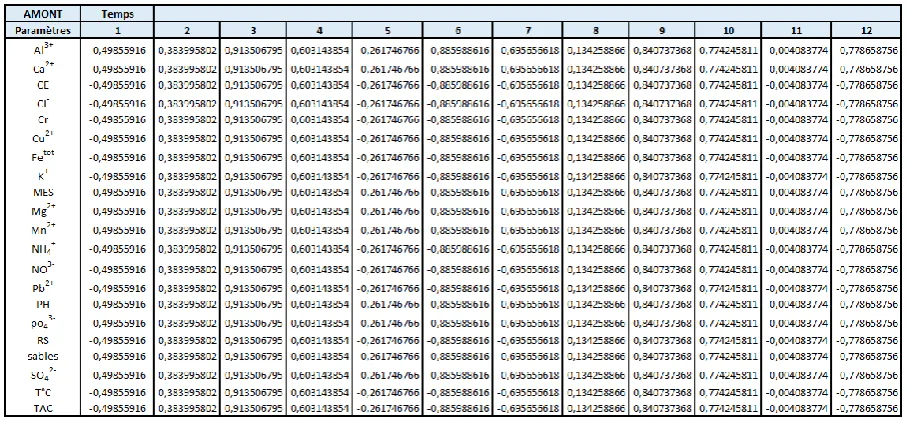
The numerical application of the expression (2) representative of the ADM solution gives the following results:
Table 3
Table 4
ADM Simulation at the Upstream Point
Comment
Tables 3 and 4 present the data estimated by the solution function of the equation of Convection, Diffusion and Dissipation at constant coefficient and source term. These two tables show that:
• The concentrations are identical each month for the
parameters: the concentration does not depend on the physicochemical parameter;
• Existence of negative concentration values;
• Since the Cosinus mathematical function is transcendent, the estimated concentration value of the ADM solution is adimensional.
Correlative Analysis: Adomian Solution vs Experimental Approach.
Table 5
Table 6
Determination Coefficient of Correlation AMONT
Comment
The analysis of these two tables shows correlation coefficients strictly correlation intervals [-1 ;-0.5] ou [0.5 ;1]: The correlation coefficient values 0.089 and 0.093 show that the estimated measurements (ADM) are moving away from the experimental measurements: No correlation between ADM MEXP.
Dimensioning and Calibration of the solution resulting from the Adomian Decomposition
Dimensioning and Calibration.
The general form of our solution is :
𝐂 𝐱, 𝐭 = 𝐀𝐂𝐨𝐬 𝐱 ∗ 𝐂𝐨𝐬 𝐭 + 𝐁 (3).
Where A, B are calibration and sizing coefficients. x: Longitudinal Cord in decimal degree at the point of sampling;
t: the sampling order;
The order is defined by the following function:
𝛗 ∶ 𝐌𝐗𝐍∗→ 𝐍∗ (𝐦, 𝐧) → 𝐧
φ m, n = n
= sampling time or the ninth month of sampling
M= {1,2,3,4,5,6,7,8,9,10,11,12} ;
N∗∶ set of non − zero natural numbers;
The determination of A and B results from the resolution of the linear system Next :
E. P=C where E is a square matrix of order 2 ; E the component vector A and B ;
C thecomponent vectorC1 et C2.
𝐶1: Average measurement in situ upstream;
𝐶2:Average downstream in situ measurement;
This linear system is translated by:
𝐂𝐨𝐬 𝐗𝐒𝟏 ∗ 𝐂𝐨𝐬(𝐭) 𝟏
𝐂𝐨𝐬 𝐗𝐒𝟐 ∗ 𝐂𝐨𝐬(𝐭) 𝟏 𝐀𝐁= 𝐂𝟏 𝐂𝟐
The determinants associated with this linear system are:
∆𝐆é𝐧é𝐫𝐚𝐥=𝐂𝐨𝐬 𝐭 ∗ (𝐂𝐨𝐬 𝐗𝐒𝟏 − 𝐂𝐨𝐬 𝐗𝐒𝟐 )
∆𝐀= 𝐂𝟏− 𝐂𝟐
∆𝐁= 𝐂𝐨𝐬 𝐭 ∗ (𝐂𝟐∗ 𝐂𝐨𝐬 𝐗𝐒𝟏 − 𝐂𝟏∗ 𝐂𝐨𝐬(𝐗𝐒𝟐))
The solutions of this linear system are given by:
𝐀 = ∆𝐀
∆𝐆é𝐧é𝐫𝐚𝐥=
𝐂𝟏−𝐂𝟐
𝐂𝐨𝐬 𝐭 ∗(𝐂𝐨𝐬 𝐗𝐒𝟏 −𝐂𝐨𝐬 𝐗𝐒𝟐 ) (4).
𝐁 = ∆𝐁
∆𝐆é𝐧é𝐫𝐚𝐥=
𝐂𝟐∗𝐂𝐨𝐬 𝐗𝐒𝟏 −𝐂𝟏∗𝐂𝐨𝐬(𝐗𝐒𝟐) 𝐂𝐨𝐬 𝐗𝐒𝟏 −𝐂𝐨𝐬 𝐗𝐒𝟐 (5).
Coefficients A and B are specific to the pollutant monitored.
Simulation of the ADC solution
Table 7
Simulation of the ADC algorithm in Upstream
Source: Data estimated by the ADC algorithm.
Table 8
Simulation of the ADC algorithm in Aval
Comment
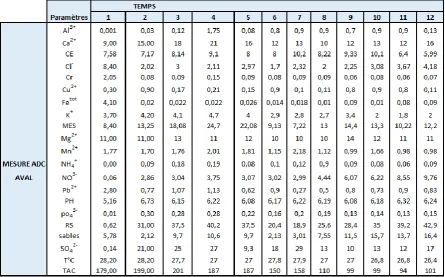
Tables 7 and 8 present the measurements estimated by the ADC algorithm.
• Validation of statistical indices.
Validation of the ADC solution is done through tests based on the statistical indices described in 3.1.5 and using the lead measurements for not taking the set of parameters; It results from the application of these indices the results inscribed in the tables:
Table 9
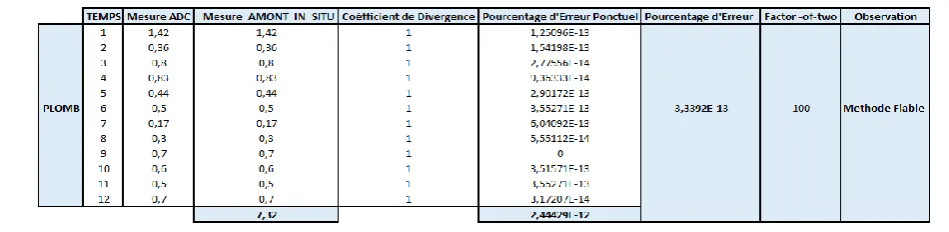
Determination of the Divergence Coefficient and Factor-of-two at the ADC vs. MEXP upstream point
Comment
Table 9 shows a factor of two of 100%, a coefficient of divergence equal to 1 and thus reflects the
reliability of the data estimated by the ADC approach, hence the reliability of this estimated upstream data approach.
Table 10
Determination of the Divergence Coefficient and Factor-of-two at ADC vs. MEXP upstream point with in situ measurements of lead.
Comment
Table 10 shows a factor of two of 100%, a coefficient of divergence equal to 1 and thus reflects the
Table 11
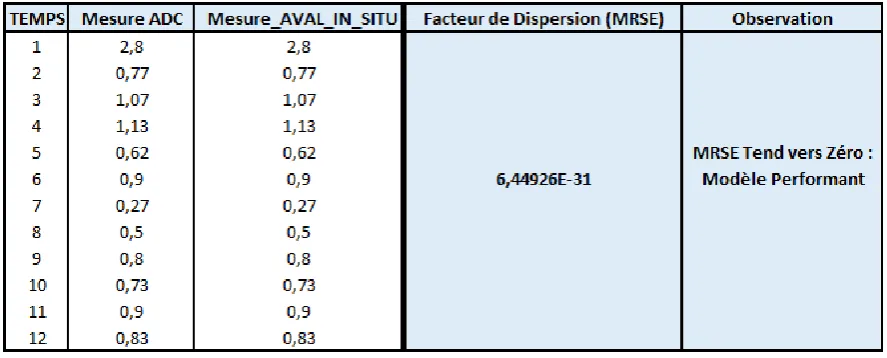
Downstream dispersion factor between ADC and MEXP with in situ measurements of lead
Comment
Table 11 presents an MRSE that tends to zero
and shows that the estimated approach of ADC data performs well downstream.
Table 12
Dispersion factor upstream between ADC and MEXP with in situ measurements of lead
Comment
Table 12 presents an MRSE that tends to zero and shows that the estimated approach of ADC data performs well upstream.
• ADC Dimensionality test
This is to check the dimensional equation on the expression of the ADC solution.
The expression of the ADC solution being :
𝐅(𝐗, 𝐓)𝐀,𝐁= 𝐀 ∗ 𝐂𝐎𝐒 𝐗 ∗ 𝐂𝐎𝐒 𝐓 + 𝐁
This expression is a parametric function having A and B for parameter. The transition to the equation to the dimensions at the point
𝐗𝟏 𝐞𝐭 𝐭𝐞𝐦𝐩𝐬 𝐭gives:
[𝐅(𝑿𝟏, 𝐭)𝐀,𝐁]=[ 𝐀 ∗ 𝐂𝐎𝐒 𝑿𝟏 ∗ 𝐂𝐎𝐒 𝐭 + 𝐁]=[A+B]
=[ 𝐂𝟏−𝐂𝟐
𝐂𝐨𝐬 𝐭 ∗(𝐂𝐨𝐬 𝐗𝐒𝟏 −𝐂𝐨𝐬 𝐗𝐒𝟐 )∗ 𝑪𝑶𝑺 𝑿𝟏 ∗ 𝑪𝑶𝑺(𝒕)
+𝐂𝟐∗𝐂𝐨𝐬 𝐗𝐒𝟏 −𝐂𝟏∗𝐂𝐨𝐬(𝐗𝐒𝟐) 𝐂𝐨𝐬 𝐗𝐒𝟏 −𝐂𝐨𝐬 𝐗𝐒𝟐 ]
=[𝐂𝟏− 𝐂𝟐]=[𝑴]
[𝑽]because the cosinus function is
transcendent and
COS(𝑿𝟏) et COS(t)are dimensionless.
The verification at point 𝐗𝟐 and at time t, will give the
same conclusion.
Table 13
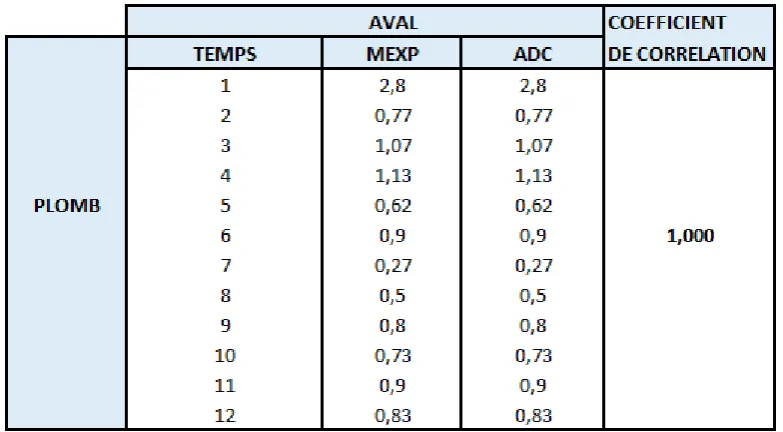
Downstream Correlation MEXP vs ADC Test
Table 14
MEXP Upstream Correlation Test vs. ADC
Comment
Tables 13 and 14 show the correlation between the ADC solution and the experimental approach (MEXP).
Discussion
The set of results illustrated in 3.1 shows that:-As the transport of the pollutant in water is a physical phenomenon thus described by a variable of interest which is a dimensioned and defined positive physical quantity (Mass concentration) then the concentration of the pollutant in the water estimated by the ADM solution would be dimensioned and positive definite: which is absurd because the solution expression in the sense of Adomian of the equation of Convection, Diffusion and
Dissipation with constant coefficient and term is adimensional (the cosine function is transcendental) and presents negative values; ADC solution is dimensioned and defined positive and conforms to the physical definition of a mass concentration; This solution is similar to that of the so-called ADE Advection equation (Dass JABBOUR, 2006), which also shows that the concentration of the pollutant in water at a point x and at time is estimated by a Gaussian-type expression given by:
𝐂 𝐱, 𝐭 = 𝐌𝟏 𝛔𝐗 𝟐𝛑∗ 𝐞
−𝟏𝟐 𝐱 𝛔𝐱
𝟐
𝒐ù 𝛔𝐗 = 𝒇(𝒕).
coefficient and term also challenges the mathematicians on the need to always carry out simulations of the models before publication or always to ensure that the approximations made during the resolution of the problem can not affect the quality of the expected result: Case of a physical phenomenon which in principle is analyzed from a variable of interest (physical quantity measurable experimentally) but estimated by an adimensional algorithm; Numerous statistical indices make it possible to evaluate the predictive performance of models or methods in relation to reality (Hanna et al., 1991, Mosca et al., 1998, Baléo et al., 2003); The statistical indices prove that the ADC solution is reliable since the Factor-of-two is 100% and efficient because the dispersion factor (MRSE) tends to zero.
Conclusion
This work has focused on the careful analysis of the solution according to the Adomian decomposition of the Convection Equation, Diffusion and Dissipation equation with constant and term coefficient (J. Bonazebi, 2014); this analysis revealed shortcomings on this solution and extended to the calibration and sizing of this solution. The ADC solution obtained from the calibration and dimensioning of the solution in the sense of Adomian is a contribution to the improvement of the solution in the sense of Adomian and will allow the monitoring of water pollutants.
Reference
1. Joseph Bonazebi Yindoula, Pare Youssouf, Gabriel Bissanga, Francis Bassano, Blaise Some, 2014 ; Application of the Adomian decomposition method and Laplace transform method to solving the convection Diffusion-Dissipation Equation.
2. Daas Jabbour, 2006 ; Étude expérimentale et modélisation de la dispersion en champ lointain suite à un rejet accidentel d’un polluant miscible dans un cours d’eau : Application à la gestion de crise. Ecologie, Environnement. Université de Provence-Aix-Marseille I.