Copyright © 2018 by Modern Scientific Press Company, Florida, USA
International Journal of Modern Management Sciences
Journal homepage:www.ModernScientificPress.com/Journals/IJMGMTS.aspx
ISSN: 2168-5479 Florida, USA Article
Flexible HRM Practices and Employee Retention: Developing
and Testing of an Integrated Model
1,*Shazia Akhter, 2Muhammad Faisal Malik, 2Muddasar Ghani Khwaja, 2Saqib Mehmood
1University of Islamabad (UoI), Islamabad, Pakistan 2SZABIST, Islamabad, Pakistan
* Author to whom correspondence should be addressed. Email: [email protected]
Article history: Received 31 October 2017, Received in revised form 17 February 2017, Accepted 20 March 2018, Published 17 April 2018.
Abstract: The scope of the current study was to investigate the impact of flexible HRM Practices on the employee retention with mediating role of employee creativity and psychological empowerment. The unit of analysis for the study is nursing staff employed in different government and private hospitals of Pakistan. Total response rate of the data collection is 91%. Sample size of 272 was faced as restraint. Sampling technique is convenience based and data collection is cross-sectional. The study has its originality as an integrative model formulated with the combination of these variables has not been tested earlier specifically in hospitals of Pakistan. Results of the study indicate that the HRM Practices (job security, flexible work arrangements, incentive & pay and skill training) have a significant and direct relationship with employee retention with effective mediating role of psychological empowerment and employee creativity. 04 HRMP selected for current study out of 14 were faced as a limitation. However, the organizations should encourage flexibility in HRMP and ensure formulation and implementation of employee concerned policies and procedures which will resultantly assist in employee retention. The study has its significance for policy makers, managers, supervisors and employees at all levels.
1. Introduction
For retention of employee, organization use different tactics such as high salaries, career development, provide healthy organization environment and best HR practices. There is a single and biggest factor that distinguishes a good company from a great company is the management of human capital within the company. The criticism on globalization proclaims that the competition all over the world has stimulated management patterns have increase in their productivity (Bloom, & Reenen, 2006). The study is conducted to find out the effect of positive implementation of HR practices on the employee retention. This construct of research is taken into consideration keeping in view Pakistan’s perspective.
The employee retention is affected by the number of factors associated; one of a considerably important is implementing flexible HR practices. Despite the fact that the top companies today are highly of the view that the capital asset of the company i.e. employee be retained by all means, however, still there is a gap where believe continues that the employees are replaceable and turnover of the employees is not having any adverse effect to the company. Highlighting this cognitive gap, there was a need to develop and test an integrative model within the society where internal flexibility of the organization’s policies
and procedure regarding human resource observe and assess the relationship with employee retention. Best and flexible HR practices help the company to retain its employees complimenting the mediations of employee creativity and psychological empowerment under the given conditions of supervisor support prevailing as a moderator to the relationship. This study gives a comprehensive model explaining better reasons and ways for employee retention (Barak, Nissly, & Levin, 2001) which had not been discussed in the available literature in the compact form.
Organizations highly emphasize and are highly concerned to have more committed workforce, because the organizational commitment leads to important outcomes such as employee retention, higher motivation, higher organization citizenship behavior and organizational support. Managers could benefit from understanding the predictors of committed manpower because they can initiate the interventions when the problem exists (Omar et.al., 2012). Meyer & Allen (1984) suggested that one of the reasons of organizational commitment is that the emotional attachment with the organization may increase the commitment level of the employees (Dost & Tariq, 2012) which leads to employee retention.
experience dissatisfaction and stress by reason of work-role requirements (Chelariu & Stump, 2011), the same have an impact on organizational commitment, employee creativity and employee retention.
This study has a novelty when taken in Pakistani context and specifically when the focus of the study is nursing staff of different hospitals. In hospitals nursing staff retention is the biggest issue as the employee is considered as the asset or capital (Shoaib et al., 2009). Another purposeful attempt of the study is to provide not only the direct relationship of HR practices to the retention of the employee but also to contribute towards providing the equally strengthened mediating paths to the relationship.
2. Flexible HR Practices
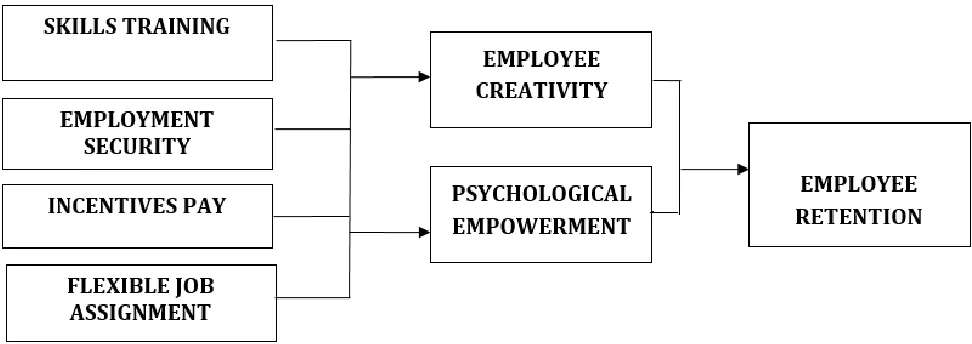
Pfeffer et.al., (2005) as a researcher has classified HR practices of any successful organizations in some basic components.
Skills Training- Skill training is considered a vital part of the comprehensive good sighting and the concentration abilities (Ahmed & Shosha, 2010).These skills provide individuals to act right in connection with environment (Gharamaleki & Rajabi, 2010) thus adding to the ease and resultantly adding to the commitment of the individual towards the organization. .
Employment Security - refers to the understanding of the absence/threat of the fear or uncertainty of loss of employment. The concept of employment security is known as the shield against the unfair dismissals or disengagements. The most often used definition used is that the workers have the fortification against short-notice dismissal from employment (Dasgupta, 2001).
Incentive Pay - Money is one of the motivational factors that are used to encourage people. Besides other factors like recognition, security and fair treatment tend to have a great deal. Enhanced level of performance is related to people and it is their discretion to share in the benefits. Therefore, a number of organizations seek to recompense performance with contingent compensation in one way or the other (Pfeffer, Hatano & Santalainen, 2005).
Flexible job assignment - Studies of assignments constitute a notable stream in management literature. Researchers and practitioners alike have recognized the role that flexible job assignments play for multinational corporations (Lari, 2004).
develop such strategies which increase the level of commitment towards organization in the behavior of employees.
Employee retention can be defined as the ability/ capability of the organization to hold onto its employee whom organization want to keep for long time for taking the competitive edge over its competitors (Johnson et.al., 2000). The concept of retention considered several levels because it cannot be influence from one level (Klein et al., 1994). So organizations need to develop different strategies at different levels to retain its employees. It is also necessary to formulate best fit strategies (Gering & Conner, 2002) because if these strategies will not be executed properly, all efforts since recruitment of the employee will fail (Earle, 2003). That is why organizations need to research on different aspects of employee retention not only on the salary increments, offering promotions or perks and benefits. Such
increments, perks and benefits defined in HR practices as incentive and pays. If the organization is
appreciating the contribution of employees by giving them handsome perks and benefits they want to
remain in the organization.
Moreover, employee retention can be effected through skill trainings. If the organization is
providing skill trainings to their employee, employee wants to remain in the organization. Standing (1999) defines that training and development are reproductive skills. This can influence the retention of employees. The training program offer to employees leads to positive perception of employees that the
organization values their contribution which further leads to increase the commitment level of employee
(Allen and Meyer, 1997). Benson et.al (2004) suggests that HR practices which improve the skills of employees decrease voluntary turnover from the organization. In addition when employee and employer
needs of training met there is a strong chances that employee will stay in the organization (Sheridan, 1992; Wood, 1999).
Bassi and Van Buren, (1999) explain that job security is a strong influencer of employee commitment. This is the confirmation of Huselid (1995) study where he defined that due to provision of
job security from the organization can decrease the employee turnover intention. Basically job security
is the long standing commitment of the organization to its workforce. Such things where career security
take place employee feel more satisfy (Howard and Foster, 1999) which exhibit from their attitude
through retention. Security is related to different kind of security i.e. economic security, work security
(Standing, 1999) and skill security. These kinds of securities are having the direct relationship with
employee retention if the employees are getting such securities.
H1: Flexible HR Practices has direct and positive relationship with employee retention.
There are several factors which are influencing on employee’s retention; one of the important
indicators of employee retention is organization commitment (Curtis and Wright 2001). Employees with
high commitment level are those who are achieving maximum job satisfaction level. There are many
studies available, which are examining the relationship of job satisfaction and turnover and concluding
with the uniform outcome that there is a strongly negative relationship between these two variables
(Cotton &Tuttke, 1986).Another study identified that there are seven factors which can enhance
employee retention (Walker, 2001). Among these seven factors, provision of employee creativity
(Provision of challenging works) is also a factor which can enhance employee retention. The
organization commonly invests more to retain its potential employees rather than others (Dries,
Pepermans & Carlier, 2008). Theory on creativity explains importance of person context interactions (Amabile, 1996; Woodman, Sawyer & Griffin, 1993), and also in the literature on person-environment fit (Kristof, 1996). It has been examined that creative teams are those who perceived that they are working on jobs with high task interdependence and perform supportive activities (Shalley and Gilson, 2004). Moreover Becker et al. (1997) argued that HRM practices operate most directly through employee creativity. The biggest organizations failure is that they cannot provide opportunities to their employees to involve in creative work. This will result in demoralize the employees for retention.
H2: Employee creativity has a significant relationship with employee retention.
H3: Employee creativity mediates the relationship of HR practices and employee retention.
Psychological Empowerment was a concept which took importance in literature at the time when organizations were entering into global competition state. At the early stage, different researchers defined psychological empowerment in different ways. Some used it as motivational concept (Conger & Kanungo, 1988). Some other argued on this concept by saying that psychological empowerment cannot be defined by using single concept, as it has different facets (Thomas and Velthouse, 1990). After sometime for psychological empowerment the researcher used two approaches. Where one approach is focus on organization’s structural feature with believe to empower its employee. This approach relates
to organizational or structural empowerment (Kanter, 1986) and the second approach focuses on that empowerment existed only when employee perceived that they are empowered, this can be defined as psychological empowerment. This type of psychological empowerment is different from the actual organizational features. Later on, the second approach was to take considerable place in literature and researchers focus on this approach rather than the organizational structural’s features. According to that
the organization and achieve the organizational goals/ objective by his/ her own way (Thomas &Velthouse, 1990).
According to the literature it was observed/ studied that psychological empowerment can be helpful in improving the performance of employees, productivity of employees and also enhance the job satisfaction level of employee (Sashkin, 1984) and this job satisfaction leads to retention as well as to organizational commitment. Bowen & Kawler (1992) explained that empowerment’s element gives
direction and responsibilities over task to employees, in organization empowering employees is also using as a tool of motivation. Moreover, employee psychological empowerment has different outcomes such as motivation, organizational commitment and job satisfaction which lead to employee retention. It was found that due to psychological empowerment job satisfaction cannot be ignored as if the employee is dissatisfied with his working environment he may intend to leave the job or loses his performance level. So organizations use this approach to retain its employee by giving them the feeling of empowerment. Same as Thomas and Velthouse (1990) defines the relationship of empowerment and management practices. Conger and Kanungo in (1988) further confirm the relationship that HR practices can help the organization to empower their employees. According to the relationship of psychological empowerment with employee retention and with HR practices the hypothesis can be derived as
H4: Psychological empowerment has significant relationship with employee retention.
H5: Psychological empowerment mediates the relationship of HR practices and employee retention.
3. Research Methodology
3.1. Population and Sample
Since the research focuses on the hospitals situated in Pakistan, the population of the study is the nursing staff of this type of organization. The hospitals in Pakistan are robust, sensitive and bring a considerable share to the GDP of the National Economy. The sample mainly consists of nursing staff of different private and public hospitals. The sample size of the study was determined at two hundred and seventy two (272). More than 300 questionnaires were distributed in different hospitals based in Islamabad and Rawalpindi including government, semi government, private hospitals as well as clinics etc. Out of 300 questionnaires 275 have been received back. Out of which 3 are incomplete with some deficiencies so 272 were finalized for data analysis. The overall response rate found as 91 %.
3.2. Sample Characteristics
The frequency analysis reports gender-wise suggests that majority of the respondents were female. Out of the total of 272, 207 were female that makes them 76.1% of the total sample. On the other hand, as the study is focusing on female nurses, so the male respondents were relatively low (i.e. only 65 in number contributing only 23.9% of the sample). Moreover the statistics show that the majority of the respondents are reported to be from the age group of 20 years to 30 years i.e. 230 of the total sample of 272 respondents (84.6%), the second highest bracket is of 13.2% from the age group of 31 years to 40 years i.e. 36 out of 272 respondents. There are only 6 respondents were reported between the age group from 41 years to 50 years. Most of the respondents were having hand on nursing experience as 240 are having 5-6 years’ experience, 30 are having 10-15 years’ experience and rest are having above 15 years’ experience.
3.3. Instrumentation
The nature of the items included in the questionnaire is such that all of them i.e. HR practices, employee creativity, psychological empowerment and employee retention have to be filled by the nursing staff. All the items in the questionnaire were responded to using a 5-points Likert-scale where 1 (strongly disagree) to 5 (strongly agree), unless otherwise stated.
3.4. Measures
mediator was measured by Spreitzer’s (1995b) psychological empowerment scale. The reliability of
11-item scale of psychological empowerment is 0.86. 11-11-item scale was used to assess employee’s retention, developed by Kyndt, Dochy, Michielsen & Moeyaert (2009) scales. The reliability of this scale is 0.86. The survey technique employed in this study is most widely used method i.e. at convenience sampling technique. This study collects data from 12 organizations working under the umbrella of hospital Sector through questionnaire.
4. Results
4.1. Correlation
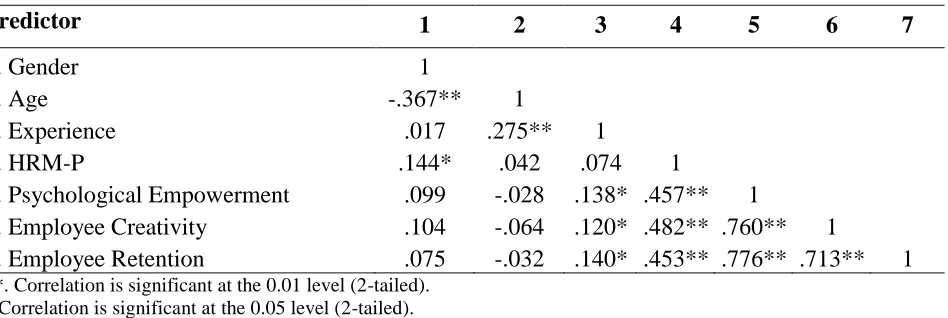
The correlation results are listed in table 1.
Table 1: Correlation
Predictor 1 2 3 4 5 6 7
1. Gender 1
2. Age -.367** 1
3. Experience .017 .275** 1
4. HRM-P .144* .042 .074 1
5. Psychological Empowerment .099 -.028 .138* .457** 1
6. Employee Creativity .104 -.064 .120* .482** .760** 1
7. Employee Retention .075 -.032 .140* .453** .776** .713** 1 **. Correlation is significant at the 0.01 level (2-tailed).
*. Correlation is significant at the 0.05 level (2-tailed).
The results as indicated in table 1 show the correlation among the different variables under study. The table also shows the results with reference to the demographic variables shows insignificant results in relation to the HRMP except gender i.e. gender (r= .144). The correlation analysis of dependent variable (Employee Retention) with demographic factors shows the significant relationship only with experience i.e. experience (r=.140), similarly having weak and insignificant relationship with gender (r = .075) and age (r =-.032). The correlation table also clears that the mediator such as employee creativity has positive and significant relationship with HRMP (r = .482). The other mediator psychological empowerment has similar results as it is having significant relationship with HRMP i.e. r = .457.
4.2. Regression Analysis
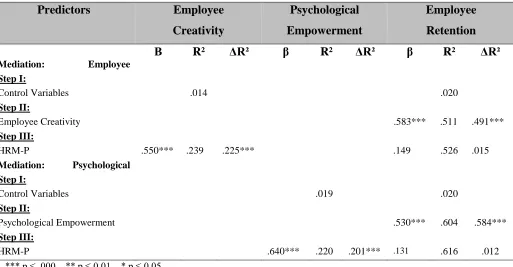
The results of the regression analysis are presented in tables 2 and 3.
Results of the regression analysis shows that the Human Resource Practices has significant relationship with employee retention as it has β value .470 at significant level of .000 (p ≤ 0.05). Thus,
the above stated hypothesis is accepted.
Table 2: Hierarchical Regression analysis for determinants of HRM-P
Predictors Employee Retention
Β R² ΔR²
Step I:
Control Variables .020
Step II:
HRM-P .470*** .217 .197***
Employee Creativity .645*** .511 .491***
Psychological Empowerment .572*** .604 .584**
*** p ≤ 0.001, ** p ≤ 0.01, * p ≤ 0.05
Table 3: Mediated Regression Analysis
Predictors Employee
Creativity
Psychological Empowerment
Employee Retention
Β R² ΔR² β R² ΔR² β R² ΔR²
Mediation: Employee
Creativity Step I:
Control Variables .014 .020
Step II:
Employee Creativity .583*** .511 .491***
Step III:
HRM-P .550*** .239 .225*** .149 .526 .015
Mediation: Psychological
Empowerment Step I:
Control Variables .019 .020
Step II:
Psychological Empowerment .530*** .604 .584***
Step III:
HRM-P .640*** .220 .201*** .131 .616 .012
*** p ≤ .000, ** p ≤ 0.01, * p ≤ 0.05
H2: Employee creativity has a positive relationship with employee retention.
Results of the regression analysis shows that the employee creativity has significant relationship with employee retention as it has β value .645 at significant level of .000. Therefore, the above stated
H3: Employee creativity mediates the relationship of supervisory support and employee retention. The results of the analysis reveal that the β value of the mediating relationship of employee
creativity between HRM-P and employee retention is .149 and found P value as insignificant. According to instruction of Barron and Kenny in 1986, the above stated hypothesis is accepted.
H4: Psychological empowerment has significant relationship with employee retention.
Regression analysis indicates that psychological empowerment has a significant relationship with employee retention with β value of .572 at a significance level of .000. Consequently, the stated
hypothesis is accepted.
H5: Psychological empowerment mediates the relationship of supervisory support and employee retention.
On the basis of mediated regression analysis it has been found that psychological empowerment has an insignificant role in mediating the relationship between HRMP and employee retention (β = -.131). Thus, the above stated hypothesis is accepted.
5. Discussion
it as organization’s investment which creates trust on organization. It is also playing an important role
in the retention of employee (H1).
Employee retention can influenced by the creativity of the employee as earlier researcher defined that creativity is a contextual phenomenon, employees can get some sort of benefits or losing some sort of benefits rather to take decision of leaving or staying in the organization due to this contextual phenomenon i.e. creativity. Creative employees also need some training through which they polish their skills of creativity. If employees are getting the opportunity of creativity in the organization generally have less intention to leave the organization (H2). Moreover, present study results reveal that creativity is mediating the relationship between HRMP, employee retention and creativity. When employee is having flexible incentive and pay package they try to give new ideas to organization and playing important role in the success of organization. Such kind of employees perceived as highly motivated employees so they try to retain in the organization. Moreover the employees who are getting job security, flexible work arrangement and skill training are more creative because they feel more secure in the organization with having strong feelings that organization will support their new idea. Finally, creativity can be influenced by the different factors (i.e. job security, flexible work arrangements etc.) when organization controls such factors it can give better results (H3). The results of another mediation i.e. psychological empowerment reveal that it is mediating between the relationship of HRMP and employee retention. Psychological empowerment varies from industry to industry and organization to organization. In the current study, psychological empowerment have significant results i.e. with increase in which show that in the hospitals there are some contextual factors i.e. job characteristics of tasks, performance appraisal, training, job securities and organization policies and procedures. These contextual factors influence the psychological empowerment of employee (Spretizer, 1995). Among different variables human resource management practices can increase the feeling of empowerment in the employee, when employee is feeling that their organization is giving them flexible work arrangement, skill training, job security and handsome amount they perceived organization as loyal organization this can increase the feeling of empowerment which ultimately helps the employee to retain in the organization (H4, H5).
6. Conclusion
employee creativity and psychological empowerment. Results of the study indicate that flexibility in working hours (flexible job assignments), providing job security, incentive pays & packages and providing skill trainings the nursing staff’s psychological empowerment and their creativity can increase
which helps the nursing staff in retention.
6.1. Limitations
Despite that there are 05 hypotheses which have significant results; there are some limitations of the study i.e. out of 14 only 04 HRM- Practices consider for the study. Another limitation of the study is that data were collected only from the hospitals situated in Rawalpindi and Islamabad. Due to given time frame it is impossible to focus on all nursing staff of one hospital, so the data were collected from only one employee group in one hospital.
6.1. Implications
This study has several practical implications for the different sector organizations not only the nursing staff of hospital. Organizations can use the results of this study to design specific employee retention strategies aimed to reducing employee turnover. In the hospitals nursing staff are facing work family conflict due to limited time, organization can increase the flexibility in working hours, motivate the employees for job sharing attitude which can decrease the turnover intention.
6.2. Future Research Directions
In the current study only 4 HRMP taken for the study, in future the researcher can use the model with all HRMP for study. Moreover the current model can replicate in the service sector organization which can give better results.
References
Akhtar, S., & Malik, M. F. (2016). Effect of Boredom and Flexible Work Practices on the Relationship
of WFC with Procrastination and Affective Commitment: Mediation of Non-Work-Related
Presenteeism. Global Journal of Flexible Systems Management, 17(4): 343-356.
Almer, E. D., & Kaplan, S. E. (2000). Myths and realities of flexible work arrangements. The CPA journal, 70(4): 14.
Allen, N. J., & Meyer, J. P. (1997). Commitment in the workplace: Theory, research and application. Thousand Oaks.
Ahmed, M.F., Shosha, N.T. (2010). Efficiency of the program of visual training. Procedia Social and Behavioral Sciences, 2082-2088.
Bowen, D. E., & Lawler, E. E. (1992). Total quality-oriented human resources management. Organizational Dynamics, 20(4): 29-41.
Bassi, L. J., & Van Buren, M. E. (1999). Valuing investments in intellectual capital. International Journal of Technology Management, 18(5-8): 414-432.
Bloom, N., Kretschmer, T. & Reenen, J.V. (2006). Work-Life Balance, Management Practices and Productivity.
Barak, M. E. M., Nissly, J. A., & Levin, A. (2001). Antecedents to retention and turnover among child welfare, social work, and other human service employees: What can we learn from past research? A review and meta-analysis. Social service review, 75(4): 625-661.
Becker, B. E., Huselid, M. A., Pickus, P. S., & Spratt, M. F. (1997). HR as a source of shareholder value: Research and recommendations. Human resource management, 36(1): 39-47.
Baltes, B. B., Briggs, T. E., Huff, J. W., Wright, J. A., & Neuman, G. A. (1999). Flexible and compressed workweek schedules: A meta-analysis of their effects on work-related criteria. Journal of Applied Psychology, 84(4): 496.
Benson, G. S., Finegold, D., & Mohrman, S. A. (2004). You paid for the skills, now keep them: Tuition reimbursement and voluntary turnover. Academy of Management journal, 47(3): 315-331.
Conger, J. A., & Kanungo, R. N. (1988). The empowerment process: Integrating theory and practice. Academy of management review, 13(3): 471-482.
Chelariu, C., & Stump, R. (2011). A study of work-family conflict, family-work conflict and the contingent effect of self-efficacy of retail salespeople in a transitional economy. European Journal of Marketing, 45(11/12): 1660-1679.
Cotton, J. L., & Tuttle, J. M. (1986). Employee turnover: A meta-analysis and review with implications for research. Academy of management Review, 11(1): 55-70.
Curtis, S., & Wright, D. (2001). Retaining employees-the fast track to commitment. Management Research News, 24(8/9): 59-64.
Conger, J. A., &Kanungo, R. N. (1988). The empowerment process: Integrating theory and practice. Academy of management review, 13(3): 471-482.
Dries, N., Pepermans, R., & Carlier, O. (2008). Career success: Constructing a multidimensional model. Journal of Vocational Behavior, 73(2): 254-267.
Dasgupta, S. (2001). Employment Security: Conceptual and Statistical Issues. International Labor Organization. N.A.
Earle, H. A. (2003). Building a workplace of choice: Using the work environment to attract and retain top talent. Journal of Facilities Management, 2(3): 244-257.
Gering, J., & Conner, J. (2002). A strategic approach to employee retention. Healthcare Financial Management, 56(11): 40-44.
Gajendran, R. S., & Harrison, D. A. (2007). The good, the bad, and the unknown about telecommuting: meta-analysis of psychological mediators and individual consequences. Journal of Applied Psychology, 92(6): 1524.
Gharamaleki, N.S. Rajabi, S. (2010). Efficacy of life skills training on increase of mental health and self esteem of the students. Procedia Social and Behavioral Sciences, 1818-1822.
Howard, L. W., & Foster, S. T. (1999). The influence of human resource practices on empowerment and employee perceptions of management commitment to quality. Journal of Quality Management, 4(1): 5-22.
Huselid, M. A. (1995). The impact of human resource management practices on turnover, productivity, and corporate financial performance. Academy of management journal, 38(3): 635-672.
Johnson, J. T., Griffeth, R. W., & Griffin, M. (2000). Factors discriminating functional and dysfunctional salesforce turnover. Journal of business & industrial marketing, 15(6): 399-415.
Kanter, R. (1986). Supporting innovation and venture development in established companies. Journal of business venturing, 1(1): 47-60.
Klein, K. J., Dansereau, F., & Hall, R. J. (1994). Levels issues in theory development, data collection, and analysis. Academy of Management Review, 19(2): 195-229.
Kyndt, E., Dochy, F., Michielsen, M., & Moeyaert, B. (2009). Employee retention: Organizational and personal perspectives. Vocations and Learning, 2(3): 195-215.
Kristof, A. L. (1996). Person‐organization fit: an integrative review of its conceptualizations,
measurement, and implications. Personnel psychology, 49(1): 1-49.
Lari, M.B. (2004). Intelligent Management Systems in Operations. The Journal of the Operational Research Society, 55(2): 123-131
Meyer, J. P., & Allen, N. J. (1984). Testing the" side-bet theory" of organizational commitment: Some methodological considerations. Journal of applied psychology, 69(3): 372.
Pfeffer, J., Hatano, T. & Santalainen, T. (2005). Producing Sustainable Competitive Advantage through the Effective Management of People[and Executive Commentary]. The Academy of Management Executive,19(4): 95-108.
Sashkin, M. (1984). Participative management is an ethical imperative. Organizational dynamics, 12(4): 5-22.
Spreitzer, G. M. (1995). Psychological empowerment in the workplace: Dimensions, measurement, and validation. Academy of management Journal, 38(5): 1442-1465.
Shoaib, M., Noor, A., Trimzi, S. R., & Bashir, S. (2009). Determinants of Employee Retention In Telecom Sector Of Pakistan. CBRC, Lahore, Pakistan, 4.
Standing, G. (1999). Global labour flexibility: Seeking distributive justice. Palgrave Macmillan.
Sheridan, T. B. (1992). Musings on telepresence and virtual presence. Presence: Teleoperators and virtual environments, 1(1), 120-126.
Shalley, C. E., & Gilson, L. L. (2004). What leaders need to know: A review of social and contextual factors that can foster or hinder creativity. The Leadership Quarterly, 15(1), 33-53.
Spreitzer, G. M. (1995). Psychological empowerment in the workplace: Dimensions, measurement, and validation. Academy of Management Journal, 38: 1442-1465.
Thomas, K. W., & Velthouse, B. A. 1990. Cognitive elements of empowerment. Academy of Management Review, 15: 666-681
Thomas, K. W., & Velthouse, B. A. (1990). Cognitive elements of empowerment: An “interpretive”
model of intrinsic task motivation. Academy of management review, 15(4): 666-681.
Wood, S. (1999). Human resource management and performance. International journal of management reviews, 1(4): 367-413.