Vol. 6, No. 1, 2015, 35-44
ISSN: 2320 –3242 (P), 2320 –3250 (online) Published on 22 January 2015
www.researchmathsci.org
35
International Journal of
Fuzzy One Point Method for Finding the Fuzzy Optimal
Solution for FTP and FUAP
L.Sujatha1 and S. Elizabeth2 1
Department of Mathematics, Auxilium College (Autonomous), Vellore-632006 Tamil Nadu, India, e-mail: [email protected]
Corresponding Author
2
Department of Mathematics, Auxilium College (Autonomous), Vellore-632006 Tamil Nadu, India, e-mail: [email protected]
Received 15 October 2014; accepted 25 November 2014
Abstract. The crisp transportation problem is one of the earliest applications of linear
programming problems. It is solved with the assumption that the cost parameters are specified in a precise way. But in real life situations, it is not possible to get relevant precise data for the cost parameter; this gives rise to fuzzy environment. In recent years, fuzzy transportation problem and fuzzy assignment problem have received much attention. It helps the decision maker to arrive at the optimal solution using imprecise data which is very often used for solving problems of engineering and management sciences. In this paper, we have coined few defuzzification formulae for triangular fuzzy number and presented new procedures for fuzzy one point method which is utilized to identify the optimal solution for fuzzy transportation problem (FTP) and fuzzy unbalanced assignment problem (FUAP). Examples are illustrated to demonstrate the proposed approach in detail. Finally the results obtained under fuzzy environment are compared with the existing crisp results to arrive at a conclusion.
Keywords: Fuzzy environment, fuzzy one point method, triangular fuzzy numbers, fuzzy
transportation problem, fuzzy unbalanced assignment problem, network, decision making
AMS Mathematics Subject Classification (2010): 90C08, 90C90, 90C70, 97M40 1. Introduction
36
problems. Nagoor Gani and Abdul Razak [4] obtained a fuzzy solution for a two stage cost minimizing fuzzy transportation problem in which supplies and demands are trapezoidal fuzzy numbers. Nagoor Gani et al. [5] used an improved version of Vogel’s Approximation Method to find the efficient initial solution for the large scale transshipment problems. Dinagar and Palanivel [1] investigated fuzzy transportation problem, with the aid of trapezoidal fuzzy numbers and proposed fuzzy modified distribution method to find the optimal solution in terms of fuzzy numbers. Pandian and Natarajan [6] proposed a new algorithm namely, fuzzy zero point method for finding a fuzzy optimal solution for a fuzzy transportation problems, where the transportation cost, supply and demand are represented by trapezoidal fuzzy numbers. An assignment problem (AP) which is a special type of linear programming problem plays an important role in industry and other applications. In an assignment problem, the main task is to assign exactly one job to one person, so that for performing all the jobs, the total cost is minimum or the total profit is maximum. A fuzzy assignment problem (FAP) is an assignment problem in which the assignment costs are fuzzy quantities. It is a special case of FTP. Lin and Wen [3] solved the assignment problem by a labeling algorithm with fuzzy interval number costs. Hadi Basir Zadeh [10] proposed ones assignment method for solving assignment problems. Srinivasan and Geetharamani [7] applied Robust’s ranking technique for solving fuzzy assignment problem using ones assignment method. Thus numerous papers have been published in Fuzzy Transportation Problem and Fuzzy Assignment Problem. This paper is structured as follows: In section 2, we have reviewed the preliminary concepts of fuzzy set theory and coined the defuzzification formulae for triangular fuzzy number. In section 3 and subsection 3.1, we have proposed new algorithms namely, fuzzy one point method for finding a fuzzy optimal solution for a FTP and FUAP respectively where all parameters are triangular fuzzy numbers. Through illustrative examples, the fuzzy optimal solution obtained in this paper is compared with the existing crisp result. Section 4, concludes the paper.
2. Preliminaries
Definition 2.1. (Triangular fuzzy number)
Let A be a triangular fuzzy number, it can be represented by A=(a,m,b;1)with membership functionµA( x) given by
≤ < −
−
= < ≤ − −
=
otherwise b x m m b x b
m x
m x a a m a x
x
A
, 0
, ) ( / ) (
, 1
, ) ( / ) (
) (
µ
Definition 2.2. (Defuzzification formulae for triangular fuzzy number)
a) Mean Measure of triangular fuzzy number A
LetA=(a,m,b;1)be a triangular fuzzy number. Mean measure of A is given by
). ( 2 / ) ( 1 ) ( 1 )
37
Figure 2.1: Mean measure of A
b) Left-Right Measure of triangular fuzzy number A
Let A=(a,m,b;1) be a triangular fuzzy number, the Left-Right measure of A is given by
[
]
{ }∫
− − + − − + =1 0 ] ) )[( 1 ( ) ( )(A λb b mα λ m aα a dα
LRM , where
λ
∈(0,1],α
∈(0,1].Ifλ
=0.5,then. 2 2 1 ) ( + +
= m a b A
LRM Herea=m−
α
and b=m+β,then . 2 ) ( 2 2 1 ) ( + −= m β α A
LRM This is utilized
only when right spread (
β
) is not the same as the left spread (α
).Figure 2.2: Left – Right measure of A
3. Algorithm for fuzzy transportation problem
Let k = 1,2,3 be the 3 stages of FTP.
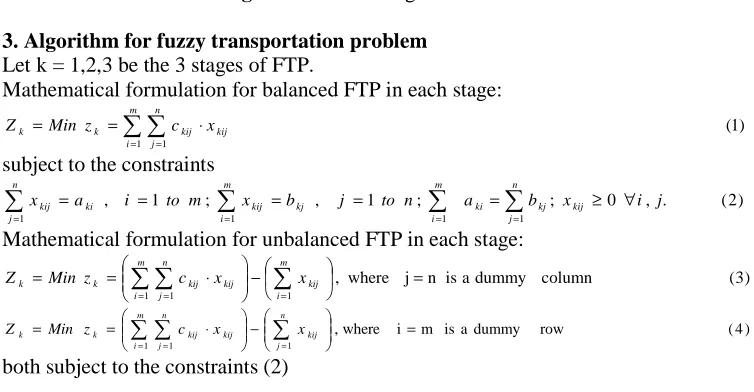
Mathematical formulation for balanced FTP in each stage:
) 1 ( 1 1
∑ ∑
= = ⋅ = = m i n j kij kij kk Min z c x
Z
subject to the constraints
) 2 ( . , 0 ; ; 1 , ; 1 , 1 1 1 1 j i x b a n to j b x m to i a x kij n j kj ki m i kj m i kij ki n j
kij = =
∑
= =∑
=∑
≥ ∀∑
= =
= =
Mathematical formulation for unbalanced FTP in each stage:
) 3 ( column dummy a is n j where , 1 1 1 = − ⋅ = =
∑ ∑
∑
= = = m i kij m i n j kij kij kk Min z c x x
Z ) 4 ( row dummy a is m i where , 1 1 1 = − ⋅ = = ∑ ∑ ∑ = = = n j kij m i n j kij kij k
k Min z c x x
Z
both subject to the constraints (2)
Note: There may be cases where we have to apply the objective functions (1) and (3), (4)
if the 3 stages are the combination of balanced and unbalanced FTP.
38
and ( 1 , 2 , 3 )
~
j j j
j b b b
b = be the fuzzy demand (FD) at destination Dj. Letc~ij =(c1ij,c2ij,c3ij)
be the fuzzy transportation cost (FTC) of FTT [~cij]from source Si to destination Dj. Here FS, FD, FTC are taken as triangular fuzzy numbers. Then the problem is to determine a feasible way of transporting the available amount at each source to satisfy the demand at each destination so that the total transportation cost is minimized under fuzzy environment. This problem can be represented as follows:
D1 ………. Dn FS
S1
11 ~
c ……..
n
c1
~
1 ~
a
⋮ ⋮ ⋮ ⋮
Sm ~cm1 ……… c~mn a~ m
FD 1 ~
b ……….. b~n
Table 3.1: Fuzzy transportation problem
Step 3.1: FTP is now divided into 3 stages. In the 1st stage, the transportation costc1ijof transportation table (TT) [c1ij], supplya1i and demand b1jare considered. In the 2
nd stage,
ij
c2 of TT [c2ij], supplya2i and demand b2jare considered. In the 3
rd
stage, c3ij of TT
]
[c3ij , supplya3i and demand b3jare considered. This is for all i = 1 to m and j = 1 to n.
Procedure for the 1st stage of FTP( it is in the form of crisp transportation problem):
Step 3.2: Check whether the given TP is a balanced one. If not, convert it into balanced
TP by introducing the dummy column or dummy row with cost entry as one.
Step 3.3: Divide each row entries of the transportation table by row minimum that is if
i
u is the minimum of the ith row of the table [ ]
1ij
c then divide the ith row entries by ui , so
that the resulting table is[c1ij/ui].
Step 3.4: Divide each column entries of the resulting transportation table after using the
Step 3.3 by the column minimum that is if vj is the minimum of jth column of the resulting table [c1ij/ui] then divide jth column entries by vj so that the resulting table is
] / ) /
[(c1ij ui vj . It may be noted that(c1ij /ui)/vj ≥1 for all i, j. Each row and each column
of the resulting table[(c1ij /ui)/vj] has at least one fuzzy one entry.
Step 3.5: Choose the row or column with only one fuzzy one and allot the minimum of
source and demand corresponding to that cell. Check whether the fuzzy supply points are fully used and all fuzzy demand points are fully received. If so go to Step 3.7. If not, go to Step 3.6.
Step 3.6: Draw minimum number of lines horizontally and vertically to cover all the
39
Step 3.7: This allotment yields an optimal solution to the given 1st stage of FTP with the objective function 1 1 1 1 1
1 c x Z
z Min m i ij n j
ij⋅ =
=
∑∑
= =
, if the 1st stage of FTP is balanced, without introducing a dummy
column or a dummy row (or)
1 1 1 1 1 1 1
1 c x x Z
z Min m i ij m i ij n j
ij =
− ⋅ =
∑∑
∑
= = =, if the 1st stage of FTP is
balanced by introducing a dummy column j = n(or)
1 1 1 1 1 1 1
1 c x x Z
z Min n j ij m i ij n j
ij =
− ⋅ =
∑ ∑
∑
= = = ,if the 1st stage of FTP is balanced by introducing a dummy row i = m. All these objective functions are subject to the constraints
∑
∑
∑
∑
= = = = ∀ ≥ = = = = = m i m i n j ij j i j ij i n jij a i to m x b j to n a b x i j
x
1 1 1
1 1 1 1 1 1 1
1 , 1 ; , 1 ; ; 0 , .
Now repeat Step 3.2 to Step 3.7 for the 2nd stage of FTP and for the 3rd stage of FTP. Finally, the combination of the optimal solutions obtained in the 3 stages gives a fuzzy optimal solution A = (Z1,Z2,Z3) to the given fuzzy transportation problem. It is then
defuzzified using the definition 2.2.
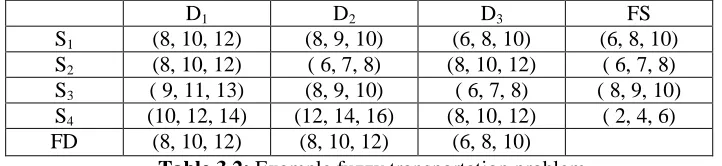
Numerical Example 3.1. Consider the following fuzzy transportation problem. The aim
of the decision maker is to minimize the total fuzzy transportation cost.
D1 D2 D3 FS
S1 (8, 10, 12) (8, 9, 10) (6, 8, 10) (6, 8, 10)
S2 (8, 10, 12) ( 6, 7, 8) (8, 10, 12) ( 6, 7, 8)
S3 ( 9, 11, 13) (8, 9, 10) ( 6, 7, 8) ( 8, 9, 10)
S4 (10, 12, 14) (12, 14, 16) (8, 10, 12) ( 2, 4, 6)
FD (8, 10, 12) (8, 10, 12) (6, 8, 10)
Table 3.2: Example fuzzy transportation problem
Procedure for 1st stage of FTP:
D1 D2 D3 S
S1 8 8 6 6
S2 8 6 8 6
S3 9 8 6 8
S4 10 12 8 2
D 8 8 6 22
It is a balanced TP.
Table 3.3: Applying step 3.1 and step 3.2
D1 D2 D3
S1 1.06 1.33 1
S2 1.06 1 1.33
S3 1.2 1.33 1
40
Table 3.4: Applying step 3.3 and step 3.4
D1 D2 D3 S
S1 *6 6
S2 *6 6
S3 * 8
S4 * 2 * 2
D 8 8 6
* denote the places of 1’s.
Table 3.5: Applying step 3.5
Here fuzzy supply points are not fully used and fuzzy demand points are not fully received.
Therefore go to Step 3.6 and repeat the process until all fuzzy supply points are fully used and all fuzzy demand points are fully received.
D1 D2 D3 S
S1 *6 * * 6
S2 *6 6
S3 *2 *6 8
S4 *2 2
D 8 8 6
Table 3.6: The final optimal table
Step 3.7: The optimal solution to the given 1st stage of FTP is Min
z
1 = 8 x 6 + 6 x 6 + 8 x 2 + 6 x 6 + 10 x 2 = 156.For the 2ndstage and 3rd stage, the same procedure is repeated. Thus, the optimal solution for the FTP is A= (156,240,340) = (a,m,b) which is a fuzzy value, whose membership function is
≤ < −
= < ≤ −
=
340 240
, 100 / ) 340 (
240 ,
1
240 156
, 84 / ) 156 ( ) (
x x
x x x
x
A µ
Here
α
= 84,β = 100, therefore the defuzzified value of A is
+
+ =
2 2 1 )
(A m a b
LRM = 244,
which is closer to the crisp transportation solution namely 240 [8].
41
3.1. Algorithm for fuzzy unbalanced assignment problem
Let k = 1,2,3 be the 3 stages of FUAP.
Mathematical Formulation for balanced FAP in each stage:
∑ ∑
= = ⋅ = = n i n j kij kij kk Minz c x
Z
1 1 (5)
subject to the constraints
. , 1 or 0 ; 1 , 1 ; 1 , 1 1 1 j i x n to i x n to j x kij n j kij n i
kij= =
∑
= = = ∀∑
=
= (6)
Mathematical formulation for FUAP in each stage:
1 1 1 − ⋅ = =
∑∑
= = n i n j kij kij kk Minz c x
Z
(7) subject to the constraints (6).
Construct the fuzzy assignment table[~cij]for the given fuzzy assignment problem. Here ) , , ( ~ 3 2 1ij ij ij
ij c c c
c = is in the form of triangular fuzzy numbers.
Step 3.1.1: Check whether the given fuzzy assignment problem is a balanced one. If not,
convert the fuzzy unbalanced assignment problem (FUAP) into balanced fuzzy assignment problem by introducing the dummy column or dummy row with cost (1, 1, 1).
Step 3.1.2: FAP is now divided into 3 stages. In the 1st stage, the costc1ij of assignment
table (AT) [c1ij]is considered. In the 2nd stage and the 3rd stage, the cost c2ijof AT [c2ij] and the cost c3ijof AT [c3ij] is considered respectively.
Procedure for the 1st stage of FAP (it is in the form of crisp Assignment Problem):
Step 3.1.3 and Step 3.1.4: These steps are same as Step 3.3 and Step 3.4 respectively. Step 3.1.5: Test whether we can choose only one one’s in each column and in each row.
If so go to Step 3.1.7. If not, go to Step 3.1.6.
Step 3.1.6: Draw minimum number of lines horizontally and vertically to cover all the
ones. Then choose the least uncovered element and divide all the uncovered elements using it and multiply at the intersection of lines, leaving other elements unchanged. Now, check whether each row and each column has atleast one fuzzy one entry. If so go to Step 3.1.5, else go to Step 3.1.3, Step 3.1.4 and then to Step 3.1.5.
Step 3.1.7: This allotment yields an optimal solution to the given FUAP in the 1st stage, with the objective function
∑
∑
∑∑
= = = = ∀ = = = = = = − ⋅ = n j ij ij n i ij n i ij n jij x Z x j ton x i ton x or i j
c z Min 1 1 1 1 1 1 1 1 1 1
1 1 subject to 1, 1 ; 1, 1 ; 0 1 , .
Repeat Step 3.1.3 to Step 3.1.7 for the 2nd stage of FAP and for the 3rd stage of FAP. Finally, the combination of the optimal solutions obtained in the 3 stages gives a fuzzy optimal solution A=(Z1,Z2,Z3)to the given FUAP. It is then defuzzified using the definition 2.2.
42
to assign the repair work of road to the contractors so that the total fuzzy assignment cost is minimized.
R1 R2 R3 R4
C1 ( 8, 9, 10) (8, 14, 20) (16, 19, 22) (10, 15, 20)
C2 (5, 7, 9) (12, 17, 22) (15, 20, 25) (16, 19, 22)
C3 (8, 9, 10) (16, 18, 20) (18, 21, 24) (16, 18, 20)
C4 (5, 10, 15) (9, 12, 15) (16, 18, 20) (16, 19, 22)
C5 (5, 10, 15) (10, 15, 20) (18, 21, 24) (10, 16, 22)
Table 3.1.1: Fuzzy unbalanced assignment problem
R1 R2 R3 R4 R5
C1 ( 8, 9, 10) (8, 14, 20) (16, 19, 22) (10, 15, 20) (1, 1, 1)
C2 (5, 7, 9) (12, 17, 22) (15, 20, 25) (16, 19, 22) (1, 1, 1)
C3 (8, 9, 10) (16, 18, 20) (18, 21, 24) (16, 18, 20) (1, 1, 1)
C4 (5, 10, 15) (9, 12, 15) (16, 18, 20) (16, 19, 22) (1, 1, 1)
C5 (5, 10, 15) (10, 15, 20) (18, 21, 24) (10, 16, 22) (1, 1, 1)
Table 3.1.2: Fuzzy balanced assignment problem by introducing the dummy column
Procedure for 1st stage of FAP:
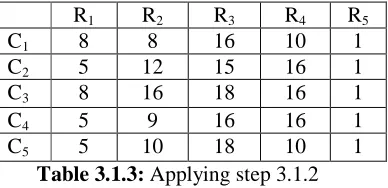
Table 3.1.3: Applying step 3.1.2
Applying Step 3.1.3, Step 3.1.4 and Step 3.1.5, we get the below table 3.1.4
R1 R2 R3 R4 R5
C1 1.6 1* 1.07 1• 1•
C2 1• 1.5 1* 1.6 1•
C3 1.6 2 1.2 1.6 1*
C4 1* 1.13 1.07 1.6 1•
C5 1• 1.25 1.2 1* 1•
•denote the 1 is not selected and * denote the 1 is selected.
Table 3.1.4: The fuzzy optimal table
Step 3.1.7: The optimal solution to the given FUAP in the 1st stage is Minz1 = (8 x 1 + 15 x 1 + 1 x 1 + 5 x 1 + 10 x 1) – 1 = 38.
For the 2nd stage and 3rd stage, the same procedure is repeated. Thus, the optimal solution for the FUAP is A= (38, 54, 66) = (a,m,b) which is a fuzzy value, whose membership function is
R1 R2 R3 R4 R5
C1 8 8 16 10 1
C2 5 12 15 16 1
C3 8 16 18 16 1
C4 5 9 16 16 1
43
≤ < −
= < ≤ −
=
66 54 , 12 / ) 66 (
54 ,
1
54 38 , 16 / ) 38 ( ) (
x x
x x x
x
A µ
Here
α
= 16,β
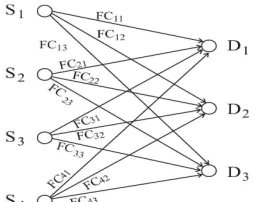
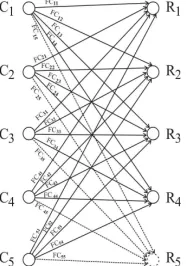
= 12, therefore the defuzzified value of A is LRM( A)= 53, which is closer to the crisp unbalanced assignment solution namely 54[8].Figure 3.1.1: Fuzzy unbalanced assignment network
4. Conclusion
Many researchers have focused on FTP and FAP, since it aim at providing a decision maker with the optimal solution using imprecise data. Unfortunately, most of the existing techniques provide only crisp solutions for the FTP and FAP. The main disadvantages of these methods are, it might lose some useful information. In this paper, a systematic procedure is developed to obtain the optimal solution for the FTP and FUAP by using the fuzzy one point method, where the final result is a fuzzy value. To compare with the existing crisp result, the fuzzy value is defuzzified using the definition defined in this paper. It gives a clear view that the optimal solution obtained under fuzzy environment is more or less closer to crisp value. Therefore the method proposed in this paper serve as an important tool for the decision makers when they are handling various types of complicated problems having fuzzy parameters.
REFERENCES
1. D.S.Dinagar and K.Palanivel, The transportation problem in fuzzy environment,
International Journal of Algorithms, Computing and Mathematics, 2 (2009) 65-71.
2. F.L.Hitchcock, The distribution of a product from several sources to numerous localities, MIT Journal of Mathematics and Physics, 20 (1941) 224-230.
3. C.J.Lin and U.P.Wen, A labeling algorithm for the fuzzy assignment problem, Fuzzy
Sets and Systems, 142 (2004) 373-391.
4. A.Nagoor Gani and K.Abdul Razak, Two stage fuzzy transportation problem,
Journal of Physical Sciences, 10 (2006) 63-69.
5. A.Nagoor Gani, R.Baskaran and S.N.Mohamed Assarudeen, Improved Vogel’s
Approximation Method to Solve Fuzzy Transshipment Problem, Intern. J. Fuzzy
44
6. P.Pandian and G.Natarajan, A new algorithm for finding a fuzzy optimal solution for fuzzy transportation problems, Applied Mathematical Sciences, 4 (2010) 79-90. 7. A.Srinivasan and G.Geetharamani, Method for solving fuzzy assignment problem
using one’s assignment method and Robust’s ranking technique, Applied
Mathematical Sciences, 7 (2013) 5607-5619.
8. P.R.Vittal and V.Malini, Operations Research (Resource Management Techniques), 1st Edition, Margham Publications, Chennai, 2002.
9. A.Zadeh, Fuzzy Sets, Information and Control, 8 (1965) 338-353.
10. H.B.Zadeh, Ones assignment method for solving assignment problems, Applied
Mathematical Sciences, 6 (2012) 2345-2355.
11. H.J.Zimmermann, Fuzzy programming and linear programming with several