P
age
47
Self Concept of Adolescents of Karnal District Studying at
Secondary Level
Ms Meena
Research scholar, BSPH Madras
ABSTRACT:
The present study titled “Self concept of adolescents of karnal district studying at secondary level” is a descriptive study conducted by using survey method of research. From the selected 10 rural and urban secondary schools of Karnal 500 secondary students studying in 9th class have been selected by random sampling technique. The Self Concept Questionnaire by Raj Kumar Saraswat (1992) has been used to collect data in the present study. Collected data was analyses with the help of spss-17. On the basis of data analysis results were concluded as: 1.No significant difference in physical, temporal and intellectual aspects of self concept of male and female studying in secondary schools of Karnal are found. Contrary to that social, educational moral and overall aspect of self concept of male and female studying in secondary schools of Karnal.2.Significant difference in social, educational moral and overall aspects of self concept of male and female studying in secondary schools of Karnal are found. The direction of difference was in favour of female adolescent. The results indicated that male still needed motivation as well as social and government assistance and encouragement for male and their parents as well.
KEY WORDS: Self Concept, Adolescent, secondary school
INTRODUCTION
P
age
48
Mishra 1989 indicates that self-concept is positively related with their school achievement. Self-concept is a factor which helps to study the human behaviour and personality. There are several different components of self-concept: physical, academic, social, and transpersonal.
The self-concept is undergoing something of a renaissance in contemporary social psychology. It has, of course, been a central concept within symbolic interactions’ since the seminal writings of Mead (1934), Cooley (1902), and James (1890). However, even within this sociological tradition there has been a revitalization of interest in the self-concept: with developments in role theory (Turner 1978; Gordon 1976), with the increasing focus on the concept of identity (McCall & Simmons 1978; Stryker 1980; Gordon 1968; Guiot 1977; Burke 1980), with the re-emergence of interest in social structure and personality (House 1981; Turner 1976; Kohn 1969, 1981; Rosenberg 1979), and with the reconceptualization of small group experimental situations (Alexander and colleagues 1971, 1981; Webster & Sobieszek 1974).
Above description and background of the study on self concept indicates that behavoural has many contributors and factors like family and culture, physical, social and school environment and it has deep relationship with self concept of students. Very little study has been conducted focusing the self concept of adolescents’ in India especially in Haryana and Karnal. This study explores the positive and negative contributors of self concepts and behaviours and its relationship. Keeping this in mind researcher has planned to conduct the study using these two variables on adolescent of karnal study in secondary schools.
OBJECTIVES OF THE STUDY:
Following objectives have been framed to achieve the objective of the study. These are:
1. To study the self concept of adolescents’ studying in rural and urban area secondary schools of Karnal District.
2. To compare the self concepts of male and female adolescents’ studying in secondary schools of Karnal.
3. To find out relationship between the behaviours and self concept of adolescents’ studying in secondary schools of Karnal District.
HYPOTHESES OF THE STUDY:
The descriptions of hypotheses on the basis of objectives are as under:
1. There will be significant difference in the self concept of adolescents’ studying in rural and urban secondary schools of Karnal District.
2. There will be significant difference in the self concept of male and female adolescents’ studying in secondary schools of Karnal District.
OPERATIONAL DEFINITIONS OF THE TERMS USED IN THE STUDY:
Self concept:
P
age
49
contemporary researches that the way an individual perceives himself goes to shape his behaviour patterns.
Self concept is a dominant element in personality pattern; therefore, the measurement of self-concept becomes essential. A variety of methods and techniques have been developed to measure self-concept. The problem of measuring the self concept to a large extent still remains unsolved. The difficulty in conducting research in such an area is that the concept of self is not very well defined and is in a state of flux. There are several terms that are virtually synonymous with self concept among them are “Self image”, the “Ego” “Self understanding”, “Self perception” and “Phenomenal Self”.
In this study self-concept refer to self concept inventory which provides six separate dimensions of self-concept, viz., physical, Social, Intellectual, Moral, Educational and Temperamental Self-concept. It also gives a total self-concept score. The self-concept dimensions measured by this inventory are:
1. Physical – Individuals view of their body, health, physical appearance and strength.
2. Social – Individuals sense of worth in social interactions
3. Temperamental – Individuals view of their prevailing emotional state or predominance of a particular kind of emotional action.
4. Educational – Individuals view of themselves in relation to school, teachers and extracurricular activities.
5. Moral – Individuals estimation of their moral worth, right and wrong activities.
6. Intellectual –Individual’s awareness of their intelligence and capacity of problem solving and
judgments.
Rural Area
In the present study teachers’ working in the suburbs of the Karnal i.e. outside the boundaries of karnal city was considered as rural.
Urban Area
In the present study urban includes working within the municipality of karnal city.
Secondary Schools
Secondary Schools are those educational institutions with Classes IX and X
OBJECTIVES OF THE STUDY:
Following objective has been framed to achieve the objective of the
Research methodology and design:
Method of the Study
P
age
50
Population of the Study
The population of the study comprised of all the secondary students studying in Haryana board secondary schools of Karnal District.
Sample and sampling procedure: From the selected 10 rural and urban secondary schools of Karnal 500 secondary students studying in 9th class have been selected by random sampling technique.
Tools used:: For the present study Self Concept Questionnaire by Raj Kumar Saraswat (1992) was used:
Data analysis and results of the study:
Objective 1: To study the self concept of adolescents’ studying in rural and urban area
secondary schools of Karnal District.
Hypothesis 1: There will be significant difference in the self concept of adolescents’ studying in rural and urban secondary schools of Karnal District.
The first objective of the study was to compare the self concepts ofadolescents’ studying in rural and urban area secondary schools of Karnal. Descriptive analysis (frequency count & percentage (%) and inferential analysis were computed and the results of analysis were shown in the Table 1 to 3.
Table 1 showing distribution of self concept of adolescents’ studying in urban secondary schools of Karnal
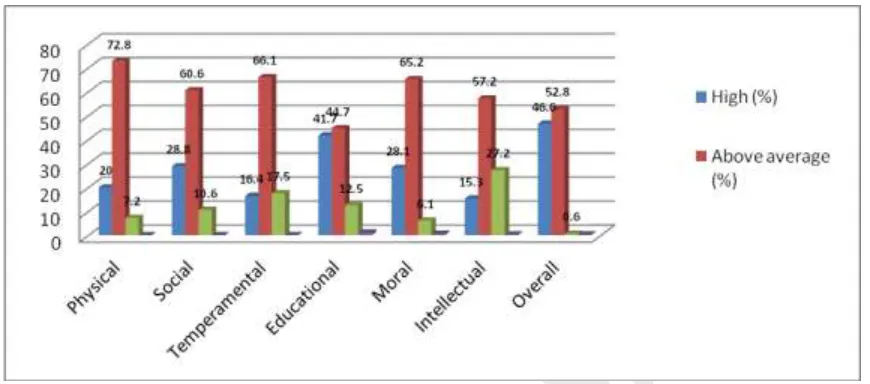
In the present study, observation of the table 1 showed that physical aspect of self concept of rural adolescents’ 20% was found as high, 72.8% as above average, 7.20% as average and 00% as below average. As far as Social aspect of self concept was concerned 28.8% was found as high followed by 60.60% as above average and 10.60% as average and 00% as below average. As far as temperamental aspect of self concept was concerned 16.40 % was found as high, 66.10% as above average, and 17.50% as average and 00% as below average. As far as educational aspect of self concept was concerned, 41.70 % was found as high, 44.70% as above average, and 12.50% as average and 1.10% as below average. As far as moral aspect of self concept was concerned, 28.10 % was found as high, 65.20% as above average, and 6.10% as average and .60% as below average. The intellectual aspect of self concept was found 15.30 % as
S.No. Factors High (%) Above average (%) Average (%) Below average (%)
1. Physical 20.00 72.80 7.20 0
2. Social 28.80 60.60 10.60 0
3. Temperamental 16.40 66.10 17.50 0
4. Educational 41.70 44.70 12.50 1.10
5. Moral 28.10 65.20 6.10 0.60
6. Intellectual 15.30 57.20 27.20 0.30
P
age
51
high, 57.20% as above average and 27.20% as average and 0.3% as below average. The overall of self concept was recorded 46.60 % as high, 52.80% as above average and 0.6% as average and 0.33% as below average. Same is depicted in the Fig 1.
Fig 1 showing distribution of self concept of adolescents’ studying in urban secondary schools of Karnal
Table 2: showing distribution of self concept of adolescents’ studying in rural secondary schools of Karnal
In the present study of self concept of adolescents’ studying in rural secondary schools of Karnal was investigated and the observation of the table 4.2.2 showed that physical aspect of self concept of urban girls was 22.00 % as high, 62.23% as above average, 7.27% as average and 8.50% as below average. The social aspect of self concept was observed 18.50% as high, 60.65% as above average, and 10.46% as average and 10.39% as below average. Similarly temperamental aspect of self concept was recorded 26.43 % as high, 49.00% as above average, and 10.57% as average and 14.00% as below average. The educational aspect of self concept was found 51.73 % as high, 24.65% as above average, and 10.50% as average and 13.12% as below average. Moral aspect of self concept was observed 18.16 % as high, 35.14% as above average and 26.05% as average and 20.65% as below average. The intellectual aspect of self concept was observed 25.30 % as high, 57.20% as above average, and 7.20% as average and 10.30% as below
S.No Factors High (%) Above average (%) Average (%) Below average (%)
1. Physical 22.00 62.23 7.27 8.50
2. Social 18.50 60.65 10.46 10.39
3. Temperamental 26.43 49.00 10.57 14.00
4. Educational 51.73 24.65 10.50 13.12
5. Moral 18.16 35.14 26.05 20.65
6. Intellectual 25.30 57.20 07.20 10.30
P
age
52
average. The overall of self concept was analyzed 34.79 % as high, 48.11% as above average, and 12.01% as average and 23.55% as below average. Same is depicted in the Fig 2.
Fig 2 showing distribution of self concept of adolescents’ studying in rural secondary schools of Karnal
Table 3: Showing comparison between self concepts of rural and urban adolescents studying in secondary schools of Karnal
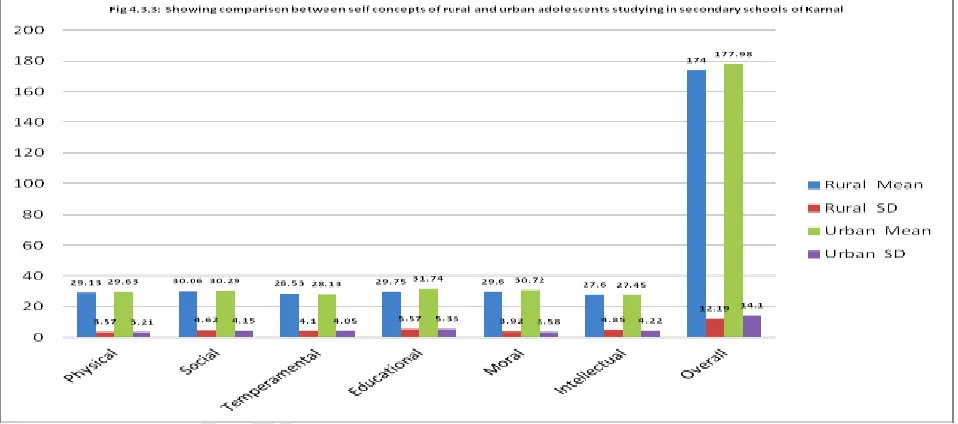
In the present study observation of the table 3 showed that mean and SD of physical aspect of self concept of adolescents’ studying in rural secondary schools of Karnal were: 29.13, 3.57: 29.63, 3.21 and calculated t-value was 1.39. This t-value is less than the table value at 498 d.f. This means no significant difference in physical aspect of self concept of adolescents’ studying in rural secondary schools of Karnal was found. Similarly mean and SD of social aspect of self concept of adolescents’ studying in rural secondary schools of Karnal was: 30.06, 4.62: 30.29, 4.15and calculated t-value was 0.50 that is less than the table value at 498 d.f. Therefore no significant difference in social aspect of self concept of adolescents’ studying in rural secondary schools of Karnalwas found. Similarly mean and SD of temperamental aspect of self concept of adolescents’ studying in rural secondary schools of Karnal was: 28.53, 4.10: 28.13, 4.05 and
S .No. Factors Rural Urban t-value
Mean SD Mean SD
1. Physical 29.13 3.57 29.63 3.21 1.39
2. Social 30.06 4.62 30.29 4.15 .50
3. Temperamental 28.53 4.10 28.13 4.05 .94
4. Educational 29.75 5.57 31.74 5.36 3.45**
5. Moral 29.60 3.92 30.72 3.58 2.81*
6. Intellectual 27.60 4.85 27.45 4.22 .30
P
age
53
calculated t-value was 0.94 which is less than the table value at 498 d.f. Therefore no significant difference in Temperamental aspect of self concept of adolescents’ studying in rural secondary schools of Karnal was found. Similar result was also found with intellectual of self concept of adolescents’ studying in rural secondary schools of Karnal.
The observation of the above table also indicated that educational, moral and overall of self concept of adolescents’ studying in rural secondary schools of Karnal have significant differences. The direction of difference was in favour of rural adolescents’ studying in rural secondary schools of Karnal. This was consistent with the research that indicated that high-ability students have high academic self-concept (e.g., Colangelo et al., 1987; Hotulainen and Shofield, 2003; Kelly and Colangelo, 1984; Kelly and Jordan, 1990; McCoach and Siegle, 2002). Due to the tendency of this population of students to have high academic self-concept, when a student with high levels of ability exhibits low academic self-concept, educators should view this as a sign of concern for the student and follow-up with additional support. Same is depicted in the fig 3.
Fig 3 Showing comparison between self concepts of rural and urban adolescents studying in secondary schools of Karnal
Objective 2: To compare the self concepts of male and female adolescents’ studying in secondary schools of Karnal.
Hypothesis 2: There will be significant difference in the self concept of male and female adolescents’ studying in secondary schools of Karnal.
P
age
54
Table 4 showing distribution of self concept of male adolescents’ studying in secondary schools of Karnal.
In the present investigation the distribution of the self concepts of male a adolescents’ studying in secondary schools of Karnal was observed and is presented in the table 4.4.1 that showed physical aspect of self concept of male adolescent was 22.23% as high, 52.53% as above average, 27.27% as average and 7.98% as below average. Social aspect of self concept was observed 28.57% as high, 40.65% as above average, and 27.46% as average and 3.32% as below average. The temperamental aspect of self concept was recorded 24.49 % as high, 39.74% as above average, and 23.57% as average and 12.02% as below average. The educational aspect of self concept was found 51.73 % as high, 24.65% as above average, and 10.50% as average and 13.12% as below average. Also moral aspect of self concept was observed 28.26 % as high, 45.14% as above average, and 16.65% as average and 10.88% as below average. The intellectual aspect of self concept was recorded 25.39 % as high, 47.26% as above average, and 17.20% as average and 10.15% as below average. The overall of self concept was analyzed and found 30.11 % as high, 41.66% as above average, and 20.44% as average and 9.58% as below average. Same is depicted in the Fig 4.
Fig 4 Showing distribution of self concept of male adolescents’ studying in secondary schools of Karnal.
S.No Factors High (%) Above average (%) Average (%) Below average (%)
1. Physical 22.23 52.53 27.27 7.98
2. Social 28.57 40.65 27.46 3.32
3. Temperamental 24.49 39.74 23.57 12.02
4. Educational 51.73 24.65 10.50 13.12
5. Moral 28.26 45.14 16.65 10.88
6. Intellectual 25.39 47.26 17.20 10.15
P
age
55
Table 5 Showing distribution of self concept of female adolescents’ studying in secondary schools of Karnal
In the present study the observation of the table 5 showed that physical aspect of the self concepts of female adolescents’ studying in secondary schools of Karnal was observed 14.10% as high, 62.82% as above average, 17.27% as average and 5.79% as below average. The social aspect of self concept was recorded 28.14% as high, 42.51% as above average, and 17.29% as average and 12.06% as below average. Similarly temperamental aspect of self concept was observed 12.46 % as high, 46.19% as above average, and 27.25% as average and 14.10% as below average. As far as educational aspect of self concept was concerned it was found that 29.76% as high, 24.56% as above average, and 32.50% as average and 13.18% as below average. The moral aspect of self concept was found 18.19 % as high, 45.20% as above average, and 26.10% as average and 10.51% as below average. The intellectual aspect of self concept was observed 25.30 % as high, 37.20% as above average, and 22.28% as average and 15.22% as below average. The overall of self concept was analyzed and found 21.33 % as high, 43.08% as above average, and 23.78% as average and 11.81% as below average. Same is depicted in the Fig5.
S.No Factors High (%) Above average (%) Average (%) Below average (%)
1. Physical 14.10 62.82 17.27 5.79
2. Social 28.14 42.51 17.29 12.06
3. Temperamental 12.46 46.19 27.25 14.10
4. Educational 29.76 24.56 32.50 13.18
5. Moral 18.19 45.20 26.10 10.51
6. Intellectual 25.30 37.20 22.28 15.22
P
age
56
Fig 5 showing distribution of self concept of female adolescents’ studying in secondary schools of Karnal
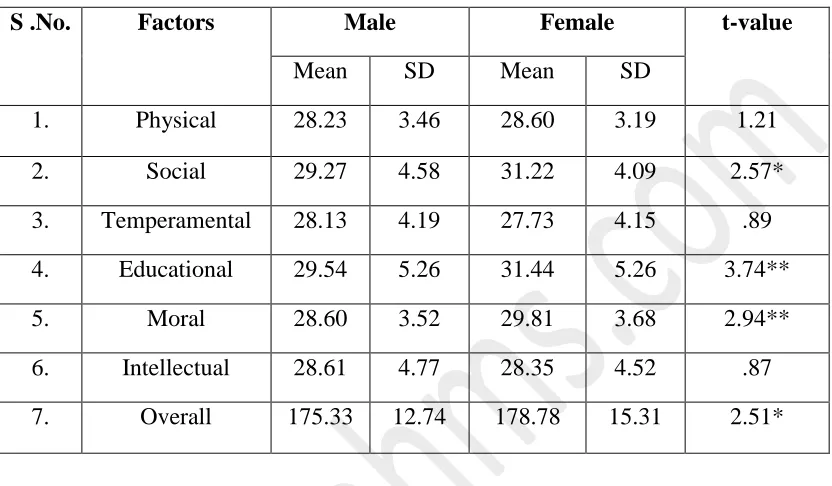
Table 6 showing comparison between self concept of male and female studying in secondary schools of Karnal
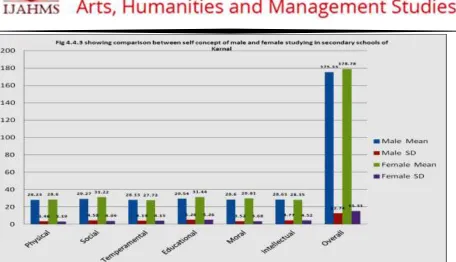
Observation of the table 6 shows that mean and SD of physical, temporal and intellectual aspect of self concept of male and female studying in secondary schools of Karnal was less than the table value at 498 d.f. This means no significant difference in physical, temporal and intellectual aspects of self concept of male and female studying in secondary schools of Karnal are found. Contrary to that social, educational moral and overall aspect of self concept of male and female studying in secondary schools of Karnal was higher than the table value at 498 d.f. This means there is significant difference in social, educational moral and overall aspects of self concept of male and female studying in secondary schools of Karnal are found. The direction of difference was in favour of female adolescent. The results indicated that male still needed motivation as well as social and government assistance and encouragement for male and their parents as well. This is consistent with the research that indicated that high-ability students have high academic self-concept (Colangelo et al., 1987; Hotulainen and Shofield, 2003; Kelly and Colangelo, 1984; Kelly and Jordan, 1990; McCoach and Siegle, 2002). Due to the tendency of the population of students to have high academic self-concept, when a student with high levels of ability exhibited low academic self-concept, educators should view this as a sign of concern for the students and follow-up with additional support. Thus the hypothesis 2 is partially accepted. Same is depicted in the following fig, 6.
S .No. Factors Male Female t-value
Mean SD Mean SD
1. Physical 28.23 3.46 28.60 3.19 1.21
2. Social 29.27 4.58 31.22 4.09 2.57*
3. Temperamental 28.13 4.19 27.73 4.15 .89
4. Educational 29.54 5.26 31.44 5.26 3.74**
5. Moral 28.60 3.52 29.81 3.68 2.94**
6. Intellectual 28.61 4.77 28.35 4.52 .87
P
age
57
Fig 4.4.3 showing comparison between self concept of male and female studying in secondary schools of Karnal
FINDINGS OF THE STUDY:
The obtained data on the three tools administered were analyzed using frequency count and percentage (%), Mean SD and t-test. The results obtained on the basis of the analysis of data were presented in chapter fourth. The following statistical tools were used for analyzing the data. All the tools were used in accordance with the nature and distribution of data. Following are the objective wise important results of the study.
No significant difference in physical, temporal and intellectual aspects of self concept of male and female studying in secondary schools of Karnal are found. Contrary to that social, educational moral and overall aspect of self concept of male and female studying in secondary schools of Karnal.
Significant difference in social, educational moral and overall aspects of self concept of male and female studying in secondary schools of Karnal are found. The direction of difference was in favour of female adolescent. The results indicated that male still needed motivation as well as social and government assistance and encouragement for male and their parents as well.
REFERENCES:
i. Brown, Elinor L.; Jun( 2004). The Relationship of Self-Concepts to Changes in Cultural Diversity Awareness: Implications for Urban Teacher Educators. Urban Review, Vol 36(2), Jun 2004. pp. 119-145.
P
age
58
iii. Gordon, C. (1968) Self-conceptions: configurations of content. In The Self in Social Interactions, ed. C.Gordon, K. J. Gergen, Vol. 1. NY: Wiley Gordon, C. 1976. Development of evaluated role identities. Ann. Rev. Social. 2:405-33
iv. Gordon, K. J. Gergen. NY: Wiley Gergen, K. J. (1971). The Concept of Self. NY: Holt,
Rinehart and Winston
v. Guiot, J. M. (1977). Attribution and identity construction: some comments. Am. Social. Rev. 42:692-704 Hales, S. 1980. A developmental model of self- esteem based on competence and moral behaviour: a longitudinal and cross-sectional analysis. PhD thesis. Univ. California, Berkeley
vi. H. H., Critchfield, L. L. 1975. Contrasting self-esteem theory and consistency theory in predicting interpersonal attraction. Sociometry 38:247-60
vii. Hales, S. (1981a). The inadvertent rediscovery of "self" in social psychology. Paper presented at the Am. Psychol. Assoc. Meet., Los Angeles
viii. Hales, S. (1981b). Understanding the relationship between self-esteem and social desirability: A longitudinal study. Paper presented at the Soc. Res. Child Devel. Meet.
ix. Boston Harter, S. 1978. Effectance motivation reconsidered: toward a developmental model. Hum. Devel. 21:34-64
x. Harter, S. (1986). Processes Underlying Children’s Self-Concept; in J. Suls (Ed.).
Psychological Perspectives en the Self. (Vol. III). Hillsdale, New Jersey: Lawrence Erlbaun Associates.
xi. Kharlukhi, B.; (2005). A Study of Self-concept in relation to some Selected Personality Variables among Teacher Trainees in Meghalaya. Ph. D., in Edu. North Eastern Hill University, Shilong.
xii. Khosravi, M( 2005) A Comparative Study of Relationship between Self-Concept and Anxiety among Adolescent Students. University of Pune, Pune.
xiii. Kinch, J. W. 1963. A formalized theory of the self-concept. Am. J. Social. 68:481-86 Kohn, M. L. 1969. Class and Conformity. Homewood, IL: Dorsey Press
xiv. Kohn, M. L. 1981. Personality, occupation, and social stratification: a frame of reference. In Research in Social Stratification and Mobility, ed. D. J. Trieman, R. V. Robinson, Vol. 1. Greenwich, CT: JAI Press Krauss,
xv. Long, B. H., Henderson, E. H., Ziller, R. C. 1967. Developmental changes in the self- concept during middle childhood. Merrill- Palmer Q. 13:210-15
xvi. Marsh, H. W. (1990). Causal ordering of academic self-concept and academic achievement:
A multivariate, longitudinal panel analysis. Journal of Educational Psychology, 82, 646-656.
P
age
59
xviii. Marsh, H. W., Hau, K., & Kong, C. (2002). Multilevel Causal Ordering of Academic Self-Concept and Achievement: Influence of Language of Instruction (English Compared With Chinese) for Hong Kong Students. American Educational Research Journal, 39(3): 727-63.
xix. Marsh, H., & Seeshing, A. (1997). Causal effects of academic self-concept on academic achievement: structural equation of longitudinal data. Journal of Educational Psychology,
89(1), 41-54.
xx. Mary, R.S. and Paul, J.;(2005). Self-concept of Integrated Course Students in Pondicherry. Journal o f Educational Research and Extension, Vol.42 (1), 1-8.
xxi. Mboya, M. M. (1998). Self-concept of academic ability as a function of sex, age, and academic achievement among African adolescents. Perceptual and Motor Skills. 87(1): 155-161.
xxii. Morse, S., Gergen, K. (1970) Social comparison, self-consistency, and the concept of self. J. Person. Soc. Psychol. 16:148-56