The Open Journal of Occupational Therapy
The Open Journal of Occupational Therapy
Volume 6
Issue 2 Spring 2018 Article 10
April 2018
Reliability of the Bulb Dynamometer for Assessing Grip Strength
Reliability of the Bulb Dynamometer for Assessing Grip Strength
Colleen Maher
University of the Sciences in Philadelphia - USA, [email protected]
Seoyoung Yoon
University of the Sciences in Philadelphia - USA, [email protected]
Shannon Donovan
University of the Sciences in Philadelphia - USA, [email protected]
Rochelle J. Mendonca
Temple University - USA, [email protected]
Follow this and additional works at: https://scholarworks.wmich.edu/ojot
Part of the Occupational Therapy Commons
Recommended Citation Recommended Citation
Maher, C., Yoon, S., Donovan, S., & Mendonca, R. J. (2018). Reliability of the Bulb Dynamometer for Assessing Grip Strength. The Open Journal of Occupational Therapy, 6(2). https://doi.org/10.15453/ 2168-6408.1404
This document has been accepted for inclusion in The Open Journal of Occupational Therapy by the editors. Free, open access is provided by ScholarWorks at WMU. For more information, please contact
Reliability of the Bulb Dynamometer for Assessing Grip Strength Reliability of the Bulb Dynamometer for Assessing Grip Strength
Abstract Abstract
Background: Hand function is an overall indicator of health and is often measured using grip strength. Hand-held dynamometry is the most common method of measuring grip strength. The purpose of this study was to determine the inter-rater and test-retest reliability, the reliability of one trial versus three trials, and the preliminary norms for a young adult population using the Baseline® Pneumatic Squeeze Bulb Dynamometer (30 psi).
Methods: This study used a one-group methodological design. One hundred and three healthy adults (30 males and 73 females) were recruited. Six measurements were collected for each hand per participant. The data was analyzed using Intraclass Correlation Coefficients (ICC) two-way effects model (2,2) and paired-samples t-tests.
Results: The ICC for inter-rater reliability ranged from 0.955 to 0.977.
Conclusion: The results of this study suggest that the bulb dynamometer is a reliable tool to measure grip strength and should be further explored for reliable and valid use in diverse populations and as an
alternative to the Jamar dynamometer.
Comments
The authors report no conflicts of interest to disclose.
Keywords Keywords
Hand strength, grip, muscle strength, dynamometer, hand function
Credentials Display
Colleen Maher, OTD, OTR/L, CHT; Seoyoung Yoon, MOT, OTR/L; Shannon Donovan, MOT, OTR/L; Rochelle J. Mendonca, PhD, OTR/L
Copyright transfer agreements are not obtained by The Open Journal of Occupational Therapy (OJOT). Reprint permission for this Applied Research should be obtained from the
corresponding author(s). Click here to view our open access statement regarding user rights and distribution of this Applied Research.
DOI: 10.15453/2168-6408.1404
Hand function is an indicator of overall health and well-being and correlates with an individual’s ability to perform meaningful and purposeful activities (Lawrence et al., 2015; Ranganathan,
Siemionow, Sahgal, & Yue, 2001). Hand function encompasses strength, endurance, and range of motion, all of which allow individuals to engage in basic daily routines as well as complex functional activities. Health care professionals often administer grip strength testing to assess hand function (Reuter, Massy-Westropp, & Evans, 2011; Tyler, Adams, & Ellis, 2005). Hand function can be
measured with multiple assessments and instruments, including hand-held dynamometry (Blankevoort, van Heuvelen, & Scherder, 2013; Irwin & Sesot, 2010; Ranganathan et al., 2001; Sisto & Dyson-Hudson, 2007). Dynamometers that are used for grip strength measurement are typically classified as hydraulic, bulb (vigorimeters), spring, and electronic.
The Jamar Hydraulic Hand Dynamometer is one of the most commonly used hydraulic hand-held dynamometers. It has five adjustable slots for different grip positions. These grip positions recruit different muscle groups that contribute to grip strength (intrinsic muscles, extrinsic muscles, or a
combination of both). The Jamar dynamometer measures isometric grip force up to 90 kg or 200 pounds (Seftchick, Detullio, Fedorczyk, & Aulicino, 2011). Research has identified the Jamar dynamometer as the gold standard for grip strength measurement because of its well-established norms and psychometric properties (Blankevoort et al., 2013; Fess, 2011; Kennedy, Jerosch-Herold, & Hickson, 2010;
Mathiowetz et al., 1985; Reuter et al., 2011). Although the Jamar dynamometer is the gold standard, it is not always the best measure of grip strength for some individuals, such as older adults and individuals with rheumatoid arthritis, who may experience fragile or unstable hand structure (Fess, 2011; Jones et al., 1991; Kennedy et al., 2010; Link, Lukens, & Bush, 1995; Sisto & Dyson-Hudson, 2007; Tyler et al., 2005). Members of the young adult population who may be experiencing thumb pain and
carpometacarpal (CMC) arthritis because of texting and cell phone use may find the Jamar dynamometer difficult to grip (Eapen, Kumar, & Bhat, 2010; Gustafsson, Thomée, Grimby-Ekman, & Hagberg, 2017; Ming, Pietikainen, & Hänninen, 2006; Williams & Kennedy, 2011). Health care practitioners need to have a repertoire of reliable and pain-free measurement tools from which to select based on the client’s needs.
The bulb dynamometer, which assesses grip strength by measuring the amount of pressure applied to the compressible bulb-shaped rubber handle, can be used as an alternative method to the Jamar dynamometer. The amount of grip pressure measured is dependent on the amount of hand contact over the surface of the bulb (Innes, 1999). A study by Ward and Adams (2007) compared four
dynamometers for test-retest reliability with 30 participants. The baseline bulb dynamometer, which assesses grip pressure, was found to be as reliable as the Jamar dynamometer, which measures grip force for assessing hand strength. However, the sample size in their study was small (n = 30), and the study focused on test-retest reliability. Studies that have used the bulb or bulb-like dynamometers have
primarily focused on establishing preliminary norms for children, comparing the bulb to other hand-held dynamometers, and evaluating the ease of using the bulb dynamometer (de Souza,de Baptista,
Benedicto, Pizzato, & Mattiello-Sverzut, 2014; Desrosiers, Bravo, Hérbert, & Dutil, 1995; Fike & Rousseau, 1982). The purpose of this study was to evaluate the inter-rater reliability, the test-retest reliability, and the reliability of one versus three trials, and to provide preliminary normative data for a young adult population using the bulb dynamometer.
1 Maher et al.: Bulb dynamometer reliability
Method Study Design and Participants
A descriptive design was used in this study to assess the reliability of the bulb dynamometer in testing grip strength. A convenience sample of 103 healthy adults who were either students or employees at a private university in Pennsylvania were recruited to participate. The inclusion criteria required
participants to be (a) 18 years of age and older, (b) absent of any hand injury or hand condition requiring medical attention in the past year, and (c) able to sit in the testing position. The university’s Institutional Review Board approved the study and the participants signed an informed consent to participate in the study.
Instruments
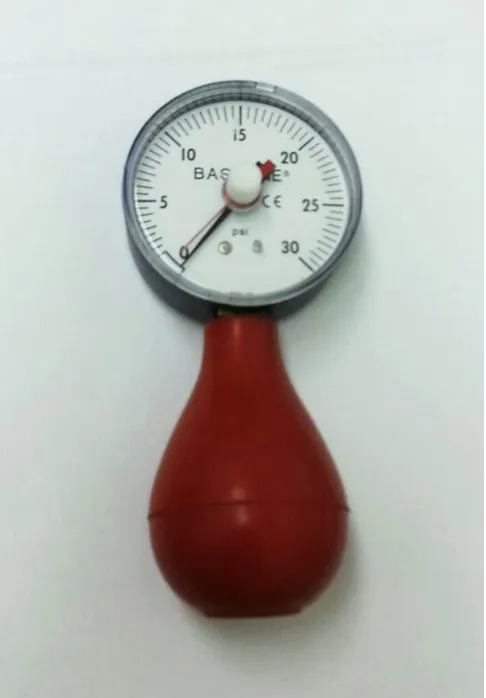
The Baseline® Pneumatic Squeeze Bulb Dynamometer with a maximum pressure indicator was used to measure the participants’ grip strengths. This instrument measures overall grip strength from 0 to 30 psi. The bulb-shaped handle of this dynamometer is soft, 13 cm in circumference, and allows for easy gripping. There is a seam that goes around the center of the bulb that can be used as a marker for hand placement (see Figure 1).
Figure 1. Baseline® Pneumatic Squeeze Bulb Dynamometer (NC 70122).
Procedures
Prior to the study, two raters received training from a certified hand therapist on the techniques to perform the measurements. The training protocol followed the American Society of Hand Therapists (ASHT) recommended guidelines for positioning: the participants sat up straight in a chair (without arms), feet flat on the floor, shoulder adducted to side, elbow flexed to 90 degrees, and forearm in neutral (Shechtman & Sindhu, 2015). To ensure consistency throughout the study, the raters were instructed to place the bulb dynamometer in the participant’s hand with the seam resting between the third and fourth digits and with the dial facing away from the participant. The raters also created and used a standardized script to explain the grip strength testing procedures to the participants.
Grip strength measurement. Both raters tested each participant. The participants were
randomly assessed by either Rater 1 or Rater 2 first, followed by an assessment by the other rater, and a 1 min rest period between the two raters’ assessments. The rater sat directly across from the participant. The rater read the standardized script out loud, ensured that the participant maintained the proper grip strength testing posture, and placed the bulb dynamometer in one of the participant’s hands. When prompted, the participant squeezed the bulb with his or her hand with maximum force. Each participant completed one set of three grip strength trials in each hand, starting with the right hand and alternating hands after every trial, with no break between the trials. This procedure was then repeated with the second rater. Six trials were taken on each hand for a total of 12 trials in both hands, with six by each rater. The three grip trials for each rater for each hand were averaged to obtain a mean grip
measurement. After each trial, the maximum pressure indicator was reset to “0” to ensure accuracy. The data were recorded on the individual’s personal data collection sheet. At the end of the data collection, each participant completed 12 trials, and each rater administered 618 grip testing trials.
Statistical Analysis
Only peak grip strength was measured with the Baseline® Pneumatic Squeeze Bulb Dynamometer. Grip strength scores from both raters and for all administrations of the test were transferred from a data collection sheet into an SPSS data file. Data were analyzed using IBM SPSS 23.0 (Version 23; IBM Corp., Armonk, NY). Reliability was estimated by using the scores for all trials with both raters. Inter-rater reliability and test-retest reliability were assessed using a type (2,2)
Intraclass Correlation Coefficient (ICC) with two-way mixed effects model at a 95% confidence interval (Shrout & Fleiss, 1979). The ICC considers both systematic and random error and was used to
summarize the strength of the reliability. ICCs were interpreted with the following guidelines: good reliability is greater than .75, moderate reliability is between .50 and .75, and poor reliability is less than .50 (Portney & Watkins, 2009). A paired samples t-test was conducted to compare the difference between one grip strength trial, which was the first trial for each participant, and the average of three grip strength trials to determine if using one trial was as reliable as using three. In addition, the norms for grip strength using the bulb dynamometer were obtained for participants 18 to 29 years of age. The means, standard error, minimum, and maximum value for grip strength were calculated for each age group.
Results
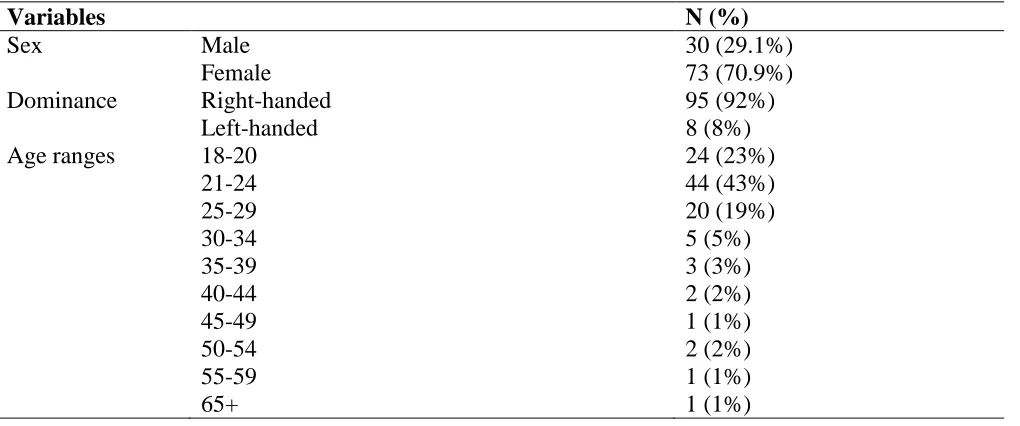
One hundred and three healthy adults (30 males and 73 females) were recruited for this study. All of the participants met the inclusion criteria. Table 1 shows that participants were obtained in all age ranges except for the range 60 to 64 years of age. Most of the participants were 18 to 29 years of age. In addition, most of the participants were right-handed.
3 Maher et al.: Bulb dynamometer reliability
Table 1
Descriptive Data of Study Participants
Variables N (%)
Sex Male 30 (29.1%)
Female 73 (70.9%)
Dominance Right-handed 95 (92%)
Left-handed 8 (8%)
Age ranges 18-20 24 (23%)
21-24 44 (43%)
25-29 20 (19%)
30-34 5 (5%)
35-39 3 (3%)
40-44 2 (2%)
45-49 1 (1%)
50-54 2 (2%)
55-59 1 (1%)
65+ 1 (1%)
Inter-rater reliability was assessed by comparing the scores of both raters for the first trial and the average of three trials. Inter-rater reliability coefficients for two raters with 95% Confidence Intervals (CIs) are shown in Table 2. ICCs for inter-rater reliability for both single ratings and the average of ratings ranged from 0.955 to 0.977 for the two raters, which is considered excellent reliability (Portney & Watkins, 2009).
Table 2
Inter-Rater Reliability (Consistency of Ratings between Rater 1 and Rater 2)
Hand and Trial ICC2,2 95% CI
Right hand Trial 1 .957 .936 to .971
Left hand Trial 1 .955 .934 to .970
Right hand average of three trials .977 .966 to .984
Left hand average of three trials .972 .959 to .981
Test-retest reliability was assessed by evaluating the consistency of grip strength across three trials for each participant. Consistency was evaluated for each hand and for each rater. ICC for test-retest reliability ranged from 0.975 to 0.977 for three trials of grip strength for the same hand as shown in Table 3.
Table 3
Test-Retest Reliability (Consistency of Scores of each Rater for Three Trials of the Same Hand) for the Bulb Dynamometer
Hand and Rater ICC2,2 95% CI
Right hand Rater 1 .976 .966 to .983
Left hand Rater 1 .977 .968 to .984
Right hand Rater 2 .975 .965 to .982
Left hand Rater 2 .976 .967 to .983
This study also compared the reliability of taking one measurement versus the average of three measurements. The results showed that there were no significant differences between taking one rating or the average of three ratings using the bulb dynamometer.
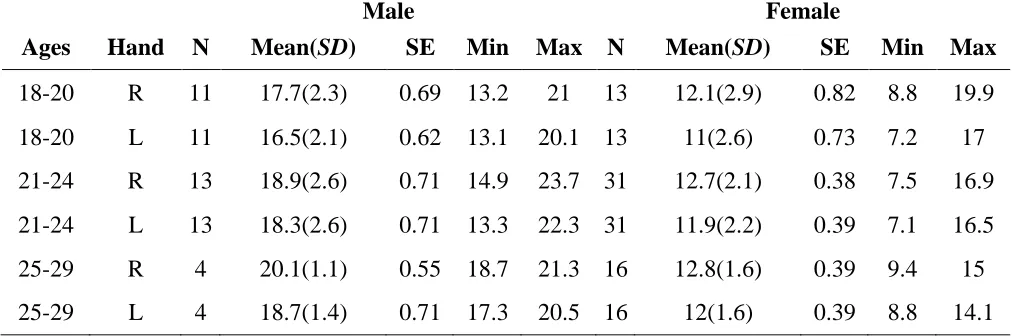
The participants were categorized by age and gender to obtain norms. There were 15
participants in the 30 to 65+ age ranges; therefore, norms were not calculated for these ages. Table 4 reports the bulb dynamometer grip strength norms for participants 18 to 29 years of age.
Table 4
Baseline® Pneumatic Squeeze Bulb Dynamometer Grip Strength Norms for 18 to 29 year olds
Male Female
Ages Hand N Mean(SD) SE Min Max N Mean(SD) SE Min Max
18-20 R 11 17.7(2.3) 0.69 13.2 21 13 12.1(2.9) 0.82 8.8 19.9
18-20 L 11 16.5(2.1) 0.62 13.1 20.1 13 11(2.6) 0.73 7.2 17
21-24 R 13 18.9(2.6) 0.71 14.9 23.7 31 12.7(2.1) 0.38 7.5 16.9
21-24 L 13 18.3(2.6) 0.71 13.3 22.3 31 11.9(2.2) 0.39 7.1 16.5
25-29 R 4 20.1(1.1) 0.55 18.7 21.3 16 12.8(1.6) 0.39 9.4 15
25-29 L 4 18.7(1.4) 0.71 17.3 20.5 16 12(1.6) 0.39 8.8 14.1
Discussion
This study demonstrated that the Baseline® Pneumatic Squeeze Bulb Dynamometer (30 psi) had both high inter-rater reliability and test-retest reliability. High inter-rater reliability suggests that an individual can be tested for grip strength by multiple raters using this instrument without increasing the risk for inaccurate measurement collection or rater bias, while high test-retest reliability demonstrates that the bulb dynamometer can be used consistently for repeated measurements in measuring grip strength. These results were consistent with studies that reported high inter-rater reliability with the Martin Vigorimeter, which is another type of the bulb dynamometer (Jones et al., 1991; Link et al., 1995).
The results also demonstrated that there were no significant differences in scores when comparing one trial versus the average of three trials. In practice, the recommendation is to take the average of three trials for accuracy; however, this study demonstrates that there is no difference in grip strength measures in these two scenarios. Similar studies on the Jamar dynamometer found one trial to be as reliable as three trials (Coldham, Lewis, Lee, 2006; Hamilton, Balnave, & Adams, 1994). The use of one trial is especially relevant with clients who may have difficulty maintaining maximal strength for a prolonged period due to hand weakness or pain.
Strengths
One of this study’s strengths was that the number of participants (n = 103) recruited met the criteria for a large effect size based on the statistical power analysis The standard ASHT protocol for grip strength measurement was followed, which correlates with other research studies that examine grip strength testing (Albrand, Munoz, Sornay-Rendu, DuBoeuf, & Delmas, 2003; Desrosiers et al., 1995; Giampaoli et al., 1999; Irwin & Sesto, 2010; Rolland et al., 2006).
5 Maher et al.: Bulb dynamometer reliability
Limitations
A limitation of this study was that the participants were required to perform 12 consecutive trials, and some of the participants reported fatigue in their hands. Future studies should incorporate longer resting intervals between trials to reduce fatigue. Moreover, a one-size bulb handle was used for all measurements, and individuals with larger hands may have had more difficulty squeezing the device. The Baseline® Pneumatic Squeeze Bulb Dynamometer does not provide guidelines or instructions for taking grip strength measurements, which may lead to differences in how grip strength is measured using this instrument.
Conclusion
This study’s findings could contribute to the repertoire of reliable and valid assessments in the field of occupational therapy. Many health care professionals use dynamometers to assess an
individual’s grip strength and hand function (Reuter et al., 2011; Tyler et al., 2005). The Jamar
Hydraulic Hand Dynamometer is currently the gold standard for measuring grip strength, but there has been evidence that the bulb dynamometer is a more appropriate tool for certain populations, such as those of young children, older adults, and individuals with rheumatoid arthritis (Fess, 2011; Jones et al., 1991; Link et al., 1995). This study demonstrated that the bulb dynamometer is a reliable tool for adults and young adults and should be investigated further as an alternative to the Jamar dynamometer. As the reliability of the bulb dynamometer continues to be investigated across age groups, future studies should aim to establish norms for this instrument to promote its use as an evidence-based tool in practice.
References
Albrand, G., Munoz, F., Sornay-Rendu, E., DuBoeuf, F., & Delmas, P. D. (2003). Independent predictors of all osteoporosis-related fractures in healthy postmenopausal women: The OFELY study. Bone, 32(1), 78-85.
https://doi.org/10.1016/S8756-3282(02)00919-5
Blankevoort, C. G., Van Heuvelen, M. J., & Scherder, E. J. (2013). Reliability of six physical performance tests in older people with dementia. Physical Therapy, 93(1), 69-78.
https://doi.org/10.2522/ptj.20110164
Coldham, F., Lewis, J., & Lee, H. (2006). The reliability of one vs. three grip trials in symptomatic and asymptomatic subjects. Journal of Hand Therapy, 19(3), 318-327.
https://doi.org/10.1197/j.jht.2006.04.002 de Souza, M. A., de Baptista, C. R., Benedicto, M. M. B.,
Pizzato, T. M., & Mattiello-Sverzut, A. C. (2014). Normative data for hand grip strength in healthy children measured with a bulb
dynamometer: A cross-sectional study.
Physiotherapy, 100(4), 313-318.
https://doi.org/10.1016/j.physio.2013.11.004
Desrosiers, J., Bravo, G., Hérbert, R., & Dutil, E. (1995). Normative data for grip strength of elderly men and women. American Journal of Occupational Therapy, 49(7), 637-644.
https://doi.org/10.5014/ajot.49.7.637
Eapen, C., Kumar, B., & Bhat, A. K. (2010). Prevalence of cumulative trauma disorders in cell phone
users. Journal of Musculoskeletal Research,
13(3), 137-145.
https://doi.org/10.1142/S0218957710002545
Fess, E. E. (2011). Functional tests. In T. M. Skirven, A. L. Osterman, J. M. Fedorczyk, & P. C. Amadio (Eds.), Rehabilitation of the hand and upper extremity (6th ed., pp. 152-162). Philadelphia, PA: Elsevier-Mosby.
Fike, M. L., & Rousseau, E. (1982). Measurement of adult hand strength: A comparison of two instruments. OTJR: Occupation, Participation and Health, 2(1), 43-49.
https://doi.org/10.1177/153944928200200105
Giampaoli, S., Ferrucci, L., Cecchi, F., Noce, C., Poce, A., Dima, F., . . . Menotti, A. (1999). Hand-grip strength predicts incident disability in non-disabled older men. Age and Ageing, 28(3), 283-288. https://doi.org/10.1093/ageing/28.3.283 Gustafsson, E., Thomée, S., Grimby-Ekman, A., &
Hagberg, M. (2017). Texting on mobile phones and musculoskeletal disorders in young adults: A five-year cohort study. Applied Ergonomics, 58, 208-214.
https://doi.org/10.1016/j.apergo.2016.06.012 Hamilton, A., Balnave, R., & Adams, R. (1994). Grip strength testing reliability. Journal of Hand Therapy, 7(3), 163-170.
https://doi.org/10.1016/S0894-1130(12)80058-5
Innes, E. V. (1999). Handgrip strength testing: A review of the literature. Australian Occupational Therapy Journal, 46(3), 120-140.
https://doi.org/10.1046/j.1440-1630.1999.00182.x
Irwin, C. B., & Sesto, M. E. (2010). Reliability and validity of the Multiaxis Profile Dynamometer with younger and older participants. Journal of American Hand Therapy, 23(3), 281-289.
https://doi.org/10.1016/j.jht.2010.02.002
Jones, E., Hanly, J., Mooney, R., Rand, L., Suprway, P., Eastwood, B., & Jones, J. (1991). Strength and function in the normal and rheumatoid hand.
Journal of Rheumatology, 18(9), 1313-1318. Retrieved from http://www.jrheum.org/
Kennedy, D., Jerosch-Herold, C., & Hickson, M. (2010). The reliability of one vs. three trials of pain-free grip strength in subjects with rheumatoid arthritis. Journal of Hand Therapy, 23(4), 384-391. https://doi.org/10.1016/j.jht.2010.05.002
Lawrence, E. L., Dayanidhi, S., Fassola, I., Requejo, P., Leclercq, C., Winstein, C. J., & Valero-Cuevas, F. J. (2015). Outcome measures for hand function naturally reveal three latent domains in older adults: Strength, coordinated upper extremity function, and sensorimotor processing.
Frontiers in Aging Neuroscience, 7(108).
https://doi.org/10.3389/fnagi.2015.00108
Link, L., Lukens, S., & Bush, M. (1995). Spherical grip strength in children 3 to 6 years of age. American Journal of Occupational Therapy, 49(4), 318-326. https://doi.org/10.5014/ajot.49.4.318 Mathiowetz, V., Kashman, N., Volland, G., Weber, K.,
Dowe, M., & Rogers, S. (1985). Grip and pinch strength: Normative data for adults. Archives of Physical Medicine and Rehabilitation, 66(2), 69-74. Retrieved from http://www.archives-pmr.org/ Ming, Z., Pietikainen, S., & Hänninen, O. (2006).
Excessive texting in pathophysiology of first carpometacarpal joint arthritis. Pathophysiology,
13(4), 269-270.
https://doi.org/10.1016/j.pathophys.2006.09.001
Portney, L. G., & Watkins, M. P. (2009). Foundations of clinical research: Applications to practice (3rd ed.). Upper Saddle River, NJ: Prentice Hall. Ranganathan, V. K., Siemionow, V., Sahgal, V., & Yue,
G. H. (2001). Effects of aging on hand function.
Journal of the American Geriatric Society,
49(11), 1478-1484.
https://doi.org/10.1046/j.1532-5415.2001.4911240.x
Reuter, S. E., Massy-Westropp, N., & Evans, A. M. (2011). Reliability and validity of indices of hand-grip strength and endurance. Australian Occupational Therapy Journal, 58(2), 82- 87.
https://doi.org/10.1111/j.1440-1630.2010.00888.x
Rolland, Y., Lauwers-Cances, V., Cesari, M., Vellas, B., Pahor, M., & Grandjean, H. (2006). Physical
performance measures as predictors of mortality in a cohort of community- dwelling older French women. European Journal of Epidemiology,
21(2), 113-122. https://doi.org/10.1007/s10654-005-5458-x
Shechtman, O., & Sindhu, B. (2015). Grip. In J. MacDermid, G. Solomon, & K. Valdes (Eds.),
ASHT clinical assessment recommendations (3rd ed.). Mount Laurel, NJ: American Society of Hand Therapy (ASHT).
Seftchick, J. L., Detullio, L. M., Fedorczyk, J. M., & Aulicino, P. L. (2011). Clinical examination of the hand. In T. M. Skirven, A. L. Osterman, J. M. Fedorczyk, & P. C. Amadio (Eds.),
Rehabilitation of the hand and upper extremity
(6th ed., pp. 55-71). Philadelphia, PA: Elsevier-Mosby.
Shrout, P. E., & Fleiss, J. L. (1979). Intraclass
correlations: Uses in assessing rater reliability.
Psychological Bulletin, 86(2), 420-428.
https://doi.org/10.1037/0033-2909.86.2.420
Sisto, S. A., & Dyson-Hudson, T. (2007). Dynamometry testing in spinal cord injury. Journal of Rehabilitation Research and Development,
44(1),123-136.
https://doi.org/10.1682/JRRD.2005.11.0172
Tyler, H., Adams, J., & Ellis, B. (2005). What can handgrip strength tell the therapist about hand function? British Journal of Hand Therapy,
10(1), 4-9.
https://doi.org/10.1177/175899830501000101 Ward, C., & Adams, J. (2007). Comparative study of the
test-re-test reliability of four instruments to measure grip strength in a healthy population. The British Journal of Hand Therapy, 12(2), 48-54.
https://doi.org/10.1177/175899830701200202 Williams, I. W., & Kennedy, B. S. (2011). Texting
tendinitis in a teenager. Journal of Family Practice, 60(2), 66-69. Retrieved from http://www.mdedge.com/jfponline
7 Maher et al.: Bulb dynamometer reliability