Please cite this article as: Y. Karimi, S. Rashahmadi, R. Hasanzadeh, The Effects of Newmark Method Parameters on Errors in Dynamic Extended Finite Element Method Using Response Surface Method, International Journal of Engineering (IJE), IJE TRANSACTIONS A: Basics Vol. 31, No. 1, (January 2018) 65-70
International Journal of Engineering
J o u r n a l H o m e p a g e : w w w . i j e . i rA Computational Study about the Effect of Turbines Pitched Blade Attack Angle on
the Power Consumption of a Stirred Tank
M. R. Ashory*, F. Talebi, H. Roohi Ghadikolaei
Department of Mechanical Engineering, Semnan University, Semnan, Iran
P A P E R I N F O
Paper history:
Received 23 November 2016
Received in revised form 02 December 2017 Accepted 02 December 2017
Keywords: Turbulent Flow Power Consumption Mixing Vessel Shear Thinning Fluid Blade Attack Angle
A B S T R A C T
In this study, the stirring mechanism of shear-thinning fluids benefiting from four blades in turbulent flow is considered. The fluid is studied inside a stirred cylindrical tank with a flat bottom. The height of fluid is equal to the cylinder’s diameter and the impeller is positioned centrally. A CFD simulation has been carried out and three-dimensional turbulent flow is numerically analyzed using the Shear Stress Transport k-ω (k- ω SST) model. The parameters related to power consumption including attack angle and flow index were studied. The power consumed during the mixing of the shear thinning liquids under a specific Reynolds number and attack angle is less than that consumed when the fluid used is water, which is a Newtonian fluid. As the power law index decreases, the corresponding power consumption also declines. At a certain attack angle and power law index, an increase in the Reynolds number first significantly decreases power consumption; beyond a given range, the consumption plateaus. To validate the numerical simulation results, the findings derived on the basis of the power number used in this work were compared with the test results of other studies, and good agreement was observed.
doi: 10.5829/ije.2018.31.01a.10
1. INTRODUCTION1
The stirring mechanism of fluids in one or multiple phases has been an interesting field for many researchers working in different industries including nuclear, food, petrochemical, dyeing, etc. Many of these processes benefit from mechanical stirrers which usually consist of a number of flat impellers in a cylindrical vessel for the purpose of stirring Newtonian and non-Newtonian fluids which usually have shear thinning behavior. For shear tinning fluids, the viscosity decreases when the shear rate increases. Therefore, in higher rotational speeds the flow is usually turbulent [1-3].
One of the first researches that can be noted in the field of stirring fluids in stirred vessels is that of Hiraoka et al. [1]. They performed a 2D numerical study on Newtonian and non-Newtonian fluids generated by two-blade impellers and paddle agitators in low impeller
*Corresponding Author’s Email: [email protected] (M. R. Ashory)
measures are quantified. Venneker et al. [9] examined the impact of Reynolds number and flow index for the turbulent flow and non-Newtonian fluid, experimentally and using LDV. Hamed Bashiri et al. [10] investigated the turbulent fluid flows in stirred tanks using a non-intrusive particle tracking technique. In this research, CFD simulation is conducted using RANS-based turbulence models for a 6-flat blade Rushton turbine and 45° four-pitched blade turbine.
The literature review shows that no concrete studies have been directed toward four-blade impeller agitators. We therefore investigated the flow characteristics of shear thinning fluids in a stirrer with a four-blade impeller under turbulent flow. Specifically, the effects of changes in blade attack angle, rotational speed, and fluid rheological behavior on power consumption were examined. CFX 16.2 (ANSYS, Inc.) was used to numerically simulate the turbulent flow of the fluids. The Metzner–Otto concept was adopted to model the properties of the non-Newtonian fluids, and the k-ω SST model was used to model the turbulent flow regime.
2. NUMERICAL ISSUES
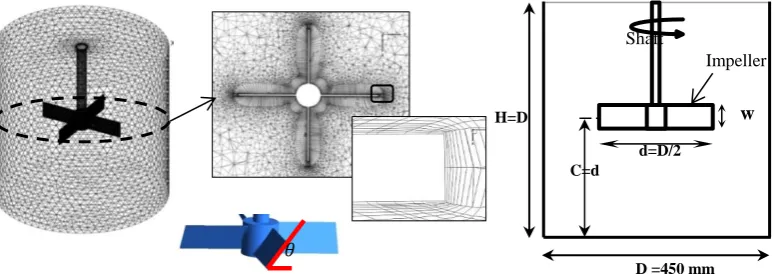
The stirring system considered for this study is depicted in Figure 1. As can be seen, the stirring tank is a cylindrical vessel of flat-bottomed type and most of its dimensions are considered as a constant function of tank diameter, D = 450 mm. A four-blade turbine with a diameter of d = D/2 and clearance of C = d are taken as impellers and the height of the fluid is exactly the same as tank height (H=D). The thickness of each blade is 2 mm and its height w = D/10. The shaft, having a diameter of ds= D/30, is coaxial with the centerline of the cylinder. The attack angle of blades (θ) is considered equal to 45°, 60°, 75° and 90°. Moreover, the results of simulation are presented in nondimensionalized form, so that they could be extended to any arbitrary diameter of the tank.
In This study, the computer program CFX 16.2 (ANSYS-Inc) was used to simulate the 3D flow fields in stirred vessel equipped with a four bladed impeller. The Navier- Stokes equations were written in a rotating reference frame. Therefore, the centrifugal and the Coriolis acceleration terms are added. In this numerical study, the pressure at the center of each cell, and the velocity components at the center of the six faces of the cell (one component on the two corresponding orthogonal faces) were calculated. The pressure-velocity coupling is handled by the semi-implicit algorithm pressure linked equation
)
SIMPLE(
which is described by Patankar [11].The geometry was created using ANSYS Design Modeler. The volume of the vessel was divided into two parts: stationary (e.g., vessel) and rotating (e.g., impeller). There are three different approaches for solving such a problem, namely, the sliding mesh (SM) method, the mixing plane method and the multiple reference frame (MRF) method. Reviews on the matter can be studied in (Zadghaffari et al. [12]; Ameur [13]; Bashiri et al. [10]). The MRF method is the simplest of the three. This approach is appropriate when flows at the boundary between inner and outer zones are nearly uniform. Since there are no baffles, in stirred tanks, large-scale transient effects are absent and MRF method can be used. The boundary conditions consist of setting each velocity component equal to zero on the blades and the axial shaft, because the rotating frame, and setting the angular velocity component equal to the rotation speed at the vertical walls. On the bottom, the angular velocity is chosen equal to 2πN [17].
The MRF method can be used in our study since there are no baffles in stirred tanks and large-scale transient effects are not present. In this method, the boundary conditions consist of setting each velocity component equal to zero on the blades and the axial shaft, because of the rotating frame, and setting the angular velocity component equal to the rotation speed at the vertical walls and on the bottom surface the angular velocity is chosen equal to 2πN.
Figure 1. Numerical mesh and Geometry of mixing system
w
D =450 mm H=D
d=D/2 C=d
Shaft
Impeller
Figure 1 shows the mesh created by the ANSYS Meshing program. The mesh size is decreased near the walls and blades. To examine the independency of the mesh, several mesh configurations were analyzed and finally a mesh with 1530000 elements for which the velocity changes of its blade tip were less than 2% with respect to the previous model with 1250000 elements was selected.
3. RHEOLOGICAL MODEL
In the present work, simulations were conducted on non-Newtonian shear thinning fluids. According to the reports in this field, the shear-thinning behavior was controlled by means of the weight percentage of polymer added in water. The polymer Xanthan gum, with the commercial name Keltrol RD is employed in this study. Rheological properties of the fluids used are based on measurement performed by Venneker et al. [9] as given in Table 1.
The method of Metzner and Otto [14] was used to obtain the average shear rate and the apparent viscosity was then calculated from the power law equation:
𝛾̇ = 𝑘𝑠𝑁 (1)
where 𝑘𝑠 is a weak function of the stirrer type and for Rushton turbine is equal to 11.5. For a Newtonian fluid, the Reynolds number is given by:
2
ReNd / (2)
And for a shear thinning fluid with the average shear rate Equation (1):
2 2
1
Re
n
n s
N d
m k
(3)
The power consumption, P, in a stirred tank can be calculated from the torque acting on the impeller [15]:
𝑃 = 2𝜋𝑁𝜏 (4)
where 𝑁 is the rotational speed in rev/s and 𝜏 is the torque applied on the impeller.
The power number is then computed as:
3 5 /
NpP N d (5)
TABLE 1.Rheological properties
Concentration (%) 𝑚 × 10−3 [𝑃𝑎. 𝑆𝑛] n[-]
0.045 9.5 0.8
0.05 16.5 0.71
0.08 34 0.64
0.1 74.8 0.56
The radial coordinate is defined in dimensionless form as:
* 2r , * Z
R Z
D D
(6)
4. RESULT AND DISCUSSIONS
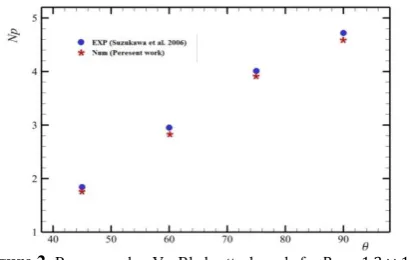
In order to validate the CFD model, the results were compared to that of K. Suzukawa et al. [4] tests with the same geometrical configuration. The fluid under study was water and blades attack angle was set to 90°, 75°, 60° and 45°. Figure 2, visualizes the Power number (Np) for a tank with a diameter of 450 mm and velocity of 2.37 rev/s, i.e. Re = 1.2 × 10⁵. As is obvious, a good agreement exists between numerical and experimental results.
5. EFFECT OF BLADE ATTACK ANGLE
To evaluate the attack angle effect (θ) on the shear thinning fluid stirring mechanism, velocity field contour for Keltrol solution with a power law index of n = 0.8 and Re = 50000 is studied in Figure 3. Velocity field contour is drawn for two planes of coordinate system, namely, XY and YZ plane and for four attack angles: 45°, 60°, 75° and90°. It can be seen that the more the attack angle is reduced from 90 and approaches 45°, the more fluid is pumped toward the bottom of the tank and higher mixing efficiency is achieved. As a consequence, according to the results, for tanks having blades not close to the bottom of the cylinder and for better mixing of fluids possessing higher viscosities, taking advantage of pitched blade impeller is more effective.
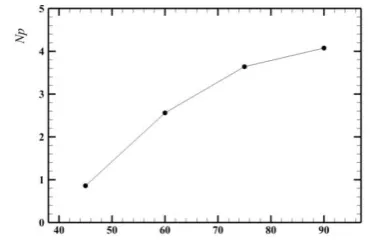
Among the important parameters studied in stirring systems is the power number Np, calculated according to Equation (5). The impact of attack angle on the parameter Np for the above-mentioned fluid is depicted in Figure 4.
XY Plane YZ Plane
θ = 90°
θ = 75°
θ = 60°
θ = 45°
Figure 3. The effect of Blade attack angle for Keltrol solution with n=0.8 and Re=50 000
It can be observed from this figure that for a specific Reynolds number, the value of Np grows with an increase in the attack angle, in a way that when using a
Figure 4. Power number Vs. attack angle ( θ = ) for Keltrol solution with n=0.8 and Re=50000.
flat blade, this value rises to more than four times the value of the case whose blades attack angle is 45°. In other words, according to Equation (5), the consumed power for stirring the fluid reduces by decreasing the angle of attack from 90° to 45°.
Figure 5 shows the ratio of radial, tangential and axial velocities to blade tip speed (V/Vtip) based on the dimensionless radial coordinate (R∗) for solution with n = 0.71 and Re = 100000. As can be seen, values of all three velocity parameters become smaller as the angle decreases. It can be inferred from Figure 5 that by distancing from the impellers and getting closer to the vessel walls, all three velocity components lessen, although their reduction patterns are not similar. Furthermore, in an approximate distance of R∗=
0.8 to 1, the value of velocity components become almost the same for various attack angles. Furthermore, within this level of study (Z∗= 0), radial and tangential velocities approach zero as they get closer to the vessel wall. This is in contrast to the fact that axial velocity has negative values in this region. In other words, the axial velocity which has a lower value compared to the other two velocity components, approaches zero when distancing from the impeller tip in the region R∗=
0.6 to 0.7 and then finds a negative value. It is obvious from the figure that the smaller the attack angle, the faster the axial velocity approaches zero and becomes negative.
Axial component Tangential component Radial component
6. EFFECT OF RHEOLOGICAL PARAMETER
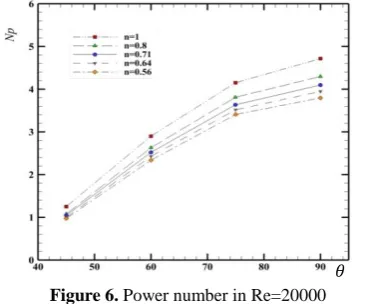
In this section, the effect of fluid rheology is investigated on the stirring process. To achieve this goal, the variations of power number (Np) for different solutions of Table 1 in the Reynolds number = 20000 and different attack angles are presented in Figure 6. It can be understood that as the power law index (n) increases, the power number at a specific angle and Reynolds number increases. It should be mentioned that rotational velocities for achieving a certain Reynolds number is not identical for different fluids. For instance, rotational velocities for reaching a Reynolds number of 20000 for a tank with the diameter of 450 mm and different solutions are shown in Table 2.
Figure 6. Power number in Re=20000
TABLE 2. Rotational speed for Re= 20000.
Solution Wt% 𝐦 × 𝟏𝟎−𝟑 [𝐏𝐚. 𝐒𝐧] n[-] N[rev/s]
Water - 1.0 1.00 0.4
Keltrol
0.045 9.5 0.8 2
0.05 16.5 0.71 2.5
0.08 34.0 0.64 3.6
0.1 74.8 0.56 5
5. CONCLUSION
The purpose of the present study was to investigate the effects of changing the blades attack angle and fluid shear thinning rheology in turbulent flow on power consumption in a four-blade impeller. The result of computational fluid dynamics simulation shows that by decreasing the attack angle, more fluid will be pumped into the bottom of the vessel, resulting in a better mixture. Also, power consumption for stirring of the fluid is reduced by decreasing the blade attack angles.
Additionally, the results indicate that the flow index (n) is proportional to the power number.
6. REFERENCES
1. Hiraoka, S., Yamada, I. And Mizoguchi, K., "Two dimensional model analysis of flow behaviour of highly viscous non-newtonian fluid in agitated vessel with paddle impeller", Journal of Chemical Engineering of Japan, Vol. 12, No. 1, (1979), 56-62.
2. Youcef, K., Bouzit, M., Hadjeb, A., Arab, I. and Beloudane, M., "CFD study of the effect of baffles on the energy consumption and the flow structure in a vessel stirred by a rushton turbine", Mechanika, Vol. 22, No. 3, (2016), 190-197.
3. Abid. M, C.X. and J, B., "Modeling of the 3d hydrodynamics on 2-blades impellers in stirred tanks filled with a highly viscous fluid", The Canadian Journal of Chemical Engineering, Vol. 72, No., (1994), 184-193.
4. Suzukawa, K., Mochizuki, S. and Osaka, H., "Effect of the attack angle on the roll and trailing vortex structures in an agitated vessel with a paddle impeller", Chemical Engineering Science, Vol. 61, No. 9, (2006), 2791-2798.
5. Schäfer, M., Yianneskis, M., Wächter, P. and Durst, F., "Trailing vortices around a 45° pitched‐blade impeller", AIChE Journal, Vol. 44, No. 6, (1998), 1233-1246.
6. Aubin, J., Fletcher, D.F. and Xuereb, C., "Modeling turbulent flow in stirred tanks with cfd: The influence of the modeling approach, turbulence model and numerical scheme", Experimental Thermal and Fluid Science, Vol. 28, No. 5, (2004), 431-445.
7. Beshay, K., Kratěna, J., Fořt, I. and Brůha, O., "Power input of high-speed rotary impellers", Acta Polytechnica, Vol. 41, No. 6, (2001).
8. Roy, S. and Acharya, S., "Scalar mixing in a turbulent stirred tank with pitched blade turbine: Role of impeller speed perturbation", Chemical Engineering Research and Design, Vol. 90, No. 7, (2012), 884-898.
9. Venneker, B.C., Derksen, J.J. and Van den Akker, H.E., "Turbulent flow of shear-thinning liquids in stirred tanks—the effects of reynolds number and flow index", Chemical Engineering Research and Design, Vol. 88, No. 7, (2010), 827-843.
10. Bashiri, H., Alizadeh, E., Bertrand, F. and Chaouki, J., "Investigation of turbulent fluid flows in stirred tanks using a non-intrusive particle tracking technique", Chemical Engineering Science, Vol. 140, (2016), 233-251.
11. Patankar, S.V., "Numerical heat transfer and fluid flow: Computational methods in mechanics and thermal science", (1980).
12. Zadghaffari, R., Moghaddas, J. and Revstedt, J., "Large-eddy simulation of turbulent flow in a stirred tank driven by a rushton turbine", Computers & Fluids, Vol. 39, No. 7, (2010), 1183-1190.
13. Ameur, H., "Mixing of complex fluids with flat and pitched bladed impellers: Effect of blade attack angle and shear-thinning behaviour", Food and Bioproducts Processing, Vol. 99, (2016), 71-77.
14. Metzner, A. and Otto, R., "Agitation of non‐newtonian fluids", AIChE Journal, Vol. 3, No. 1, (1957), 3-10.
15. Gimbun, J., Rielly, C.D., Nagy, Z.K. and Derksen, J., "Detached eddy simulation on the turbulent flow in a stirred tank", AIChE Journal, Vol. 58, No. 10, (2012), 3224-3241.
A Computational Study about the Effect of Turbines Pitched Blade Attack Angle on
the Power Consumption of a Stirred Tank
M. R. Ashory, F. Talebi, H. Roohi Ghadikolaei
Department of Mechanical Engineering, Semnan University, Semnan, Iran
P A P E R I N F O
Paper history:
Received 23 November 2016
Received in revised form 02 December 2017 Accepted 02 December 2017
Keywords: Turbulent Flow Power Consumption Mixing Vessel Shear Thinning Fluid Blade Attack Angle
ديكچ ه
هعلاطم نیا رد ،
راکوزاس لایس طلاتخا
shear-thinning
هرپ راهچ هناورپ کی طسوت ،شوشغم نایرج میژر رد یا
یسررب
هدش هناوتسا نزخم کی زا لکشتم طلاتخا متسیس .تسا تخت فک اب یا
تسا رپ لایس زا نزخم رطق اب لداعم عافترا ات هک
.دراد رارق نزخم طسو رد هناورپ و هدش شوشغم نایرج یزاس هیبش
هدافتسا اب لدم زا
k- ω SST
یدعب هس لیلحت رد
CFD
تسا هدش ماجنا طولخم یفرصم ناوت رب رثوم یاهرتماراپ .
هیواز ریظن نک و هلمح
صخاش ( نایرج
flow index
)
لایس طلاتخا رد یفرصم ناوت .تفرگ رارق هعلاطم دروم
shear-thinning
،صاخ هلمح هیواز و زدلونیر ددع کی تحت
یم بآ ینتوین لایس زا رتمک هچ ره و دشاب
صخاش دع شهاک ناوت د دبای
، یم شهاک زین یفرصم ناوت نیا نینچمه .دبای
،
و هلمح هیواز کی رد صخاش
هظحلام لباق شهاک ببس ادتبا زدلونیر ددع شیازفا ،صخشم ناوت ددع یفرصم ناوت
هدش
هدودحم کی زا و هیبش جیاتن یجنس هحص روظنم هب .درادن نآ شهاک رد ینادنچ ریثات دعب هب یا
ب ناوت ددع ،یزاس ه
تسد
جیاتن اب شهوژپ نیا زا هدمآ هلاقم
رگید یا هسیاقم دش و نیب یبوخ قابطنا اهنآ